• About Me
  • Other Writings
  • Interview Clips
  • All About Me: American Racism, American Narcissism, and the Conversation America Can’t Have
  • Video Clips
  • Boy @ The Window Pictures
  • Boy @ The Window Theme Music

Notes from a Boy @ The Window

~

Notes from a Boy @ The Window

Tag Archives: Economic Inequality

Race and The OJ Simpson Effect at 20

12 Thursday Jun 2014

Posted by decollins1969 in 1, Carnegie Mellon University, culture, Eclectic, Mount Vernon New York, Pittsburgh, Politics, Pop Culture, race, Sports, Work, Youth

≈ 2 Comments

Tags

1994 NBA Finals, Covenant Church of Pittsburgh, Dialogue on Race, Economic Inequality, Game 5, Houston Rockets, Internalized Racism, Men's Retreat, New York Knicks, Newsweek, Nicole Brown Simpson, O.J. Simpson, OJ Simpson, Pharrell Williams, Race Riots, Racial Stereotypes, Racial Stigma, Racism, Ron Goldman, Time Magazine, Trial, White Bronco


O.J. Simpson on the covers of Newsweek and Time Magazine, (the picture on right altered to make Simpson appear darker and caused an outcry), June 27, 1994. (Theo's Little Bot via Wikipedia). Qualifies as fair use due to low resolution of image and relevance to subject matter.

O.J. Simpson on the covers of Newsweek and Time Magazine, (the picture on right altered to make Simpson appear darker and caused an outcry), June 27, 1994. (Theo’s Little Bot via Wikipedia). Qualifies as fair use due to low resolution of image and relevance to subject matter.

Today’s the twentieth anniversary of the deaths of Nicole Brown Simpson and Ron Goldman, still officially-allegedly murdered by the once great NFL Hall of Fame running back O.J. Simpson. In five days, it’ll be twenty years since the bizarre police chase of Simpson in a white Ford Bronco with his friend Al Cowlings on I-405 in the Los Angeles area. In the process, he took all of us — the media, the sports world, and anyone who cared about race and justice — on a ride that folks are still talking about two decades later. It had an impact on me in terms of how I saw Blacks and Whites and race. I shouldn’t have been, but I was mildly surprised that so many would become so emotionally caught up in a double-homicide case involving what at one time was one of the world’s most recognizable faces.

That week twenty years ago was my absolute commitment to two events. The NBA Finals between my New York Knicks and the Houston Rockets. And a church retreat for the male members (nearly 100 of us, almost all Black — talk about irony!) of Covenant Church of Pittsburgh. It was to be a week of watching my Knicks play at home and three days in the mountains of Western Pennsylvania at a retreat lodge, in a spirit of learning how to be godly men and of adult male bonding. The first full day of the retreat was June 17. After a day of workshops, prayer, praise, and singing (at least for me and the rest of the men’s choir), we all piled into the rec room to watch Game 5 of the Final. Only to see an overhead shot of a slow-moving white Bronco being trailed by an escort of L.A.’s finest instead of Patrick Ewing, John Starks, Doc Rivers, Charles Oakley, and the rest of the cast of characters from my favorite team.
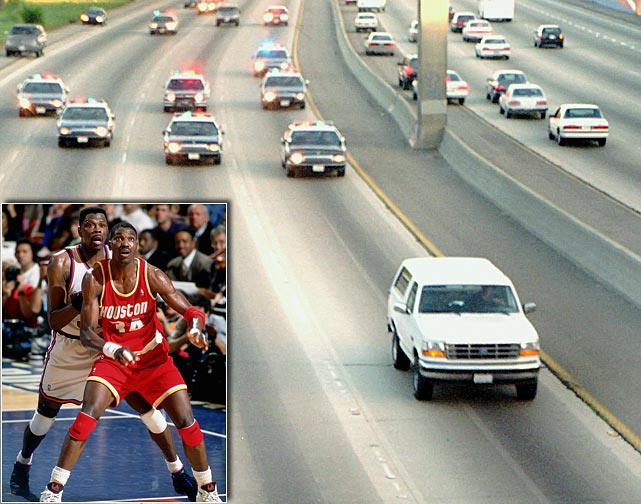
Screen shot of NBA on NBA coverage of 1994 NBA Finals, Game 5, MSG, New York at Bronco chase of OJ Simpson, I-405 in L.A., June 1, 1994. (SI photos via Tumblr).

Screen shot of NBA on NBA coverage of 1994 NBA Finals, Game 5, MSG, New York at Bronco chase of OJ Simpson, I-405 in L.A., June 17, 1994. (SI photos via Tumblr).

The Knicks won, which was great, but I barely saw the game. They were up 3-2, but would lose the last two games in the next six days in Houston, turning Choke City into Clutch City overnight. But that wasn’t what I was thinking about when it first happen. I hoped that the police wouldn’t shoot Simpson before he had a chance to go to trial. The L.A. riots were just two years before. I feared that the issue of race would be front and center, with Simpson’s issues with his now dead White ex-wife.

What I saw within ten days of the Bronco chase was an artificially darkened Simpson on the cover of Time. I watched as the media condemned Simpson well before the trial. As Blacks were becoming angrier about the coverage. As Whites grew more confident about Simpson being convicted, losing his fortune and fame, and possibly getting the death penalty (or at least, life imprisonment). It was amazing how quickly folks took sides on the issue. My mother proclaimed that O.J. was innocent long before the prosecution botched the trial. Some of my grad school colleagues — all White, mind you — made all kinds of assumptions about where I stood on O.J. Simpson. They didn’t like the fact that I was willing to wait until the trial to make up my mind.

Many have benefitted from the O.J. Simpson effect over the last twenty years. From lawyers to journalists, TV stations and authors, many have reaped benefits and have built careers from the O.J. Simpson trial and verdict. Greta Van Susteren, Dan Abrams, Nancy Grace, Court TV (now TruTV), the late Johnnie Cochran, Alan Dershowitz, Christopher Darden and Robert Shapiro, among so many others. Even Mark Fuhrman got a book and a radio talk show (at least for a while) out of the trial. One could argue that Kim Kardashian, daughter of Simpson defense “Dream Team” lawyer Robert Kardashian, has benefited, albeit indirectly (it’s not as if her father’s a regular on her family’s reality shows, right?).

Conservative media in general received the greatest indirect residuals of all from the murders, trial, and acquittal involving Simpson. The events between June 12, ’94 and October 3, ’95 helped intensify an atmosphere of conservatism, a sense that our nation was out of control. With the acquittal, it made sense to millions for cable and talk radio to increase its coverage of news, especially news with a more “fair and balanced” slant.

National dialogue on race cartoon, July 21, 2010. (Bob Englehart/Hartford Courant).

National dialogue on race cartoon, July 21, 2010. (Bob Englehart/Hartford Courant).

Obviously Simpson hasn’t benefited. Our national dialogue on race hasn’t improved, either. Whites still seemingly want Blacks to be stereotypes and to shut up while entertaining them with our lives and our deaths. Some Black elites still make a point of divorcing themselves from other Blacks and from the world that’s race in America, Pharrell Williams most recently so. And with rapidly increasing economic inequality, it’s a wonder that thousands of Whites haven’t come in to Black and Latino neighborhoods to burn down businesses and beat up and lynch those of us unlucky to encounter their mobs, like they typically did this time a century ago.

All because of the multitude of examples of individual Black success, and occasions of Black-on-White (and especially blond)-woman-violence. Things change, but the cancer that is Whiteness and race remain the same, “a shame and a pitiful,” as my father would say.

The Week The Lights Went Out In America

08 Tuesday Oct 2013

Posted by decollins1969 in 1, Boy @ The Window, culture, Eclectic, Mount Vernon New York, New York City, Politics, Pop Culture, race, Work, Youth

≈ Leave a comment

Tags

American Dominance, American Economy, Arab-Israeli War 1973, Best Days, Brighter Future, Economic Inequality, Gas Lines, Inflation, Job Discrimination, Low-Wage Jobs, OPEC Oil Crisis, OPEC Oil Embargo, Political Will, Politicians, Poverty, Prosperity, social mobility, Stagflation, Superpower, unemployment, Yom Kippur War


Gas station displayed a sign that explained the flag policy during the first OPEC oil embargo and crisis (Oregon), May 1974. March 26, 2013. (NARA via Wikipedia). In public domain.

Gas station displayed a sign that explained the flag policy during the first OPEC oil embargo and crisis (Oregon), May 1974. March 26, 2013. (NARA via Wikipedia). In public domain.

It wasn’t the middle of September of ’08, either. It was the beginning of October ’73, forty Yom Kippur holy days ago. There had been signs for any American who had cared to look at the cracks in the US dominance of the world economy ceiling. Rising unemployment, higher inflation, new monetary control measure, competition from a mostly rebuilt West Germany and Japan. The twenty-eight year-long run America had as the undisputed and undefeated leader of the capitalist world was on its way to a close, and ninety-nine percent of all Americans didn’t know or didn’t care enough to know.

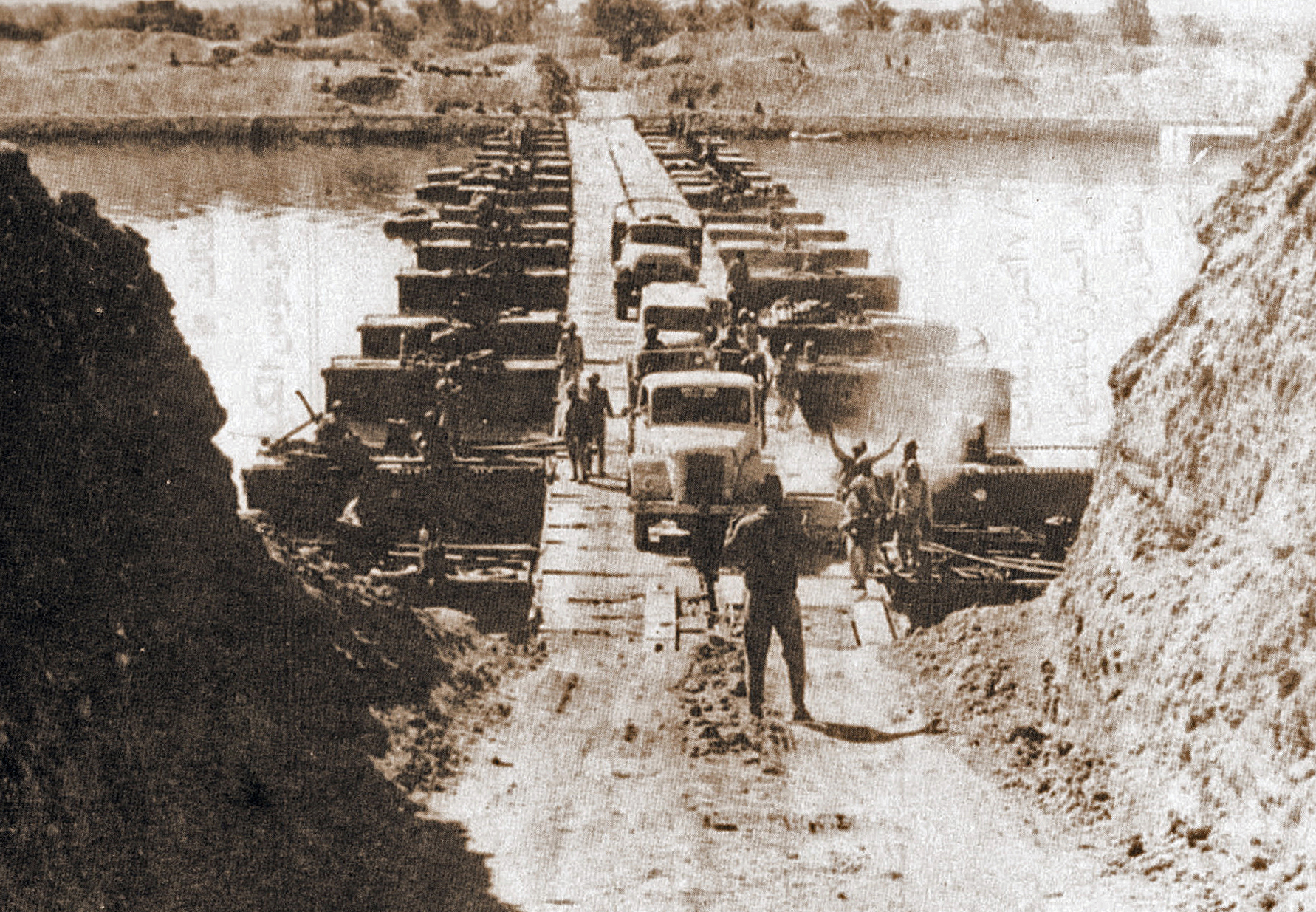
No, the Yom Kippur War between Syria, Egypt and Israel didn’t cause the US to become more dependent on the rest of the world. But our support of Israel against countries from which we imported oil did lead to OPEC’s decision to deny us oil. Up to that point, our government had pretty much done whatever it wanted geopolitically, on behalf of containing Communism and American corporations. It was this week forty years ago, though, that truly began to teach ordinary Americans that there would be consequences for our foreign policy actions without regard for folks who lived at the blunt end of them.

Egyptian forces cross on one of the bridges laid across the Suez Canal, October 7, 1973.   (CIA/Soerfm via Wikipedia). In public domain.

Egyptian forces cross on one of the bridges laid across the Suez Canal, October 7, 1973. (CIA/Soerfm via Wikipedia). In public domain.

I was just a couple of months away from turning four, but I do have vague memories of the week and month from four decades ago. Within a block of where my Mom worked, Mount Vernon Hospital, was a gas station, one that by the end of October had lines wrapped around the block as motorists in their six-miles-to-the-gallon guzzlers desperately waited for some petrol. It was loud and chaotic, from the little bit that I do remember. Fast forward to about a year later, when my Mom took me and my other brother Darren to the old Met grocery store on South Fulton in Mount Vernon. There, she complained about the $2.69 she had to spend on a five-pound bag of Domino’s Sugar ($14.53 in 2013 dollars). I remember her sighing about the high prices and the fact that her paycheck wouldn’t be able to keep up.

It would be years later still before I realized that the last of America’s easiest days as an economic and geopolitical superpower were during my years as a toddler. I did feel secure back then, not knowing about my father’s alcoholism, my mother’s insecurities about being a Black Southern girl living in and around New York City. I had yet to witness the violence embedded in my family, or in my neighborhoods, for that matter. I knew nothing of drug addiction or authentic Blackness, of racism and systemic job discrimination. I had yet to learn that the economic and educational opportunities that had been available to millions of Americans — almost regardless of race and gender — were about to become that much harder to attain and retain as I grew older.

Now, forty years later, as memories of the Reagan and Clinton years have faded, I think of America’s heady days, ones that now seem of lore. I realize that America could have even better days ahead. If we were to acknowledge human involvement in climate change and invest heavily in a green economy. If quality, well-funded universal pre-K to higher education became our reality, without creating one system for elites and another for everyone else. If we as a people finally said it was time to repair $3 trillion worth of infrastructural damage to our bridges and roads, to our sewer and water systems, and to our electrical grid. If we somehow decided to end our expensive wars on drugs and on Black men, on anyone whom we think (but do not know) may do our nation’s interests (if not our people) harm.

Collage of workers placing an F-Series bed onto frame at  Louisville Assembly Plant (Kentucky), 1973. (http://media.ford.com)and a woman carrying a sign past a McDonald's on East 125th Street during a protest by fast food workers and supporters, New York, NY, April 4, 2013. (Stan Honda/AFP/Getty Images via http//:financialpost.com).

Collage of workers placing an F-Series bed onto frame at Louisville Assembly Plant (Kentucky), 1973. (http://media.ford.com); a woman carrying a sign past a McDonald’s on East 125th Street during a protest by fast food workers and supporters, New York, NY, April 4, 2013. (Stan Honda/AFP/Getty Images via http://financialpost.com).

But I know that we won’t have those better days, at least not yet. Not with narcissistic politicians either lining their pockets with money or lining their minds with sugarplum hopes for the Rapture and Armageddon. Not with a media more interested in the political horserace and petty optics than in giving us the full story. And not with an American public more interested in Miley Cyrus than in funding for more psychologists in public schools.

It’s truly depressing to know how far our nation hasn’t come in four decades, virtually my entire lifetime. At least I know, though. For so many born after me — not to mention lacking self-reflection — they may never know what should’ve been.

On the Insignificance of Saggy Pants & Respectability

20 Friday Sep 2013

Posted by decollins1969 in Boy @ The Window, culture, Eclectic, eclectic music, Movies, music, Politics, Pop Culture, race, Youth

≈ Leave a comment

Tags

Birmingham Church Bombing, Black Elite, Boyz n the Hood (1991), Economic Inequality, Florida A&M University, Hip-Hop Culture, Institutional Racism, John L. Lewis, Jonathan Ferrell, March on Washington, NWA, Police Brutality, Racism, Respectability, Saggy Pants, Thug Life, TLC, Trayvon Martin, Tupac, Violence, White Supremacists


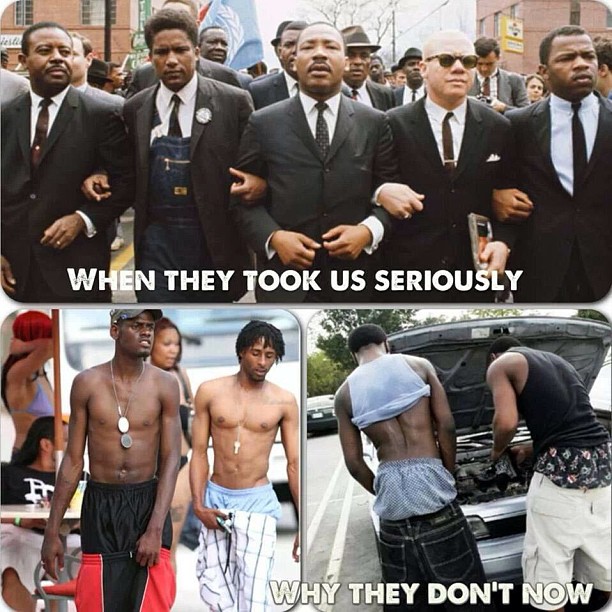
"When They Took Us Seriously/Why They Don't Now" poster, September 20, 2013. (Tim Brinkley/Google +).

“When They Took Us Seriously/Why They Don’t Now” poster, September 20, 2013. (Tim Brinkley/Google +).

In the past month of March on Washington and “I Have A Dream” speech commemorations and Birmingham church bombing dedications, a series of images lamenting rap culture and “thug life” have made their way around the Internet. The one that has stuck with me the most has been the image of the Selma March in 1965 juxtaposed with seemingly random photos of young Black males with saggy pants. The caption reads, “When they took us seriously/Why they don’t now.” Really? White supremacists took respectable Negroes seriously in the ’60s because they marched and wore suits, but don’t take Black males seriously now because of the saggy pants phenomenon? The truth is, they did and didn’t take us seriously then and now, and it has almost nothing to do with pulling our pants up above our boxers.

I have to say, though, that I hate saggy pants. It makes the people wearing them look somewhere between goofballs and idiots. It’s never mattered to me whether White guys or Black guys or college guys or hip-hop divas have worn saggy pants. I didn’t like it when it became a style in the early ’90s, thanks in large measure to NWA and Tupac, TLC and Snoop Dog and a host of other hip-hop/rap artists. I certainly don’t like it now, and would never buy a pair for my ten-year-old son to wear that way. The saggy pants style has been a sad twist on hand-me-downs and poverty as marketable clothes for the hip-hop cool.

But the saggy pants style has never translated for me as embracing a  “thug life” or some devolution of Black culture or American society. It wasn’t life imitating art, ala Boyz n the Hood (1991), Menace II Society (1993) or Clockers (1997). Nor have I ever seen it as something that meant that Whites or the new Black elite could say, “See. These Black folk don’t deserve respect, or health care, or a quality education, or good-paying jobs.” Over the past two decades, I’ve seen it as a style — a bad style, to be sure — but a style that some Blacks (and Whites, Latinos and Asians) have embraced.

Any young Black person who’s striving for higher education, or careers, or their own stereotypical success story in life, will tell you that they don’t wear saggy pants for every time or season. Even those who don’t know learn very quickly that saggy pants aren’t welcome in allegedly more respectable settings. If anything, the prevalence of saggy pants in 2013 has as much to do with the reality that opportunities for education, employment and prosperity remain so out of reach that it really doesn’t matter to many what they wear and where they wear it. There’s no need to code switch if everyone in your world knows the same exact code of cool.

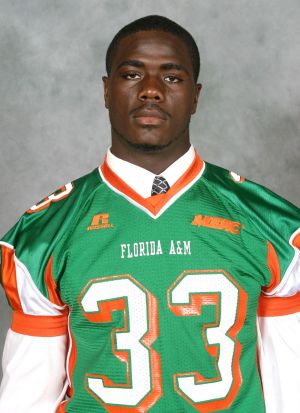
Jonathan Ferrell, Florida A&M football picture, September 20, 2013. (AP/Florida A&M University).

Jonathan Ferrell, Florida A&M football picture, September 20, 2013. (AP/Florida A&M University).

Recent events have made it pretty obvious that it really doesn’t matter what Black males wear. We remain targets for deeply ingrained stereotypes, institutional racism, and pre-emptive White violence. Whether it was Trayvon Martin wearing a hoodie in the rain, or John Lewis wearing a suit in Selma forty-eight years ago, it hasn’t mattered to Whites in fear of the Black boogie man. Florida A&M University graduate and former football player Jonathan Ferrell learned this deadly lesson in North Carolina just a week ago. It doesn’t matter what we wear, at least as far as many Whites and some Black elites are concerned.

Blacks all look the same to them, and looked the same to them in the ’60s. Suits, hoodies or baggy pants, we’re criminals and imbeciles from birth, thugs for life, and a drain on families and American society. This doesn’t mean that any one of us shouldn’t take responsibility for how we act, speak and look in public. I dare say, though, that structural economic issues like unemployment in deeply impoverished Black communities (or crank-infested White ones) won’t be solved with young folk pulling their pants up. We need to stop focusing on the insignificant, because saggy pants and respectability are the trees in this morphing forest of racism and economic inequality.

K-16 Education Reform and the Unlevel Playing Field

23 Friday Aug 2013

Posted by decollins1969 in 1, Academia, culture, Eclectic, Politics, Pop Culture, race

≈ Leave a comment

Tags

Adult Learners, College Affordability, College Success, Degree Attainment, Dr. Steve Perry, Economic Inequality, Education Inequality, Employability, First-Generation Students, High-Stakes Testing, Higher Education, K-16 Education Reform, Michelle Rhee, Poor Students, Private Foundations, Student Loans, Students of Color, Teacher Accountability, Two-Tiered System, US Department of Education, Wendy Kopp


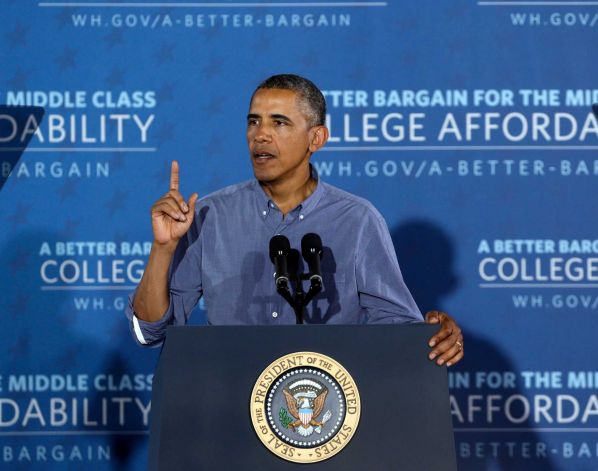
President Barack Obama speaking college affordability and a rating system, University of Buffalo (NY), August 22, 2013. (http://sfgate.com).

President Barack Obama speaking college affordability and a rating system, University of Buffalo (NY), August 22, 2013. (http://sfgate.com).

The shape and direction of education reform in America’s public schools and in US higher education is such that one can only conclude that this is the century in which social mobility will be limited to a precious and lucky few. With high-stakes testing and No Child Left Behind on the K-12 side, and the rise of for-profit online institutions in postsecondary education, we’re well on our way to a two-tiered system of education. One tier for the affluent, who will attend private schools and elite colleges, and a much lower tier for the rest of us, who will increasingly receive a watered down public education and have ever more limited higher education options.

The Problem With Mainstream K-16 Reformers:

The problem is, though, most reformers actually believe that their efforts at reform will result in a fairer and more level playing field for our kids and for first-generation college students of every stripe. They have an unwavering desire to make testing the cornerstone of curriculum revisions and the key determinant in measuring teacher effectiveness, and thus, tying future funds to school performance levels. Or, in the case of for-profit online higher education, they believe that financial aid in the form of student loans, accelerated classes with a curriculum strictly geared for current job market trends and lack of academic support is the shape of their river. Leaving vulnerable millions of first-generation students — particularly low-income adult learners (many of whom are of color) — to dropping out of college with tens of thousands of dollars of student loans to pay off and with few good career prospects.

Mock Time Magazine cover with Michelle Rhee alleging her full knowledge of cheating scandal in DC Public Schools, April 14, 2013.  (By a college student whose mom is a 7th grade teacher -http://www.susanohanian.org/)

Mock Time Magazine cover with Michelle Rhee alleging her full knowledge of cheating scandal in DC Public Schools, April 14, 2013. (By a college student whose mom is a 7th grade teacher -http://www.susanohanian.org/)

These reforms go further in providing an unlevel playing field. One where only a privileged few get to go down Mount Everest in a helicopter. The rest of us, meanwhile, must climb up Everest, ill-equipped for the climate while dodging rock slides, avalanches and other land mines all along the way.

An Unasked Question About K-12 Reform:

That reformers don’t see this is one thing. That they don’t even ask the questions that they should about their reform endgame has been the real problem for years. For example, they don’t ask the simple question, “Will high-stakes testing and teacher effectiveness measures close the achievement gap and make it so that students regardless of race and family income will be well prepared after graduating high school for college or for workforce training?”

The answer to this, of course, is no. High-stakes testing cannot and will not close the achievement gap or lead to students graduating high school better prepared for college and the 21st century working world. Teachers and administrators will continue to devote more of their time and efforts to testing than to other aspects of their jobs, for fear of losing their jobs. Reformers will continue to use the mantra of testing to siphon those precious and limited taxpayer dollars out of state legislatures and school boards to cover the costs of test development and test-based teacher evaluations. And students attending the allegedly worst performing schools will continue to lose good teachers and move from school to school in search of the promise — but not the reality — of a quality K-12 education.

Reformers like Michelle Rhee, Wendy Kopp and Dr. Steve Perry (not to be confused with Journey’s lead singer) don’t ask this question. They are too busy procuring funds from the Bill & Melinda Gates Foundation, Lumina Foundation for Education, the Wallace Foundation and the US Department of Education to discuss the shape of their reform river. They are much more interested in proving a strong correlation between teacher effectiveness and student achievement via test scores, because they believe this is the way, truth and life for K-12 reform. And pretty soon, we will know that this correlation either doesn’t exist or is a weak one at best, under some rather ideal circumstances.

An Unasked Question About Higher Education Reform:

Futurama poster "A Mindless Worker Is A Happy Worker," August 23, 2013. (http://d3.ru)

Futurama poster “A Mindless Worker Is A Happy Worker,” August 23, 2013. (http://d3.ru)

For-profit institutions involved in online higher education do no better in asking fundamental questions about their endgame. University of Phoenix, Kaplan University and Capella University don’t ask, “Is an accelerated online college format that is highly dependent on underprepared first-generation college students, provides few or no academic support services and is heavily subsidized by federal student loans the best possible postsecondary education for these students?” Of course it isn’t. Over the past 20 years, these institutions have been too busy figuring out ways to increase the enrollment of low-income students to ask this question. They have been more interested in drawing in as much federal student loan aid as possible to cover the costs of student enrollment to ask whether they are providing the best services.

For those not-so-lucky students attending these institutions, they face a great distance between the promises of this new higher education regime and its brutal reality. For-profits promise an online education that is tailor-made for students’ job and career aspirations, one even more alluring because it is an allegedly convenient fit for the demands of any adult lifestyle. For-profits seem to be proud of the fact that fewer than 20 percent of their students complete a degree eight years after they first enroll in one of their courses. For those few students who do manage to complete a degree, many are finding that their narrowly focused degrees don’t match up with their career aspirations.

Irony and Shame:

The irony is that for-profit online higher education has all but moved away from testing at a time when the only thing that matters in K-12 education is testing, from a child’s first week in kindergarten to his or her last day of 12th grade. The ironic shame of it all is that reformers in both K-12 and higher education never ask the question of what we should expect at the end of the reforming rainbow. Their reform efforts are purely about making a profit, for themselves or for others. The rest of us, meanwhile, can’t wait for Superman, with reformers stealing his powers on both ends of the K-16 spectrum, and placing kryptonite for real reform at every turn.

—-

I wrote all this months ago. Now, with President Barack Obama offering a formalized version of accountability for higher education institutions that connects market-relevant degrees and employment to college success, him and his administration are pushing the two-tiered agenda even further. Private elite colleges can easily opt out of this Race to the Top-esque rating system for higher education costs-to-employability ratios, and create their own measures around affordability, degree-attainment and career pathways. Or not, for that matter.

Public institutions — the ones tied most directly to US Department of Education funds — will have little choice but to go down this money-wasting path. One that in the end will do nothing for first-generation students, students of color, older students, heck, any student who comes from a humble background. “It’s a shame and a pitiful,” as my father would say.

My First Walk (and Making Plans)

15 Thursday Aug 2013

Posted by decollins1969 in 1, Academia, Boy @ The Window, culture, Eclectic, Hebrew-Israelite, Mount Vernon New York, race, Religion, Youth

≈ Leave a comment

Tags

Affluence, Bronxville, Child Abuse, College, Coping Strategies, Domestic Violence, Eastchester, Economic Inequality, Making Plans, New Rochelle, Pelham, Phyllis, Poverty, Racism, Tuckahoe, Walking


Thirty-one years ago this week was the beginning of an inadvertent coping strategy that would lead me away from 616, out of Mount Vernon, New York, into Pittsburgh, and college, and grad school. (And eventually, to a worn-out right knee, leg exercises and a running regiment that I’ve adhered to for nearly a decade.) It was a walk that was literally my only time away from home and my summer of abuse at the hands of my late idiot ex-stepfather Maurice Washington (or Judah ben Israel). It was a walk in which I began to plan my escape from the madness.

From Boy @ The Window:

“It was August ’82, and I didn’t know if I’d make it to the end of the year.

“If masturbation were the only thing that I discovered that month, I might’ve begun aspiring for some other kind of life. Instead, I decided on another boring August day to do something else novel. I didn’t want to go to Wilson Woods again. We didn’t have any money anyway. I decided to take my siblings on a walk on the wild side, to walk outside our immediate neighborhood. First Darren and I took baby Maurice and Yiscoc in his new stroller out of 616 and walked to Pelham…The four of us walked and strollered down East Lincoln Avenue, across the stone bridge over the Hutchinson River Parkway into Pelham, and turned left on Fifth Avenue to go north. This was uncharted territory for all of us, especially me. I hadn’t been down in the city all year, and my life for most of the summer was spent between Wilson Woods, Pearsall Drive, and 616. North Pelham might as well have been Helena, Montana to me.

‘We don’t know where we’re going,’ Darren said.

‘Yeah, and?,’ I said in response.

‘Okay, but it’s your fault if we get lost, Donald,’ Darren said.

“We didn’t get lost. We walked until we hit Chester Heights, the beginning of the village of Eastchester. It was amazing in that it was much more suburban than Mount Vernon or the part of Pelham that I’d known up until that moment. The homes were luxurious by my standards. Everyone seemed to own a BMW, Volvo, Mercedes-Benz, or Peugeot. There weren’t many sidewalks around, only well-manicured lawns. We had walked into a ritzy community without any warning. But instead of becoming depressed or angry, it made me introspective. ‘Look at these houses!,’ I said to Darren as we walked by one Tudor-style home after another three-story mansion, broken up only by a few cul-de-sacs.

We walked across another bridge, this one with an overhanging meshed metal fence, across the Cross-County Parkway, and ended up in Mount Vernon for a brief moment. We veered right as we walked up a hill and out of Mount Vernon again. After walking through what appeared to be an enchanted forest, we discovered we were in Bronxville. Even at twelve, I knew that Bronxville was just about the richest community in America. And it looked like it, too. I began to think that the world was a cruel place, having rich Whites living so close to us yet their lives were so far apart from ours. Darren, having been around rich Whites through Clear View for nearly eight years, didn’t think too much of it.

“That’s when it hit me. If I wanted to live a better life, to have a nice house and a car and a family, it seemed to me that I needed an education, a college education. I wasn’t going to get there just graduating from high school, especially in Humanities, where the expectations for college were so high that some kids already knew that they were going to law school. I just knew that I couldn’t go through another summer of abuse. So I said to myself, ‘I’ve got to get through the next five years. I’ve got to go to college.’ I knew almost intuitively that my choices were to continue to experience abuse without reaching for something that I thought I could do based on my smarts. Yet it seemed like an impossible task.

“So as we walked through the villages of Bronxville and Tuckahoe, ending up on North Columbus Avenue/Route 22, I began to think about what I wanted to get out of eighth grade. It seemed to me that the most important class for my future was Algebra, since that led to higher forms of math. I knew English and Social Studies would be really easy, but with success in Algebra, I could go into high school with a little more confidence.

First Walk

First Walk

“That’s when we passed by a ranch-style home with a stone facade. I looked and saw someone out in front I hadn’t seen since the end of the school year. It was Phyllis, outside in the front yard with her sister, apparently back from bike riding. She called us over, and the four of us talked. Phyllis asked what we’d been up to over the summer. This was the first Black family I’d seen during our two-hour walk.

“Of course I didn’t go into any detail about what we’d been up to. After all, the one thing that the past year had taught me was not to open up my mouth and say everything that was on my mind! So I let her and her older sister Claudia do most of the talking. They’d gone somewhere, somewhere down South to visit family. It looked like they were having a good time, the time of their lives compared to us.

‘Do you live around here?,’ Phyllis asked.

‘Oh, we’re on a long walk and just happened to be in the neighborhood,’ I said.

‘Okay,’ she said in response.

“In the neighborhood. Sure, if Bronxville, Eastchester, Pelham and 616, all part of our eight-mile trek, was all part of one gigantic neighborhood. After about ten minutes, we continued home. Darren was more excited about seeing Phyllis and her sister than I was.

“Yet it wasn’t that I was unexcited… I finally had a plan, a long-term plan, for dealing with the situation at 616. I knew that there would be a lot of smaller steps that I’d have to take before even getting to college, much less getting a degree…Otherwise I really didn’t have anything else to look forward to, except what I thought would be a very painful life and an extremely early death.”

That walk — and the hundreds of walks (and runs) I went on all through eighth grade and high school –was the difference between becoming a professor and a writer and having died well before the turn of this century. If not literally, then certainly psychologically.

Why Obama Is Only A Failed Centrist President

07 Monday Jan 2013

Posted by decollins1969 in 1, culture, Eclectic, Patriotism, Politics, Pop Culture, race

≈ 1 Comment

Tags

Bipartisanship, Centrist, Congress, Corporate Interests, Democratic Party, Deregulation, Economic Inequality, Fiscal Cliff, Fiscal Cliff Deal, George H. W. Bush, George W. Bush, Gerald Ford, Jimmy Carter, Lyndon Johnson, Media Coverage, Neo-conservatives, Presidency, President Barack Obama, President Bill Clinton, President Obama, Republican Party, Richard Nixon, Ronald Reagan, social mobility, Social Safety Net, Washington


Photo portrait of President Lyndon B. Johnson [our last transformational President] in the Oval Office, leaning on a chair, March 10, 1964. (Arnold Newman, White House Press Office via Wikipedia). In public domain.

Photo portrait of President Lyndon B. Johnson [our last transformational President] in the Oval Office, leaning on a chair, March 10, 1964. (Arnold Newman, White House Press Office via Wikipedia). In public domain.

I don’t say what I have to say about President Barack Obama lightly. But in light of the recent “fiscal cliff deal”  and the negotiations process that preceded it, I’ve now become convinced that Obama will be seen as a pretty good president. Period. Obama hasn’t been a unique president, despite his race or relatively humble beginnings. Obama is hardly a great president, either. Nor will Obama be a transformational president. If anything, Obama falls right in line with every American president since the election of Richard Nixon in 1968.

Photo of living presidents with then President-Elect Barack Obama in the Oval Office, January 7, 2009. (http://npr.org).

Photo of living presidents with then President-Elect Barack Obama in the Oval Office, January 7, 2009. (http://npr.org).

The fact is, Obama is a centrist president, beholden to the military-industrial complex, prison-industrial complex, Wall Street and corporate interests, just like Nixon, Ford, Carter, Reagan, Bush 41, Clinton and Bush 43 before him. That Obama is Black and intellectual in his approach matters little in terms of actual policies or in the path that he and his administration have taken toward incremental policies and half-baked compromises. Based on some of Obama’s policies, I could even make the argument that the President is a borderline neo-conservative, although I don’t think you can generalize this argument to every policy.

This has been an argument I’ve made in my US History courses over the past couple of years. When I’ve raised the idea that Nixon was a liberal Republican, that President Bill Clinton was a neo-con (see the repeal of Glass-Steagall Act in 1999 and TANF welfare reform in 1996 as but two examples), and that Obama is hardly a liberal at all, my students have collectively gasped. How dare I say that Nixon was more liberal than Clinton, that Obama is somewhere between a centrist and a neo-con!

But then I’ve worked with them through discussion to talk about the major domestic and foreign policy agendas of the past seven presidents in comparison to our current president. On so many issues, from the US relationship with Israel to the War on Drugs, from welfare reform to financial deregulation, from a re-escalation of the Vietnam War to the surge in Afghanistan, there hasn’t been a nanometer of space of difference in executive branch decision-making. Whether the people in these positions of power have been Nixon and Henry Kissinger, Jimmy Carter and Cyrus Vance, George W. Bush, Dick Cheney and Colin Powell, or Obama and Hillary Clinton.

So I’ve had my students work through parts of Obama’s agenda. The surge and gradual drawing down of US military forces in Afghanistan, in which part of their role is nation-building. “How is that any different from Bush 43?,” I’ve asked. The historic Affordable Care Act, a so-called universal health care bill that fails to cover 20 million Americans and works through complex networks of government subsidies and private insurers, a neo-con plan that failed as an alternative to single-payer under Clinton in 1994. “How is this really a liberal or progressive idea?,” I’ve asked. The continuing War on Drugs, the reauthorization of the Patriot Act, the highest rates of deportation of undocumented immigrants ever. “But yeah, Obama’s a liberal!,” I’ve said sarcastically in concluding this discussion with my students.

Some folks, like the reformed neo-con Bruce Bartlett, have compared the Democratic Party of recent years to the liberal Republicans of yesteryear. Bartlett, though, has stopped short of calling Democrats centrist neo-cons, which is in fact a much more apt description. Bartlett also stopped short in time, as he argued that the tipping point for the Democratic Party’s movement from left-of-center to right-of-center began with President Clinton in the 1990s. But that’s incorrect. The tipping point began when the Democratic Party’s New Deal coalition of labor unions and blue-collar Whites, Southern whites, Catholics and Blacks fell apart as part of a backlash against President Lyndon Johnson’s support of the Civil Rights Movement and the War on Poverty in the late-1960s.

Photo of Presidents George H.W. Bush, Reagan, Carter, Ford and Nixon at the  Ronald Reagan Presidential Library dedication, Simi Valley, CA, November 4, 1991. (Anne Cusack/Los Angeles Times).

Photo of Presidents George H.W. Bush, Reagan, Carter, Ford and Nixon at the Ronald Reagan Presidential Library dedication, Simi Valley, CA, November 4, 1991. (Anne Cusack/Los Angeles Times).

Most Americans, though, don’t have the knowledge or luxury of taking a long view of history and their lives in attempting to put Obama in context. The media’s constant coverage of every trumped-up, imagined or real crisis hardly helps matters, either. They assume on behalf of the public the idea that there are two equal and opposite sides to every issue and every argument, which means most journalists failed geometry in high school. As a result, most Americans believe that Obama’s a liberal because the media consistently makes the false claim that all Democrats are liberals and that a Black guy with a Harvard law degree who used to be a community organizer must be a liberal.

How is a budget cutting agenda that puts Social Security, Medicaid and Medicare on the table as entitlements (and not a paid-for weak social safety net) a liberal idea or policy agenda? How is coming out reluctantly in favor of gay marriage some great progressive stance, comparable to President Kennedy’s speech in favor of civil rights in 1963? How is consistently giving into oligarchic conservatives by pushing hard for a meager tax increase on the most privileged members of our nation — the people who benefited the most from 40 years of policies that have greatly increased the gap between rich and poor — part of a liberal strategy? It isn’t and they aren’t.

Obama being three steps to Congress’ left on gay marriage and a tax increase is an incredibly weak counterargument to the fact that he’s a centrist. And a failed one at that, as his centrism has been based on garnering bipartisan support of weak legislation in terms of socioeconomic appropriations and strong legislation in terms of defense and Big Brother-esque laws. Obama has pushed climate change, long-term unemployment and underemployment, social mobility and real education reform either off his presidential agenda or into the hands of the private sector.

Thank you, but no, Obama’s a centrist, not a liberal. If you want to see a liberal policymaker in action, the nearest place to go these days is Ottawa, not Washington.

Emancipation and Compromise

01 Tuesday Jan 2013

Posted by decollins1969 in 1, culture, Eclectic, Patriotism, Politics, Pop Culture, race

≈ 3 Comments

Tags

American Civil War, Compromise, Economic Inequality, Emancipation Proclamation, Fiscal Cliff, Fiscal Cliff Deal, Harry Reid, President Abraham Lincoln, President Barack Obama, President Lincoln, President Obama, Racism, Sen. Mitch McConnell, Slavery, Social Justice, social mobility, Social Safety Net, The Great Emancipator, US Civil War


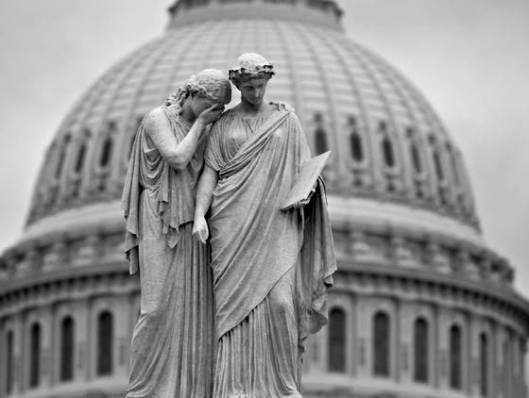
Statuary by the US Capitol, Washington, DC, December 25, 2012. (J. Scott Applewhite/AP).

Statuary by the US Capitol, Washington, DC, December 25, 2012. (J. Scott Applewhite/AP).

Today marks 150 years since President Abraham Lincoln issued an order as Commander-in-Chief that granted freedom to slaves in territories that remained in rebellion against the Union. It enabled Lincoln to become know as the Great Emancipation, and paved the road for the passage and ratification of the 13th Amendment to the Constitution, outlawing slavery in the US, nearly three years later. This is a great thing to remember on this New Years Day, and yet, the Emancipation Proclamation exemplifies flaws in the political tactics of our leaders.

We seldom see real, lasting changes in our nation. Our Founding Fathers wrote our very Constitution with the expressed purpose of protecting “life, liberty, and property,” specifically the property of rich White male slaveowners and merchants. Lincoln used his office to strip the Southern one-percenters of the Civil War period of the one thing that was central to their “way of life,” the liberty of owning African slaves, of treating humans as property.

But even Lincoln’s proclamation was as much political posturing as it was an order on the road to emancipation and abolition. It would take the bulk of 1863, 1864 and 1865 to bring enough of the Confederate states under Union Army control to make emancipation a reality for three out of four million slaves. Border states and areas already under Union Army would only be forced to free the other one million slaves with the ratification of the 13th Amendment on December 6, 1865. This wasn’t exactly a great compromise, especially for the slaves and for abolitionists.

Fast-forward a century and a half to our tumultuous Congress and jelly boned White House. They’re fighting over tax cuts that should’ve never been enacted in ’01, or expanded in ’03. The cuts should’ve expired two years ago instead of fourteen hours ago. The compromise that the Senate passed at 2 am today is weaker than the Emancipation Proclamation. At least Lincoln knew that he had an Army and Navy that could enforce it over time. In the case of President Barack Obama, Senators Harry Reid and Mitch McConnell, the compromise deal is worth about as much as Neville Chamberlain’s “peace in our time” Munich Agreement with Hitler in September 1938, and led indirectly to World War II less than a year later.

"Kicking the can down the road" cartoon, September 23, 2012. (Clay Bennett/ Chattanooga Times Free Press).

“Kicking the can down the road” cartoon, September 23, 2012. (Clay Bennett/ Chattanooga Times Free Press).

The media loves to say that “both sides need to compromise to make a deal.” President Obama loves to say that “no side can get a hundred percent of what they want.” Let’s follow this line of thought by looking at the compromises that led to the Civil War and Lincoln’s proclamation. Here’s seventy-six years of compromise (starting with the US Constitution):

  • Kicking can of end of US participation in international slave trade to 1808;
  • African slaves (not term used) equated to three-fifths of a person for political representation purposes;
  • Missouri Compromise of 1819 (creating distinction between slave and free states at the 36°30′ parallel);
  • Gag Resolution (forbade Congress from debating anti-slavery bills on the floor of the House and (essentially) the Senate between 1836 and 1844);
  • The Compromise of 1850, which tore up the Missouri Compromise, opening up new territories for slavery’s expansion, while allowing California into the Union as a free state; and
  • Kansas-Nebraska Act (1854) officially declared policy of “popular sovereignty,” that each territory in its petition for statehood could determine to be a state that allowed or did not allow slavery.

Years of compromise led to increasing violence to protect or destroy slavery (including “Bleeding Kansas” and John Brown’s Harper’s Ferry raid in 1859), and of course, to the Civil War. So while Lincoln’s Emancipation Proclamation was itself a compromise, it might as well have been an ultimatum compared to the previous seven decades of inaction and negotiation.

Emancipation Proclamation reproduction, National Underground Railroad Freedom Center,  Cincinnati, OH, (photo taken November 15, 2009). (Wikipedia). In public domain.

Emancipation Proclamation reproduction, National Underground Railroad Freedom Center, Cincinnati, OH, (photo taken November 15, 2009). (Wikipedia). In public domain.

Not that taxes, spending and the social safety net are the same as slavery. But after nearly four decades of declining social mobility, expanding economic inequality and every conceivable break in favor of the wealthy and corporations, isn’t it time to stop compromising our lives and our children’s lives?

Unless we consider the reality that Congress is only doing what its greedy Civil War-era predecessors did a century and a half ago. That the White House is too beholden to moneyed interests to stand for anything that truly helps ordinary Americans. That it will take something far more serious than the Great Recession (or even something potentially as violent as the Civil War) to make this group finally find religion.

← Older posts
Newer posts →

Boy @ The Window: A Memoir

Boy @ The Window: A Memoir

Places to Buy/Download Boy @ The Window

There's a few ways in which you can read excerpts of, borrow and/or purchase and download Boy @ The Window. There's the trade paperback edition of Boy @ The Window, available for purchase via Amazon.com at http://www.amazon.com/Boy-Window-Donald-Earl-Collins/dp/0989256138/

There's also a Kindle edition on Amazon.com. The enhanced edition can be read only with Kindle Fire, an iPad or a full-color tablet. The links to the enhanced edition through Apple's iBookstore and the Barnes & Noble NOOK edition are below. The link to the Amazon Kindle version is also immediately below:

scr2555-proj697-a-kindle-logo-rgb-lg

Boy @ The Window on Amazon.com: http://www.amazon.com/Boy-The-Window-Memoir-ebook/dp/B00CD95FBU/

iBookstore-logo-300x100

Boy @ The Window on Apple's iBookstore: https://itunes.apple.com/us/book/boy-the-window/id643768275?ls=1

Barnes & Noble (bn.com) logo, June 26, 2013. (http://www.logotypes101.com).

Boy @ The Window on Barnes & Noble: http://www.barnesandnoble.com/w/boy-the-window-donald-earl-collins/1115182183?ean=2940016741567

You can also add, read and review Boy @ The Window on Goodreads.com. Just click on the button below:

Boy @ The Window

Twitter Updates

Tweets by decollins1969
  • RSS - Posts
  • RSS - Comments

Archives

  • June 2025
  • April 2023
  • September 2022
  • August 2022
  • July 2022
  • June 2022
  • May 2022
  • April 2022
  • March 2022
  • January 2022
  • December 2021
  • November 2021
  • October 2021
  • September 2021
  • August 2021
  • July 2021
  • June 2021
  • April 2021
  • March 2021
  • February 2021
  • January 2021
  • December 2020
  • November 2020
  • October 2020
  • September 2020
  • August 2020
  • July 2020
  • May 2020
  • April 2020
  • March 2020
  • January 2020
  • December 2019
  • November 2019
  • August 2019
  • July 2019
  • June 2019
  • May 2019
  • April 2019
  • March 2019
  • February 2019
  • January 2019
  • December 2018
  • November 2018
  • October 2018
  • September 2018
  • August 2018
  • July 2018
  • June 2018
  • May 2018
  • March 2018
  • February 2018
  • January 2018
  • December 2017
  • November 2017
  • October 2017
  • September 2017
  • August 2017
  • July 2017
  • June 2017
  • May 2017
  • April 2017
  • March 2017
  • February 2017
  • January 2017
  • December 2016
  • November 2016
  • October 2016
  • September 2016
  • August 2016
  • July 2016
  • June 2016
  • May 2016
  • April 2016
  • March 2016
  • February 2016
  • January 2016
  • December 2015
  • November 2015
  • October 2015
  • September 2015
  • August 2015
  • July 2015
  • June 2015
  • May 2015
  • April 2015
  • March 2015
  • February 2015
  • January 2015
  • December 2014
  • November 2014
  • October 2014
  • September 2014
  • August 2014
  • July 2014
  • June 2014
  • May 2014
  • April 2014
  • March 2014
  • February 2014
  • January 2014
  • December 2013
  • November 2013
  • October 2013
  • September 2013
  • August 2013
  • July 2013
  • June 2013
  • May 2013
  • April 2013
  • March 2013
  • February 2013
  • January 2013
  • December 2012
  • November 2012
  • October 2012
  • September 2012
  • August 2012
  • July 2012
  • June 2012
  • May 2012
  • April 2012
  • March 2012
  • February 2012
  • January 2012
  • December 2011
  • November 2011
  • October 2011
  • September 2011
  • August 2011
  • July 2011
  • June 2011
  • May 2011
  • April 2011
  • March 2011
  • February 2011
  • January 2011
  • December 2010
  • November 2010
  • October 2010
  • September 2010
  • August 2010
  • July 2010
  • June 2010
  • May 2010
  • April 2010
  • March 2010
  • February 2010
  • January 2010
  • December 2009
  • November 2009
  • October 2009
  • September 2009
  • August 2009
  • July 2009
  • June 2009
  • May 2009
  • April 2009
  • March 2009
  • February 2009
  • January 2009
  • December 2008
  • November 2008
  • October 2008
  • September 2008
  • August 2008
  • July 2008
  • June 2008
  • May 2008
  • April 2008
  • March 2008
  • February 2008
  • January 2008
  • December 2007
  • November 2007
  • October 2007
  • September 2007
  • August 2007
  • July 2007
  • June 2007

Recent Comments

decollins1969's avatardecollins1969 on No Good Teaching Deed Goes…
Mary Rose O’Connell's avatarMary Rose O’Connell on No Good Teaching Deed Goes…
Lyndah McCaskill's avatarLyndah McCaskill on The Raunchiest of Them Al…

NetworkedBlogs on Facebook

NetworkedBlogs
Blog:
Notes From a Boy @ The Window
Topics:
My Life, Culture & Education, Politics & Goofyness
 
Follow my blog

616 616 East Lincoln Avenue A.B. Davis Middle School Abuse Academia Academy for Educational Development AED Afrocentricity American Narcissism Authenticity Bigotry Blackness Boy @ The Window Carnegie Mellon University Child Abuse Class of 1987 CMU Coping Strategies Crush #1 Crush #2 Death Disillusionment Diversity Domestic Violence Economic Inequality Education Family Friendship Friendships Graduate School Hebrew-Israelites High-Stakes Testing Higher Education History Homelessness Humanities Humanities Program Hypocrisy Internalized Racism Jealousy Joe Trotter Joe William Trotter Jr. K-12 Education Love Manhood Maurice Eugene Washington Maurice Washington Misogyny Mother-Son Relationship Mount Vernon High School Mount Vernon New York Mount Vernon public schools Multiculturalism MVHS Narcissism NFL Pitt Pittsburgh Politics of Education Poverty President Barack Obama Race Racial Stereotypes Racism Relationships Self-Awareness Self-Discovery Self-Reflection Sexism Social Justice Teaching and Learning University of Pittsburgh Violence Whiteness Writing

Top Rated

Blog at WordPress.com.

  • Subscribe Subscribed
    • Notes from a Boy @ The Window
    • Join 103 other subscribers
    • Already have a WordPress.com account? Log in now.
    • Notes from a Boy @ The Window
    • Subscribe Subscribed
    • Sign up
    • Log in
    • Report this content
    • View site in Reader
    • Manage subscriptions
    • Collapse this bar
 

Loading Comments...