Noah’s Ark, Judges & Lessons Not Learned

Tags

, , , , , , , , , , , , , , ,


Celebration of Osama bin Laden's death outside of White House, May 1-2, 2011. http://cfnews13.com

One of the really cool things about having lived an eclectic life — whether by choice or parentage — is that I often see things around me very differently from most people. It may make me goofy or an oddball, but it also makes me the thinker that I am.

Even on matters of belief, I find myself at odds with most Christians. It’s made it hard for me to find a church that I’m comfortable with for more than a few services. Today’s American Christians, Protestant, Catholic, Evangelical or otherwise are for the most part a bunch of hypocritical and self-absorbed — but hardly self-reflective — imperialists who use scripture and religious traditions at every turn to thwart equality and peace. We lack the wisdom necessary for real faith, and knowledge necessary for real understanding.

In the case of global warming and climate change, this deliberate ignorance has bothered me for years. The fact that so many have been willing to ignore droughts, floods, hurricanes and tornadoes in favor of “drill, baby, drill” has been a point of disgust. Add to it the belief for many that these are the signs and wonders of the book of Revelations is somewhere between absolutely stupid and arrogance unlike few

Johan's Ark, a half-sized replica of Noah's Ark, in the port of Schagen, The Netherlands, September 3, 2006. Ceinturion (via Wikipedia), in public domain via Creative Commons Attribution-ShareAlike license versions 2.5, 2.0, and 1.0.

other than God has ever seen. Even theologians have trouble interpreting the many contradictory messages of Revelations. Yet most of us prefer this explanation to the scientific proof that our burning of oil, coal, forests and vegetation over the past 250 years has done damage to the global climate.

Fewer who claim to be Christian use the Bible as a way to understand what’s happening beyond fire, brimstone and thunderbolts, making these folks no different from Norse or Greek pagans scared of Thor or Zeus’ wrath. Take Genesis and the story of Noah. It’s ultimately a story of great faith and climate change. Noah had the unique wisdom — some would say revelation — that a great flood would eventually arrive, and dutifully prepared for it while everyone else refused to believe and conducted business as usual. Eight millennia later, with enough scientific evidence to convince a doubting Thomas of climate change, and denial and debating Revelations is all that most of us do.

Or take the historic announcement Sunday night. After nine years, seven months and twenty days, the architect of 9/11 — not to mention the embassy bombings in ’98, attacks in Indonesia, the UK, Spain, and other parts of the world — Osama bin Laden, was killed by US special forces in Pakistan. As conflicted as I can be about many things, I wasn’t conflicted about US forces capturing or killing him. Not because I’m a bloodthirsty person, and not because I believe in the cause of invading other countries to capture leaders of a global terrorist organization. But because a billionaire global terrorist leader is a danger to us all.

So relief, a little bit of vindication, even, is what I felt, followed by the thought that this helps Obama and completely invalidates Bush’s preemptive war and occupation doctrine for both Afghanistan and Iraq. Not to mention thousands of dead and $4 trillion spent. Then followed by dread, because of the idiotic giddiness and hyper-patriotic vitriol spewed Sunday night and all day Monday by my fellow Christians. I’m not arguing that some folks shouldn’t have been a bit happy, felt some relief, and shouldn’t have been in tears. It’s been a long decade of intolerance, ignorance and insecurity that’s followed 9/11. But “USA! USA! USA!”? We took out one man. Al Qaeda still exists, along with a whole bunch of other homegrown and foreign terrorists, many unaccounted for.

Many of my fellow Christians would deny a peaceful afterlife to bin Laden’s spirit because of the evil that he did while here on Earth, playing the role of judge, jury and executioner. Not entirely unlike the judges in the Old Testament, providing law in a leaderless land of lawlessness. I’m hardly suggesting that we should all forgive and forget, even though that’s what we should ideally do. I doubt, though, that expressing glee equivalent to the Pharisees after the Romans crucified Jesus is high on the Christian playbook list.

All of this also leaves me sad. Because it shows that there’s no way on what’s left of God’s green Earth that most of us American Christians can repair the damage we’ve done to ourselves, our country, and the rest of the world. We won’t admit that jobs and gas for our cars today are more important than the environmental, economic and geopolitical future of our children. That the underlying conditions that led to the rise of Osama bin Laden — US political and economic imperialism all over the rest of the world — haven’t changed enough to prevent the rise of another in his place. We might as well keep doing what we’re doing. Chanting patriotic slogans while waiting on the side of a road, bags packed, waiting for Jesus’ return. While the world around us burns.

One Good Woman

Tags

, , , , , , , , , , , , , , ,


My Wife, Angelia Levy, April 2010. Angelia N. Levy

Today is our eleventh wedding anniversary. Tomorrow is a Crush #1 day. The next month covers a series of events that includes my first “date” with my now wife nearly sixteen years ago. Not to mention my last “dates” with the woman who’s the subject of my blog post, “The Power of Another E” (April ’09) from twenty years ago.

And then there’s my Mom, somewhere in the background, distant but still there, reminding me of all that made me, well, me. At least the me that wanted Crush #1, thought too highly of the twenty-two year-old version of “Another E,” and was ready to be involved with my eventual wife. Things have grown so much more complicated since the days when I couldn’t say “Hi” to a woman, much less date or be married to one.

One of my favorite adult contemporary songs about how women can inspire in relationships is Peter Cetera’s “One Good Woman” (1988). It was the first song I’d heard that really summed up the way I’d felt about my first crush back in ’82. And it provided a stark contrast to the way I felt about my second crush/obsession by the time the fall of ’88 rolled around. I bopped to the feelings in that song for much of my sophomore year at Pitt.

But I wasn’t a fool. I knew that there wasn’t anyone in my life at the time, or had been at any time, who could measure up to those lyrics. While Crush #1 definitely “brought out the best in me,” it certainly wasn’t because of her “love and understanding.” The two things I longed for in my life from others I cared for and about was love and understanding. My mother had little of either by the time I was a teenager, even though I know that she did the best she could. It just wasn’t close to good enough. So I put some of my faith in those lyrics, my romantic side in singing those words, eventually with no one in mind.

Even with dating and the ’90s, and even though I played “One Good Woman” less and less, I sought someone in my life who’d fit those lyrics. The problem with a country full of arrogant narcissists — me included — is that most of us present with DSM-IV neuroses (and in some cases, psychoses) long before we reach the stage of love and understanding. For better and certainly for worse, my mother was really the only woman who approximated any sense of the feeling Cetera releases so well in his song. And by approximate, I mean less than one-tenth of the full strength of the music and lyrics of “One Good Woman.”

This isn’t necessarily a bad thing. Sons shouldn’t really think too often of their mother in a romantic light. It certainly would’ve helped to have known how deeply or how superficially I was loved by my mother, but I had nothing in my dating life really to compare it to.

That was, until I met my eventual son’s mother. Angelia was everything in Cetera’s “One Good Woman” lyrics. She wasn’t a dream of it like Crush #1. Or an obsession like Crush #2. Or someone who could be that for a moment like “Another E” or be a trifling ass the next minute like so many women I dated between ’91 and ’96. She was a real woman, good, bad, warts and all.

So when we married eleven years ago, with the Napster era that was, I downloaded Cetera’s “One Good Woman” and made it a permanent part of the collection that would end up on my iPod in ’06. Except that in recent years, my “One Good Woman” image feels more like John Legend’s “Ordinary People,” proving that even women that inspire you to love, cherish and understand are human beings as well.

When I listen to “One Good Woman” these days, I do think of my wife. But I also think of all of the other women who’ve inspired me over the years. Including my mother. Including even some of my more trifling exs. I love my wife, and I hope things in our marriage continue to work even as we work through whatever issues we have from time to time.

Still, I need to remember that romance comes and goes, but marriage only works when people work hard to communicate when they don’t understand, despite their love for each other. If either of us were to quit, it shouldn’t diminish all of the good that I saw and see in that woman, my wife, and the life we’ve had over the past fifteen plus years.

Hail To Pitt

Tags

, , , , , , , , , , , , , , , , , , , , , ,


University of Pittsburgh Logo, April 27, 2011. http://www.pitt.edu

I can be hard on people, places and things, especially the ones I like and love. That’s as true of my undergraduate alma mater as anything else. Twenty years ago this date, I graduated from the University of Pittsburgh. I didn’t attend the cattle-call ceremony at the Civic Arena that Sunday in ’91. Almost none of my immediate circle of friends attended, either. My mother and my younger siblings, still in the midst of welfare, weren’t going to be there to see me anyway. The Penguins were on that day, in the middle of a dominant playoff run, with Lemieux scoring at will. And I had other things on my mind that day and weekend. Like, will I be able to go to grad school without taking out tens of thousands of dollars in student loans?

This was a time of major transition for me. Two years removed from the end of the reign of my ex-stepfather at 616, and four years after I graduated from Mount Vernon High School and my obsession

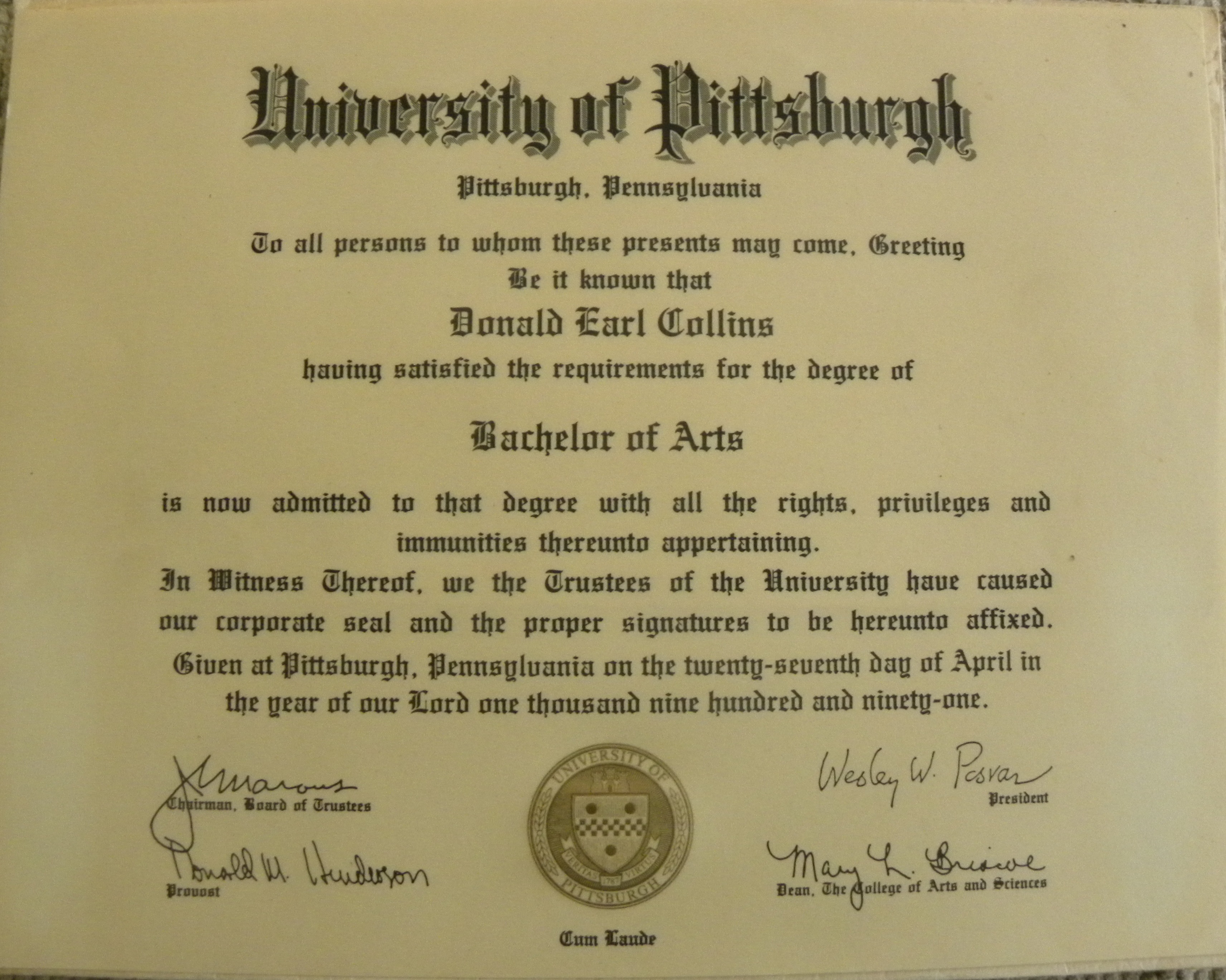
My B.A. degree, University of Pittsburgh, April 27, 2011. Note that this was Wesley Posvar's last graduation signature. The university president would retire the following month amid a $3 million golden parachute scandal.

with Crush #2. I was essentially the same person, and yet there was something inside me that had started clawing its way out over the previous year. It was a drive, a determination, a rage that I’d buried since my first year in Humanities and the summer of abuse that followed in ’82. I was going to graduate school, at least I hoped that I was. Or I was going to have to find a real job, something that made me feel like I had diarrhea.

I knew on my Pitt graduation date that the departments of history at NYU, University of Maryland and Pitt had accepted me into their masters programs. But NYU wanted me to make a signed commitment before they awarded me any financial aid. The University of Maryland conveniently lost my application packet during their graduate fellowship decision process. By the time my packet resurfaced, the department had awarded all of their fellowships, and decided to put me on provisional status. Not based on my grades, mind you, but based on how late they were in going through my application. Pitt had accepted me a couple of weeks before my graduation, but I was sixth on the alternate list for teaching fellowships that would cover my tuition and provide a stipend.

I felt a lot of anxiety about all of this uncertainty regarding my immediate future. It helped to have friends, even with my friends in the middle of their own uncertainty. My friend Marc was working at a Black newspaper, dreaming of law school but uncertain about his prospects. Three other friends, including someone I was sort of dating, were taking their last classes or unsure about grad school or law school. Even my summer job working for a project at the Western Psychiatric Institute and Clinic was shaky. It only paid $5.20 an hour, and I could’ve easily gone back to Mount Vernon and New York making $8 an hour or more doing the same work.

But as uncertain as I felt about things, this much I was certain about. The four years I spent at Pitt were ones that cocooned me in a way that none of my time growing up in Mount Vernon, New York did. I began to heal while I was there, academically, socially, emotionally. I was far from done learning how to connect to people, but I wasn’t the twelve-year-old neophyte keeping only the most rudimentary connections to humans either. My education was a valuable part of that experience. The friendships and other bonds I forms, the lessons I learned about trust, the efforts — however limited — the university made toward creating a campus climate that embraced diversity were all appreciated.

Even at the time, I felt comfortable at Pitt because it was the first place I learned to be comfortable in my own skin. It was a place where my friends, my acquaintances and others around me didn’t look at me like I was a freak because I listened to U2, sang in high-falsetto or walked at Warp Factor 3 to get across campus.

Those are the feelings, those good feelings, that I have about my four years of undergrad and two years of grad school (more on that in May) at the University of Pittsburgh. So, “Hail to Pitt,” and to my Pitt friends and folks from the classes of ’90-’94, Happy Graduation Anniversary Day.

High Falsetto Highs and Lows

Tags

, , , , , , , , , , , , , , , , ,


I know that I’m weird, a freak, and if I were a quarter-century younger, a bit geekish. Well, maybe a geek in a tall man’s body with fourteen percent body fat. Music is one of those things that separates me as weird. Not just because of what I listen to from moment to moment. Smooth jazz to R&B to hip-hop soul to ’80s pop to ’90 White male angst grunge to rap to divas like Mariah Carey and Celine Dion. Few people I know — much less males, much, much less Black males — have any appreciation for eclectic musical tastes. But they’ve had almost no tolerance for my high-falsetto singing voice over the years.

Puberty was the reason I discovered it all. My closest friends and wife don’t believe me when I tell them that I used to be able to hold a tune. That in sixth, seventh and eight grade, I sang with my elementary school and middle school chorus. I was a baritone, and a decent one at that. But the voice changes of puberty cracked my voice and sent it into high falsetto in ’83, ’84 and into ’85, whenever I did try to sing.

So I went with it. Once I reconnected with music outside of school in the ’80s, I sang mostly in that ear-splitting, shaky and unevenly high tone and pitch to everything I liked. And that made me stand out, mostly as the weird guy with the Walkman that my fellow Black males made fun of for not being cool. Did I care? Sure, in an obvious, I-know-I-don’t-fit-in kind of way. But, did I care? For the most part, no. I knew enough to not walk down certain streets in Mount Vernon and certain part of the high school singing in that voice, walking to the beat of my own internal music box.

That voice was my release. As awful as I sounded in it, as imperfect and grating my tone, as much of a strain as I put on my cords, it was one of a handful of ways for me to experience happiness, joy, laughter. Other emotions besides rage, fear and anger. That’s what singing Cyndi Lauper’s “Time After Time,” Michael Jackson’s “Human Nature,” and a-ha’s “Take On Me” well outside my normal vocal range did for me. It gave me a high without the benefit of pot, and a low without the benefit of friends.

Singing in high falsetto still brings a natural high. Except now, I laugh at myself while doing it, and I don’t care about the people who think I’m a freak because I sound like a buffoon. Damn right.

Milky White Skin

Tags

, , , , , , , , , , , , , , , , , ,


Bethesda Literary Festival logo, April 21, 2011. http://www.bethesda.org

I attended the Bethesda Literary Festival last weekend. It’s been a while since I’ve gone to any conference involving writers, wannabe writers, published authors and other curiously weird types. I usually find these events somewhere between dreadfully boring and undeniably soul-sucking. I wish that I could say that the festival held at various parts of downtown Bethesda were an exception. But what I can say is that the Bethesda Literary Festival provided the best desserts — especially the cupcakes (my guess, from Georgetown Cupcakes) — I’ve had at any literary event.

Bethesda Literary Festival 2011 Logo, April 21, 2011. http://www.bethesda.org

The most poignant event at the festival for me was the Essay and Short Story Contest winners for ’11. Grouped into two categories — over 18 and young adults — the winners were announced and had the opportunity to read from their stories and essays. I must admit, some of the stories were compelling. (That word, compelling, a common word lit agents have used as a reason for rejection of Boy @ The Window. I often think that they’re working from an unspoken definition of what compelling really is.) But I also found most of the stories cliché, typical, White both in terms of the actual color as well in racial and cultural terms.

Listening to these aspiring authors, young and talented writers read their work reminded me so much of a line from Finding Forrester, where the character played by Sean Connery says, “Writers write so that readers can read. Let someone else read it.” It’s difficult for any writer to read something they’ve written with the passion and emotion contained within their own words. And with two exceptions — a mother reading for her daughter about a dying aunt, and a seventeen-year-old reading his essay in poetry slam fashion — the Forrester axiom was in full effect.

I kept checking my watch, hoping that I’d hear something that would inspire me or at least pique my interest. The latter did occur, but not in the way in which I would’ve expected. I listened to one forty-

Ridiculousness of Milky Skin, April 21, 2011. Donald Earl Collins

something short-story honorable mention read about a “tongue licking ice cream.” Earlier, there had been a young adult winner, reading phrases like “Same cloudless indigo eyes. Same auburn, frizzy locks. Same childish, pearly pudge of skin…”

It all took me back to novels and other pieces of literature from my high school days. Like Shakespearean plays in which actors described some young English woman as having “milky skin,” as a point of attraction and lust. That kind of writing, the constant shifting and sliding of adjectives and adverbs. It drove me crazy in ’85. Last weekend, it made my eyes glaze over, with both looking like the clear frosting on a glazed donut.

I yawned with the anticipation of more of the same stories that writers and publishers have been selling for as long as I’ve been alive. I knew what was coming. Stories of epiphanies and social consciousness, upper-middle-class-White-Bethesda-and-Potomac-style. Stories of parallel and pain, from climbing Mt. Kilimanjaro and grave illness to autism to death and dying. Universal stories that somehow were milky White, told in a style that made the messy truth of it as palatable as a slice of key lime pie.

I don’t write that way. But not because I can’t. I could write page after page in vivid description of Crush #1. I could count each hair on her well-muscled forearms on the way to measuring every mole on her shoulders, every tooth in magnitude of whiteness, every capillary in her eyeballs. I could spend a few pages describing the different smells of flatulence and excrement I grew up with at 616. From the sweetness of a spaghetti and meat sauce fart to the lingering death-knell scent of a bathroom after the flushing of what once was a combination of coffee, beer and fried chicken.

Literary nonfiction, memoir, or other serious writing endeavors, though, are about the balance between the sweet milky whiteness of the literary and the messy realness of me as the writer. In the case of Boy @ The Window, of me as the main character as well. Descriptions of milky or caramel colored skin do reside among its pages. But so do descriptions of conversations, characters, actions and emotions. All as part of telling a story, sharing some truth, beyond the romance of the purely literary.

The Tyranny of Salvation

Tags

, , , , , , , , , , , , , , , , , , , , , , ,


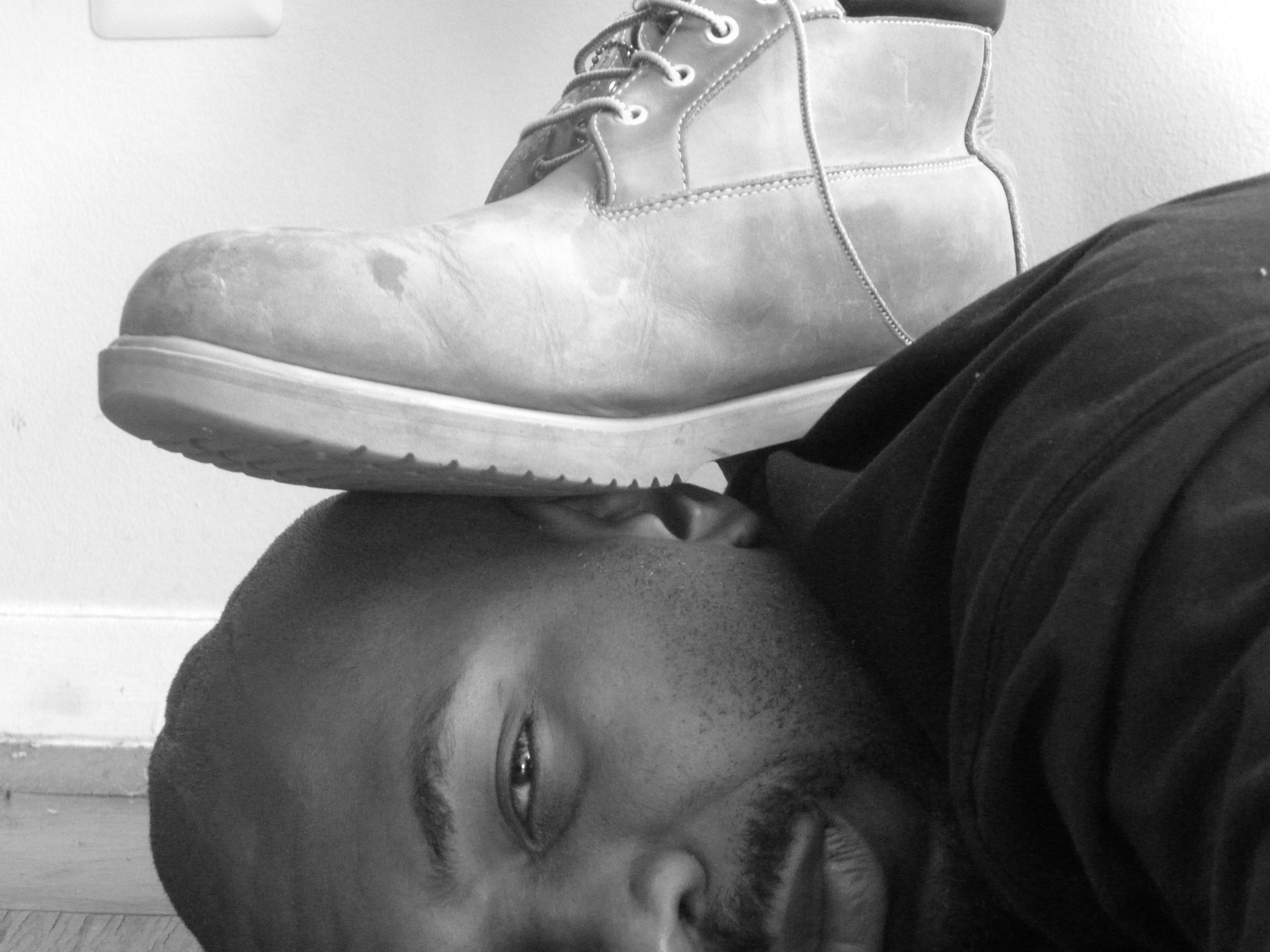
Foot On My Neck & Head, symbolic of my years as a Hebrew-Israelite, April 18, 2011. Donald Earl Collins

Thirty years ago this date, on a sunny Saturday in April ’81, the false prophet known as my stepfather came back into our lives with a new religion, delaying my spiritual growth by at least three years. The day before both Easter and Passover that year, me, my mom and my older brother Darren became Hebrew-Israelites, Black Jews, Afrocentric Jewish Negroes, strange folks among strange folks in our strange land. It was supposed to be my and our salvation, the beginning of glorious times. Instead, it was a hell on Earth like no other, with fists, kicks and empty stomachs to look forward to for the next three years.

An excerpt from Boy @ The Window seems appropriate here:

Maurice returned to our lives in April ’81 after a six-month separation from my mom (sort of, because unbeknown to us, she was pregnant with my younger brother Yiscoc, a Hebrew variation for Isaac) claiming that he was a different man, a changed man, thanks to an allegedly reincarnated Balkis Makeda and his Hebrew-Israelite conversion.

This was the religion my stepfather converted to after he and Mom had separated. In the period before his return, my stepfather had been working on Mom, attempting to convince her that he was now a good man and could be trusted as the man of our house. He loved Jehovah, had stopped smoking, and had learned how to love himself. And he had changed his name to Judah ben Israel, not legally, mind you. The name literally means “Lion of God and of Israel,” and referred to my stepfather as a royal descendant of Jacob/Israel, the immediate father of the Israelite people. It was in this context that my stepfather gained a sense of himself and control over his world.

I didn’t know what to think at first. After I had watched Maurice load up on lamb shanks and pork chops on the first Saturday in October six months earlier, I hadn’t expected him to come back at all. I already thought of the man as the great pretender after three and a half years of living in the same 1,200 square-foot space together. That, and eating like he was Dom DeLuise at a banquet, were his only true talents. As few and far between my visits with Jimme were after Mom’s divorce became final in ’78, I’d always seen an inebriated Jimme as more of a father than Maurice could be if he really tried.

Still, despite my confusion and skepticism, I worked extremely hard to convince myself that Maurice’s conversion was real. Especially since Mom had decided to welcome him back into all of our lives. I had to. Because becoming a Hebrew-Israelite wasn’t exactly a process in which free will was involved. Our mother told us that this would be our religion “for the rest of our lives.” Then our stepfather came to explain this “way of life” to us, and we put on our white, multi-holed, circular kufis for the first time. I had no idea what Mom and Maurice had pushed us into.

A part of me was on the outside looking in, thinking, “this is crazy.” But we were already the children of one divorce, and I wasn’t sure if I wanted to see another one so soon. Darren, to his credit, played along as if being a Hebrew-Israelite was just a role in a school play.”

I lost many of my sixth-grade friends when I showed up to school the Tuesday morning after Easter and Passover with a kufi on my head, including my best friend Starling.

I might not have lost my childhood thirty years ago on this date. But it was the beginning of eight years wandering in the wilderness. It was a bitter, tyrannical wilderness, populated by wolves in sheep’s clothing, Maurice Washington number one among them. I stepped on many landmines in the process of finding myself again.

Still, those years are ones I can’t get back. It’s amazing that I found God at all, given all of the crap we’re told by spiritual leaders about the road to salvation.

Slavery and the Civil War: Not What You Think


Schweitzer is mostly right but wrong neverthele­ss. Yes, states’ rights was the immediate cause of the Civil War. But, an individual state’s right to do what? To have slavery. Eleven states didn’t secede from the Union between November 1860 and April 1861 because of tariffs, taxes or Indian removal policy.

Your article presuppose­s that in slavery’s absence, something else would’ve caused the Civil War. That assumption doesn’t help us very much, because it ignores the central issues of slavery and race, and how those issues played a central economic role in building the US prior to 1861. Not to mention the major factor in creating a unifying effect for the nation in the connection­s between freedom and race, at least before the 1850s.

The other issue that’s important here is that many of the themes of the Civil War remain unresolved­. Southern Whites defending a flag and a “way of life” that depended on the subjugatio­n of millions of people during slavery and after the Civil War — you know, the Jim Crow era (1877-1970­-ish). When folks defending the Stars and Bars use the term “way of life,” they never describe it in any detail, as if we know what this means, as if we’re only talking about barbeques and blue-grass bands. The day that Confederat­e apologists get real about slavery and segregatio­n is the day that we can finally stop debating about the causes of the Civil War and the sanctity of the blood-stai­n Confederat­e flag.
Read the Article at HuffingtonPost