Ivy League Dilemma – Addendum

Tags

, , , , , , , ,


My addendum to the “Ivy League Dilemma” post, as there are several lessons to learn from my stumbling successfully into college at the University of Pittsburgh:

1. Always do your homework regarding the kinds of schools you want to attend. Easier said than done when you’re sixteen, the Internet didn’t exist, and your family doesn’t have the money to take you to visit schools prior to applying. Even with the disadvantage of poverty and lack of knowledge, I certainly had enough money for the $1.25 fare to catch the 2 to 110th Street and transfer to the 1 to get off at 116th, then walk up the step to find myself on Columbia University’s campus in ’86 or early ’87. That I didn’t see Columbia’s campus until ’90 is inexcusable.

2. Never allow the slights and ridicule of others determine where you should and shouldn’t go to school. I assumed that because my affluent and White (and some Black) Humanities classmates were snobbish, cliquish and entitled that I would see the exact same patterns at places like Columbia and Yale, making me more likely to see the University of Pittsburgh as an oasis from that side of human nature. It turned out that I was right and wrong. Pitt was so big, with so many different kinds of students, that there wasn’t this exaggerated sense of academic entitlement that I’d been a part of in the six years prior to attending. Over the years, I’ve learned that even truly talented and affluent students could be and often are wonderful human beings.

3. Don’t become intimidated by competition just because of the pressures and failures of the past. I don’t think that I was intimidated per se, but I do think that I wanted to not make a fool of myself among other high academic achievers either. My mix of the schools in which I applied in the fall of ’86 reflects this middle-of-the-road and contradictory thinking:

University of Pittsburgh                Columbia University
Rensselaer Polytechnic Institute  Rochester Institute of Technology
Hobart & William Smith Colleges  SUNY Buffalo
Yale University                              University of Rochester

I simply didn’t know enough — or knew anyone who knew enough — about me, my potential, and about the kinds of schools I’d been looking for to apply to the best mix of schools back then. Today, knowing what I was like then, but also knowing what I know now, I can reasonably assume that the list below would’ve been the best one for me to work from a quarter-century ago:

University of Pittsburgh                University of Pennsylvania
Cornell University                         Brown University
University of Toronto                    University of North Carolina
Georgetown University                 New York University

Of course, hindsight in my case is 20/10. This list just means I have a ten-year head start in helping my son figure out his higher education plans.

The Ivy League Dilemma

Tags

, , , , , , , , , , , , , , , ,


Columbia University's Butler Library at night, New York City, October 13, 2008. (Andrew Chen via Wikipedia). Permission granted via GNU Free Documentation License.

A quarter-century ago this weekend, I made the decision to attend the University of Pittsburgh over Columbia University. Given that I lived in Mount Vernon, New York, this was a decidedly weird decision. So much so that I didn’t tell my mother of my plans for nearly two weeks, and waited until April to tell my classmates. But there’s a well marbled story here, of bad Ivy League practices, not to mention my need to get away from family and classmates alike.

I applied to eight schools in all, including Yale, Columbia and Pitt. If it weren’t for Pitt’s brochure of pizza and students having a good time, I wouldn’t have applied there to begin with. The only rejection I received was from Yale, in early February ’87. Oh well!

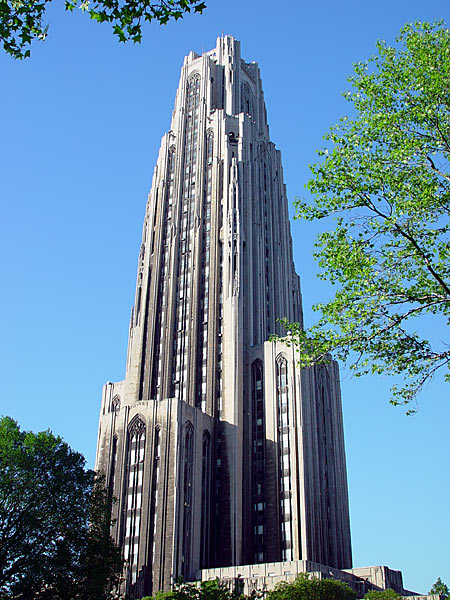
Cathedral of Learning, University of Pittsburgh, December 20, 2010. (http://www.photohome.com). In public domain.

Over the next five weeks, I received one acceptance and packet of materials after another, including Columbia and the University of Pittsburgh. All but Columbia gave me a full financial aid package of one kind or another. All offered either a partial or a full-tuition scholarship for four years except for Columbia. Pitt had offered me one of their inaugural half-tuition academic scholarships that they called the Challenge Scholarship, meant to attract low-income students and students of color from across the country.

I called Columbia’s financial aid office in mid-March to ask why they hadn’t offered me any kind of academic scholarship. They called me back to tell me that they wanted to “make sure” that I really couldn’t afford to go their West Harlem, er, Morningside Heights school.

“But you have my Mom’s financial paperwork,” I said.

“Well, we could send out a private investigator to track down your father and take a look at his finances. If everything checks out, either he can cover part of your tuition or we can offer you a scholarship,” the man on the other end of the phone said.

I was floored by the smug arrogance coming out of the phone. “My dad hasn’t paid child support in eight years,” I said, ready for an argument.

“We want to make sure that he doesn’t have money for your tuition,” was the creditor’s response.

“Thanks but no thanks. You either trust me or you don’t,” I said with conviction, and hung up the phone.

I was torn between having some idiot private investigator digging through my father Jimme’s pitiful life and finances and saying “Go to Hell!” to Columbia. I didn’t want to see the worst case scenario occur, which was that some fool would go back to Columbia and say that Jimme could afford to pay $3,000 of my tuition per year. In the three years up to March ’87, Jimme had given me $3,500 total.

Then I thought of other pros and cons, and as I thought of them, I wrote them out. Columbia was an Ivy League school, the University of Pittsburgh wasn’t. Yet, Columbia was more expensive than Pitt by more than two dollars to one ($18,000 per year versus $7,500) and the students at Columbia would likely be similar in education, socioeconomic background and attitudes to my Humanities classmates.

But the most important factor in saying “No” to Columbia besides their financial aid sleaziness was 616 and Mount Vernon. If I went to school there, where would I live and where would I study? Home? You got to be kidding! Mount Vernon Public Library? They only stayed open until nine pm, and were never open on Sundays. On campus? That would only work if I were able to get a decent paying part-time job on campus. After sorting through this, I knew that Columbia was out.

The look on my mother’s face when I told her said it all. She was as shocked as I’d ever seen her. She kept

Low Memorial Library, Columbia University, New York City, August 25, 2006. (Wikipedia). Permission granted via Creative Commons Attribution-Share Alike 2.5 Generic.

trying to convince me to go upstate to Hobart and William Smith, to see about going to Columbia for their private investigator. This after a year of her telling me that applying to West Point would “make me a man” because “women love men in uniform” and applying to HBCUs made sense because she’d given $25 to the United Negro College Fund.

My classmates spent the next couple of months asking me where Pittsburgh was and why I wanted to go there. All I knew was that I needed to get away from the New York area for a while and that the University of Pittsburgh’s tuition was cheaper than almost anything I would’ve faced in New York. I knew that they had a decent computer science program — this was to be my first major. But I also knew that I wasn’t stuck if I wanted to change majors or study something other that computer science.

In the end, I obviously made the right decision for me at the time. If I had to do it again, maybe I would’ve applied to the University of Pennsylvania or Georgetown. I certainly would’ve been better off in terms of immediate career options and income. But given the friendships that I formed, the degrees I earned and the wife that I have, I’m not sure if another good choice like the ones above would’ve been any better than going to Pitt. At least for my rather fragile psyche and near nonexistent social life.

Half Truths, Whole Foods

Tags

, , , , , , , , , ,


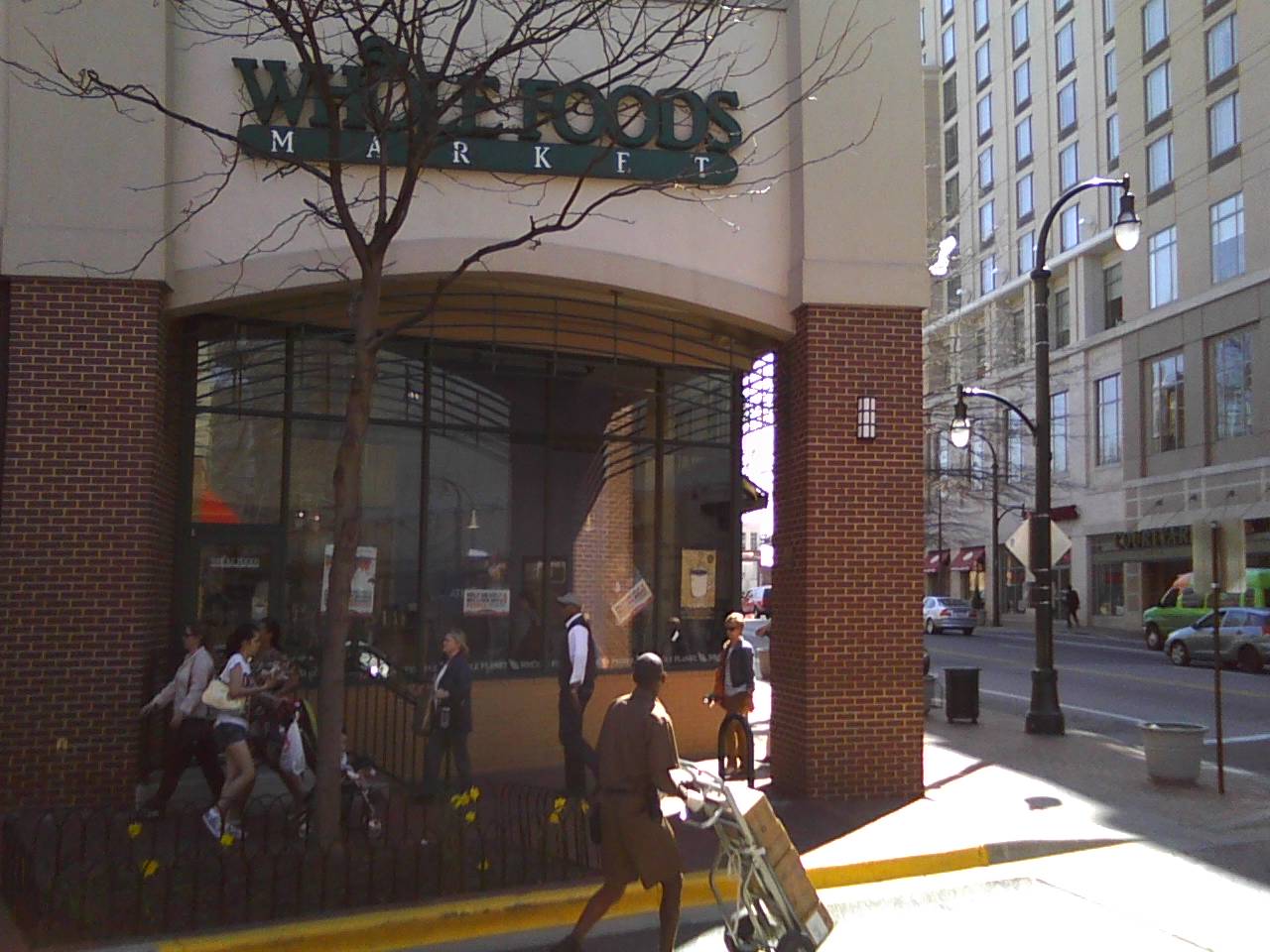
Whole Foods entrance, Downtown Silver Spring, MD, March 14, 2012. (Donald Earl Collins).

Well, at least as far as the Silver Spring Whole Foods store is concerned. After eleven and a half years, I’ve decided to no longer shop at this Whole Foods location.

Now, knowing me, you might think it’s because of Whole Foods’ neo-con founder, who somehow doesn’t believe in universal health care or worker’s rights. Or maybe it’s because Whole Foods’ distribution practices of shipping in coffee from Colombia and olive oil from Lebanon, Greece and Italy isn’t exactly good for the workers in those countries, not to mention the environment and my wallet. Or it’s because I see the ways in which the Silver Spring Chamber (of Secrets) of Commerce has warped Downtown Silver Spring into a pedestrian’s nightmare, of national chain businesses with primacy over downtown residents.

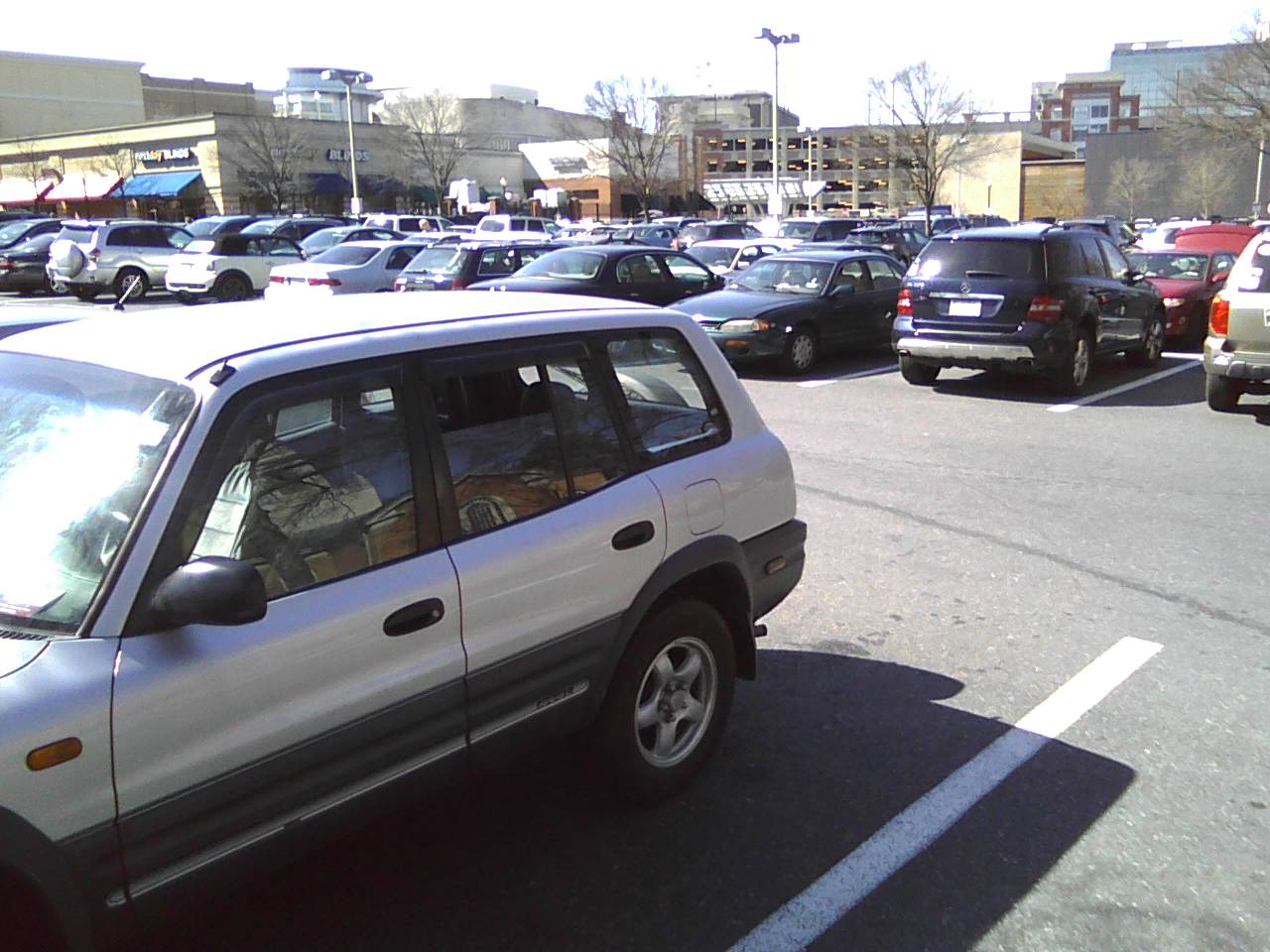
Parking lot area for Whole Foods-Silver Spring, St. Michael the Archangel Catholic Church, Strosnider's, CVS, about 80% full, March 14, 2012. (Donald Earl Collins).

But it’s none of those important and oft-thought-about issues for me. I still plan to shop at other Whole Foods stores in the DC area, albeit much more rarely than before. It comes down to two simple issues: inconvenience and customer service. We live three blocks away from the Silver Spring Whole Foods, and so it’s actually easier to walk there to shop than to drive there. But if I happen to be doing a combination shop, where I often hit two or three stores to buy about $120 in groceries on a Saturday or Sunday, that means using the Honda Element, which also means that there’s no way for me to park anywhere near the store.

This isn’t just on the weekends. Even on the days I’ve walked over, whether after work, after dropping Noah off at school, or at the end of the day, the parking area looks as if folks are preparing for a Nor’easter. I’ve actually seen customers get into actual fights over a parking space. It’s that crowded and chaotic there.

The store itself often has looked like the parking lot over the years. Lots of entitled people walking lazily down aisles, as if Whole Foods rented the space out to them for the afternoon, all while stepping in front of you for an item on the shelf without saying “Excuse me,” stepping on my foot for good measure. Or of beleaguered Whole Foods staff members in the meat, fish, deli and bakery departments, often with the weary look of waiters working at some country club, all while attempting to meet the whimsical expectations of the privileged class of customers before them.

But it’s the actual responses of the folks who work there now that’s been most disgusting.Two months ago, a cashier with name tag “Tai” rang up my groceries at the Silver Spring Whole Foods. I was left with my reusable bags while quickly trying to slide my debit card, enter my information and pay for groceries. When I had a second to try to hand Tai my grocery bags, she didn’t take them, and started with another customer as she handed me my receipt, bags in hand and no groceries bagged.

When I asked, “Are you gonna help me bag?,” Tai said “You holding the bag.”

“What, do I have to ask for you to bag?,” I then asked.

“Duh!,” Tai said with a pause. All while begrudgingly bagging the last of my groceries.

“This kind of treatment is ridiculous, and your attitude’s unacceptable,” I said, ready to beat her up in an alternate universe.

I tweeted this incident to Whole Foods Montgomery County that same day. No response. I emailed the Silver Spring Whole Foods management about the incident the following day. No response. So I boycotted the store for over a month. Only to shop there last week and have some cashier tell me to take my headphones off after I had already said no to giving money to a Whole Foods charity. Headphones, by the way, which were never on to begin with.

Side of Whole Foods-Silver Spring adjacent to Courtyard by Marriott on Fenton, March 14, 2012. (Donald Earl Collins).

This was hardly what the Silver Spring Whole Foods was like when it opened on September 6, ’00. Then, the management and the staff seemed overjoyed to provide their services. Now, it’s as if they believe that they are the only game in town, as if my money has to go into their cash registers. In other words, it’s like shopping at a really expensive version of CVS.

I’ve been to Whole Foods’ from the Union Square one in New York to others in the DC area, in Atlanta, in other parts of the country. I’ve never been treated as if I didn’t matter except at the Silver Spring store. Apparently the smugness of the corporation that is Whole Foods and the entitlement that is the Whole Foods shopper has also infected the Whole Foods staff at the Silver Spring location. The truth is, I had put up with a bit of the first two for years, but the truth is, I should’ve never put up with any of it. So, I’m out and I’m gone.

My First Vacation, Valedictorian Included

Tags

, , , , , , , , , , , , , , , , ,


Ballston high-rise (on right), Arlington, VA, where I stayed with "V" and her roommate during first DC area visit, June 26, 2008. (http://therealestatedirt.com).

I’ve lived in the DC area now for nearly thirteen years, but it was this time two decades ago that I came to the DC area for the first time. This was my first vacation ever as an adult, and the first time I’d gone on a vacation of any kind since my mother took me and my older brother Darren on a day trip to Amish country in Pennsylvania at the end of third grade, in June ’78. The visit had as many layers to it as a Vidalia onion, as it involved my past, present and future, and all at once.

At the center of my visit was spending time with my Humanities classmate and friend “V,” the valedictorian of Mount Vernon High School’s Class of ’87. I crashed at her and her roommate’s place in the Ballston section of Arlington, Virginia for a week during my spring break in March ’92. As I said in a previous post (see my “A Friendship Changing Lanes” post from October ’11), I’m not sure how our acquaintanceship ever became a friendship. Somewhere between having circumstances in which our fathers weren’t around consistently, or at least being able to relate to Billy Joel, or both of us scoring “5”s on the AP US History exam.

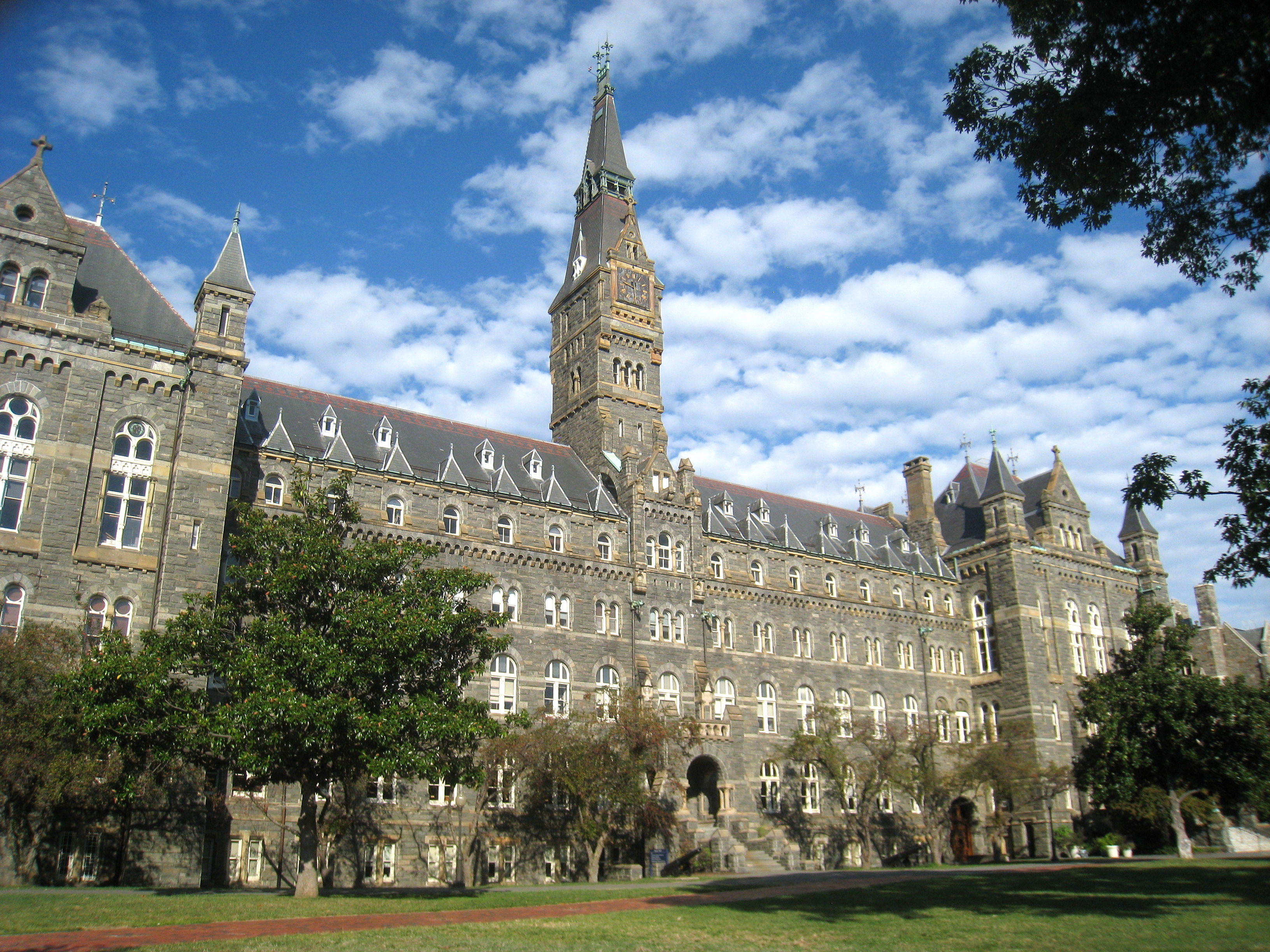
Healey Hall (front gate perspective), Georgetown University, Washington, DC, September 19, 2010. (Daderot via Wikipedia). In public domain.

The fact that we went our respective ways, to Pitt and Johns Hopkins, helped. The fact that we wrote each other about some of our social triumphs and challenges helped more. Most importantly, it helped a lot that we both were more honest about our family troubles. Everything from my mother’s need to divorce my idiot ex-stepfather and the issues with my younger siblings to V’s mother’s health issues and her struggling with burnout trying to watch over her family while going to school. So, by the time I began my second semester of grad school, we’d become fairly close.

I hadn’t seen V since the day before New Years Eve ’88, the last Friday of that year. I hadn’t planned to visit V at the start of the year, but by the middle of February, I needed a break from Pitt and graduate school (see my “Paula Baker and The 4.0 Aftermath” post from January ’12). As I knew that I was two months away from finishing my master’s, I had begun to check out some alternatives to doing my history PhD at Pitt.

Key Bridge, connecting Georgetown area with Rosslyn section of Arlington, VA, at sunset (picture taken from west), September 18, 2008. (Jersey JJ via Flickr.com). In public domain.

Through Dr. Transatlantic Studies himself, Marcus Rediker — he was a Georgetown University history professor who somehow had been given an empty office in Pitt’s history department — I made arrangements to do some informational interviews at Georgetown during my early March spring break.

As soon as I told V of my opportunity to check out Georgetown, she offered me a place to stay for the week. I made arrangements through a couple of friends driving to Virginia to have them drop me at V’s that first Saturday in March.

The trip was a whole series of firsts and seconds for me. I rode Metrorail for the first time, went to Capitol Hill for the first time, and visited Howard University for the first time. I also spent one full day hanging out with V at Suitland High School in Prince George’s County, Maryland, where she was a first-year math teacher. Other than a couple of rowdy students, V was a very good teacher, and not just for a rookie.

My meeting at Georgetown went pretty well also. I managed to get a sweatshirt out of the deal, one that I still wear to this day. Aside from that, finding out from a then second-year grad student (and now and associate professor in African American history at Georgetown) that his annual stipend was only $7,500 a year in expensive DC made my decision for me. I decided that despite the name recognition, Georgetown wouldn’t be where I’d earn a PhD.

I also visited with V’s sister and mother toward the end of that week. V’s sister was in the process of transferring to Goucher, a far cry from the rising high school freshman I’d last seen a week before my freshman year at the University of Pittsburgh. V’s mother seemed happier in Virginia than in New York, but medically speaking, she had gotten worse since ’87. Her speech was slower and more slurred, and her upper body motions were even more limited than I last remembered. It was a reminder that as much as things had gone well for V over the years, she also faced the intense pressure of trying to care for a slowing dying mother and her sister, and all at twenty-two years old.

What I came away with from that week as my friends picked me up the following Saturday afternoon were two things. One, that I really liked being in an area with great diversity, with Whites, Blacks, Latinos and Asians from all walks of life, but without the rude chaos and energy that was and remains New York. Two, that V and I had truly become friends, as adults in our twenties, mostly unattached from how we saw each other when we were in Humanities and high school.

Salutatorian Story

Tags

, , , , , , , , , , , ,


Caravaggio’s Narcissus (1594-96) – talk about someone with interpersonal issues – May 15, 2011. (Masur via Wikipedia). In public domain.

As I began to work on Boy @ The Window six years ago, I realized that my story would be far from complete without the words and thoughts of my former classmates, teachers, and family members in my head. Thoughts about themselves. Thoughts about Humanities. Thoughts about me. Thoughts about our world and our times. After all, I hadn’t thought about most of these folks in nearly two decades.

I had already started with my late, wonderful teacher and mentor, Harold Meltzer several years earlier. My first interview with him was in August ’02, but the first time we discussed the possibility of me doing Boy @ The Window goes back to February ’95. I was working on my doctoral thesis, living in DC for a couple of months while hitting the archives and libraries up for dusty information. In need of a writing break, I gave him a call on one cold and boring Saturday afternoon.

Meltzer answered with his usual “H. MMMMMMM. here?,” the M’s strung together like a long string of pearls bouncing slightly as you’d lay them gently on a table. When I said who it was, he said, “DONNIE!! Why, it’s so good of you to call!” in his halting suburban New York accent. Little did I know that this was the start of a three-hour-long conversation.

We spent a lot of time talking about the salutatorian of my class, the Class of ’87. To me, he — let’s call him ‘S’ — was always an enigma. I genuinely felt both in awe of and disheartened by his presence in my life during the Humanities years. I thought it was amazing that he was able to do as much as he did. The high school band. The mock trial team. The school newspaper. Our yearbook. An appearance on Phil Donahue! At least he wasn’t a star basketball player too, especially in Mount Vernon.

I felt the side effects of S’s success. Teachers telling me that I should be more like S, as if I was S’s younger, underachieving brother. I saw how S occasionally cashed in on his built-up academic capital to give himself more time to work on assignments no one else got a second of overtime to do. I don’t think I ever wanted to be S or become close friends with him, though. Something about his need to be well-liked by our peers and teachers bothered me.

I said as much during a three-hour meeting we had during my first work-related trip to Sacramento during the second week of March ’06. When S asked what I thought of him, I said, “I thought that you were…obsequious, ingratiating…no, that’s too strong…I sensed that you needed to be liked by our classmates and teachers.” I don’t know exactly what S thought about my description of him, but then again, he did ask.

Mitt Romney’s proof positive that short of himself, calling someone obsequious is a strong statement. Romney at CPAC 2011, Washington, DC, February 11, 2011. (Gage Skidmore via Wikipedia). In public domain.

S asked during our first meeting and interview in March ’06, “What do you think I thought of you?”

“For the most part, as far as you were concerned, I didn’t exist . . . I mean, I was there, of course, but I wasn’t in any of your circles, so I didn’t really exist for you as a real person,” I said in response.

I based that answer on S’s rare attempts to make conversations with me, ones that were mostly of the shaking-his-head-in-confusion ones. He didn’t get my attraction to the pop/rock band Mr. Mister, an ’80s prelude to Creed, I guess. “They can’t sing,” S said to me in Warns’ English class once as a reference to Mr. Mister’s #1 hit “Broken Wings.” The incident on the school bus on our Albany/FDR trip was another example (see my “An a-ha Moment” post from October ’10).

Meltzer never made me feel like a was a freak. Nor did he ever engage in comparing me to S. But he obviously was concerned about him, and had been so even when we were in eleventh grade. As for me, he said, for probably the one-hundredth time, “I never worried about you, Donnie.”

At the time of my ’95 conversation with Meltzer, I’d recently published an op-ed in my hometown and county newspaper, “Solving African American Identity Crisis,” Somehow our discussion of that piece led to a discussion of S. Meltzer told me that S “had a really hard time at Harvard” and that he’d “graduated with Gentleman’s Ceeeeeeeee’s,” the C’s rolling off his tongue in the process.

Meltzer asked if I knew what S’s problem was when I brought up the whole June ’89 conversation I had with S, the one that showed me his obvious confusion about himself (see my “Strange Days” post from June ’09). After an unusually long pause on the phone — it was long even by Meltzer’s own standards — he said, “You’re exactly right.” We spent the rest of our S discussion talking about him in high school and his need to be liked as a significant part of his identity issue.

I thought of all this as me and S ended our meeting that cloudy Northern California day six years ago. As I explained my plans to track down Crush #1 as part of what would become Boy @ The Window, S warned that she “has some interpersonal issues.” As if she were somehow off her medication when she visited S in ’04. I said, “Don’t we all?” in response. Neither of us had any room to talk about anyone else’s issues.

Was I Really In Love In 7th Grade?

Tags

, , , , , , , , , , , ,


Tomorrow will mark thirty years since I began an emotional journey the likes of which I’ve only approximated maybe three other times since. In the three decades since, I’ve learned that I was actually in love for the first time. Not just a crush, or puppy love, or some preteen infatuation. Love, actually and truly. But as a person of deep thought, a boy surrounded by sexism and misogyny, and a lonely and semi-ostracized twelve-year-old, I didn’t have the thoughts, much less the words, to describe what I felt between March 4 and May 30 of ’82 (see my “On Women and Wired Weirdness” post from March ’11).

To think that this all pretty much started because I picked a fight with Crush #1 at the end of class on the first Thursday in March in 7S. Almost all of my extracurricular incidents that year began or ended in our homeroom with our homeroom/English teacher Mrs. Sesay. The incident began because Crush #1 asked a question about a subject that Mrs. Sesay had spent the entire week going over, a concept that Sesay would test us on that Friday. I laughed out loud — thinking that I was only snickering — after Crush #1 asked that question.

Thinking nothing of it, I began to pack up after the 2:15 pm bell rang. Crush #1 came up to me and pushed me from behind.

“You’re an ugly, arrogant asshole!” she said with the distaste of a ballerina being asked for money by a junkie.

I called her “stupid” and then said something else stupid. “You’re an idiot!,” Crush #1 yelled as she threw two punches into my chest and a third at my jaw.

The fight lasted about fifteen or twenty seconds, but after landing a punch on her left boob and nipple, I stopped fighting, already descending into the land of the idiot romantic, as in The Doobie Brothers “What A Fool Believes” (1979). All while Crush #1 kept hitting me, then being pulled away from me by a couple of her friends. One of them, the recently deceased Brandie Weston, called me a “pervert” as they exited the classroom.

I know that I wasn’t the first boy in history to start a fight with a girl who I’d come to like or love, but I do think that boys who do that have a lot of weird in them. Mind you, I hadn’t quite hit puberty yet, so my testosterone levels weren’t high enough yet to be the cause of my brain malfunction. No, my very sexism and her fierce sense of tomboyish feminism was why I liked her in the first place, and I drank deep from that well for the next three months.

I’ve had thirty years to reflect on this incident and the three months of school-day dreaming that followed. There are only a handful of childhood memories I’ve thought about more. For years, though, I’d packed my emotions away. Through high school and Crush #1’s first dating experiences, through my own high school and 616 trials and tribulations, through college and graduate school and my years of dating and then marriage to my wife of twelve years.

Then, as I began work on Boy @ The Window six years ago, I opened up that dusty box of memories and emotions, to find them almost as strange at thirty-six as they had been at twelve. But unlike in ’82, I shared it with a bunch of friends, and especially my wife. After telling the story of me and Crush #1, my wife said, she was my “first love. It doesn’t matter if she didn’t reciprocate.” Or, for that matter, if she didn’t know. It was the first time it dawned on me that I really had fallen in love before I’d learned how to love. Wow.

It explained why after so many years, through all of my ups and downs, and despite the love I do feel, have and show to family and friends in my life, that Crush #1 would show up in my dreams. It helped me understand why I found few girls, young women and women attractive prior to going to college, and even then, they didn’t compare. It also let me know that a feeling like that can’t die, doesn’t die. If anything, it allows room for more love, and more understanding for how to love in the process.

The video above is about the best way I can express what I felt in ’82, without the complete sappiness of an incurable romantic, or worse yet, a tragic one. Like Professor Snape (as played by Alan Rickman) in the Happy Potter movies, or worse still, Ralph Fiennes’ character in The English Patient (1996). Combining music and two of my three favorite sports (the other one’s golf, but Tiger’s inappropriate for this theme), it’s a mere approximation for how I felt back then.

There’s plenty of other music I could’ve used (see my “The Ultimate Crush” post from March ’08 and “Desert Rose” post from April ’09), other themes like figure skating or ballet that would better show what I saw and felt in Crush #1, and what I see and sometimes feel in my dreams on occasion now. I guess that I really was in love. But there’s at least one thing I can do now. I can be there for Noah when it happens to him for the first time.

End of An Era

Tags

, , , , , , ,


Coach John Thompson, John Thompson Show, ESPN 980 AM, Washington, DC, February 29, 2012. (http://espn980.com).

It’s Leap Year Day, so in light of having the first February 29 in four years, I want to take a different tack today. For it just so happens that today is John Thompson’s last day on the air on ESPN 980 AM in Washington, DC. The legendary former Georgetown University men’s basketball coach will air his final radio show this afternoon.

Thompson has had this show for about thirteen years, and I’ve listened off and on now for seven of them. What has made him interesting to listen to over the years has been his ability to be ornery, light-hearted, downright goofy and insightful, and all at the same time — whether I agreed with him or not. That the seventy-year-old Thompson has managed to maintain a solid audience across all demographics has been a sign of his ability to be a man with an old-school philosophy without become an old man. It’s a fine balance that Thompson maintained show after show, regardless of the outrageous calls he responded to time and again.

I’ve been a fan of Coach Thompson’s since I was in high school. Back then, he had Patrick Ewing and later Alonzo Mourning as part of his vaunted Hoya Paranoia defense. They won it all in ’84, only to be done in by Villanova’s raining of shots from all angles in the NCAA Championship Game in ’85. Despite his normally gruff demeanor, Thompson handled the loss with the graciousness and sportsmanship that was rare even then, and almost impossible to find now.

I came to like Thompson even more when he was an analyst on TNT’s NBA games in the early ’00s. I used to call him “Sugar Bear” because of the way in which he delivered his take on players and coaches. It was through that context that I learned of The John Thompson Show, and began listening nearly seven years ago.

More than anything else, I appreciated the fact that many segments of his show had little or nothing to do with sports. Even as uncomfortable as he may have been about the topic, he discussed race, poverty, crime, relationship, the Black church, public education and higher education. I think that this diversity of ideas and topics is what I’ll miss the most. That Thompson used his show to educate his listeners — as well as educate himself — about much more than sports speaks to him as the educator he has been for most of his adult life.

I don’t know if I could’ve ever played for Thompson — between my relative lack of talent and my ears being burned from his yelling at me on every possession. But I have enjoyed listening to him and his show.