Working for My Father

Tags

, , , , , , , , , ,


Me and My Father, August 2007

The first job outside of 616 I ever had was working for my father Jimme. Off and on from September ’84 through the early part of July ’85, me and my older brother Darren schlepped our way between 616, Jimme’s place on South 10th Avenue, the 2 Subway and the Upper West and Upper East Side. We cleaned high-rise offices, high-rise condos, and high-rise co-ops in the process. The last of those jobs was twenty-five years ago this week. This was Jimme’s way of making us earn the money he’d been giving us (really me) since the end of ’82.

Whenever anyone asked me what Jimme did — which was really rare — I usually said, “Oh, my dad’s a carpet cleaner.” I didn’t see him as a simple janitor, although it was true that he cleaned stuff. But Jimme didn’t clean toilets or latrines or bathroom sinks and tubs. He cleaned the floors of office buildings — carpeted, wooden, or otherwise — thoroughly treating any surface he encountered with industrial cleaning machines. He cleaned high-rise co-ops and condos where the mortgage or rent payment per month was more than our rent at 616 for a year. It was an important job in his eyes, and I wasn’t going to diminish it because other folks couldn’t understand or wouldn’t have a clue as to the amount of labor involved in Jimme’s work.

155 West 68th - One of Many Cleaning Jobs in '84 and '85

I didn’t have much of an idea beyond seeing him mop a floor at Salesian High School until I started working for him on a Friday night or a Saturday or Sunday morning. This wasn’t an easy task. We saw Jimme almost everyday for the first three weeks of the summer of ’85, cleaning the carpets and floors of one high-rise after another on the Upper West Side, especially between 67th and 72nd near Broadway. We did mostly night work, in office buildings and in condos. We also had a couple of stints on the Upper East Side around 86th. We carted the industrial carpet cleaning and floor equipment for stripping, buffing, and waxing on the 2, 5, and 6 trains at three in the morning.

Jimme didn’t drink much during these weeks of withering toil and sweat. He was constantly irritated with us, though. “Got no reason to be tired, bo’,” he’d say. “Hurry up an’ dump out that water!,” Jimme would yell. And with a killer’s cold, strangled look, he’d say to us, “I dun told you how to do dis shit right, now I got to do it my gotdamn self!”

It was fascinating seeing Jimme work and work us as hard as he did. Darren didn’t complain much, but then again, he didn’t do much work either. It was up to me and Jimme, and with my dad in a perpetual state of irritation, I was getting pissed too.

“I feel sorry for the people who work for you during the day! I hope I never have to work for you again!,” I yelled over the roaring machines on several occasions.

“Shut up ya faggat!,” Jimme would yell back. Or he’d just mutter in anger, and look at me as if he were ready to stab me in the neck.

In some of the condos we’d clean, Jimme would help himself to whatever he thought wouldn’t be missed — sport coats, shoes and socks mostly. Sometimes we’d take breaks to go to this Jewish deli that used to be on 65th and Broadway/Columbus, across from the Lincoln Center. They made turkey, hot pastrami and corned beef sandwiches stuffed with meat and loaded with every ingredient you could think of — all for five dollars. That, a bag of Doritos, their blondie desserts and a sixteen-ounce carton of Hershey’s chocolate milk made the torture of working for my dad during his brief period of sobriety more bearable. Otherwise we’d tune the radio we had with us to the Mets game while we were working, broadcast by WHN, an AM country oldies station (as in ’40s and ’50s oldies) that was obviously on its last legs.

We’d work these high-rises at night, sleep during only part of the day, with siblings Maurice, Yiscoc, Sarai, and Eri at home, after all, and catch the Subway for another night of work. Until the week after the fourth of July. Jimme decided that it was now all right to have some of his Miller Beer “pep up” while we were working. Besides the usual “I make fitty million dollas a week” and “I buy an’ sell muddafuccas,” Jimme decided that a Subway car was a good place to relieve himself at two in the morning one night.

The lack of sleep, my dad’s crankiness, and now his verbal abuse and drinking while working had all caught up with me. After that week, I quit. I told Jimme, “I’m not doing this anymore. You’ll have to find someone else to drink with.” Those were good times, good times. At least when compared to living at 616.


Un-Father Figure

Tags

, , , , , ,


Random Suge Knight Mugshot (closest I could find to what my stepfather looked like in '82)

Recently, a fellow writer — and poet — Abdul Ali, put together a series of posts with other writers regarding their experiences with their fathers or father figures. I thought about contributing to his efforts, but I couldn’t. I could’ve easily told any number of stories about being the father of Noah Michael Collins, my extraordinarily strong and sweet soon-to-be-seven year old. But I knew that I couldn’t tell that story in under 500 words. When it comes to growing up and helping others grow up, my life has been unduly complicated, bordering on suicidal misery. Especially in discussing fathers.

Today marks twenty-eight years since Maurice Washington whipped me like I was Kunta Kente for allowing myself to be mugged for $10 by Pookie at Wilson Woods Pool. That is, before I told him I hated him and was then nearly knocked unconscious and ended up with bruised ribs and a bloody lip. I’ve written about this before, in posts from July ’07, ’08, and ’09. That today’s date falls exactly on a Tuesday twenty-eight years later makes this a bit more unique.

No, today’s post has more to do with the motivations behind what happened twenty-eight years ago. You see, I learned later on that my stepfather was attempting to teach me a lesson in manhood by making a deal with the young wannabe thug Pookie to rob me. Part of the lesson was that I needed to defend myself against the world. The other part was that I should see Mr. Maurice as my one and only father, disregarding the fact that Jimme was alive, if not well, and still my father.

Even under the best light, the despicable act of putting a twelve-year-old at the early stages of puberty through some idiotic test of manhood was a form of psychological abuse so grave that this alone should’ve earned Maurice Washington a Joel Steinberg Award for the furthest thing away from a father. Otherwise, it was a cruel and calculated thing that my stepfather pulled, perhaps the worst thing he ever did to any of us. I wasn’t asking for a rite of passage, and even if I needed to pull my head out of books, was this the best way to do that?

I could think of a million more mean words to say about the bastard if I so chose. Only a sadistic sociopath could come up with a worse scenario for blaming the victim of a crime that he set up to happen and then punish the victim by perpetrating another crime. Yet, for a host of reasons, I can’t. I can’t allow myself the painful luxury of making this blog my version of revenge. And I can’t afford spend all of my time in righteous indignation mode.

Noah With One Of My Ties

I’ve often wondered whether it’s enough for me to take the 180-degree approach to discipline regarding Noah. That is, to mete out discipline — almost exclusively non-corporal in nature — tinged with grace and mercy, or to just take the path of my screaming with belt-in-hand mother and stepfather. I look at myself when I take Noah’s toys away, or deny him dessert or TV time, or send him to bed early. Those things actually hurt me when I do them, probably more than they do him. I feel for him, right in the pit of my stomach. That’s how I know that I’m nothing like the so-called father I had to live with at 616 for so many years.

Patriot Days

Tags

, , , , , , , ,


Source: Donald Earl Collins, Fear of a "Black" America Cover

Few things are more annoying or more confusing than my understanding of patriotism and how others — mostly White — perceive my patriotism and the patriotism of people of color more broadly. It’s something that I’ve struggled to grasp for more than thirty years. For those of you whose patriotism is akin to breathing, that’s your prerogative. I’ve found that something like one’s love for their country, like one’s belief in God (or not), shouldn’t be one that comes without thought or without any doubts at all. For without giving it any serious or critical thought or without any questioning or lingering doubts, most American patriotism is like being a Yankees or a Lakers fan. Patriotism in that sense is simply rooting for a team that can do no wrong, one that is expected to win in any contest simply because that’s all they’ve ever done.

My sense of patriotism began in ’79, when I started to devour history books and volumes of World Book Encyclopedia. I wasn’t completely naive, because I had also read Lerone Bennett’s/Ebony’s three-volume Black America set while learning about World War II. But I did believe that America ultimately stood for goodness and prosperity, for freedom and democracy all over the world. I fervently saluted the flag at pledge of allegiance time in school in fourth, fifth, sixth and seventh grade.

Snoopy & Charlie Brown. Source: Charles Schulz, Peanuts

At one point between fourth and sixth grade, I even created a pretend nation-state in our bedroom at 616, where I played out domestic and foreign policy issues through make-believe characters, from, of all things, the Peanuts comic strip. I saw the Cold War with the Soviet Union as one we absolutely had to win in order to keep the totalitarian communists at bay. Several of my Humanities classmates can attest to my defense of American foreign policy as late as ninth grade.

But even as I generally saw the US as the country the Scholastic Weekly Reader described it to be, I had my doubts as to America the always right and beautiful. It started at the end of fifth grade, when I hit the chapter in our social studies book about how we ended World War II with Hiroshima and Nagasaki. I hadn’t seen the mushroom cloud or the fire-bleached skulls before then. It scared me, but more importantly, it made me think about how cruel it was to wipe out a city the size of Mount Vernon but with three times as many people in the same space.

Then, with the Reagan Years and the almost complete refusal to acknowledge racism and poverty in the ’80s got me to the point where I refused to recite the pledge by my junior year of high school. One of the reasons I never saw the military as an option for escaping the abuse and poverty I’d grown up with was because I saw American foreign policy as one that was at least as imperialistic as that of the Soviets. Iran-Contra, Vietnam, El Salvador and Grenada were examples of us over-stepping our role as the leader of the free world.

It got worse for me before it got better. The Gulf War (’90-’91) and my growing knowledge of American history and atrocities at home and abroad made me feel as if this country was never meant for me, never meant to be mine.

Luckily I had other people from which to draw inspiration about how to approach a nation that generally takes people like me for granted, as if my life and death doesn’t matter at all. People as varied as Derrick Bell, Martin Luther King, Jr., Malcolm X, W.E.B. Du Bois, Anna Julia Cooper, Zora Neale Hurston, and Ralph Ellison — not to mention my Army ROTC friends who served — served to inspire another sense of patriotism.

Their writings and speeches, their acts on behalf of civil rights, human rights and social justice did teach me two things. One, that even folks who serve in the military deserve credit for understanding that their projection of American power means little without clear objectives and a clear sense that this use of power is necessary, justifiable and can actually matter to and gain the support of the rest of the world. Two, that holding my country’s feet to the fire around racism, poverty, imperialism and other forms of injustice is a form of patriotism. Without the socially conscious, this country’s ideals, its flag and other symbols of power, are meaningless beyond the imperial. So, for better and for worse, happy birthday America.

The Last Airbender, or Shyamalan’s Cynical Egg?

Tags

, , , , , , , ,


I’ve been reading the reviews. On HuffingtonPost, by Roger Ebert, on Twitter and so on. I’ve been watching the previews since December. I’ve read all of the articles about casting and race (see my post “Racebending Avatar: The Last Airbender” from April 2009). As of midnight in New York and L.A., the movie has finally arrived. And for most fans of the greatest animation series ever, The Last Airbender‘s DOA, SOL, and FUBAR, all wrapped into one. M. Night Shyamalan, who hasn’t done a great film since Shyamalan and Mark Wahlberg, 2008. Licensed with Cc-by-sa-2.0Sixth Sense in ’99, should’ve used all six of his senses before agreeing to wield a cleaver to a show based on multicultural authenticity and a sense of humanity only matched by its revealing humor.

The truth is, this isn’t all Shyamalan’s fault. Michael DiMartino and Bryan Konietzko, the creators of the animated series Avatar: The Last Airbender, sold their movie rights and creative direction for this movie so easily and cheaply. They may as well have been the McDonald brothers selling what’s now McDonald’s to Roy Kroc back in 1955. The producers of the film and Paramount Studios should be shot with a turkey for letting a live-action film based on an animated series — which almost never works out — make it to a CGI board, much less a screen.

But even with all of that, the picking of mostly White actors to play multiethnic roles was horrendous. The making up for this by making all of the actors playing Fire Nation characters — the bad guys — Maori and South Asian was another sign. Not at all dissimilar from the constant complaints about Star Trek: Nemesis (2002), the last of that long-running franchise. The special effects of fire and water-bending — not so special, in the words of Beavis and Butthead. And 3D effects? Huh? Really?

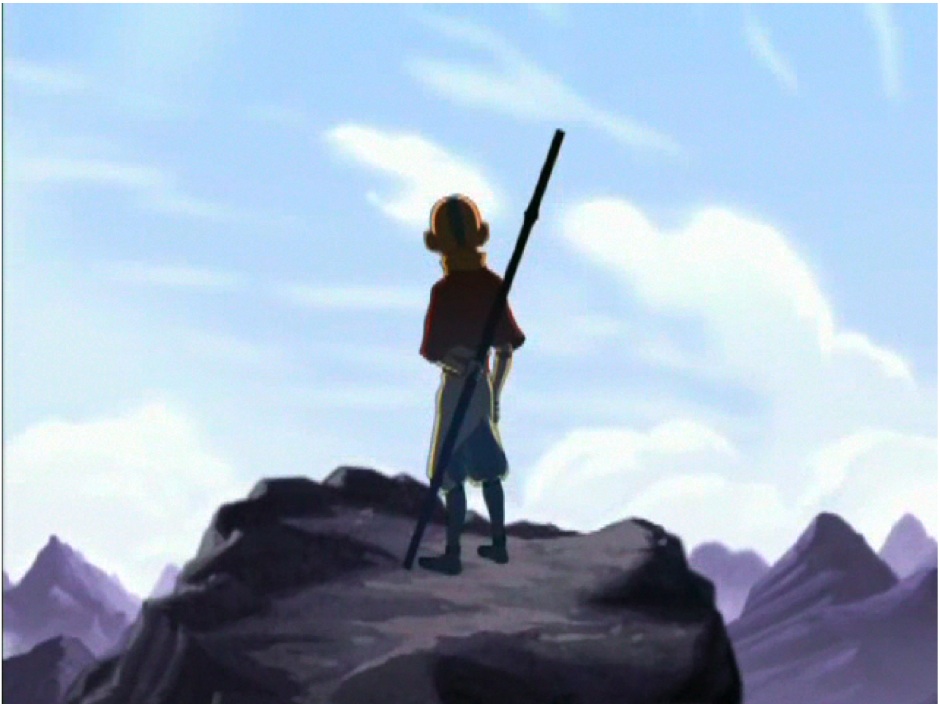
Avatar Aang, Back Turned. Screen Shot, Avatar: The Last Airbender

This shows how cynical the world that controls what we see and hear is. They think that the consuming public is so stupid, our kids so demanding, that they can serve us slop out of a garbage can with a fungus-covered plastic spoon, and then expect us to like it. It’s still a world in which our heroes and villains must look and act a certain way, our appreciation for anything not overtly American gets thrown out of a window, our need for the bombastic more important than our need for the authentic.

The real jaded-ness here, though, is that The Last Airbender wasn’t made with fans of the animated series in mind, the majority of whom are teenagers and adults. No, this movie was made for the five to ten-year-old set, the ones who may or may not have seen the Nicktoons replays of Avatar: The Last Airbender. But even the kids who have seen the series cannot appreciate the layers of complexity in the show, the richness of the characters, or the overall dialogue of the series. That’s what folks like Shyamalan are counting on.

My son was asking about The Last Airbender this morning, because he thinks that it’ll be like the animated series. Soon to be seven, Noah has a more thorough understanding of the series than most his age. But he doesn’t know how bad this movie is. If I’m pushed to or if he begs, I might take him, if only to show him how a good series can be turned into a horrible film. Then I’ll ask Shyamalan to give back his salary for making such schlock.

A Real Piece of Work

Tags

, , , , , , , , ,


Gabe Kaplan as Kotter (an image sub for my former boss)

“You’re a real piece of work,” my former boss Joe Carbone said to me one day, about this time twenty years ago. He smiled when he said it, though, which made me take the statement less seriously than I would’ve otherwise. It was my introduction to the politics of my new workplace for the summer of ’90.

For ten weeks between June and August ’90, I worked at the main office of Westchester County’s Department of Community Mental Health in White Plains. My immediate supervisor that summer was Joe Carbone, a highly-placed higher-up in the department. It turned out that he lived three blocks from me on East Lincoln in Mount Vernon, and that one of his kids graduated a year ahead of me at MVHS. Small world as usual. That gave us a little something in common.

When it came to work, though, I think our styles were a bit different. I worked as hard and as quickly as I could to finish the database-related projects he’d assign, then I worked as hard as I could to get to know the other staff and the other aspects of the office. And when that ran out, I’d work on getting ready for my senior year and my project on the resegregation that occurred in magnet schools in the ’80s. It was in that context that Carbone had called me “a real piece of work.” I guess I didn’t look like I was working that hard. Or maybe it was too obvious that I found my school research more interesting than my database work. Or maybe he just envied the way I used my time when I ran out of things to do (or things to make up to do, for that matter).

Whatever it was, I wasn’t the model worker, at least in the sense that I worried about my job, about pleasing my bosses more than the quality of my work, about making things merely look good. Carbone may well have been saying as much, constantly comparing me to some guy who worked for him in ’89 who was a junior at Yale. Like the Ivy League moniker alone was supposed to impress. If there had been one thing I learned in three years of college, that differential equations, primary resource grad-level research papers, and scholarly monographs looked about the same in the hands of a good Yale or Pitt student. I was glad to hear those comparisons go away after my first six weeks there.

Still, despite this “real piece of work” issue, Carbone remains the best supervisor I ever had. He made my tasks and duties clear, gave me room to work and make mistakes, introduced me to a wide variety of colleagues and work styles, and, if the mental health field had been my passion, would’ve been a great mentor for sure. He was my Kotter and I saw myself as his Horshack.

Yesterday also reminded me of the contrast between someone like Carbone in the workplace and the people I worked for when I was a manager in a social justice fellowship program in DC nine years ago. We had a meeting with our funder in New York in June ’01. Having met with funders before, I already knew the deal, and had explained that deal to the program assistant and associate in the days leading up to the meeting.

Napoleon's Mother (aka Ms. Wisdom). Source: Robert Lefevre, Letizia Ramolino, 1813

But apparently that wasn’t enough. My immediate supervisor and his all-wise supervisor’s supervisor and so-called mentor (henceforth known as Ms. Wisdom) had us meet twice to discuss this meeting and what each of us were to discuss, right down to the exact words we should use. They discussed protocol and etiquette, as if we were in nuclear disarmament talks with the former Soviet Union, China, North Korea, Iran and Israel all at the same time.

When I pointed out at the second meeting that these meetings were in fact redundant and panic-inducing — very politely, I might add — I got pulled into the superintendent’s office and accused of not taking the meeting up in New York seriously. Ms. Wisdom told me that I could quit at any time, and that she “would be around long after” I was gone. At least she was wrong about that prediction.

It made for a very stressful preparation for a meeting about the state of a program that had only been around for two years. Still, despite the lack of sleep, the micromanaging and threats, I felt ready, and I hoped that the other staff were ready as well. None of that

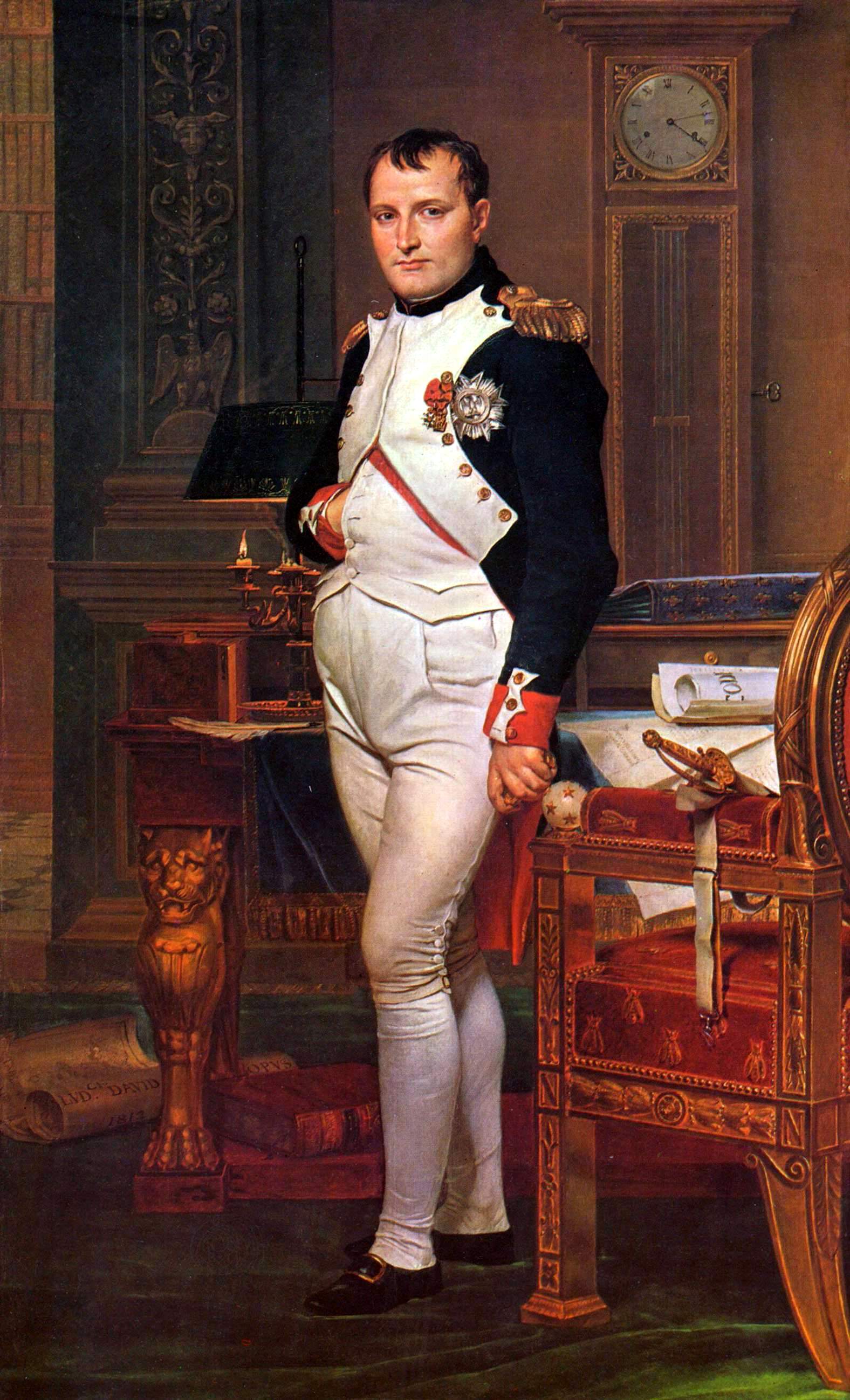
Napoleon I. Source: Jacques-Louis David, 1812

mattered, though, once the meeting in New York was underway. My immediate boss was so keyed up that he literally did all of the talking for our group of six. When I say all, I mean all except for two comments from me, one from Ms. Wisdom, and one from our program associate. By the end of the two hours, I thought that the man would’ve jumped on the conference table and done a jig for an additional $100,000.

My ex-boss was euphoric of course, even though the director at the time (now the executive director of the ACLU) specifically said that we “should consider looking for alternate sources of funding” for the program to ensure its viability after 2004. I thought then that he and Ms. Wisdom were real pieces of work. Even at the time, that reminded me of Joe Carbone, and gave me something to smile about. Maybe I’m a real piece of work, too. But at least I’m one in progress.

Great Northern Beans and Rice

Tags

, , , , , , , , , ,


Great Northern Beans (they never looked this good growing up)

I wrote this six years ago, but I realized this week that the thirtieth anniversary of my last bout of physical abuse at the hands of my now deceased stepfather was upcoming (which I didn’t include in Boy @ The Window). Wow! There are moments that I can’t believe I survived all that.

====================================================

It’s been twenty-eight years since I unwittingly carried a $10 bill halfway hanging out of my right hand for a hoodlum named “Pookie” to steal at Wilson Woods Pool in Mount Vernon, leading to so many evil things occurring in my life. But I’ve talked about this already. I’ve talked about my idiot ex-stepfather Maurice Washington and his equally idiotic attempt at making me a man in his own decrepit image. I’ve even talked about the domestic violence that I was exposed to first and second-hand by him. What I talk about now is a variation on a theme, and a story that won’t be in Boy @ The Window — it would disrupt the flow of the period of time in question.

It all started with the usual at 616. It was the end of January ’86, and we were short on money. It was the middle of the week, so it wasn’t as if I could track down my father Jimme for a couple of extra bucks. So my mother, out of a rare sense of desperation — since there wasn’t any food to eat at 616 — turned to my then stepfather for help. As par for the course since ’83, his response was to call me over. “Boy, go get some Great Northern Beans and rice,” he said. It was the eighth occasion in five years that he had paid for a meal for the family — which only happened to include four of his kids, and he chose the cheapest thing he could think of.

“That’s it? That’s all we get?,” I said in response to his wonderful act of generosity. “Boy, I feed my family,” the lipid-laden idiot said. Being an idiot myself for a moment, I said back, “All you’ve ever done is just buy a couple of meals!,” as I turned around to go to the store.

Maurice jumped me from behind, knocking me head-first into the kitchen wall, and just kept punching me. He got me twice in the mouth. I obliged by covering up and then biting down on his knuckles on the second mouth punch, which caused some cuts and bleeding. My mother walked in and got between us. For once, the dumb ass had nothing else to say. He was angry and breathing hard, as if he’d been in a three-rounder with Mike Tyson. I was stunned, but I stood my ground, with my fists balled up. After scowling at the fool for a few seconds, I left for the store.

The damage that this last incident of physical abuse caused is with me to

My front teeth, including slightly darker lower tooth (right/my left), two root canals later, May 14, 2012, (Donald Earl Collins).

My front teeth, including slightly darker lower tooth (right/my left), two root canals later, May 14, 2012, (Donald Earl Collins).

this day. My stepfather chipped my upper front tooth on my right in two places, and caused enough damage to one of my lower front teeth that I would eventually need a root canal done on it seven years later. So yeah,  I should’ve kept my mouth shut — literally — when it came to issues with my abuser.

On the other hand, given our unhealthy obesity times today, Great Northern beans and rice isn’t such a bad meal, right? For vegans, I’d imagine that this is a very good meal. But not when the person you despised most in your world when you were a teenager’s buying it, and buying it in a begrudging and miserly way.  Of course, now beans and rice are actually expensive and considered healthy food by the arugula-eating sector of our society. Go figure!

=====================================================

The kicker, though, came the Monday after this last incident. I’d completely forget that I was supposed to do an oral presentation in my 11th grade English class, first period. Completely. And this, I did write about in Boy @ The Window:

For Mrs. Warns’ class, we had a presentation assignment that I didn’t even remember existed. The first day of presentations came, and she designated me as the first presenter. I was caught completely off-guard. I didn’t have time to whip up something, so I did the only thing I could think of. I balled up a piece of paper like I normally did a few times a day, stood up and walked to the front of the classroom. I took a shot at the garbage can and missed like I usually did, this time deliberately, and proceeded to ramble for a couple of minutes about how to recover from mistakes when you make them or something. Mrs. Warns was so cross with me. “I’m very disappointed in you. You obviously didn’t prepare at all for your assignment,” she said in her Brooklyn accent. She gave me a D for my presentation, adding “and you should feel lucky to get that.

I found out later that our eventual salutatorian had gotten an extension for his presentation. I was more mad with myself than anything else, knowing unfair things had always been in my life to that point. Today, I could take the garbage can and put it upside my teacher’s head, take the balled-up paper and throw it at my former classmate, and find my ex-stepfather’s grave and piss on it. Of course, I’d have to have some Great Northern beans and rice first, so that I could give the obese idiot a good fart as well.

School’s Out — But Should It Be?

Tags

, , , , , , , ,


Source: Country Square Apts, Carrollton, TX

This week, my son Noah began his 10-week summer vacation from school in earnest. So far, he’s at his daycare, swimming three days a week, and bowling today. He’s not the only one. So many of my former students at the high school level have been celebrating their summer vacations from school. For some, Memorial Day weekend was the official beginning of summer. For others, particularly in New York, June 25 is the last day of school this year. Most are somewhere in between.

Great for all of them. They are young, they are students, they should be happy to not be stuck in the regimentation that is K-12 education for two and a half months. But the reality is, it shouldn’t be this way. Our American school year should be at least thirty days — or six to seven weeks longer (counting holidays) — than it is right now.

We complain about students coming back to their next school year having forgotten a good portion of what they learned the previous school year. Yet parents complain that a longer school year means higher income and property taxes and a disruption of summer vacations. Teachers and teachers unions refuse to budge on this issue, for they want higher pay (and rightly so) for teachers on a full twelve-month (as opposed to a nine or ten-month) contract and guaranteed time off. School boards can’t afford to do a 210-or-more-day school year. The costs of keeping open school facilities, school food programs, paying teachers and staff, are already hard enough to meet during the current school year format.

But that doesn’t mean that we shouldn’t try. We’re in the second decade of the twenty-first century, expecting to compete with the likes of Japan, China, India, Brazil, Russia — heck, Cuba, the EU, even Canada — with a system designed as we understand it today between 1890 and 1920. That’s just wrong. If anything, we should take a page from the modern university and two-year institution and stagger our K-12 school year into a quarter or fifths system, with two to three weeks off between each quarter or fifth. If we made the standard nine-week marking period ten weeks long — with at least two weeks off between each marking period — it would extend the standard school year from the end of August to the end of July, leaving a full month off for teachers and students alike. There would be no need for a summer marking period. But if you had one, as such, it could then only run two to three weeks.

For those who find that solution unsatisfactory, there is another solution. Keep the standard nine-week marking periods, but stagger the summer sessions. Half of the students and teachers will have the period between early June and mid-July off, and the other half, mid-July to the end of August off. That would provide the break necessary for recovery from the school year, provide sufficient time for families and teachers to take vacations, and would extend the teaching contracts of teachers an extra four to six weeks.

No matter what anyone proposes, there will be many who will fight to oppose the extension of the school year.  I don’t know too many people who need — or more importantly, can afford — a ten or twelve-week vacation with their kids. Teachers spend part of their summers in professional development anyway, so teaching a few more weeks wouldn’t diminish their teaching skills. And students — well, many students do extra work during the summer months anyway. Why not make that work standard? Oh well. Here I go again, swimming upstream!