• About Me
  • Other Writings
  • Interview Clips
  • All About Me: American Racism, American Narcissism, and the Conversation America Can’t Have
  • Video Clips
  • Boy @ The Window Pictures
  • Boy @ The Window Theme Music

Notes from a Boy @ The Window

~

Notes from a Boy @ The Window

Category Archives: Sports

The Student-Athlete System and the Exploitation Lens

01 Friday Apr 2016

Posted by decollins1969 in 1, Academia, culture, Eclectic, eclectic music, music, Politics, Pop Culture, race, Sports, Work, Youth

≈ Leave a comment

Tags

"I Got Plenty O' Nuttin'" (1935), Bob Stoops, College Athletes, Ed O'Bannon, Exploitation, Jim Boeheim, Justifications, Kirk Schulz, Mark Emmert, National Collegiate Athletic Association, NCAA, NCAA Division I Football, NCAA Division I Men's Basketball, O'Bannon v. NCAA (2015), Ocsar G. Johnston, Porgy & Bess, Real Sports (HBO), Rhetoric, Sharecropping, Slavery, Student-Athletes, The Business of Amateurs (2016), The Sporting News

NCAA logo, September 4, 2014. (Getty Images/SportingNews.com).

NCAA logo, September 4, 2014. (Getty Images/SportingNews.com).

In July, US District Judge Claudia Wilken gave final approval to a combined $60 million in settlements of former and current college athletes’ claims against the NCAA and EA Sports. The deal granted as many as 93,000 claims of up to $7,000 for the use of college athletes’ images and likenesses in video games between 2003 and 2014. The groundbreaking decision provides student-athletes payments for the fruits of their labor for the first time. But these combined settlements are separate from the O’Bannon v. NCAA case. This main lawsuit against the NCAA’s use of unpaid college athletes remains in limbo. The NCAA asked for and the courts granted a stay, delaying a process that would make every college athlete eligible for some compensation in exchange for universities using their labor.

Beyond the response that often compares the NCAA student-athlete labor system to slavery, few have discussed the ways in which the NCAA’s defenders construct their arguments for the status quo. In many ways, the NCAA system isn’t much different from sharecropping. It was an agricultural economic system mostly located in the American South that took advantage of impoverished Whites and Blacks between 1870 and 1980. Both provided meager benefits like room, board, and clothing at an exorbitant cost while reaping huge profits from its workers. One system kept sharecroppers deeply in debt while the other has kept college athletes from profiting off of their work. The carrot in sharecropping was access to land to grow cotton and other crops for a profit at the end of a harvest season, minus landownership and all the necessary tools, seeds, and other necessities for producing those crops. The incentive in the NCAA’s system has been a year-to-year scholarship to cover the cost of a four-year degree, with the remote possibility in a handful of sports to earn enough recognition to become a professional athlete. Minus, until last fall, coverage for books, clothing, food outside of sporting events and practices, and the hours necessary to take advantage of an athletic scholarship. Defenders of both systems fought tooth-and-nail to keep sharecroppers and college athletes from organizing themselves into unions.

Unlike in slavery, the majority of sharecroppers were White, although more than a third were African American. All entered into sharecropping under contract, though the poor economic conditions of the South after the Civil War and the terror of White supremacist groups left poor Whites and Blacks few options. Likewise, NCAA’s college athletes also sign contracts and waivers that left them with few options in pursuing their athletic craft or in completing a college degree a year earlier than the average college student. And at least three different ways, the people defending the NCAA’s student-athlete system match sharecropping’s defenders with the language of exploitation. Though neither system is slavery, both are still closely related forms of exploitation, with a brutality that provides few good options for those engaged in doing the actual work.

George Gershwin's Porgy & Bess, with "I Got Plenty O' Nuttin'" (1935), oft sung by Ella Fitzgerald and Louie Armstrong (among others), April 1, 2016. (cropped and combined).

George Gershwin’s Porgy & Bess, with “I Got Plenty O’ Nuttin'” (1935), oft sung by Ella Fitzgerald and Louie Armstrong (among others), April 1, 2016. (cropped and combined).

1. The circular reasoning argument. This one is where defenders use the very label of their system — whether “sharecroppers” or “student-athletes” — to justify the existence and need for their system. Historian Chris Myers Asch documented numerous examples of this in his 2008 book The Senator and the Sharecropper. Asch included in his book a 1936 interview with psychologist John Dollard, one in which Mississippi planter William Alexander Percy said, “To live among a people whom, because of their needs, one must in common decency protect and defend is a sore burden in a world where one’s own troubles are about all any life can shoulder” (p. 70). Especially since many elites like Edward Everett Davis — dean of North Texas Agricultural College (now University of Texas at Arlington) from 1925 to 1946 — saw sharecroppers as “the most serious rural problem in the South.” In his The White Scourge (1940), Davis wrote that sharecroppers were “those biologically impoverished tribes of marginal humanity — black, white, and Mexican — subsisting on cotton” (p. ix).

Compare this line of reasoning with NCAA President Mark Emmert’s on why universities should not pay college athletes. On the 2011 Frontline episode “Money and March Madness,” Emmert said, “fact is, they’re not employees, they’re student-athletes.” In another interview, for the upcoming documentary The Business of Amateurs (release date TBD), Emmert said, “there’s not even a salary to debate. They’re not employees, they’re students.” For Emmert and the portions of the public who support his stance, the label “student-athlete” by itself justifies not paying college athletes, just like the label “sharecropper” did for planters who frequently cheated their workers out of profits. The idea for both has been they are but children that institutions need to care for, albeit under contract.
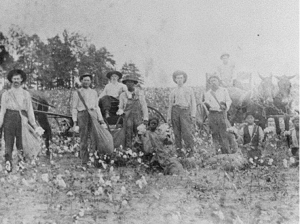
Black and White sharecroppers in Randolph County, Georgia, 1910. (Georgia Archives, Vanishing Georgia Collection)

Black and White sharecroppers in Randolph County, Georgia, 1910. (Georgia Archives, Vanishing Georgia Collection)

2. The low or no profit-margin argument. This has been a popular idea, to claim that despite the wealth generated under sharecropping, landowners made few, if any, profits. As shown by historian Lawrence J. Nelson in his 1999 book King Cotton’s Advocate, Oscar G. Johnston, head of the financial division of the Agricultural Adjustment Administration (a New Deal program), wrote in a 1937 memo, “any person familiar with the operation realizes that the sharecropper system is more favorable to the tenant than the cash wage system [paying hourly wages].” According to Johnston, any “criticisms” of sharecropping as an exploitative economic system came “from persons wholly ignorant of the system or the economic situation” (p. 88).

Syracuse University men’s basketball coach Jim Boeheim claimed that there are few to no profits in college athletics in his 2013 New York State Associated Press symposium speech. “I’m not against kids getting money. But the problem is, you give the 12 basketball players $150, now you gotta give the field hockey players. So now you’re talking 150 athletes. One-hundred fifty times $150 times eight. That’s a lot of money,” Boeheim said. In pleading for a stay in the O’Bannon case last year, the NCAA’s lawyers said that it and “many schools and students” would be “irreparably harmed” if the court allowed the injunction to go into effect. Yet the NCAA’s $11-billion contract with CBS and Turner Broadcasting for the NCAA Men’s Basketball Tournament and $500-million-per-year contract with ESPN for the college football playoffs contradicts the notion of irreparable harm.

3. The fringe-benefits argument. This is the assertion that a person’s status in this system produces material and intangible benefits, even despite the potential pitfalls and vulnerabilities. Asch wrote of another 1936 interview John Dollard conducted, in which one farmer said, “when times are bad he has to take care of the Negroes first, whether they make anything or not.” Another farmer said that sharecroppers only worked about three months out of the year, and used the rest of their time to “fish, fool around, attend revivals, and follow other trivial pursuits” (p. 71). Despite the evidence of poverty for the vast majority, planters consistently painted sharecroppers’ lives as ones with benefits than ones full of rampant exploitation.

Oklahoma football coach Bob Stoops' 17,000 square-foot home on lakefront property, Norman, OK, November 25, 2015. (http://sportshoop.la/).

Oklahoma football coach Bob Stoops’ 17,000 square-foot home on lakefront property, Norman, OK, November 25, 2015. (http://sportshoop.la/).

The common refrain in college athletics is likewise about benefits that outweigh injuries, long-term disabilities, the pressures of athletic and academic performance, and the loss of material benefits. University of Oklahoma head football coach Bob Stoops put it this way in a 2013 Sporting News interview: “I don’t see why people say these guys don’t get paid. It’s simple, they are paid quite often, quite a bit and quite handsomely.” They also “get room and board…the best nutritionist, the best strength coach to develop you, the best tutors to help you academically, and coaches to teach you and help you develop. How much do you think it would cost to hire a personal trainer and tutor for four to five years?,” Stoops said. The athletic scholarship, a non-guaranteed, year-by-year deal, is the only fringe benefit that matters in the case of college athletes.

Like Oscar Johnston’s defense of the sharecropping system in the 1930s, the NCAA’s defense fits the pattern of “it’s a terrible system, but it could be much worse.” During his Real Sports conversation last March, Kansas State University president and NCAA Board of Governors member Kirk Schulz said, “Well, a scholarship at Kansas State, a four-year scholarship, is about $180,000, and our average debt load of all of our students is about $26, $27,000.”

—————————————–

Apparently, the system is fair precisely because naked exploitation is better than the illusion of choices given to the typical college student. These arguments in support of student-athlete system dovetail almost perfectly with the arguments that supported sharecropping as a necessary evil in the 1930s. The justifications are paternalistic and elitist, with a mix of class and racial imagery to boot. To the point where any NCAA executive, college or university coach or athletic director, university president or journalist in support of not paying these athletes should be beyond embarrassed.


The Fountain of Middle Age

27 Sunday Dec 2015

Posted by decollins1969 in 1, Boy @ The Window, Christianity, culture, Eclectic, Mount Vernon New York, Movies, New York City, Pittsburgh, Politics, Pop Culture, race, Religion, Sports, Youth

≈ Leave a comment

Tags

616, 616 East Lincoln Avenue, Aging, Back To School (1986), Beauty, Demographics, Family, Fountain of Middle Age, Fountains, Friends, Health, Philadelphia, Rodney Dangerfield, Self-Reflection, Youth


Alexander Stirling Calder's "Swann Memorial Fountain," Benjamin Franklin Parkway, Philadelphia, PA, August 18, 2012. (Donald Earl Collins).

Alexander Stirling Calder’s “Swann Memorial Fountain,” Benjamin Franklin Parkway, Philadelphia, PA, August 18, 2012. (Donald Earl Collins).

By most measures, today marks my full transition from relative youth to middle age. Although, when I really think about it, didn’t I really hit middle age in December ’07, when I turned thirty-eight? The average life expectancy of an American male is about seventy-seven, right? And for Black males, it’s barely sixty-five. Given my family history, though, I won’t hit middle age for another two years. My maternal grandfather turned ninety-six three months ago, and my paternal grandfather lived until he was ninety-six. Even my father’s still moving along at seventy-five, despite his battle with alcoholism between the ages of twenty and fifty-eight.

I do feel things in my body and mind that until a few years ago were merely minor aches and pains. My right hip is misaligned with my left hip, likely from years of walking at warp speed, lots of basketball, and six years of my running regime. My L-5 vertebrae is a bit compressed, due to years of activity, including many years hunched over a keyboard trying to make myself into a writer, author and educator. My right knee has been a bother since I was twenty-four, but the issue has gotten worse in the past two years (maybe time for some HGH or microfracture surgery?). I now have white-coat syndrome (because most doctors and nurses get on my last nerve), and I’m mildly anemic. No, folks, forty-six isn’t the new thirty-six, even if I can still run forty yards in under five seconds, pop a three over my son’s outstretched hand or leg press 360 pounds.

Me via Photo Booth, December 17, 2015. (Donald Earl Collins).

Me via Photo Booth, December 17, 2015. (Donald Earl Collins).

But I still have good health and a mostly healthy body and mind. Since I turned twenty-seven, my weight has never been higher than 241 pounds (including clothes, wallet, phone, and keys) or lower than 212 (I weight 229 now). I can still memorize when inspired to do so, remember virtually anything important from my life from the age of four to the present, and could still probably win at Jeopardy if I ever got the call.

What’s more impressive, though, is whom remains in my life now that I’m no longer “young” anymore. My friends live all over the map, from the DC area to Pittsburgh to the Bay Area and New York, from Atlanta to Athens and from Seattle to Shanghai. I’ve made peace (mostly) with my family and my past, even if they aren’t always at peace with me. There’s my wife and son, of course, who are mostly likely the reason I’m still “young” relative to my age. Though I remain a Christian, I do not have the blind faith or evangelical -isms of my youth, and I’m at peace with that as well. I’m probably further to the left culturally and politically than I was at sixteen, twenty-six, or thirty-six. Because I’ve learned, sadly, that so much of what I was taught or fed growing up was either incorrect or a complete lie. But even with that sad disillusionment, I’ve come to accept the possibility of change for myself and the Sisyphean task that this nation and world always has been.

Me at 45 and 364.25 days, Pittsburgh, PA, December 26, 2015. (Donald Earl Collins).

Yet even the idea of middle age has changed in the minds of capitalists as the Baby Boomer generation has begun retirement and all of them have received their first AARP cards. Before 2000, the ad folks and entertainment folks had split up adults into the age demographics of 18-34, 35-44, 45-64, and 65 and up. Now, it’s 18-24, 25-54, and 55 and up. This privileges Baby Boomers (as usual) and props up Millennials (folks who used to be Gen Y). My middle age is not the same as Baby Boomers’ middle age. Even in demographic representations, money-grubbing capitalists give us Gen Xers little respect.

Rodney Dangerfield quipped this funny line in Back to School (1986):

Coach Turnbull: What’s a guy your age doing here with these kids?
Thornton (played by Dangerfield): I’m lookin’ for the fountain of middle age.

Maybe when I’m sixty-five (like Rodney Dangerfield was in this film), I’ll be looking for the Fountain of Middle Age, too. But my choice will be to stand in it for the next thirty or forty years!

Joe Theismann’s Leg and the Day I Learned ESPN Existed

18 Wednesday Nov 2015

Posted by decollins1969 in 1, Boy @ The Window, culture, Eclectic, Mount Vernon New York, New York City, Pop Culture, Sports, Youth

≈ Leave a comment

Tags

ABC, Broken Leg, Careers, ESPN, Football, Joe Theismann, Lawrence Taylor, Monday Night Football, New York Daily News, New York Giants, Sportscenter, Washington Redskins


Back cover of New York Daily News, November 19, 1985. (http://nydailynews.com/).

Back cover of New York Daily News, November 19, 1985. (http://nydailynews.com/).

In a really early draft of Boy @ The Window, I wrote the following about my ’85 New York Giants:

My football Giants had a chance to win the NFC East. But on a night in mid-November, after LT ran over Redskins’ quarterback Joe Theismann’s leg, which made a popping noise for all the world to hear on Monday Night Football, their season slowly slid south.

That was thirty years ago on this date. My Giants finished 10-6 that year, but had lost the division to the Cowboys, and would later get shutout by the Bears in a frosty cold day at Soldier Field that January. Thank you, Sean Landeta!

But the main story on November 18, 1985 was the ending of Joe Theismann’s roller-coaster career. Until this morning, I hadn’t seen Lawrence Taylor’s knee drive through Theismann’s right leg while twisting the rest of him around in at least twenty years. It somehow looked more gruesome today than it did to me in ’85. Maybe that’s because of tendonitis in my right knee or the hairline fracture I had in my left fibula on MLK Day ’10 while playing pickup basketball. Or probably because my life was much more painful in ’85 living in Mount Vernon, New York than it is now. One sympathizes. Taylor-to-Theismann proved the much-used cliche, “We’re all just one play away.”

We still lost the game, to Jay Schroeder no less, 23-21. The biggest story coming out of the game, though was Theismann’s crushed right leg. Over and over again, starting with ABC and Monday Night Football, they showed the play that ended Theismann’s career. And with each showing, I got to hear the pop that went with Theismann’s compound break.

By the next afternoon, I learned that this station called ESPN was showing highlights of my Giants loss. They, too, played the replay of Theismann’s demise over and over and over again. We had the sports channel as part of our cable package, so I watched. After years of watching stations with W’s as part of their name, I couldn’t understand why this one was called ESPN. By the time I’d hit bedtime that Tuesday evening, I’d seen and heard Theismann’s leg break nearly a hundred times. My love/hate affair with ESPN and SportsCenter had begun, thanks in part to the end of Theismann’s professional playing days.

Theismann waited a bit more than twenty years to look at the replay of the last moments of his NFL career. Good thing he did. He probably would’ve gone into shock after seeing his leg break 10,000 times in the course of a week.

This Is NOT Sparta!

11 Wednesday Nov 2015

Posted by decollins1969 in 1, culture, Eclectic, Movies, Patriotism, Politics, Pop Culture, race, Religion, Sports

≈ Leave a comment

Tags

Black Americans, Black Migration, Blind Patriotism, Civil Rights Movement, Civilians, Erasure, Freedom, History Lessons, Honoring, Hyper-Patriotism, Invisibility, Jim Crow, Meaning, Native Americans, Patriotism for Profit, Sacrifice, Service, Slavery, Veterans Day


"If you live in a free country, thank a veteran" poster slogan, November 10, 2015. (http://facebook.com).

“If you live in a free country, thank a veteran” poster slogan, November 10, 2015. (http://facebook.com).

Just like with Memorial Day and with Independence Day, I often find myself conflicted about Veterans Day. Not because I think individual members of the military deserve praise or scorn. As usual, the vast majority of Americans think too simplistically about their country, its people, its intentions and history, even its holidays. Too many of us go along to get along. It’s as if we expect the contradictions and tensions that make up our times and days like today to simply melt away in some high-pitched display of blind patriotism. I have not — and likely will never be — that American, pumped up with pride and affection, shouting slogans as gospel truth, thanking every member of the military for every single breath of American air that I breathe. And that is because the narrative for days like today has never worked for me.

In some respects, the blind march of Veterans Day is with Americans every single day. The media covers the military and individual military members as if all of them have spent weeks on the front lines, as if all of them are patriots above reproach. Almost all of us have known someone who’s served, and we know that service for most was never as simple as wrapping the American flag around themselves in defense of American freedoms halfway around the world (or at a base a few miles from home). In recent months, we’ve learned that much of the constant drumbeat of military-fueled patriotism the military itself has bought and paid for, at NFL and college football and baseball games. Reinforcing one of America’s main values — profit.

Army National Guardsmen about to run on field with American flags with the New England Patriots, Super Bowl XLIX, University of Phoenix Stadium, Glendale, AZ, February 1, 2015. (http://latimes.com; Getty Images).

Army National Guardsmen about to run on field with American flags with the New England Patriots, Super Bowl XLIX, University of Phoenix Stadium, Glendale, AZ, February 1, 2015. (http://latimes.com; Getty Images).

Today is Veterans Day, created seventy-seven years ago in the aftermath of the Great War, the “War to End All Wars,” World War I. It was a terrible war, after all. Ten million soldiers and sailors on all sides died, twenty million found themselves ripped and torn apart, and eight million civilians died. But not for or in the US, where 120,000 soldiers and sailors died, a few hundred thousand were wounded, and few hundred civilians died. The US didn’t enter the war until April 1917, nearly three years into the raging Eurasian conflict. American weapons manufacturers and merchants profited greatly from the war even before the US declared war on Germany, selling arms and food to both sides.

War is never simple. Neither should be what we think of those who served or are serving. Veterans Day is about respecting those who have served or are serving. Like my youngest brother Eri, or my Uncle Felton, or my sister-in-law or my late uncle-in-laws. Thanking or respecting them, though, shouldn’t be tied directly to the idea that I “live in a free country.” I don’t believe that the US is a free country, not for me and for millions of others like me. Nor do I believe that the US military has played a role in preserving my individual freedoms and liberties historically. I am a Black man living in a society built in part on systemic racism, often maintained or reinforced by the US military. Except for some elements of the Union Army during the Civil War, the US military has played a very small role in making sure that I or anyone who looks like me — male, female or transgender — lives in a free country.

Not to mention, the US hasn’t been invaded in over 200 years (I don’t want to hear about Pancho Villa — that wasn’t an invasion). Since when does fighting North Koreans, the Viet Cong, or even Nazis equate to me and others and our “freedoms?” Seriously, every time someone says this, it’s as if you’re attempting to erase long civilian fights for civil rights, for the most basic of freedoms that the US purports to grant to every citizen. Folks who say that we should be grateful to the military for living in a free country completely make invisible Native Americans. The US military was what guaranteed their near annihilation, deculturalization and unyielding poverty, especially from 1865 on.

"This is madness!" with actor Peter Mensah, screen shot from 300 (2007), November 11, 2015. (http://youtube.com).

“This is madness!” with actor Peter Mensah, screen shot from 300 (2007), November 11, 2015. (http://youtube.com).

Yes, some of you will note that I can write my post without fear of retribution from the government. Then I will say in response, “How does serving overseas guarantee my rights?” It doesn’t. A lot went into putting me in a better position in my life. Black migration, the Civil Rights Movement (flaws and all), the sacrifices of Black and White civilian leadership (including their deaths). I am one generation removed from sharecropping and tenant farming in Georgia and Arkansas, one generation removed from the last years of the Jim Crow era. But somehow, the US military is responsible for me living “in a free country.” Sorry, but that’s a narrative I cannot get behind.

So, we should all thank individual veterans for their service. We should honor the dead and the broken among them. For whether they came to serve out of a deep sense of patriotism, because of the draft (prior to 1973), because there weren’t any jobs in their communities, or because they wanted a chance at today’s version of the GI bill, some of them have paid dearly in their service. But since we do not live in a military junta or in a totalitarian society, I dare say that I don’t have to go along with the narrative that without the military, I would be a slave. History contradicts every aspect of this false narrative.

This isn’t Sparta (Sparta wasn’t even Sparta). Nor should the US ever be Sparta.

“Glory Days”

25 Sunday Oct 2015

Posted by decollins1969 in 1, Boy @ The Window, culture, Eclectic, eclectic music, Jimme, Mount Vernon High School, Mount Vernon New York, music, My Father, New York City, Pop Culture, race, Sports, Youth

≈ Leave a comment

Tags

"Glory Days" (1985), Baseball, Baseball Glove, Bruce Springsteen, Darryl Strawberry, Double Play, Dwight Gooden, John Tudor, Lenny Dykstra, Merit, Meritocracy, Modell's Sporting Goods, MVHS, Myths, Naivete, New York Mets, Single-Minded, St. Louis Cardinals, Talent, Varsity Baseball


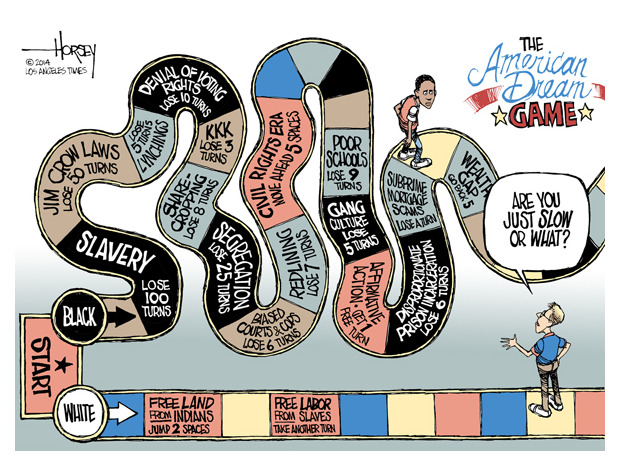
There are times I wish I could have back the tunnel-vision naiveté I had to have during my Boy @ The Window years. The kind of naiveté in which I believed I could literally do anything, with hard work and talent alone. You know, that great old American myth of a level playing field, a meritocracy. It took me years to give this myth of an ideal up, despite the evidence of the lie all around me.

The American Dream Game cartoon, January 21, 2014. (David Horsey/LA Times).

The American Dream Game cartoon, January 21, 2014. (David Horsey/LA Times).

Three decades ago, I believed in it. I had to. If I hadn’t, I would likely not be here to say anything about merit or any other American falsehood or truth. Where my belief in the meritocracy was strongest was in sports, where literal examples of the level playing field abounded. I was coming off a year of watching my Mets win 98 games while missing the playoffs by three games, yielding the NL East to the St. Louis Cardinals. It was really one game during the next-to-last series of the year, against the Cardinals in St. Louis. Dwight Gooden won a pitcher’s duel against John Tudor while Darryl Strawberry and Lenny Dykstra hit timely or game-winning home runs in the first two games. But we couldn’t win that final game. As unfair as it seemed, the Mets had given me a great season.

So great that it inspired me to try out for baseball that year, out of all the sports I could’ve played. It had become my favorite sport, and knowing I had more of acumen for football and basketball didn’t distract me from my master plan. But first, I needed to learn how to play baseball.

My year slipped a bit in October and November as football and baseball provided distraction, which was why I had to refocus in early December. And not just because I spent my time watching TV. Richard P. — for me an almost unknown person — had invited me to practice with the varsity baseball team. He might’ve been in my gym class or friends with Suzanne. Richard P. was a senior and a star pitcher who’d been clocked throwing a ninety-mile-an-hour fastball — absolutely awesome! Of course I said “Yes” without thinking about my reality at home. I never owned a baseball glove, never played on any Little League team, and had only used a baseball bat during softball and gym class three times between seventh and eleventh grade. I had Jimme take us to Modell’s Sporting Goods store in the city and bought a $55 outfielder’s glove.

I still needed to break it in, which would be even harder with the crooked ring and pinky fingers on my left hand. With Richard P. and the other members of the baseball team, some of the breaking-in happened pretty quickly. I went to three of their practices in October and saw the difference that the years of athletic experience I didn’t have made in the case of the varsity players. Frank dived for a ball at his shortstop position on our indoor Astroturf practice field, caught it, got up, and gunned the ball to first base. His right arm had two purple rug burn marks on it. “There’s no way I’d ever want to dive for a ball like that,” I thought. The next thing I knew I was out there with the team taking grounders at shortstop and catching balls at first base. We were practicing double-plays. One grounder came up on me faster than I expected. I got down for the ball, got it in my glove, but then it popped out as I rose up to throw it to second. The ball popped out and went right to Frank at second, who then threw to first, a real double-play. I got cheered and jeered at the same time!

My first-base experience was less memorable. I caught several Richard P. throws to first in holding-the-runner simulations. Every time I caught one of his balls I wanted to scream from the pain. I needed to get calluses on my left hand fast if I was going to hang with these guys!

1980s-era Mets cap, October 25, 2015. (http://academy.com).

1980s-era Mets cap, October 25, 2015. (http://academy.com).

If given another year, with lots of practice, I probably could’ve made this baseball team. But to what end? I already had a plan for going to college, on the academic track, after all. “So what if the baseball team was stacked with Italian guys and I was better at basketball? I should be able to play what I want to play.” That’s what I thought at the time, at least.

Merit, even in sports, is never the only consideration. Egos, politics, the expense of playing a specific sport, and of course, race, all play a role in the paths that athletes take and in the decision-making of coaches as well. I was just too naive, too focused on one thing, too stupid at fifteen to allow myself to see that my raw talent was never going to be enough. Five months after that last practice, though, I did see the truth, if only for a moment or two.


Aside

Brotherly Love

12 Wednesday Aug 2015

Posted by decollins1969 in 1, Boy @ The Window, culture, Eclectic, High Rise Buildings, Jimme, Mount Vernon High School, Mount Vernon New York, My Father, New York City, Pop Culture, race, Sports, Youth

≈ Leave a comment

Tags

Bronxville, Brother-Brother Relationship, Chester Heights, Competition, Darren, Eastchester, Internalized Racism, Jealousy, Jump Shot, Lessons, Mental Disability, Mental Retardation, Self-Discovery, Self-Loathing, Shyness, Sibling Relationship, Sibling Rivalry, The Clear View School


Not quite the courts at Chester Heights (aka, Bronxville/Mount Vernon border), but more or less what would've looked like 30 years ago, Eastchester Playground, Capitol Projects, Bronx, NY, August 11, 2015. (http://www.nycgovparks.org/).

Not quite the courts at Chester Heights (aka, Bronxville/Mount Vernon border), but more or less what they would’ve looked like 30 years ago, Eastchester Playground, Capitol Projects, Bronx, NY, August 11, 2015. (http://www.nycgovparks.org/).

This is a Boy @ The Window story, one that occurred a little more than thirty years ago, and so typical of my experiences growing up with my older brother Darren. Nothing I ever did to help my older brother seemed to help him overcome the trap of going to The Clear View School, a school for the mild to severely mentally retarded (of course, we say mentally disabled in 2015), although Darren was never such. He, in fact, had taught himself to read at the age of three, and taught me to read on my fifth birthday. Darren’s issue was severe shyness, and between my Mom, my father Jimme, and the good White liberals and moderates at The Clear View School, the trap for Darren’s potential genius had been set by the summer of ’74. By the time I was aware enough to say anything about Darren’s predicament, it was already too late.

But say and try I did anyway. Everything from sharing music to talking to Darren about our futures and my escape-Mount-Vernon-for-college plans. I shared books, and tutored him through algebra and geometry and US history.

I even tried playing sports with Darren, including basketball, which in the summer of ’85 was only my third favorite sport. As I wrote in the memoir

“Darren played at the center spot on Clear View’s basketball team, which made sense since he was already between six-three and six-four at seventeen. Of course they crushed every team they played. It was truly unfair. Darren towered over his classmates and his opponents, and being the only non-mentally retarded person on the floor, he could run rings around folks.

Still, Darren could knock down any jump shot within thirty feet of the hoop. His shot was smooth, like Isiah Thomas’ or Bernard King’s. It was the kind of shot no one on MVHS’ basketball team had at the time. Knowing this, I wanted to — no, I had to play my brother to see this shot up close. There were two well-maintained courts near 616, one in Pelham near its main street of Fifth Avenue, the other a longer walk in Chester Heights. We chose Chester Heights for most of these battles. Their court felt like a good outside court should, surrounded by trees, with level, quality-painted asphalt, and bright-white mesh nets.

The first few times we played that summer, Darren just killed me. Every time I left him open for a jumper, he buried it. It was obvious I hadn’t touched a basketball other than in gym class since I was ten. I didn’t have a jump shot, had never worked on my footwork, and could dribble only moderately well with my right hand. Forget about using my left hand! I was so afraid of hurting my two crooked fingers that the left hand’s role for me was to block shots, not to catch passes or take shots.

"Nothing but net" (in context of UPS/NCAA March Madness cross-promotional ad), March 2012. (http://compass.ups.com/).

“Nothing but net” (in context of UPS/NCAA March Madness cross-promotional ad), March 2012. (http://compass.ups.com/).

My semi-buried competitive nature got the better of me. I knew I couldn’t beat Darren in a shootout. But I knew I was quicker than my taller brother. So I decided after another embarrassing performance (I lost 23-2!) that it would be easier to play defense and try to steal a few balls to keep the next game close. Amazingly, the plan worked! It worked so well that I took Darren completely out of his game. After three blocked shots and a couple of steals, I discovered that Darren couldn’t play me one-on-one if I drove hard for the hoop, that I could beat him with my first step. So every time I got the ball I attacked the rim. The last two games we played I won by a combined score of 50-18. I started feeling bad when Darren started forcing long jumpers. After a while, he just gave up. I wanted to win, but I wanted it to be competitive, too.

Darren was so upset that we didn’t talk on our way back to 616. He then walked to the back of our apartment building and threw his basketball down the garbage chute. I wanted to continue to play because I thought it would make both of us better and give us something positive to build on in our relationship. Instead it just made Darren mad and made it even harder for me to talk to him about what was going on at 616.

Standard New York-area garbage chute door, June 2009. (http://theferrisfiles.com/).

Standard New York-area garbage chute door, June 2009. (http://theferrisfiles.com/).

I really did feel awful about how Darren felt after the game. I had shattered confidence in one of the few areas in his life in which he had any. I had humbled a star basketball player at his own game, a game I’d yet to learn. I’d given my older brother yet another reason to be jealous of me. It was shocking to watch him throw the basketball away. I really didn’t know what to say. “I’m sorry, Darren, for beating you two straight games, for making you look bad at your favorite sport?” I guess I could’ve said that. What fifteen-year-old with as much on my plate as me would, though, especially in an environment as competitive as ours when it came to basketball? It made me pity Darren for his situation at Clear View, but also left me angry with him. I was trying to help him, after all, not break his spirit. The incident left me shaking my head.”

I didn’t play basketball with Darren again until the spring of ’97, during my Teachers College interview/PhD graduation week. By that time, Darren’s jealousy and stubbornness had pretty much forced me to give up on my reclamation efforts. But, when left open, Darren could still nail a twenty-four-footer with ease.

Aside

Ode to Tiger Woods

17 Friday Jul 2015

Posted by decollins1969 in 1, culture, Eclectic, eclectic music, My Father, Politics, Pop Culture, race, Sports, Youth

≈ Leave a comment

Tags

"Hangin' On A String" (1985), "Stuck In A Moment You Can't Get Out Of" (2000), Billy Idol, Faded Glory, Golf, Grace Jones, Loose Ends, Odes, PGA, The Open Championship, Tiger Woods, U2


Gray Tiger Woods "TW" cap 2014, July 17, 2015. (http://ebay.com).

Gray Nike Tiger Woods “TW” cap 2014, July 17, 2015. (http://ebay.com).

Okay. So my wife calls me “the last true Tiger Woods fan” in her tweets about me watching Tiger struggle mightily to find his authentic swing and rhythm again, a process that supposedly was over in 2013 (when Tiger won five tournaments). But since the calendar flipped to 2014, Tiger may well be angrily muttering to himself, “Where have you f**ing gone, Eldrick ‘Tiger’ Woods?” All as he spends yet another week looking for balls in bunkers and hazards, hooking and slicing driver and 3-wood like he’s working on differential mathematics for NASA’s next deep space probe.

The loop water near the 1st green at St. Andrews' Old Course, (where Tiger put his second shot of his 1st round), Scotland, UK, July 16, 2015. (http://golfdigest.com).

The loop water near the 1st green at St. Andrews’ Old Course, (where Tiger put his second shot of his 1st round), Scotland, UK, July 17, 2015. (http://golfdigest.com).

For years I have thoroughly enjoyed watching Tiger’s dominance in a sport dominated by Whites and Whiteness. I have used and sang stock phrases and songs whenever Tiger’s competitors (e.g., Phil Mickelson, Luke Donald, Bubba Watson, Sergio Garcia, ad infinitum) have found the drink, deep grass, impassable fescue, and have gotten the yips with two-and-a-half-foot putts to tie or take the lead at a major. Watching Tiger play like he’s fifteen years older and ready for the Champions Tour right now is like, well, watching any other professional golfer play.

I’m sure Tiger will find his swing and rhythm — eventually. I’m sure, though, that I’ll only see flashes of dominance even when he does. In the meantime, like every other golfer, Tiger gets the silly golfer treatments I’ve been giving to everyone else since 1989. Today’s cut day at The Open Championship, and Tiger’s got me “hangin’ on the cut line” (thanks, Loose Ends, for lending me your song in my thoughts) — “like waitin’ on the bus, I’m waitin’ on you.”

But that’s not all for musical silliness and golf. Here’s some other smash hits Tiger has become well acquainted with in the past five years:

Sade — “You gave me the hook and slice/Hook and slice” (really, “Kiss of Life”)

Pat Benatar — “Par is for Children” (in your case, exactly like “Hell is for Children”)

Billy Idol — “Bogey, bogey, double bogey, triple bogey…” (derivative of “Mony Mony,” but not the 1968 Tommy James and the Shondells’ version)

Grace Jones — “Pull up to the bunker, baby/with driver in between, ooh, ooh” (yeah, I went there)

U2 — “I still haven’t found (a good golf swing)” (self-explanatory)

The Supremes — “Ooh baby, baby, where is my ‘A-game’?” (self-explanatory)

Thompson Twins — “Driver! Driver!/Can’t you see I’m hurting, hurting…”

That’s the extent to which I’m willing to call Tiger “just another guy” (in reference to Isiah Thomas’ ill-conceived comments on Larry Bird in 1987). Because I’m still a fan after all. Seriously. I think that U2’s “Stuck In A Moment You Can’t Get Out Of” is most appropriate for breaking out of a slump, and not wallowing in one (I should know — I’ve faced a few slumps of my own). The last six lines are most appropriate:

And if the night runs over
And if the day won’t last
And if your way should falter
Along this stony pass

It’s just a moment
This time will pass


← Older posts
Newer posts →

Boy @ The Window: A Memoir

Boy @ The Window: A Memoir

Places to Buy/Download Boy @ The Window

There's a few ways in which you can read excerpts of, borrow and/or purchase and download Boy @ The Window. There's the trade paperback edition of Boy @ The Window, available for purchase via Amazon.com at http://www.amazon.com/Boy-Window-Donald-Earl-Collins/dp/0989256138/

There's also a Kindle edition on Amazon.com. The enhanced edition can be read only with Kindle Fire, an iPad or a full-color tablet. The links to the enhanced edition through Apple's iBookstore and the Barnes & Noble NOOK edition are below. The link to the Amazon Kindle version is also immediately below:

scr2555-proj697-a-kindle-logo-rgb-lg

Boy @ The Window on Amazon.com: http://www.amazon.com/Boy-The-Window-Memoir-ebook/dp/B00CD95FBU/

iBookstore-logo-300x100

Boy @ The Window on Apple's iBookstore: https://itunes.apple.com/us/book/boy-the-window/id643768275?ls=1

Barnes & Noble (bn.com) logo, June 26, 2013. (http://www.logotypes101.com).

Boy @ The Window on Barnes & Noble: http://www.barnesandnoble.com/w/boy-the-window-donald-earl-collins/1115182183?ean=2940016741567

You can also add, read and review Boy @ The Window on Goodreads.com. Just click on the button below:

Boy @ The Window

Twitter Updates

Tweets by decollins1969
  • RSS - Posts
  • RSS - Comments

Archives

  • June 2025
  • April 2023
  • September 2022
  • August 2022
  • July 2022
  • June 2022
  • May 2022
  • April 2022
  • March 2022
  • January 2022
  • December 2021
  • November 2021
  • October 2021
  • September 2021
  • August 2021
  • July 2021
  • June 2021
  • April 2021
  • March 2021
  • February 2021
  • January 2021
  • December 2020
  • November 2020
  • October 2020
  • September 2020
  • August 2020
  • July 2020
  • May 2020
  • April 2020
  • March 2020
  • January 2020
  • December 2019
  • November 2019
  • August 2019
  • July 2019
  • June 2019
  • May 2019
  • April 2019
  • March 2019
  • February 2019
  • January 2019
  • December 2018
  • November 2018
  • October 2018
  • September 2018
  • August 2018
  • July 2018
  • June 2018
  • May 2018
  • March 2018
  • February 2018
  • January 2018
  • December 2017
  • November 2017
  • October 2017
  • September 2017
  • August 2017
  • July 2017
  • June 2017
  • May 2017
  • April 2017
  • March 2017
  • February 2017
  • January 2017
  • December 2016
  • November 2016
  • October 2016
  • September 2016
  • August 2016
  • July 2016
  • June 2016
  • May 2016
  • April 2016
  • March 2016
  • February 2016
  • January 2016
  • December 2015
  • November 2015
  • October 2015
  • September 2015
  • August 2015
  • July 2015
  • June 2015
  • May 2015
  • April 2015
  • March 2015
  • February 2015
  • January 2015
  • December 2014
  • November 2014
  • October 2014
  • September 2014
  • August 2014
  • July 2014
  • June 2014
  • May 2014
  • April 2014
  • March 2014
  • February 2014
  • January 2014
  • December 2013
  • November 2013
  • October 2013
  • September 2013
  • August 2013
  • July 2013
  • June 2013
  • May 2013
  • April 2013
  • March 2013
  • February 2013
  • January 2013
  • December 2012
  • November 2012
  • October 2012
  • September 2012
  • August 2012
  • July 2012
  • June 2012
  • May 2012
  • April 2012
  • March 2012
  • February 2012
  • January 2012
  • December 2011
  • November 2011
  • October 2011
  • September 2011
  • August 2011
  • July 2011
  • June 2011
  • May 2011
  • April 2011
  • March 2011
  • February 2011
  • January 2011
  • December 2010
  • November 2010
  • October 2010
  • September 2010
  • August 2010
  • July 2010
  • June 2010
  • May 2010
  • April 2010
  • March 2010
  • February 2010
  • January 2010
  • December 2009
  • November 2009
  • October 2009
  • September 2009
  • August 2009
  • July 2009
  • June 2009
  • May 2009
  • April 2009
  • March 2009
  • February 2009
  • January 2009
  • December 2008
  • November 2008
  • October 2008
  • September 2008
  • August 2008
  • July 2008
  • June 2008
  • May 2008
  • April 2008
  • March 2008
  • February 2008
  • January 2008
  • December 2007
  • November 2007
  • October 2007
  • September 2007
  • August 2007
  • July 2007
  • June 2007

Recent Comments

MaryPena's avatarMaryPena on My Day of Atonement/Bitter Hat…
decollins1969's avatardecollins1969 on No Good Teaching Deed Goes…
Mary Rose O’Connell's avatarMary Rose O’Connell on No Good Teaching Deed Goes…

NetworkedBlogs on Facebook

NetworkedBlogs
Blog:
Notes From a Boy @ The Window
Topics:
My Life, Culture & Education, Politics & Goofyness
 
Follow my blog

616 616 East Lincoln Avenue A.B. Davis Middle School Abuse Academia Academy for Educational Development AED Afrocentricity American Narcissism Authenticity Bigotry Blackness Boy @ The Window Carnegie Mellon University Child Abuse Class of 1987 CMU Coping Strategies Crush #1 Crush #2 Death Disillusionment Diversity Domestic Violence Economic Inequality Education Family Friendship Friendships Graduate School Hebrew-Israelites High-Stakes Testing Higher Education History Homelessness Humanities Humanities Program Hypocrisy Internalized Racism Jealousy Joe Trotter Joe William Trotter Jr. K-12 Education Love Manhood Maurice Eugene Washington Maurice Washington Misogyny Mother-Son Relationship Mount Vernon High School Mount Vernon New York Mount Vernon public schools Multiculturalism MVHS Narcissism NFL Pitt Pittsburgh Politics of Education Poverty President Barack Obama Race Racial Stereotypes Racism Relationships Self-Awareness Self-Discovery Self-Reflection Sexism Social Justice Teaching and Learning University of Pittsburgh Violence Whiteness Writing

Top Rated

Blog at WordPress.com.

  • Subscribe Subscribed
    • Notes from a Boy @ The Window
    • Join 103 other subscribers
    • Already have a WordPress.com account? Log in now.
    • Notes from a Boy @ The Window
    • Subscribe Subscribed
    • Sign up
    • Log in
    • Report this content
    • View site in Reader
    • Manage subscriptions
    • Collapse this bar
 

Loading Comments...