• About Me
  • Other Writings
  • Interview Clips
  • All About Me: American Racism, American Narcissism, and the Conversation America Can’t Have
  • Video Clips
  • Boy @ The Window Pictures
  • Boy @ The Window Theme Music

Notes from a Boy @ The Window

~

Notes from a Boy @ The Window

Category Archives: Politics

Defining Loyalty

16 Thursday Aug 2012

Posted by decollins1969 in 1, Academia, Boy @ The Window, Christianity, culture, Eclectic, Patriotism, Politics, Pop Culture, race, Religion, Work, Youth

≈ 6 Comments

Tags

Carnegie Mellon University, Collaboration, Contradictions, Covenant Church of Pittsburgh, Integrity, job interview, Joe Trotter, Ken, Lap Dog, Mitt Romney, New Voices Fellowship Program, Paul Ryan, Synergy, Vision, Yes-Man


Gov. Mitt Romney and ‘blind trust,’ June 7, 2012. (http://politicalticker.blogs.cnn.com).

One of any number of concepts I’ve had trouble wrapping my head and heart around over the years has been loyalty. At least, what others in my life have defined as loyalty. For the most part, loyalty for the vast majority of these folk has meant surrounding themselves with yes-men and yes-women, to have people around them who’d prefer the method of going along to get along. True loyalty, of course, is more about supporting a person and their ideals, ideas, calling and purpose, and not just agreeing with their every word and deed, no matter the contradictions, no matter who it hurts.

I’ve seen it in my own life, so many times, in high school, college, grad school, academia, the nonprofit world, and in church. Over and over again, people who believe that leadership means everyone should fall in line and follow someone else’s vision, without question or contribution. It’s the ultimate form of American entitlement, the one thing that all people in authority — secular or spiritual — have in common in our society and culture.
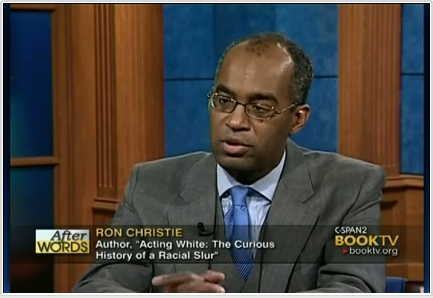
Republican operative Ron Christie, the ultimate yes-man, November 9, 2010. (http://c-spanvideo.org). In public domain.

One example of this was my former boss Ken, who complained about what he claimed was my lack of loyalty to the New Voices Fellowship Program when I made the decision to move on to another position at the end of ’03. He talked about loyalty as if I was a feral dog who needed to be broken and tamed in order to be useful. I said that loyalty “isn’t just about the person, it’s about the work that needs to be done.”

But I’d go a step further than that now. Loyalty in the workplace requires not only the ability of two or more individuals to trust each others’ judgment and quality of work. It also requires a synergy of vision, a sense of purpose that obligates the people in question to provide transparency, constant communication and certainly criticism in the journey to make any vision a reality.

I remembered this a few years after moving on from New Voices, at an interview I had with the head of the Center of Africana Studies at the University of Pennsylvania. He began with the question, “So how are you going to contribute to my vision of building the kind of world-class center that will attract the attention of scholarship everywhere?” The director lost me with his emphasis on “my vision.” I’m thinking, “I don’t know you, but somehow, I’m supposed to trust your vision purely because you say so. Are you kidding me? I’m to be loyal to you just because — you’re Black, you’re a decade older than me, you’re at an Ivy League university? Really?” To this day, that was the weirdest interview in which I’d ever been a part.

I saw this also at the church to which I’d been a member of the longest in my adult life, Covenant Church of Pittsburgh (which was in Wilkinsburg, by the way). From ’91 to ’97, I attended services, was part of the men’s choir, tutored high school students and went on retreats. I sometimes turned a blind eye to the occasional hypocrisy around sex, money and marriage in sermons versus what I actually witnessed.

One February ’97 Sunday after I finished a year’s worth of battles with my dissertation advisor Joe Trotter — another person who wanted my false sense of loyalty (see my “Running Interference” post from April ’11)  — I couldn’t take it at CCOP anymore. After a month-long drive to raise $250,000 above our normal tithes and offerings to buy a plot of land to build a megachurch in Monroeville, our pastor made an announcement and delivered a fiery sermon. The announcement was that God had told him to now up the ante to a three-million dollar campaign for money to build the church on this new property.
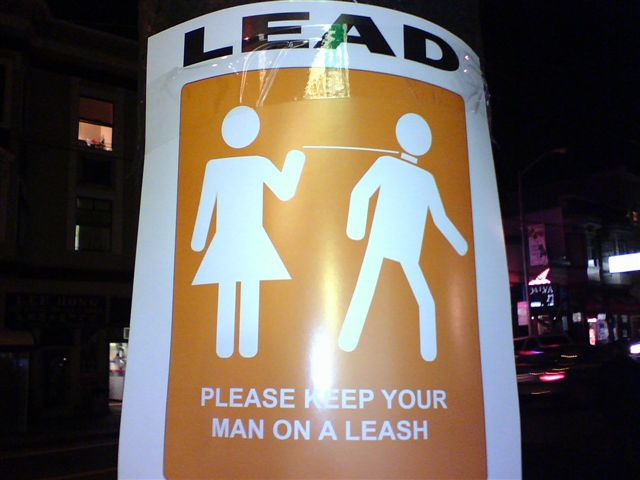
Man on a leash, June 12, 2010. (dtoy2009 via Flickr.com). In public domain.

Before I had time or faith to absorb that bit of information, my pastor delivered a forty-five minute sermon that blamed Wilkinsburg’s fifty-percent unemployment rate, gang violence and despair on “homosexuals and whoremongers.” I’d heard other statements and similar sermons like this before, but not for nearly an hour, not after an appeal to worshippers to give more than one-tenth of their gross income to CCOP for a new church.

I knew for a fact that some of my fellow CCOP members were giving as much as one-fifth of their disposable income already. I also knew that their were some CCOP members who were in the closet. To require loyalty to a vision without building a consensus on such, while also denigrating the very people from whom you demand loyalty was just downright disgusting to me. So I left CCOP, never to return.

This year’s presidential election cycle, particularly on the GOP/TPer side, seems to demand the same kind of blind loyalty that my former boss, potential boss, former dissertation advisor and former pastor all wanted from me or people like me. I learned a long time ago, though, that what people like Mitt Romney and Paul Ryan want isn’t loyalty. They want lap dogs, people willing to overlook their own interests in order to help them achieve theirs.

The Human Race Addendum

13 Monday Aug 2012

Posted by decollins1969 in 1, Academia, Boy @ The Window, Christianity, culture, Eclectic, Mount Vernon New York, Politics, Pop Culture, race, Religion, Work, Youth

≈ Leave a comment

Tags

Barry Switzer, Economic Inequality, Hard Work, Human Race, Individual, Leveling Playing Field, Marathon, Mitt Romney, Paul Ryan, Romney-Hood, social mobility, Track & Field, William H. Holmes Elementary


2008 NYC Marathon. Source: http://ingnewyorkcitymarathon.files.wordpress.com

2008 NYC Marathon. Source: http://ingnewyorkcitymarathon.files.wordpress.com

Two years ago, I wrote a post about a curious observation I made about inequality, unfairness and humanity, all courtesy of my fourth grade teacher, Mrs. Pierce (“Hard Work and the Human Race,” September ’10 – see below). In the thirty-four years since this observation, it’s fairly obvious that the great college football coach legend Barry Switzer was right about how people like Romney think about their station in life. “Some people are born on third base and go through life thinking they hit a triple.”

GOP presidential hopeful Mitt Romney’s pick of Paul Ryan as his vice-president is a confirmation of the idea that there are folks in America who truly believe that their success came only as a result of hard work, luck and prayer. But to use a better analogy, it’s easy to be a winner when your born in middle of the fourth lap of a 400m race, while someone like me had to fight just to get in the starting block. Politically, Carter and Reagan was the spark for my understanding of economic inequality. Three and a half decades later, the Romney-Ryan ticket reflects the long and winding road this mythology of “equal opportunity, not equal outcomes” has taken our nation. Only, equal opportunities do not exist for most of us, as the track and field analogy illuminates.

===========================

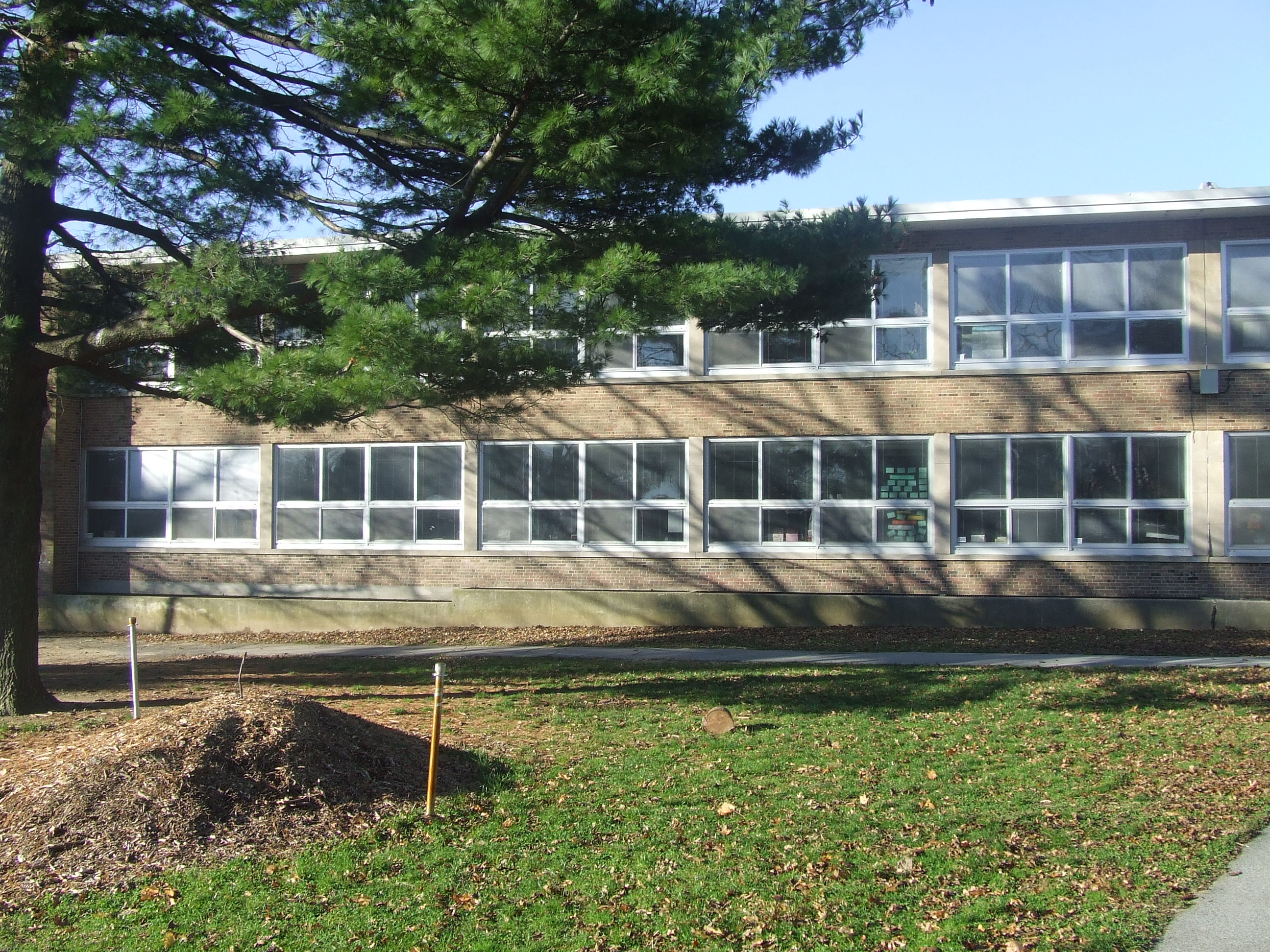
When I was nine years old, my fourth grade teacher at Holmes, Mrs. Pierce — a grouch of an older White woman, really — talked about the human race and attempted to describe our species’ variations. She tried to do what we’d call a discussion of diversity now. It went over our heads, no doubt because she didn’t quite get the concept of diversity herself.

Holmes Elementary School, Mount Vernon, NY [Top left corner was Mrs. Pierce’s classroom in 1978-79 year], November 22, 2006. (Donald Earl Collins).

Like the fourth-grader I was, I daydreamed about the term, human race. I thought of Whites, Blacks, Asians, Hispanics, young and old, male and female, from all over the world, all on a starting line. It was as if four billion people — that was the world population in ’79 — were lined up to run a race to the top of the world. In my daydream, some were faster than others, or at least appeared to be, while others hobbled along on crutches and in wheelchairs. Still others crawled along, falling farther and farther behind those who were in the lead, the ones that looked like runners in the New York City marathon. Before I could ponder the daydream further, Mrs. Pierce yelled, “Wake up, Donald!.” as if I’d really been asleep.

A high school friend recently gave me some much-needed feedback on my Boy @ The Window manuscript. Her feedback was helpful and insightful, and very much appreciated. But some of it reminded me of the realities of having someone who’s a character in a story actually read that story. Their perceptions will never fully match up with those of the writer, which is what is so groovy and fascinating about writing in the first place.

One of the things that struck me as a thread in her comments — not to mention in so many conversations I’ve had with my students about race and socioeconomics — was the theme of individual hard work trumping all obstacles and circumstances. As if words, slights, and mindsets in the world around us don’t matter. As if poverty is merely a mirage, and bigotry, race and racism merely words on a page. Sure, a story such as the one I have told in this blog for the past three years is about overcoming roadblocks, especially the ones that we set ourselves up for in life, forget about the ones external to our own fears and doubts.

At the same time, I realized what my weird daydream from thirty-one years ago meant. Some people get a head start — or, in NASCAR terms, the pole — before the race even starts. That certainly doesn’t make what that individual accomplishes in life any less meaningful, but knowing that the person had an advantage that most others didn’t possess does provide perspective and illuminates how much distance the disadvantaged need to cover to make up ground. Those who limp and crawl and somehow are able to compete in this human race have also worked hard, likely at least as hard as those with a head start, and more than likely, harder than most human beings should ever have to work.

2009 London Marathon. (http://www.newsoftheworld.co.uk/)

Plus, there are intangibles that go with race, class and other variables that determines how the human race unfolds. “Good luck is where hard work meets opportunity,” at least according to former Pittsburgh Penguins goaltender Tom Barrasso. Most human beings work hard, but all need opportunities that may provide a real sprint to catch up or take a lead in the human race. Family status, political influence, social and community networks, religious memberships, being in the right place at the right time, all matter and are connected to race and class, at least in the US.

The moral of this story is, hard work matters, individual accomplishment matters. Yet a panoramic view of the race in which humans are engaged matters more in putting our individual successes and the distance that remains in some reasonable perspective. Without that, we’re all just pretending that individual hard work is the only thing that matters, when that’s only half the battle, or half of half the battle.

Working With Wackos, Part 2

10 Friday Aug 2012

Posted by decollins1969 in 1, Academia, Boy @ The Window, culture, Mount Vernon New York, Politics, Work, Youth

≈ Leave a comment

Tags

Bob Beane, Demotion, Firing, Micromanagement, Mismanagement, Mount Vernon Clinic, Office Politics, Ralph Williams, report, Self-Discovery, Valerie Johnstone, Westchester County Department of Community Mental Health


Daniel Craig in Layer Cake (2004), October 4, 2010. (http://www.guardian.co.uk).

This is the second of my two posts about my last summer working with a group of misfits and backstabbing micro-managers at the Mount Vernon Mental Health Clinic (as part of Westchester County Department of Community Mental Health) in ’92. I left off by talking about the decision I faced when the head of the clinic, Dr. Williams, wanted me to write a report that would implicate Johnstone as both an incompetent and capricious office manager. It would’ve been a report that would’ve led to Valerie Johnstone’s firing (see my “Working With Wackos, Part 1” post from last month).

Luckily I had the weekend before my last week at the job to think it through. I approached my task the same way I approached a research project. I interviewed my co-workers — at least in a way without them knowing that I was doing a formal interview — about their problems with Johnstone and about their refusal to learn the new computers and billing system for the office. I documented various incidents that I either experienced or witnessed in which Johnstone was far from professional. I even discussed the overall office dynamics and argued that they were the reason why the clinic had fallen behind twice in the past decade on hundreds of thousands of dollars worth of Medicaid and Medicare billing to New York State.

But I did more than that. I in fact put together two versions of the report. One version was specifically for Dr. Williams, one that could justify the demotion — if not the firing — of Johnstone. The other, much fuller version was one in which I made the case that Dr. Williams and Johnstone were both culpable as they created an unprofessional and chaotic atmosphere at the clinic.

The Things We Think And Do Not Say “Memo” from Jerry Maguire (1997), August 9, 2012. (http://theuncool.com).

I made the point in the second version that it wasn’t just their violent language and their nasty public and private arguments. Nor was it just their disappearances from the office for hours at a time or showing up hours late looking hung over. Their mercurial natures and their lack of respect for the office and each other had trickled down to the office staff. So much so that some summer office worker like myself had no chance of training staff on how to use a computer or a new billing system.

On my last day at work, Friday, July 31, I handed in version one to Dr. Williams, who was giddy with delight, and gave me a hug and a handshake. I left work early that day, and immediately took the 40 bus up to White Plains, to the main Westchester County Department of Community Mental Health on Post Road. I went to Bob Beane’s office (the department’s director), and dropped off version two of my report. Beane had already left for the weekend. I sneaked in and out that day, as I had worked at this office the summer and holiday season ’90, and I didn’t want questions from my one-time co-workers about why I was there.

The following Friday morning, as I got ready to walk from 616 to the Mount Vernon clinic to pick up my final summer paycheck, the phone rang. It was Beane on the other end of the phone, asking me questions about my report. He asked me how much of what was in it was true. “All of it,” I said. “I need you to come into the office so I ask you some more questions,” Beane said in response. Since I was already about to walk out the door, I hung up and went into my warp-factor-9-walk to find out what was going on (and to get my paycheck without a lot of fuss).

Heads Will Roll sculpture, Embarcadero Center #4, San Francisco, June 25, 2010. (http://artsysf.buzznet.com).

I walked into the equivalent of an emotional tsunami. One of my former co-workers was in tears, while another looked completely stunned. Beane pulled me into Johnstone’s office, and closed the door. I explained what had been going on at the office between Dr. Williams and Johnstone over the previous eight weeks, and likely over the previous three years. Beane paused, then told me what had occurred when he read my report earlier in the week. He decided to fire Dr. Williams, while he demoted Johnstone and moved her to the Yonkers clinic. Beane was in the process of meeting with my former co-workers to verify what was in my report.

After he apprised me, Beane handed me my final paycheck. Then he said, “Thank you. What you did here was very brave and very helpful. But you know you can’t work here again.”

“I know. I knew that when I gave you my report,” I said. Thus ended my career working for Westchester County government.

On Dumb-Assed Ignorance and Race

07 Tuesday Aug 2012

Posted by decollins1969 in 1, culture, Eclectic, Politics, Pop Culture, race

≈ Leave a comment

Tags

African Americans, Anti-Intellectualism, Authenticity, Blackness, Blacks, Bringing The Pain (1996), Chris Rock, Comedians, D.L. Hughley, Gabby Douglas, Gabrielle Douglas, Hair, Ignant, Ignit, Ignorance, Intellectual, Olympics, President Barack Obama, President Obama, Stereotypes, Twitter


Gabrielle Douglas on balance beam, Olympics Women’s Gymnastics All-Around, London, August 2, 2012. (Gregory Bull/AP).

A couple of years ago, I wrote a post titled “On Being An Ignit American” (February ’10). It was about how this issue of what is and isn’t “authentically” Black often has folk Black, White, Brown and Yellow thinking and speaking in stereotypes, especially Black folk, who should know better. The past week has demonstrated well how ignit some of us are or can be on this issue of race and so-called authenticity.

The thousands of ignit tweets on Gabby Douglas’ hair in the midst of her becoming the first African American to win gold the Olympic gymnastics all-around was just dumb and shameful. I mean, who the heck cares about what Douglas’ hair looked like as she hovered a good five feet over the balance beam last Thursday? Did it keep her from winning gold? Did it suddenly mean that she was no longer Black? No! All it showed was how much better an athlete, person and woman Gabby Douglas was and is than the dumb asses who decided to take issue with her hair.

Given that Douglas was competing and practicing every day, at sixteen, in a city she can’t be familiar enough with to run to a hairdresser, why would it be necessary for her to satisfy the superficial ignit folks among the Twiterati? Seriously, we don’t expect our male athletes to “get their hair did,” even though most of them have bed head on the eve of their competitions. No, the thousands of dumb-ass comments about Douglas’ hair is a reflection on a group of people who have never been passionate enough about any dream of theirs to take risks, to sacrifice, to give everything they are and have to achieve that dream. They also lie to themselves, in that being Black and female is to care more about your hair than your goals in life.

D.L. Hughley at The Huffington Post Pre-Inaugural Ball, Washington, DC, January 20, 2009. (Carl Clifford and D.L. Hughley via Flickr.com/Wikpedia). Released via cc-Attribution 2.0 Generic license.

Then there’s D.L. Hughley, the master of the put-down. He’s the kind of guy that if I’d gone to high school with him in Mount Vernon, I’d killed myself from the constant ridicule, or beaten him half to death with a brick. What makes someone like Hughley dangerous as a comedian is that he thinks he’s much smarter than he really is. Hughley, though, is about as smart about race as Rush Limbaugh, and only slightly more funny.

Let’s face it, on the IQ scale of comedians on race, if Richard Pryor was a 225, Eddie Murphy a 190, and Chris Rock a 155, Hughley would be about a 72. Even Bill Burr would be a 99-108 on this scale. Hughley obviously has deep connections in the entertainment world. How else can anyone explain all the small screen opportunities he’s had the past two decades? Perhaps it’s because Hughley’s funny, if only in a pedestrian, what-is-and-isn’t-authentically-Black sort of way.

Which is why I bring Hughley up here. Last week, while thousands of folks made fun of Gabby Douglas’ hair, he gave an interview on SiriusXM Radio mocking President Barack Obama’s intellectual and calm response to criticism. Hughley said, President Obama “doesn’t seem to get that you have to be willing at some point to fight fire with fire. He’s closer to being a white kid. Intellectually, like his experiences are so different from mine that, I should say, he responds like an intellect as opposed to a regular guy.”

Yes, Hughley, or should I say, dumb ass, Obama’s experiences are different from yours. He went to Occidential College in California for two years before transferring to Columbia on an academic scholarship. He worked as a community organizer on social justice issues for four years before getting in to Harvard Law School. He was president of the Harvard Law Review, a state senator for eight years, a US Senator for four, a constitutional law professor, all before become POTUS. As your contemporary Chris Rock would say, “How the f— you expect him to sound?” Hughley, you are so seriously ignant about race and authenticity that it may be time for you to go back to school.

Don’t you Gabby Douglas’ haters and ignant folks like Hughley get it yet? There’s always been more than one way to be Black, to be human. Why should we choose to act the same way, think the same way, look the same way, to satisfy the limited way in which you see the world. You are people of the worst sort. Too ignant to truly understand the world around you, and too chicken to really better yourselves, to pursue your own dreams and success.

On Hugs and Walks

01 Wednesday Aug 2012

Posted by decollins1969 in 1, Boy @ The Window, culture, Eclectic, Mount Vernon New York, Politics, Pop Culture, race, Youth

≈ Leave a comment

Tags

616, 616 East Lincoln Avenue, Adulthood, Bronxville, Chester Heights, Child Abuse, College Plans, Crush #2, Dreams, Eastchester, Economic Inequality, Manhood, Maurice Eugene Washington, Maurice Washington, Pelham, Poverty, Puberty, Self-Discovery, Shuckin' an' Jivin', Tuckahoe, Walks


Commodus hugging Maximus as he plunges dagger into back (screenshot), Gladiator (2000), August 1, 2012. (Donald Earl Collins). Qualifies as fair use under US Copyright laws – low resolution of picture.

The beginning of August for me thirty years ago was the beginning of adulthood for me. I had little choice. After five weeks of emotional, psychological, physical and spiritual abuse, my choices were to either allow myself to be broken or to find something to hope for. Otherwise, my life would’ve been over before my thirteenth birthday.

I thought hard about how to end the summer of ’82’s abuse. I figured that I could pretended to be something I wasn’t — a loving, wayward stepson. I begged for my stepfather’s forgiveness and even called him “Dad” while he beat me for the sixth time in a month, on August 1, ’82. He stopped, finally, and gave me a hug. I cried tears of rage and hate, because I couldn’t even stand to touch or smell the man, much less being pressed against his overabundance of fat. I prayed for his death to be long and painful, as if I had a dagger in my right hand, ready to plunge into his back left ribs.

Dagger through back rib and heart (screenshot), Gladiator (2000), August 1, 2012. (Donald Earl Collins). Qualifies as fair use – low resolution of picture.

If masturbation were the only thing that I discovered that month, I might’ve begun aspiring for some other kind of life. Instead, I decided on a boring early August day to do something else novel. I didn’t want to go to Wilson Woods again. We didn’t have any money anyway. I decided to take my siblings on a walk on the wild side, to walk outside our immediate neighborhood. Darren and I took baby Maurice and Yiscoc in his new stroller out of 616. We walked and strollered down East Lincoln Avenue, across the stone bridge over the Hutchinson River Parkway into Pelham, and turned left on Fifth Avenue to go north. This was uncharted territory for all of us, especially me. North Pelham might as well have been Helena, Montana to me.

“We don’t know where we’re going,” Darren said.

“Yeah, and?,” I said in response.

“Okay, but it’s your fault if we get lost, Donald,” Darren said.

Sarah Lawrence College, Bronxville, NY, August 1, 2012. (http://slc.edu). In public domain.

We didn’t get lost. We walked until we hit Chester Heights, the beginning of the village of Eastchester, and then Bronxville. It was amazing in that it was much more suburban than Mount Vernon or the part of Pelham that I’d known up until that moment. The homes were luxurious by my standards. Everyone seemed to own a BMW, Volvo, Mercedes-Benz, or Peugeot. There weren’t many sidewalks around, only well-manicured lawns. We had walked into several ritzy communities without any warning.

I began to think that the world was a cruel place, having rich Whites living so close to us yet their lives were so far apart from ours. But instead of becoming depressed or angry, it made me introspective. “Look at these houses!,” I said to Darren as we walked by one Tudor-style home after another three-story mansion, broken up only by a few cul-de-sacs. Darren, having been around rich Whites through Clear View for nearly eight years, didn’t think too much of it.

That’s when it hit me. If I wanted to live a better life, to have a nice house and a car and a family, it seemed to me that I needed an education, a college education. I wasn’t going to get there just graduating from high school, especially in Humanities, where the expectations for college were so high that some kids already knew that they were going to law school. I just knew that I couldn’t go through another summer of abuse. So I said to myself, “I’ve got to get through the next five years. I’ve got to go to college.” Yet it seemed like an impossible task.

As we meandered our way back toward Mount Vernon, we ended up on North Columbus Avenue/Route 22. That’s when we passed by a ranch-style home with a stone facade. I looked and saw someone out in front I hadn’t seen since the end of the school year. It was “P,” my eventual Crush #2, outside in the front yard with her sister, apparently back from bike riding. She called us over, and the four of us talked. This was the first Black family I’d seen during our two-hour walk.

Of course I didn’t go into any detail about what we’d been up to. After all, the one thing that the past year had taught me was not to open up my mouth and say everything that was on my mind! So I let her and her older sister do most of the talking. They’d gone somewhere down South to visit family.

“Do you live around here?,” P asked.

“Oh, we’re on a long walk and just happened to be in the neighborhood,” I said.

“Okay,” she said in response.

The Denzel Washington Walk, American Gangster (2007), August 1, 2012. (http://variety.com)

“In the neighborhood.” Sure, if Bronxville, Eastchester, Pelham and 616, all part of our eight-mile trek, were all one gigantic neighborhood! After about ten minutes, we continued home. Darren was more excited about seeing my eventual Crush #2 and her sister than I was.

I wasn’t unexcited. P was far and away the nicest person to me in 7S all year. She stepped up when others made fun of me. I just took her being nice to me the same way Laura Ingalls from Little House on the Prairie probably took it when Mrs. Olsen was nice to her.

Still, I finally had a plan. I knew that there would be a lot of smaller steps that I’d have to take before even getting to college, though. But in looking at where P and her sister lived, I at least knew that someone in their family must’ve taken similar steps in the not-too-distant past.

The Third Armpit of Hell

27 Friday Jul 2012

Posted by decollins1969 in 1, Boy @ The Window, culture, Eclectic, High Rise Buildings, Marriage, Mount Vernon New York, My Father, New York City, Politics, Pop Culture, race, Upper East Side, Upper West Side, Work, Youth

≈ 1 Comment

Tags

Coming-of-Age, Dante's Inferno, Economic Inequality, Growing Up, Home, Metro-North, Neighborhoods, New York, New York City, NYC, Poverty, Race, Self-Discovery, Subway Trains, The City


Illustration of Dante’s Inferno, Map of Lower Hell, 16th century. (Giovanni Stradano via Wikipedia). In public domain.

During most of my Pittsburgh years, whenever someone I knew asked me what it was like to live in the New York City area, I often said two things. One, that “New York was a great place to live if you have money.” But, “if you don’t have money, New York could be like the third armpit of hell.”

I didn’t even bother to discuss Mount Vernon until I was well into graduate school. Too unknown, too complicated to explain its proximity to the Bronx and to midtown Manhattan. And from the average Pittsburgher’s perspective, it was a distinction without a difference. As far as some were concerned, Mount Vernon could’ve just as easily been outside of Buffalo as it could’ve been in the heart of Harlem.

But I definitely knew better, that my relationship with Mount Vernon and “The City” was a love-hate one, born from my growing-up experiences during the Reagan years. The lens with which I viewed the New York City area, a trifocal one of race, poverty and “outsider” status, made me ambivalent about my times growing up in Mount Vernon and all of my times in New York.

2 NYC subway train with graffiti (cropped), 1980s, December 20, 2009. (Cope2 via http://www.doobybrain.com/). Qualifies as fair use – low resolution picture.

I have my father Jimme to thank, though. Without him, I would still be afraid of New York, not just ambivalent about it. Drunk or not, working or on his way to a hole-in-the-wall bar. Jimme would take me and my older brother Darren out and down to the city often enough, to ride the Subway, to hang out with him in Harlem, Spanish Harlem, and especially Midtown. Whether it was to help him with his janitorial work on weekends, or just to hang out, we frequented Manhattan and other parts of the five boroughs off and on between ’80 and ’85, ’82 — the year of abuse — excepted.

Because of that year, the longest time I spent outside of the city growing up was between April ’81 and July ’83. After not making it down to Manhattan in all of ’82, we went to Midtown in July, where we learned about two of my father’s watering holes between 43rd and 47th. They were both near Mickey Mantle’s restaurant on 47th. He also had an Irish pub he’d like to go to around East 59th and Third, a drinking bar near his job on 64th and Columbus, and a couple of places near Macy’s on 34th Street. Because of our height and the times, when it was still legal for eighteen-year-olds to drink in public watering holes, me and Darren were allowed into these fine establishments. I learned a lot about vermouth, vodka, Cosmos and Long Island Iced Tea that summer.

Grand Central Terminal Main Concourse in New York City, March 4, 2006. (Janke and Diliff via Wikipedia). Permission granted via cc-Attribution-Share Alike 3.0 license.

I also learned a lot about the not-so-nice side of New York in those years. I recognized this as I’d board the Uptown 2 Subway from West 42nd Street and 7th Avenue in Manhattan at the tail end of rush hour. As I’d board the train, I’d notice the crunch of humanity in all of its oblivion, self-absorption, and diversity. As the doors close, I’d watch as the express train passed 50th, 59th, and 66th Street before it would grind to a halt at 72nd Street. I’d notice that a fair number of the White passengers alighted here. Between 96th and 125th Street, the load of the train would gradually lighten as about half of the passengers who’d crushed me between a tall, stale-breathed smoker and a woman who wasn’t my girlfriend were now at street level.

About three-quarters of the passengers for the rest of my trip would be Latino and Afro-Caribbean. After another hour of endless stops in the Bronx, the 2 would pull me out of my slumber as it would slowly roll into the rickety East 241st stop.

By the time I was a rising senior at Pitt, I certainly didn’t need my father to accompany on my trips into Manhattan. I also avoided the long trek from 616 across Mount Vernon to 241st to take the 2 whenever I could afford to. Metro-North was a luxurious godsend compared to the puddles of piss and infinite amounts of graffiti on the Subway I’d seen throughout the ’80s.

Toph’s “Hairy Pits” from Avatar: The Last Airbender (screenshot), July 26, 2012. (Donald Earl Collins). Qualifies as fair use — low resolution picture.

But it introduced me to other odious issues. Like Grand Central Station, which by the summer of ’90 was in desperate need of renovation. Especially the restrooms, festooned with enough garbage, feces and bodily odors and fluids to make a coroner vomit.

Off a return trip from Pittsburgh that summer, I made the mistake of having no choice but to use the almost  unusable facilities there, which in the end I couldn’t use. Meanwhile, I observed homeless males hanging out in the restroom with carts, along with an individual who looked to have Kaposi’s sarcoma, an obvious sign of full-blown AIDS.

That’s when I coined New York to be “the third armpit of hell,” the place where poverty had meant your dreams were dead on arrival. For once, it made me content that I was from a place where many smug New Yorkers disdainly considered “upstate.” Though the New York City area has changed — and mostly for the better — since ’90, it’s still a place where economic inequality can easily grind the life out of people.

Tells In Telling The Tale

21 Saturday Jul 2012

Posted by decollins1969 in 1, culture, Eclectic, Movies, Politics, Pop Culture

≈ Leave a comment

Tags

Art Imitating Life, Battlestar Galactica (2004 series), Bones, DS9, Firefly, Fringe, Imagination, Phalanges, Sarcoidosis, Star Trek: Deep Space 9, Star Trek: Deep Space Nine, Star Trek: DS9, Stories, Tales, Telling, Tells, TV Shows, Writing


Adm. Adama hugging Starbuck scene (screen shot/cropped), Battlestar Galactica, 2009. (http://blazingangel.tumblr.com).

I guess that we as individuals each have tells in telling stories, including our life stories. Certainly all writers have a tell, a catch phrase or common set of words that use in telling a story or in setting a scene. All artists have a unique signature, a nuance within a particular style or genre that sets them apart from someone painting by numbers. Sometimes, at least for me, it takes heavy doses of a writer’s style or of someone’s art for me to see the unique tells in the telling.

Firefly series opening logo, July 21, 2012. (Adamwankenobi via Wikia.com).

That’s been so true for me in watching entire TV series through Netflix over the past two years, whether through DVD or online streaming. Since the spring of ’10, I’ve watched, in order and their entirety, Star Trek: DS9, Star Trek: Enterprise, Star Trek: Voyager, House, Firefly, Heroes, Breaking Bad, Dexter, Six Feet Under, Oz, Eureka, Warehouse 13, Battlestar Galactica, Bones and Fringe, mostly through Netflix. Now, some of these shows I’d seen plenty of when they were regular series, especially DS9, Six Feet Under, House and Oz, while I viewed most of these series for the first time.

There’s something different about watching a TV series all at once than watching it once a week in twelve, twenty-four or twenty-six episode blocks year by year. Especially with unlimited streaming. Earlier this year, I watched all seventy-six episodes of Battlestar Galactica over a six-day span in April, including the first two seasons between Saturday morning and Sunday evening Easter weekend (see my post “Battlescar Galactica” from June ’12).

In watching so many episodes, you quickly sense the rapport being actors, the plot and its direction, and the tells about a particular episode or season of a show. In watching DS9, I learned that whenever Quark would mention Dax’s relationship with a Gallamite (a race with a transparent skull) or a Tholian ambassador, I’d learn something revealing about one of the main characters, especially Dax or Quark. Only, there may’ve been only one scene in 176 episodes in which there was a Gallamite character, and none for a Tholian ambassador.

With House, if the “sarcoidosis” diagnosis came up before the last segment of an episode, it was always wrong, but if it came up in the last segment, it would occasionally be correct. The writers obviously knew that sarcoidosis was such a general diagnosis that it could mean nothing in nearly all the show’s mystery illnesses, revealing the desperation and pressure the characters felt in finding the right diagnosis to save someone’s life.

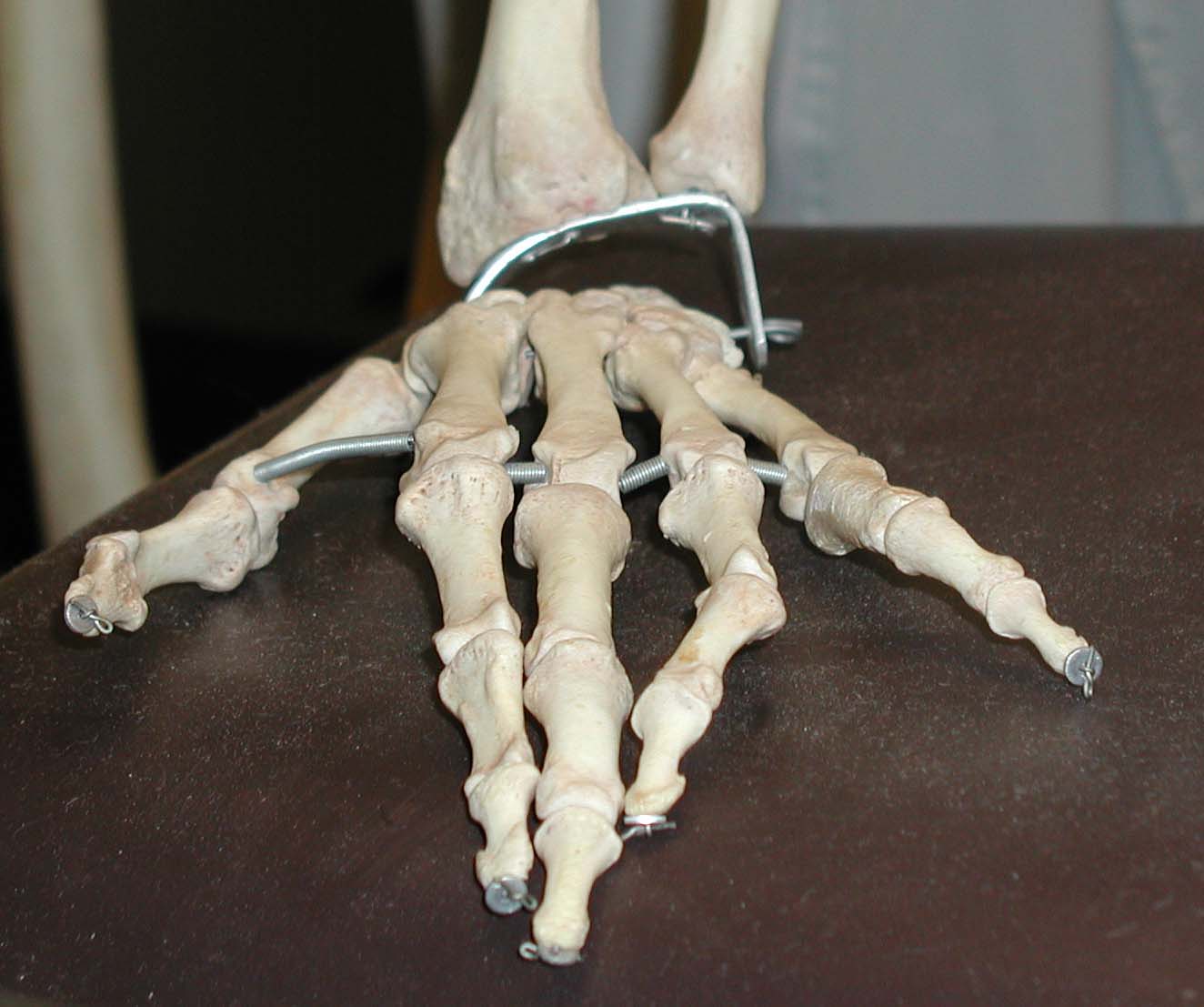
Bones in the human hand (from authentic human skeleton), March 25, 2004. (Raul654 via Wikipedia). Released to public domain via GNU Free Documentation License.

For other shows, it could be a word, a line, an appearance of a sign or character even. For the first five seasons of Bones, the tell for Brennan’s emotional state — or lack of one — was how she’d say “phalanges,” “distal phalanges,” or even “ungual phalanges.” Brennan wiggled her “phalanges” with delight for babies and kids, and examined microscopic details of dead peoples’ phalanges with scientific coldness otherwise. For the sci-fi western Firefly, lines like “the money was too good” and cursing in Mandarin Chinese illuminated the contrast between haves and have-nots of twenty-sixth century humans, between technological advances and moral devolution.

There’s also Fringe’s opening with changes in colors signifying alternate universes and timelines. Not to mention Breaking Bad’s opening scenes foreshadowing how a season would conclude, or the use of light-skinned or biracial actresses as either technically or ephemerally brilliant characters on Fringe, Warehouse 13 and Bones.

But my all-time favorite tell in any season these days is from Battlestar Galactica, when Adama asks,

“What do you hear, Starbuck?”

“Nothing but the rain, sir,” she says

“Then grab your gun and bring in the cat.”

No matter how the characters felt, how dire the situation, or how triumphant the moment, it was the line that showed how precious the connections we have and need to have with each other and with our humanity.

I think that the way I can — we can — watch movies, TV series, read books and articles, look at art, and listen to music through these tells can tell me a lot about a writer, a musician or an artist. But it also tells me a lot about me. Not just that I’m a little weird. I’m also a sucker for a good story, one that is a bit ironic, a tad asymmetrical, that is quirky and epic, unique and yet mundane. A story that mirrors my life is one that tells me about me, at least in part.

← Older posts
Newer posts →

Boy @ The Window: A Memoir

Boy @ The Window: A Memoir

Places to Buy/Download Boy @ The Window

There's a few ways in which you can read excerpts of, borrow and/or purchase and download Boy @ The Window. There's the trade paperback edition of Boy @ The Window, available for purchase via Amazon.com at http://www.amazon.com/Boy-Window-Donald-Earl-Collins/dp/0989256138/

There's also a Kindle edition on Amazon.com. The enhanced edition can be read only with Kindle Fire, an iPad or a full-color tablet. The links to the enhanced edition through Apple's iBookstore and the Barnes & Noble NOOK edition are below. The link to the Amazon Kindle version is also immediately below:

scr2555-proj697-a-kindle-logo-rgb-lg

Boy @ The Window on Amazon.com: http://www.amazon.com/Boy-The-Window-Memoir-ebook/dp/B00CD95FBU/

iBookstore-logo-300x100

Boy @ The Window on Apple's iBookstore: https://itunes.apple.com/us/book/boy-the-window/id643768275?ls=1

Barnes & Noble (bn.com) logo, June 26, 2013. (http://www.logotypes101.com).

Boy @ The Window on Barnes & Noble: http://www.barnesandnoble.com/w/boy-the-window-donald-earl-collins/1115182183?ean=2940016741567

You can also add, read and review Boy @ The Window on Goodreads.com. Just click on the button below:

Boy @ The Window

Twitter Updates

Tweets by decollins1969
  • RSS - Posts
  • RSS - Comments

Archives

  • June 2025
  • April 2023
  • September 2022
  • August 2022
  • July 2022
  • June 2022
  • May 2022
  • April 2022
  • March 2022
  • January 2022
  • December 2021
  • November 2021
  • October 2021
  • September 2021
  • August 2021
  • July 2021
  • June 2021
  • April 2021
  • March 2021
  • February 2021
  • January 2021
  • December 2020
  • November 2020
  • October 2020
  • September 2020
  • August 2020
  • July 2020
  • May 2020
  • April 2020
  • March 2020
  • January 2020
  • December 2019
  • November 2019
  • August 2019
  • July 2019
  • June 2019
  • May 2019
  • April 2019
  • March 2019
  • February 2019
  • January 2019
  • December 2018
  • November 2018
  • October 2018
  • September 2018
  • August 2018
  • July 2018
  • June 2018
  • May 2018
  • March 2018
  • February 2018
  • January 2018
  • December 2017
  • November 2017
  • October 2017
  • September 2017
  • August 2017
  • July 2017
  • June 2017
  • May 2017
  • April 2017
  • March 2017
  • February 2017
  • January 2017
  • December 2016
  • November 2016
  • October 2016
  • September 2016
  • August 2016
  • July 2016
  • June 2016
  • May 2016
  • April 2016
  • March 2016
  • February 2016
  • January 2016
  • December 2015
  • November 2015
  • October 2015
  • September 2015
  • August 2015
  • July 2015
  • June 2015
  • May 2015
  • April 2015
  • March 2015
  • February 2015
  • January 2015
  • December 2014
  • November 2014
  • October 2014
  • September 2014
  • August 2014
  • July 2014
  • June 2014
  • May 2014
  • April 2014
  • March 2014
  • February 2014
  • January 2014
  • December 2013
  • November 2013
  • October 2013
  • September 2013
  • August 2013
  • July 2013
  • June 2013
  • May 2013
  • April 2013
  • March 2013
  • February 2013
  • January 2013
  • December 2012
  • November 2012
  • October 2012
  • September 2012
  • August 2012
  • July 2012
  • June 2012
  • May 2012
  • April 2012
  • March 2012
  • February 2012
  • January 2012
  • December 2011
  • November 2011
  • October 2011
  • September 2011
  • August 2011
  • July 2011
  • June 2011
  • May 2011
  • April 2011
  • March 2011
  • February 2011
  • January 2011
  • December 2010
  • November 2010
  • October 2010
  • September 2010
  • August 2010
  • July 2010
  • June 2010
  • May 2010
  • April 2010
  • March 2010
  • February 2010
  • January 2010
  • December 2009
  • November 2009
  • October 2009
  • September 2009
  • August 2009
  • July 2009
  • June 2009
  • May 2009
  • April 2009
  • March 2009
  • February 2009
  • January 2009
  • December 2008
  • November 2008
  • October 2008
  • September 2008
  • August 2008
  • July 2008
  • June 2008
  • May 2008
  • April 2008
  • March 2008
  • February 2008
  • January 2008
  • December 2007
  • November 2007
  • October 2007
  • September 2007
  • August 2007
  • July 2007
  • June 2007

Recent Comments

MaryPena's avatarMaryPena on My Day of Atonement/Bitter Hat…
decollins1969's avatardecollins1969 on No Good Teaching Deed Goes…
Mary Rose O’Connell's avatarMary Rose O’Connell on No Good Teaching Deed Goes…

NetworkedBlogs on Facebook

NetworkedBlogs
Blog:
Notes From a Boy @ The Window
Topics:
My Life, Culture & Education, Politics & Goofyness
 
Follow my blog

616 616 East Lincoln Avenue A.B. Davis Middle School Abuse Academia Academy for Educational Development AED Afrocentricity American Narcissism Authenticity Bigotry Blackness Boy @ The Window Carnegie Mellon University Child Abuse Class of 1987 CMU Coping Strategies Crush #1 Crush #2 Death Disillusionment Diversity Domestic Violence Economic Inequality Education Family Friendship Friendships Graduate School Hebrew-Israelites High-Stakes Testing Higher Education History Homelessness Humanities Humanities Program Hypocrisy Internalized Racism Jealousy Joe Trotter Joe William Trotter Jr. K-12 Education Love Manhood Maurice Eugene Washington Maurice Washington Misogyny Mother-Son Relationship Mount Vernon High School Mount Vernon New York Mount Vernon public schools Multiculturalism MVHS Narcissism NFL Pitt Pittsburgh Politics of Education Poverty President Barack Obama Race Racial Stereotypes Racism Relationships Self-Awareness Self-Discovery Self-Reflection Sexism Social Justice Teaching and Learning University of Pittsburgh Violence Whiteness Writing

Top Rated

Blog at WordPress.com.

  • Subscribe Subscribed
    • Notes from a Boy @ The Window
    • Join 103 other subscribers
    • Already have a WordPress.com account? Log in now.
    • Notes from a Boy @ The Window
    • Subscribe Subscribed
    • Sign up
    • Log in
    • Report this content
    • View site in Reader
    • Manage subscriptions
    • Collapse this bar
 

Loading Comments...