• Spinning Sage’s Gold: Allegories on the Western-Dominated Present and a Possible Post-Western Future (2025)
  • About Me
  • Other Writings
  • Interview Clips
  • Video Clips
  • Boy @ The Window Pictures
  • Boy @ The Window Theme Music

Notes from a Boy @ The Window

~

Notes from a Boy @ The Window

Author Archives: decollins1969

Spencer for Higher

23 Saturday Oct 2010

Posted by decollins1969 in 1, Academia, Boy @ The Window, Eclectic

≈ Leave a comment

Tags

Carnegie Mellon University, Dissertation Fellowship, Doctoral Thesis, Finding Purpose, Grant Making, Grant-seeking, Spencer Foundation, Teaching, Writing


Spenser For Hire Title Screen, February 26, 2008. Source: http://www.aolcdn.com/new_promos/dl_spenser_733x270.jpg

Higher education, that is. Sixteen years ago this weekend, I put my application in the mail for a Spencer Foundation Dissertation Fellowship. It was a $15,000, one-year award that would give me time off from teaching or doing grunt work for my advisor and other professors. I’d have a year to do nothing but do work on my doctoral thesis, to travel, do additional research and lock myself in my apartment for week on end to write what would become a 505-page document.


But don’t let me over-glamorize the moment. After all, I’d applied for fellowships and been in search for grants in the years before and after this application. The University of Pittsburgh had made me part of the first class of recipients for their Challenge Scholarship in ’87. I’d been awarded a graduate student assistantship and teaching assistantships throughout grad school. The Ford Foundation Predoctoral Fellowship — I applied for it twice, in ’91 and ’93. Soon after my Spencer application, I also applied for the Ford Foundation Dissertation Fellowship and the NEH (National Endowment for the Humanities) Dissertation Fellowship (which they disbanded the following year).

I’d later apply for a few postdoctoral fellowships in ’96 and ’97. Then, once I became part of the nonprofit sector, grant-seeking became a part of my jobs. Including letters of inquiry, concept papers, about three dozen grant proposals that I worked on in part or in whole. Not to mention meetings with foundation program officers, numerous networking opportunities at the Independent Sector and other conferences. Between them all, I directly or indirectly helped raise about $1.4 million over the past ten years, and played a role in programs that possessed about $11 million in funding overall.

 

Spencer Foundation Logo, October 23, 2010

But the most satisfied I ever was in putting together a proposal, or in receiving an award, or in participating in a grant-related experienced, was when I applied for the Spencer Foundation Dissertation Fellowship. You see, I’d spent nearly eighteen months preparing myself to apply. I started doing my dissertation topic research a full year before the October ’94 application deadline, months before my advisor and committee were to officially approve my topic and research.


I’d started going through microfilm of Black Washington newspapers from the 1920s, 1930s, and 1940s, looking up Census data, thinking of places to look up old records of DC Public Schools  from the segregation era, and contemplating interviewing former teachers and students who’d worked at or attending DCPS between 1920 and 1970. It was exhausting doing that and taking a full load of classes, struggling with finances so badly that I had no money for new sneakers, that I’d walk in three-year-old sneakers with holes in them to and from campus in ankle-deep snow to push this project forward. Of course, I lined the sneakers with plastic bags from Giant Eagle to keep my socks and feet dry and warm.

Yes, I was committed to the task all right, and probably should’ve been committed in the process. But it was also worth it. I felt — rather, I practically knew — that it would all work out with the Spencer Fellowship somehow. And it did, not just because of the award, and not just because of my friend and mentor, Catherine Lacey (see April 2009 post). It worked, because it helped me find my calling as a writer and teacher. It worked because it helped bring to the fore my ambivalence about academic writing and scholarship as the raison d’etre of an academically-trained historian.

The application, fellowship and that year free from Carnegie Mellon’s clutches helped put me on the right path. Even if I didn’t know it at the time.


The Land of Second Chances – For Who?

21 Thursday Oct 2010

Posted by decollins1969 in 1, Boy @ The Window, culture, Eclectic, Politics, Pop Culture, race, Sports

≈ Leave a comment

Tags

America the Beautiful, Born in the USA, Bruce Springsteen, Chris Rock, Eliot Spitzer, John Mellencamp, Level Playing Field, Life Chances, Michael Vick, Mike Barnicle, Pink Houses, Ray Rice, Second Chances, Struggling Middle Class, Tony Kornheiser, Working Poor


Purple Mountain Majesty, October 21, 2010. Source: http://bojack.org

I’m so tired of hearing commentators talk about how this is a country that gives people second chances. “What? Really? Are you insane?,” I think when I hear such drivel from people like Tony Kornheiser and Joe Scarborough. Do these talking heads even think about who they’re talking about or what they mean when they say the words “second chances?”

Seriously, true second chances in this country are reserved for folks who are among the elite — rich, famous, public officials, entertainers, athletes (sometimes), usually (but not always) White, almost always male and heterosexual. For these folk, America is a land of second chances. For most of us, this isn’t even a land of first chances, much less second ones. As Bruce Springsteen would say, “born down in a dead man’s town, the first kick I took was when I hit the ground” is an apt description for a majority of Americans.

The working-poor and living-from-paycheck-to-paycheck sub-middle class, while doing all they can to improve the life chances of their kids, ultimately are dependent on breaks provided within our society for their kids to have a chance. It comes down to a decent, if not happy family life, with no major financial or job disruptions. And living in a decent neighborhood, along with being able to attend an above-average public school or having parents willing to scrape together the money for private or parochial school. Not to mention finding opportunities for outside opportunities for their kids to explore themselves, like through art classes, soccer teams, travel, and so many other things that make growing up more than just a biological process that occurs in chaos.

Little Pink Houses, Carole Spandau, Uploaded October 21, 2010. Source: http://fineartamerica.com

Little Pink Houses, Carole Spandau, Uploaded October 21, 2010. Source: http://fineartamerica.com

If anything goes wrong, if a kid makes even a relatively minor mistake, that first chance will go away. Homelessness, bankruptcy, poor grades, even minor criminal activity or rebellion against authority figures will short-circuit chance number one. For kids of color, especially males, a robbery, playing around with marijuana, a fight at school or repeating a grade puts them in jeopardy long before they may realize that life doesn’t grant them a whole lot of first chances to begin with.

If these kids are lucky or disciplined enough to make it to adulthood with a high-school education, that may open a door, but it still won’t grant even the first chance. As comedian Chris Rock would say, many of these kids have to “make miracles happen” — force open doors — for that first real chance for their lives.

Not so for the likes of Eliot Spitzer, Ben Roethlisberger, even (to a lesser extent) Michael Vick. These folks aren’t struggling to find themselves while living in obscurity, and have more opportunities to work with in any given day than the average American person will likely have in their lifetime. But for White males with money and/or the public spotlight, second chances are almost automatic. Spitzer has his own show on CNN. Roethlisberger would’ve only lost his job if he’d been convicted of rape. Former Boston Globe columnist Mike Barnicle is still a respected journalist in many circles, even though he’s a proven a plagiarist and fiction writer. Vick, meanwhile, only got a second chance after he served two years hard time for dogfighting.
Even for the famous and financially fortunate — yet of color — the second chance remains elusive. Tiger Woods didn’t break any laws, didn’t commit a crime, but has spent the past year as a pariah (no need to go into the psychosis that comes with race and males of color, Black ones in particular). Jayson Blair will probably never have another shot at hardcore journalism. Maybe Blair shouldn’t have a second chance, but then, neither should Barnicle.

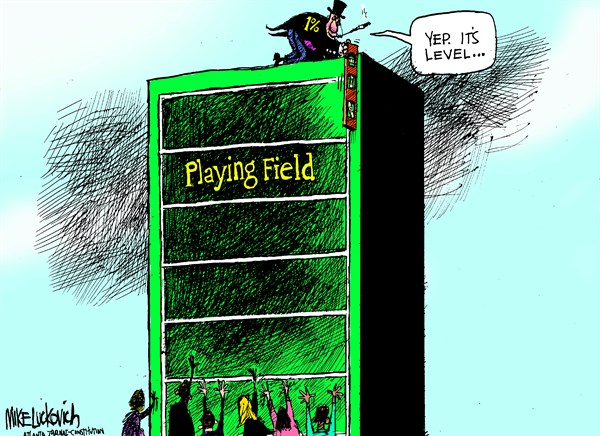
1%'s Playing Field cartoon (applicable to who gets second chances, too), December 28, 2013. (Mike Luckovich, Atlanta Journal-Constitution).

1%’s Playing Field cartoon (applicable to who gets second chances, too), December 28, 2013. (Mike Luckovich, Atlanta Journal-Constitution).

To be sure, John Edwards, Larry Craig and Jim McGreevey won’t be running for office again. But they are exceptions to the rule. Edwards could’ve jeopardized the Democratic Party’s ’08 election with his scandal, while Craig and McGreevey were outed as closeted gays involved in down-low activities. We don’t give politicians like these second chances.

So, we are a land of second chances. At least for those with the keys to the kingdom of the public arena. You just have to be straight, White, male, affluent, committed a crime before the age of twenty-one — and one that didn’t involve murder or Black-on-White crime — to have them.

As for Ray Rice, because many assume that his one act of domestic violence toward his now wife Janay Palmer Rice is the only one he’s committed, and because of all his charitable contributions, the NFL will grant him a second chance. The question isn’t whether Rice deserves a second chance. The question is why Janay Palmer Rice never had a first chance at a violence-free relationship. The answer is patriarchy, misogyny, racial animus, and increasing class inequality. What second chances, and for whom indeed!

The Testing Season

12 Tuesday Oct 2010

Posted by decollins1969 in 1, Academia, Boy @ The Window, culture, Eclectic, Politics, race

≈ Leave a comment

Tags

Academic Achievement, ACT, Anthony Carnevale, AP, Colleges & Universities, Educational Testing Service, ETS, GMAT, GRE, High-Stakes Testing, LSAT, MCAT, SAT, Standardized Testing, Strivers Research


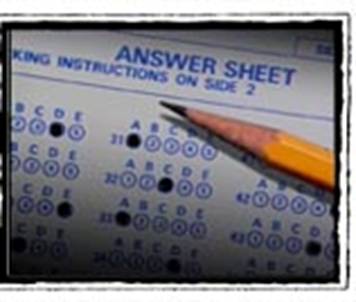
Mock SAT Answer Sheet, October 12, 2010. Source: http://kellgradcoach.blogspot.com

This really is the testing season, isn’t it? In many more ways than one. For voters, the underemployed and the unemployed, the welfare poor, for undocumented workers, for the Obama Administration, for so many others. But the testing season I’m talking about is standardized testing. Between the SAT, GRE, LSAT, MCAT, GMAT, and ACT, high school students and college undergrads face incredible amounts of stress over a five-decade-long practice that, in the end, reveals more about the system of competition that technocratic university administrators and eugenics-type scientists have created than it actually does

ETS Logo, from http://www.ETS.org, October 12, 2010

about our own abilities.


My own standardized testing history includes the following (not counting the AP or New York State Regents exams, which occur in May and June, another testing season), starting with elementary school:

1. SRAs (1st through 6th grade – ironically, started by Lyle Spencer, who also founded the Spencer Foundation, which sponsored my doctoral dissertation research in 1995-96)

2. PSATs (10th grade)

3. SATs (11th and 12th grade)

4. GREs (junior and senior years, Pitt)

5. LSATs (senior year, Pitt)

My highest score on the SAT — 1120 (540 Verbal, 580 Math). My highest score on the GRE — 1730 (530 Verbal, 580 Math, 620 Analytical). On the LSAT, I scored in the 50th percentile, not bad for someone who studied for it for only two weeks. What does any of this prove in the whole scheme of things? Nothing, really. If these scores were truly great predictors of future academic performance, then Harvard, Yale, Princeton and Carnegie Mellon should have graduation rates approaching 100 percent. Which would explain why many elite institutions have either downgraded their use of these tests in their admissions formulas, or in the case of the big three and UC-Berkeley regarding the SAT, are barely using them at all.


My GRE Score, October 1990.

But for most colleges and universities, these tests are a critical factor in a student’s acceptance and enrollment. They are a necessary evil for figuring out who has academic potential and who doesn’t, at least according to ETS and admissions directors. Which is why I still don’t understand why educators and other folks haven’t taken former ETS vice-president Anthony Carnevale’s work around “strivers” seriously. Or, rather, I do understand. Why give someone like me a leg up because my SAT score was an 1120 — giving my score more weight than a 1280 score for a White kid from a middle class background? All scores are equal. That’s why we call them standardized tests, a standard that doesn’t measure up to the realities of earning a degree.


I guess for those I know who are rolling into these exams this fall (and in some cases, before March or April), the best advice I can give is to get the best score you can. But don’t despair if your scores are only in the 51th, 64th, or 74th percentile, like mine were on the different sections of the GRE. What will ultimately matter is how you perform after you’ve been accepted by and enrolled in that institution.

I’ve given some thought to going back to school in the next couple of years, possibly even law school. Not to become a lawyer, but to make myself more marketable outside of academia and within the philanthropic world. For some odd reason, there are lots of people with law degrees who are working in education reform, international development, and social justice. Go figure.

But even this professor will likely have to take the LSATs again in order to apply to a law program at Georgetown, UPenn or some other school. And that will mean trying to figure out why A and B won’t sit together at the same conference table, but B can sit next to E, except when meetings are held on Tuesdays.

An a-ha Moment

08 Friday Oct 2010

Posted by decollins1969 in 1, Boy @ The Window, Eclectic, eclectic music, Mount Vernon High School, music, Youth

≈ Leave a comment

Tags

"Take On Me", a-ha, Aiwa, Albany NY, Billboard Pop Chart, FDR, FDR Mansion, Friendship, High Falsetto, Hunting High And Low, Hyde Park, Music, Walkman


Screen shot from the music video of “Take on Me” *Artist(s): a-ha *Director: Steve Barron *Copyright: ©1985 Warner Bros. Records==Fair use in “Take on Me”

Today’s date marks a full twenty-five years — a whole quarter century — since me and my AP US History classmates rolled out from Mount Vernon High School at 6:30 am for a trip to Albany and Hyde Park. But nothing historical was especially eye-opening on this date. No, it was really more about the people, one in particular, that made this time an a-ha moment.

Our eccentric and late AP US History teacher, Harold Meltzer, used this trip to get us out of the classroom. to make history and government more real to us. We — meaning our AP class and folks from Meltzer’s Government class — went to Albany to meet our state representative and to learn a bit about the history of New York State’s governance. We also made a stop to visit the FDR mansion in Hyde Park. The trip to Albany was itself a three-and-a-half hour school bus ride.

Besides the standard exaggerated bouncing up and down we did whenever the bus hit a bump somewhere along I-87 North, there were a couple of things to note. It was my first time outside the New York metro area since ‘78, when Darren, my mother, my soon-to-be-stepfather and I went to Amish country in Pennsylvania. The Roosevelt’s master bedroom and “king-sized” bed was much smaller than I thought. FDR and Eleanor both looked pretty tall to me in their pictures and in those ’30s newsreels. And the Norwegian pop band a-ha had climbed to the top of the Top-40 pop charts with “Take on Me” a few days before.

A-ha? Well, “SD” had a brand-new $150 Aiwa Walkman (its normal retail value in ’85) with a state-of-the-art design and stereo system, including Dolby noise reduction and equalizer controls. The entire trip to Albany and Hyde Park and back she played a-ha’s Hunting High and Low album nonstop on the bus. After hearing the beginning of the song for what seemed like the 117th time, I chimed in, and SD sang briefly out loud with me: “Talking away, I don’t know what I’m to say….” I’d heard the lead singer’s “TAAAAAKKKKEEE!” without the need for an interpreter so many times already, since SD sat a row or two behind me. So me being me, during the return trip I attempted to hit the same high falsetto note to see if I could compete with a Norwegian pop star.
As soon as I hit the note for “TAAAAAKKKKEEE!” — badly, as it was in my balls-strangled version of high falsetto — the window in the row behind me on my right shattered and scattered all around D and A’s seats. D was closest to the window, and she was unhurt, but we had to stop for about ten minutes. Everyone was laughing this nervous, “this-is-funny-but . . . ” laugh, like audience members laughing at a Richard Pryor joke. Five of my classmates all but gave me a sarcastic standing ovation. After all, it turned out that no rocks or stones were found on the bus, and there wasn’t a sign of a sniper anywhere. All we could think was that I’d dialed up the correct frequency and shattered a glass window that may’ve been weak already from everyday wear and tear. I thought it was amazing to generate that kind of power with my voice. Even if it meant that I’d get flack for it.

But that’s not all I took from that day. I’d accidentally become more than an acquaintance with SD. Not only did I eventually go and buy a-ha’s Hunting High and Low. I appreciated all of her ’80s pop music. From Heart’s “What About Love” to Scandal’s “The Warrior” — it’s listed in our yearbook as SD’s favorite song. I picked up a writing habit that I use to this day, putting a dash through my 7’s and Z’s to make sure to distinguish them from 1’s and S’s.

It was a fun trip for me, even though most in my class would’ve likely preferred a trip to Grand Central over Albany and FDR’s mansion. It was fun because I had made a connection that would lead to friendship.

How People of Color Should Re-Interpret the Rules of Race

05 Tuesday Oct 2010

Posted by decollins1969 in 1, Eclectic, Politics, Pop Culture, race

≈ Leave a comment

Tags

CNN, Derrick A. Bell, Derrick Bell, Faces at the Bottom of the Well, Hype, LeBron James, Media, Minorities, People of Color, Race, Racism, Rick Sanchez, Rules of Racial Standing, Social Justice, Soledad O'Brien


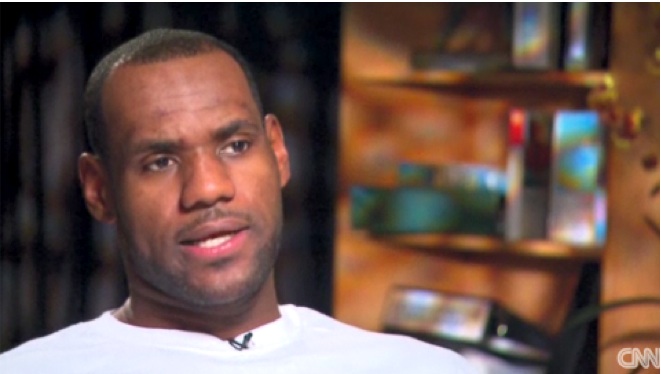
LeBron CNN Interview Screen Shot, September 29, 2010. Source: http://www.youtube.com/watch?v=SvQhaCIa8lM

Soledad O’Brien, LeBron James (and his foot-in-mouth manager) and Rick Sanchez all have something in common. They are persons of color whose understanding of the rules of race — or the “Rules of Racial Standing,” as law professor Derrick Bell describes them — is about as sophisticated as an amoeba’s. If you ask me, they all played “the race doesn’t matter, even if it does” game, and they all got burned in some way as a result.

O’Brien to many — mostly Black and Latino — came off as a race-baiter, while James looked overly sensitive in his understated response to O’Brien’s “Do you think there’s a role that race plays…?” question. Sanchez was the worst of all, calling Daily Show host Jon Stewart a “bigot” and insinuating that CNN and shows like The Daily Show are controlled by Jews, liberal Jews of course, but Jews nevertheless. All while scoffing at the idea that Jews are an oppressed minority in the US.

It all points to one simple problem. That many, if not most, persons of color in the public eye don’t understand — or care to understand — the rules of race in the media. This is important. For people of color cannot re-interpret these rules without understanding them first.

Faces at the Bottom of the Well Book Cover, October 5, 2010 (Donald Earl Collins)

Derrick Bell‘s “Rules of Racial Standing,” from his bestselling Faces at the Bottom of the Well (1992), is a guidepost for why independent voices on issues of race are difficult to come by, in law and in the media. But as a person of color, there are ways to re-interpret these rules to make them work in unintended ways, at least, unintended by those in the media. The five rules (and their re-interpretations) are:

First Rule

(“Rule of Illegitimate Standing”) …No matter their experience or expertise, Blacks’ statements involving race are deemed “special pleading” and thus not entitled to serious consideration.

Translation: when in the public idea and asked a question on race, give an unexpected answer, one that is thought-provoking, even controversial, to at least push a more lengthy and serious discussion of race.

Second Rule
(“Rule of Legitimate Standing”) Not only are Blacks’ complaints discounted, but Black victims of racism are less effective witnesses than are Whites, who are members of the oppressor class. This phenomenon reflects a widespread assumption that…cannot be objective on racial issues…

Translation: While even having a DVD or an iPhone filming racist behavior or actions in progress may be ignored, having a multicultural group in support of a complaint will receive much more attention than striking out alone.

Third Rule

(“Rule of Enhanced Standing”) …The usual exception…is the Black person who publicly disparages or criticizes other Blacks who are speaking or acting in ways that upset Whites. Instantly, such statements are granted “enhanced standing” even when the speaker has no special expertise or experience in the subject he or she is criticizing.

Translation: Let the Tara Wall’s, Anna Holmes’, John McWhorter’s and Dinesh D’Souza’s of this world know that their opinions will not go unchallenged, that their alleged expertise on race is nothing more than an opinion sanitized for center-right consumption. That’s what blogs, Twitter, Facebook, and Huffington Post are for.

Fourth Rule
(“Rule of Superenhanced Standing”) When a Black person or group makes a statement or takes an action that the White community or vocal opponents thereof deem “outrageous,” the latter will actively recruit Blacks willing to refute the statement or condemn the action. Blacks who respond to the call for condemnation will receive superstanding status…

Translation: See the re-interpretation of the Second Rule, especially in the case of Fox (or Faux ) News. One Alan Keyes or Alex Castellanos does not equal a group of progressives using their numbers, media savvy and social media as an antidote to the “one sane person of color” rule.

Fifth Rule
(“Rule of Prophetic Understanding”) …Using this knowledge, one gains the gift of prophecy about racism, its essence, its goals, even its remedies. The price of this knowledge is the frustration that…that no amount of public prophecy, no matter its accuracy, can either repeal the Rules of Racial Standing or prevent their operation.

Translation: This may be true, but there are still millions of Americans who would prefer to hear people of color and truly progressive Whites make better use of the media to dilute the piss and vinegar that is pseudo-liberalism and mainstream news these day.

There are exceptions to these rules, such as when someone White or of legitimate standing vouch for his or her otherwise controversial views. But people of color need to bend these rules, break them when necessary. All so that the answer to the question “Was race a factor in…?” isn’t, “No,” or “No, this is a colorblind society,” or “Yes,” without a sophisticated answer. This is what the media wants, not necessarily out of racism, but out of making money. In order to get what Americans need, the media it needs, people of color must resist giving the media the hype that it wants.

Montgomery County Parks & Its Poorly Maintained Basketball Courts

30 Thursday Sep 2010

Posted by decollins1969 in 1, Eclectic

≈ Leave a comment

Tags

Basketball Courts, Belle Ziegler Park, Budget, Chevy Chase, Facilities, Facilities Management, Forest Glen Park, Jessup-Blair Park, M-NCPPC, Maintenance, Maryland-National Capital Park and Planning Commission, Meadowbrook Park, Montgomery County MD, Montgomery County Parks, Montgomery Hills Park, Playgrounds, Renovations, Silver Spring, Silver Spring Intermediate Park, Sligo-Dennis Ave Park, Takoma Park, Tennis Courts, Woodland Park


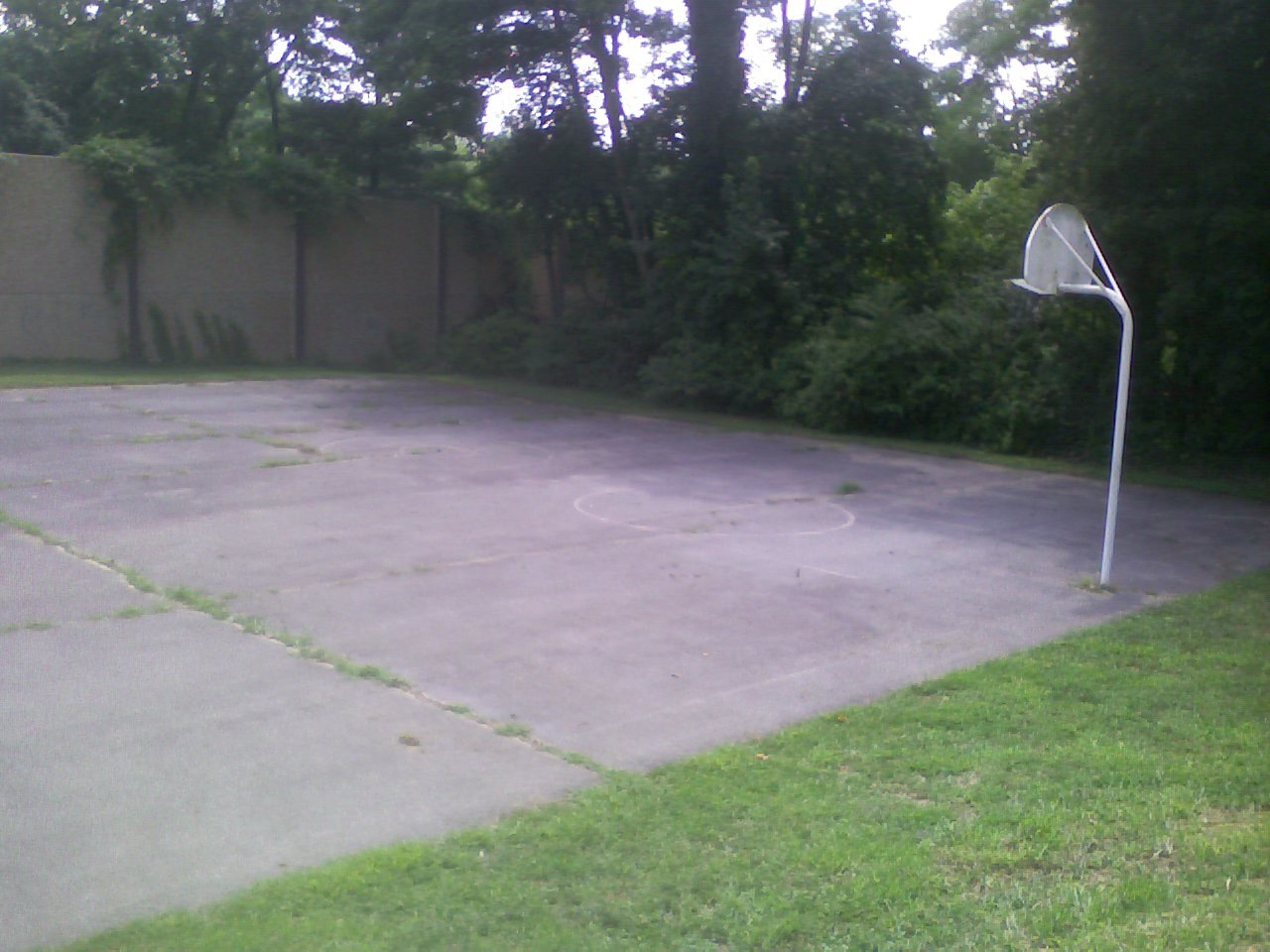
Forest Glen Park basketball court, Silver Spring, MD, August 10, 2010. Source: Donald Earl Collins

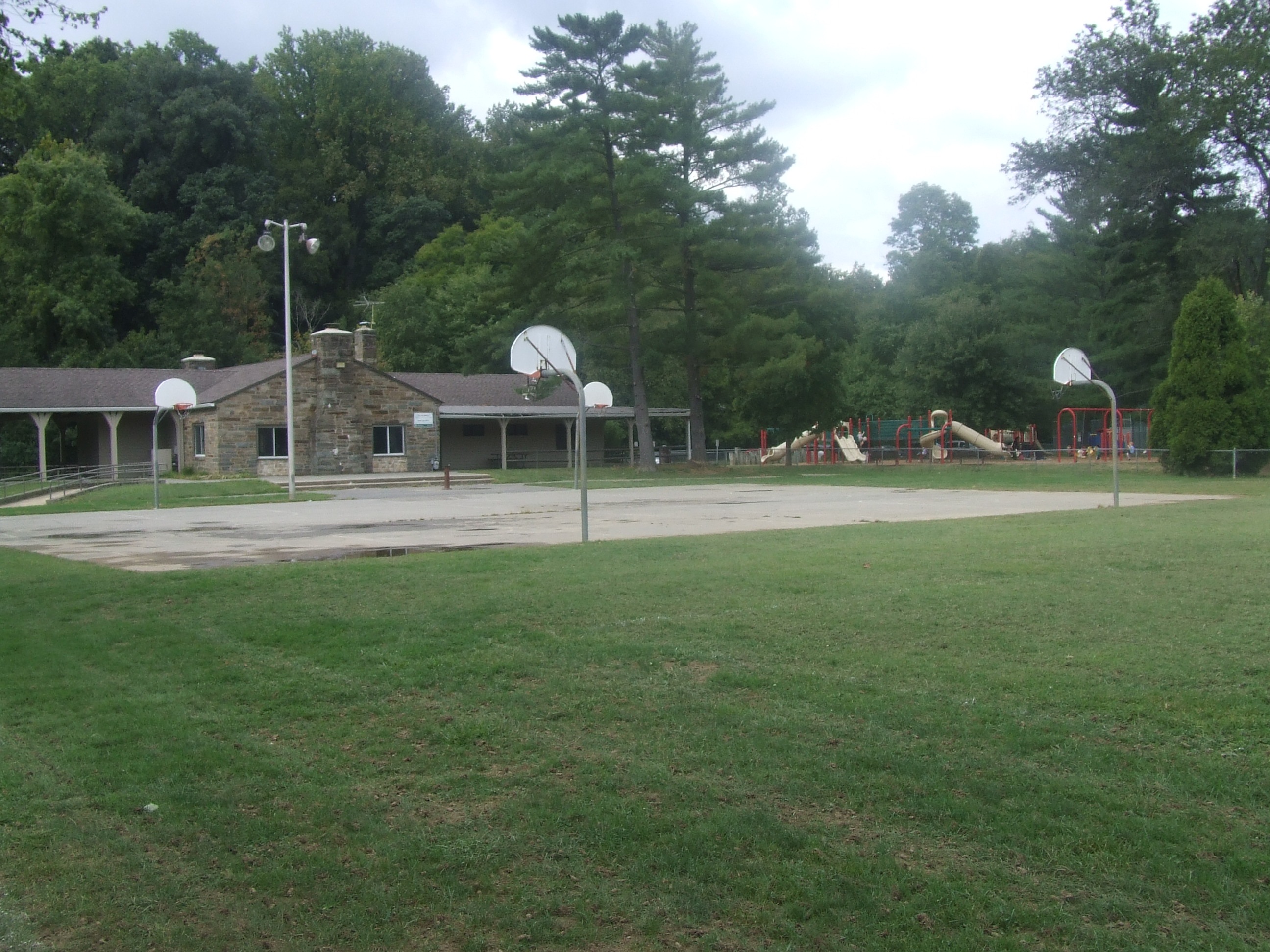
Montgomery County Parks has done a poor job of maintaining its facilities. Especially its outdoor basketball courts, where the department has spared precious little funds for their maintenance and renovation. Even in cases where renovations have occurred, some courts remain substandard. Others are so poorly maintained, though, that they have fallen into non-use.

Given the growth in the county’s population over the previous decade – particularly of working-class Latino immigrants – and the growth in obesity rates, Montgomery County Parks is taking a risk with its poor maintenance and renovation record. The risk: that residents will assume – rightly or wrongly – that the county believes that certain parks and certain basketball courts aren’t worth the time and money to fix for fear of certain kinds of people.

Montgomery County, Maryland, part of suburban Washington, DC, is one of the ten richest counties in the United States, at least according to the US Census Bureau. As part of the Maryland-National Capital Park and Planning Commission (M-NCPPC) for Montgomery and Prince George’s counties, Montgomery County Parks has worked with an annual average budget of $121 million over the past five years for its dozens of parks and facilities. Yet in all eight parks that are part of this article, visited between July and September, the outdoor basketball courts had numerous deficiencies (see pictures attached). Montgomery County Parks has not responded to inquiries on this topic.

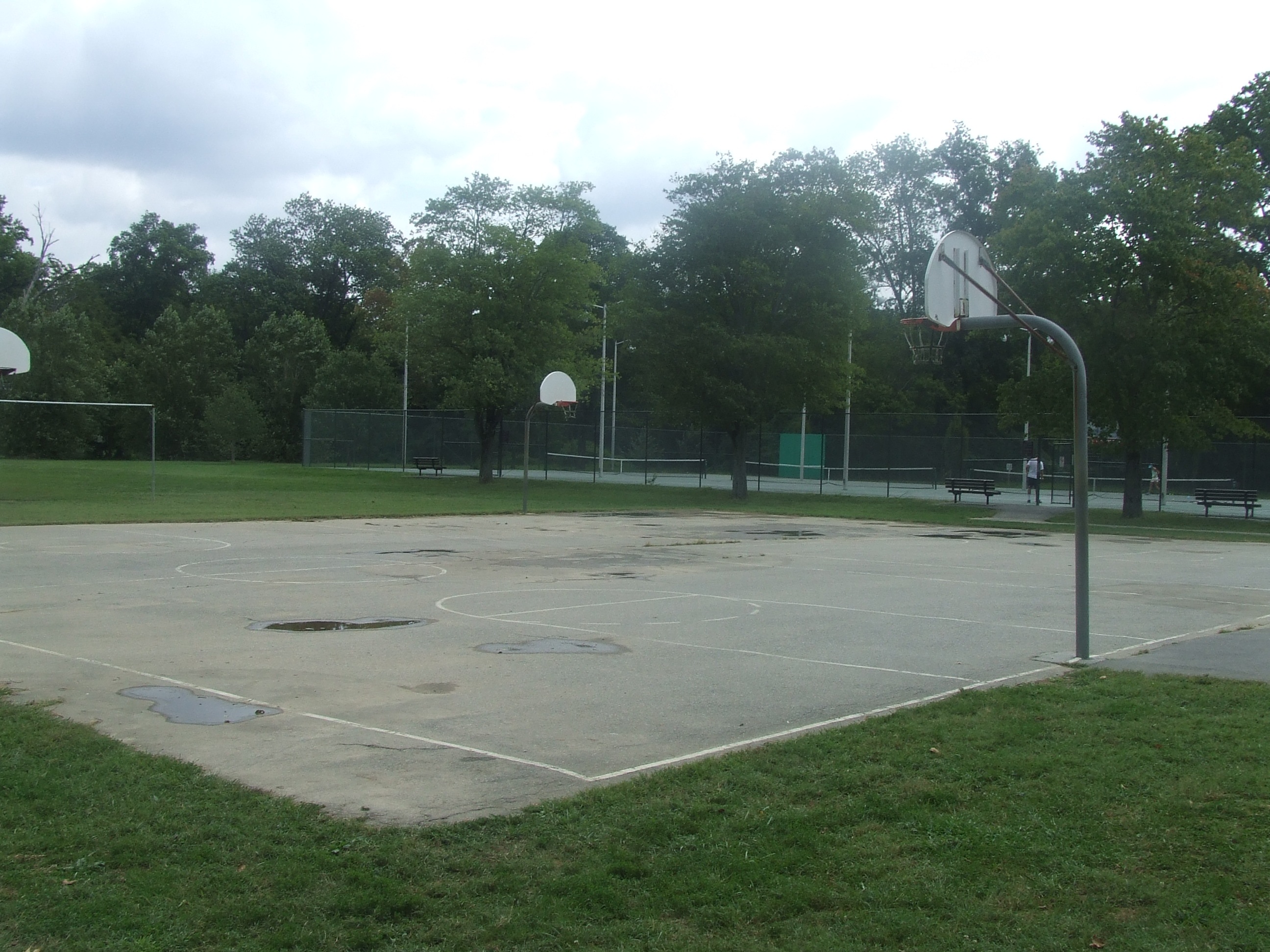
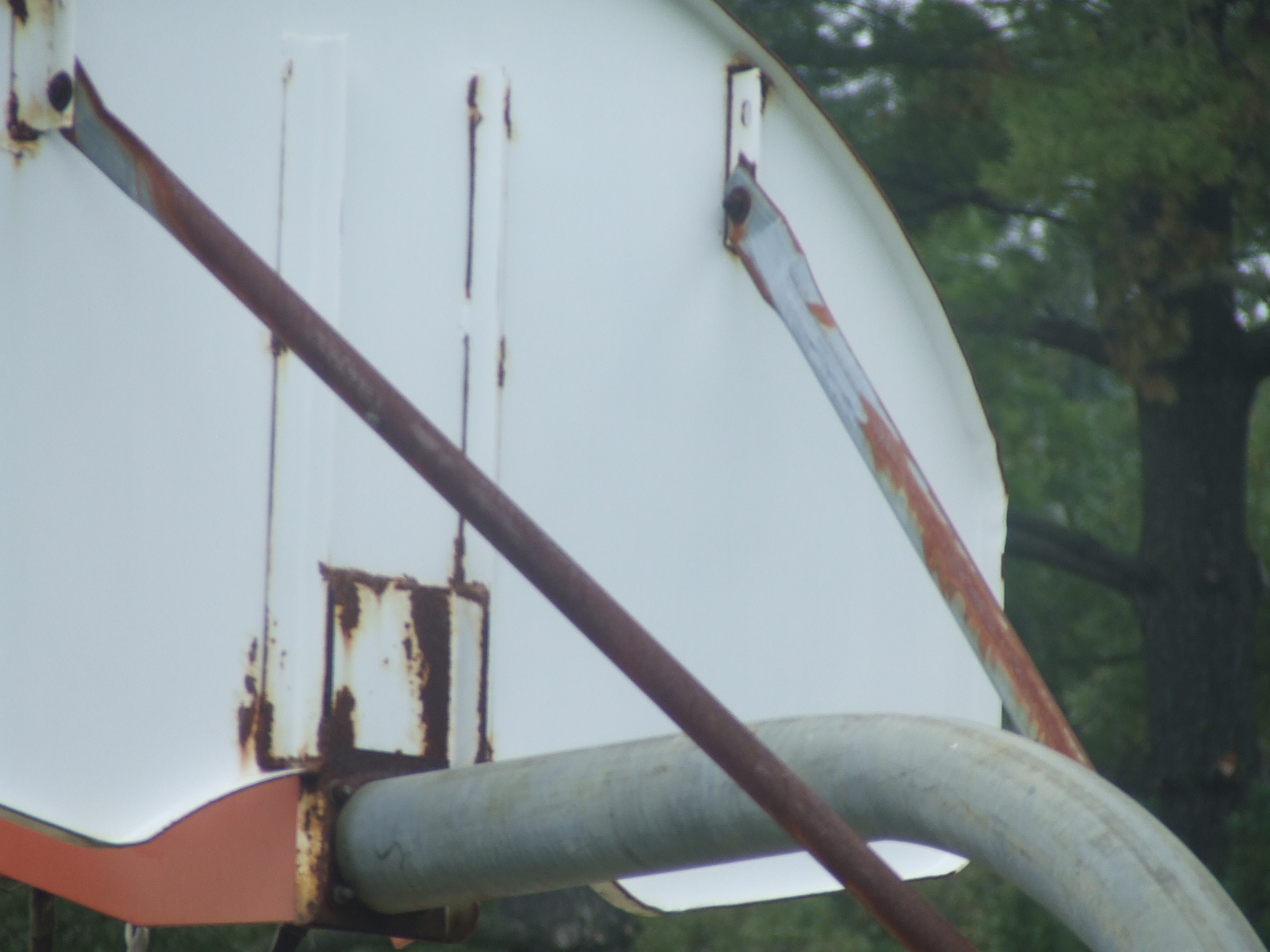
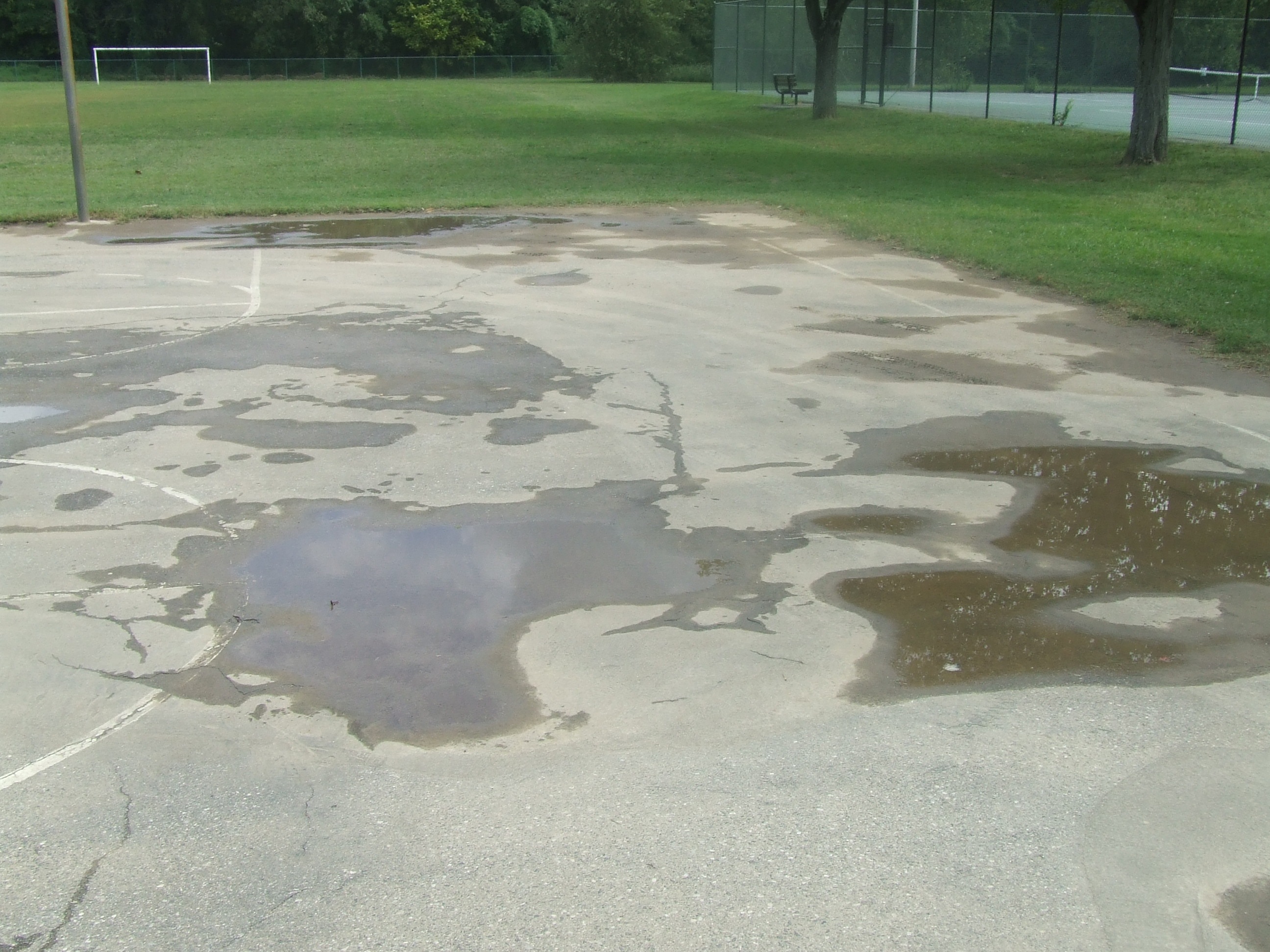
At Meadowbrook Park in Chevy Chase, there were two full basketball courts with an asphalt surface. That surface, however, was one that was weather-beaten and had undergone a series of patchwork repairs that from all appearances occurred more than a decade ago. It had rained the day before, and the multiple puddles on the court had yet to dry up or drain. There were muddy footprints and tire tracks on one side of the court. The faded-white backboards had severely rusted mounts and piping. One of the hoops had twisted about 45 degrees to the right, so off-centered that it would need to be replaced completely. Not more than fifteen yards away from the unfenced outdoor courts was a group of four tennis courts, well maintained and properly gated, with lights that can be turned on after sundown for night-time matches.

At Jessup-Blair Park on the Silver Spring-Washington, DC border, a renovation that had occurred in 2006-07 had already shown signs of disintegration. The surface of the renovated full court and half-court was the same as the surface of the tennis court, a hard but modified green asphalt surface. There were grass-filled holes and cracks in various spots throughout the basketball court, likely from the stress of full-court basketball games and the constant dribbling of basketballs.

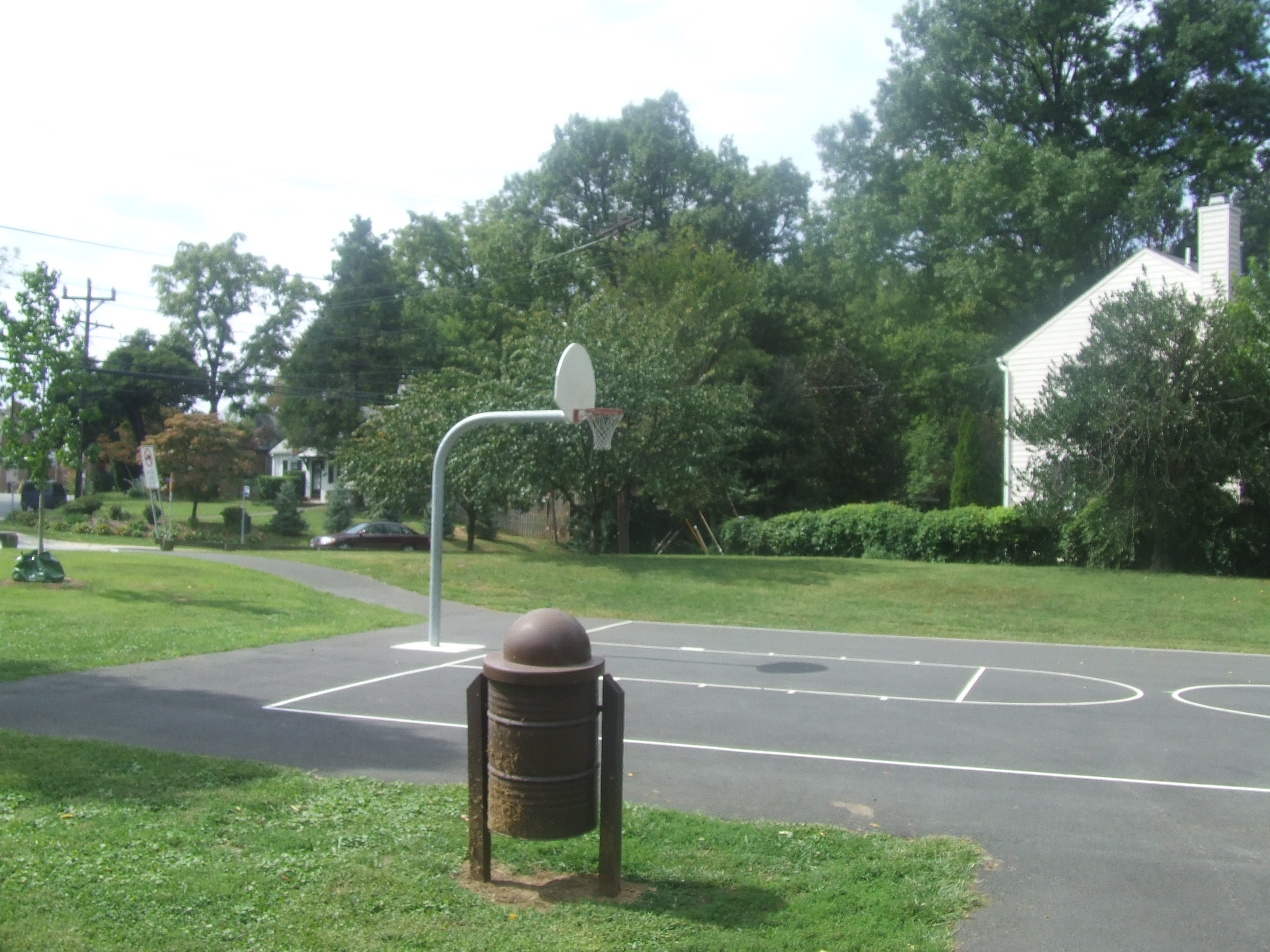
The full court at Jessup-Blair was easily the largest one of the eight examined here, regulation size, with sixteen paces between mid-court and the three-point lines of each half court, and twenty-one paces between the three-point line and the hoop. The hoops themselves measured 10.5 feet off the ground, set up no doubt to discourage dunking, but a bit of a challenge for anyone attempting a jump-shot. Outdoor courts at other parks, including Montgomery Hills, Sligo-Dennis Avenue and Woodland, varied between six and thirteen paces between mid-court and each half-court’s three-point-line, and between twelve and eighteen paces between the three-point-line and each hoop. All had sloping issues, in which the court tilted lower or higher from one side to another.

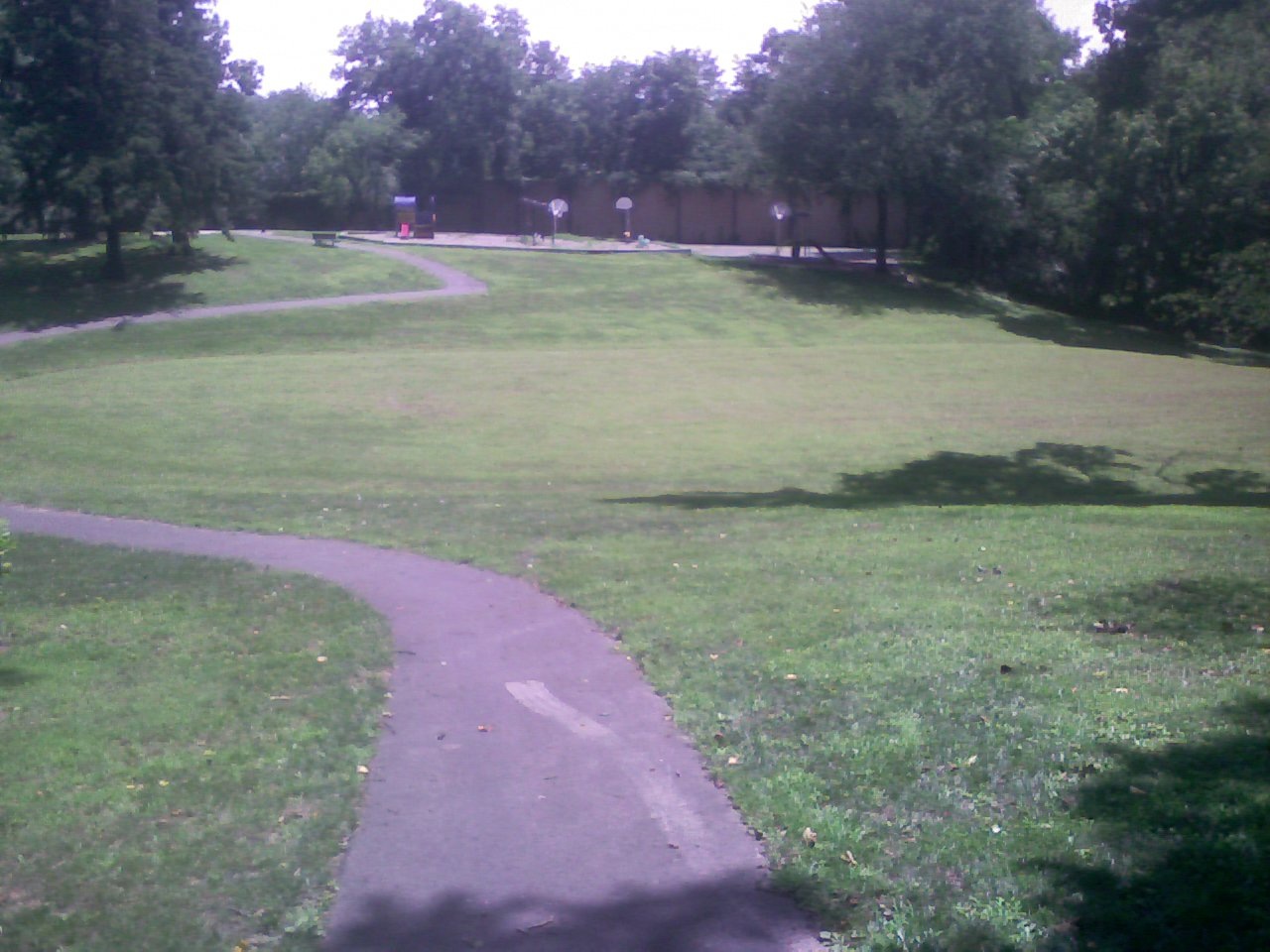
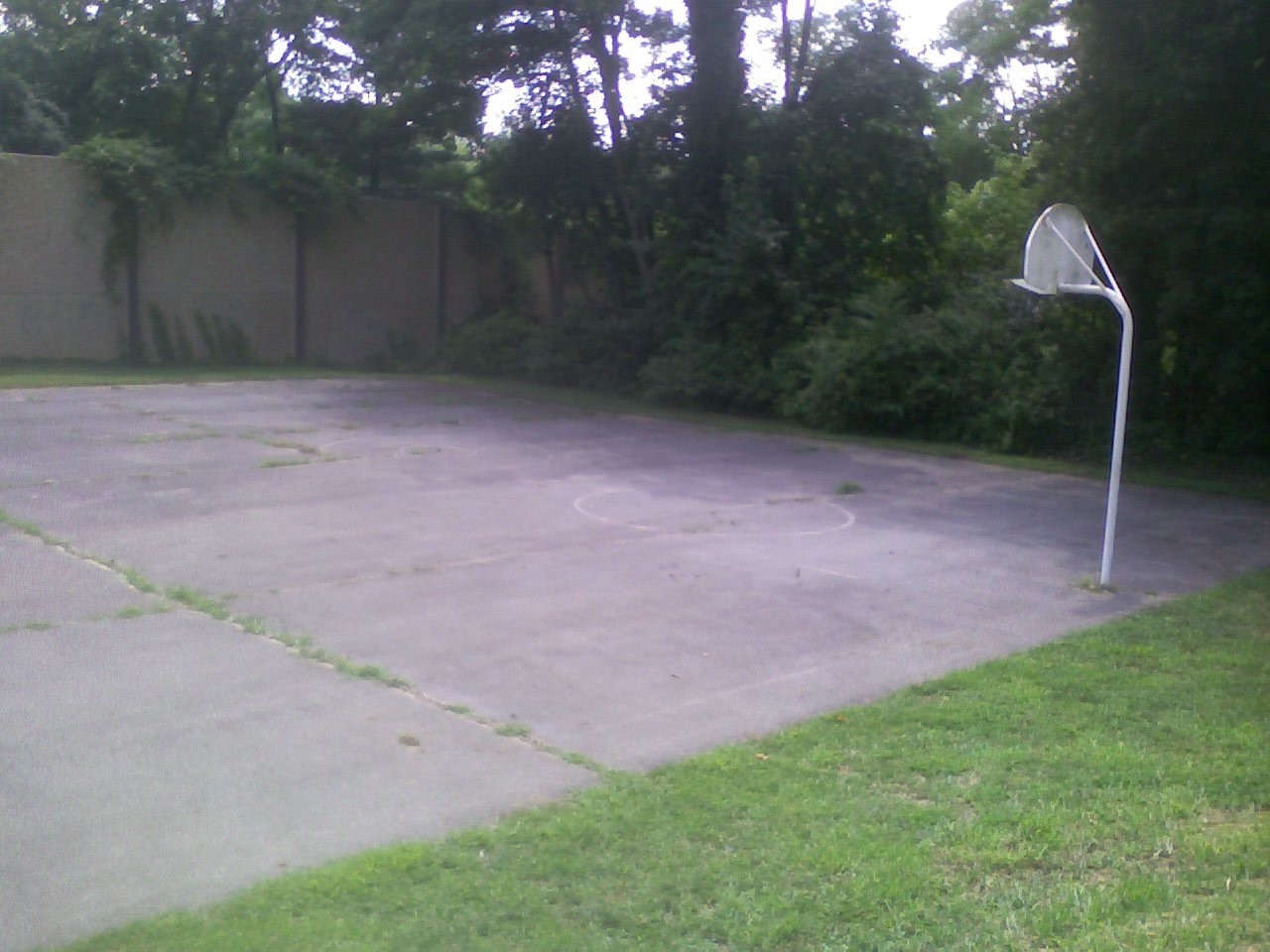
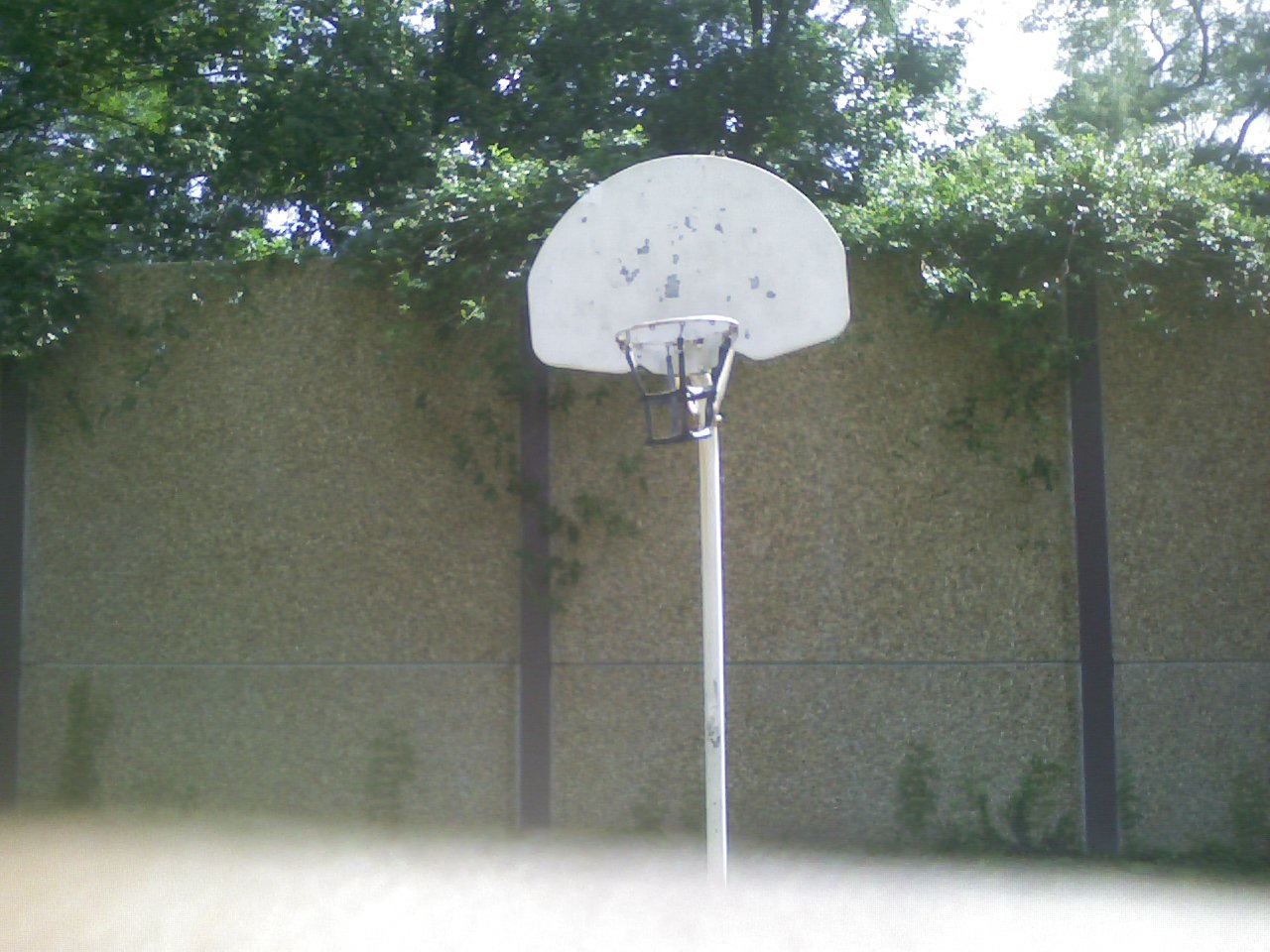
Forest Glen Park’s basketball court was also in critical need of repair. The court was full of potholes, and grass had grown through the numerous deep cracks in the buckling asphalt. The pole, hoop and backboard was missing from one of the two full courts, and the high, uranium-cake colored wall dividing the basketball court from I-495 North had faded graffiti scribbled on it.

All in all, the outdoor basketball courts, while the worst facilities offered by Montgomery County Parks, were hardly the only facilities in need of repair. But they are among the easiest facilities to renovate and maintain. Leveling ground the size of a high school or college court, pouring concrete and asphalt, installing poles, hoops and backboards and painting mid-court, half-court, three-point and other lines costs little compared to re-seeding a soccer field (Jessup-Blair Park) or detoxifying a lake (Wheaton Regional Park).

It would also help to put up fences and gates around these courts, to separate them from the rest of these parks, the same thing Montgomery County Parks would do automatically for tennis courts or a skateboard park. Having neglected these facilities only shows how little one of the richest counties in the US cares about providing low-cost outdoor activities for its new generation of younger residents.

Forest Glen Park basketball court, Silver Spring, MD, August 10, 2010. Source: Donald Earl Collins
Belle Ziegler Park Sign, Takoma Park, MD, September 17, 2010 (Donald Earl Collins)
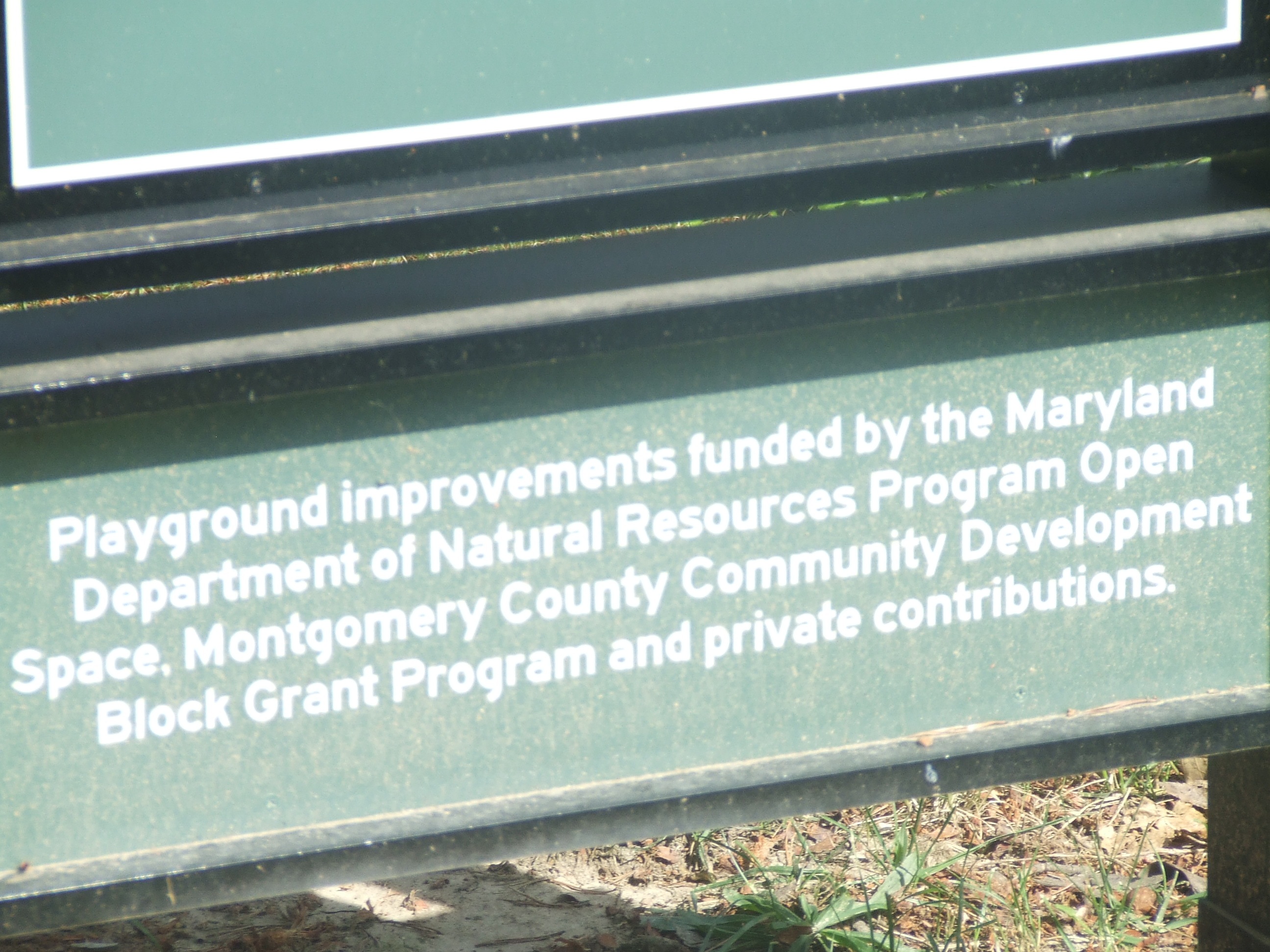
Note on Belle Ziegler Park renovation, Takoma Park, MD, September 17, 2010 (Donald Earl Collins)
Basketball court at Belle Ziegler Park, Takoma Park, MD, September 17, 2010 (Donald Earl Collins)
Metal mesh, hoop and backboard at Belle Ziegler Park, September 17, 2010 (Donald Earl Collins)

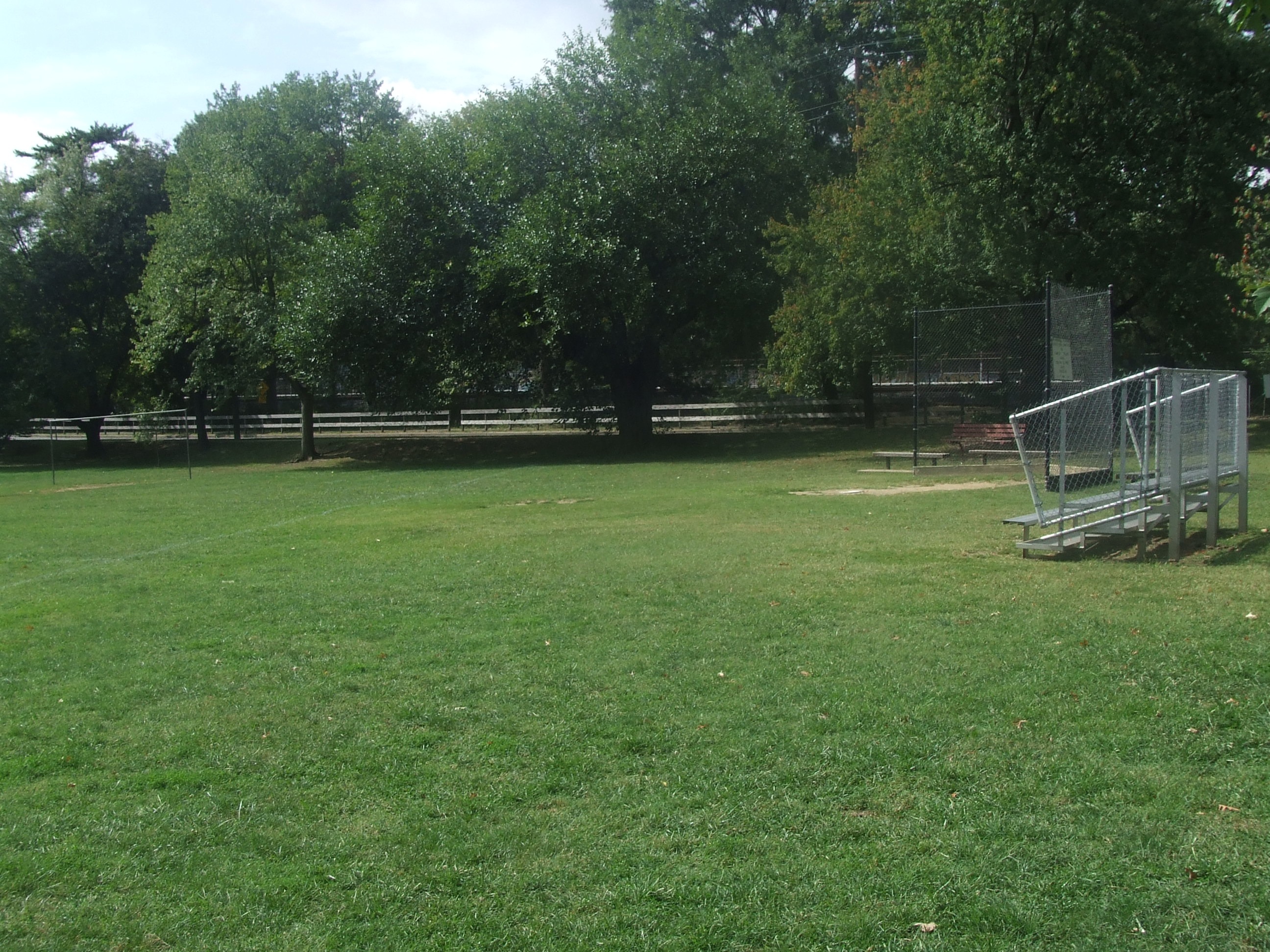
Soccer/softball field and bleachers, Belle Ziegler Park, September 17, 2010 (Donald Earl Collins)
Sign of renovation, Belle Ziegler Park, September 17 2010 (Donald Earl Collins)
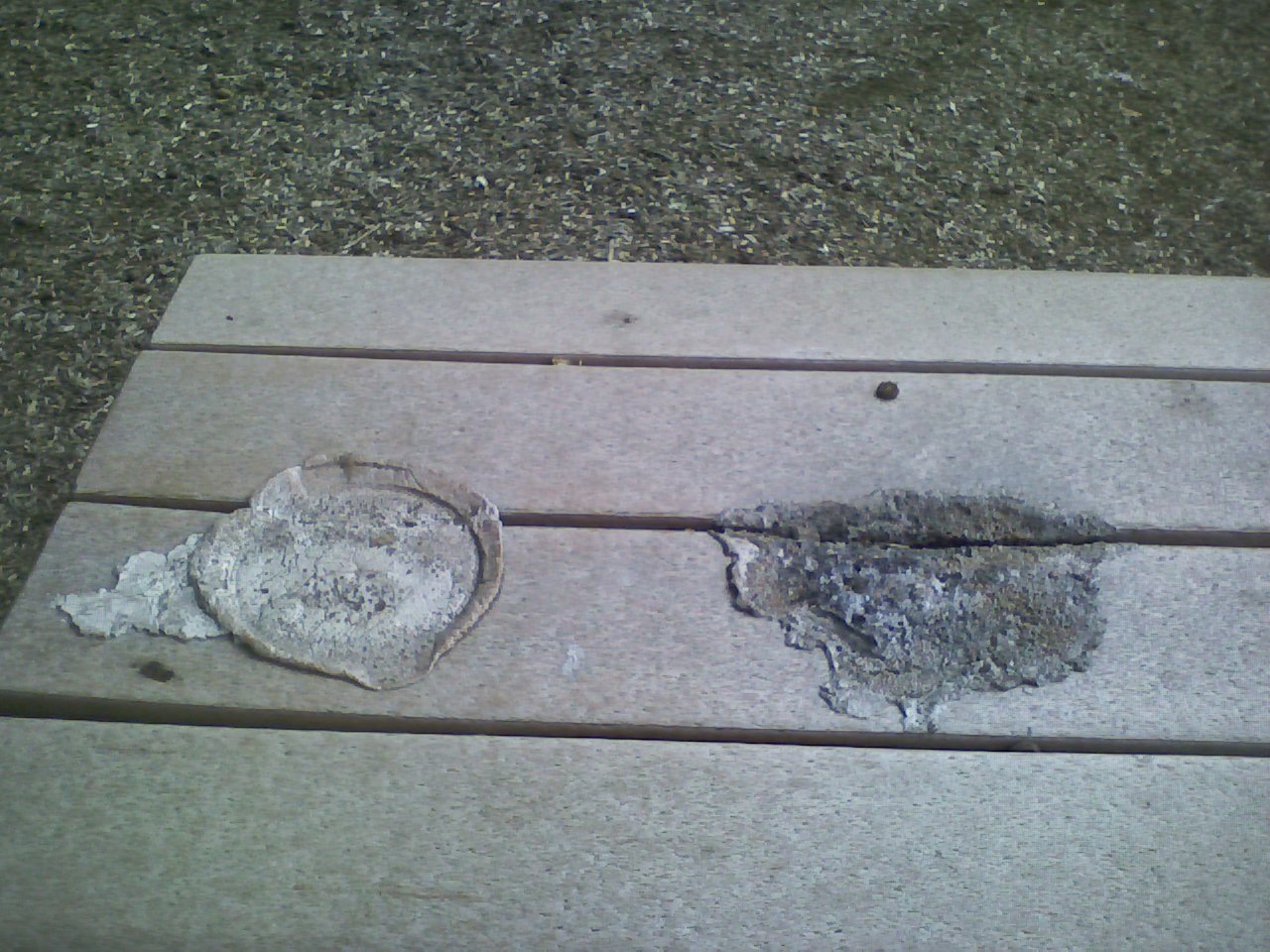
Defaced park table top, Belle Ziegler Park, September 17, 2010 (Donald Earl Collins)
Forest Glen Park Sign, Silver Spring, MD, September 25, 2010 (Donald Earl Collins)
Pathway through Forest Glen Park, Silver Spring, MD, July 30, 2010 (Donald Earl Collins)

Basketball courts, Forest Glen Park, July 30, 2010 (Donald Earl Collins)
One of the full courts (minus a hoop) at Forest Glen Park, July 30, 2010 (Donald Earl Collins)
Asphalt surface and grass outcropping of basketball courts, Forest Glen Park, July 30, 2010 (Donald Earl Collins)
Mid-court and full court dividing lines with cracks and grass growth, Forest Glen Park, July 30, 2010 (Donald Earl Collins)
Basketball hoop and backboard at Forest Glen Park, July 30, 2010 (Donald Earl Collins)

Jessup-Blair Park Sign, Silver Spring-Washington DC border, September 25, 2010 (Donald Earl Collins)
The full court at Jessup-Blair Park, Silver Spring, MD, August 10, 2010 (Donald Earl Collins)
Basketball surface and grass-filled pothole at Jessup-Blair Park, August 10, 2010 (Donald Earl Collins)
The full court’s slope from left to right, Jessup-Blair Park, August 10, 2010 (Donald Earl Collins)
Another picture of the full court’s tilt, this time from the far ends of the court (a downhill view), Jessup-Blair Park, August 10, 2010 (Donald Earl Collins)

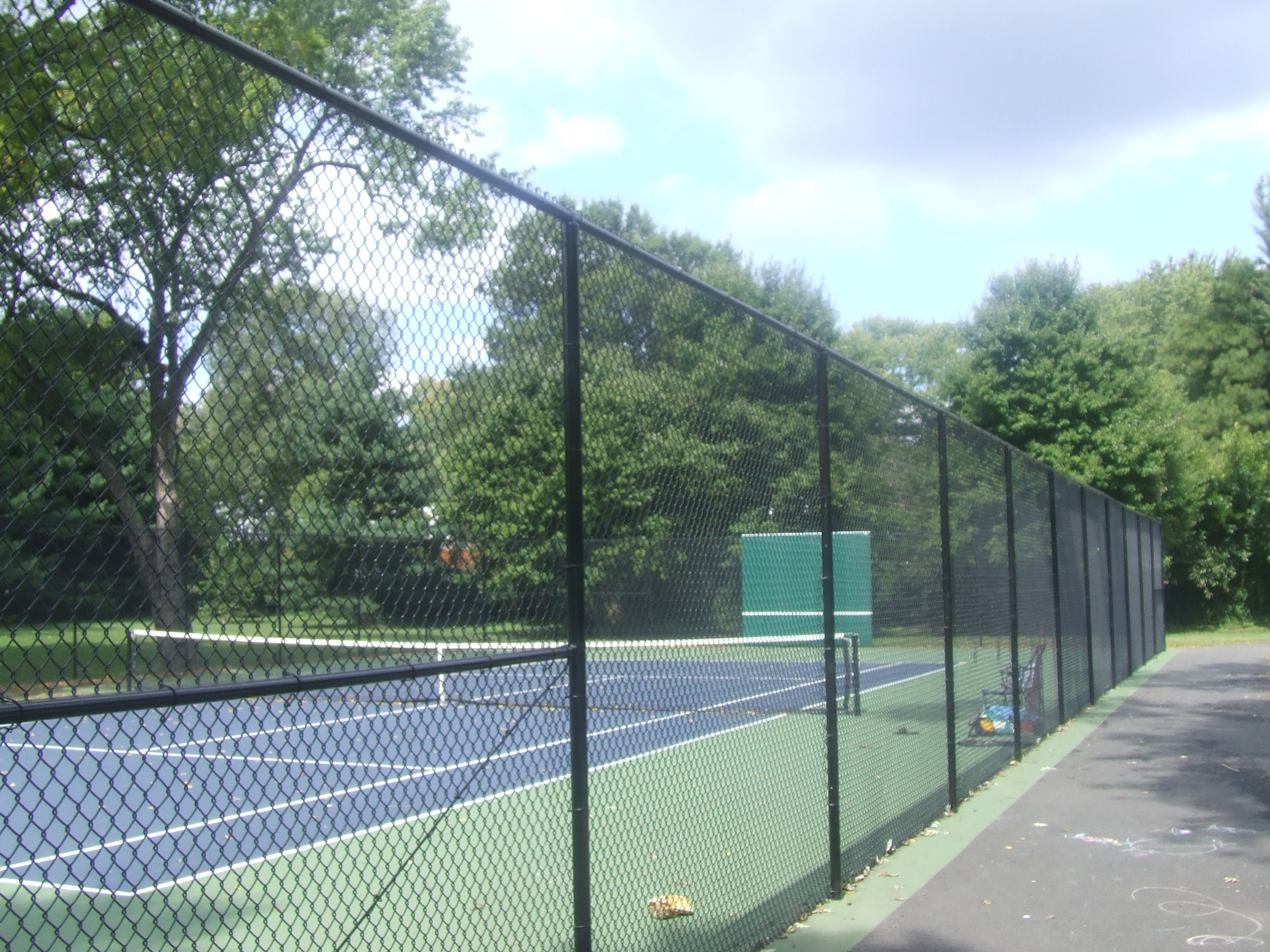
Tennis courts in background, edge of basketball court in foreground (note the fence for the tennis court and asphalt surfaces for both courts), Jessup-Blair Park, August 10, 2010 (Donald Earl Collins)
Basketball hoop on full court, Jessup-Blair Park. (Note the tape measurer in the middle of the picture) August 10, 2010 (Donald Earl Collins)
The height of the hoops at Jessup-Blair Park (126 inches, or 10.5 feet, counting the tape measurer casing), August 10, 2010 (Donald Earl Collins)
Meadowbrook Park Sign, Chevy Chase, MD, September 17, 2010 (Donald Earl Collins)
The basketball courts at Meadowbrook Park, Chevy Chase, MD, September 17, 2010 (Donald Earl Collins)

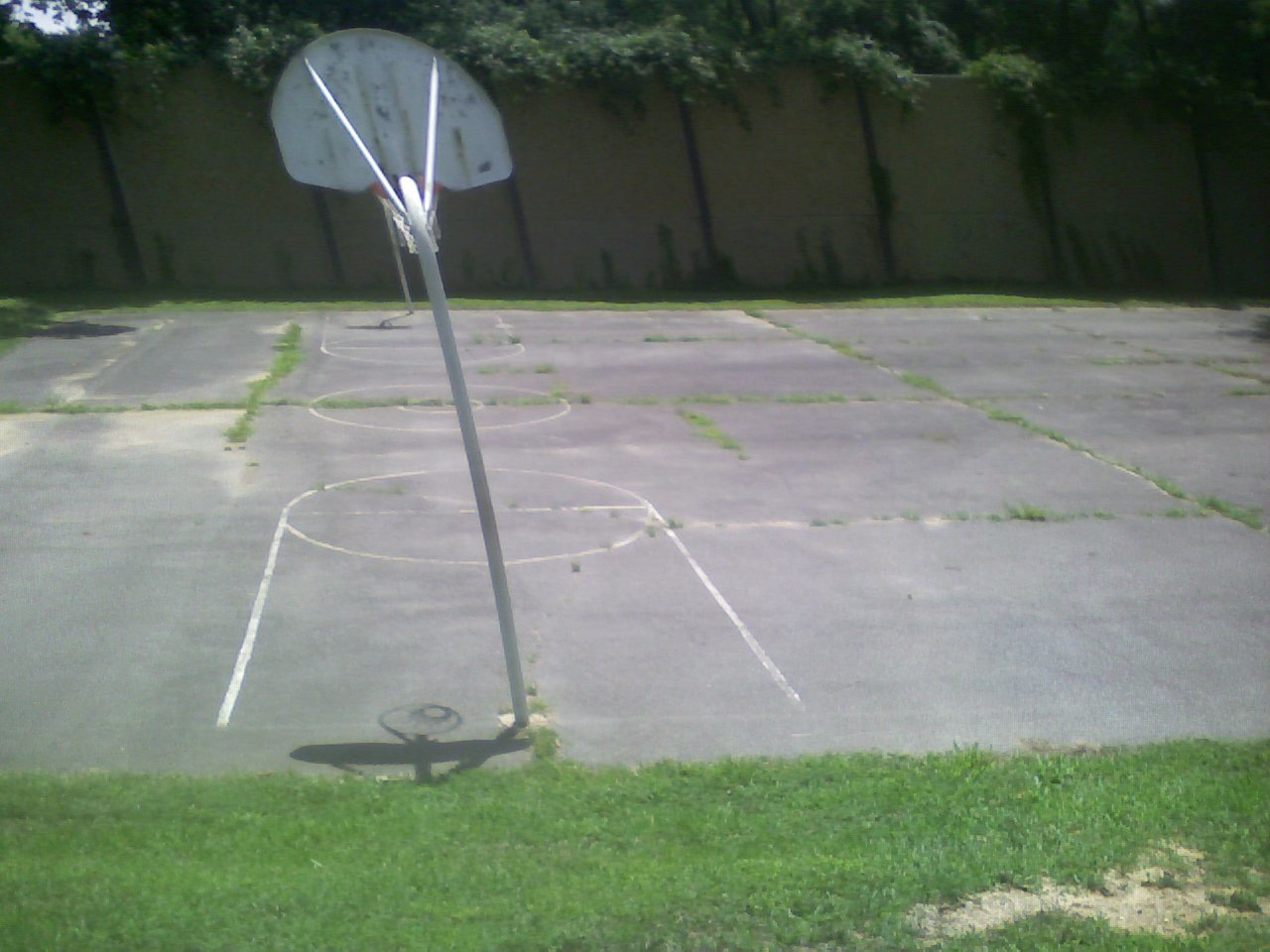
Straight-on shot of severely bent hoop and pole on one full court, Meadowbrook Park, September 17, 2010 (Donald Earl Collins)
Two of the hoops at Meadowbrook Park, including the bent one, September 17, 2010 (Donald Earl Collins)
Asphalt surface of basketball courts, Meadowbrook Park, September 17, 2010 (Donald Earl Collins)
A closer view of the asphalt surface of the basketball courts and the puddle-filled depressions on the court, Meadowbrook Park, September 17, 2010 (Donald Earl Collins)
Muddy tire track and footprints on basketball court, Meadowbrook Park, September 17, 2010 (Donald Earl Collins)

Cracks and grass outcroppings on basketball courts, Meadowbrook Park, September 17, 2010 (Donald Earl Collins)
The basketball courts (taken from the soccer field perspective) at Meadowbrook Park, September 17, 2010 (Donald Earl Collins)
One (1) of the four (4) gated tennis courts at Meadowbrook Park, September 17, 2010 (Donald Earl Collins)
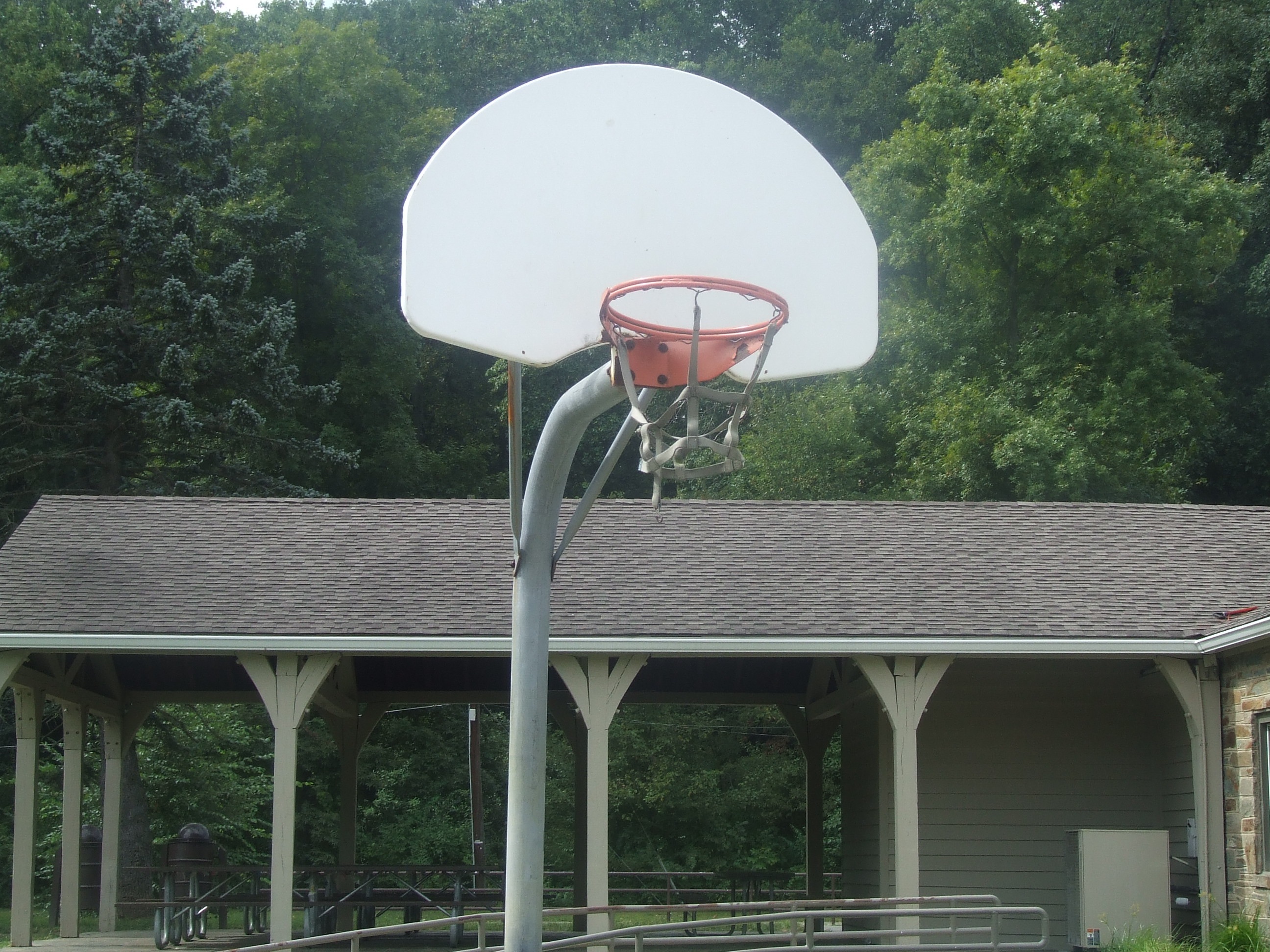
Backboard, support and pipe at Meadowbrook Park, Chevy Chase, MD, September 17, 2010 (Donald Earl Collins)
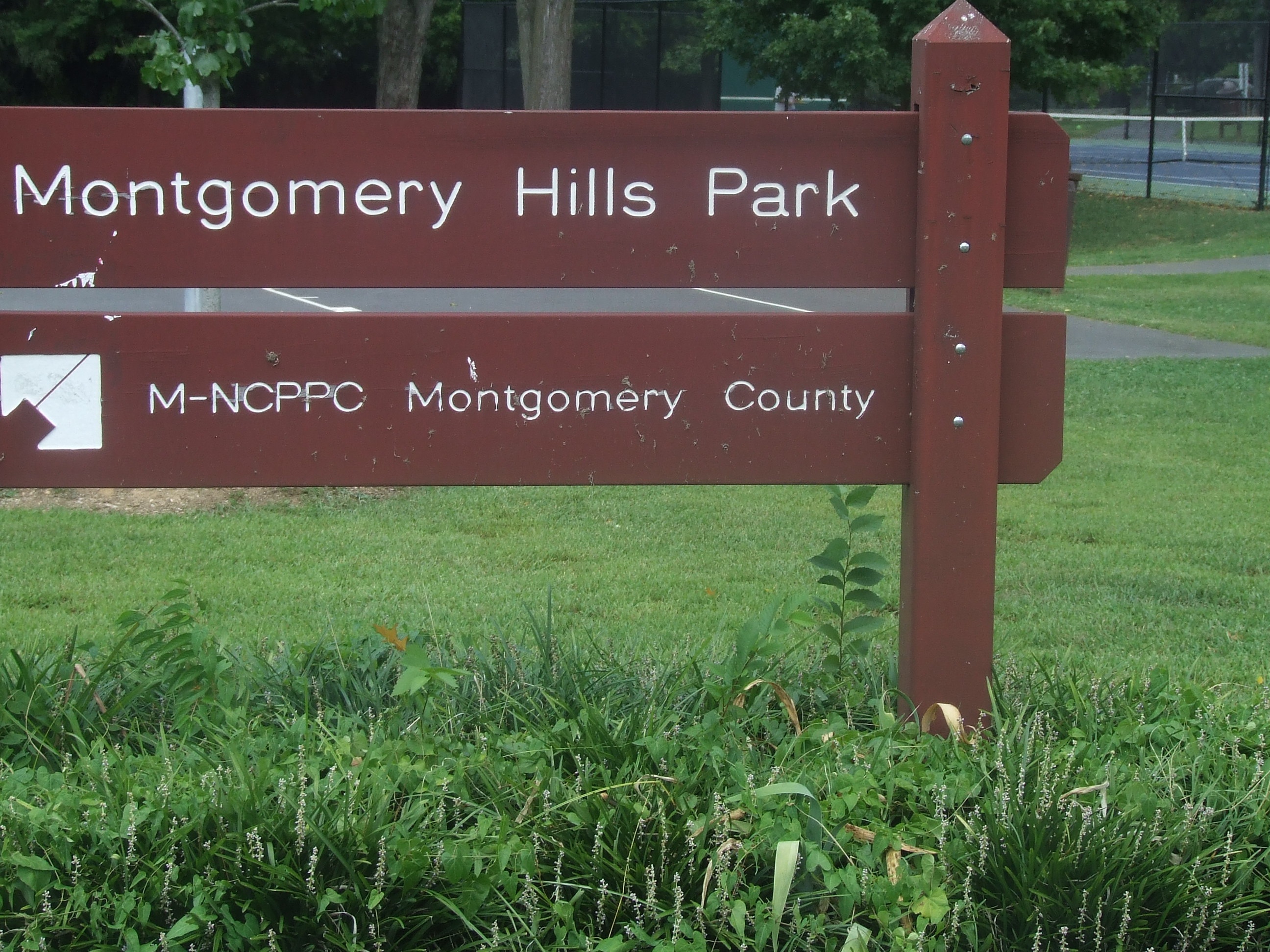
Montgomery Hills Park sign, Silver Spring, MD, September 17, 2010 (Donald Earl Collins)

The one full basketball court at Montgomery Hills Park (note the uphill-downhill slope of the court), Silver Spring, MD, September 17, 2010 (Donald Earl Collins)
Another example of the uphill-downhill tilt of the basketball court, Montgomery Hills Park, Silver Spring, MD, September 17, 2010 (Donald Earl Collins)
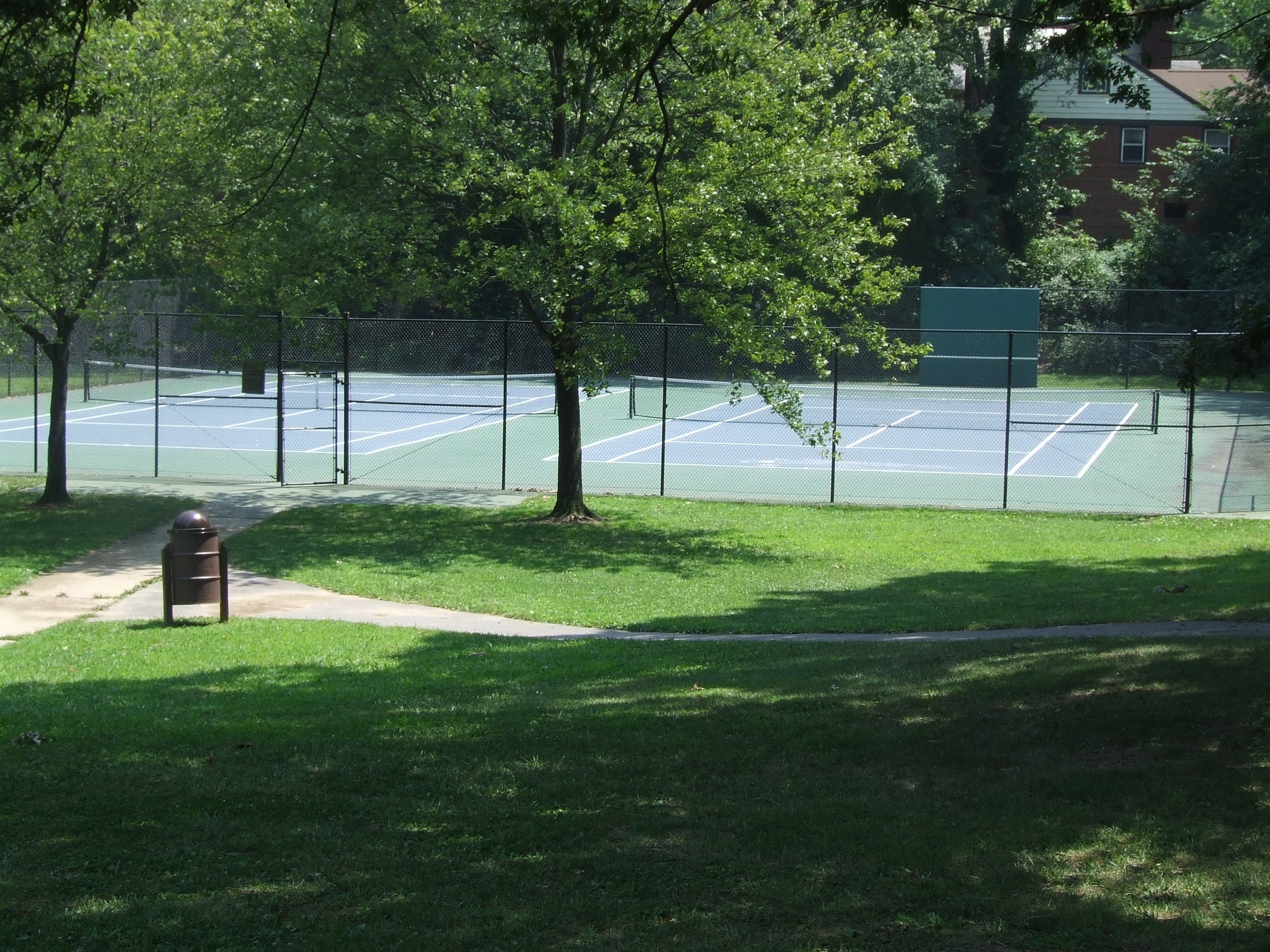
Renovated tennis court, including new gate, Montgomery Hills Park, September 17, 2010 (Donald Earl Collins)
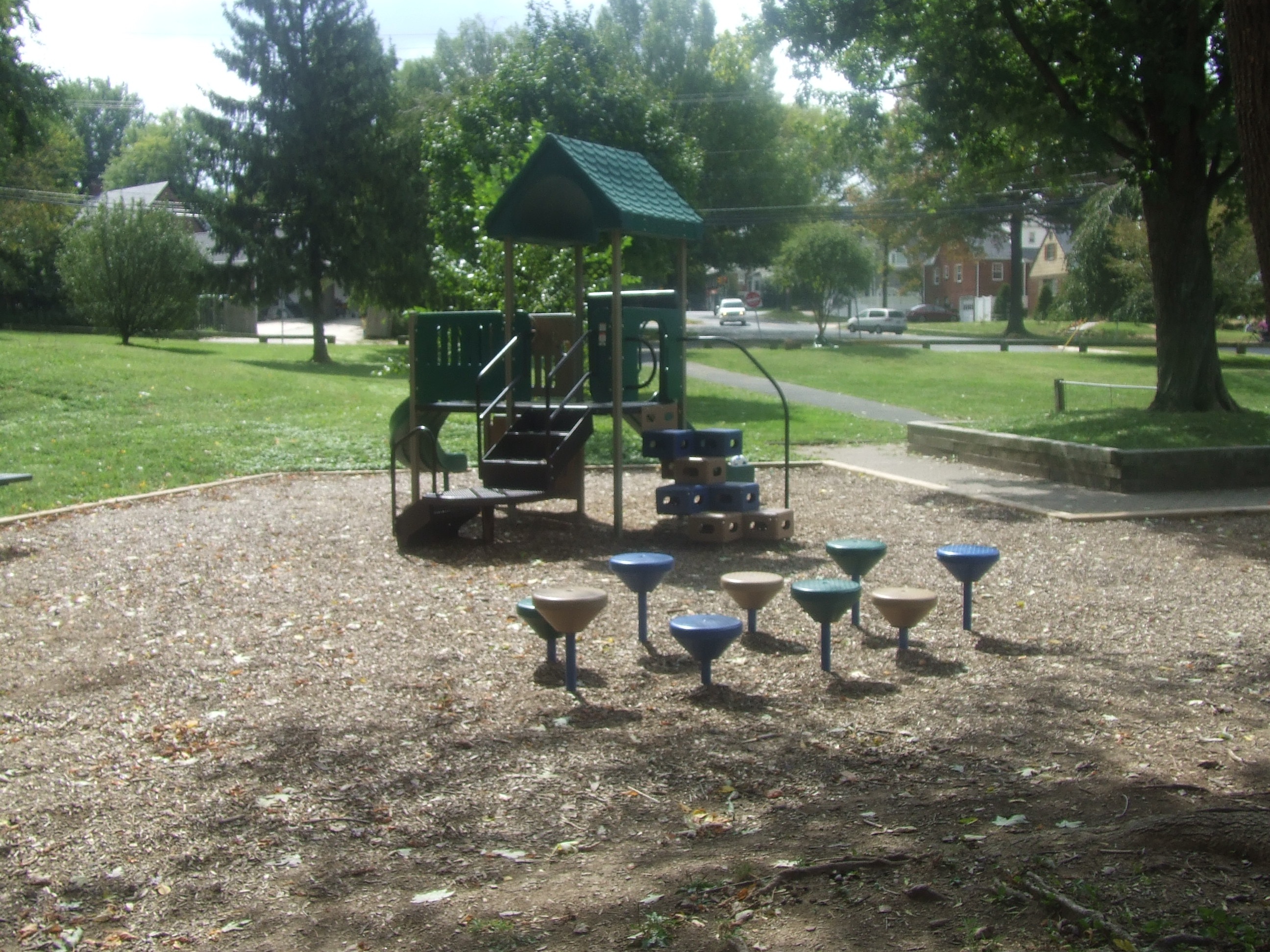
Part of renovated playground, Montgomery Hills Park, September 17, 2010 (Donald Earl Collins)
A minature fake boulder for children to climb as part of renovation, Montgomery Hills Park, September 17, 2010 (Donald Earl Collins)

Another part of the playground renovation, Montgomery Hills Park, September 17, 2010 (Donald Earl Collins)
Silver Spring Intermediate Park, Silver Spring-Takoma Park, MD border (across from Montgomery College), September 25, 2010 (Donald Earl Collins)
The hill adjacent to one of the two full courts and the fenced in tennis courts at the bottom of the hill, Silver Spring Intermediate Park, Silver Spring, MD, August 10, 2010 (Donald Earl Collins)
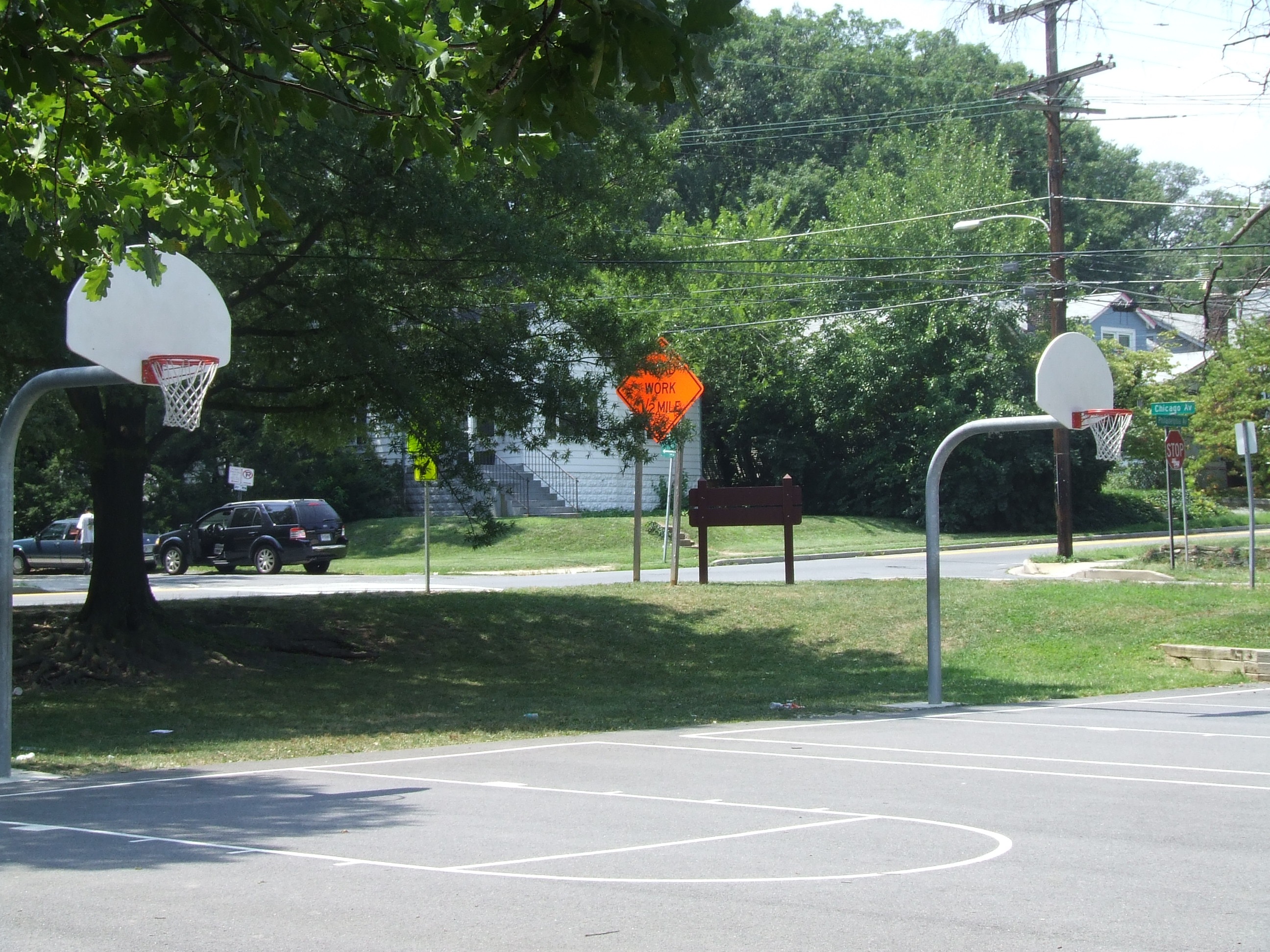
The hoops facing Philadelphia Avenue, Silver Spring Intermediate Park, Silver Spring, MD, August 10, 2010 (Donald Earl Collins)
The hoop facing the parking lot, Silver Spring Intermediate Park, Silver Spring, MD, August 10, 2010 (Donald Earl Collins)

The other hoop facing the parking lot, Silver Spring Intermediate Park, August 10, 2010 (Donald Earl Collins)
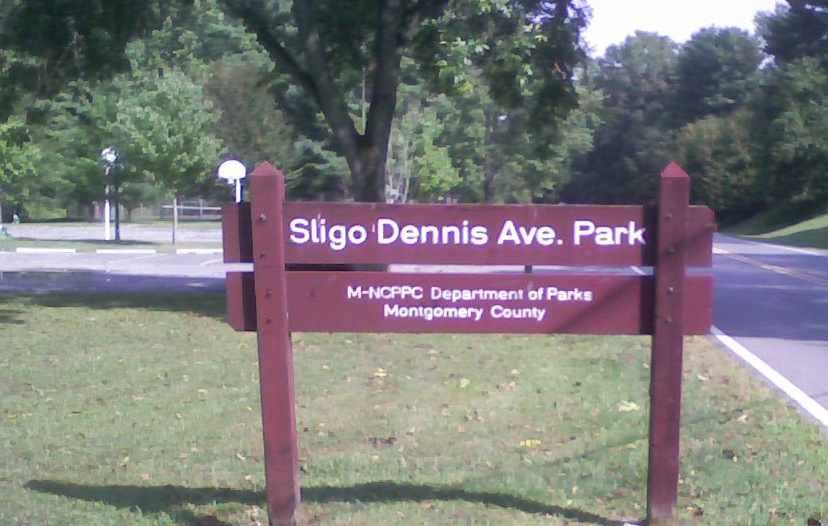
Sligo Dennis Ave Park sign, Sligo Creek Parkway, Silver Spring, MD, September 23, 2010 (Donald Earl Collins)
Two full courts for basketball, along with one other full court (not picured), Sligo Dennis Ave Park, Silver Spring, MD, September 23, 2010 (Donald Earl Collins)
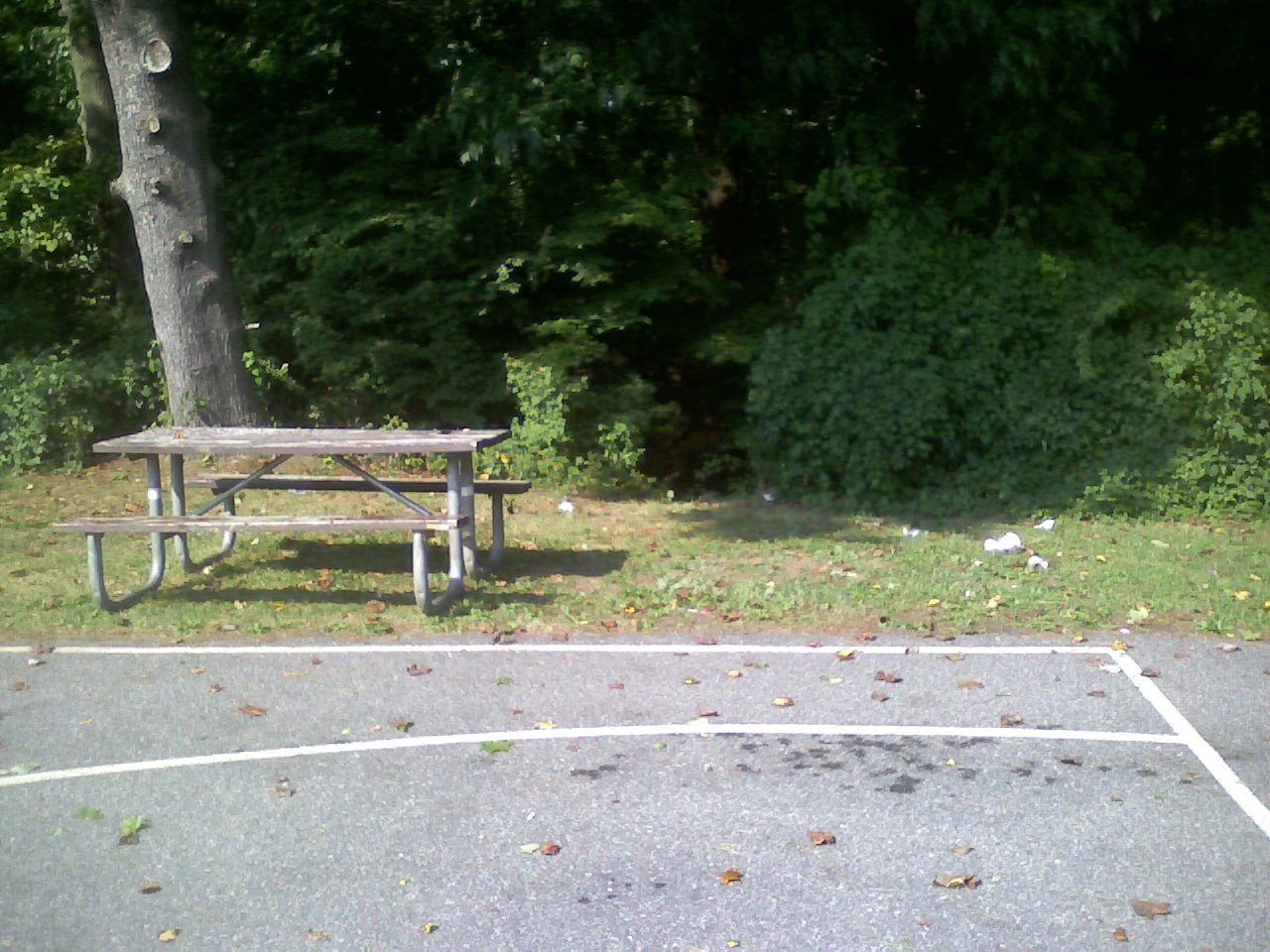
Three-point line on second full-court, adjacent to the woods and a revine, Sligo Dennis Ave Park, Silver Spring, MD, September 23, 2010 (Donald Earl Collins)
A hoop at one end of a full court, with the woods in the immediate background, Sligo Dennis Ave Park, September 23, 2010 (Donald Earl Collins)

The tennis courts next to the basketball courts at Sligo Dennis Ave Park, September 23, 2010 (Donald Earl Collins)
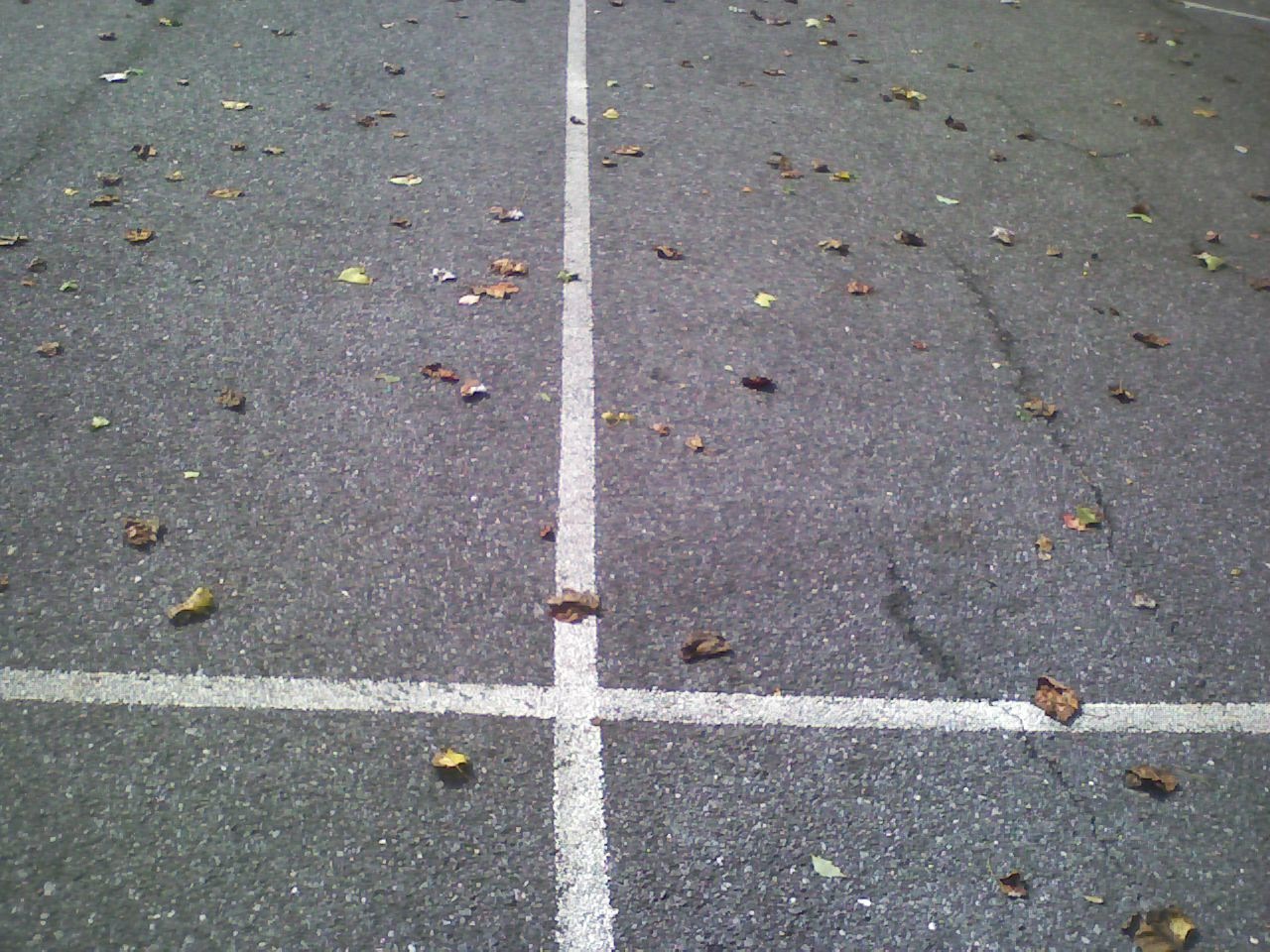
The lines — and the lack of space — separating the two main full courts at Sligo Dennis Ave Park, September 23, 2010 (Donald Earl Collins)
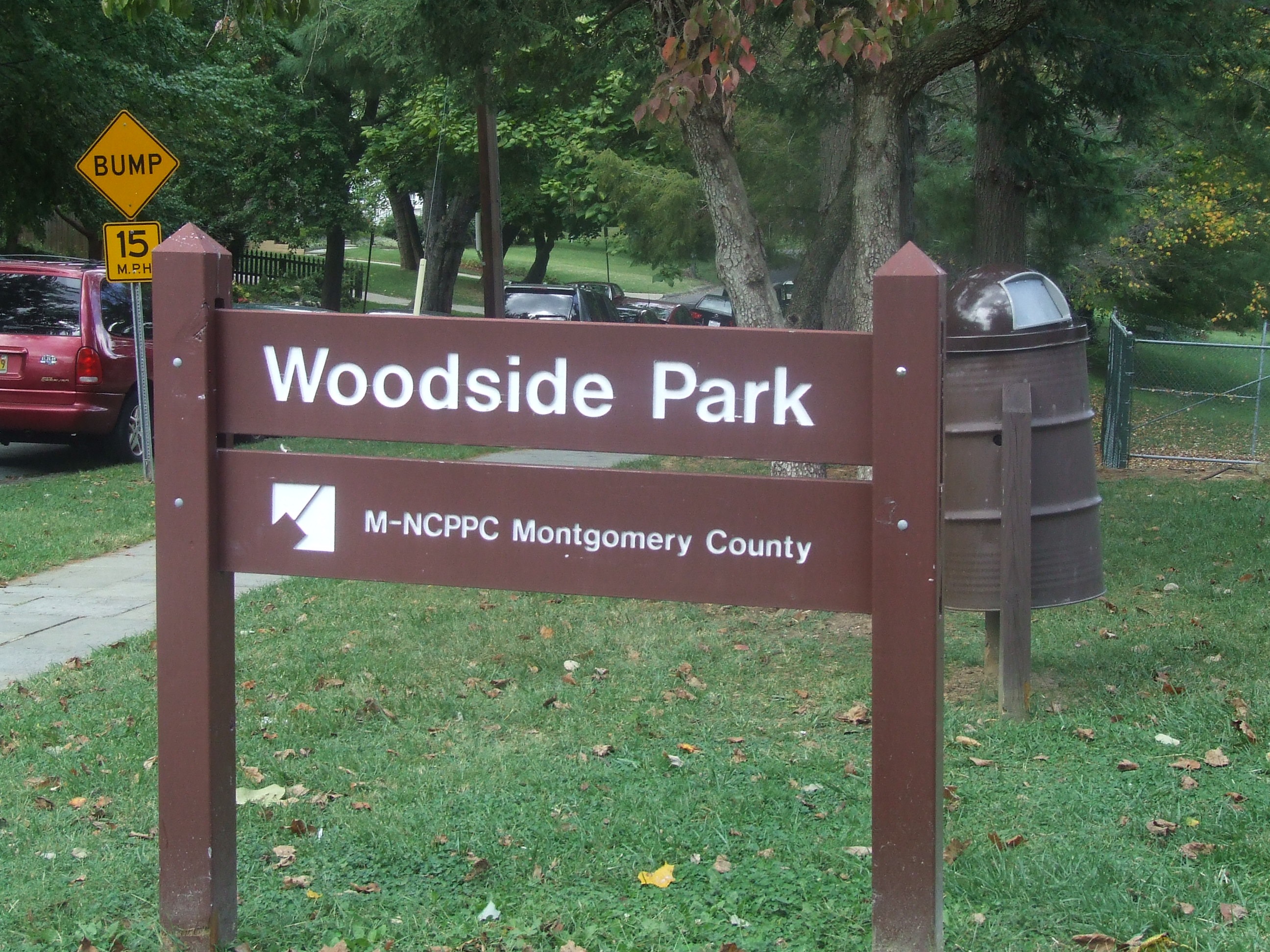
Woodside Park sign, Downtown Silver Spring, MD, September 17, 2010 (Donald Earl Collins)
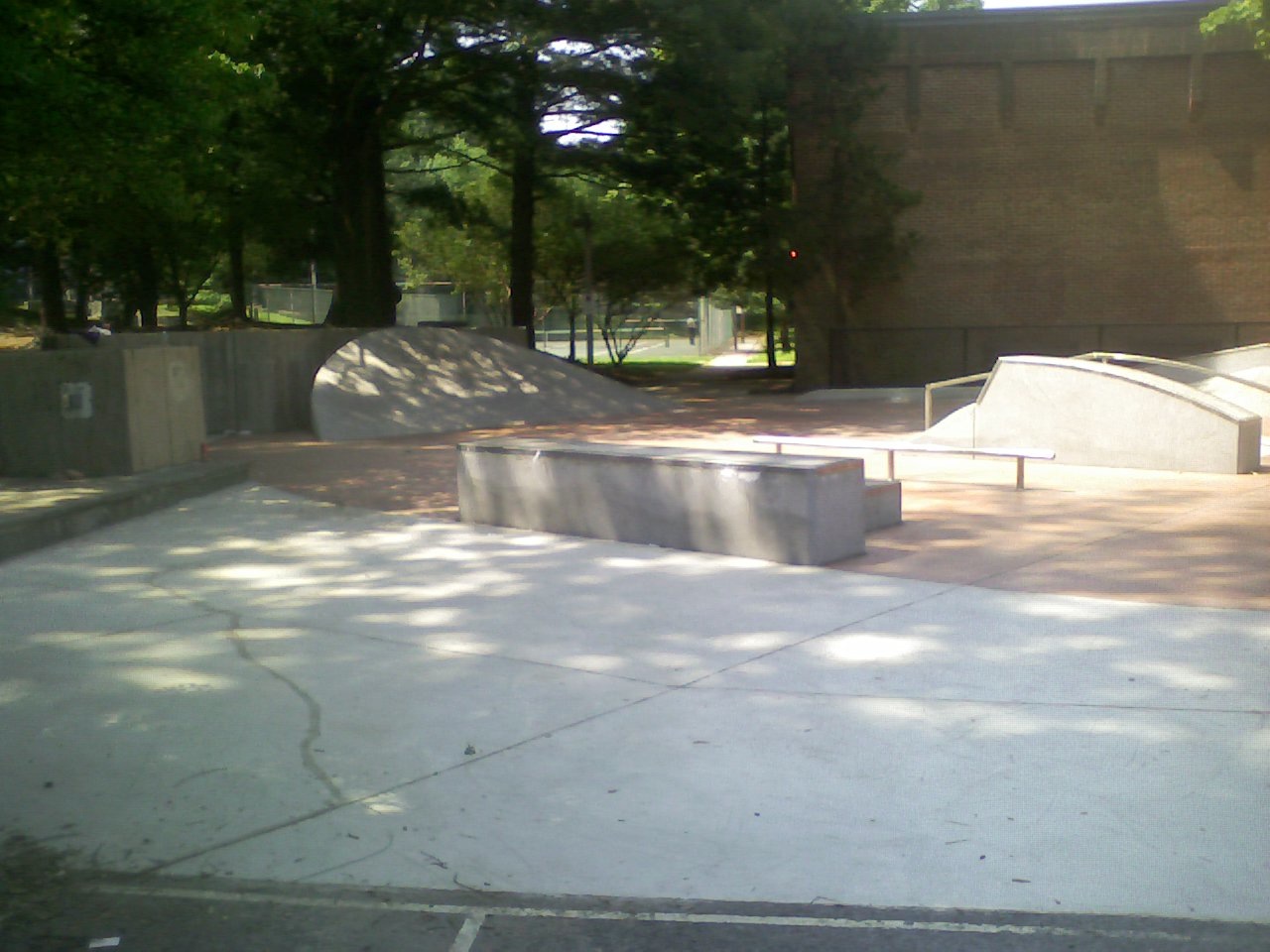
The newly installed mini-skateboard park (minus a fence between it and the basketball court), Downtown Silver Spring, MD, August 8, 2010 (Donald Earl Collins)
The one outdoor full court at Woodside Park (there is one indoor basketball court — usually closed — at this facility as well), Downtown Silver Spring, MD, August 8, 2010 (Donald Earl Collins)

The front court at Woodside Park facing Georgia Avenue (note the fence to keep basketballs from flying into traffic), Downtown Silver Spring, MD, August 8, 2010 (Donald Earl Collins)
The other end of the basketball court and the skateboard park (again, minus a fence), Woodside Park, August 8, 2010 (Donald Earl Collins)
A fuller view of the half court and skateboarding area, along with the adjancent health clinic and (closed) indoor basketball court, Woodside Park, August 8, 2010 (Donald Earl Collins)
The back end of the court, this time with a fence separating it from the skateboard park, Woodside Park, September 17, 2010 (Donald Earl Collins)
Another view of the skateboarding park and the new fence, Woodside Park, September 17, 2010 (Donald Earl Collins)

A full view of the hoop, new fence and skateboarding area, Woodside Park, September 17, 2010 (Donald Earl Collins)
Renovations to the playground area, including a bouncing apparatus, Woodside Park, September 17, 2010 (Donald Earl Collins)
A climbing area that had been recently installed as part of the playground renovations, Woodside Park, September 17, 2010 (Donald Earl Collins)
A fuller shot of the new equipment in the playground area, Woodside Park, September 17, 2010 (Donald Earl Collins)
The tennis court at Woodside Park a month after a powerful storm detroyed the fence around and net in it, September 17, 2010 (Donald Earl Collins)


Half-Baked Z and Christian Zeal

27 Monday Sep 2010

Posted by decollins1969 in 1, Boy @ The Window, Christianity, culture, Eclectic, Jimme, Mount Vernon High School, New York City, Religion, Youth

≈ Leave a comment

Tags

Arrogance, Baked Ziti, Christian Zeal, Kufi, Religion, Religious Zeal, Teaching and Learning, Wisdom


Baked Ziti. Source: http://culinariaitalia.files.wordpress.com/

Sometimes I’ve let my enthusiasm for good things in my life get the better of me. Perhaps that’s because there have been few periods in my life where nearly everything has gone the way I’d expect, especially in my Humanities years. One of those times had been in the months before, during and after my conversion to Christianity in ’84. After I outed myself at the beginning of tenth grade as a Christian and stood up (for once) to my idiot stepfather by refusing to wear my kufi ever again, things in my mind had improved. So much so that I was ready for my life to change, as if my conversion were a magic wand and I was Cinderella.

My conversion became a badge of honor, my Bible my new crutch in the first few months after becoming a Christian and the beginning of tenth grade. I read it every chance I had. At lunch, in my trips into New York with my father Jimme and my brother Darren, before I went to bed at night. Like a nine-year-old, I so wanted my life to change that I forgot that I still had work to do in order to change it. Prayer and fasting (deliberate, of course, and not the empty refrigerator kind) wouldn’t be enough. But I acted like it was.

Torture & the Spanish Inquisition (the direction of unchecked zeal).

It didn’t help that I had Z as a history teacher, one who almost automatically rubbed me the wrong way. She assumed that she was right about everything and looked like an older, worn-out, schoolmarmish version of Madonna to me, a woman whose best days were long past. She was about average height with blonde-gray hair, which looked like it had been freeze-dried. She dressed like a woman who didn’t realize we were in a public school and who didn’t see herself as a real person. Her voice was a slow-whine Brooklyn-accented version of Cyndi Lauper’s, the kind that made me think that she was talking down to us. It irritated the heck out of me when she’d call one of us “Peaches” or when she’d say, “When they’re slow they’re slow,” a reference to how long it would take us to answer one of her idiotic, non-history history questions. A personable person with emotions and empathy, the kind of person equipped to teach a diverse student body, Z was not.

After finishing one of Z’s bubble tests early, fifteen minutes early, as a matter of fact, I handed it in and pulled out my Bible. When she noticed what I was reading, she panicked. “Put that away! Put that away now!,” she yelled from her gray steel desk, exasperated. The exchange we had occurred while other classmates were finishing their exams.

“I’m just reading my Bible.”

“You can’t read that in school!”

“I know my rights! I have a First Amendment right to read the Bible in school, and you’re not teaching right now anyway!”

She threatened to send me to the principal’s office. I called her an “atheist” and put my Bible away. It was the start of a confrontational relationship between me and her.

We got into it quite a few times. One time was over what she was teaching in class, what exactly I don’t remember. What I did in response to it was to blurt out “Is this what you call history? All you talk about is art and music!” She banished me to the hallway outside of class for that one. I called her a “stupid atheist” on my way out.

We were both right and both wrong, both arrogant in our own way. Z was a teacher without an appreciation for student development and socialization. I was a new Christian on a high, believing that my spiritual status would by itself put me in right standing whatever I did. In the end, Z should’ve allow me to read my Bible, and I shouldn’t have confronted her based on her religious or non-religious beliefs. Our perspectives were half-baked, our stances too inflexible. I’m just glad that I’ve become a better person and Christian since those first days.

← Older posts
Newer posts →

Boy @ The Window: A Memoir

Boy @ The Window: A Memoir

Places to Buy/Download Boy @ The Window

There's a few ways in which you can read excerpts of, borrow and/or purchase and download Boy @ The Window. There's the trade paperback edition of Boy @ The Window, available for purchase via Amazon.com at http://www.amazon.com/Boy-Window-Donald-Earl-Collins/dp/0989256138/

There's also a Kindle edition on Amazon.com. The enhanced edition can be read only with Kindle Fire, an iPad or a full-color tablet. The links to the enhanced edition through Apple's iBookstore and the Barnes & Noble NOOK edition are below. The link to the Amazon Kindle version is also immediately below:

scr2555-proj697-a-kindle-logo-rgb-lg

Boy @ The Window on Amazon.com: http://www.amazon.com/Boy-The-Window-Memoir-ebook/dp/B00CD95FBU/

iBookstore-logo-300x100

Boy @ The Window on Apple's iBookstore: https://itunes.apple.com/us/book/boy-the-window/id643768275?ls=1

Barnes & Noble (bn.com) logo, June 26, 2013. (http://www.logotypes101.com).

Boy @ The Window on Barnes & Noble: http://www.barnesandnoble.com/w/boy-the-window-donald-earl-collins/1115182183?ean=2940016741567

You can also add, read and review Boy @ The Window on Goodreads.com. Just click on the button below:

Boy @ The Window

Twitter Updates

Tweets by decollins1969
  • RSS - Posts
  • RSS - Comments

Archives

  • June 2025
  • April 2023
  • September 2022
  • August 2022
  • July 2022
  • June 2022
  • May 2022
  • April 2022
  • March 2022
  • January 2022
  • December 2021
  • November 2021
  • October 2021
  • September 2021
  • August 2021
  • July 2021
  • June 2021
  • April 2021
  • March 2021
  • February 2021
  • January 2021
  • December 2020
  • November 2020
  • October 2020
  • September 2020
  • August 2020
  • July 2020
  • May 2020
  • April 2020
  • March 2020
  • January 2020
  • December 2019
  • November 2019
  • August 2019
  • July 2019
  • June 2019
  • May 2019
  • April 2019
  • March 2019
  • February 2019
  • January 2019
  • December 2018
  • November 2018
  • October 2018
  • September 2018
  • August 2018
  • July 2018
  • June 2018
  • May 2018
  • March 2018
  • February 2018
  • January 2018
  • December 2017
  • November 2017
  • October 2017
  • September 2017
  • August 2017
  • July 2017
  • June 2017
  • May 2017
  • April 2017
  • March 2017
  • February 2017
  • January 2017
  • December 2016
  • November 2016
  • October 2016
  • September 2016
  • August 2016
  • July 2016
  • June 2016
  • May 2016
  • April 2016
  • March 2016
  • February 2016
  • January 2016
  • December 2015
  • November 2015
  • October 2015
  • September 2015
  • August 2015
  • July 2015
  • June 2015
  • May 2015
  • April 2015
  • March 2015
  • February 2015
  • January 2015
  • December 2014
  • November 2014
  • October 2014
  • September 2014
  • August 2014
  • July 2014
  • June 2014
  • May 2014
  • April 2014
  • March 2014
  • February 2014
  • January 2014
  • December 2013
  • November 2013
  • October 2013
  • September 2013
  • August 2013
  • July 2013
  • June 2013
  • May 2013
  • April 2013
  • March 2013
  • February 2013
  • January 2013
  • December 2012
  • November 2012
  • October 2012
  • September 2012
  • August 2012
  • July 2012
  • June 2012
  • May 2012
  • April 2012
  • March 2012
  • February 2012
  • January 2012
  • December 2011
  • November 2011
  • October 2011
  • September 2011
  • August 2011
  • July 2011
  • June 2011
  • May 2011
  • April 2011
  • March 2011
  • February 2011
  • January 2011
  • December 2010
  • November 2010
  • October 2010
  • September 2010
  • August 2010
  • July 2010
  • June 2010
  • May 2010
  • April 2010
  • March 2010
  • February 2010
  • January 2010
  • December 2009
  • November 2009
  • October 2009
  • September 2009
  • August 2009
  • July 2009
  • June 2009
  • May 2009
  • April 2009
  • March 2009
  • February 2009
  • January 2009
  • December 2008
  • November 2008
  • October 2008
  • September 2008
  • August 2008
  • July 2008
  • June 2008
  • May 2008
  • April 2008
  • March 2008
  • February 2008
  • January 2008
  • December 2007
  • November 2007
  • October 2007
  • September 2007
  • August 2007
  • July 2007
  • June 2007

Recent Comments

MaryPena's avatarMaryPena on My Day of Atonement/Bitter Hat…
decollins1969's avatardecollins1969 on No Good Teaching Deed Goes…
Mary Rose O’Connell's avatarMary Rose O’Connell on No Good Teaching Deed Goes…

NetworkedBlogs on Facebook

NetworkedBlogs
Blog:
Notes From a Boy @ The Window
Topics:
My Life, Culture & Education, Politics & Goofyness
 
Follow my blog

616 616 East Lincoln Avenue A.B. Davis Middle School Abuse Academia Academy for Educational Development AED Afrocentricity American Narcissism Authenticity Bigotry Blackness Boy @ The Window Carnegie Mellon University Child Abuse Class of 1987 CMU Coping Strategies Crush #1 Crush #2 Death Disillusionment Diversity Domestic Violence Economic Inequality Education Family Friendship Friendships Graduate School Hebrew-Israelites High-Stakes Testing Higher Education History Homelessness Humanities Humanities Program Hypocrisy Internalized Racism Jealousy Joe Trotter Joe William Trotter Jr. K-12 Education Love Manhood Maurice Eugene Washington Maurice Washington Misogyny Mother-Son Relationship Mount Vernon High School Mount Vernon New York Mount Vernon public schools Multiculturalism MVHS Narcissism NFL Pitt Pittsburgh Politics of Education Poverty President Barack Obama Race Racial Stereotypes Racism Relationships Self-Awareness Self-Discovery Self-Reflection Sexism Social Justice Teaching and Learning University of Pittsburgh Violence Whiteness Writing

Top Rated

Blog at WordPress.com.

  • Subscribe Subscribed
    • Notes from a Boy @ The Window
    • Join 103 other subscribers
    • Already have a WordPress.com account? Log in now.
    • Notes from a Boy @ The Window
    • Subscribe Subscribed
    • Sign up
    • Log in
    • Report this content
    • View site in Reader
    • Manage subscriptions
    • Collapse this bar
 

Loading Comments...