
• About Me
  • Other Writings
  • Interview Clips
  • All About Me: American Racism, American Narcissism, and the Conversation America Can’t Have
  • Video Clips
  • Boy @ The Window Pictures
  • Boy @ The Window Theme Music

Notes from a Boy @ The Window

~

Notes from a Boy @ The Window

Tag Archives: W. E. B. Du Bois

Grad School & My Most Special Summer Reading List

31 Saturday Aug 2013

Posted by decollins1969 in 1, Academia, Boy @ The Window, culture, Eclectic, Pittsburgh, Politics, Pop Culture, race, University of Pittsburgh, Work, Youth

≈ Leave a comment

Tags

"I Have A Dream" speech, Afrocentricity, Black Culture, Black History, Blackness, Books, Carter G. Woodson, Department of HIstory, Elaine, Graduate School, Higher Education, Joe White, K-12 Education, Malcolm X, March on Washington, Multicultural Education, Pitt, Readings, Self-Discovery, Toni Morrison, W. E. B. Du Bois, Western Psych, Western Psychiatric Institute & Clinic


Just a small sample of the books I read/re-read summer before grad school in 1991, August 31, 2013. (Donald Earl Collins).

Just a small sample of the books I read/re-read summer before grad school in 1991, August 31, 2013. (Donald Earl Collins).

For me, August 28 this week was significant for any number of reasons. It wasn’t just that it was fifty years to the exact day and date that the March on Washington occurred and MLK gave his “I Have A Dream” speech. Or that is was fifty-eight years to the date that White supremacists lynched Emmett Till for allegedly whistling at some flat-butt White girl. This past Wednesday was also twenty-two years to the day and date that I began my first day of graduate school as a master’s student in the University of Pittsburgh’s Department of History.

Of course, I didn’t discuss this earlier this week (it would’ve been incredibly arrogant on my part to bring this up three days ago). My big steps for myself were infinitesimal when in measured comparison to the beginning of the two-year height of the official Civil Rights Movement. But even on an afternoon in which I attended my first course and meeting about teaching/advising assignments for the semester, it did feel like a bit of a triumph. Especially when considering what I had to do that spring and summer to get into the program with funding in the first place.

I didn’t learn that much that day. Except the low contempt Joe White and some of the other professors held toward pedagogy and teaching. “You already know more than your students,” White said as advice to us who’d be TAs that semester. I was lucky to not be among them for my first year. I was a GSA assisting in the advising of history majors, some of whom were my fellow undergrads just a few months before. But even then, I thought two minutes’ worth of advice on viewing students as empty vessels was insufficient training for learning how to lecture and facilitate conversations with upwards of 100 students spread out over several discussion sections each week.

I had other things on my mind at that moment, though, including the relief that I’d survived a summer making $5.20 per hour as a full-time employee with a Western Psychiatric Institute & Clinic project in which the project investigators were far more psychotic than the patients. Aside from that, I thought about how the previous four months had served as my preparation for the White world of grad school.

I’d done a lot of reading that late spring and summer, spurned on by boredom, disappointment in my weirdly evolving friendship with Elaine, and a sense that I needed to read to fortify myself against the neo-Marxists in my eventual field. So I read. I started off with Alex Haley’s The Autobiography of Malcolm X (1965), believe it or not, the first time I’d ever read it. Like so many before me, it made my views of the man less black and white than it had been before. I then picked up W. E. B. Du Bois’ Souls of Black Folk (1903), the first time I’d read that book since I wrote a book report on it for Mrs. O’Daniel’s class in fifth grade. Unsurprisingly, I got much more out of it in May ’91 than I did in May ’80.

I didn’t stop there, as my reading took me on three different tracks in June, July and August. One was the “I didn’t get to read this before” track, as I read Toni Morrison’s Tar Baby, Song of Solomon and Beloved (didn’t understand it then, and still don’t get the big deal about it now). Along with Alice Walker’s The Color Purple, Maya Angelou’s I Know Why The Caged Bird Sings (1969), bell hooks and several others on Black Women’s literature. Then, I decided to go back and reread some James Baldwin and Richard Wright that I’d first read for high school, and added Ralph Ellison’s Invisible Man (1952) to the mix. On the non-literature track, I ended up reading Franz Fanon, Du Bois’ Black Reconstruction (1935) — at least, I put a significant dent in it — Derrick Bell’s And We Are Not Saved (1987), and other writings on Black history and culture (broadly speaking).

But the third track would end up taking me on a path toward my dissertation topic and my first book, Fear of a “Black” America (2004). It started with articles on multicultural education that took me to James Banks’ theoretic constructions of what multicultural education ought to have been, but wasn’t. I also found myself reading books like Jonathan Kozol’s Savage Inequalities (1991), Molefi Asante’s The Afrocentric Idea (1987), Dinesh D’Souza’s Illiberal Education (completely indecipherable in a circular firing squad of a thesis kind of way) and Carter G. Woodson’s The Mis-education of the Negro (1933). I was reading anything that could inform my thinking about K-12 and higher education and how it played the role as both equalizer and oppressor for so many Black folks over the years.

Books, Grad School & Blackness

Books, Grad School & Blackness

It was easily the most reading I’d done on my own since the year before I’d gone into seventh grade, middle school and the Humanities Program. I wanted to read all I wanted to read before spending the next few years drowning my brain in hundreds of books and articles that I’d absolutely need to read as a historian. In the process, I may’ve radicalized myself a bit for the otherwise hum-drum experience of reading mind-numbing accounts of history in which the authors didn’t seem to see their own sense of high-brow White maleness.

And with all of it, I surprised myself. I realized once again that my Black classmates and 616 neighbors were wrong about me not being Black enough. Their “Black” wasn’t my “Black,” of course. But all those books confirmed for me that there were many ways to be Black that folks who didn’t read could barely understand.
“The Negro Problem,” “The Jewish Question,” & “Closing the Achievement Gap”

10 Saturday Aug 2013

Posted by decollins1969 in 1, Academia, culture, Eclectic, Politics, Pop Culture, race

≈ Leave a comment

Tags

Anti-Union, Booker T. Washington, Closing the Achievement Gap, Corporatized Education Reform, Crisis in Education, Education Reform, Eugenicists, Eugenics Movement, Frederick Hoffman, High-Stakes Testing, Jewish Question, Negro Problem, Parallels, Private Foundations, Teacher Effectiveness, Teachers Unions, Technocrats, W. E. B. Du Bois


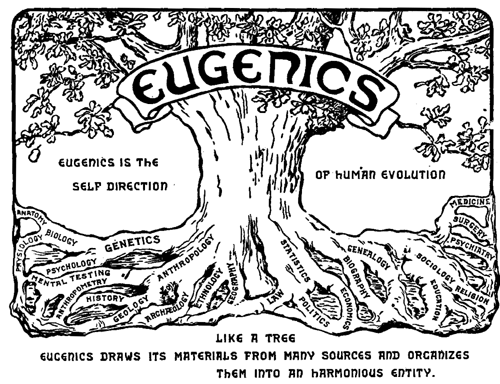
Logo of the Second International Congress of Eugenics, 1921, May 9, 2005. (Fastfission via Wikipedia). In public domain.

Logo of the Second International Congress of Eugenics, 1921, May 9, 2005. (Fastfission via Wikipedia). In public domain.

What do these three disparate phrases have in common? This came up during my recent lunch with my friend Andrew at Lebanese Taverna a little more than a week ago. Among other things, we were lamenting the dominant theme of education reform as union-busting and the supplanting of teachers with high-stakes tests and Teach for America substitutes.

As we discussed Andrew’s second book on the 1990s culture wars and their roots in the 1960s conservative movement, it occurred to me that what both of us have thought of as recent or new really wasn’t. The efforts over the past decade to “close the achievement gap,” an actual problem really, are based in the nineteen and twentieth-century eugenics movement more than it is in a real sincere effort to confront the barriers to high academic achievement for students in poverty and for students of color.

Satirical cartoon of Rudyard Kipling's The White (?) Man's Burden ("white" colonial powers being carried as the burden of their "colored" subjects),  Life Magazine, March 16, 1899. (Travb via Wikipedia). In public domain.

Satirical cartoon of Rudyard Kipling’s The White (?) Man’s Burden (“white” colonial powers being carried as the burden of their “colored” subjects), Life Magazine, March 16, 1899. (Travb via Wikipedia). In public domain.

“How does it feel to be a problem?,” W. E. B. Du Bois asked numerous times and wrote in numerous ways in his The Souls of Black Folk (1903).  The Negro problem for White scholars and politicians at the turn of the twentieth century varied from Frederick Hoffman’s 1896 statistical eugenics argument that predicted the “extinction of the Negro” to the much more common struggle of how to educate the Negro (but not educate them too well). Hoffman’s White supremacy argument was a bit outside the mainstream even for his Whites-are-always-right era. The more mainstream problem of Negro education became one of “practical” vocational (or, as it was called at the time, industrial) education as advocated by accommodationist Booker T. Washington versus Du Bois’ higher education and leadership preparation for the Black Talented Tenth.

We’re here again, in the early twenty-first century, with the technocrats in government and White paternalists in the private foundation world sounding the alarm that there’s an achievement gap between the affluent and the poor, as well as between Whites, Blacks and Latinos. Except that this achievement gap’s been around for a half-century. Except that the biggest single factor in raising student achievement rates is family income and occupation(s), not more testing or a theory of change to assess teacher effectiveness. Except that schools in the districts in which the achievement gap is the most obvious — segregated, mostly poor and of color — are underfunded when accounting for inflation and other factors (e.g., age of school buildings, teacher-student ratios).

So too with the “Jewish question” in comparison to this crisis in education. One of the worst kept secrets in the first half of the twentieth century was that the Jewish question wasn’t just a Nazi German one, but an American one as well. The real Jewish question for American educators was how to explain Jewish overrepresentation as high achievers in public education and as the best and brightest in higher education. That despite the work of eugenicists — the technocrats of their day — to tweak IQ tests and entrance tests in favor of affluent White Anglo-Saxon Protestants.

They couldn’t answer their Jewish question in higher education, except to limit the number of Jews accepted in elite institutions like Harvard, Yale and Princeton (in the latter case, to the point of exclusion). But we know how Nazi Germans decided to address their Jewish question — exclusion, discrimination, persecution, and the Final Solution. All to the detriment of advanced science and technology programs, not to mention the German economy. Vast resources went to a deadly and ultimately useless cause, all in the name of racial purity and betterment for “Nordic Aryans.”

"Mind The Gap" warning in London Underground, Victoria Station, November 27, 2011. (Reinhard Dietrich via Wikipedia). Released to public domain.

“Mind The Gap” warning in London Underground, Victoria Station, November 27, 2011. (Reinhard Dietrich via Wikipedia). Released to public domain.

In a very limited sense, the same is occurring with the education reform movement these days. Educators and politicians all pulling billions of dollars that could otherwise go to free breakfast and lunch programs, psychological services, physical education and arts programs for an eugenics-light agenda. No one from this movement has suggested a final solution as such, but they do believe that teachers unions, bad teachers and not enough STEM programs are the problem. Note that though the goal here is to “close the achievement gap,” the actual things that occur at schools in which most of the high-achieving Whites and Asian Americans (many of whom attend private and parochial schools) aren’t on the table at all.

Ultimately, the problem with the fear-mongering crowd on the “problem,” the “question” and the “gap” is that their perspective is one of the all-knowing, all-seeing White paternalist. One whose ideas about a situation or a group comes out of thin air, in some strange attempt to help said situation or group. In the case of today’s version of education reform, the only end-game is to destroy public education while exacting a profit in the process. Closing the achievement gap? Yeah, if “closing the gap” is defined by closing schools, killing unions and leaving most of America’s poor and of color students with no alternative for a better future.

The Great “Original Sin” Debate

03 Wednesday Oct 2012

Posted by decollins1969 in 1, Academia, Boy @ The Window, culture, Eclectic, eclectic music, music, Politics, Pop Culture, race, Youth

≈ Leave a comment

Tags

"Moment of Surrender" (2009), Black Reconstruction (1935), Carnegie Mellon University, Chants Democratic (1984), David Roediger, Marcus Rediker, Media's Game Mentality, Obama-Romney Debate, Original Sin, Pitt, Race, Sean Wilentz, Slavery, U2, University of Pittsburgh, W. E. B. Du Bois, Wages of Whiteness (1991), Wendy Goldman


Obama-McCain Third Debate (post-debate picture), Hofstra University, Hempstead, NY, October 15, 2008. (Jim Bourg/Reuters).

We’ve finally meandered our way into the presidential debate cycle portion of our Election ’12 cycle. I’m grateful to finally see what the media has built up to be a match between the Pittsburgh Steelers and the New York Giants! Not really, of course. But from standpoint of political reporters and pundits alike, tonight’s first debate between President Barack Obama and Mitt Romney might as well be a sports event.

In the end, though, this isn’t as much a presidential debate as it is a personality contest with questions and psychologists’ interpretations of nonverbal communication. It will be more hype than substance, more stiff than an overbaked souffle. One of the men — most likely President Obama — will win this first debate, though it won’t be clear how significant this “win” will be, given the trends for the past couple of months.

Professor Wendy Goldman, Carnegie Mellon University, circa 2012, October 3, 2012. (http://www.history.cmu.edu).

I am reminded of another debate, one that occurred in my Comparative Working-Class Formation graduate seminar at Carnegie Mellon University in the fall of ’93. It was taught by Professor Wendy Goldman, wife of Marcus Rediker, both decidedly Marxist, but in Goldman’s case, Marxist without any considerations of race at all. It was a course that turned into a debate because I’d already grown tired of professors at Pitt who believed race and gender to be identities subsumed under the long, hard human battle over class inequality (see my post “Dairy Queens, Dick Oestreicher and Race” from February ’11).

All semester-long, there had been a three-way tug-of-war between me (and occasionally, my former Pitt grad school colleague who decided to hop across the bridge to Carnegie Mellon to take this course), ten brown-nosing students who’d agree with her despite the evidence (led by Mike and Mark, the “M&M Boys,” as I labeled them for my friends and colleagues) and Goldman. I didn’t expect my now fellow Carnegie Mellon grad students to take my side. But I did expect them to read E.P. Thompson and Sean Wilentz and other folks with a critical eye and not just to get an A out of our professor. There may have been one or two other classes I dreaded more in three years of grad school. Yet I’d never been around a professor more unaware of their own biases than Goldman (see my “Crying Over E.P. Thompson” post from September ’09).

It all came to a head when it was time to discuss David Roediger’s Wages of Whiteness (1991) and, indirectly, Sean Wilentz’s Chants Democratic (1984) on the last Thursday in October ’93, which happened to be my mother’s forty-sixth birthday. Both authors looked at the formation of the White American (and male) working-class in the first half of the nineteenth century. Goldman, as usual, took the stance that the only ideology of significance was one that proclaimed class inequalities the predominant issue explaining the radicalization of the American working-class.

Michelangelo’s sin of Adam and Eve painting, Sistine Chapel ceiling, Vatican City (1508-1512), May 20, 2005. (The Yorck Project via Wikipedia). In public domain.

Finding this a bit laughable (a mistake on my part), I pressed my argument that at least in the case of US history, race and class distinctions have been and remain intertwined. So much so that a typical neo-Marxist analysis of the American working-class couldn’t apply. The next two hours were me and my Pitt colleague against the M&M Boys, the other brown-nosers and Professor Goldman. Luckily in my case, I could not only quote Roediger and Wilentz, but Herbert Gutmann, W.E.B. Du Bois, and a host of other scholars to press home my counterargument. At the end, our professor said to me, in utter exasperation, “I guess we should just go back to original sin.” It meant that I was being a racial determinist, which I guess was supposed to be an insult as well as her version of “No mas, no mas!”

Aside from the fact that America’s “original sin” really was the taking of Native American lands and the systemic destruction of Native American peoples and culture, I really didn’t have much of a response to Goldman’s excited utterance. I finished my argument with a final volley that included Du Bois’ Black Reconstruction (1935) and Roediger, and class adjourned sooner thereafter.

My brown-nosing classmates looked pretty beat from the class session, while me and my colleague from Pitt were both energized from the three-hour class. Still, we couldn’t help but discuss Goldman’s Moment of Surrender at the end of the class. Of course we knew what her “original sin” comment meant when it came to race and slavery. The comment, though, seemed small and petty coming from a professor, one that was too personal, and not professional.

Still, the worst thing I learned is that it took Roediger’s Wages of Whiteness to confirm ideas that Du Bois had begun writing about in 1903 and 1935. That, for me, made me apprehensive about wanting to work with scholars who may well see me and my work as well-intentioned, but inferior to theirs. At the same time, I learned that, for better and for worse, that not going along to get along can be a good thing, especially after years of ridicule from people of all stripes for doing so.

My “original sin” of not going along with whatever Goldman said forced a debate, one of the more exciting times I had in grad school, certainly at Carnegie Mellon. How could that be bad?

On Lena Horne

12 Wednesday May 2010

Posted by decollins1969 in 1, Eclectic

≈ Leave a comment

Tags

Activism, Civil Rights, Culture, Double-Consciousness, Hollywood, Jazz, Lena Horne, Race, W. E. B. Du Bois


Maybe this isn’t the right time or place to be bringing this up. I’ll probably be vilified by my slightly older-than-me readers who’ll claim that since I didn’t grow up when Ms. Horne was in her prime, that I don’t know what I’m talking about. That, of course, hasn’t stopped me before, and won’t stop me now. But two things have to be said about the late Lena Horne that most reporters and commentators on her life have either overemphasized or glossed over completely. One, that there’s a huge difference between breaking down barriers and commenting on injustice and full-fledged civil rights activism. Two, that Horne represented the issue of double-consciousness in Hollywood and entertainment in ways that few want to discuss now that she’s no longer with us.

Yes, I have seen Horne on the silver and small screen, even in my limited years on the planet. Yes, I know what she did on behalf of Black soldiers during World War II, the ground she broke in film and music, the use of her position in entertainment to speak truth about discrimination, exclusion and harassment in Hollywood. That makes her a groundbreaking icon. It makes her a bit of a civil rights activist. But it doesn’t put her in the same sentence as Dorothy Height, Paul Robeson, or Ella Baker. Maybe that’s unfair and unrealistic, but the journalists and commentators have exaggerated Horne’s impact in this area.

I’ve always found the stories of the mesmerizing Ms. Horne interesting. Not that I didn’t understand, between the beauty and all of that talent, evident as late as her appearance on, of all things, The Cosby Show in ’89 or ’90. But a radio commentator recently suggested that the late Horne could’ve passed for White, but decided to be one of the rare ones to stand up for her race instead. Really? Really? Mostly light, bright and almost-White Blacks didn’t pass for White, even when it would’ve been convenient for them to do so. Although Horne was light, I don’t think it would’ve been easy for her to pass, for a whole variety of cultural, familial, and other reasons. She deserves credit for this, I suppose, but no more credit than the likes of Walter White, Nella Larsen or Mary Church Terrell.

Which brings up the one unspoken, complicated fact that has gone unmentioned, especially among Black pundits and writers. That Horne benefited from her looks — her light, bright and almost-Whiteness — as much as she had to fight discrimination because of them. Her beauty and her skin served as the embodiment of double-consciousness, in Hollywood and in mid-twentieth century African America. She was Black and yet not Black in the eyes of MGM and its execs. Yet she was also a Black icon who represented the ideal in terms of her lightness, at least as far as the times themselves dictated in African America. I’m not suggesting that the late Ms. Horne took full advantage of this reality — far from it. But I do believe that she gained advantages that didn’t fall so easily toward others, like Hattie McDaniel and Louise Beavers.

Was Lena Horne one of the great Black female  — heck, American — performers of the twentieth century? Of course! Did she entertain like few others could? Absolutely! Was her impact on race relations, African American civil rights, and our understanding of race and skin tone far more complicated that is being portrayed in commentaries and obituaries? You betcha!

Newer posts →

Boy @ The Window: A Memoir

Boy @ The Window: A Memoir

Places to Buy/Download Boy @ The Window

There's a few ways in which you can read excerpts of, borrow and/or purchase and download Boy @ The Window. There's the trade paperback edition of Boy @ The Window, available for purchase via Amazon.com at http://www.amazon.com/Boy-Window-Donald-Earl-Collins/dp/0989256138/

There's also a Kindle edition on Amazon.com. The enhanced edition can be read only with Kindle Fire, an iPad or a full-color tablet. The links to the enhanced edition through Apple's iBookstore and the Barnes & Noble NOOK edition are below. The link to the Amazon Kindle version is also immediately below:

scr2555-proj697-a-kindle-logo-rgb-lg

Boy @ The Window on Amazon.com: http://www.amazon.com/Boy-The-Window-Memoir-ebook/dp/B00CD95FBU/

iBookstore-logo-300x100

Boy @ The Window on Apple's iBookstore: https://itunes.apple.com/us/book/boy-the-window/id643768275?ls=1

Barnes & Noble (bn.com) logo, June 26, 2013. (http://www.logotypes101.com).

Boy @ The Window on Barnes & Noble: http://www.barnesandnoble.com/w/boy-the-window-donald-earl-collins/1115182183?ean=2940016741567

You can also add, read and review Boy @ The Window on Goodreads.com. Just click on the button below:

Boy @ The Window

Twitter Updates

Tweets by decollins1969
  • RSS - Posts
  • RSS - Comments

Archives

  • June 2025
  • April 2023
  • September 2022
  • August 2022
  • July 2022
  • June 2022
  • May 2022
  • April 2022
  • March 2022
  • January 2022
  • December 2021
  • November 2021
  • October 2021
  • September 2021
  • August 2021
  • July 2021
  • June 2021
  • April 2021
  • March 2021
  • February 2021
  • January 2021
  • December 2020
  • November 2020
  • October 2020
  • September 2020
  • August 2020
  • July 2020
  • May 2020
  • April 2020
  • March 2020
  • January 2020
  • December 2019
  • November 2019
  • August 2019
  • July 2019
  • June 2019
  • May 2019
  • April 2019
  • March 2019
  • February 2019
  • January 2019
  • December 2018
  • November 2018
  • October 2018
  • September 2018
  • August 2018
  • July 2018
  • June 2018
  • May 2018
  • March 2018
  • February 2018
  • January 2018
  • December 2017
  • November 2017
  • October 2017
  • September 2017
  • August 2017
  • July 2017
  • June 2017
  • May 2017
  • April 2017
  • March 2017
  • February 2017
  • January 2017
  • December 2016
  • November 2016
  • October 2016
  • September 2016
  • August 2016
  • July 2016
  • June 2016
  • May 2016
  • April 2016
  • March 2016
  • February 2016
  • January 2016
  • December 2015
  • November 2015
  • October 2015
  • September 2015
  • August 2015
  • July 2015
  • June 2015
  • May 2015
  • April 2015
  • March 2015
  • February 2015
  • January 2015
  • December 2014
  • November 2014
  • October 2014
  • September 2014
  • August 2014
  • July 2014
  • June 2014
  • May 2014
  • April 2014
  • March 2014
  • February 2014
  • January 2014
  • December 2013
  • November 2013
  • October 2013
  • September 2013
  • August 2013
  • July 2013
  • June 2013
  • May 2013
  • April 2013
  • March 2013
  • February 2013
  • January 2013
  • December 2012
  • November 2012
  • October 2012
  • September 2012
  • August 2012
  • July 2012
  • June 2012
  • May 2012
  • April 2012
  • March 2012
  • February 2012
  • January 2012
  • December 2011
  • November 2011
  • October 2011
  • September 2011
  • August 2011
  • July 2011
  • June 2011
  • May 2011
  • April 2011
  • March 2011
  • February 2011
  • January 2011
  • December 2010
  • November 2010
  • October 2010
  • September 2010
  • August 2010
  • July 2010
  • June 2010
  • May 2010
  • April 2010
  • March 2010
  • February 2010
  • January 2010
  • December 2009
  • November 2009
  • October 2009
  • September 2009
  • August 2009
  • July 2009
  • June 2009
  • May 2009
  • April 2009
  • March 2009
  • February 2009
  • January 2009
  • December 2008
  • November 2008
  • October 2008
  • September 2008
  • August 2008
  • July 2008
  • June 2008
  • May 2008
  • April 2008
  • March 2008
  • February 2008
  • January 2008
  • December 2007
  • November 2007
  • October 2007
  • September 2007
  • August 2007
  • July 2007
  • June 2007

Recent Comments

decollins1969's avatardecollins1969 on No Good Teaching Deed Goes…
Mary Rose O’Connell's avatarMary Rose O’Connell on No Good Teaching Deed Goes…
Lyndah McCaskill's avatarLyndah McCaskill on The Raunchiest of Them Al…

NetworkedBlogs on Facebook

NetworkedBlogs
Blog:
Notes From a Boy @ The Window
Topics:
My Life, Culture & Education, Politics & Goofyness
 
Follow my blog

616 616 East Lincoln Avenue A.B. Davis Middle School Abuse Academia Academy for Educational Development AED Afrocentricity American Narcissism Authenticity Bigotry Blackness Boy @ The Window Carnegie Mellon University Child Abuse Class of 1987 CMU Coping Strategies Crush #1 Crush #2 Death Disillusionment Diversity Domestic Violence Economic Inequality Education Family Friendship Friendships Graduate School Hebrew-Israelites High-Stakes Testing Higher Education History Homelessness Humanities Humanities Program Hypocrisy Internalized Racism Jealousy Joe Trotter Joe William Trotter Jr. K-12 Education Love Manhood Maurice Eugene Washington Maurice Washington Misogyny Mother-Son Relationship Mount Vernon High School Mount Vernon New York Mount Vernon public schools Multiculturalism MVHS Narcissism NFL Pitt Pittsburgh Politics of Education Poverty President Barack Obama Race Racial Stereotypes Racism Relationships Self-Awareness Self-Discovery Self-Reflection Sexism Social Justice Teaching and Learning University of Pittsburgh Violence Whiteness Writing

Top Rated

Blog at WordPress.com.

  • Subscribe Subscribed
    • Notes from a Boy @ The Window
    • Join 103 other subscribers
    • Already have a WordPress.com account? Log in now.
    • Notes from a Boy @ The Window
    • Subscribe Subscribed
    • Sign up
    • Log in
    • Report this content
    • View site in Reader
    • Manage subscriptions
    • Collapse this bar
 

Loading Comments...