• About Me
  • Other Writings
  • Interview Clips
  • All About Me: American Racism, American Narcissism, and the Conversation America Can’t Have
  • Video Clips
  • Boy @ The Window Pictures
  • Boy @ The Window Theme Music

Notes from a Boy @ The Window

~

Notes from a Boy @ The Window

Tag Archives: Racism

Richard Cohen & Rational Racism

17 Wednesday Jul 2013

Posted by decollins1969 in 1, culture, Eclectic, New York City, Politics, race, Youth

≈ Leave a comment

Tags

Affirmative Action, Derrick Bell, Paternalism, Racial Profiling, Racism, Richard Cohen, Stop and Frisk, Ta-Nehisi Coates, White Liberals, Whiteness


Electron microscope image of a lymphocyte, (a.k.a. cancer cell), September 20, 1976. (Dr. Triche/NCI via Wikipedia). In public domain.

Electron microscope image of a lymphocyte, (a.k.a. cancer cell), September 20, 1976. (Dr. Triche/NCI via Wikipedia). In public domain.

Ta-Nehisi Coates’ response to Richard Cohen’s “Racism vs. reality” column in The Washington Post (July 15, 2013) is so spot on that I had to post something about it. “The Banality of Richard Cohen and Racist Profiling” is a must read for anyone who’s tired of those White “liberals” who remain okay with racism for the sake of perceived safety. Below was my two cents on both Coates’ piece and the sidetracking some whom commented on Coates’ piece tried to do by equating racial profiling with affirmative action:

“Richard Cohen is no different than the racist and race-baiting journalists of not too long ago. You know, the ones who’d put ‘Negro Rapes A White Girl’ on the front page of the Chicago Tribune, Washington Post or New York Times, back in the days when Whites would riot and destroy Black neighborhoods upon seeing such headlines. All to sell newspapers, not to actually start a real and serious dialogue on race, racism and remedies.

And this is precisely what makes Cohen and his ill-conceived logic so dangerous. His is a piece that’s meant to make White ‘liberals’ feel okay about the denial of humanity and rights to Blacks. Especially since White ‘liberals’ must also feel that they’re protected and safe from the Black male boogieman criminal.

Don’t get caught up in a debate about affirmative action as some sort of intellectual counterbalance. It’s a false equivalency, plain and simple. More to the point, it’s a distraction from the real point. Like TNC, the late Derrick Bell wrote about this at length. The idea that we as African Americans, male and female, must embody all of the evils and stereotypes of this nation in order for Whites to feel safe. It’s so insulting, so soul-destroying, so infuriating, this immutable racism of Cohen and the millions of folk who think like him.”

Rachel Jeantel, A Real, True Beautiful Friend

28 Friday Jun 2013

Posted by decollins1969 in 1, Boy @ The Window, culture, Eclectic, Mount Vernon High School, Mount Vernon New York, Movies, Politics, race, Youth

≈ 2 Comments

Tags

Beauty, Black Twitter, Criminal Justice System, Cultural Stereotypes, Doc Holliday, Don West, Friendship, Friendships, George Zimmerman, Lazy Tongue Syndrome, Media Coverage, Rachel Jeantel, Racial Stereotypes, Racism, Stereotypes, Tombstone (1993), Trayvon Martin, Val Kilmer


Witness Rachel Jeantel continued her testimony,  George Zimmerman trial, Sanford, FL, June 27, 2013. (Jacob Langston, AP/Orlando Sentinel; http://time.com).

Witness Rachel Jeantel continued her testimony, George Zimmerman trial, Sanford, FL, June 27, 2013. (Jacob Langston, AP/Orlando Sentinel; http://time.com).

There will be months’ worth of stuff written and said about Rachel Jeantel and her performance on the witness stand during the George Zimmerman trial. Everything from her dark skin and being overweight to her lazy tongue syndrome and reluctance to take the witness stand. Between Black Twitter on Wednesday critiquing her language, shyness, and style and blond-haired, bubble-headed Whites picking apart her testimony on Thursday, it’s a wonder that anyone sees Ms. Jeantel as a human being. She’s far more than the hero, villain or ghetto girl that folks in social media have and will portray her to be.

Ms. Jeantel is beautiful to me, skin-deep and otherwise. Yes, she’s not perfect, which is one of the things that makes her a beautiful person. The most important thing to remember about Jeantel, though, is that she’s a real person and a real friend. The truest friend any human being could ever hope to have. I should know. I’ve never had more than eight people in my life at any time that I could truly call friend, and none during my preteen and teenage years before college. Of those, about half have proven themselves to be fair-weather friends, unreachable when I’ve needed them the most.

Jeantel is the ultimate friend, for she has acted in Trayvon Martin’s best interests even after his death. A friendship that gave her the strength to tell the truth, to endure ridicule and scorn and hours of cross-examination from Don West. Jeantel gave voice to Martin from beyond the grave, knowing that she was in the right.

Jeantel makes me think of a scene from Tombstone (1993), the one with Val Kilmer playing Doc Holliday. Dying from the long-term effects of tuberculosis and living the life of an alcoholic gambler, Holliday continued to ride with Wyatt Earp to hunt down his youngest brother’s killers. When asked, “Why you doin’ this, Doc?,” Holliday said

“Because Wyatt Earp is my friend.”

In response, the other character said, “Friend? Hell, I got lots of friends.” To which Holliday replied, “…I don’t.”

Jeantel may well have lots of friends, but her friendship with Trayvon Martin is as real, true and beautiful as it gets. I hope that my close friends are even one-tenth as true to me after I’m dead as she was to Martin this week.

Monkey See, Baboon Do

22 Wednesday May 2013

Posted by decollins1969 in 1, Boy @ The Window, culture, Eclectic, Mount Vernon New York, Pop Culture, race, Youth

≈ Leave a comment

Tags

8U, A.B. Davis Middle School, Baboon, Beauty, Bigotry, Humanities, Italian Club, Monkey, Racism, Stereotype Threat, Teenagers, Writing, Writing Scrapheap


Monkey See Monkey Do, May 22, 2013. (http://kidsunder7.com).

Monkey See Monkey Do, May 22, 2013. (http://kidsunder7.com).

There are plenty of stories and vignettes that ended up on the Boy @ The Window scrap heap. Most because they weren’t relevant, some because a particular person or character really wasn’t a significant player in the book. In my final set of story revisions (not dialogue revisions) in ’09 and ’10, I operated under the “two or more rule.” If a person or character showed up fewer than two times in the book, I took them out, as they really weren’t as significant as I originally thought.

But in the case of the Sonya story below, it was a tough cut. I wanted to craft a book in which people felt everything I went through while not feeling sorry for me. I think and hope that I did. Though this story contained many elements of what I wanted in the rest of the book, it didn’t quite fit. Still, it serves as a good reminder of how mean even someone as polite (but certainly not always nice) as I am today could be at thirteen.

—————————

“Sonya was major fodder for Alex in eighth grade. She had a short Afro, an ‘au naturale’ to be exact. She wasn’t nearly as polished in maintaining her looks as many of the other girls in 8U. Sonya wasn’t ugly by any stretch. But by her not attempting to beautify herself in any way, she stood out for some in our class. Why would’ve she needed to anyway? She was also well-spoken, intelligent and outgoing, at least at the beginning of the year. Unfortunately for Sonya, my Italian Club classmates Alex, et al. were around to call her all kinds of names, like ‘baboon,’ and ‘monkey.’ I felt sorry for her, but I was also angry with her too. It pissed me off to see her respond to these semi-racist barbs with a blank face or even a smile.

It pissed me off so much that I ended up calling Sonya one of those names by the end of the school year. One day in homeroom, par for the course, Alex and company picked with Sonya again, calling her a ‘baboon’ among other things. She just sat there with that silly ‘Oh well’ smile on her face, as if they were telling her that she should go into professional modeling. Under my breath, I called her ‘monkey,’ and not as a joke. I just couldn’t believe that she was going to sit there like some pre-Civil Rights era Black in the South and take their crap without any response.

Except that I had called Sonya a ‘monkey’ within earshot of her and Alex. She ran out of the room, apparently to the girls bathroom, where she cried for several minutes, I later learned from Allison. I immediately tried to apologize, which Sonya eventually accepted (after my eighth grade science teacher Ms. Mignone and Allison shamed me for what I said). What I said was unacceptable to me, and the rationale was too intellectual for my own good. For Sonya, it simply came down to her looks, not her disposition. I wished that it had never happened, given what I faced from some of my classmates on a semi-regular basis.”

———————————————————-

1990s R&B/hip-hop duo Zhané from their 1994 album cover Pronounced Jah-Nay, May 22, 2013. (http://centrictv.com).

1990s R&B/hip-hop duo Zhané, from 1994 album cover Pronounced Jah-Nay, May 22, 2013. (http://centrictv.com).

The Sonya story has many of those elements, exposing me good, bad and ugly in the process. It’s about race and teenage ignorance and intellect. It’s about stereotype threat on one obvious level and trying to fit in on an unconscious one. It’s about the person I needed to become in high school as well as how I got to be that quiet yet observant person. The story is significant, yet because I only dealt with Sonya for two paragraphs in a 345-page book (in print form), it didn’t make the final cut. Because there are other and more central characters and stories in which stereotype threat and the ugly side of my immaturity both come out, I didn’t include Sonya.

Luckily, I also have a blog, where even scrap-heap stories can find the light of a new day. So, for this week, the thirtieth anniversary of my calling Sonya a “monkey,” I apologize again. I was a baboon for saying it in the first place. And Sonya, I hope you are well!

All The Media’s Stereotypes

21 Sunday Apr 2013

Posted by decollins1969 in 1, culture, Eclectic, eclectic music, Patriotism, Politics, Pop Culture, race, Religion, Youth

≈ 1 Comment

Tags

"Dirty Laundry" (1982), 9/11. Jingoism, Boston, Boston Marathon Bombing, Branch Davidian Compound, Breaking News, Centrism, Chechnya, CNN, Cultural Stereotypes, Don Henley, Dzhokhar Tsarnaev, FOX News, Immigrants, Immigration, Islam, Jihadists, John King, Jonathan Capehart, Lockdown, Media Bias, New York Post, Oklahoma City Bombing, Police Chase, Racial Stereotypes, Racism, Stereotypes, Tamerlane Tsarnaev, Terrorism, Terrorized, Waco, Washington Post, West Texas Fertilizer Plant Explosion, Xenophobia


Dzhokhar & Tamerlan Tsarnaev in Boston Marathon crowd moments before bomb blasts, April 15, 2013. (http://www.mirror.co.uk)

Dzhokhar & Tamerlan Tsarnaev in Boston Marathon crowd moments before bomb blasts, April 15, 2013. (http://www.mirror.co.uk)

The mainstream American media was just one big, almost unbelievable fail this past week. Between the Boston Marathon bombing and the subsequent hunt for brothers Dzhokhar and Tamerlan Tsarnaev, the ricin letters to Mississippi GOP politicians and President Obama and the fertilizer plant explosion in West, Texas. In the last case, the one that killed and injured more people than two dumb asses in Boston. Yet, somehow, in a world in which the best answer should be “I don’t know” or “We don’t know yet,” media folks and their experts have been tweeting and reporting at the level of gossip for the past five or six days.

Usually a fairly careful journalist/columnist, Jonathan Capehart of The Washington Post tweeting three hours after the Boston Marathon bombing on April 15, “April 19: Anniversary of storming of Branch Davidian compound & the Okla. City bombing.” At that point, we didn’t even know the number of people killed, maimed or injured. Nor did we know the number of bombs that had exploded in Copley Square. Think, man, think!

The more famous comments of the week came out of CNN’s shop, though. John King had breaking news Wednesday afternoon that law enforcement officials had identified a “dark-skinned male” suspect. Being a White guy working in mainstream media means that you never have to say “I’m sorry,” apparently. Especially when all of his “breaking news” reporting turned out to be completely wrong.

Let’s not really analyze the so-called reporting of FOX News or the New York Post. You’d get more truth from a psychic doing a Vulcan mind-meld with Tamerlan Tsarnaev’s brain right now than you could from Murdoch’s news media world in a year.

Let’s also not forget many of the so-called terrorism experts whom guessed wrong about race, immigrant status and so many other details this past week. Not to mention reports whom apparently couldn’t find Chechnya on a map if the republic were blown up to 100x normal map size and they put a floodlight on it.

But the most disturbing — yet not very surprising — thing about the past seven days has been how the US media has engaged in a near-endless campaign of racial stereotypes, immigrant stereotypes, terrorism stereotypes, religious stereotypes, patriotism stereotypes, and hyperbole that attempts to defy history. A simple list should help:

  • Terrorist(s) = Arab Muslims
  • Males from the Caucasus = Caucasians, but not White
  • Muslims who commit a violent act = terrorists
  • Violent criminals = anyone not White (especially Blacks & Latinos)
  • Violent mass-murdering Whites = mentally disturbed (i.e., NOT terrorists)
  • Arab Muslims = immigrants, NOT US citizens
  • Indo-Europeans who are White (phenotypically) & citizens but not born in US = Immigrants
  • Boston = city terrorized like no city ever before

On this last one, I must put on my academic historian hat. As in — are you kidding me? Anyone ever hear of Boston in the years before and during the American Revolution? Or, in more recent times, the Oklahoma City bombing in ’95, 9/11 and Lower Manhattan, the DC sniper rampage in ’02? Or, if the idea here is that terrorism should only be viewed through the prism of those who feel terrorized, what about poor Blacks on the South Side of Chicago, in SE Washington, DC, or poor Latinos in cities like Albuquerque and Phoenix? Or, for that matter, innocent civilians in Yemen and Pakistan attempting to avoid being among the “collateral damage” caused by our drone wars for terrorist scalps?

And then, there was the need for release, for yelps of relief and cheers of joy over the successful capture of Dzhokhar Tsarneav late Friday evening, with chants of “USA! USA! USA!” included. Of course people should feel relief for the end of a tense situation. But let’s not get carried away with the tide here.

Stereotype quote taken from Annie Murphy Paul article (May 1998) in Psychology Today, January 16, 2011. (http://nwso.net/). In public domain.

Stereotype quote taken from Annie Murphy Paul article (May 1998) in Psychology Today, January 16, 2011. (http://nwso.net/). In public domain.

We know nothing of motive, but we do know that the police will return to its regularly scheduled racial and socioeconomic profiling in the coming days. We can’t wrap our collective heads around the idea that two assimilated White American immigrants decided to kill runners at the Boston Marathon. Yet we also somehow decided to culturally and legally un-Americanize them — something we didn’t do with Timothy McVeigh. Chants patriotic might be a way to show solidarity, but we refuse to come to grips with the racial/xenophobic and anti-Muslim psychology that comes with these impromptu outbreaks of so-called unity.

Don Henley’s “Dirty Laundry” remains just as relevant now as his tune about the American news media was three decades ago. Still, the completely centrist and biased, always-concerned-about-the-bottom-line media is a mere reflection of our narcissistic and imperialistic selves.

The Impossible Choice of Driving While Black

18 Monday Mar 2013

Posted by decollins1969 in 1, Boy @ The Window, culture, Eclectic, Politics, Pop Culture, race

≈ Leave a comment

Tags

Colesville Road, Driving While Black, Institutional Racism, Internalized Racism, MCPD, Mistrust, Montgomery County Police Department, Police Intimidation, Police State, Racism, Silver Spring, Traffic Conditions, Walking While Black


Police brutality poster, March 18, 2013. (http://lovethetruth.com).

Police brutality poster, March 18, 2013. (http://lovethetruth.com).

Let me say this right off. I can’t stand cops. I haven’t since I was about five or six years old. That was when a couple of dumb-ass Mount Vernon Police officers idly stood by and laughed as my father was being taken to the hospital with a stab wound in his left thigh, the result of a fight between him and my mother. I’ve been accosted, stopped, frisked and followed by police in Mount Vernon, the Big Apple, DC, Silver Spring, Los Angeles and Virginia since I turned sixteen back in ’85. Mostly for the simple issue of being an over-six-foot tall Black male and man. Walking while Black in Beverly Hills or on my own campus at Carnegie Mellon. Or Driving While Black in Pittsburgh or Maryland (see my post “Why Black Men Carry A Public Anger” from March ’12)..

To me, the issue is not as simple as a White racist cop finding excuses to harass, intimidate or beat up a Black or Brown person. It actually doesn’t matter what race or ethnicity a police officer happens to be, because their uniform, badge and gun are way more important to them than race. By definition, then, they represent our collective psyche of bigotry when it comes to race, class, gender and criminality. So don’t argue with me about the race of any cop in terms of police brutality and intimidation.

Two Bad Driving Choices

For the first time in about a half-decade, a police office pulled me over. This time, it was half my fault, albeit, it depends on how you define fault. Thursday afternoon, March 14, I was driving down Colesville Road past University Blvd East, to do a left turn on Lorain. From there, I’d meander my way back to the Shell station on the opposite side of University Blvd – it’s cheaper than the one on Colesville. Now, there’s a sign on the median next to the left turning lane that prohibits making a U-turn.

No U-Turn sign & left turning lane, Colesville Rd & Lorain Ave, Silver Spring, MD, March 14, 2013 (2:35 pm). (Donald Earl Collins).

No U-Turn sign & left turning lane, Colesville Rd & Lorain Ave, Silver Spring, MD, March 14, 2013 (2:35 pm). (Donald Earl Collins).

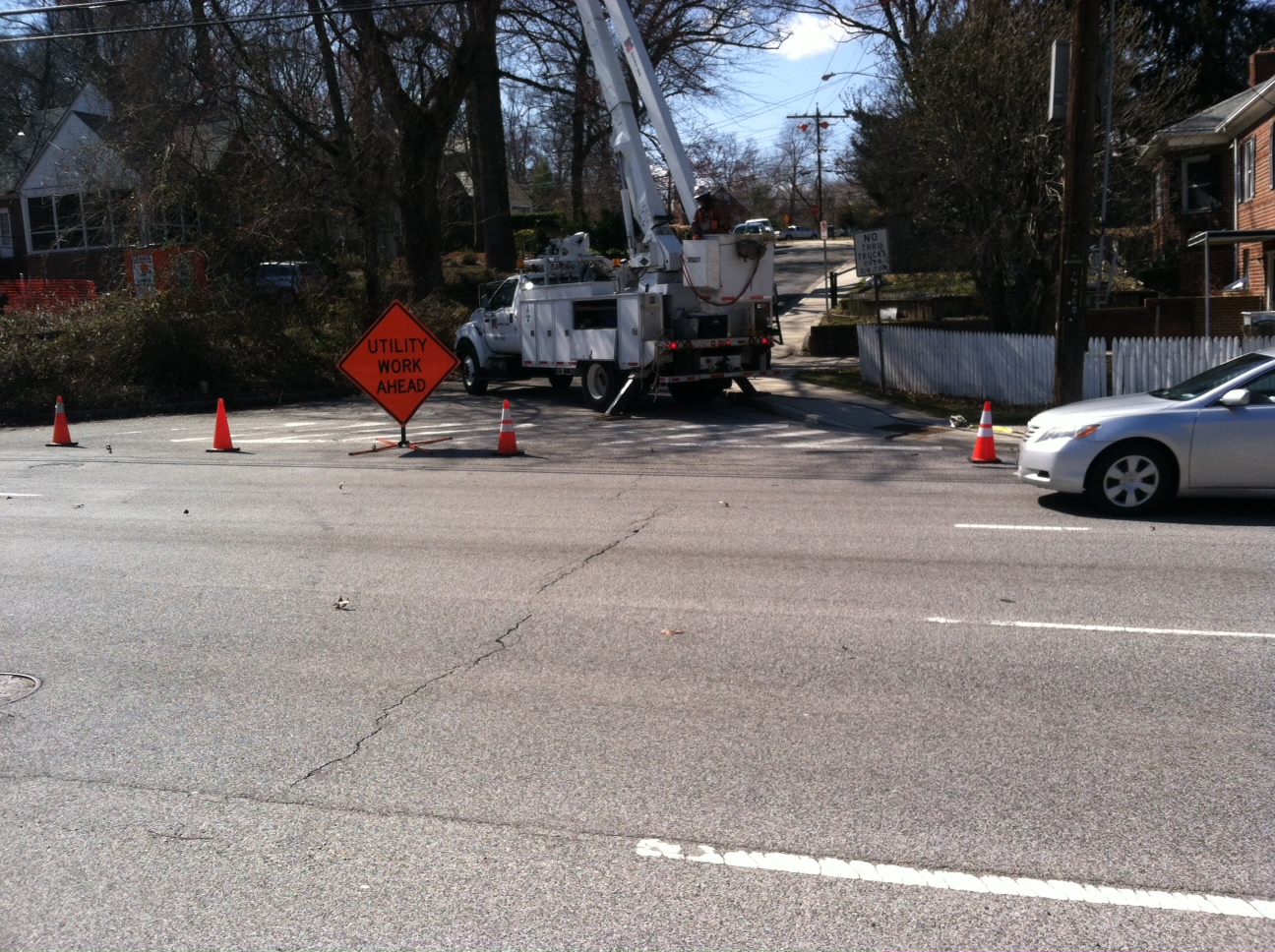
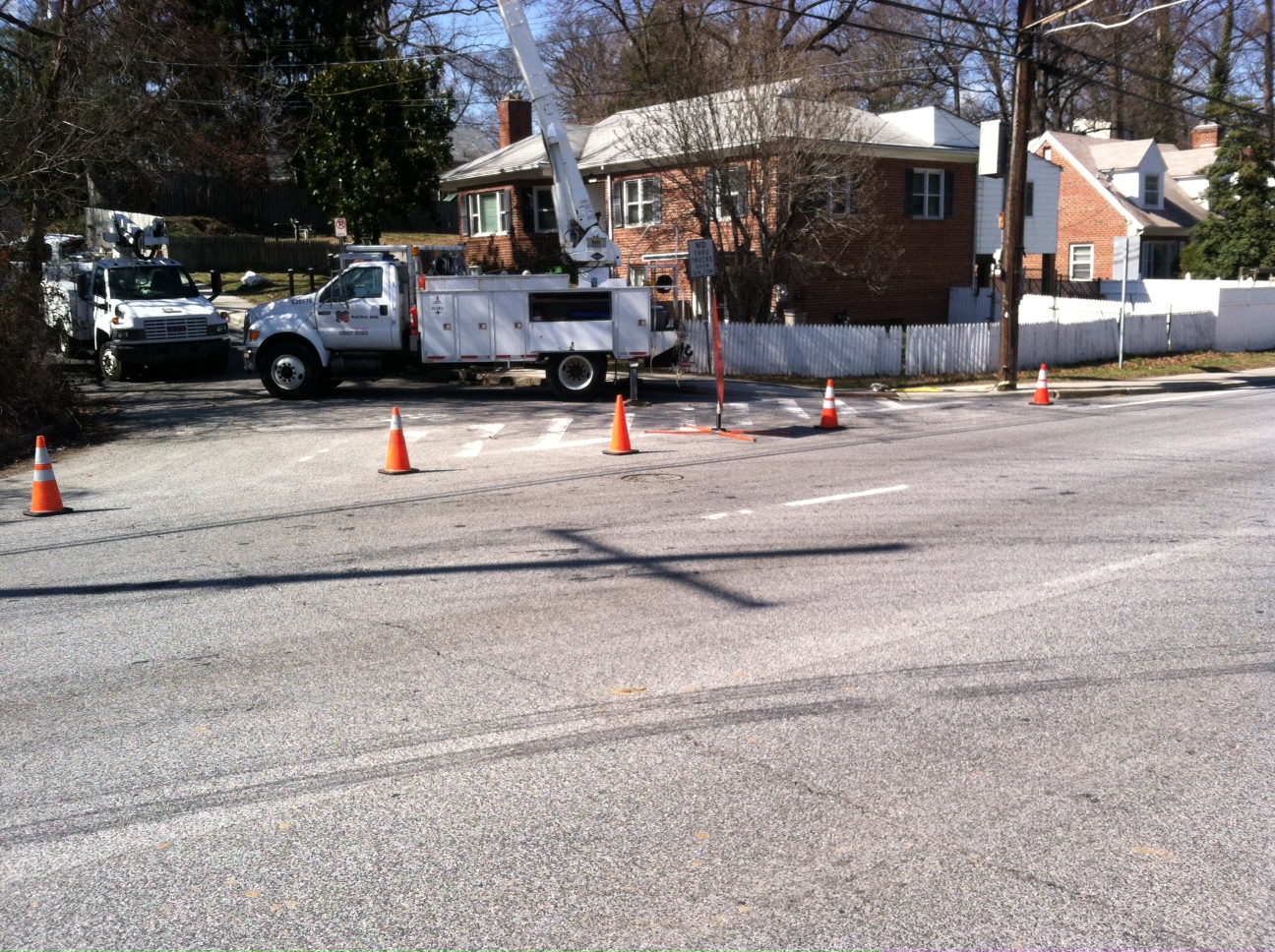
The problem on March 14 was, though, that a utility crew had closed up the street, between their trucks and their cones, making it impossible to make the left turn. I had no warning for this until I reached the front of the left turn lane. By then, I had a blue Toyota Camry behind me, and heavy traffic coming down the adjacent lanes on my side of Colesville.

So I had a choice, and not much time to make one. I couldn’t back up. Cutting across the solid left turning lane line is technically a traffic violation, one which could lead to me being pulled over by police. Not to mention, with so much traffic, I could’ve easily caused a traffic accident.

There wasn’t any traffic coming from the opposing side of Colesville. So I made the U-turn, figuring that this was the only actual choice that made any sense at all. Within three seconds, a siren approached, so I pulled over on the next block, right next to the Colesville Shell gas station. The whole time I’m thinking, “What the heck else was I supposed to do – run over the cones and then jam my car into the back of a utility truck?”

Utility work closing off Lorain Avenue (cones included, Silver Spring, MD, March 14, 2013 (2:37 pm). (Donald Earl Collins).

Utility work closing off Lorain Avenue (cones included, Silver Spring, MD, March 14, 2013 (2:37 pm). (Donald Earl Collins).

Admittedly I was nervous, as I consider police to be about as honest as Mafia bosses and city council members beholden to their local Chambers of Commerce. But I also realized that even if the police officer issued me a ticket, I’d have a crapload of evidence in my favor that would lead to a judge dismissing the citation.

The Not-So-Friendly Neighborhood Cop

So I waited. And waited. Then, after five minutes, a police officer named M. Kane (ID # 1382 for those truly interested) came up to my window, one who must’ve been having the worst day ever. Even for a White or Black police officer, he looked like he was ready to brutalize anyone who said more than “Yes, sir! I’ll suck you dick, sir!” to him. That pissed me off right away. Because a traffic violation, especially under these circumstances, didn’t rise to the level of the threatening nonverbal communication that was coming off of him like heat from an exhaust pipe.

I did get a written warning, and then some directions about what do next. The problem was, the officer issued his directions in a low grind of a growl, and I actually didn’t hear all he said. So I asked, reluctantly

“Officer, can I pull over here into the gas station? That’s where I was on my way to when you pulled me over.”

“You can go wherever the hell you wanna go, just pull out over this other car here!,” he yelled, so close to me I could feel the hot air and spit from his mouth as he was yelling. He looked at me with mean, dead eyes, the kind of look that so many folks who look like me have seen from police all these years.

I pulled out, probably a minute or so away from being arresting for assaulting a police officer, because that’s probably what I would’ve done in a parallel universe.

More Choices

What could I had done, really, to have avoided the situation? Have better hearing? Found my way into a car accident? Not left the house to go get gas and hamburger rolls before going to the Y for a five-mile run? Well, Montgomery County could’ve actually cut off the left turning lane with cones, making folks go elsewhere to make left turns. That is, if they were more interested in safety than in handing out warnings and tickets!

Utility work on Lorain Avenue (slightly different angle - 3rd truck hidden from view), March 14, 2013 (2:38 pm). (Donald Earl Collins).

Utility work on Lorain Avenue (slightly different angle – 3rd truck hidden from view), March 14, 2013 (2:38 pm). (Donald Earl Collins).

Beyond that, I don’t have much choice other than to be me. Despite almost every part of me wanting to smash in this police officer’s head with a twenty-five pound weight, the spirit inside said to forgive, and so, I forgave. But that doesn’t mean condone or not write about my experience. After all, if this officer is like this every day, then he’s a walking time bomb, set to go off on the wrong person of color at the wrong time.

I don’t want to hear about how dangerous it is to be a cop. Right now, it’s dangerous to be a teacher or professor, given mass shootings over the past six years. Last I checked, these officers weren’t conscripted into service. They chose their line of work. I don’t expect cops to ever be nice. But professional would be a pretty good standard to meet.

The Emotional, The Personal and Black History

01 Friday Feb 2013

Posted by decollins1969 in 1, Academia, Boy @ The Window, culture, Eclectic, Movies, Patriotism, Politics, Pop Culture, race, Youth

≈ 3 Comments

Tags

A Lynching in Marion, African American History, Anger, Black History, Black History Month, Carnegie Mellon University, Comparative Slavery, Emotions, Fear, Fogel and Engerman, Grief, Indiana (1995), Irony, Jim Crow, Larry Glasco, Laurence Glasco, Learning, Lynching, Pitt, Racism, Rage, Roots (1977), Sarcasm, Seymore Drescher, Slavery, Students, Sy Drescher, Teaching and Learning, Time on the Cross (1974), UMUC, University of Pittsburgh


Black History Month 2013 electronic poster, February 1, 2013. (http://dclibrary.org).

Black History Month 2013 electronic poster, February 1, 2013. (http://dclibrary.org).

After all of these years — and thirty-seven years’ worth of Black History Months — I sometimes forget how emotionally charged Black history can be. After all, I’m an academically trained historian, one whose emotional range varies from sarcastic to ironic with most things US, World and African American history. But ever so often, I’m reminded by my students about the sadness and pain involved in learning history. I surprise myself sometimes at how passionate or angry I can become in revisiting a piece of history that I otherwise would show no emotion for on most days.

Black history, though, can bring out both the water works and the daggered eyes. My African American history students at Carnegie Mellon University surprised me one day in October ’96 during a discussion I tried to have about lynching and the KKK. It was based on the Indiana PBS documentary, A Lynching in Marion, Indiana, about the lynching of two Black men and the almost lynching of a young Black male for allegedly killing and robbing a White male and raping a young White female in 1930.

The forty-five minute documentary showed clips of defaced and emasculated Black men hung from trees, beaten beyond recognition and even burned postmortem. It also showed films of KKK rallies in the 1920s and early 1930s Indianapolis and other towns in the state, as well as pictures from the Marion lynching itself. The young Black man in Marion, one James Cameron, was only saved from lynching because a member of White mob actually protected him. It turned out, per usual, that the alleged murder and rape was a false accusation, but Cameron still had to spend four years in jail for a crime he didn’t commit.

Thomas Shipp and Abram Smith, lynched in Marion, IN, August 7, 1930. (Lawrence H. Beitler). Qualifies as fair use under US Copyright laws, as It is the only image known to depict this hanging, and is used here to illustrate the event.

Thomas Shipp and Abram Smith, lynched in Marion, IN, August 7, 1930. (Lawrence H. Beitler via Wikipedia). Qualifies as fair use under US Copyright laws, as It is the only image known to depict this hanging, and is used here to illustrate the event.

My students could barely speak to me or each other after the film, much less be part of a dispassionate discussion of the film. My Black students were tearful and angry, and my White students were pale and scared. I let them express their emotions for about ten minutes, but waited until the next class to draw out a more comprehensive discussion. As this was the first standalone class I’d taught as an adjunct professor, I was a bit unprepared for the how emotional my students became, how personally they took the film and its content.

But I should’ve been better prepared, especially given my own emotions about Black and other histories over the years. I remember the first time I watched Roots, along with millions of other Americans, in February ’77. I cried or was stunned that whole week. Twelve years later, in my undergraduate readings seminar for History majors at Pitt, I found myself angry with my classmates. My eventual first graduate advisor Larry Glasco was leading a discussion on slavery and the Middle Passage. I didn’t know why, but I was angry that whole class. It wasn’t just a knee-jerk anger. It was a low-heat rage, beyond anything my idiotic classmates were saying about slavery in the eventual US not being as brutal as slavery in the Caribbean or Brazil.

The following semester, I took my first graduate course as a Pitt junior, Comparative Slavery with Sy Drescher. We got into a discussion of Fogel and Engerman’s Time on the Cross (1974), a study in which the authors tried to show scientifically that slavery wasn’t as bad for Africans in the US as it was for Africans in the Caribbean and Brazil. Using records from one plantation, Fogel and Engerman tried to show that since few slaves were whipped, that therefore slavery wasn’t brutal for my African ancestors. I was pissed when some of the grad students in my class defended Time on the Cross  idea that 1,800 calories a day was sufficient for the average slave. It pissed me off so much that I had to leave the seminar room for five minutes to make sure I didn’t punch someone.

Me really pissed, at CMU PhD graduation, Pittsburgh, PA, May 18, 1997. (Angelia N. Levy).

Me really pissed, at CMU PhD graduation, Pittsburgh, PA, May 18, 1997. (Angelia N. Levy).

I see some of this in my UMUC students sometimes. Students who turn every issue in US history into a referendum on race. “Immigrants exploited? Well, not compared to African Americans as sharecroppers!” Or “Jim Crow was really a second slavery,” some of my students have said emphatically, as if Blacks did nothing during Reconstruction or Jim Crow to make their lives better. They feel, and rightfully so for the most part, that Blacks have gotten a raw deal throughout American history, and that it is my job to expose the hypocrisy of racism in every lecture and discussion.

It’s emotional and it’s personal. But it’s also historical, which means not so much putting emotions or personal investment aside as much as it does putting these emotions and personal investments in perspective. I’ve never been dispassionate about history – I’ve just learned how to use my New York-style sarcasm to hide my passion pretty well.

The Falsehoods of a Civil Rights Movement Legacy

15 Tuesday Jan 2013

Posted by decollins1969 in 1, Academia, Boy @ The Window, culture, Eclectic, Mount Vernon High School, Mount Vernon New York, New York City, Patriotism, Politics, Pop Culture, race, Youth

≈ Leave a comment

Tags

Birthday, Civil Rights, Civil Rights Movement, Class Divide, Educational Aspirations, Estelle Abel, Generation X, Generation Y, Generational Divide, Generational Prejudice, Legacy, Martin Luther King Jr., Mythology, Myths, Police Brutality, Post-Civil Rights Generation, Poverty, Racism, Stop and Frisk


Martin Luther King, Jr. Memorial statue, National Parks Service, Washington, DC, August 2, 2012. (NPS via Wikipedia). Qualifies as fair use under US Copyright laws, as this is a 2D picture of a 3D sculpture.

Martin Luther King, Jr. Memorial statue, National Parks Service, Washington, DC, August 2, 2012. (NPS via Wikipedia). Qualifies as fair use under US Copyright laws, as this is a 2D picture of a 3D sculpture.

Well, it’s not officially Martin Luther King Day yet, but since Dr. King was actually born on January 15, 1929, better for me to talk about him today than next week. Especially with President Obama’s second inaugural going on at the same time. But what a legacy! Yet his generation of civil rights activists and righteous protesters have done as much harm to his legacy as have conservatives invoking his “I Have a Dream” speech every time they’re called out on their bigotry.

Yeah, that’s right, I said it! One of the benefits — if you want to call it that — of being born in ’69 is that I’ve witnessed the devolution of the Civil Rights Movement and its leaders and followers into a gauntlet of gatekeepers who expect everyone from my generation to start every sentence paying homage to their sacrifices. I have no problems with that, at least in theory. But the reality is that most folks from the Civil Rights generation — at least the successful ones — made few if any sacrifices for “the cause.” They were in the right place at the right time with the right education and managed to find jobs, careers and positions of influence while the least fortunate of us all saw few material or psychological benefits from Dr. King’s ultimate sacrifice.

I’ve already talked at length about Estelle Abel, a former Mount Vernon High School Science Department chair (see my posts “My Last Day” from June ’11 and “In-Abel-ed” from June ’12 for much more). Her soliloquy about sacrifice and the Civil Rights Movement was supposed to make me feel bad about letting Black Mount Vernon, New York down because I only graduated fourteenth in my class out of over five hundred students. There are others, former and current teachers, professors, librarians, politicians, writers, producers, editors, pastors, politicians, bosses and charlatans who’ve made a point to discuss their elitist notions of the Civil Rights Movement and generation with me.

Hundreds of thousands descended on Washington, DC's Lincoln Memorial August 28, 1963. (Marines' Photo via Wikipedia). In public domain.

Hundreds of thousands descend on Lincoln Memorial August 28, 1963. (Marines’ Photo via Wikipedia). In public domain.

But most — if not all — of these folks are wrong about their glorified view of the Movement and its legacy four and a half decades later. For college educated, middle class African Americans, life has gotten better, even with bigotry, glass ceilings, DWB, a less stable economy, and the conservative backlash that has gone on unabated since the three years before Dr. King’s assassination. For Blacks not as fortunate, almost nothing has changed, at least not for the better.

Some of it, to be sure (and to cut Bill Cosby some slack), is because of individual choices and poor decision-making. Folks, however, can rarely make decisions outside of their own context and circumstances — think outside of the box, in other words — without a significant amount of help. Poverty in all of its forms is just as grinding now as it was a half-century ago. To expect people from the generations since Dr. King to suddenly forget their poverty, abuse, neglect and exploitation and give praise to a generation where many but far from most made sacrifices for the Movement is ludicrous.

I’m certain that had Dr. King lived over the past forty-five years, he wouldn’t have stood by to allow his generation to constantly criticize the under-forty-five as slackers and immature and unfocused, as folks more concerned with money than equality. King likely would’ve made the point that the post-Civil Rights Generations X and Y are merely a reflection of their upbringing, of their parents and teachers and mentors’ nurturing and training. He would’ve made the same point that others from his generation like the late law professor and scholar-activist Derrick Bell has made over the years. That fighting racism, educational neglect and economic exploitation requires more tools than the moral high-ground, protests, marches, a sympathetic media and obvious redneck tactics. The Movement is itself a shifting terrain that requires new tools and tactics to achieve small victories over a long period of time, longer than most folks from the era are willing to admit.

I actually don’t have a strong ax to grind against the Civil Rights generation. Without folks like Dr. King or Jesse Jackson, Medgar Evers or Ella Baker, I wouldn’t have found myself in a gifted-track program in middle school or high school in the ’80s. But let’s not act as if my life was a walk in the park. The legacy of the Civil Rights era never stopped a fist from being thrown into my face by my now ex-stepfather. It never kept us from going on welfare or kept two of my siblings from bring diagnosed as mentally retarded.

NYPD Stop and Frisk caption (actual details for photo unknown), August 2012. (http://thinkprogress.org).

NYPD Stop and Frisk caption (actual details for photo unknown), August 2012. (http://thinkprogress.org).

Nor did the Civil Rights Movement’s legacy stop teachers and professors from putting up barriers to my success as a student or employers from putting up a glass ceiling in an attempt to slow my career advance. It never stopped me from being followed and frisked by police or harassed by overzealous security guards. It’s never paid one of my bills, kept food on my plate or kept me from experiencing homelessness. It’s never even been a source of pride, because that would mean that the Civil Rights Movement and its legacy would belong to me as much as it does to the people who allegedly marched with Dr. King.

I can’t wait for those who cling almost in desperation to the idyllic legacy of Dr. King and the cause to retire and fade away, for the ’60s to truly be over. Maybe that’s when folks from the post-’60s generation — folks like me who care about economic and educational equity, social justice and spiritual transformation — will be able to make an impact on our nation’s sorry state of consciousness without pouring libations to folks who gave up on Dr. King’s work ages ago.

← Older posts
Newer posts →

Boy @ The Window: A Memoir

Boy @ The Window: A Memoir

Places to Buy/Download Boy @ The Window

There's a few ways in which you can read excerpts of, borrow and/or purchase and download Boy @ The Window. There's the trade paperback edition of Boy @ The Window, available for purchase via Amazon.com at http://www.amazon.com/Boy-Window-Donald-Earl-Collins/dp/0989256138/

There's also a Kindle edition on Amazon.com. The enhanced edition can be read only with Kindle Fire, an iPad or a full-color tablet. The links to the enhanced edition through Apple's iBookstore and the Barnes & Noble NOOK edition are below. The link to the Amazon Kindle version is also immediately below:

scr2555-proj697-a-kindle-logo-rgb-lg

Boy @ The Window on Amazon.com: http://www.amazon.com/Boy-The-Window-Memoir-ebook/dp/B00CD95FBU/

iBookstore-logo-300x100

Boy @ The Window on Apple's iBookstore: https://itunes.apple.com/us/book/boy-the-window/id643768275?ls=1

Barnes & Noble (bn.com) logo, June 26, 2013. (http://www.logotypes101.com).

Boy @ The Window on Barnes & Noble: http://www.barnesandnoble.com/w/boy-the-window-donald-earl-collins/1115182183?ean=2940016741567

You can also add, read and review Boy @ The Window on Goodreads.com. Just click on the button below:

Boy @ The Window

Twitter Updates

Tweets by decollins1969
  • RSS - Posts
  • RSS - Comments

Archives

  • June 2025
  • April 2023
  • September 2022
  • August 2022
  • July 2022
  • June 2022
  • May 2022
  • April 2022
  • March 2022
  • January 2022
  • December 2021
  • November 2021
  • October 2021
  • September 2021
  • August 2021
  • July 2021
  • June 2021
  • April 2021
  • March 2021
  • February 2021
  • January 2021
  • December 2020
  • November 2020
  • October 2020
  • September 2020
  • August 2020
  • July 2020
  • May 2020
  • April 2020
  • March 2020
  • January 2020
  • December 2019
  • November 2019
  • August 2019
  • July 2019
  • June 2019
  • May 2019
  • April 2019
  • March 2019
  • February 2019
  • January 2019
  • December 2018
  • November 2018
  • October 2018
  • September 2018
  • August 2018
  • July 2018
  • June 2018
  • May 2018
  • March 2018
  • February 2018
  • January 2018
  • December 2017
  • November 2017
  • October 2017
  • September 2017
  • August 2017
  • July 2017
  • June 2017
  • May 2017
  • April 2017
  • March 2017
  • February 2017
  • January 2017
  • December 2016
  • November 2016
  • October 2016
  • September 2016
  • August 2016
  • July 2016
  • June 2016
  • May 2016
  • April 2016
  • March 2016
  • February 2016
  • January 2016
  • December 2015
  • November 2015
  • October 2015
  • September 2015
  • August 2015
  • July 2015
  • June 2015
  • May 2015
  • April 2015
  • March 2015
  • February 2015
  • January 2015
  • December 2014
  • November 2014
  • October 2014
  • September 2014
  • August 2014
  • July 2014
  • June 2014
  • May 2014
  • April 2014
  • March 2014
  • February 2014
  • January 2014
  • December 2013
  • November 2013
  • October 2013
  • September 2013
  • August 2013
  • July 2013
  • June 2013
  • May 2013
  • April 2013
  • March 2013
  • February 2013
  • January 2013
  • December 2012
  • November 2012
  • October 2012
  • September 2012
  • August 2012
  • July 2012
  • June 2012
  • May 2012
  • April 2012
  • March 2012
  • February 2012
  • January 2012
  • December 2011
  • November 2011
  • October 2011
  • September 2011
  • August 2011
  • July 2011
  • June 2011
  • May 2011
  • April 2011
  • March 2011
  • February 2011
  • January 2011
  • December 2010
  • November 2010
  • October 2010
  • September 2010
  • August 2010
  • July 2010
  • June 2010
  • May 2010
  • April 2010
  • March 2010
  • February 2010
  • January 2010
  • December 2009
  • November 2009
  • October 2009
  • September 2009
  • August 2009
  • July 2009
  • June 2009
  • May 2009
  • April 2009
  • March 2009
  • February 2009
  • January 2009
  • December 2008
  • November 2008
  • October 2008
  • September 2008
  • August 2008
  • July 2008
  • June 2008
  • May 2008
  • April 2008
  • March 2008
  • February 2008
  • January 2008
  • December 2007
  • November 2007
  • October 2007
  • September 2007
  • August 2007
  • July 2007
  • June 2007

Recent Comments

MaryPena's avatarMaryPena on My Day of Atonement/Bitter Hat…
decollins1969's avatardecollins1969 on No Good Teaching Deed Goes…
Mary Rose O’Connell's avatarMary Rose O’Connell on No Good Teaching Deed Goes…

NetworkedBlogs on Facebook

NetworkedBlogs
Blog:
Notes From a Boy @ The Window
Topics:
My Life, Culture & Education, Politics & Goofyness
 
Follow my blog

616 616 East Lincoln Avenue A.B. Davis Middle School Abuse Academia Academy for Educational Development AED Afrocentricity American Narcissism Authenticity Bigotry Blackness Boy @ The Window Carnegie Mellon University Child Abuse Class of 1987 CMU Coping Strategies Crush #1 Crush #2 Death Disillusionment Diversity Domestic Violence Economic Inequality Education Family Friendship Friendships Graduate School Hebrew-Israelites High-Stakes Testing Higher Education History Homelessness Humanities Humanities Program Hypocrisy Internalized Racism Jealousy Joe Trotter Joe William Trotter Jr. K-12 Education Love Manhood Maurice Eugene Washington Maurice Washington Misogyny Mother-Son Relationship Mount Vernon High School Mount Vernon New York Mount Vernon public schools Multiculturalism MVHS Narcissism NFL Pitt Pittsburgh Politics of Education Poverty President Barack Obama Race Racial Stereotypes Racism Relationships Self-Awareness Self-Discovery Self-Reflection Sexism Social Justice Teaching and Learning University of Pittsburgh Violence Whiteness Writing

Top Rated

Blog at WordPress.com.

  • Subscribe Subscribed
    • Notes from a Boy @ The Window
    • Join 103 other subscribers
    • Already have a WordPress.com account? Log in now.
    • Notes from a Boy @ The Window
    • Subscribe Subscribed
    • Sign up
    • Log in
    • Report this content
    • View site in Reader
    • Manage subscriptions
    • Collapse this bar
 

Loading Comments...