• About Me
  • Other Writings
  • Interview Clips
  • All About Me: American Racism, American Narcissism, and the Conversation America Can’t Have
  • Video Clips
  • Boy @ The Window Pictures
  • Boy @ The Window Theme Music

Notes from a Boy @ The Window

~

Notes from a Boy @ The Window

Tag Archives: Education

Anthony Cody, Gates Foundation in Ed Reform Debate

13 Thursday Sep 2012

Posted by decollins1969 in 1, Academia, Politics, race

≈ 2 Comments

Tags

"Letter From Birmingham Jail" (1963), 21st Century Education, Anthony Cody, Bill & Melinda Gates Foundation, Charter Schools, Education, Education Reform, Impatient Optimists, Irvin Scott, K-12 Education, K-16 Education, Marketplace, Stacey Childress


The below is my response to Irvin Scott and Stacey Childress’ (of the Bill & Melinda Gates Foundation) “Response to Anthony Cody: The Role of the Marketplace in Education.” Given their corporatist, technocratic stance on education reform, I guess I should stop applying for jobs with Gates, since I don’t think they do much in the way of good work in education.

========================================

The use of MLK’s “Letter From Birmingham Jail” is self-serving and sanctimonious here at best, along with the idea that charter schools are public schools, as if the two are interchangeable. King’s letter wasn’t just about the growing impatience of African Americans on the long road to equality. It’s also about how to walk the road, the tools necessary to walk the road, as well as the urgency with which we should walk the road. In my dealings with the Gates Foundation over the years as a nonprofit manager for various projects and initiatives, speed has often been more valuable than getting it right. From the first funding of community-based computer labs in libraries (like Carnegie Library of Pittsburgh) to small schools collaborations with nonprofits and NYC DOE, moving from thought to finish was typically at warp factor five or higher. Even program officers I’ve met or known at Gates have admitted over the years that not every multi-million dollar expenditure for small schools, teacher effectiveness, or teacher evaluations has come with plenty of setbacks and mistakes, as well as inconclusive or minimally positive results.

To argue that charter schools are public schools is technically correct, but in practice, hardly so. Charter schools have their own boards, often do not draw their teachers from the same pool as traditional public schools, and many have selection criteria for students. Charter schools — particularly ones with higher levels of success — often have board members with deep pockets or are able to raise funds through those kinds of connections. They may have by-laws that enable them to hire non-union teachers, non-traditional teachers, even college instructors, in ways that traditional public schools simply cannot. And though the selection criteria for students varies from one charter school to the next, traditional public schools don’t have that option.

Yes, we need a twenty-first century education system in the US. But we’re not going to get there with more high-stakes standardized testing, with curriculum and teacher evaluations that are tied to test scores, with the funding of every half-baked idea that has its roots in the twentieth century. Real reform requires more than smart people entrusted with a portfolio of $5 or $10 million. It comes with real cooperation with educators, a commitment to engage parents, a curriculum that is about education beyond a test, a full-fledged effort at human development, not just job training. One thing that would be a place to start would be to focus on K-16 education, instead of separating the K-12 and post-secondary spheres, you know, to break free of our twentieth-century thinking about American education.

Irvin Scott and Stacey Childress should know all of this already. If they do not, shame on them for not doing the research and outreach that is a necessary part of grantmaking. However, since they do, it seems to me they need to do less defending of the Gates Foundation’s record and more work and real collaboration to move forward. “We don’t need no education” reform, so long as it continues to come out of elite money and thinking that dictates to the rest of us what reform will look like.
The Wussification of Grading

29 Wednesday Aug 2012

Posted by decollins1969 in 1, culture, Eclectic, Politics, Youth

≈ Leave a comment

Tags

Core Curriculum, Education, Elementary School, Grading Systems, K-12 Education, MCPS, Montgomery County Public Schools, Politics of Education, Psychology of Grading, Test Teaching, Testing, Wussification


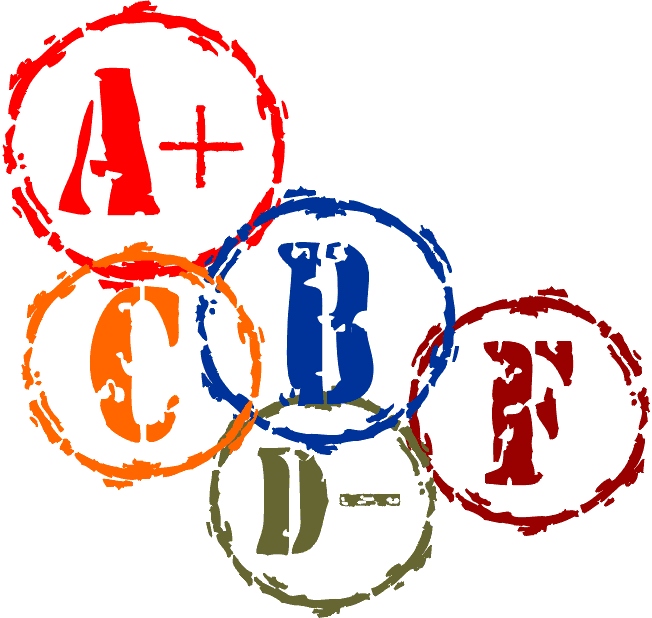
Grades Collage, January 24, 2010. (http://hopkins.typepad.com).

Montgomery County Public Schools opened its doors to students for the start of the 2012-13 school year on Monday, August 27. With the start of the school year came some new changes to the report card and grading system, at least for MCPS’ elementary schools. Starting this year, the school district has dropped the old grading system of O, S and N (Outstanding, Satisfactory and Needs Improvement) for first and second graders, and the old A, B, C, D and E system for third, fourth and fifth graders. Instead, they’ve introduced a new grading system for all 1st-5th graders:

Score Description
ES Exceptional at the grade-level standard
P Meets the grade-level standard by demonstrating proficiency of the content or processes for the measurement topic
I In progress toward meeting the grade-level standard
N Not yet making progress or making minimal progress toward meeting the grade-level standard
M Missing data – no grade recorded
NEP Not English Proficient; may be used for a level 1 or 2 ESOL student for no more than two marking periods.

According to MCPS, “[t]he goal of this grading format is to give families a clear understanding of your child’s progress toward end of year grade level expectations.”

Now, I’ve been an educator of some sort now for the better part of two decades, and have worked with several grading systems as a college professor. Not to mention having to learn different grading systems as a student even before that. Trust me when I say that this new grading system isn’t a clear one, and isn’t easy to understand.

But the overall goal is clear. MCPS wants to tie grades to their new yet only partially implemented integrated Curriculum 2.0, adopted as part of the new Core Curriculum for the state of Maryland. It is an integrated, standards-based curriculum that introduces a variety of interrelated themes across the various subjects for K-5 (although fourth and fifth grade will not see any of this curriculum until 2013, when my son is in fifth grade). In theory, this grading system will be more directly tied to students’ proficiency levels in achieving or exceeding state-level standards in reading, mathematics, writing and other subjects for their grade level.

Sounds reasonable, doesn’t it? After all, if a child is proficient in say, the fourth-grade standard for reading, then they would receive a P grade. This is unreasonable, though, and for at least a couple of reasons. For one, it means the entire MCPS elementary school curriculum has become about meeting standards that will be tested at the state-level on the MSA, and at the county level on MAP-R. The curriculum itself has now become integrated into the testing game at the elementary school level.

Second, and maybe even more important here, is the idea that grading-to-a-testing-based-curriculum is a better and more accurate way to assess children. I’m not sure how this helps kids, though. If a student does well enough to score multiple “ES'” on their report card, they’ve exceeded the standard for their grade level. But this doesn’t necessarily mean they are ready for the next grade level. If a student has multiple N’s on their report card, does that mean that they have failed to meet the standards in several subjects at their grade level, that they aren’t making progress?

ESPN logo, August 29, 2012. (http://thebiglead.com). In public domain.

It seems to me that beyond understanding the grading system and the tensions in its methodology is the fact that, in the end, these grades aren’t going to mean much to MCPS’ K-5 students. Or to students across the state of Maryland, for that matter. After all, an A, C, or E is much easier to interpret than an ES, P, I or N (or ESP(i)N, as I’ll begin to call it from now on). Psychologically speaking, while this grading system takes some symbolic pressure off of performance via state and county test scores, it also means that kids won’t have a full appreciation for success, mixed success or failure beyond a curriculum of testing.

It would’ve been smarter to go to a qualitative grading system — something that I know some schools and universities have used over the years — than to this one that ties curriculum and grading systems to testing. At least with a descriptive system of grading, you can get in a single paragraph a fairly focused analysis from a teacher about a student’s progress, their strengths, weaknesses and where they’ve had good or great success. This new MCPS grading system, though, is the academic equivalent of giving every team in a children’s soccer league a trophy, whether their record was 10-0 or 0-10. It pretty much renders grading meaningless, as everything is about standards and measurements, and ultimately, testing.

College Isn’t For Everyone

07 Thursday Jun 2012

Posted by decollins1969 in 1, Academia, Boy @ The Window, culture, Eclectic, Politics, race

≈ Leave a comment

Tags

Adult Learners, College Access, College Success, Economic Inequality, Education, Education News, Education Reporting, Educational Inequality, For-Profit Colleges, Ivy League Schools, Jay Mathews, K-16 Education, Parental Advantages, Parents, Politics of Education, Poverty, Public Education, Public Institutions, Taking Advantage, Washington Post


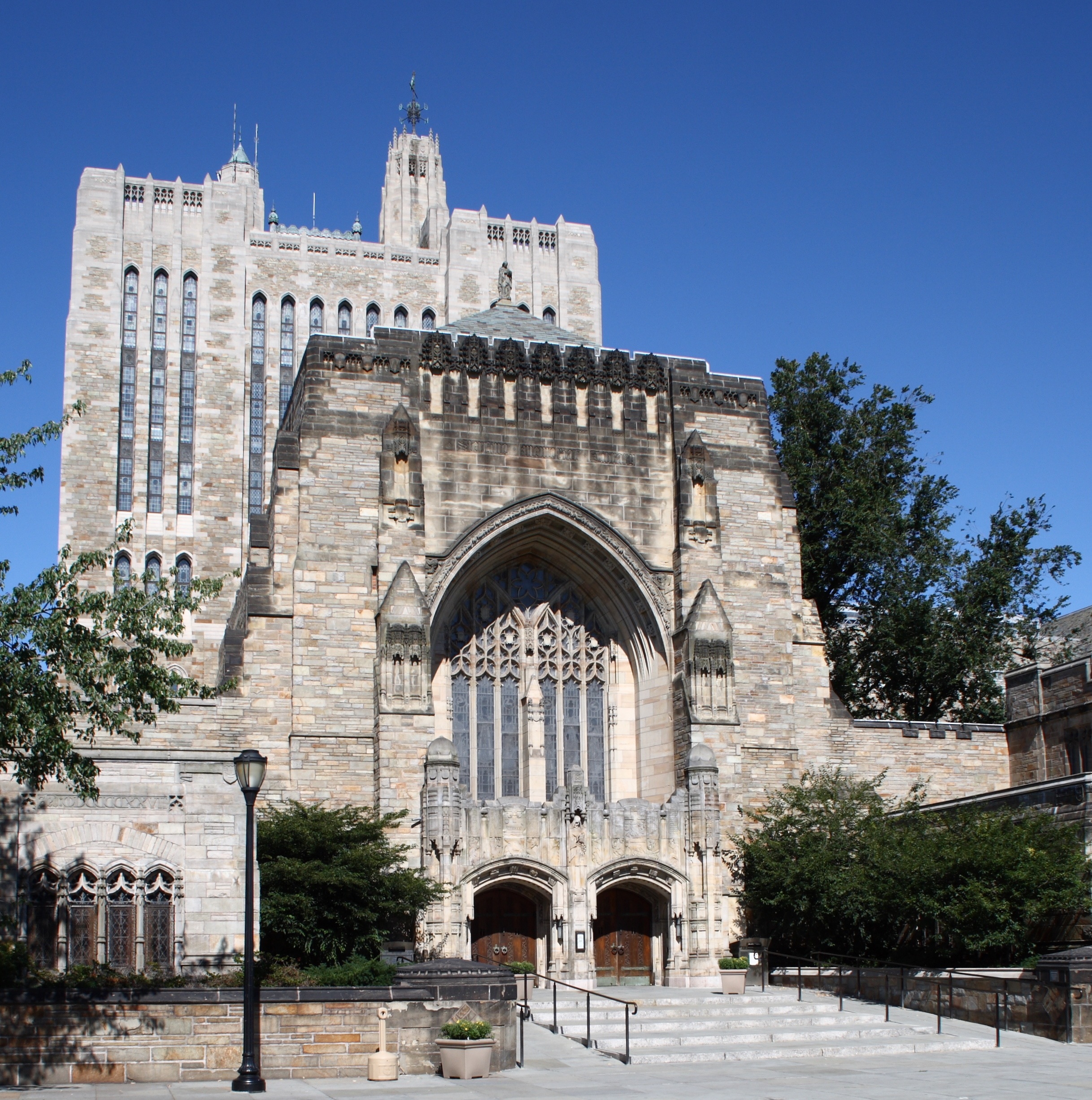
Sterling Memorial Library (cropped), Yale University, New Haven, CT, September 3, 2008. (Ragesoss via Wikipedia). Permission granted via licenses with GFDL and Creative Commons cc-by-sa-2.5.

In May ’05, I attended a conference in DC hosted by the Council for Opportunity in Education on college access and college success. Jay Mathews, an education columnist with The Washington Post, was a guest speaker. Mathews spent most of his talk telling educators that the public doesn’t care for our extensive analysis of what does and doesn’t work in K-16 education reform. “Readers only care about two things,” Matthew said — testing, and “how can I get my kid into Harvard, Yale or Princeton?”

I certainly didn’t like Mathews’ smug and dismissive talk, but he was right about one point, however inadvertent on his part. That most Americans don’t think about education news unless it either confirms their worst fears — that public education is a waste of taxpayer dollars — or confirms their highest hopes — that an Ivy League school (or the near equivalent) accepts Tyler or Courtney as students. Little else matters for most of the American reading public, because columnists, reporters and editors like Mathews have long since abandoned the idea that education is a playing-field leveler for most people. “College isn’t for everyone,” is the common refrain in Mathews’ world, and in the world of most right-thinking Americans.

What does go unreported and underreported, though, is that most Americans with the money and knowledge to give their kids every advantage possible, and do so in a rather ruthless fashion. All while denying other kids in their community similar opportunities, deliberately or otherwise. Over the past thirty-five years, property taxes and other taxes that cover the costs of a public education have been slashed, as taxpayers revolted in places like California and New York in the 1970s and 1980s.

That alone has meant two things: the contributions of the federal government to public education increased to make up for these long-term tax cuts, and the ability of most American school districts to provide all of the necessary resources for students has gone down. This opened the door for the politicized hammering of teachers unions as too powerful, and the growth of the testing mandate since the early 1990s, further weakening public education. Need I even mention public charter schools as the suggested alternative for Americans of lower-income?

Gated community, Houston, TX area [but virtual gates in education for years], February 13, 2012. (Chelsea Lameira via http://www.houstonagentmagazine.com)

But that’s only part of the story. There are plenty of parents who take even more advantage of loopholes based on money and knowledge. They hold their kids out of school a full year before kindergarten, giving them an extra twelve months to become proficient readers before they’ve ever stepped into a classroom. They pay for tutors and Kumon early on, but not because their kids are struggling with reading, writing and math. No, these parents pay for this extra help to give their students the ability to score in the top percentiles on tests that will label their children as “gifted.”

Some parents even transfer their children to different schools within a district with the “right” demographic mixtures to ensure their student’s success and their ability to be noticed. Some parents will begin the process of preparing their kids for the SATs and for AP courses via Kaplan or Princeton Review as early as fifth and sixth grade. And all to ensure that, in the end, their kids will have the post-high school choice of an Ivy League school, or at least, an equivalent elite school, like a Stanford or Georgetown.

These parents, the majority of Americans who would only readily agree with Mathews’ worldview on education news, aren’t evil. But, then again, we all know what the road to Hell is paved with. And in this case, these advantages on the one end point to the severe disadvantages on the other end, no matter how rare it is for the likes of Mathews to write about.

I’m not talking about poverty from birth to eighteen per se, although I could go there in detail. No, it’s the end result, the young adult or over-the-age-of-twenty-five person who finally decides after years of educational neglect to take advantage of the twenty-first century, to go to college after struggling to finish elementary, middle and high school. Most of these students never knew a tutor, never had a parent who understood the loopholes in public education of which to take advantage.

These adult students come into college — often a for-profit institution like University of Phoenix, a

University of Maryland University College administrative offices, Largo, MD, July 2, 2010. (Donald Earl Collins).

community college or a public institution like the one in which I teach now in University of Maryland University College — as raw and unpolished. These students are often long on enthusiasm, yet short on the skills and especially knowledge they need for success. And they have a sharp learning curve in order to get there. One in which these students have to learn in a year or what it took the most advantaged Americans eighteen or nineteen years to learn. The graduation rates of these institutions illustrate how difficult it is for most adult students to climb Mount Everest in their shorts, and all in the middle of a blizzard.

“College isn’t for everyone,” I hear Mathews and millions of other smug Americans say. Of course it isn’t. Especially when you make sure that it isn’t, through money, knowledge and cunning politics.

“It Is Done” – 15 Years Later

21 Monday Nov 2011

Posted by decollins1969 in 1, Academia, Boy @ The Window, culture, Eclectic, race, Youth

≈ Leave a comment

Tags

Academia, Barbara Lazarus, Barbara Sizemore, Betrayal, Calling, Careers, Carnegie Mellon University, Catherine Lugg, Dan Resnick, Daniel P. Resnick, Dissertation, Distrust, Education, Epiphany, Joe Trotter, Joe William Trotter Jr., Self-Discovery, Writing


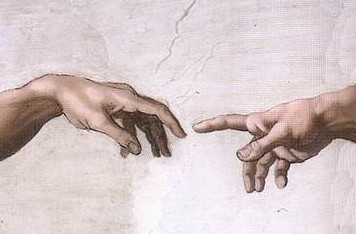
Hands of God & Adam, fingers about to touch, Sistine Chapel ceiling, Vatican, Michelangelo, 1508-1512 (via Wikipedia). In public domain.

The next twenty-four hours will mark a decade and a half since my former dissertation advisor Joe Trotter wrote today’s title quote in a God-like-pronouncement of an email to me regarding my final content-based revisions to my doctoral thesis. With those revisions following my committee meetings in October, I was now officially Dr. Collins. I knew that. I just didn’t feel it.

Working on a book-length research project with an abusive advisor and disinterested committee members at a school as conservative and isolating as Carnegie Mellon University left me exhausted. For I never felt I could ever be all of myself there. I made myself into the scholar I hoped that I wouldn’t become. At least, the twenty-one version of me that began graduate school back in ’91 held that hope. Five years later, I felt alienated from my own purpose and calling, and was more than unsure about becoming a full-time professor and historian. Especially given the wonderful examples of scholarly inhumanity and hypocrisy that Trotter, Dan Resnick and so many others had proven themselves to be (see “You’re Not Ready” post from November ’08 and “And Now, A Plagiarism Moment” post from September ’10).

I was burned out. I felt numb, with a boiling mantle of rage underneath the surface. If Trotter had said the

Arching fountain of a Pahoehoe (like my post-PhD rage) approximately 10 m high issuing from the western end of the 0740 vents, a series of spatter cones 170 m long, south of Pu‘u Kahaualea, September 10, 2007. (USGS via Wikipedia). In public domain.

wrong thing to me at the wrong time in ’96, I probably would’ve laid him out with a right hook to the jaw. And Resnick’s lucky that I didn’t own a car, because I might’ve run him down with it.

As it was, when Trotter attempted to meet with me a few weeks later to discuss “my future,” I refused. Especially given his suggestions for job applications. One, a one-year position at a University of Nebraska branch campus. The other, a CUNY school in Queens with a proposed position that wouldn’t begin until July ’98. I told him, “You don’t get to determine my future, certainly not without me.”

What should’ve been a period of rest and repair between Thanksgiving Week ’96 and graduation day in May ’97 was hardly that at all. It took me, really and truly, six months to recover from the dissertation process, and probably close to two years to not pass by or go on Carnegie Mellon’s campus without wanting to strangle my dissertation committee with piano wire. By then, I’d moved on to the rather mundane task of figuring out how to cobble together a career that wasn’t dependent on a full-time faculty position in academia.

And over the past fifteen years, I have pieced together several careers. As a part-time college professor, as a nonprofit program officer and as a consultant. It helped to have people like the late Barbara Lazarus and my dear friend Cath Lugg in my corner in those first years after I’d finished my doctorate. It helped that I expanded my career options from merely pursuing a history professorship wherever Joe Trotter’s winds could’ve taken me.

But it helped, most of all, for me to start trusting my instincts, my own heart, again. The irony of my complete disillusionment at the end of my degree-earning journey was that it left me with the time to contemplate whom I thought I really was, what I really wanted to do in life, and how I wanted to do it.

It was far from an immediate process of epiphanies and revelation. It took me nearly six years after finishing my dissertation to see myself as a writer, cutting through twenty years of denial and abuse in the process. It took me a little longer to see myself as a writer first and foremost, with all of my other professional hats second, third, and so forth. To understand that mine was a concern far greater than multiculturalism in education. My role as a writer and educator was also about aspirations, academic pathways to success, racial and ethnic equity in education, access to and success in college.

Barbara Sizemore, 1927-2004, circa mid-1990s. (http://sesp.northwestern.edu).

Now, that doesn’t mean that I haven’t looked back to wonder what could’ve been. If I were a White male with my credentials, I’d long ago been doing what I’ve been fighting to do as a writer and educator for years. If my advisors had been someone like a Cornel West or Henry Louis Gates. Or if I had attended an Ivy League school in undergrad. Or if I’d earned a master’s degree in journalism or communications, or a doctorate in a school of education or in psychology.

The late Barbara Sizemore once warned me about earning my doctorate in history some two decades ago. “You always have to do things the hard way, don’t you?,” she said to me with disapproval when she learned of my acceptance into Pitt’s history PhD program. I should’ve said, “Yes, I do.” Because the last fifteen years have been a hard road, as all roads to enlightenment are.

Holes in Foundation Shield of Education Funding

03 Thursday Nov 2011

Posted by decollins1969 in 1, Academia, Boy @ The Window, Eclectic, Politics, race

≈ Leave a comment

Tags

Academia, Bill Gates. Makin' It Rain, Collaboration, Early College High Schools, Education, Education Reform. K-16 Education, Foundations, Funding, Higher Education, K-12 Education, K-8 Schools, Linkages, P-20 Education, Race, Real Reform. Overhaul of P-20 Education, Social Justice, Synergy


Leather knight shield with holes, November 2, 2011. (http://paulssupplies.com)

As an educator and someone who has worked in the nonprofit world on education reform issues for slightly less than half of my life (I turn forty-two next month), it’s curious and disappointing to continue to see a scatter-shot and tweaking approach to education reform. An approach that often gets the bulk of the funding from private and corporate foundations.

If what Bill Gates said at the National Education Summit in Washington, DC in February 2005 is correct, that “American high schools are obsolete in their current form” — and I believe he is — then why does his foundation and others fund mostly small-scale projects? Especially ones that have few, if any, possibilities for replication or for making American high school more relevant to the twenty-first century?

But let me not pick on the Bill & Melinda Gates Foundation as being neglectful of seeing the big, panoramic picture on K-12, K-16 or even P-20 education. Below, in general, are the parts of education process the big foundations have tended to fund over the past five to ten years:

Preschool, Pre-K Education = Annie E. Casey Foundation, Pew Trusts

K-12 Education = Gates Foundation, Hewlett Foundation

Higher Education, Education Research = Spencer Foundation (most $$$ now via AERA/NAE), Mellon Foundation

Higher Education Access/Success = Lumina Foundation for Education, Ford Foundation, Gates Foundation, Jack Kent Cooke Foundation

Student Financial Aid = Lumina Foundation for Education, Gates Foundation

Teacher Effectiveness = Gates Foundation, Hewlett Foundation, Ford Foundation

Poverty, Community Development, Race = W.K. Kellogg Foundation, MacArthur Foundation, Pew Trusts, Ford Foundation, Annie E. Casey Foundation, Gates Foundation.

They have funded and still do fund everything from early childhood education programming, credentials for early childhood educators, small schools, research for curriculum realignment, online education options for K-12, leadership programs for principals and school superintendents, to student and teacher incentive programs, fiscal and human resources allocation, early and middle college high schools, and assessments for teacher effectiveness. (By the way, that is the longest sentence I’ve ever written, at least without editing into

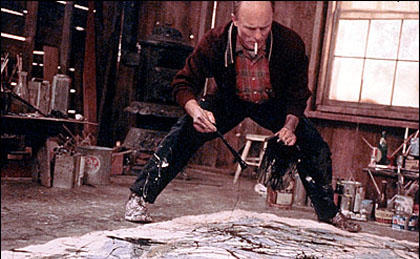
Ed Harris as Jackson Pollock in Pollock (2000), spreading and throwing paint, August 6, 2009. (http://www.totalfilm.com).

smaller sentences).

Seems like everything in the P-20 education universe is covered, right? Except, I’d defy anyone in or out of the education field to try to add all of this up into a comprehensive overhaul of early childhood and K-12 education that would then force reform in higher education.

The reason that we can’t assume that all of this adds up to real reform is simple. A dozen or so foundations pouring billions of dollars into a quarter-trillion dollar a year system through tens of thousands of grants, each working on a separate problem? By definition, a comprehensive overhaul isn’t possible. It’s as unlikely as Wall Street disengaging itself from American politics without a decade of Occupy Wall Street.

We could start, conceivably, with the idea of early and middle college high schools. One where school districts and the colleges and universities adopting these high schools collaborate on creating a system that would leave high school graduates with the equivalent of two years of college training or an associate’s degree. Or in the case of students who made plans to not go to college, two years of training that would make them employable in the twenty-first century workforce.

Only, these early and middle college high schools would be without the additional burden of providing remediation to ninth graders not ready for what we now call high school. Bottom line: we need a single-track college/career ready system that begins its work in preschool and pre-K programs, one in which these programs are tied to elementary schools, so that it doesn’t take the poorest of students three years to catch up. We need linkages between elementary and middle schools — or as many researchers suggest, K-8 schools — where the work to make students ready for algebra, critical thinking through writing and the arts could take shape in a more supportive and coherent environment.

More direct linkages between schools and community organizations and services — health clinics, psychological services, nonprofit organizations focused on the arts, writing, sports, science and math — are

Crane removing part of Berlin Wall at Brandenburg Gate, December 21, 1989. (SSGT F. Lee Corkran/US Dept of Defense). In public domain.

necessity to build communities that are committed to large-scale education reform. For if these organizations and systems continue to work in parallel series rather than in collaboration, all these attempts at reform are for naught.

But foundations have always been leery to link their work, to fund for the long-term, to think in ways that encourage collaboration — kind of like corporations, Wall Street bankers and the GOP. They also tend not to hire deep thinkers on issues like education. Or at least, the linkages between education, race, class, gender, community and the workforce.

Though they are doing a better job these days, especially in the case of the Kellogg Foundation on race, we need a more solid shield. One that is truly about transforming P-20 education, and not just tweak it with data and pilot programs. Funding programs without a grander vision might as well be a “make it rain” party at a strip club.

Education Incorporated

13 Thursday Oct 2011

Posted by decollins1969 in 1, Academia, culture, Eclectic, Politics, race, Work, Youth

≈ 1 Comment

Tags

"genius" award, Anya Kamenetz, Bill & Melinda Gates Foundation, Brookings Institution, Center for American Progress, Corporate Interests, Corporate Models, DIYu, Early College High Schools, Education, Education Reform, Edupunks Guide, Higher Education, K-12 Education, MacArthur Foundation Award, Michelle Rhee, No Child Left Behind, Roland Fryer Jr., Single-Track College Prep School Systems, Teach for America, The Hamilton Project, The New Teacher Project, Wendy Kopp, Workforce Development


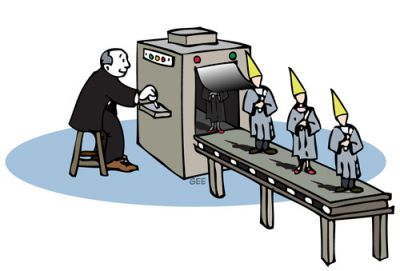
Capitalist Education Factory, November 1, 2010. (Source/http://communiststudents.org.uk).

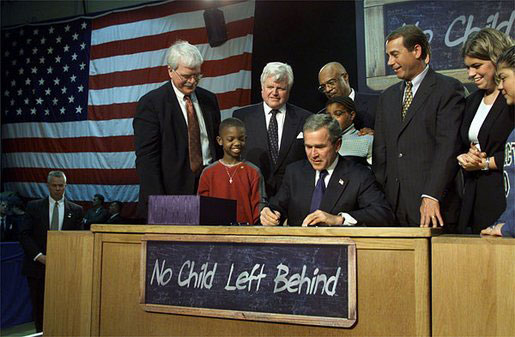
A generation ago, most of us in education worried about a federal government takeover of America’s 15,000 school districts with mandated standards. Wow, that prediction was way off, wasn’t it? (Oh, wait, the No Child Left Behind Act, passed in 2001, created a new era of national standards for accountability, not to mention high-stakes testing).

President George W. Bush signs into law the No Child Left Behind Act, Hamilton HS, Hamilton, Ohio, January 8, 2002. (http://www.whitehouse.gov). In public domain.

Now, we worry with good reason, as corporate interests inject themselves into education reform at every level. This has brought an imbalance to the education reform conversation that hasn’t existed since the days of Andrew Carnegie and the height of immigration of swarthy peoples from Southern and Eastern Europe. Now, as it was a century ago, it was the inclusion-vs.-exclusion debate. Whether to provide the best possible education for all comers, or sort and kick out as many “dull-minded” “undesirables” (both literally from 1911 to describe the learning disabled, immigrants and Black migrants) in K-12 schools as possible.

But this debate today — if we can really call it that — includes higher education. Of course, we know better than to call the millions of potential students who need some sort of post-high school training and education “morons” (also a 1911 term used by White psychologists who assumed anyone not WASP didn’t have the mental capacity to make use of a high school education). Yet we do attempt to sort these students and potential students into categories, like “adult learners,” “non-traditional students,” even “Edupunks,” a term

Anya Kamenetz, author of Edupunks Guide, at University of South Dakota, August 27, 2010. (http://www.usd.edu). In public domain.

coined by author Anya Kamenetz.

None of this has eliminated a common refrain in our field. That a four-year degree “isn’t for everyone,” as Kamenetz said to me after I asked her a tough question regarding the accessibility of her ideas for a Do-It-Yourself-university (DIYu) process of pursuing a college degree. It was a conference hosted by the Center for American Progress, but paid for by the Bill & Melinda Gates Foundation. Her idea, while helpful to 18-30 year-olds who are tech-savvy and with enough income to make this piecemeal education process work, was unhelpful to low-income students, and students of color over the age of thirty. And Kamenetz’s response was the typical exclusionary one.

Apparently, in our current economic climate, a full-time job isn’t for everyone either. Still, despite this reality, the Gates Foundation, Lumina Foundation for Education, and the Hewlett Foundation have all adopted similar models of thought around K-12 and higher education reform that have legitimized the work of people like Wendy Kopp and Michelle Rhee (Teach for America and The New Teacher Project, respectively) and institutions like University of Phoenix and Kaplan University. Models which draw heavily from corporate paradigms for success, including the punishment of failure. But they haven’t led millions of us to jobs in the new economy.

I recently attended a meeting hosted by the Brookings Institution’s Hamilton Project, in which authors presented a series of papers on K-12 education reform. Supposedly with cutting-edge ideas. Like one presented by MacArthur Foundation “genius” (emphasis on the quotation marks) Award winner Roland Fryer on providing student incentives linked to immediate and long-term educational goals for those most at risk of

Professor Roland Fryer, Harvard University Department of Economics, September 2011. (http://economics.harvard.edu).

dropping out of school, like low-income boys of color. Examples of paying fifth graders in Houston and New York $2 for every book they read or for completing their homework wasn’t so much cutting-edge as it was unremarkable. Incentives are fine, if you can pay for them or show how they nurture a passion for learning beyond the goal of completing individual tasks. This, of course, the “genius” couldn’t show.

The ridiculous assumption that Fryer made, arguing that because money in K-12 education had doubled since 1970, that funding wasn’t the issue, would’ve made me laugh as a high school senior. When you account for inflation, K-12 funding has declined, and not by a small amount, since the 1970s, and by the way, the millennial generation has created a new demand for schools, as the number of new schools or schools in need of renovations adds to this doubling in four decades. Fryer’s exclusion of data that a first-year graduate student wouldn’t have missed made me realize that most people in the field are so desperate for ideas that anything that sounds new must be good or cutting-edge. Especially if it’s funded by the Gates Foundation.

It’s not just the Gates Foundation, per se. It’s the idea that since things aren’t working for millions of students and undereducated workers, a model that concentrates on teacher effectiveness and treating students as customers — whether in fifth grade or in college — is the best way to go. This attitude has become so pervasive among well-funded education reformers that the idea of increasing funding for schools, or of making schools from pre-K on focus on all students in need of college/workforce readiness is about as welcome as Michael Moore at a Koch Brothers fundraiser.

Early college high schools and single-track, college-prep K-12 school districts, two of the great secrets of K-12 and higher education reform, remain such because these are difficult to bring to scale, and require more upfront investment than most philanthropists and businesses are willing to make. Not to mention, these represent the hard work of real reform, but ones that won’t make people like Kamenetz, Fryer, Kopp and Rhee stars. But by all means, let’s continue to fund every hair-brained idea as if tweaking our education system will yield results like a nuclear fusion plant on steroids.

A Friendship Changing Lanes

03 Monday Oct 2011

Posted by decollins1969 in 1, Boy @ The Window, Christianity, Eclectic, Mount Vernon High School, Mount Vernon New York, My Father, race, Religion

≈ Leave a comment

Tags

Education, Family, Friendship, Friendships, Humanities, Ideology, Johns Hopkins University, Mount Vernon High School, Mount Vernon New York, MVHS, Politics, Race, Religion, University of Pittsburgh, Valedictorian


Changing Lanes (Movie, 2002) Screen Shot, March 2008. (Source/http://swedenborgiancommunity.org).

Part of the problem of being me is the fact that my close friends change as I change. Meaning that there have been transitional periods throughout my life that my old friends fall away. Oftentimes I make new ones, and sometimes, like during my six years in Humanities, my best friend was my imagination. Ironically, the best friendship I had from my Humanities days came with a classmate that I hadn’t become close to until my last couple of years at Mount Vernon High School. More ironically, that friendship didn’t truly become such until we both went away for college in ’87.

I’ve written about her before, the valedictorian of my class, whom I called “V” in a previous post (see Valedictorian Blues from July ’09). To be honest, I’m not sure how our acquaintanceship ever became a friendship. Somewhere between having circumstances in which our fathers weren’t around consistently, or at least being able to relate to Billy Joel, or both of us scoring “5”s on the AP US History exam.

But really, it might’ve just come down to both of us not belonging, or facing a small degree of ostracism from our Humanities and MVHS classmates overall. I wasn’t Black and cool enough, and V, well, she was a classic White nerd, a grinder who had the gall to finish ahead of our Black male salutatorian, at least from the perspective of some authority figures and the school’s popular crowd.

The fact that we went our respective ways, to Pitt and Johns Hopkins, helped. The fact that we wrote each other about some of our social triumphs and challenges helped more. Most importantly, it helped a lot that we both were more honest about our family troubles. Everything from my mother’s need to divorce my idiot stepfather and the issues with my younger siblings to V’s mother and her health issues and struggling with burnout trying to watch over her family while going to school.

So, by the time I began my second year of grad school, we’d become fairly close. I visited her and her family in the DC area eight times during the ’90s, and went to her mother’s funeral and wake in ’96. V came to my PhD graduation ceremony the following year. By ’97, me and V had been friends for ten years, and known each other more than fifteen. For more than six years, she’d really been the only person from my Humanities and high school days with whom I’d been in regular contact.

Changing lanes, Las Vegas Strip, December 12, 2010. (Source/Bjørn Giesenbauer - http://Flickr.com).

Who knew that within four years of marching for my doctorate that our friendship would become a distant one? I think that our approaches to life was so different that we couldn’t help but become distant friends. I am one who refuses to take life on its own terms. If I had taken V’s approach, I’d still be living in Mount Vernon, New York, only with a nine-dollar-an-hour job sorting mail or flipping carcinogenic burgers. V’s was based on some sort of realism that mixed with a sense of eugenic inevitability. That one’s slot in life should remain such, and if one does make it, one must do so without ruffling any feathers.

Besides that, it was obvious that things about who we had been since the early ’80s had evolved, and was changing even more rapidly as we reached our late twenties. I was no longer the blank-faced, closed-mouthed, socially-awkward kid I was in ’82. V was no longer responsible for watching over her mother and her younger sister. We agreed to disagree on so many things. Our politics diverged. Our views on race and racism were growing further apart, as if I was Michael Eric Dyson and she was Ann Coulter.

But even with all of that, I think the seeds of it began when I started dating my future wife at the end of ’95. Something about being in a serious relationship has changed the dynamics of every friendship I had then and have now. I never thought that my friendship with V would be affected. But of course it was. We live in a world where a man and a woman can’t be close friends without it being made into something more than friendship.

Like the seasons, people change, and even if they change for the better, our change will cause our friendships to change as well. It’s just too bad that V couldn’t adapt to all of the good changes in my life like I adapted to hers.

← Older posts
Newer posts →

Boy @ The Window: A Memoir

Boy @ The Window: A Memoir

Places to Buy/Download Boy @ The Window

There's a few ways in which you can read excerpts of, borrow and/or purchase and download Boy @ The Window. There's the trade paperback edition of Boy @ The Window, available for purchase via Amazon.com at http://www.amazon.com/Boy-Window-Donald-Earl-Collins/dp/0989256138/

There's also a Kindle edition on Amazon.com. The enhanced edition can be read only with Kindle Fire, an iPad or a full-color tablet. The links to the enhanced edition through Apple's iBookstore and the Barnes & Noble NOOK edition are below. The link to the Amazon Kindle version is also immediately below:

scr2555-proj697-a-kindle-logo-rgb-lg

Boy @ The Window on Amazon.com: http://www.amazon.com/Boy-The-Window-Memoir-ebook/dp/B00CD95FBU/

iBookstore-logo-300x100

Boy @ The Window on Apple's iBookstore: https://itunes.apple.com/us/book/boy-the-window/id643768275?ls=1

Barnes & Noble (bn.com) logo, June 26, 2013. (http://www.logotypes101.com).

Boy @ The Window on Barnes & Noble: http://www.barnesandnoble.com/w/boy-the-window-donald-earl-collins/1115182183?ean=2940016741567

You can also add, read and review Boy @ The Window on Goodreads.com. Just click on the button below:

Boy @ The Window

Twitter Updates

Tweets by decollins1969
  • RSS - Posts
  • RSS - Comments

Archives

  • June 2025
  • April 2023
  • September 2022
  • August 2022
  • July 2022
  • June 2022
  • May 2022
  • April 2022
  • March 2022
  • January 2022
  • December 2021
  • November 2021
  • October 2021
  • September 2021
  • August 2021
  • July 2021
  • June 2021
  • April 2021
  • March 2021
  • February 2021
  • January 2021
  • December 2020
  • November 2020
  • October 2020
  • September 2020
  • August 2020
  • July 2020
  • May 2020
  • April 2020
  • March 2020
  • January 2020
  • December 2019
  • November 2019
  • August 2019
  • July 2019
  • June 2019
  • May 2019
  • April 2019
  • March 2019
  • February 2019
  • January 2019
  • December 2018
  • November 2018
  • October 2018
  • September 2018
  • August 2018
  • July 2018
  • June 2018
  • May 2018
  • March 2018
  • February 2018
  • January 2018
  • December 2017
  • November 2017
  • October 2017
  • September 2017
  • August 2017
  • July 2017
  • June 2017
  • May 2017
  • April 2017
  • March 2017
  • February 2017
  • January 2017
  • December 2016
  • November 2016
  • October 2016
  • September 2016
  • August 2016
  • July 2016
  • June 2016
  • May 2016
  • April 2016
  • March 2016
  • February 2016
  • January 2016
  • December 2015
  • November 2015
  • October 2015
  • September 2015
  • August 2015
  • July 2015
  • June 2015
  • May 2015
  • April 2015
  • March 2015
  • February 2015
  • January 2015
  • December 2014
  • November 2014
  • October 2014
  • September 2014
  • August 2014
  • July 2014
  • June 2014
  • May 2014
  • April 2014
  • March 2014
  • February 2014
  • January 2014
  • December 2013
  • November 2013
  • October 2013
  • September 2013
  • August 2013
  • July 2013
  • June 2013
  • May 2013
  • April 2013
  • March 2013
  • February 2013
  • January 2013
  • December 2012
  • November 2012
  • October 2012
  • September 2012
  • August 2012
  • July 2012
  • June 2012
  • May 2012
  • April 2012
  • March 2012
  • February 2012
  • January 2012
  • December 2011
  • November 2011
  • October 2011
  • September 2011
  • August 2011
  • July 2011
  • June 2011
  • May 2011
  • April 2011
  • March 2011
  • February 2011
  • January 2011
  • December 2010
  • November 2010
  • October 2010
  • September 2010
  • August 2010
  • July 2010
  • June 2010
  • May 2010
  • April 2010
  • March 2010
  • February 2010
  • January 2010
  • December 2009
  • November 2009
  • October 2009
  • September 2009
  • August 2009
  • July 2009
  • June 2009
  • May 2009
  • April 2009
  • March 2009
  • February 2009
  • January 2009
  • December 2008
  • November 2008
  • October 2008
  • September 2008
  • August 2008
  • July 2008
  • June 2008
  • May 2008
  • April 2008
  • March 2008
  • February 2008
  • January 2008
  • December 2007
  • November 2007
  • October 2007
  • September 2007
  • August 2007
  • July 2007
  • June 2007

Recent Comments

MaryPena's avatarMaryPena on My Day of Atonement/Bitter Hat…
decollins1969's avatardecollins1969 on No Good Teaching Deed Goes…
Mary Rose O’Connell's avatarMary Rose O’Connell on No Good Teaching Deed Goes…

NetworkedBlogs on Facebook

NetworkedBlogs
Blog:
Notes From a Boy @ The Window
Topics:
My Life, Culture & Education, Politics & Goofyness
 
Follow my blog

616 616 East Lincoln Avenue A.B. Davis Middle School Abuse Academia Academy for Educational Development AED Afrocentricity American Narcissism Authenticity Bigotry Blackness Boy @ The Window Carnegie Mellon University Child Abuse Class of 1987 CMU Coping Strategies Crush #1 Crush #2 Death Disillusionment Diversity Domestic Violence Economic Inequality Education Family Friendship Friendships Graduate School Hebrew-Israelites High-Stakes Testing Higher Education History Homelessness Humanities Humanities Program Hypocrisy Internalized Racism Jealousy Joe Trotter Joe William Trotter Jr. K-12 Education Love Manhood Maurice Eugene Washington Maurice Washington Misogyny Mother-Son Relationship Mount Vernon High School Mount Vernon New York Mount Vernon public schools Multiculturalism MVHS Narcissism NFL Pitt Pittsburgh Politics of Education Poverty President Barack Obama Race Racial Stereotypes Racism Relationships Self-Awareness Self-Discovery Self-Reflection Sexism Social Justice Teaching and Learning University of Pittsburgh Violence Whiteness Writing

Top Rated

Blog at WordPress.com.

  • Subscribe Subscribed
    • Notes from a Boy @ The Window
    • Join 103 other subscribers
    • Already have a WordPress.com account? Log in now.
    • Notes from a Boy @ The Window
    • Subscribe Subscribed
    • Sign up
    • Log in
    • Report this content
    • View site in Reader
    • Manage subscriptions
    • Collapse this bar
 

Loading Comments...