• About Me
  • Other Writings
  • Interview Clips
  • All About Me: American Racism, American Narcissism, and the Conversation America Can’t Have
  • Video Clips
  • Boy @ The Window Pictures
  • Boy @ The Window Theme Music

Notes from a Boy @ The Window

~

Notes from a Boy @ The Window

Tag Archives: 616 East Lincoln Avenue

The Writing Bug

19 Thursday Aug 2010

Posted by decollins1969 in 1, Boy @ The Window, Eclectic, eclectic music, music, Youth

≈ Leave a comment

Tags

616 East Lincoln Avenue, Abuse, Domestic Violence, Humanities, Mount Vernon New York, Writing


Writing Bug. Source: http://imaginationsoup.net/wp-content/uploads/2009/06/

It’s been twenty-nine years since I first saw myself as a writer and attempted to pursue writing in any form. It was the summer of ’81, the summer before Humanities and seventh grade, the year before the summer of my abuse. For me at least, this was a calm summer, like I was sitting out by a lake with only a slight breeze blowing around me. I was enjoying the peace and quiet of being near still water, of an occasional rustle of trees, of a plop or two of something dropped into the lake. This was a time for me to imagine our lives as better, better than they actually were. I was on an end-of-elementary school and Humanities-acceptance high. I couldn’t have been any higher than if I had snorted coke at one of those drug-fueled parties my mother used to drag us to hang out with her Mount Vernon Hospital buddies when I was five or six (Luckily, my mother didn’t do drugs.)

I spent most of that summer writing my first book. It was a book about the top-secret military hardware the Department of Defense didn’t want the rest of America to know about. I remained consumed with reading about war and military technology in my spare time — I wouldn’t have learned the word “fortnight” otherwise! Everything from the B-1 bomber to the M-1 Abrams tank to the Trident submarine and MX missile was to be in this scoop on the latest in military high-tech. I even wrote a letter to the Pentagon for declassified pictures of these weapons, which I received in mid-July. By the time of my brother Yiscoc’s birth (one form of Hebrew for “Isaac” and pronounced “yizz-co”) later in the month, I’d written nearly fifty pages on these weapons and why they were so cool for the US military to have. Especially in light of the Soviet military threat. Unfortunately, they didn’t declassify the fact that America’s latest tank used depleted uranium in parts of its hull or in its cannon shells. That would’ve been a real scoop at the time.

I also began to keep my own journal as I began to lose interest in America’s military hardware at the end of that summer. Little did I know what was to come at 616 and in seventh grade in Humanities. My journal was an off and on again project of dreadful tales of hunger, humiliation and heartache. By the time of Crush #1 and witnessing my stepfather’s attack of my mother on Memorial Day ’82, I could barely write at all. The last thing I wrote for my journal (which was a spiral notebook) was about my own abuse throughout July ’82. By the time that ended, I didn’t feel like writing anymore.

But that wasn’t the end of the story. My imagination, my constant talking to myself, my eventual fascination with having an eclectic variety of music and rooting for underdog teams and athletes were all part of a writing process that actually didn’t require me to write. All of these coping mechanisms and more gave me more to write about once I went off to college, and especially after my ex-stepfather broke up with my mother after my sophomore. It wasn’t an accident that within a few months of dumb ass moving out in June ’89, I had started my first journal in seven years. I guess that I always had the writing bug, even when I didn’t possess the paper necessary to write.

Ex-Stepfather’s Balance Sheet

03 Tuesday Aug 2010

Posted by decollins1969 in 1, Boy @ The Window, Christianity, Eclectic, Religion

≈ 2 Comments

Tags

616 East Lincoln Avenue, Ex-stepfather, Fatherhood, Manhood, Maurice Eugene Washington, Mount Vernon New York, Sarai, St. Joseph's Hospital


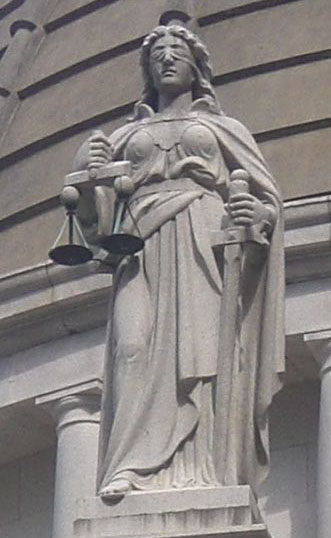
Scales of Justice. No Copyright.

Today marks my idiot ex-stepfather’s sixtieth birthday. Like monsters and other things that go bump in the night, I remember Maurice Washington’s birthday for no other reason than because he made my life — all of our lives at 616, really — a living hell between ’81 and ’89. Of course, the years between ’77 and ’81 weren’t exactly a picnic themselves. The balance sheet of his time as my stepfather would make the national debt look like pocket change by comparison.

The days and weeks since the death of my sister Sarai — and my ex-stepfather’s daughter — have proven how little some people want to change. Four days after I arrived in Mount Vernon and at 616 to help my mother with Sarai’s funeral arrangements, my mother’s telephone rang. It was around 10:30 pm on that muggy, mid-July night, with fans blowing hot air through the otherwise quiet apartment. Quiet because my brothers Maurice and Yiscoc were out and about, and my youngest brother Eri had taken his son to see others on the Washington side of his family. The caller ID showed that the call was coming from St. Joseph’s Hospital in Yonkers, and with my younger siblings out roaming the streets, I immediately became concerned.

I picked up the telephone, said “Hello?,” anticipating some bad news. “How DARE you, YOU BASTARD!,” a man yelled. I had no idea who it was at first. Then, when I heard, “How dare you plan MY daughter’s funeral!,” I suspected that it was my ex-stepfather, but I wasn’t sure. I hadn’t heard his bellowing and bombastic voice in nearly sixteen years. “Who the heck is this?,” I asked. “Who do you THINK this is? Who’s Sarai’s father? Who’s Sarai’s father?” the idiot yelled, as if I were still sixteen and living under the same roof with him.

I ignored the question, and with about a five-second delay as my ex-stepfather reloaded, I said, “I’m not planning Sarai’s funeral. I’m helping my mother plan it.” After that, the dumb ass continued to yell. “A funeral on a Saturday? A Saturday?!?,” he said, as if Sarai was a Hebrew-Israelite, as if any of us cared what he wanted, really.

“Put your mother on the phone! Put your mother on the phone!” he continued. My mother was fully asleep for the first time in nearly five days. I wasn’t about to wake her up. I said, “No. No I’m not.” As he continued yelling, I said, “Until you calm down and start talking rationally, I’m not letting you talk to my mother.” My ex-stepfather paused, then found some more bullets for his yelling gun. “Rational? How I’m supposed to be rational. Put your mother on the phone, boy!,” he yelled as I hung up the telephone. I turned the ringer off, knowing that the fool would continue to call until what was left of his brain would explode, or at least until the nurses drugged him up to make him sleep.

Why was my ex-stepfather in the hospital? Besides his daily need for dialysis, he managed to break his one remaining leg in two places. The broken leg became infected, turned gangrene, and was amputated, at or above the knee I believe. All this apparently happened in June. My ex-stepfather, a fourth-degree black belt in Isshin-ryu Karate, a man who could lift the sixteen-year-old version of myself and the eighteen-year-old version of my older brother Darren with each arm, was now fully wheelchair bound. This, of course, is irony that often can only be found in fiction books like Catch-22, Crime and Punishment or The Kite Runner.

I remember my ex-stepfather giving me two pieces of good advice in the twelve years he was officially with

Balance Sheet.

my mother, either living together or married. Once, when I was fourteen, he caught me walking down the street with my head down, looking at my feet instead of holding my head up. He said, “Donald, your tall, be proud of your height. Don’t ever hang your head. Hold it up straight.” A few months later, when I was just about ready to move in with my father Jimme, he convinced me to stay with my mother at 616. The latter piece of advice was extremely self-serving, but it was good advice anyway.

On balance, though, the man did virtually nothing that could be considered fatherly by anyone outside of Idi Amin or Josef Stalin. Yes, there are worse men and women in the world, but most of them have substantially more power, money and influence than Maurice Eugene Washington. Still, few have literally paid the price for their evils the way he has in the past twenty years. A horribly bad back, Type-2 diabetes, an almost complete loss of kidney function, and a double amputee. That makes me feel sorry for him, even though a part of me doesn’t want to.

Seven Years of Fatherhood

30 Friday Jul 2010

Posted by decollins1969 in 1, Boy @ The Window, Youth

≈ Leave a comment

Tags

616 East Lincoln Avenue, Birthday, Failure, Fatherhood, Mount Vernon New York, Noah, Sins


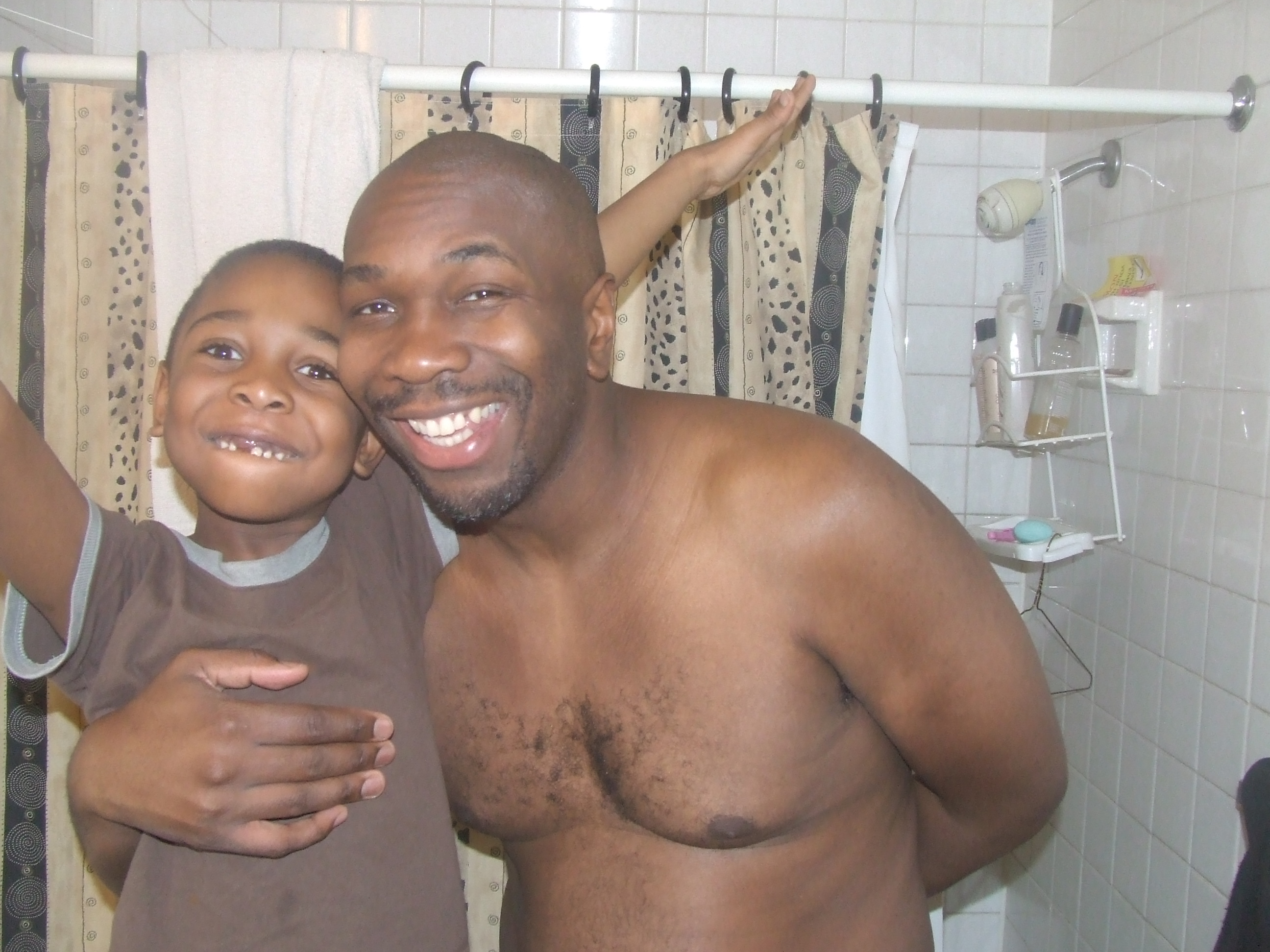
Noah and Daddy, May 29, 2006

Noah’s seven today. Seven! I should be happy. Noah’s healthy, done well in school so far, is curious about himself and his world, and despite it all, has remained sheltered in ways that I never experienced. Even with all of my vivid and weird imaginations I used to protect myself from the world, Noah is much more well-adjusted than I was at any time growing up.

But I’m not happy. It’s not Noah’s fault. I want so much more for him as he begins to form a continual, day-to-day memory cycle. Like not to see his father as a struggling author whose memoir may never be published. It’s a possibility, not one I dwell on too often, but a possibility anyway. Or worse, be seen as a lousy father because Boy @ The Window and my other writings would make it hard for him to have the close relationship we have now. Or worst, he sees me as nothing but a strange and eccentric old fool because of the contents of my second book and because of all the weird things I care about.

I do feel sometimes as though I have failed my son. I haven’t been able to generate as much income for our present and future as I would’ve liked, given my choices for work and career so far. Who was I kidding? A nonprofit manager, a consultant, an adjunct associate professor? Those aren’t jobs that are easy for Noah to explain to his friends. A father who can’t reach into his bank account and pay for a vacation or something like acting classes at the drop of a hat? Really, what good am I?

More than that. I feel like I haven’t completely overcome my past, that the psychological and emotional scars of my growing-up years do manifest themselves in my fathering and in my son. It’s nothing obvious. Subtle reminders, like Noah asking, “When are we going to buy a house?,” a question I used to ask my mother until I turned nine. Or when I see Noah struggling to assert himself in his first friendships, where some of his so-called friends make dumb jokes about his name. Or when Noah waits for others in his cohort to call him into a huddle to play before he’ll actually play with them.

I have to remind myself that shyness isn’t hereditary, nor the signs of sins visited upon anyone from

Noah and Daddy, December 27, 2009

central Georgia with the last name “Collins.” That I can’t try to force him into becoming an uber-extrovert, the way my father, ex-stepfather and mother tried to do with me and my older brother Darren. That worked so well that Darren has never had a meaningful relationship in his adult life, and it took the first five years of my adult life to recover from the damage.

Still, I don’t want to pass on to Noah any of the damage that remains. At the same time, I want him to become the well-rounded person and young man whom I became by my early twenties. I feel the time slipping and ticking away to make the right choices, and to have all the necessary resources to do so.

I know that I’m being way too hard on myself. But I can’t help it. I want my son to have the ability to take on the world, if necessary, in ways that I couldn’t when I was his age, or really any age growing up. I had to leave 616, leave Mount Vernon, to declare the past dead in my mind for fifteen years to do that. I don’t want Noah to need that amount of determination and suffering in order to just make it in this world.

I want him to maintain some sense of innocence and confidence earlier and longer than I did. I want him to find himself and then make sure that I don’t beat it out of him with my emotional and psychological baggage, and keep the world from doing the same. This is my prayer, for today and for the next eleven years. Amen.

Crush #1 and Other Bedtime Stories

10 Saturday Jul 2010

Posted by decollins1969 in 1, Boy @ The Window, Eclectic, Jimme, Mount Vernon High School, Sports, Youth

≈ Leave a comment

Tags

616 East Lincoln Avenue, A.B. Davis Middle School, Bedtime Stories, Characters, Class of 1987, Classmates, Holmes ES, Humanities, Mount Vernon High School, Mount Vernon New York, Stories


Noah Sleeping, September 2009

For about the past year and a half, me and my wife have spent some of our time at the end of the day with our son Noah telling him bedtime stories. Actually, it’s been mostly me, since my wife doesn’t like making up stuff. At first, it was just about every night, with me telling Noah true stories about family, friends, former classmates and my school experiences.

I’d often put Noah in those stories, especially the ones I knew he’d laugh at. Like the science teacher who came in one day smelling like a skunk had sprayed him because a skunk actually did. Or the story about my second day of high school, where I had to fight a class hipster because he thought that I was a wimpy push-over.

With me injecting Noah into these stories — usually as the character Ben 10 turning into Big Chill or Humongousaur — I realized I had to embellish a bit, making some of my real-life encounters less like real-life. I told stories about my father where I changed almost all of the wording because the real stories involved more profanity and bigotry than a five or six-year-old should ever have to hear. I’d leave out parts of stories about how mean some of my classmates or teachers were just to make sure Noah was ready to go to sleep happy and without asking me a lot of questions about my past.

About six months ago, I started making up stories, about eighty-five percent fictional in nature. The names

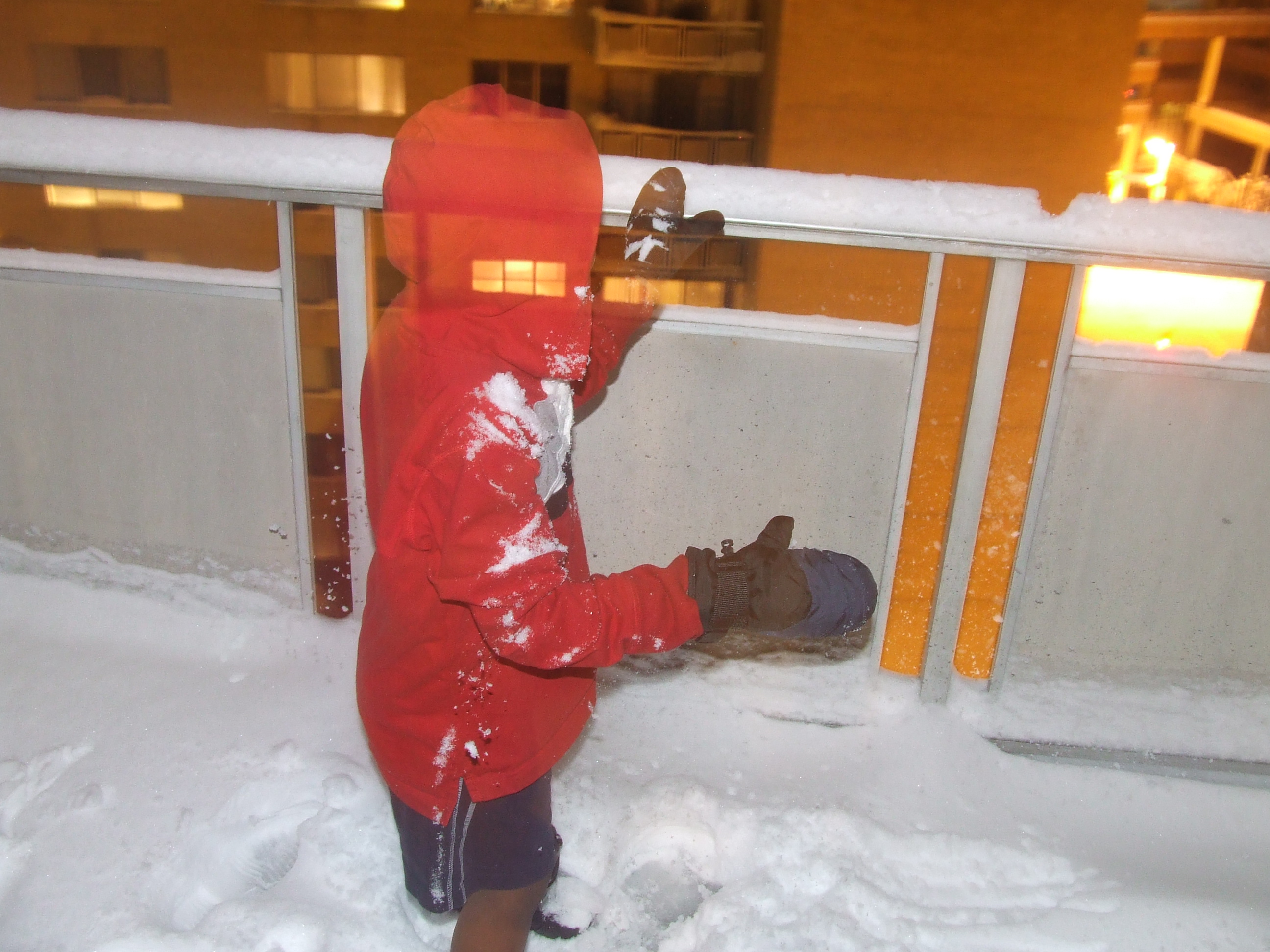
Noah in Snowaggedon (on balcony), February 2010

and places remained the same, but the incidences and their improbable outcomes didn’t. I figured out that Noah mostly enjoyed a few choice characters: a fictionalized ’80s version of my father, a singing, wise-cracking fictional classmate, a super-smart classmate who’d get a case of the “ums” and “uhs” under duress, a friend from my elementary school days who’d fart when under pressure, and an even more tomboyish version of my Crush #1. Noah has since asked for those characters in my stories over and over again.

He’s also asked a lot of questions about my real-life classmates, teachers and family. Like, “Did you really have a classmate who sings ‘Roxanne’ all the time?” Or “Did [your friend] really fart all the time?” “Are you still friends with [super-smart boy]?” So I pulled out the MVHS Class of ’87 yearbook that I had borrowed from a former classmate when revising drafts of Boy @ The Window to show Noah pictures of them so that he could see that these weren’t the larger-than-life, made-up characters I used in my bedtime stories. Not to mention using the power of Facebook to bring home that fact as well.

This past week, Noah’s asked a few more questions. “Do you still like [Crush #1] a lot?,” Noah asked me a couple of days ago. “I still like her, but not the way I liked her when I was twelve,” I said in response, kind of shocked that he asked me that question out of the blue. I then thought for a moment, “Maybe I should keep the twelve-year-old in me to myself until he’s older.”

Noah Salutes

Then I realized. I have to tell Noah these stories. At the very least, it’ll help him not make the same mistakes I made growing up. That way, he won’t have to spend most of his time growing up without good friends, without an eleven-year gap between kisses, with mostly stories that would make most six-year-olds cry. Or, at the least, sad. He can read all about it when he’s older and Boy @ The Window’s published.

That’s The Way of The World

31 Monday May 2010

Posted by decollins1969 in 1, Eclectic

≈ Leave a comment

Tags

616 East Lincoln Avenue, Domestic Violence, Memorial Day, Mount Vernon New York


We’ve come together on this special day
To sing our message loud and clear

Looking back we’ve touched on sorrowful days
Future, past, they disappear — Earth, Wind & Fire, 1975

Today’s day and date marks twenty-eight years exactly since my stepfather beat my mother unconscious not more than twelve feet from my bedroom (’82 calendar = ’10 calendar). It was a traumatic experience, something like witnessing a nuclear explosion but somehow surviving to tell the story, with my vision fully intact. I talked about this before, on this blog, in a number of posts over the past three years. It’s unfortunate that Memorial Day for me is more about this event than it is about patriotism or brave soldiers long gone. Especially since I embarked on this Boy @ The Window project of mine five years ago.

The worst thing about this day and date for me is that it reminds me of loss, sorrow, my past hate, my renewal of forgiveness for myself and for my family. For at 3:30 in the afternoon twenty-eight years ago, my childhood ended. It didn’t matter how much of a child I was, how goofy or weird I may’ve acted afterward, or how much child-like wonder and joy has remained over the years. I can never go back to being the purposefully naive twelve-year-old I was back then. Not at 3:32 pm on May 31, ’82, and certainly not now.

That’s the way of the world
Plant your flower and you grow a pearl
A child is born with a heart of gold
The way of the world makes his heart so cold

It’s too bad iPods didn’t exist in ’82, because I could’ve used a moment or two to give my last rites to my youth through one of my all-time favorites, Earth, Wind & Fire. That is, after helping my mother regain consciousness, feeding my younger siblings, making my older brother help me with my mother and generally being upset with myself that I didn’t call the police. Unfortunately, my idiot stepfather loved Earth, Wind & Fire as well (at least their earlier funk and later disco hits, nothing of substance, thank goodness). Still, the lyrics to “That’s The Way Of The World” fit the emotions of that day as far as my life was concerned. That’s The Way Of The World

My mother swears to this day that she doesn’t remember the incident. Good for her, I guess. My ex-stepfather, now almost sixty, is a Type-2 diabetic whose kidney functions have been non-existent for seventeen years, and as of a year ago, lost a leg to a disease of his own overeating making. There are times, I must admit, that I’m all right with the fact that this man’s life has become a nightmare over the past two decades. That I get a sense of reckoning out of his downward spiral. But those thoughts are quickly followed up by the urge to forgive, and certainly not for his sake. Strictly for my own. I wouldn’t want his health situation, for myself or for anyone else.

You will find peace of mind
If you look way down in your heart and soul
Don’t hesitate ‘cause the world seems cold
Stay young at heart…

So I’ve come to on this special day to say my message loud and clear. That the ways of this world will choke the youth and life out of us if we allow it. The only reason that I’m still able to feel child-like most of the time is because of my hopes, dreams and vivid imagination, as well as God’s grace over the years. With Noah these past seven years, I’ve stayed young at heart (and, for the most part, in body as well). “‘Cause you’re never, never, never old at heart.”

Trip to the ‘Burgh

26 Wednesday Aug 2009

Posted by decollins1969 in 1, Academia, Boy @ The Window, culture, Eclectic, Jimme, Mount Vernon High School, Mount Vernon New York, My Father, New York City, Politics, Pop Culture, race, Youth

≈ Leave a comment

Tags

616, 616 East Lincoln Avenue, Amtrak, Leaving Home, NAACP, Pittsburgh, Racism, The Pennsylvanian, University of Pittsburgh, Yellow Cab


My years as a full-fledged adult now number twenty-two. On this day and date, I left 616, Humanities, MVHS, Mount Vernon public schools, Mount Vernon and NYC behind for the first time. Even though I’d call New York City and Grand Central Station “the third armpit of hell” for the next seven years, I had plenty of times during my undergraduate days in which I missed the sights and smells of New York, the constant buzz. Not to mention quality deli meats, good pizza, Clover Donuts, the noise of Subway cars and Metro-North trains. But from the moment I started getting ready, truly ready to go, I had already left these things behind.

It was the last Wednesday in August when I took my five suitcases, Army bag, and two boxes by cab from 616 to 241st. But not before a long and tearful good-bye with my mother, Eri, Sarai, and Maurice. Yiscoc didn’t wake up to say good-bye until I was practically out the door. My stepfather insisted on giving me an extra fifty dollars for my college journey. I thought for a second about turning it down, and decided against it. “This was the least he owed me,” I thought. I felt bad about leaving, especially for Eri, who was just a little more than three years old. Darren and I took my stuff downstairs to the Reliable Taxi cab at five in the morning, got to the Subway stop and met Jimme there. We quietly rode the train to Penn Station on West 34th, where I’d catch the 7:50 am Amtrak for Pittsburgh. Once it was time to catch the train, Darren and Jimme helped with getting all of my stuff on the train, most of which I half-realized I probably wouldn’t need. We hugged, and Jimme actually teared up. This was the second time in a row I’d seen him sober, and he seemed happy for me.

The train ride to Pittsburgh was much longer than I expected. My assumption was that since Philly and Pittsburgh were in the same state that the ride wouldn’t last more than a couple of hours. What I didn’t know was that once we pulled into the City of Brotherly Love that the engineers would have to uncouple the electric engine and connect a diesel one. What I didn’t know was that the trip across the state of Pennsylvania was a long and windy one, with hills and mountains, small towns and tunnels. What I didn’t know was that there would be a boring recording describing the construction of track through the Allegheny Mountains which led to the creation of Horseshoe Lake. I took two naps, listened to five tapes, and with all of that, still had an hour and a half to spare. I ended up talking with a young Catholic priest during that time about the nuances of Christian faith and how Christians often misapply their faith in secular situations.

We pulled in about thirty minutes late, just before 5 pm. I immediately found a phone book and called for a Yellow Cab. I waited, and waited, and waited, all while about six cabs came up and picked up other passengers from my train. I looked at the downtown skyline and thought, “It doesn’t look like a hick town so far.” Yet the cab drivers sure acted like it was. They refused to make eye contact with me, much less pick me up. After an hour, I called Yellow Cab again, this time threatening them with a lawsuit. “If I don’t see a cab real soon, I’m contacting the NAACP and filing a discrimination lawsuit!,” I yelled to the dispatcher over the phone. Within three minutes I got my taxi. I was already beginning to think that Pittsburgh wasn’t my best choice for pursuing higher education.

My first drive through the heart of Pittsburgh reminded me of what people had been saying for years about New York and how great it was. Once we passed through downtown, which took less time than driving through Mount Vernon, we went through these decidedly working-class neighborhoods and Black communities that looked at least they belonged in South Side Mount Vernon. Then we reached the Oakland section of the ’Burgh. School buildings, college dorms that looked like silos, shops and restaurants abounded. Just before we turned left off of Forbes Avenue, I saw it, the Cathedral of Learning, for the first time. I was starting to feel better about my decision.

The driver turned left again, off Atwood and onto Fifth Avenue, then a right onto Lothrop, where, of course, Lothrop Hall was. It was an eleven-story dirty uranium-brown building, where years of coke soot had built up. There were few students or staff around. I went through security, using my high school ID for the last time, and the guard gave me a temporary dorm pass that I could use until I got my Pitt ID. My dorm room was on the third floor. It overlooked a drab and empty yet clean courtyard. I was lucky, since there was a good chance I might’ve ended up with a roommate. The dorm rooms at Lothrop went to one student apiece. I was so exhausted from all of the emotions and stresses of the day. I grabbed some junk food from the vending machine in the lobby, called my mother to tell her I was fine, somehow found the Mets game on my portable radio, and fell asleep in my twin bed.

Despite all that had happened at 616, in Humanities, MVHS and in Mount Vernon, I was homesick the last third of the semester. Not homesick because I missed having my ex-stepfather say, “take that base out of ya voice before I cave ya chest in.” Not homesick because I missed spending my Friday evenings and Saturdays tracking down Jimme at some dive in the Bronx or in Manhattan. I think that I was homesick because I was still reeling from crush #2, which made me realize that I never really had a home in the first place.

It took me a bit longer — about a year or so — to realize that despite the ‘Burgh’s lack of almost anything I’d normally describe as city or city-suburban life, I could still make the place my home. At the very least, the University of Pittsburgh was relatively more diverse, urban, and exciting than compared to the rest of the area. That was the reason I was there, after all. Still, I gave myself the room necessary to criticize the university and the city when I saw fit. But I also took time to look around, to see that whatever else was or wasn’t going on, I was in charge of my life now, and safe from the slights, hurts and abuses of my past.

Strange Days

24 Wednesday Jun 2009

Posted by decollins1969 in 1, Boy @ The Window, Christianity, culture, Eclectic, Jimme, Marriage, Mount Vernon High School, Mount Vernon New York, Movies, music, race, Youth

≈ Leave a comment

Tags

616 East Lincoln Avenue, Black Male Identity, College Years, Crush #1, Humanities, Identity, Mount Venron HIgh School, Popularity, Salutatorian, Self-Reflection


Cover for the album Strange Days by The Doors, September 1967, scanned June 27, 2008. (Father McKenzie via Wikipedia). Qualifies as fair use because of low resolution of scanned album cover.

Being on campus at Princeton teaching for a few weeks and working with college-ready high school students sometimes takes me back into my past. It’s funny really, realizing that the “best and the brightest” were hardly the best and weren’t quite so bright, even at the time I went to school with them. That’s not to say that the students I’ve had or have now at Princeton or the classmates I graduated with didn’t or don’t have loads of potential. They did and do. It’s more about what can happen when teachers, administrators and parents fill our heads full with delusions of grandeur, with ideas of intellectual greatness based on signs of academic excellence. It’s what can happen when students spend more time trying to keep up with the image of high academic achievement that others have created for them rather than finding their own path, one that allows them to be themselves and to tap into their potential.

I know, I know, some students strive and thrive even with the pressures from their parents, the doting of teachers, and the turning-the-other-way of administrators. I could also be accused of playa hatin’, I suppose. After all, I was far from popular in my glory days of high school, and only found myself in the last two and a half years of college. But that’s just it. Even I had to come to grips with my family’s expectations — especially the lack of them — in high school and college. I needed to find myself in order to be all that I could be in college and in grad school. I needed to make a clean break from the doubters in my life — including of course, my teachers and administrators.

That’s the unfortunate truth I faced in my last two years at Mount Vernon High School. Especially when the class rankings came out a month into our senior year. Out of 545 potential graduates, I was ranked fourteenth. I was a little disappointed because I didn’t crack the top ten, mostly because I knew I needed scholarship money and a good financial aid package to help pay for college, wherever I went. I had already learned that my performance wasn’t good enough for my teachers in eleventh grade. They kept reminding me that I was doing nothing in comparison to the salutatorian in our class, an involved-in-everything Black male. I guess I could’ve argued that they should’ve been comparing me to our Class of ’87 valedictorian, but my teachers saw the second in our class as a much more well-rounded student. At the very least, I knew from the comparisons that the person I was supposed to be more like had a charming way with our teachers.

I saw this particular classmate as more of an enigma than many of the other ones I had done time with in Humanities. I genuinely felt both in awe of and disheartened by his presence in my life during the Humanities years. I thought it was amazing that he was able to do as much as he did. The high school band. The mock trial team. The school newspaper. Our yearbook. An appearance on Phil Donahue! At least he wasn’t a star basketball player too, especially in Mount Vernon.

Yet I saw the results of all of that involvement on his part, and not just in terms of how teachers saw me. As far as teachers were concerned, it was as if I was this classmate’s younger, underachieving brother. But I also saw how the young man occasionally worked his reputation to his advantage, cashing in on his built-up academic capital to give himself more time to work on assignments no one else got a second of overtime to do. I don’t think I ever wanted to be him or become close friends with him, though. Something about his need to be well-liked by our peers and teachers bothered me. So I was happy in more ways than one to see our salutatorian gallop into the sunset with his diploma, a law firm job in Manhattan, and his ticket to Harvard punched some twenty-two years ago.
Ralph Fiennes and Angela Bassett in Strange Days (1995), screen shot, November 12, 2009. (http://ugo.com via Fox Entertainment). Qualifies as fair use because of low resolution of screen shot, not meant for redistribution.

Something strange happened in the days after the final fight between my mother and ex-stepfather in June ’89 (see my “The Miracle of Divorce” post from earlier this month). It was a week after idiot Maurice had moved out for the last time. Me and my older brother Darren were on our way to my father Jimme’s for money and because Darren was in the process of moving out of 616 — God knows he needed to. Along the way, we bumped into Crush #1, which is a story unto itself, a good one that is. Ten minutes later we bumped into salutatorian off The Avenue and West First, still trekking toward Jimme’s. This surprise meeting trumped my Crush #1 conversation and made a lasting impression on my understanding of myself as a Black male. So much so that I had a long conversation with my late teacher Harold Meltzer about it years later.

When I bumped into the man en route to Jimme’s with Darren, he’d just gotten off work at his summer law firm job in the city, his third summer working there. He was wearing a hideous green-and-white-checkered dress shirt with dark green suspenders and even darker green slacks. Why hideous? Because on a hot and hazy day in late-June ’89, a day in which batting an eyelash required some degree of sweat, the guy was dressed like it was the middle of March. The color scheme didn’t blend at all with his dark chocolate skin, and his face was both greasy and sweaty from a long, hard day. But the biggest shock was his hair. It was conked — or fried as some folks say — ala Miles Davis or Malcolm Little before he became Malcolm X. This was the first thing I noticed, even before the Green Giant getup. Since I was already in a pissy mood, one only mildly moderated by my Crush #1 sighting and conversation, I didn’t outwardly react to it.

I realized as I stood there with Darren talking to my former classmate what had bothered me about him

Jolly Green Giant statue in Blue Earth, Minnesota, May 20, 2006. (Jonathunder via Wikipedia). Released into public domain via CC and & GFDL.

during all of our years together in Humanities. I had called him an “Oreo Cookie “—Black on the outside, White in the middle — in my head and under my breath on a few occasions during our Humanities years. Yet this sighting and conversation let me know that I was wrong. Sadly, I realized that our salutatorian didn’t have any identity at all. He made himself into whomever others wanted him to be. To his family, he was the mild-mannered and religiously faithful kid who just happened to be smart. To our teachers, he was super-intelligent, an overstretched overachiever whom teachers gave the benefit of the doubt if his assignment was late and he needed an extra day. To many of us, he was the polar opposite of our eventual valedictorian, a talented competitor who was far more worthy of our school’s number one status. I’m sure to a fair number of his Harvard classmates saw him as a marvel, either not “Black” enough or too much of a “credit to his race.”

The person I saw that day wasn’t the confident, take-on-the-world with a-smile-on-his-face person I’d seen in action for six years in Humanities. He was confident enough to attempt to act that way toward me, though. I got the story about how life at Harvard was good, that he was succeeding academically and that he’d found a way to fit in with his mostly White, six-figure and two-comma classmates. He also still intended to go to law school. And though his job at the law firm was difficult, he said that he enjoyed that also. My former classmate must’ve thought that he was talking to the uncultured twelve-year-old I once had been. His utter lack of details about classes, people, majors or professors let me know right away that life for his at America’s preeminent university was somewhere between rocky and a living hell.

My conversation with the person folks thought I should be much more like was a major revelation. It explained why it took until I was a sophomore in college to find my footing. We all had significant identity issues, exaggerated by our competitive conditioning as Humanities students. These weren’t typical teenage struggles over being cool or not. Especially when being cool meant being “Black” or “Italian” or “anti-intellectual” or a “brainiac,” not just “cool” in general. You could say that our grades and ranks—or shunning them as the case might’ve been—were as much a part of our individual identities as being affluent or Jewish or Black. Our salutatorian may well have been an extreme example of this, but he was hardly alone. Everyone in Humanities, even the “cool” cliques within had their share of identity issues to reconcile or struggle with.

My own identity issues were many and varied. In my case, though, I’d been working on reconciling mine since the middle of seventh grade. I realized that the battle I’d been waging for so long came out of my identity crisis, one that started as a spiritual disconnect between being a Hebrew-Israelite and watching my stepfather break every rule in the Talmud while attempting to break me and my mother. That battle didn’t even begin to subside until I decided to embrace myself for who I was, good, bad and ugly. Once I took that proactive step, shooting for the best person I could be and small miracles like real friendships were only a matter of time. It’s a lesson that I hope the high-potential students I’ve taught the past couple of years learn, and learn well.

← Older posts
Newer posts →

Boy @ The Window: A Memoir

Boy @ The Window: A Memoir

Places to Buy/Download Boy @ The Window

There's a few ways in which you can read excerpts of, borrow and/or purchase and download Boy @ The Window. There's the trade paperback edition of Boy @ The Window, available for purchase via Amazon.com at http://www.amazon.com/Boy-Window-Donald-Earl-Collins/dp/0989256138/

There's also a Kindle edition on Amazon.com. The enhanced edition can be read only with Kindle Fire, an iPad or a full-color tablet. The links to the enhanced edition through Apple's iBookstore and the Barnes & Noble NOOK edition are below. The link to the Amazon Kindle version is also immediately below:

scr2555-proj697-a-kindle-logo-rgb-lg

Boy @ The Window on Amazon.com: http://www.amazon.com/Boy-The-Window-Memoir-ebook/dp/B00CD95FBU/

iBookstore-logo-300x100

Boy @ The Window on Apple's iBookstore: https://itunes.apple.com/us/book/boy-the-window/id643768275?ls=1

Barnes & Noble (bn.com) logo, June 26, 2013. (http://www.logotypes101.com).

Boy @ The Window on Barnes & Noble: http://www.barnesandnoble.com/w/boy-the-window-donald-earl-collins/1115182183?ean=2940016741567

You can also add, read and review Boy @ The Window on Goodreads.com. Just click on the button below:

Boy @ The Window

Twitter Updates

Tweets by decollins1969
  • RSS - Posts
  • RSS - Comments

Archives

  • June 2025
  • April 2023
  • September 2022
  • August 2022
  • July 2022
  • June 2022
  • May 2022
  • April 2022
  • March 2022
  • January 2022
  • December 2021
  • November 2021
  • October 2021
  • September 2021
  • August 2021
  • July 2021
  • June 2021
  • April 2021
  • March 2021
  • February 2021
  • January 2021
  • December 2020
  • November 2020
  • October 2020
  • September 2020
  • August 2020
  • July 2020
  • May 2020
  • April 2020
  • March 2020
  • January 2020
  • December 2019
  • November 2019
  • August 2019
  • July 2019
  • June 2019
  • May 2019
  • April 2019
  • March 2019
  • February 2019
  • January 2019
  • December 2018
  • November 2018
  • October 2018
  • September 2018
  • August 2018
  • July 2018
  • June 2018
  • May 2018
  • March 2018
  • February 2018
  • January 2018
  • December 2017
  • November 2017
  • October 2017
  • September 2017
  • August 2017
  • July 2017
  • June 2017
  • May 2017
  • April 2017
  • March 2017
  • February 2017
  • January 2017
  • December 2016
  • November 2016
  • October 2016
  • September 2016
  • August 2016
  • July 2016
  • June 2016
  • May 2016
  • April 2016
  • March 2016
  • February 2016
  • January 2016
  • December 2015
  • November 2015
  • October 2015
  • September 2015
  • August 2015
  • July 2015
  • June 2015
  • May 2015
  • April 2015
  • March 2015
  • February 2015
  • January 2015
  • December 2014
  • November 2014
  • October 2014
  • September 2014
  • August 2014
  • July 2014
  • June 2014
  • May 2014
  • April 2014
  • March 2014
  • February 2014
  • January 2014
  • December 2013
  • November 2013
  • October 2013
  • September 2013
  • August 2013
  • July 2013
  • June 2013
  • May 2013
  • April 2013
  • March 2013
  • February 2013
  • January 2013
  • December 2012
  • November 2012
  • October 2012
  • September 2012
  • August 2012
  • July 2012
  • June 2012
  • May 2012
  • April 2012
  • March 2012
  • February 2012
  • January 2012
  • December 2011
  • November 2011
  • October 2011
  • September 2011
  • August 2011
  • July 2011
  • June 2011
  • May 2011
  • April 2011
  • March 2011
  • February 2011
  • January 2011
  • December 2010
  • November 2010
  • October 2010
  • September 2010
  • August 2010
  • July 2010
  • June 2010
  • May 2010
  • April 2010
  • March 2010
  • February 2010
  • January 2010
  • December 2009
  • November 2009
  • October 2009
  • September 2009
  • August 2009
  • July 2009
  • June 2009
  • May 2009
  • April 2009
  • March 2009
  • February 2009
  • January 2009
  • December 2008
  • November 2008
  • October 2008
  • September 2008
  • August 2008
  • July 2008
  • June 2008
  • May 2008
  • April 2008
  • March 2008
  • February 2008
  • January 2008
  • December 2007
  • November 2007
  • October 2007
  • September 2007
  • August 2007
  • July 2007
  • June 2007

Recent Comments

MaryPena's avatarMaryPena on My Day of Atonement/Bitter Hat…
decollins1969's avatardecollins1969 on No Good Teaching Deed Goes…
Mary Rose O’Connell's avatarMary Rose O’Connell on No Good Teaching Deed Goes…

NetworkedBlogs on Facebook

NetworkedBlogs
Blog:
Notes From a Boy @ The Window
Topics:
My Life, Culture & Education, Politics & Goofyness
 
Follow my blog

616 616 East Lincoln Avenue A.B. Davis Middle School Abuse Academia Academy for Educational Development AED Afrocentricity American Narcissism Authenticity Bigotry Blackness Boy @ The Window Carnegie Mellon University Child Abuse Class of 1987 CMU Coping Strategies Crush #1 Crush #2 Death Disillusionment Diversity Domestic Violence Economic Inequality Education Family Friendship Friendships Graduate School Hebrew-Israelites High-Stakes Testing Higher Education History Homelessness Humanities Humanities Program Hypocrisy Internalized Racism Jealousy Joe Trotter Joe William Trotter Jr. K-12 Education Love Manhood Maurice Eugene Washington Maurice Washington Misogyny Mother-Son Relationship Mount Vernon High School Mount Vernon New York Mount Vernon public schools Multiculturalism MVHS Narcissism NFL Pitt Pittsburgh Politics of Education Poverty President Barack Obama Race Racial Stereotypes Racism Relationships Self-Awareness Self-Discovery Self-Reflection Sexism Social Justice Teaching and Learning University of Pittsburgh Violence Whiteness Writing

Top Rated

Blog at WordPress.com.

  • Subscribe Subscribed
    • Notes from a Boy @ The Window
    • Join 103 other subscribers
    • Already have a WordPress.com account? Log in now.
    • Notes from a Boy @ The Window
    • Subscribe Subscribed
    • Sign up
    • Log in
    • Report this content
    • View site in Reader
    • Manage subscriptions
    • Collapse this bar
 

Loading Comments...