The Turd Dream

Tags

, , , , , , , , , , , , , , , , , ,


Russet Potatoes, January 23, 2011. Source: http://www.Fotosearch.com. Qualifies as fair use under US Copyright laws because of the limited use of picture and because its use is for illustrative purposes directly related to the topic of this post.

I found myself at a party one cold and starry evening, standing in an equally cold kitchen. It was really bright in the kitchen, almost to the point of overpowering my eyes. The walls and cabinets were all-white, the counters made of formica, and the floor light blue-and-white tiled. This was in stark relief from the adjacent living room. It was in a red-brown, ’70s dimmed-light den mode, with beads hanging over the doorway leading out of the kitchen to it. It was the kind of party I never had the chance to go to in high school.

But everyone was there. Even people I hadn’t seen since my Davis Middle School days. The class valedictorian and salutatorian, the affluent and middle class types who went to Pennington Elementary, Crushes #1 and #2, members of the Italian Club, and so many others were there. Two of them were peeling potatoes and throwing them into big pots of boiling water. They started slicing and dicing them, laughing as they were throwing the pieces into the bubbling clean and clear liquid.

Except these weren’t potatoes. These were turds, each shaped like a large Russet, being peeled and chopped, looking white but quickly turning crappy-brown upon contact with the air. The two turd-peelers shared the boiled and mashed turds with my former classmates, who were smiling in glee and eating them up with delight. I then looked at this six-foot, trapezoidal pyramid of a rack in the middle of the super-bright kitchen. It was full of turds, stacked on each one of its seven levels. It was enough to feed the guests several times over.

When I sat up from this dream in my small room in a shared row house on Welsford in Pittsburgh and found myself in the present, the first Saturday of February ’90, I gave Mom a call. I told her about the dream in all of its strange details. I asked her what she thought of it. “You’re friends are full of shit,” she said. After laughing so hard that I nearly rolled out of bed, I said, “That can’t be. It’s got to be more complicated than that.”

Yet I knew that Mom was absolutely right. Most of the people I knew during my years in Humanities — classmates, teachers, administrators, family members and neighbors — were full of crap when it came to me. I certainly included myself in that category. I might’ve made sure of or accidentally given myself a couple of enemas between 7S and the University of Pittsburgh. But it would’ve been hard to stay clean around all the filth on which we dined growing up. This was thanks in large measure to our community leaders and all of the racial and socioeconomic strife that was part of everyday politics and conversations at school and at city hall.

What Mom said was ironic, too. For better and mostly for worse, Mom, father and ex-stepfather had crapped up our lives with their baggage. The turds from their lives were the reason why my dreams had grown to be so vivid, so complicated by the time I reached adulthood. Mostly, my dreams and nightmares brought me to anger, as if someone were trying to steal my life from me, which, as it turned out, was how I felt most of the time when I was awake. And that also made me resolute whenever I left my dreams for the conscious world.

This was the final break between my immediate past of Mount Vernon, the whole Hebrew-Israelite and Humanities thing, and all of the ridicule, ostracism, poverty and abuse that came with those things. My past experiences were all now a part of my dream world. It was an occasional reminder that I wasn’t really myself in the relatively recent past.

That was nearly twenty-one years ago. Except for the occasional email from an ex-teacher or ex-Humanities classmate, the only reminders I have of the time before I became myself again are my Boy @ The Window project and manuscript. And though I don’t necessarily see the people whom I grew up with and around as being full of crap these days, I do see how our collective community baggage would make it difficult for many of us to find our way, our calling. Even in the midst of the best education our city had to offer.

Final Countdown: Keith Olbermann And MSNBC Announce They Are Parting Ways (VIDEO)


I’ve loved Countdown and have watched Keith Olbermann since his days on ESPN SportsCent­er with Dan Patrick. As much as I’m a fan of his work, and as much as I think MSNBC mismanaged its relationsh­ip with Olbermann, I also know that Olbermann can be emotionall­y volatile and holier-tha­n-thou (though mostly in a good way). That kind of employee can and does grate on staff after a while, no matter how much they understand the person they’re working with. Keep in mind, Keith Olbermann’­s other stops — ESPN, FOX News — also ended abruptly. Like many large personalit­ies, especially smart ones, Olbermann became impatient in the form and restrictio­ns that came with his work, and wanted to continue to push the envelope. It stands to reason that Olbermann’­s departure was almost inevitable­, even if there had been no turmoil between him and MSNBC’s muckity-mu­cks.

But there’s a larger issue here. Where does MSNBC go from here? I like Lawrence O’Donnell, but his personalit­y is rather milquetoas­t compared to Olbermann’­s. Rachel Maddow is great, incredibly sharp and snarky, and with Chris Hayes (has anyone ever noticed how he he could sub as the lead singer of Green Day if he put on eye liner, or is it just me? – I digress), the best thing to Countdown. In any case, MSNBC has no good alternativ­e beyond the usual media suspects — older, male & White — and Maddow to compete in this new, old corporatiz­ed media world.
Read the Article at HuffingtonPost

45% Of Students Don’t Learn Much In College


There’s more than enough blame to go around on the K-16 continuum, and not just blame that traditiona­l colleges and universiti­es deserve. Quite frankly, most college students should have developed critical thinking skills long before they’ve even applied to a given college or university­. These are skills that our middle schools and high schools should be helping them develop, with college rounding this developmen­t out. Instead, between cut budgets, high-stake­s testing, and a national atmosphere in which critical thinking is criticized­, most K-12 students have never applied critical thinking in any of education. To expect professors — most of whom aren’t trained teachers — to fix this by making the college years MORE rigorous is asking for a higher college dropout rate. No student learns anything in terms of critical thinking by being a college drop out.

But that isn’t all that’s wrong here. The study itself is flawed by assuming that more reading and more writing = more critical thinking. Critical thinking, or the ability to thinking independen­tly based on a variety of evidence, perspectiv­es, and inductive and deductive reasoning from such is also about quality. Professors can triple the amount of reading and writing that students do, and it won’t make a dent in this swimming-u­pstream-is­sue. And only 24 schools out of 3,100 colleges and universiti­es for this study? Come on! This isn’t even close to a representa­tive sample.
Read the Article at HuffingtonPost

Why Ferengi Are Jewish & The Maquis Are Latino

Tags

, , , , , , , , , , , , , , , , , , , , , , , , , , , , , ,


Ferengi Characters, Star Trek: DS9, "Little Green Men" Episode Screen Shot, January 16, 2011. Image qualifies as fair use under United States copyright law because of its low quality and limited use nature.

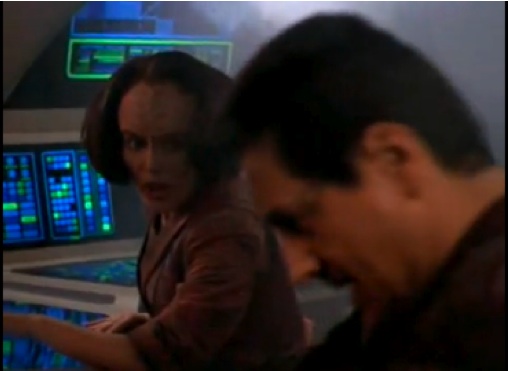
Maquis Characters, Star Trek: Voyager, "Caretaker, Part I" Episode Screen Shot, January 16, 2011. Image qualifies as fair use under United States copyright law because of its low quality and limited use nature.

In honor of Martin Luther King Day ’11, it’s my privilege to discuss Star Trek and stereotypes. For whatever reason, I’ve spent the better part of the past six months watching episodes of different Star Trek series in my spare entertainment time. Whether the theatrically great DS9 (Deep Space 9), the ever-goofy TNG (Next Generation), or the uneven and mediocre Voyager, the Star Trek franchise that made runs of four different series between ’87 and ’05 had at least one theme consistent with our much less harmonious twentieth and twenty-first century times. Playing to stereotypes seemed to be a common undercurrent, though with great makeup artists — and at least with DS9, good writing and acting — those stereotypes were light and subtle.


In watching, it amazed me that nearly all actors who played the alien Ferengi were Jewish. Yes, the actors who played the Ferengi characters were supposed to be short, but I didn’t know that Jews had cornered the acting market for people under five and a half feet tall. Armin Shimerman, Aron Eisenberg, Wallace Shawn, and Max Grodenchik all played the main Ferengi characters on DS9. Not so ironically, the Ferengi culture centered itself on making profit by virtually any means necessary, a pretty vile stereotype for an entertainment franchise based on a future and better human race.

Reggie Miller, Potential Ferengi


Even while watching DS9 in the late-90s, when all of the episodes were new ones, I commented to my friends that NBA Hall-of-Famer Reggie Miller could easily play a Ferengi, even at six-foot-seven, because the makeup artists would have very little work to do. Of course, that wasn’t to be.


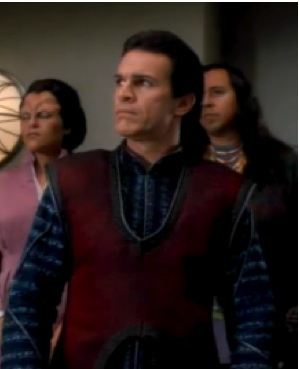
Tony Plana as Maquis Character, Star Trek: DS9, "The Maquis" Episode Screen Shot, January 16, 2011. Image qualifies as fair use under United States copyright law because of its low quality.

It wasn’t just the Jews-as-Ferengi that I picked up on the first or second time around. On both Voyager and DS9, the Maquis, a guerilla group fighting for disputed territories, had a disproportionate number of Latino actors playing those lead characters. Robert Beltran, Roxann Dawson and Tony Plana (mostly known these days as the father on the recently ended TV series Ugly Betty) were among the Latino actors playing these characters. I guess that the passionate or hot-blooded Latino stereotype played a role in the selection of these quality actors to play passionate or hot-blooded rebels in the relatively placid paradise of the Star Trek galaxy.


Of course, Black men on these shows found themselves emasculated for the most part. From LeVar Burton

Anthony Montgomery as Travis Mayweather, Star Trek: Enterprise, January 16, 2011. This screen shot qualifies as fair use under US Copyright laws because it is of low resolution screen shot and is a minimal use.

as the blind engineer to Michael Dorn as the semi-defanged Klingon, and from Tim Russ as the more-emotionally-repressed-than-normal Vulcan to the milquetoast twenty-second century human played by Anthony Montgomery, these characters seldom were provided the opportunity of a higher level of complexity beyond stereotypes or in playing an anti-stereotype. The one notable exception was Avery Brooks’ character Capt. Benjamin Sisko, who became one of the Bajoran Prophets at the end of the DS9 series, destined not to enjoy the fruits of his god-like work in the here-and-now.


I’m not bringing all of this up to denigrate the Star Trek franchise. I actually love DS9, still like TNG, and can tolerate an occasional Voyager episode. Rather, this is about the battle over racial stereotypes, living them down, defying them, and being surprised when others don’t exhibit them. The fact that a franchise as optimistic and progressive as Star Trek couldn’t avoid major stereotypes says a lot about how deeply ingrained they are in our advanced culture.

Here’s a stereotype-breaking thought. Let’s make most of our images of alien humanoids out there somewhere in the Milky Way into folks who have various shades of brown skin. I know that this wouldn’t play well on any future Star Trek series. But this has about as much of a chance being true as the pink-skinned humanoids that characters in the Star Trek franchise constantly encounter. This first-contact stereotype, of course, is the hardest one of all for the Hollywood set to break.

It still amazes me that people are amazed that someone like me, a six-foot-three Black guy, has a doctorate, teaches, writes and still likes to play basketball. It also amazes me that many are still waiting for President Obama to slip into a stereotype, even though he’s bent over backwards to be neither a stereotype nor an anti-stereotype. Or, for that matter, the amazement of Blacks or others of color in watching a fast White guy play football or a tall one dunk a basketball. Stereotypes, like perceptions, are real, but not as real as the human capacity to defy them. Anyone who doesn’t believe that doesn’t believe in anything that Martin Luther King, Jr. stood for.

Kate Lynch, Annie Lennox & A CMU Education

Tags

, , , , , , , , , , , , ,


Annie Lennox, Stock Photo, January 15, 2011. Source: http://www.mediabistro.com

Probably the professor that most approximated a teacher in my courses at Carnegie Mellon University (called “CMU” by folks there, in the ‘Burgh) was Katherine Lynch (she usually went by Kate). I took her for two classes in my transfer year to Carnegie Mellon in ’93-’94.


I had Lynch for Historical Methods my first semester because, you know, a student with a master’s degree and a year of doctoral work at the University of Pittsburgh in history would have no idea about historical methodology by his third year of coursework. But the department insisted that I needed to take courses like that in order to earn their stamp of approval — that I was properly prepared for my comprehensive exams and the dissertation stage once this year of hoop-jumping ended (but that’s a blog post for another time). I also took a course with Lynch in Comparative Urban History (read “Western Europe and the US” here).

What I remember most about Professor Lynch was how much of a contradiction she was, and not necessarily in a bad way. She kept her hair short and platinum blond, wore clothes that were professional but fit that near-rocker style. Compared to the tweed jacket, sweater vest and Shaft-suit-wearing crowd of super-stuffy professors in the history department, Kate Lynch reminded me of, well, Annie Lennox in

Annie Lennox, Gaza Protest, January 3, 2009. Source: http://www.topnews.in

Eurythmics and solo (or Sharon Stone, at least in haircut). Even though I was twenty-four years old by my second time in one of her seminars, my mind in class wandered like I was in high school again. I thought of songs like “Would I Lie To You,” “Walking On Broken Glass,” “No More I Love You’s,” and my favorite when it came to Lynch, “Here Comes The Rain Again.”


The contradiction was in Lynch’s teaching style. Cold, dispassionate, and befuddling, a complete opposite of how she presented herself based on her outward appearances. I’m sure the decidedly male history department played a significant role in how she expressed herself in the classroom. I found her off-putting, to say the least. She was moody, happy and energized one class, irritated and impatient another. She’d lecture on a concept in a graduate seminar for an hour, then somehow expect us to have a vigorous discussion for the next two.

All because Lynch’s style was all about us deciphering her cryptic questions, rather than about us debating fine historical points or big historical themes. In many classes, it came down to one of us — and I was fairly good at this — finding a paragraph on page 88 of a 400-page book that addressed one of her cipher questions. My late eleventh-grade AP US History teacher and mentor Harold Meltzer and his weird and meandering stories were easier to figure out. I’ve always said that Humanities prepared me more for grad school than it did for college. In Lynch’s case, I was absolutely right.

Even with all of that, Lynch was undoubtedly the closest thing to a teacher I had in my nine courses at Carnegie Mellon. Joe Trotter was a better professor, but Lynch acted the most like a teacher, reminding me very much of many of my teachers during my Humanities years from seventh grade through high school. On that scale, at least, she was pretty good.

Yet I sensed that Lynch was holding back, not engaging us in ways that would’ve made us better students, better historians, better intellectuals. And I confirmed that sense when I finished my coursework in May ’94. She was a much warmer person and intellectual outside of the classroom, much more interested in discussing ideas — hers and mine — than she showed at any point in the two classes I had with her. In the classroom, most of my classmates felt like they were “walking on broken glass” around her. But for me outside of the classroom, Lynch was easily the most engaging and caring of the professors I took while in the “madhouse asylum” that was Carnegie Mellon’s history department.

If there was anything I learned from Lynch, it was the need to engage students, to be vulnerable (not weak, mind you) to them in order to reach even the ones that might well be unreachable. Because the opposite approach doesn’t work very well, that is, if one wants to teach and not just facilitate a “shape of the river” discussion.

Stop the Teacher Bashing Already!


The problem with this over-analy­­sis of teachers and student achievemen­­t is that the public and politician­­s act as if it’s a one-to-one correlatio­­n. We tend to think that great teachers lead to great students, when there are far too many variables (community climate, poverty, parental engagement­­, school leadership­­, district-l­­evel resources) involved to put most of the responsibi­­lity for student achievemen­­t (or lack thereof) on individual teachers and schools.

On a related note, governors like Chris Christie in New Jersey are part of the problem regarding overheated rhetoric around teachers these days. His taped verbal beat-down of a teacher at a town hall last month and the relatively warm reception it’s received was both sexist and indicative of a nation’s screwed up priorities­­. If the people lamenting the lack of livable wages were police officers, firefighte­­rs, or EMT workers, Christie’s comments would have created enough negative publicity to hamper his efforts at re-electio­­n in three years. But because it was a shrill teacher, it was okay to tell the woman in so many words to get over it and be quiet. Until we see teachers as providing a a service as important and as patriotic as a police officer or firefighte­­r, expect the battle for corporatiz­­ing K-12 education and teachers as customer service representa­­tives to continue.
Read the Article at HuffingtonPost

Cracking Skulls

Tags

, , , , , , , , , , , , ,


Bighorn sheep in Silver Canyon near the town of Bishop, California, October 24, 2007. Rhalden (copyright holder of this work, has released it into the public domain).

Originally posted January 10, 2011:

I’ve written about this before, but not completely from the context of violence. Twenty-eight years ago today, I had a violent incident in my college dorm. It was never reported, thank goodness, since it really didn’t do damage to anyone per se. But it did involve striking two human beings out of anger, in response to a prank and violence on the part of two of my Lothrop Hall dorm mates at the University of Pittsburgh, “Mike” and “Aaron.”

I came back to Pitt after the holiday season in January ’88, determined not to make the same mistakes I’d made the semester before, since another 2.63 GPA performance would mean losing my academic scholarship. Whatever homesickness I felt for Mount Vernon and New York was crushed by the realities of home life at 616 and the sheer lack of friends in Mount Vernon in general. I knew I needed to channel the anger, bitterness, hurt and embarrassment I felt regarding my Crush #2 into my second semester at Pitt.

Lothrop Hall (we lived on the third floor in 1987-88), University of Pittsburgh, June 8, 2008. (TheZachMorrisExperience via Wikipedia). Released to the public domain via CC-SA-3.0.

Lothrop Hall (we lived on the fourth floor in 1987-88), University of Pittsburgh, June 8, 2008. (TheZachMorrisExperience via Wikipedia). Released to the public domain via CC-SA-3.0.

The answer as to how to begin involved my dorm mates on the third floor, half of whom were on Pitt’s basketball team, the other half the folks I usually hung around (geeks who would make most of my high school Humanities classmates look like socialites by comparison). The latter group had spent most of November and December binge drinking and occasionally taking me along for the ride. Aaron had begun to build a pyramid of Busch beer cans in their room, one nearly five feet tall by the time I returned from the holiday break. I needed to figure out how to co-exist with these dorm mates, as they had enabled my holiday blues and sheer lack of caring about my grades with their morbid, drinking ways.

The opportunity I needed happened a few days after I straightened out my Pitt bill. As usual, I left my door open and walked down the hall to the bathroom, took a leak, and went back to the room to call my mother. When I called, my mother kept saying “Hello . . . Hello . . . Who’s there?” She apparently couldn’t here me. After my third attempt, I checked my phone to see what was wrong. One of my idiot dorm mates had unscrewed the phone and taken the transmitter piece out, which was why my mother couldn’t hear me. I couldn’t even make a call to report what they did! I set out looking for Aaron and Mike in their room. When Mike saw me, he ran and immediately closed his door, almost breaking my hand and bruising my foot as I kept slamming my body into his door and put my foot between the door and the door jam.

The Breakfas Club Screen Shot, "Cracking Skulls" line, january 9, 2011. Donald Earl Collins.

The Breakfas Club Screen Shot, “Cracking Skulls” line, january 9, 2011. Donald Earl Collins.

I thought about telling our RA, who was too busy screwing his girlfriend to notice that he had no control over our floor. So I took matters in my own hands. The next day, the stupid asses were next door in a mutual dorm mate’s room, bouncing balls off my wall and laughing like there was something funny about it. My anger turned into a rage I hadn’t felt since my fight with one of my classmates six years before. I grabbed my dust mop and unscrewed the handle, walked next door, and proceeded to smash Aaron and Mike — both drunk — on top of their heads. “I don’t hear anyone laughing now!,” I yelled. “If I don’t get my phone piece back by this time tomorrow, there’s going to be a fight, and I don’t intend to lose! We can ALL get kicked out of school!”

I’d never seen three White guys so scared and quiet. I knew I had crossed a line, but so had they. To make sure they knew that I meant business, I smashed my dust mop handle against the wall as hard as I could and said, “That’s what’s gonna happen to your heads if I don’t get my phone piece back.” They sent Samir, another dorm mate — the only other person of color in our group — as an emissary with the transmitter by the end of the day.

I didn’t allow myself to feel bad about going psycho or, from their perspective, “Black” on my dorm mates. With only a couple of exceptions, I saw everyone on my floor as the enemy for a while. And for the next couple of weeks, whenever I left the room at night for the bathroom or for something else on my floor, I kept my door locked and took the dust mop handle with me. I wasn’t crazy. I was as sane as I’d been in a long, long time.

===================================================

Could I have been expelled from the University of Pittsburgh for that incident? Possibly, but not likely. Was I crazy? Hardly. Still, it wasn’t my best moment, if you define good moment by always taking the high road. I suppose I could’ve reported Mike and Aaron to security and gotten the transmitter back that way. But at eighteen, I had already begun to get used to the idea that I had to take life on directly. That included taking risks and not following rules and procedures. I had to learn how to stand up for myself and for what I knew, even if it meant being seen as the angry Black guy or as a troublemaker.

On this day/date twenty-eight years ago, it worked. If only because the dorm mates I confronted probably had no business being in college in the first place.