• About Me
  • Other Writings
  • Interview Clips
  • All About Me: American Racism, American Narcissism, and the Conversation America Can’t Have
  • Video Clips
  • Boy @ The Window Pictures
  • Boy @ The Window Theme Music

Notes from a Boy @ The Window

~

Notes from a Boy @ The Window

Category Archives: race

Education Incorporated

13 Thursday Oct 2011

Posted by decollins1969 in 1, Academia, culture, Eclectic, Politics, race, Work, Youth

≈ 1 Comment

Tags

"genius" award, Anya Kamenetz, Bill & Melinda Gates Foundation, Brookings Institution, Center for American Progress, Corporate Interests, Corporate Models, DIYu, Early College High Schools, Education, Education Reform, Edupunks Guide, Higher Education, K-12 Education, MacArthur Foundation Award, Michelle Rhee, No Child Left Behind, Roland Fryer Jr., Single-Track College Prep School Systems, Teach for America, The Hamilton Project, The New Teacher Project, Wendy Kopp, Workforce Development


Capitalist Education Factory, November 1, 2010. (Source/http://communiststudents.org.uk).

A generation ago, most of us in education worried about a federal government takeover of America’s 15,000 school districts with mandated standards. Wow, that prediction was way off, wasn’t it? (Oh, wait, the No Child Left Behind Act, passed in 2001, created a new era of national standards for accountability, not to mention high-stakes testing).
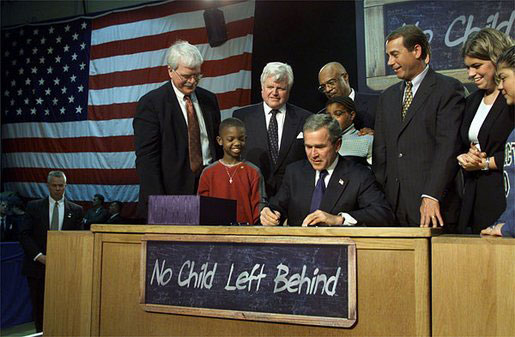
President George W. Bush signs into law the No Child Left Behind Act, Hamilton HS, Hamilton, Ohio, January 8, 2002. (http://www.whitehouse.gov). In public domain.

Now, we worry with good reason, as corporate interests inject themselves into education reform at every level. This has brought an imbalance to the education reform conversation that hasn’t existed since the days of Andrew Carnegie and the height of immigration of swarthy peoples from Southern and Eastern Europe. Now, as it was a century ago, it was the inclusion-vs.-exclusion debate. Whether to provide the best possible education for all comers, or sort and kick out as many “dull-minded” “undesirables” (both literally from 1911 to describe the learning disabled, immigrants and Black migrants) in K-12 schools as possible.

But this debate today — if we can really call it that — includes higher education. Of course, we know better than to call the millions of potential students who need some sort of post-high school training and education “morons” (also a 1911 term used by White psychologists who assumed anyone not WASP didn’t have the mental capacity to make use of a high school education). Yet we do attempt to sort these students and potential students into categories, like “adult learners,” “non-traditional students,” even “Edupunks,” a term

Anya Kamenetz, author of Edupunks Guide, at University of South Dakota, August 27, 2010. (http://www.usd.edu). In public domain.

coined by author Anya Kamenetz.

None of this has eliminated a common refrain in our field. That a four-year degree “isn’t for everyone,” as Kamenetz said to me after I asked her a tough question regarding the accessibility of her ideas for a Do-It-Yourself-university (DIYu) process of pursuing a college degree. It was a conference hosted by the Center for American Progress, but paid for by the Bill & Melinda Gates Foundation. Her idea, while helpful to 18-30 year-olds who are tech-savvy and with enough income to make this piecemeal education process work, was unhelpful to low-income students, and students of color over the age of thirty. And Kamenetz’s response was the typical exclusionary one.

Apparently, in our current economic climate, a full-time job isn’t for everyone either. Still, despite this reality, the Gates Foundation, Lumina Foundation for Education, and the Hewlett Foundation have all adopted similar models of thought around K-12 and higher education reform that have legitimized the work of people like Wendy Kopp and Michelle Rhee (Teach for America and The New Teacher Project, respectively) and institutions like University of Phoenix and Kaplan University. Models which draw heavily from corporate paradigms for success, including the punishment of failure. But they haven’t led millions of us to jobs in the new economy.

I recently attended a meeting hosted by the Brookings Institution’s Hamilton Project, in which authors presented a series of papers on K-12 education reform. Supposedly with cutting-edge ideas. Like one presented by MacArthur Foundation “genius” (emphasis on the quotation marks) Award winner Roland Fryer on providing student incentives linked to immediate and long-term educational goals for those most at risk of

Professor Roland Fryer, Harvard University Department of Economics, September 2011. (http://economics.harvard.edu).

dropping out of school, like low-income boys of color. Examples of paying fifth graders in Houston and New York $2 for every book they read or for completing their homework wasn’t so much cutting-edge as it was unremarkable. Incentives are fine, if you can pay for them or show how they nurture a passion for learning beyond the goal of completing individual tasks. This, of course, the “genius” couldn’t show.

The ridiculous assumption that Fryer made, arguing that because money in K-12 education had doubled since 1970, that funding wasn’t the issue, would’ve made me laugh as a high school senior. When you account for inflation, K-12 funding has declined, and not by a small amount, since the 1970s, and by the way, the millennial generation has created a new demand for schools, as the number of new schools or schools in need of renovations adds to this doubling in four decades. Fryer’s exclusion of data that a first-year graduate student wouldn’t have missed made me realize that most people in the field are so desperate for ideas that anything that sounds new must be good or cutting-edge. Especially if it’s funded by the Gates Foundation.

It’s not just the Gates Foundation, per se. It’s the idea that since things aren’t working for millions of students and undereducated workers, a model that concentrates on teacher effectiveness and treating students as customers — whether in fifth grade or in college — is the best way to go. This attitude has become so pervasive among well-funded education reformers that the idea of increasing funding for schools, or of making schools from pre-K on focus on all students in need of college/workforce readiness is about as welcome as Michael Moore at a Koch Brothers fundraiser.

Early college high schools and single-track, college-prep K-12 school districts, two of the great secrets of K-12 and higher education reform, remain such because these are difficult to bring to scale, and require more upfront investment than most philanthropists and businesses are willing to make. Not to mention, these represent the hard work of real reform, but ones that won’t make people like Kamenetz, Fryer, Kopp and Rhee stars. But by all means, let’s continue to fund every hair-brained idea as if tweaking our education system will yield results like a nuclear fusion plant on steroids.

Faces At The Top Of The Well

08 Saturday Oct 2011

Posted by decollins1969 in 1, Academia, Boy @ The Window, culture, Eclectic, Mount Vernon High School, Politics, Pop Culture, race, Religion

≈ Leave a comment

Tags

Baby Boomers, Capitalism, Civil Rights, Cultural Eclectic-ness, Cultural Relevance, Derrick Bell, Faces at the Bottom of the Well, Fred Shuttlesworth, Heroes, Leadership, Legacy, Media Coverage, Post-Civil Rights Generation, Professor Derrick Bell, Race, Racial Preference Licensing Act, Racism, Rev. Fred Shuttlesworth, RIP, Social Justice, Steve Jobs, Taking Risks


Signed Copy of Faces at the Bottom of the Well, October 8, 2011. (Donald Earl Collins).

In a twenty-four hour span on Wednesday, three American giants died. The Rev. Fred Shuttlesworth, the ultimate Civil Rights activist, had been reported dead first by mid-afternoon on the fifth. Then, in quick succession the media reported two other deaths. Apple co-founder, two-time CEO and 300+ patents Steve Jobs passed around 7 pm. While Civil Rights activist, law professor, critical race theorist and best-selling author Derrick Bell also passed that evening, very quietly.

The media — social, cable and otherwise — dutifully dedicated itself to rolling out every author and person connected to Jobs the Visionary, Jobs the Thomas Edison of the Information Age, Jobs the Innovative Entrepreneur. By 9:30 pm, even my ambivalence about Jobs the Capitalist (as tweeted @decollins1969)  would’ve been seen as heretical by the folks whom Jobs had fired over the years, or had their jobs outsourced to China in the past ten years.

No doubt that Steve Jobs, my he rest in peace, was a sort-of Wizard of Menlo Park, California (really, Silicon Valley, but taking poetic license here). But, as much as I love my MacBook, iPod, iTunes, iMovie and iPhoto, and other Apple products I’ve used since I wrote an AP English paper on an Apple IIe my senior year at Mount Vernon High School in ’87. I didn’t get this outpouring of love and sorrow two days ago.

Then it occurred to me that I was watching two stories. One story was of a generation that saw Jobs as the man who fused technological innovation with cultural relevancy, the folks who grew up while Jobs was in the midst of his second coming at Apple. As he remade the niche company into the largest corporation (more or less) in the world. The other story is the media story, the Baby Boomer story of a cultural rebel who made good as an Information Age capitalist while maintaining his Zen-ness, an ultimate cultural outsider-corporate insider.

Rev. Fred Shuttlesworth at Ohio Civil Rights Commission Hall of Fall Dinner, October 2009. In public domain.

As much as I think people should admire the late Steve Jobs — and there’s quite a bit to admire about his life — there’s so much more to admire about Shuttlesworth and Bell. Shuttlesworth survived multiple attempts on his life, was threatened too many times to count, co-founded the Southern Christian Leadership Conference in 1957 (along with MLK and others) and helped lead the campaign to integrate Birmingham, Alabama in the early 1960s, among many accomplishments. Rev. Shuttlesworth literally gave his blood, sweat and tears for civil rights and equality, but I didn’t see anyone put a candle on an iPad for him Wednesday night.

Bell, well, I’m a bit more biased about Professor Bell. I met him two years before he published Faces at the Bottom of the Well. Bell gave a talk at the University of Pittsburgh Law School (his JD alma mater) in October ’90 on his essay “The Racial Preference Licensing Act,” one that would end up in the book. The idea that racist businesses could opt out of an integrated America by buying a license and paying a race tax in order to deliberately bar Blacks and others of color from their services and jobs, I thought that was truly radical. The slightly older Pitt Law students, Black and White, were up in arms. One went so far as to suggest that Bell was somehow now working for the other side, those who’d like to turn back the clock to the days of Jim Crow.

Through it all, Professor Bell just smiled and joked, and most of all, explained. His story about this Act was a way of getting ahead of the tide of politicians and judges that had been eroding Black gains since the mid-1970s, of moving beyond the crucible of the Civil Rights era — integration at any cost. Bell wasn’t suggesting self-segregation. He was hoping to provoke a larger discussion of the kind of equality Blacks and progressives should hope to achieve in a post-Civil Rights era. One in which all deny racism and racial inequality, but put it in practice in their words and actions every day.

Derrick Bell by David Shankbone, August 2007. Permission granted via GNU Free Documentation License.

Bell’s ambivalence about the achievements of his generation, about the legacy of the Civil Rights Movement, about desegregation, made him the target of traditional Civil Rights royalty — the “How dare you!” crowd. But it made me and many others from the generation that actually remembers the Steve Jobs as the guy that co-built the world’s first personal computer in his garage big fans of Professor Bell.

To turn your back on three decades’ worth of struggle and success because you foresaw the coming storm around race. To bridge the divide between Baby Boomers/ the Civil Rights generation and us post-Civil Rights folks by turning complex legal theories into allegorical stories. To take a stand that costs you your job at Harvard Law to ensure that the next Asian American female candidate would be given a real chance at a job. Bell’s my hero, and I don’t have a lot of people I’d call a hero.

The media might have put Bell and Shuttlesworth at the bottom of their news cycle well — no doubt, race and the media’s consistent attempt to ignore race was a factor here — but it’s up to all of us that they are winched out of that well to the top. And I think that Jobs would agree with that. May they all RIP.

Apple logo, Think Different, 1997. (Source/TBWA\Chiat\Day). In public domain

Occupy Wall Street (and the Fed, and Capitol Hill…)

05 Wednesday Oct 2011

Posted by decollins1969 in 1, culture, Eclectic, New York City, Patriotism, Politics, Pop Culture, race, Work, Youth

≈ 1 Comment

Tags

Baby Boomers, Class Warfare, Economic Inequality, GM, Grassroots Movements, Lessons, Marches, Michael Moore, New York City, Occupy Wall Street, Pillow Pets, Protests, Sit-Ins, Wall Street


Occupy Wall Street protests, Day 14, October 1, 2011. (Source/Mrwho00tm). Permission granted via Creative Commons v. 3.0.

Folks like me have been saying for years that we need a mass movement of people to stem the tide of economic and racial inequality that this country, the Land of the Thief, um, Free, has been experiencing for more than four decades now. Finally, it’s happening, albeit in a relatively small way, around Wall Street and other cities around the country. This is great, I certainly wish I could be there, but this can only be the start of something. Because if it ends here, I don’t want to wait until I’m in my sixties to see grassroots protests cut across racial, socioeconomic (again, relatively speaking) and other lines that tend to divide us as a nation.

We need to not just occupy Wall Street, or do more than this one-day march that’s suppose to happen in New York today. Or attend rallies hosted by Van Jones. We need to occupy the Fed, Capitol Hill, every Bank of America, Goldman Sachs, Wells Fargo, AIG, JP Morgan Chase, CitiGroup, SAG, ExxonMobil, Shell, BP

Michael Moore at the 66th Venice International Film Festival, September 6, 2009. (Source/Nicholas Genin via http://flickr.com/photo/22785954@N08/3895119443). Permission granted via Creative Commons v. 3.0.

corporate office in this country. We need to say to these folks, and the corrupt, greedy, soul-destroying interests they represent that were mad and we’re not gonna take it any more.

I just want two other things to come out of this, even if the evil capitalists manage to bash every protester and faceless writers like me in the head to stop what’s been happening over the past few weeks. One is that I want the folks from my youngest sibling’s generation to get credit where credit is due, to not hear from the idiot Baby Boomer crowd about how what they’re doing is just like what they (and by they, about 1 in 50 Baby Boomers, really) did back in the ’60s. It’s not. People born in the ’80s and ’90s grew up in a nation of diminishing resources, increasing economic inequalities, increased acceptance of bigoted, xenophobic, me-first-and-always behavior and a willingness to squander trillions of dollars to go to war in our name.

If anything, these protesters are more like the factory workers at GM in 1937, who sat-in for forty-four days amid violence and threats of violence for their labor union rights in Flint, Michigan. Or like the African

Michael Moore as Pillow Pet Penguin, October 5, 2011. (Source/Donald Earl Collins).

Americans who desegregated lunch counters, boycotted stores that refused to hire them, and staged work stoppages at military ports during the Depression and in the middle of World War II. It’s relatively easy to protest a war like Vietnam from a position of strength, as already enrolled-in-college students. It’s not so easy when your future truly hangs in the balance.

A few months ago, I was playing with my son and one of his stuffed animals, a penguin Pillow Pet. I realized one evening that this Pillow Pet had many of Michael Moore’s facial features. So I began to talk like Michael Moore about the need to stop the greedy folks on Wall Street from eating all of our cake. My son said, “I do not understand what you are saying. But that doesn’t sound nice.” In response, I said, “It’s not suppose to be nice. But then again, neither are the people who’ve put people out of work.” It provoked my eight-year-old, if only for a moment, to think about inequality. The other thing I hope is that this protest provides more thought-inducing moments, for both of us.

A Friendship Changing Lanes

03 Monday Oct 2011

Posted by decollins1969 in 1, Boy @ The Window, Christianity, Eclectic, Mount Vernon High School, Mount Vernon New York, My Father, race, Religion

≈ Leave a comment

Tags

Education, Family, Friendship, Friendships, Humanities, Ideology, Johns Hopkins University, Mount Vernon High School, Mount Vernon New York, MVHS, Politics, Race, Religion, University of Pittsburgh, Valedictorian


Changing Lanes (Movie, 2002) Screen Shot, March 2008. (Source/http://swedenborgiancommunity.org).

Part of the problem of being me is the fact that my close friends change as I change. Meaning that there have been transitional periods throughout my life that my old friends fall away. Oftentimes I make new ones, and sometimes, like during my six years in Humanities, my best friend was my imagination. Ironically, the best friendship I had from my Humanities days came with a classmate that I hadn’t become close to until my last couple of years at Mount Vernon High School. More ironically, that friendship didn’t truly become such until we both went away for college in ’87.

I’ve written about her before, the valedictorian of my class, whom I called “V” in a previous post (see Valedictorian Blues from July ’09). To be honest, I’m not sure how our acquaintanceship ever became a friendship. Somewhere between having circumstances in which our fathers weren’t around consistently, or at least being able to relate to Billy Joel, or both of us scoring “5”s on the AP US History exam.

But really, it might’ve just come down to both of us not belonging, or facing a small degree of ostracism from our Humanities and MVHS classmates overall. I wasn’t Black and cool enough, and V, well, she was a classic White nerd, a grinder who had the gall to finish ahead of our Black male salutatorian, at least from the perspective of some authority figures and the school’s popular crowd.

The fact that we went our respective ways, to Pitt and Johns Hopkins, helped. The fact that we wrote each other about some of our social triumphs and challenges helped more. Most importantly, it helped a lot that we both were more honest about our family troubles. Everything from my mother’s need to divorce my idiot stepfather and the issues with my younger siblings to V’s mother and her health issues and struggling with burnout trying to watch over her family while going to school.

So, by the time I began my second year of grad school, we’d become fairly close. I visited her and her family in the DC area eight times during the ’90s, and went to her mother’s funeral and wake in ’96. V came to my PhD graduation ceremony the following year. By ’97, me and V had been friends for ten years, and known each other more than fifteen. For more than six years, she’d really been the only person from my Humanities and high school days with whom I’d been in regular contact.

Changing lanes, Las Vegas Strip, December 12, 2010. (Source/Bjørn Giesenbauer - http://Flickr.com).

Who knew that within four years of marching for my doctorate that our friendship would become a distant one? I think that our approaches to life was so different that we couldn’t help but become distant friends. I am one who refuses to take life on its own terms. If I had taken V’s approach, I’d still be living in Mount Vernon, New York, only with a nine-dollar-an-hour job sorting mail or flipping carcinogenic burgers. V’s was based on some sort of realism that mixed with a sense of eugenic inevitability. That one’s slot in life should remain such, and if one does make it, one must do so without ruffling any feathers.

Besides that, it was obvious that things about who we had been since the early ’80s had evolved, and was changing even more rapidly as we reached our late twenties. I was no longer the blank-faced, closed-mouthed, socially-awkward kid I was in ’82. V was no longer responsible for watching over her mother and her younger sister. We agreed to disagree on so many things. Our politics diverged. Our views on race and racism were growing further apart, as if I was Michael Eric Dyson and she was Ann Coulter.

But even with all of that, I think the seeds of it began when I started dating my future wife at the end of ’95. Something about being in a serious relationship has changed the dynamics of every friendship I had then and have now. I never thought that my friendship with V would be affected. But of course it was. We live in a world where a man and a woman can’t be close friends without it being made into something more than friendship.

Like the seasons, people change, and even if they change for the better, our change will cause our friendships to change as well. It’s just too bad that V couldn’t adapt to all of the good changes in my life like I adapted to hers.

“Dr. K All the Way…” & Other Fall Classics

28 Wednesday Sep 2011

Posted by decollins1969 in 1, Boy @ The Window, culture, Eclectic, Jimme, Mount Vernon High School, My Father, New York City, Politics, race, Sports, Youth

≈ Leave a comment

Tags

"Dr. K", 1986 World Series, Bryant Gumbel, Child-like Hope, Congress, Darryl Strawberry, Dwight Gooden, HBO, Jobs Bill, Lenny Dykstra, Mets Fans, Mount Vernon High School, Mount Vernon New York, New York City, New York Mets, Obama, President Barack Obama, Real Sports, Sports and Life, WHN-AM


Dwight Gooden, aka, "Dr. K," Shea Stadium, 1986. (Source/http://itsonbroadway.wordpress.com/2011/05/16/dwight-gooden-aka-dr-k/).

While the country waits to see whether Congress and the President will find a way to entertain us with political gridlock and endless compromises and capitulation, I realized this week that I have a twenty-fifth anniversary this month. It’s been a bit more than a quarter century since my New York Mets won the NL East division title (their first since ’73), one more brick in their World Series wall that year.

Those not-so-Amazing Mets were a juggernaut that year, having won 108 games and run away with the division lead by the end of June. Gooden was Dr. K., and, along with Ron Darling, Sid Fernandez, Bob Ojeda, and Jesse Orozco, led the pitching staff. While Darryl Strawberry was the straw that stirred the drink on offense, along with Lenny Dykstra, Gary Carter, Howard Jones and Keith Hernandez. God, I really loved that team!

Darryl Strawberry home run, Shea Stadium, July 2, 1988. (AP Photo/Mark Lennihan).

I really did. I imbued the Mets with all of my hopes and dreams, and saw their wins as a way to see myself as a winner. And whenever they lost a game or a series, I saw myself as having lost as well. I was aware of all of this on some level, that making my life circumstances a parallel story to that of a major league baseball team was, well, a bit childish.

But given my life since the age of eleven, I needed that outlet, that room to be a child, if only for two or three hours a day. In between watching my four younger siblings, washing clothes at the laundromat in Pelham, dealing with my alcohol father and my idiot stepfather, running back and forth to the store, applying to colleges, and facing the hell that was my senior year at Mount Vernon High School. Especially with three AP courses, a touch of senioritis, and a number of classmates at each other’s throats. Including my own.

As the season took forever to wind down (the Mets clinched the NL East division on September 17, more than two weeks before the end of the season), the pre-WFAN station for the Mets (WHN-AM, a country oldies station until the 24-hour group took it over in ’87 and renamed it WFAN) started playing their World Series-or-bust promo, “Dr. K All the Way! — Let’s Go Mets!” So silly, so goofy, so geared toward long-suffering Mets fans. “Is that the best you can do?,” I thought every time I heard the ten-second spot. Apparently it was, and it didn’t matter either way, because fans are usually too fanatic to sweat the goofy stuff.

Let’s Go Mets Go (1986) – New York Mets theme song

Let’s Go Mets Go (1986) – New York Mets theme song

I became even more involved in rooting for my team as they moved into the playoffs. I’d listen to games in class, between classes, even in between questions, it seemed, in my AP Physics class. To say the least, my grades suffered, and more than a few of my non-Mets-fan classmates berated me in the process. But how could I explain to them the psychic bond I felt to this team? A feeling that somehow, if they, the downtrodden Mets, could pull off the ultimate victory and win a World Series, that I, a nobody, could make my life a victorious one as well. My more affluent and too-busy-being-cool classmates wouldn’t have understood that. As it was, I barely understood it myself.

Fast-forward twenty-five years. I’m no longer a baseball fan, and have no intent to fall back in love with a game I find boring, and with an institution that represents culture and race in America that is so pre-Civil Rights Movement and twentieth century. Most of my Mets still have their rings, even if key players on that team have been or are in prison, recovering drug addicts, and have made and lost hundreds of millions of dollars speculating in the snuff and stock markets (see Lenny Dykstra ’09 HBO Real Sports interview excerpt via The Young Turks).

But I still have that child-like sense of hope and yearning. I just don’t place it in anonymous others anymore. I haven’t lived or died with a team since my Knicks came within a missed 3-pointer by John Starks of winning the ’94 NBA Finals in Game Six. But I do place it in myself, because between God and me, and the others I’ve met and befriended in my life, I’ve been able to move mountains.

Which is why it does and doesn’t matter if the job stimulus passes in whole, in part or even not at all. I need to take that same optimism, that same hope, convert it to more hard work, and find a way to infuse it in my son, so that he can run the race, even if and when I can’t. In the process, I hope he find heroes he can look up to in the fall, even if they are fleeting ones.

Education, A Numbers Game Love Story

22 Thursday Sep 2011

Posted by decollins1969 in 1, Academia, Boy @ The Window, culture, Eclectic, Politics, race

≈ Leave a comment

Tags

Accountability, Craps, Crunching Numbers, ETS, High-Stakes Testing, K-12 Education, K-16 Education, NCLB, P-20 Education, Politicians, Politics of Education, Psychometricians, Psychometrics, Qualitative Research, Quantitative Analysis, SAT, Statistics, Student Success, Teaching Effectiveness, The Education Trust, US Department of Education


Craps dice, like the state of education reform via numbers crunching these days, August 6, 2006. (Source/Roland Scheicher via Wikipedia). In public domain.

This could just as easily be titled, “Why your multivariate regression analysis isn’t better than my chi-square test,” because that is the state of mainstream education research these days. I find it stifling, like being wrapped in Saran Wrap covered by a condom lined in sheep’s intestines.

Numbers have their place, but the field’s obsession with crunching numbers for trends that defy quantification has increased as a result of federal mandates like NCLB and philanthropy’s accountability movement over the past fifteen years. What’s the long-term impact of the thousands of studies and the deployment of thousands of psychometricians and research analysts in P-20 education reform (that’s early childhood education, K-12, undergraduate and graduate education combined)? Not much, because our politicians and philanthropists are staking themselves to trends almost regardless of numbers.

It all started for me about this time twenty years ago. I did an independent study with Bruce Anthony Jones,

Linear regression graph with over 200 data points, February 22, 2009. (Source/Michael Hardy via Wikipedia). In public domain.

then an assistant professor in the University of Pittsburgh School of Education’s ed policy and administration department. In that one semester, I quickly learned that folks in the education field defined research in only two ways: quantitative and qualitative. And by qualitative, they meant soft research, like Carvel’s soft-serve ice cream. What I didn’t know was that many in the field were working to make the qualitative — surveys, focus groups, oral interviews/transcripts — quantifiable.

Today, everything that can be tracked in American education usually has a number attached to it. It’s hardly grades and standardized test scores anymore. Homework hours, time to task on lesson plans to work on a single problem that may be part of a high-stakes state exam, teacher effectiveness, suspensions and disciplinary reports disaggregated by race and gender. It drives me nuts, and I’ve used SAS and SPSS before, during my grad school days. I can only imagine how a teacher who just wants their students to learn and do well must feel about this numbers game.

But if education has become a number game, it most resembles the game of craps. Take the issue of teacher

Michelle Rhee, former DCPS Chancellor, one of many who've taken advantage of education as craps game, Washington, DC, February 19, 2008. (Source/US Department of Labor). In public domain.

effectiveness, often tied to state-mandates around test scores and students meeting or exceeding a percentile at a given school on these tests. Let’s say if a school as a whole actually exceeds the proficiency percentile. They may well receive more money, and teachers may well get a bonus (depending on the state and school district and union contracts, which by the way, may also be part of a statistical formula). None of this actually proves that these students are better prepared for, say, thinking independently or critically, because critical reasoning isn’t tested by most of the high-stakes state tests.

Nor can they show the writing skills necessary for student success later on in their education, as most of these tests don’t test writing comprehension skills either. Most importantly, where does teacher effectiveness come in as a factor? Do we have to account for time to task in comparison to each exam item, like a psychometrician at the Educational Testing Service (ETS) would? Do we factor out home studying/ homework time, parents’ education, income and race, or whether they eat a hearty breakfast the morning of the exam? Or do we continue to simply say, if Teacher X gets Class A to raise its state test score by 25 percent, they get a raise and a pat on the head? Really?

What’s more, whether teacher effectiveness, student success, or free and reduced lunch programs, politicians, parents and pundits hardly look at any numbers beyond any report’s executive summary. We all insist that our school and community colleges and universities get better at graduating students ready for the real world of work. Fine. Then we insist on lower taxes, blaming teachers, destroying unions, complaining about the state of things but not doing anything to make education work for all of our students. Not fine.

It doesn’t take a two-year study from The Education Trust to realize that there’s no one-to-one correlation

Taco Bell's Gordita Supreme, September 22, 2011. (Source/TacoBell.com).

between an effective teacher and higher student test scores. Or a report from the Institute of Education Sciences at the US Department of Education to know that a lunch of murder burgers and suicide fries with ketchup as a vegetable is about as nutritious as a Taco Bell gordita. School districts and many a college have gone without even adequate resources for years. But instead of providing them, we make them kneel in begging for them, and yet expect them to perform Lazarus-type miracles in the process.

We waste time with numbers and spend little time on causes and solutions that make sense in education. I think about that weak +0.4 correlation number that ETS has put out for years regarding the SAT. It’s the likelihood of someone who does well on the exam beginning their freshman year in college with a 3.0 GPA. I scored an 1120 on the SAT in October ’86, not exactly the greatest score. But I did manage a 3.02 average my first year (and a 2.63 my first semester, by the way), and still came within a few days of dropping out because I was homeless at the beginning of my sophomore year.

I dare say the numbers crunchers at ETS didn’t factor that in their multivariate analysis. Or my homesickness or obsession with a former high school crush. Mark Twain is right about statistics — they can “a good walk spoiled (or lies, I think).”

The Audacity of Low Expectations/Jealousy

19 Monday Sep 2011

Posted by decollins1969 in 1, Academia, Boy @ The Window, culture, Mount Vernon High School, Mount Vernon New York, Politics, race, Work, Youth

≈ 2 Comments

Tags

Boy @ The Window, Envy, Exceeding Expectations, Humanities, Jealousy, Low Expectations, Mount Vernon High School, Mount Vernon New York, Setting Standards, Success


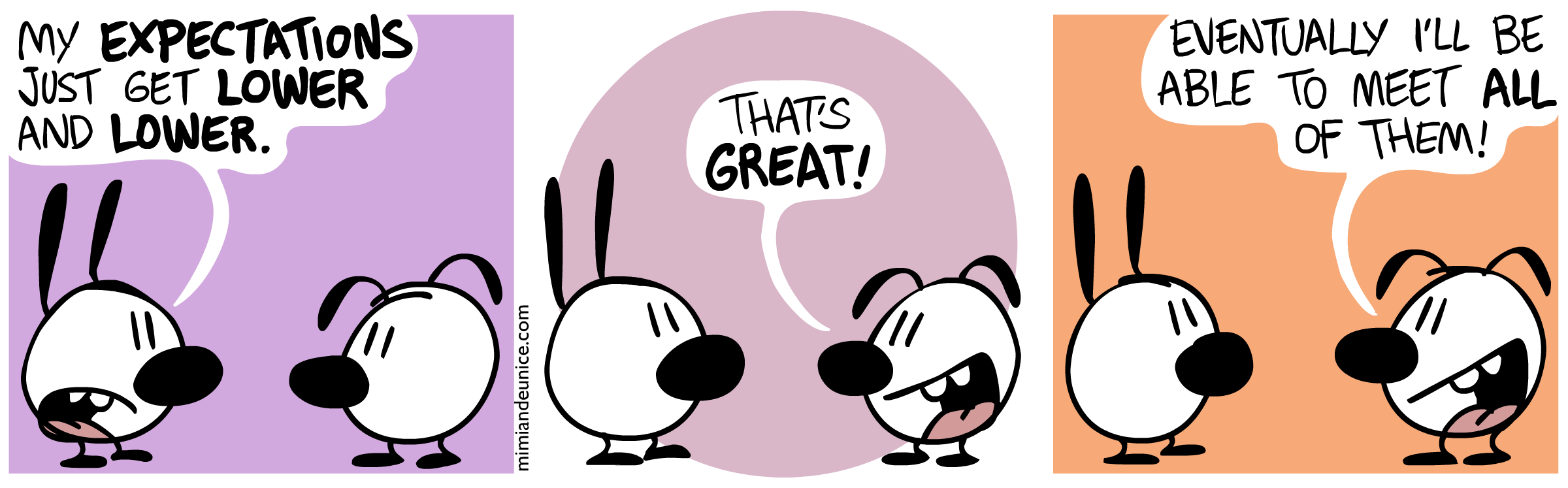
Mimi and Eunice, “Low Expectations,” September 19, 2011. (Source/http://mimiandeunice.com). Qualifies as fair use under US copyright laws because of image’s low resolution and without the intent to reproduce or distribute for profit.

It seems to me that I’ve spent a lot of time over the past three decades overcoming other people’s psychological issues. Regarding race, race and gender, race, gender and class, not to mention performance issues, success, jealousy and envy, and other psychoses that had little or nothing to do with me. It’s something that most folks who aren’t Black, male, grew up in poverty and had some success (however one defines that) really can’t understand unless they have parents who’ve told them every single day that they “weren’t good enough to live.”

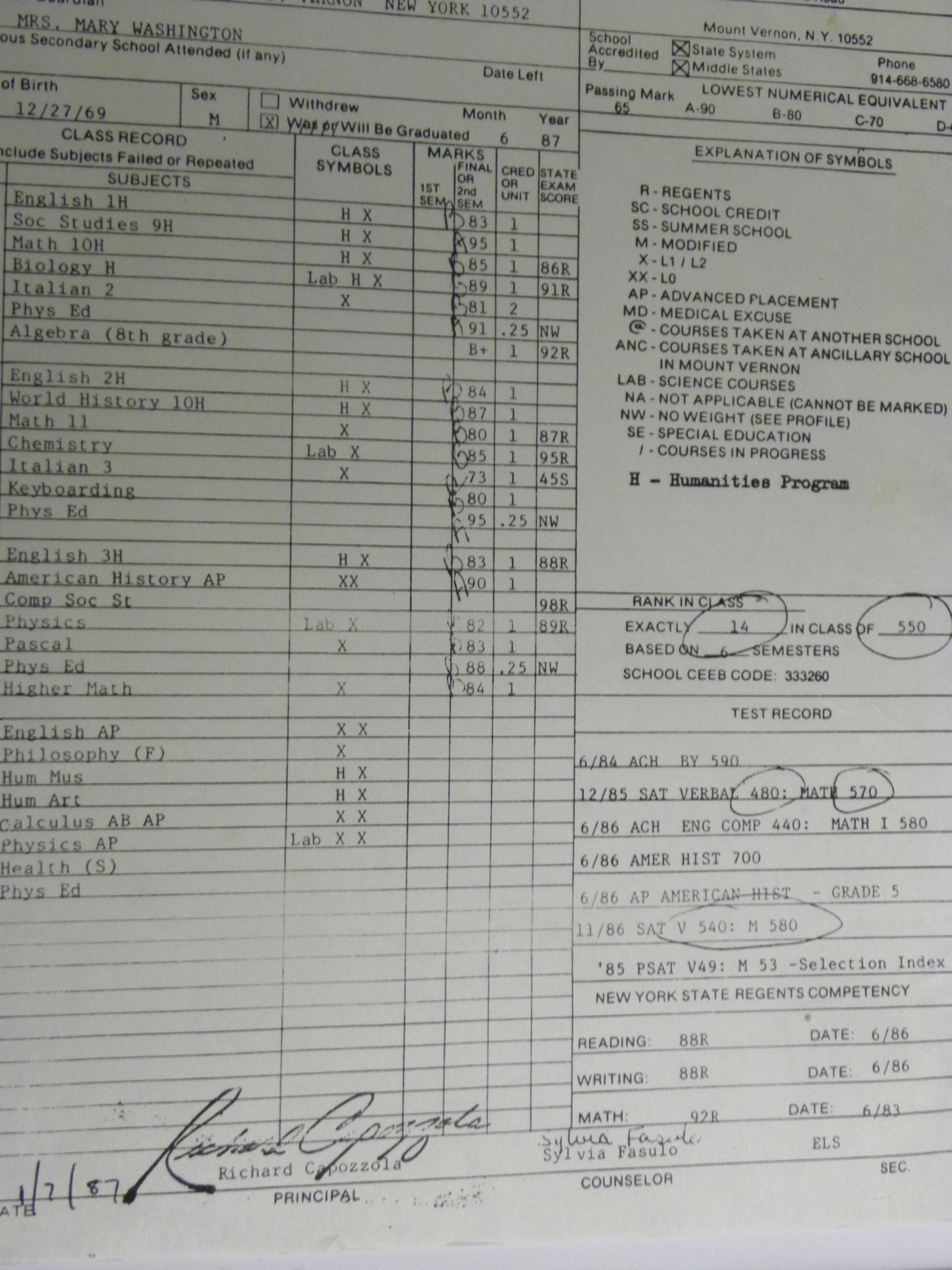
Still, these issues have mostly cropped up for me when I’ve experienced what most people would recognize as success, as if the only role I was ever supposed to play in life was that of a doormat. The first time I went through this process of blowing up other people’s low expectations of me was at the beginning of my senior year at Mount Vernon High School, about this time twenty-five years ago. A couple of weeks into the school year, MVHS released our class rankings. Out of the 545 or so students eligible to graduate as part of the Class of ’87, I was ranked fourteenth with a 3.83 average.

My MVHS trascript, courtesy of University of Pittsburgh Admissions Office, January 7, 1987. (Source/Donald Earl Collins). Note the circles from the admissions officer all over the transcript.

I understood that this was pretty good, but I was also disappointed that I hadn’t cracked the top ten. In fact, the top twelve students in our class all had GPAs above a 4.0, all because of our weighted Level 0 and Level 1 courses. Crush #1 finished just ahead of me, thirteenth in our rankings, something I saw as ironic. Despite this sign of academic success, I hoped and wished for more, and spent several late-night walks over the next few weeks second-guessing my work in tenth grade.

My classmates started to show their darker sides, some for the first time since the days of 7S. One came up to me after my AP Calculus class soon after the rankings were posted. “The only reason you’re in the top twenty’s because of history!,” implying that I was an average student in all of my other subjects. Another, much shorter and much more condescending classmate chimed in a few days later, saying that “the only thing you can do with history is play Jeopardy.” I wasn’t exactly walking around school celebrating my good fortune. I chalked it up to the stress of years of academic competition, the boiling over of senioritis and the rage associated with college preparations. The possibility that jealousy was involved didn’t cross my mind until much later. I didn’t think that anyone could be envious of my standing.

Fast-forward four years to the fall of ’90, as I prepared in earnest for grad school. Not only had I endured a short conversation at the beginning of that year with the great Sylvia Fasulo and her attempts to discourage me from pursuing grad school, law school or a career in law (see my “The Legend of Sylvia Fasulo” from September ’09). I had two professors from Pitt who told me that they weren’t sure about my chances for getting into grad school, and Reid Andrews, who flat-out told me that he didn’t think that I was “graduate school material.”

I have no doubt that if these yahoos were jealous of me at all, it was because of my age, and not my potential. They simply didn’t see how a 3.4 GPA and a 3.82 in my history major would be good enough to get me into a master’s — much less a doctoral — program. The fact that I completed my master’s degree in two semesters within twenty months of essentially being told that I was a fool left Andrews, at least, at a loss for words.

There are so many other instances in which a grad student, a professor, a supervisor, even my siblings, have expressed their low expectations and jealousy over my tiny little crumbs of success that it has left my head spinning on a broom handle. I mean, what did I really do to earn or deserve that kind of attention? I don’t own a house or have a million dollars in gold lying around. I have yet to publish an article in Rolling Stone or in The Atlantic Monthly. I don’t exactly have LeBron James or President Obama on speed dial.

So what is it about me, I’ve asked myself so many times? And then, I’ve reminded myself of something I figured out about twenty-one years ago. That the only expectations that I ultimately need to meet or exceed are my own. That what other people say about me, no matter how distasteful, really doesn’t matter, for those folks were never going to be there for me anyway.

Maybe it’s my refusal to live under someone else’s low expectations, to not allowing myself the luxury of envy, that irks those around me. Or maybe, just maybe, it’s as simple as misery loving company, and not loving mine. Either way, it’s ironic that we live in a time in which we prefer to tear each other down rather than help each other get going in our lives. Which makes my relationship with the rest of humanity so bittersweet. I guess I really am a writer!

← Older posts
Newer posts →

Boy @ The Window: A Memoir

Boy @ The Window: A Memoir

Places to Buy/Download Boy @ The Window

There's a few ways in which you can read excerpts of, borrow and/or purchase and download Boy @ The Window. There's the trade paperback edition of Boy @ The Window, available for purchase via Amazon.com at http://www.amazon.com/Boy-Window-Donald-Earl-Collins/dp/0989256138/

There's also a Kindle edition on Amazon.com. The enhanced edition can be read only with Kindle Fire, an iPad or a full-color tablet. The links to the enhanced edition through Apple's iBookstore and the Barnes & Noble NOOK edition are below. The link to the Amazon Kindle version is also immediately below:

scr2555-proj697-a-kindle-logo-rgb-lg

Boy @ The Window on Amazon.com: http://www.amazon.com/Boy-The-Window-Memoir-ebook/dp/B00CD95FBU/

iBookstore-logo-300x100

Boy @ The Window on Apple's iBookstore: https://itunes.apple.com/us/book/boy-the-window/id643768275?ls=1

Barnes & Noble (bn.com) logo, June 26, 2013. (http://www.logotypes101.com).

Boy @ The Window on Barnes & Noble: http://www.barnesandnoble.com/w/boy-the-window-donald-earl-collins/1115182183?ean=2940016741567

You can also add, read and review Boy @ The Window on Goodreads.com. Just click on the button below:

Boy @ The Window

Twitter Updates

Tweets by decollins1969
  • RSS - Posts
  • RSS - Comments

Archives

  • June 2025
  • April 2023
  • September 2022
  • August 2022
  • July 2022
  • June 2022
  • May 2022
  • April 2022
  • March 2022
  • January 2022
  • December 2021
  • November 2021
  • October 2021
  • September 2021
  • August 2021
  • July 2021
  • June 2021
  • April 2021
  • March 2021
  • February 2021
  • January 2021
  • December 2020
  • November 2020
  • October 2020
  • September 2020
  • August 2020
  • July 2020
  • May 2020
  • April 2020
  • March 2020
  • January 2020
  • December 2019
  • November 2019
  • August 2019
  • July 2019
  • June 2019
  • May 2019
  • April 2019
  • March 2019
  • February 2019
  • January 2019
  • December 2018
  • November 2018
  • October 2018
  • September 2018
  • August 2018
  • July 2018
  • June 2018
  • May 2018
  • March 2018
  • February 2018
  • January 2018
  • December 2017
  • November 2017
  • October 2017
  • September 2017
  • August 2017
  • July 2017
  • June 2017
  • May 2017
  • April 2017
  • March 2017
  • February 2017
  • January 2017
  • December 2016
  • November 2016
  • October 2016
  • September 2016
  • August 2016
  • July 2016
  • June 2016
  • May 2016
  • April 2016
  • March 2016
  • February 2016
  • January 2016
  • December 2015
  • November 2015
  • October 2015
  • September 2015
  • August 2015
  • July 2015
  • June 2015
  • May 2015
  • April 2015
  • March 2015
  • February 2015
  • January 2015
  • December 2014
  • November 2014
  • October 2014
  • September 2014
  • August 2014
  • July 2014
  • June 2014
  • May 2014
  • April 2014
  • March 2014
  • February 2014
  • January 2014
  • December 2013
  • November 2013
  • October 2013
  • September 2013
  • August 2013
  • July 2013
  • June 2013
  • May 2013
  • April 2013
  • March 2013
  • February 2013
  • January 2013
  • December 2012
  • November 2012
  • October 2012
  • September 2012
  • August 2012
  • July 2012
  • June 2012
  • May 2012
  • April 2012
  • March 2012
  • February 2012
  • January 2012
  • December 2011
  • November 2011
  • October 2011
  • September 2011
  • August 2011
  • July 2011
  • June 2011
  • May 2011
  • April 2011
  • March 2011
  • February 2011
  • January 2011
  • December 2010
  • November 2010
  • October 2010
  • September 2010
  • August 2010
  • July 2010
  • June 2010
  • May 2010
  • April 2010
  • March 2010
  • February 2010
  • January 2010
  • December 2009
  • November 2009
  • October 2009
  • September 2009
  • August 2009
  • July 2009
  • June 2009
  • May 2009
  • April 2009
  • March 2009
  • February 2009
  • January 2009
  • December 2008
  • November 2008
  • October 2008
  • September 2008
  • August 2008
  • July 2008
  • June 2008
  • May 2008
  • April 2008
  • March 2008
  • February 2008
  • January 2008
  • December 2007
  • November 2007
  • October 2007
  • September 2007
  • August 2007
  • July 2007
  • June 2007

Recent Comments

MaryPena's avatarMaryPena on My Day of Atonement/Bitter Hat…
decollins1969's avatardecollins1969 on No Good Teaching Deed Goes…
Mary Rose O’Connell's avatarMary Rose O’Connell on No Good Teaching Deed Goes…

NetworkedBlogs on Facebook

NetworkedBlogs
Blog:
Notes From a Boy @ The Window
Topics:
My Life, Culture & Education, Politics & Goofyness
 
Follow my blog

616 616 East Lincoln Avenue A.B. Davis Middle School Abuse Academia Academy for Educational Development AED Afrocentricity American Narcissism Authenticity Bigotry Blackness Boy @ The Window Carnegie Mellon University Child Abuse Class of 1987 CMU Coping Strategies Crush #1 Crush #2 Death Disillusionment Diversity Domestic Violence Economic Inequality Education Family Friendship Friendships Graduate School Hebrew-Israelites High-Stakes Testing Higher Education History Homelessness Humanities Humanities Program Hypocrisy Internalized Racism Jealousy Joe Trotter Joe William Trotter Jr. K-12 Education Love Manhood Maurice Eugene Washington Maurice Washington Misogyny Mother-Son Relationship Mount Vernon High School Mount Vernon New York Mount Vernon public schools Multiculturalism MVHS Narcissism NFL Pitt Pittsburgh Politics of Education Poverty President Barack Obama Race Racial Stereotypes Racism Relationships Self-Awareness Self-Discovery Self-Reflection Sexism Social Justice Teaching and Learning University of Pittsburgh Violence Whiteness Writing

Top Rated

Blog at WordPress.com.

  • Subscribe Subscribed
    • Notes from a Boy @ The Window
    • Join 103 other subscribers
    • Already have a WordPress.com account? Log in now.
    • Notes from a Boy @ The Window
    • Subscribe Subscribed
    • Sign up
    • Log in
    • Report this content
    • View site in Reader
    • Manage subscriptions
    • Collapse this bar
 

Loading Comments...