• About Me
  • Other Writings
  • Interview Clips
  • All About Me: American Racism, American Narcissism, and the Conversation America Can’t Have
  • Video Clips
  • Boy @ The Window Pictures
  • Boy @ The Window Theme Music

Notes from a Boy @ The Window

~

Notes from a Boy @ The Window

Category Archives: Academia

Randomness & Faith

27 Thursday Dec 2012

Posted by decollins1969 in 1, Academia, Boy @ The Window, Christianity, culture, earth, wind & fire, Eclectic, Hebrew-Israelite, Politics, Pop Culture, Religion, Youth

≈ Leave a comment

Tags

Agnostic, Atheism, Atheist, Belief, Bible, Buddhism, Evolution, Faith, Forgiveness, God, Grace, Love, Mathematics, Mystery, Physics, Randomness, Reason, Religion, Science, Scientific Method, The Universe, Youth


Randomness equation, Schrage random number generator, December 27, 2012. (http://ops.fhwa.dot.gov).

Randomness equation, Schrage random number generator, December 27, 2012. (http://ops.fhwa.dot.gov).

Today’s my forty-third birthday (at least, as of 8:37 am EST). It means that I’ve been a spiritual believer of one sort or another for nearly thirty years. With so much that has happened in my life, there are many who wonder why I believe in God, or why I’m a Christian in particular. With my expertise as a historian, my background in math and science (and continuing study of such), there have been many who’ve mocked and questioned my faith in anything other than the randomness of the universe. With the world in seemingly endless turmoil, good people maimed and killed, and evil people able to get away with maiming and killing others, there are those who greet any profession of belief in a higher power with anger and bitterness.

To me, that’s too bad. I can see all sides of this argument. I’ve been a Christian for more than twenty-eight years, and before that, an unwilling, if outwardly obvious, Hebrew-Israelite. In that time, I’ve also been an atheist, agnostic and angry, a bit of a Buddhist and a Muslim to boot. I’ve gone years without prayed and prayed at least once every day for nearly twenty years. I’ve read the Bible cover to cover at least six times in three decades, but also the Torah and the Qur’an. I’ve gone to temple, to Roman Catholic mass, to church, sometimes every week for years, sometimes not at all for years. I’ve had crises of faith and been almost unquestioning in faith over the years.

An actual double-slit experiment (electrons or photons behaving as particles and waves, in two places at same time), December 27, 2012. (http://www.bbc.co.uk/bbcfour)

An actual double-slit experiment (electrons or photons behaving as particles and waves, in two places at same time), December 27, 2012. (http://www.bbc.co.uk/bbcfour)

I’m also a believer in science and the scientific method. I realize that even with all of the advances in biology, physics, chemistry and mathematics, that there is much more we don’t know versus all that we’ve learned in the past two centuries. But that doesn’t mean that I believe that the universe — that life itself — is some random event or a long-chain series of random events. I’m with evolution on everything except the random. I don’t think that the universe can be seen as random. Even as chaotic as our lives may seem, the choices that we make do provide order. It’s never been sheer dumb luck that has determined everything that has occurred in my life, as other people have made their own choices that can easily affect the range of choices in my own life.

Most of all, while I do believe that there are reasons behind the events that occur in our lives and in world, that these reason are neither random nor something that God somehow came down from on high to make possible. Whether it’s Hurricane Sandy or Sandy Hook Elementary School, the civil war in Syria or a tsunami in the Indian Ocean, somehow so many have it that either God’s angry with us or that God allows horrible things to happen to us. Or that there is no God, because a real God would prevent these seemingly random events from occurring at all.

All this proves one thing, and one thing only. That most of us have little understanding of faith, of God, or of the universe itself. Period. Even those of us who are experts in particle physics or theoretical mathematics don’t know enough to dismiss God or to prove their educated guess (otherwise known as belief) in the randomness of the universe. Most of us who do believe in God — at least, those of us who are Christian — treat God as if he were Zeus casting down lightning bolts to keep us in line.

Roman Seated Zeus, marble and bronze (restored), Hermitage Museum, St. Petersburg, Russia, January 4, 2006. (Sanne Smit via Wikipedia). In public domain.

Roman Seated Zeus, marble/ bronze, Hermitage Museum, St. Petersburg, Russia, January 4, 2006. (Sanne Smit via Wikipedia). In public domain.

I see God in the universe, in the creation and re-creation of life, and yes, even in the various tragic and apparently chaotic events that have occurred in my life and in this world. That I don’t think these events to be random doesn’t make me any less of a thinker. I just don’t accept the blind faith of scientists in the idea that maybe cosmic rays led to the mutations in the primordial soup of our ancient oceans that led to the spark of life and evolution. I also don’t believe that God is simply presiding over every event on our planet and in the universe, making life-and-death decisions that bring pain and anguish to our lives for enjoyment or as a form of punishment.

Rather, God for me has been about living life by principles like social justice, social and spiritual mobility, love, forgiveness, grace and wisdom. Explaining what may or may not be random, each and every conceivable mystery of the universe or of life? I know that this isn’t in the Bible. But I do know that the reasons behind why bad, ugly, even evil things have happened in my life don’t include the “random nature of the universe.” People made decisions, I’ve made decisions, institutions made decisions, that have had an impact on the course, speed and direction of my life over the last forty-three years.

So, even when I’ve found myself angry with God, I’ve also been cognizant of the role all and each of us play in the heaven and hell that tends to be our lives, separate and together, in this world of ours.

Sports and “The -tions”

22 Saturday Dec 2012

Posted by decollins1969 in 1, Academia, culture, Eclectic, High Rise Buildings, Politics, Pop Culture, race, Sports, Work

≈ Leave a comment

Tags

"Social Political Economic", African American History, De-industrialization, Declining Cities, Economic Inequality, Gentrification, High School Social Studies Teaching Formula, Higher Education, History, History of American Sports, History of Education, Immigration, Industrialization, Migration, social mobility, Suburbanization, Teaching History, The -tions, Urbanization, US History, World History


Gentrification via sports collage, December 22, 2012. [Includes aerial view of location of new DC baseball stadium site, June 22, 2006, http://www.wreckingcorp.com; Nationals Park Greeting Card; Baseball Stadium Price Tag cartoon, March 27, 2008 (Nate Beeler/Washington Examiner)]

Gentrification via sports collage, December 22, 2012. [Includes aerial view of location of new DC baseball stadium site, June 22, 2006, http://www.wreckingcorp.com; Nationals Park Greeting Card; Baseball Stadium Price Tag cartoon, March 27, 2008 (Nate Beeler/Washington Examiner)]

Off and on for the past twenty years, I’ve attempted to wean my students off the ridiculous high school social studies formula for addressing an essay question or writing a history paper. Thinking about history — particularly modern world history or US history — purely in social, political and economic terms misses so much. History is about patterns, trends and dynamic processes involving people and human tendencies. So in my discussion sections for US History Since 1877 in the fall of ’92, I began to discuss the idea that you can better understand history through applying what I started to call “the -tions” as a series of trends, processes and patterns.

I did this because I’d already grown tired of students who had adopted “the formula.” The formula goes something like this. First, write an introduction (usually, without mention of the need for a clear thesis statement). Then, put facts, events, ideas and evidence in the social, political and economic changes silos (it always has to be these three). Then, write a conclusion that restates the introduction, with a “my essay/paper has proven” sentence.

Steel grain silos, Ralls, Texas, October 12, 2010. (Leaflet via Wikipedia). In public domain.

Steel grain silos, Ralls, Texas, October 12, 2010. (Leaflet via Wikipedia). In public domain.

It’s a terrible way to teach history, and a terrible way to write about it. It leaves so much out, including the idea that history is a constantly evolving process, not a static picture of events involving larger-than-life individuals herding billions of people through one period of history or another. So I decided to make immigration, industrialization, urbanization, and migration (sometimes called internal migration) a bigger focus with my students my second year of graduate school at Pitt. Some liked it, some didn’t, and some just kept writing their formulaic five-paragraph essays for their midterm and final exams. Oh well.

So, in expanding my list of -tions to include de-industrialization, suburbanization, globalization and gentrification over the years, I’ve begun to see patterns beyond what I typically teach or even write about. The rise and decline of American cities are a case in point. Especially if one compares this to the rise and decline of mainstream American team sports over time. That baseball, football and basketball have all been the nation’s first or second most popular sports at one point or another since the 1890s is a reflection of the leisure activities available to ordinary Americans living in growing or declining cities.

Of course, I could also include boxing (as this was America’s most popular sport through the first four decades of the twentieth century). But as an individual sport wrought with even more racial overtones than baseball, boxing deserves a separate discussion. For team sports, though, their rise or decline in popularity seems to have followed a number of trends related to the -tions.

Baseball was the nation’s most popular team sport from the 1890s through the 1950s, mirroring the growth of American cities (urbanization) during the same period. Immigrants from Southern and Eastern Europe helped grow these cities, as they left behind rural poverty, religious persecution and pogroms for industrial exploitation here in the US. Native-born Whites, already enamored with baseball, essentially introduced these immigrant groups to the sport, which in turn made it more popular. Of course, many sons of these immigrants became great baseball players. Blacks migrating to cities such as New York, Pittsburgh, Kansas City and Chicago also adopted the pastime. Every -tion is involved, at least, that’s my argument.

As we well know, though, baseball has declined in popularity since the 1950s, as the professional game became an integrated sport, and as millions of Whites began moving to the suburbs, taking millions of jobs with them. Blacks underwent a second massive wave of migration after 1940 that grew during the 1950s and 1960s.

During this transition, basketball and football (especially the latter) became more popular sports. Both were sports whose history and records were less revered than those in baseball, and at least appeared to be more welcoming of athletes of color than baseball. In the migration of Whites from cities to suburbs and Blacks to cities, the shuffling of team sports’ popularity and their locations began.

Pittsburgh's Civic Arena under demolitiion, March 11, 2012 (AVPHOTOGRAPHICS PGH via Flickr.com). In public domain. The "Igloo" (home of the Pittsburgh Penguins) itself was built after the demolition of the Lower Hill District between 1958 and 1961, displacing thousands of Blacks in the process.

Pittsburgh’s Civic Arena under demolition, March 11, 2012. (AVPHOTOGRAPHICS PGH via Flickr.com). In public domain. The “Igloo” (home of the Pittsburgh Penguins) itself was built after the demolition of the Lower Hill District between 1958 and 1961, displacing thousands of Blacks.

Once the US economy began to decline, and then de-industrialize, in the 1970s, 1980s, and 1990, the role of declining cities attempting to hold on to their sports franchises became a new theme. Declining post-industrial cities like Baltimore, Detroit and Cleveland lost their teams entirely to other cities, or lost them to the suburbs. While Sunbelt cities like Dallas-Fort Worth, Atlanta, Phoenix, Denver and Houston have picked up some of these pieces.

Gentrification, backed by a politically conservative model for economic growth and nary a concern for the declining income of city residents, has led to a return of professional sports teams to city centers. Billions of taxpayer dollars have gone into sports arenas and stadiums in Washington, DC, Brooklyn, Seattle, Detroit, Boston, San Jose, and so many other places across the country. But with little to no benefit for the people living in these cities, especially the poor. As a result of the inflation that came with gentrification and these commercial building ventures, millions of America’s poor have been forced to move out into poorer suburban communities that often border major cities.

Maybe it’s just me. I just don’t find much to celebrate about the business side of sports today, because it reflects the trends of growing economic inequality and much more difficult social mobility. It shows how desperate the mayors of declining cities are for growing their municipalities, without regard for its poor and working-class residents. It’s emblematic of our culture’s inability to see that the shift from industrial work to service industry work has left millions without the ability to live decent lives in city or suburb, whether they migrate to Houston or stay in New York. Sports is a reflection of these trends, but they also exacerbate them as well.

December Doctoral Decisions

13 Thursday Dec 2012

Posted by decollins1969 in 1, Academia, Boy @ The Window, culture, Eclectic, Politics, Pop Culture, race, Work, Youth

≈ Leave a comment

Tags

Advisor-Student Relationships, Advisors, Bruce Anthony Jones, Carnegie Mellon University, Doctoral Research, Graduate Fellowships, Graduate School, Joe Trotter, Larry Glasco, Lawrence Glasco, Multiculturalism, PhD programs, Pitt, Politics of Education, Politics of Graduate School, Quantitative Analysis, Quantitative Methods, School of Education, Strategy, Tactics, Tokenism, Transfer, University of Pittsburgh


Saint Wolfgang and The Devil [Faustian Bargain], by Michael Pacher, ca. 1471-1475, Munich, Germany, February 19, 2009. (The Yorck Project via Wikipedia). In public domain.

Saint Wolfgang and The Devil [Faustian Bargain], by Michael Pacher, ca. 1471-1475, Munich, Germany, February 19, 2009. (The Yorck Project via Wikipedia). In public domain.

It was this time twenty years ago that I decided to transfer from the University of Pittsburgh to Carnegie Mellon to complete my PhD in history. It was a solid tactical decision on many levels. The strategy, however, was a bust, although the reasons for this failure wouldn’t become apparent for several years.

I made the decision to leave Pitt based on at least three deficiencies. One, I was a doctoral student who’s dissertation research would be about multiculturalism, education, and a Black urban community (I hadn’t decided on Washington, DC yet). The only person in the history department with expertise in African American history was Larry Glasco, my advisor, and it had become obvious by the beginning of the 1992-93 school year that his interests had shifted to Afro-Caribbean studies, specifically Afro-Cuban history (see my post “Larry Glasco and the Suzy-Q Hypothesis” from August ’11). Larry’s understanding of such things as Black migration studies, Black education and Black intellectual developments pretty much stopped with the year he took his job at Pitt, 1969 (the year I was born).

Two for moving on from Pitt came out of my interactions with other professors and grad students in the department and in the School of Education. It was obvious during the fall of ’92 that most of my professors found me an enigma, from Dick Oestriecher’s “exceptional Black man” allowances in class (see my post “Dairy Queens, Dick Oestriecher and Race” from February ’11) to some colleagues’ comments about how easy I made grad school look (especially since I had time to talk and go up the hill to shoot hoops).

Hammer & Sickle & Pitt Flag [symbolic of Pitt's history department], December 13, 2012. (Donald Earl Collins).

Hammer & Sickle & Pitt Flag [symbolic of Pitt’s history department], December 13, 2012. (Donald Earl Collins).

I realized that in a department that placed a premium on American working-class studies, on the supremacy of class warfare and neo-Marxism above any other historical field, that my chances for graduating anytime before the year 2000 were slim. And forget about picking up a fellowship or grant to do my dissertation research or finding a job if and when I did graduate! There were still professors at Pitt — like Reid Andrews (now department chair) and the former department chair Richard Smethurst — who didn’t even think I was “grad school material,” and they said as much. I was an anomaly in an anomalous department (see my “Letter of Recommendation (or Wreck-o-mendation)” post from September ’10).

I did consider doing a PhD in education at Pitt, with possibly Bruce Anthony Jones as my advisor, or someone more senior like Bill Thomas. Bruce, though, discouraged me from that idea, as he was only an assistant professor at the time. It was obvious that Bill Thomas was a popular professor, so much in demand that I’d be lucky to meet with him three times in a semester to discuss his work, much less my own.

And I already had that kind of relationship with Larry. My third reason that led to my decision to transfer to Carnegie Mellon involved a very angry Larry at the end of November ’92. You see, one of the requirements for getting to the end of coursework status was the completion of a quantitative methodology course or the completion of a project in which quantitative methods drove said project.

I decided on the latter, but told Larry that between teaching four sections of US Since 1877 with over 100 students and taking three grad seminars with 1,500 pages of reading per week, that I wouldn’t be doing an independent study with him that fall. I said that I’d carve out time “on my own” to get started this fall, but wouldn’t be prepared to complete the quantitative methods project until the spring semester.

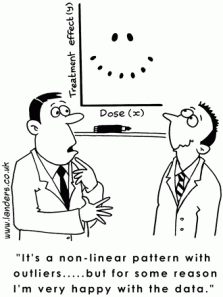
Cartoon on data points & regression analysis involving drug trials, December 13, 2012. (http://www.landers.co.uk).

Cartoon on data points & regression analysis involving drug trials, December 13, 2012. (http://www.landers.co.uk).

So after I presented some of my early findings regarding 1910 census data and infant mortality rates among Black women in Pittsburgh to Larry’s History of Black Pittsburgh class, we met to discuss how far I’d gotten in my regression analysis. I hadn’t done much with the variables yet, simply because I hadn’t had the time in November to do any off-time work. Larry became furious, said that he was “disappointed in me,” and wondered aloud if I’d make it through this year as a grad student. When I pointed out for a second time that I was doing this work in my spare time — not as an independent study course, not for a grade — he finally remember what we had discussed in August.

Larry did apologize, profusely. But I was pissed. “You’re only advising one active student, and you can’t remember what I’m working on,” I thought. With Joe Trotter at Carnegie Mellon attempting to woo me into their program, with me already taking his grad seminar in African American history, and with the writing on the wall at Pitt (where I’d already earned my B.A. and M.A. in history), I set up a meeting with Joe in mid-December to explore the possibility of transferring.

Although it would’ve been a worse decision to stay at Pitt, leaving for Joe Trotter and Carnegie Mellon was just about the worst decision I’d made as an adult (see my post “The Audacity of Youth, Grad School Style” from August ’11). For it set up so many of my other career decisions and choices I’ve made in the two decades since.

A school of education would’ve made more sense for me and the research I wanted to pursue, after all. But I would’ve had to think beyond Western Pennsylvania, taken a year off, and then pointed at Stanford, Harvard, UPenn or Teachers College as possibly better choices, better situations. Chris Rock is right. “Life is long, when you make the wrong decisions.”

Providing the Wrong Frame for Higher Education

12 Wednesday Dec 2012

Posted by decollins1969 in 1, Academia, culture, Eclectic, Politics, race, Work, Youth

≈ Leave a comment

Tags

"Investing in the Future", American Competitiveness, Center for American Progress, Critical Thinking, Drew Gilpin Faust, Educational Attainment, Efficiency, Gene Sperling, Glenn Hutchins, Harvard University, Higher Education, Innovation, K-12 Education, Neera Tanden, Philosophy of Education, Poverty, Purpose of Education, social mobility, STEM Fields, Technocrats, Workforce Development


Neera Tanden and Drew Gilpin Faust, Center for American Progress' "Investing in the Future" event (screen shot), Washington, DC, December 10, 2012. (http://americanprogress.org).

Neera Tanden and Drew Gilpin Faust, Center for American Progress’ “Investing in the Future” event (screen shot), Washington, DC, December 10, 2012. (http://americanprogress.org).

I was supposed to attend the Center for American Progress event “Investing in the Future: Higher Education, Innovation, and American Competitiveness” yesterday morning (who does a two-and-a-half-hour event two Mondays before Christmas, really?). But my son happened to have his worst night of sleep in his nine and a third years of life, compounded by a minor asthma attack. So I didn’t get to go.

I’m glad that I didn’t attend, though, as the above link to the site and video will indicate to even an educator with the patience of Jesus. After watching and skipping through the 138-minute recording today, I realized that passing a kidney stone (which I’ve actually done) would be preferable to hearing the drivel that the Center for American Progress, Harvard University and Google sponsored yesterday.

It was a tour-de-force of K-16 education as preparation for practical careers and scientific/technological innovation. Period. Not education to formulate a critical mind. Not education for the betterment of society, for social justice, for changing the world. No, Americans, our very future depends purely on the willingness of Harvard (and other elite universities), corporations and government to work together to turn out millions of students to work in STEM fields, apparently the only fields that matter in the twenty-first century.

Yesterday’s Center for American Progress event proves, more than anything else, that K-12 public education has lost the battle for educational equity and US higher education is in the process of becoming a two-tiered system. The comments and answers from Neera Tanden, Harvard President Drew Gilpin Faust, Glenn Hutchins, Gene Sperling, et al. were indicative of a class of folks who hold little interest in providing the resources necessary to level the educational playing field for poor and struggling working class students.  Or, when they did address K-12 education, it was purely in technocratic scales-of-efficiency terms, as they gave K-12 most of the blame for America’s reduced economic competitiveness.

Box of Cracker Jack bags, December 11, 2012. (http://crackerjackpopcorn.com).

Box of Cracker Jack bags, December 11, 2012. (http://crackerjackpopcorn.com).

But this is the problem with leaders involved in American education these days. Instead of opening up K-12 education to real innovations in philosophy, curriculum, a teacher’s ability to use all of their skills (measurable and intangible) in a student-centered classroom, critical thinking and neuroscience, we were given the typical mantra of testing, teacher effectiveness and cost-cutting. It means that even among our alleged best thinkers — apparently still White, mostly male and over fifty years of age — the best ideas involve an expansive education for the well-off and a Cracker Jack education for the growing numbers of the poor and those struggling to remain above the poverty line.

As for higher education, I’ve already noted that we are well on the way to a two-tiered system in the US (see my post “edX and Ex-lax (& Higher Education’s Future)” from September ’12). One tier will consist of group of schools that will remain elite and near elite, the top 500 or so colleges and universities in the country. The other group of colleges (public, HBCU and for-profit) will struggle mightily with the weight of providing a specialized education for the masses of unprepared and underprepared low-income first generation students, of color and otherwise. They will increasingly lose out to the elite university/corporate/government partnership that will lead to a cheaper, streamlined college education, and mostly online. And all without the complications of providing a well-rounded, liberal arts education.

Ben & Jerry's half baked ice cream flavor, December 11, 2012. (http://bestuff.com/).

Ben & Jerry’s half baked ice cream flavor, December 11, 2012. (http://bestuff.com/).

The speakers at “Investing in the Future: Higher Education, Innovation, and American Competitiveness” also discussed the need to make higher education cheaper. Their solutions of cheaper loans and more stringent requirements for students to meet in order to obtain merit-based aid is nothing new, and in fact reflects trends that date back to the late-1970s. Even Faust’s encouragement of spreading the Harvard solution of providing need-based aid for low-income students only works for high-achieving students, the “low-hanging fruit” strategy that allows the other grapes on the trees to rot.

To be sure, the speakers at this event also talked about comprehensive immigration reform, green jobs/economy and universal health care. But without sufficient attention to the millions and millions of poor and of color people affected by their words and deeds, the Center for American Progress event might as well have been called “Investing in the Oligarchic Past.” Same new-old solutions, same half-baked ideas that show that as long as American education and industry leaders try to force solutions on our poor, we’ll be about as competitive as the USSR was between Stalin and Glasnost/Perestroika.

We Called Him Mr. Lewis

03 Monday Dec 2012

Posted by decollins1969 in 1, Academia, Boy @ The Window, culture, Eclectic, Jimme, Mount Vernon High School, Mount Vernon New York, My Father, Politics, Pop Culture, race, Youth

≈ Leave a comment

Tags

Arne Duncan, Bill & Melinda Gates Foundation, Chemistry, Cigarettes, Disllusionment, ExxonMobil, Family Income, High-Stakes Testing, Humanities, Low-Income Students, Michelle Rhee, New York State Regents Exam, Nicotine, Organic Chemistry, Politics of Education, Poverty, Steve Perry, Students of Color, Teacher Effectiveness, Tenth Grade, US Department of Education, Wendy Kopp


Screenshot from To Sir, with Love (1967), December 3, 2012. (http://movies.tvguide.com). Qualifies as fair use under US Copyright laws - pic's low resolution/subject matter for blog.

Screenshot from To Sir, with Love (1967), December 3, 2012. (http://movies.tvguide.com). Qualifies as fair use under US Copyright laws – pic’s low resolution/subject matter for blog.

The dumb technocratic class (Wendy Kopp, Michelle Rhee, Steve Perry, Arne Duncan) and the assholes who fund them (Bill & Melinda Gates Foundation, ExxonMobil, US Department of Education) continue to pump out the mantra that effective teachers are the single most important variable in student performance, retention and graduation. This despite a half-century’s worth of research showing that family income was the far more important piece of data.

But even if Kopp, Rhee and Perry’s snake oil somehow turned out to be true, the fact is, the high-stakes testing movement and No Child Left Behind (and now Race to the Top) has turned effective teachers into lab leaders teaching to state-wide tests. Our current K-12 regime makes it so that ineffective teachers can be seen as effective because they’re only concerned with higher test scores, not actual learning. And some of them, not even concerned with that.

About this time thirty years ago, I had a group of wholly ineffective teachers in my tenth grade Humanities classes at Mount Vernon High School (see my posts “Half-Baked Z and Christian Zeal” from September ’10 and “This…Is…Jeopardy” from March ’11). Mr. Lewis was but one example of an unimaginative instructor. He was our Level 1 Chemistry teacher. We started his class in a very tense situation. There were fifty-one students in our class to start the year because the school administrators had failed to hire a new Level 0 (the highest level for the highest of the high-performing students) teacher for Chemistry. Our future valedictorian and other Level 0 folks spent a month protesting to the head of the Science Department, Estelle Abel, about the overcrowding and the mixing of the two levels. It took nearly two months before the situation was resolved. By that time, November ’84, none of us wanted Lewis for a teacher.

His was a class that could be fun and entertaining, but not usually educational. Sometimes our chemistry education came with errors and miscalculations. Perhaps his mistakes piled up because it was seventh period and near the end of the school day. Or maybe we were tired and inattentive.

Marlboro cigarette butts, September 19, 2007. (bachmont via Wikipedia/Flickr.com). In public domain.

Marlboro cigarette butts, September 19, 2007. (bachmont via Wikipedia/Flickr.com). In public domain.

The truth was that Lewis was a teacher with a serious chemical addiction. His was a chain-smoking world. When he opened up the door to the storage room where the test tubes and Pyrex jars were, stale cigarette smoke entered the room. His teeth were a pasty yellow, and they had a film that seemed to build up on them and in his mouth by the time we had him at the end of the day. On more than one occasion, Lewis would get phlegm caught in his mouth while in the middle of one of his lectures. Then he’d pause as he gulped the phlegm, and then he kept going. It was absolutely disgusting.

One day I met with Mr. Lewis after class to discuss my struggles with the material. He was at the front lab table sitting on a stool. In front of him on the table were fifteen Marlboro cigarettes, all lit and neatly lined up in a row. During our ten minutes together, he smoked one cigarette after another, sucking them down so fast that he had to pause to clear his throat from time to time. By the time I left, he’d gone through twelve out of fifteen, and I smelled like I’d been at one of my father Jimme’s bars. I was more than sure that Lewis’ nicotine dependency was a factor in his inability to teach Chemistry to us well (Cigarettes And Coffee, by Otis Redding).

My grades for the year going into the last weeks of the school year had ranged between an unimpressive 70 and an 87. But with the New York State Regents Exam in Chemistry coming up, Lewis was nonchalant in his attempts to prepare us for the Regents. Lewis went as far as to say, “There’s nothing to worry about” on the subject of organic chemistry. “There will be hardly any organic chemistry on the exam, anyway,” he said. After eight months of listening to his blathering, I thought “That’s it!” The next time I got money from Jimme, I  bought the Barron’s Chemistry Regents exam prep book. It was just before Memorial Day, and I had a month before the exam.

Barron's Regents Exams & Answers Chemistry (2011), December 3, 2012 (http://barnesandnoble.com).

Barron’s Regents Exams & Answers Chemistry (2011), December 3, 2012 (http://barnesandnoble.com).

On my Chemistry Regents I scored a 95, the third or fourth highest grade in the school (the highest grades were a 99 and 97 that year). My score raised my final grade in Lewis’ class six points, from a 79 to an 85. My score left me feeling jaded and disillusioned. “Wow,” I thought. “My teachers really don’t know much more than I do!” I knew that a lot of my Level 1 Chemistry classmates didn’t fare so well on the exams, because they believed Lewis when he said that there wouldn’t be much organic chemistry on the exam. By my own count during the exam, between thirty-five and forty of the 100 questions were organic chemistry ones.

It took having Meltzer for AP US History in eleventh grade for me to trust teachers again. I didn’t need anyone to teach tests to me. I needed a teacher who could help me open up a door into myself and into a world I hadn’t explored before. And millions of students — especially of color and from impoverished backgrounds — need teachers free to do that, without the threat of high-stakes tests hanging over them like a boulder.

James and the PAGPSA

29 Thursday Nov 2012

Posted by decollins1969 in 1, Academia, Boy @ The Window, culture, Eclectic, eclectic music, Hebrew-Israelite, Politics, Pop Culture, race, Religion, Youth

≈ 1 Comment

Tags

Activism, Afrocentric, Afrocentricity, Authentic Blackness, Black Action Society, Campus Climate, Carnegie Mellon University, Community, Diversity, Friendships, Graduate School, GSPIA, Isolation, PAGPSA, Pan African Graduate and Professional Student Association, Pitt, Pittsburgh, Politics of Graduate School, Retention, Self-Discovery, University of Pittsburgh


James and the Giant Peach photo art (1996), November 29, 2012. (http://disneymania.com.br).

About this time twenty years ago, perhaps for the first time in my life, I found myself around like-minded individuals, folks who seemed to understand me on an intellectual level. The fact that these were fellow graduate students, all at Pitt and all willing to form an association that would enable us to develop real connections across the campus, was inspiring to me. After four years of off-and-on involvement in the Black Action Society, not to mention my first year in the History grad program, I’d almost given up on the idea that I could form good friendships and acquaintance-ships through any formal gatherings.

But this was especially true regarding my thinking about my fellow Black students and other students of color. For the most part, I’d been around two kinds of students of color during my first five years at the University of Pittsburgh. One group was the semi-nerdy set, folks who cared deeply about their academic performance, but were also late-bloomers socially — people like me in more than a few ways. They tended to care little, though, about campus activism around diversity, retention or campus climate issues.

The other group was the Afrocentric set, people who often reminded me of my one-time Hebrew-Israelite brethren, whose views of Blackness were so limiting that I would’ve been a traitor just for listening to Chicago or Phil Collins. Those folks had virtually taken over the Black Action Society by my senior year. Forget mentioning popular folks, like sorors, frat guys, football, basketball and track guys and gals, or those fully invested in Pitt’s Honors College. I mingled with them all, and found little in common with them, intellectually or economically.

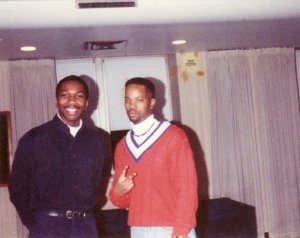
Me with Mark James, PAGPSA meeting, GSPH building, University of Pittsburgh, February 26, 1993 (Lois Nembhard).

That changed a bit my first year of grad school. Often in my walking and running across campus, I’d bump into a Black grad student here or there. At Hillman Library, the Cathedral of Learning, William Pitt Union, the SLIS building or other places. We’d recognize each other, we said hello, we even exchanged our names. Two of them in particular — Ed and Hayley — reached out to me at the end of the Spring ’92 semester, because they wanted to put together an organization that would represent our interests as grad students of color.

In mid-August, the emails began to go back and forth in earnest to establish what we’d end up calling the Pan African Graduate and Professional Student Association (PAGPSA) that fall. Through Jack Daniel’s office (see my post “The Miracle of Dr. Jack Daniel” from May ’11), we obtained the start-up funds necessary to make the new association go.

At our founding meeting that September, there were eight of us, all highly motivated to be as inclusive as possible, all feeling suddenly less isolated than we had felt a week, month or semester earlier. We decided on the “Pan African” part of the association’s name because we wanted to welcome as many graduate students of color as possible, particularly African and Afro-Caribbean students. The terms “Black” and “African American,” we agreed, wouldn’t be inclusive enough.

We also decided that despite the political implications of our new name, that this association would primarily be about bringing students together for social gatherings, for additional information and education beyond their course work and dissertations, but not to be campus activists. So many of the Black, African and Afro-Caribbean grad students at Pitt were in fact working on master’s or other professional degrees, and wouldn’t be on campus long enough to make lasting changes through activism, strictly speaking. Plus, there was the risk that activism would be so all-consuming — especially on issues like campus climate, long-term support for research and retention rates — that folks would fail to complete the work they came to Pitt to do in the first place.

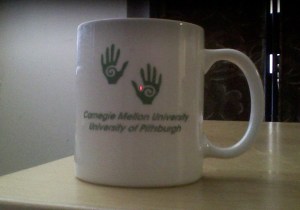
CMU-Pitt mug, from joint PAGPSA/BGSO meeting on diversity and grad school, October 1992, November 29, 2012. (Donald Earl Collins).

By the time that first meeting broke up, I was content to have met folks like Mark, Hayley, Lois, Errol, Ed, and a couple of others, to find us all on the same page about something as serious as starting a new association of a significant cross-section of Pitt’s graduate students of color. But in the process, I’d made a new friend that fall through our meetings and our joint gatherings with Carnegie Mellon’s Black Graduate Student Organization (BGSO).

James came along and challenged PAGPSA in October and November regarding our campus activism stance, arguing that being a part of any organization of students of color meant being active. Of course the leadership disagreed, but that’s how I met the man. He was a charismatic Black Iowan preacher’s son, and more politically active than anyone I’d known under the age of thirty. James had ideas about everything, from the future of hip-hop to the implications of my research on multiculturalism and Black Washington, DC.

Though he was a GSPIA (Graduate School of Public and International Affairs) master’s student and ultimately finished his degree in ’94, we would remain friends through the rest of the ’90s. Between him and Matt (see my post “My Friend Matt” from September) and PAGPSA, I remained grounded even as I became buried in the minutia of US, African American and educational policy historiography over the next half-decade. Thankfully, I no longer felt like a lone wolf. Thankfully, I knew that I wasn’t alone in a sea of graduate school and faculty White maleness after that fall.

Cath The Great

05 Monday Nov 2012

Posted by decollins1969 in 1, Academia, Boy @ The Window, culture, Eclectic, Politics, Pop Culture, race, Youth

≈ Leave a comment

Tags

Annual Meeting, Carnegie Mellon, Carnegie Mellon University, Carolina Inn, Catherine A. Lugg, Catherine Lugg, Conference, Conference Presentations, Department of HIstory, Durham North Carolina, Educational Policy, Friendship, Friendships, Graduate School, HES, History of Education Society, Pittsburgh, Politics of Education, Serendipity, Steven Schlossman, University of North Carolina


Catherine A. Lugg, circa 2009, November 5, 2012. (Catherine A. Lugg via Facebook).

I define serendipity as the ability of hard work to create what others would consider good luck, fortuitous chances, random opportunities for success. I’ve managed to do just that over and over again over the course of my life, particularly as a student and occasionally as a writer. But as a human being in search of real, positive, life-changing connections and friendships, serendipity has been very hard to make happen. When it does occur, at least for me, it becomes one of those moments that I seal in my mind, like a note in a time capsule.

The beginning of November ’94 was one of those weeks filled with serendipity. It started with the chair of the History Department at Carnegie Mellon, Steven Schlossman. He had decided that he couldn’t make it to the 1994 History of Education Society annual meeting in Chapel Hill, North Carolina. But because he had already booked a room and a flight, Schlossman apparently figured that he could simply transfer both the airline tickets and room to me instead (back in the pre-9/11 days when you could do such things without creating a potential terror alert). So Schlossman met with me a week before this conference and said that I should go “to represent the department” and because he thought it “a great opportunity” for me.

Carolina Inn at night (its better side), Chapel Hill, NC, 2007, November 5, 2012. (http://booked.com).

I wasn’t so sure, with the HES meeting being held in a mansion-turned-hotel, not quite on the University of North Carolina campus. Once I arrived from Pittsburgh on that first Wednesday in November, though, I felt at least free from the burdens of grad school at Carnegie Mellon. The weather was perfect, in the low eighties, and my World History sections for that Thursday and Friday were being covered by other teaching assistants. So I gave myself a tour of Chapel Hill, all the while wondering why didn’t I apply here for graduate school.

That was only the prelude to the four-day conference that began that Thursday. And since Schlossman had charged me to attend four sessions and to take notes on them on his behalf, I went to as many conference offerings as humanly possible. Back then, I had a much higher tolerance for boring academician-speak. So I was easily able to take detailed notes. I asked questions on topics in which I knew little. I even smiled and introduced myself to the mostly over-fifty White male crowd.

By Saturday, I had one mandatory session to attend. It was something about education in Japan and Germany post-World War II and how Japanese textbook makers left Japanese atrocities during World War II out of the nation’s history textbooks. During the Q & A, I asked what I thought was a pedestrian question, pedestrian because I forgot it five minutes after I asked it. Yet several people afterward told me that I’d asked a great question, as if I had some unique perspective or something. “It’s not even my subject matter,” I thought, adding in my mind that “Maybe some of these folks thought that the Black guy in the room didn’t really know anything.”

History of Education Society 1994 Annual Meeting program, November 3-6 1994, November 5, 2012. (Donald Earl Collins).

Or, as it turned out, my dedication to Schlossman’s charge made me seem 1,000 times as enthused about the HES meeting as anyone else attending. For two women did in fact notice me during that session. That Saturday evening, during beer, wine and spirits time in a cramped conference/ball room space, after pleasantries with a couple of older professors, I bumped into the two women again. They immediately engaged me in conversation, because they wanted to know how I managed to remain upbeat during such a boring ass conference.

Barbara and Catherine were both grad students in the School of Education at Penn State, as it turned out. Both were also PhD candidates in the midst of doctoral theses, and because of my being only twenty-four, couldn’t believe that I was a PhD candidate also. What I thought was going to be just another one of thirty conversations with older White male professors and kiss-ass grad students turned into a nearly ninety-minute discussion of research, pop culture, the HES conversation, and the ironies of life, and all with a snarkiness that only someone like me (or Rachel Maddow) could fully appreciate.

It might’ve ended there. Except that Barbara and Catherine’s research on federal education policy and achievement gap data for Latinos (especially Mexican immigrants) dovetailed pretty well with my work on multiculturalism and Black education in Washington, DC. Plus, the three of us saw an opportunity to use next year’s HES meeting as an opportunity to expose the hypocrisy of the old boys’ club and their petri-dish sense of educational issues for women, for communities of color, and for immigrants. We titled it, “Educational Historiography and Diverse Populations: Why Research Isn’t ‘Bringing a Pet to Class’.” Somehow the powers who ran HES accepted our proposal, giving us a chance to present at HES in Minneapolis in October ’95.

A skunk (something a teacher shouldn’t bring to class), November 5, 2012. (http://animal.discovery.com).

By that time, though, Barbara couldn’t make it, having recently married and having moved across the pond to the UK. Catherine ended up taking her place, and ended up doing two presentations in less than twenty-four hours. She’s been there for me as a genuine friend in academia and in my aspirations as a writer ever since.

The HES meetings  were the start of an eighteen-year friendship with Catherine, one that actually survived despite the tendency of the academic life to kill more friendships than one could ever start. I think we’re friends still because we share a same sense of the world, and both are willing to snark our way through the madness of it all.

← Older posts
Newer posts →

Boy @ The Window: A Memoir

Boy @ The Window: A Memoir

Places to Buy/Download Boy @ The Window

There's a few ways in which you can read excerpts of, borrow and/or purchase and download Boy @ The Window. There's the trade paperback edition of Boy @ The Window, available for purchase via Amazon.com at http://www.amazon.com/Boy-Window-Donald-Earl-Collins/dp/0989256138/

There's also a Kindle edition on Amazon.com. The enhanced edition can be read only with Kindle Fire, an iPad or a full-color tablet. The links to the enhanced edition through Apple's iBookstore and the Barnes & Noble NOOK edition are below. The link to the Amazon Kindle version is also immediately below:

scr2555-proj697-a-kindle-logo-rgb-lg

Boy @ The Window on Amazon.com: http://www.amazon.com/Boy-The-Window-Memoir-ebook/dp/B00CD95FBU/

iBookstore-logo-300x100

Boy @ The Window on Apple's iBookstore: https://itunes.apple.com/us/book/boy-the-window/id643768275?ls=1

Barnes & Noble (bn.com) logo, June 26, 2013. (http://www.logotypes101.com).

Boy @ The Window on Barnes & Noble: http://www.barnesandnoble.com/w/boy-the-window-donald-earl-collins/1115182183?ean=2940016741567

You can also add, read and review Boy @ The Window on Goodreads.com. Just click on the button below:

Boy @ The Window

Twitter Updates

Tweets by decollins1969
  • RSS - Posts
  • RSS - Comments

Archives

  • June 2025
  • April 2023
  • September 2022
  • August 2022
  • July 2022
  • June 2022
  • May 2022
  • April 2022
  • March 2022
  • January 2022
  • December 2021
  • November 2021
  • October 2021
  • September 2021
  • August 2021
  • July 2021
  • June 2021
  • April 2021
  • March 2021
  • February 2021
  • January 2021
  • December 2020
  • November 2020
  • October 2020
  • September 2020
  • August 2020
  • July 2020
  • May 2020
  • April 2020
  • March 2020
  • January 2020
  • December 2019
  • November 2019
  • August 2019
  • July 2019
  • June 2019
  • May 2019
  • April 2019
  • March 2019
  • February 2019
  • January 2019
  • December 2018
  • November 2018
  • October 2018
  • September 2018
  • August 2018
  • July 2018
  • June 2018
  • May 2018
  • March 2018
  • February 2018
  • January 2018
  • December 2017
  • November 2017
  • October 2017
  • September 2017
  • August 2017
  • July 2017
  • June 2017
  • May 2017
  • April 2017
  • March 2017
  • February 2017
  • January 2017
  • December 2016
  • November 2016
  • October 2016
  • September 2016
  • August 2016
  • July 2016
  • June 2016
  • May 2016
  • April 2016
  • March 2016
  • February 2016
  • January 2016
  • December 2015
  • November 2015
  • October 2015
  • September 2015
  • August 2015
  • July 2015
  • June 2015
  • May 2015
  • April 2015
  • March 2015
  • February 2015
  • January 2015
  • December 2014
  • November 2014
  • October 2014
  • September 2014
  • August 2014
  • July 2014
  • June 2014
  • May 2014
  • April 2014
  • March 2014
  • February 2014
  • January 2014
  • December 2013
  • November 2013
  • October 2013
  • September 2013
  • August 2013
  • July 2013
  • June 2013
  • May 2013
  • April 2013
  • March 2013
  • February 2013
  • January 2013
  • December 2012
  • November 2012
  • October 2012
  • September 2012
  • August 2012
  • July 2012
  • June 2012
  • May 2012
  • April 2012
  • March 2012
  • February 2012
  • January 2012
  • December 2011
  • November 2011
  • October 2011
  • September 2011
  • August 2011
  • July 2011
  • June 2011
  • May 2011
  • April 2011
  • March 2011
  • February 2011
  • January 2011
  • December 2010
  • November 2010
  • October 2010
  • September 2010
  • August 2010
  • July 2010
  • June 2010
  • May 2010
  • April 2010
  • March 2010
  • February 2010
  • January 2010
  • December 2009
  • November 2009
  • October 2009
  • September 2009
  • August 2009
  • July 2009
  • June 2009
  • May 2009
  • April 2009
  • March 2009
  • February 2009
  • January 2009
  • December 2008
  • November 2008
  • October 2008
  • September 2008
  • August 2008
  • July 2008
  • June 2008
  • May 2008
  • April 2008
  • March 2008
  • February 2008
  • January 2008
  • December 2007
  • November 2007
  • October 2007
  • September 2007
  • August 2007
  • July 2007
  • June 2007

Recent Comments

MaryPena's avatarMaryPena on My Day of Atonement/Bitter Hat…
decollins1969's avatardecollins1969 on No Good Teaching Deed Goes…
Mary Rose O’Connell's avatarMary Rose O’Connell on No Good Teaching Deed Goes…

NetworkedBlogs on Facebook

NetworkedBlogs
Blog:
Notes From a Boy @ The Window
Topics:
My Life, Culture & Education, Politics & Goofyness
 
Follow my blog

616 616 East Lincoln Avenue A.B. Davis Middle School Abuse Academia Academy for Educational Development AED Afrocentricity American Narcissism Authenticity Bigotry Blackness Boy @ The Window Carnegie Mellon University Child Abuse Class of 1987 CMU Coping Strategies Crush #1 Crush #2 Death Disillusionment Diversity Domestic Violence Economic Inequality Education Family Friendship Friendships Graduate School Hebrew-Israelites High-Stakes Testing Higher Education History Homelessness Humanities Humanities Program Hypocrisy Internalized Racism Jealousy Joe Trotter Joe William Trotter Jr. K-12 Education Love Manhood Maurice Eugene Washington Maurice Washington Misogyny Mother-Son Relationship Mount Vernon High School Mount Vernon New York Mount Vernon public schools Multiculturalism MVHS Narcissism NFL Pitt Pittsburgh Politics of Education Poverty President Barack Obama Race Racial Stereotypes Racism Relationships Self-Awareness Self-Discovery Self-Reflection Sexism Social Justice Teaching and Learning University of Pittsburgh Violence Whiteness Writing

Top Rated

Blog at WordPress.com.

  • Subscribe Subscribed
    • Notes from a Boy @ The Window
    • Join 103 other subscribers
    • Already have a WordPress.com account? Log in now.
    • Notes from a Boy @ The Window
    • Subscribe Subscribed
    • Sign up
    • Log in
    • Report this content
    • View site in Reader
    • Manage subscriptions
    • Collapse this bar
 

Loading Comments...