• Spinning Sage’s Gold: Allegories on the Western-Dominated Present and a Possible Post-Western Future (2025)
  • About Me
  • Other Writings
  • Interview Clips
  • Video Clips
  • Boy @ The Window Pictures
  • Boy @ The Window Theme Music

Notes from a Boy @ The Window

~

Notes from a Boy @ The Window

Author Archives: decollins1969

Anger Issues and Management, Inc

25 Saturday Sep 2010

Posted by decollins1969 in 1, Boy @ The Window, Christianity, Mount Vernon High School, Religion, Youth

≈ Leave a comment

Tags

7S, A.B. Davis Middle School, Anger, Anger Management, Christianity, Envy, Fights, Jealousy, Mount Vernon High School, Mount Vernon New York, MVHS, Patience, Pittsburgh, Race, Ridicule, Righteous Indignation, Scorn, University of Pittsburgh, Wisdom


Rage of the Incredible Hulk. Source:http://www.ramasscreen.com

Exposure to abuse, ridicule and scorn in fairly large dosages when you’re young will leave you with anger issues to manage. I should know. Don’t believe the impressions that my classmates from Humanities and MVHS and my friends from my first two years at Pitt have of me. I may have appeared to smile, to be happy-go-lucky, to be sober and monk-like. But mostly, I was angry, not in a raging, vengeful way, but in a depressed way, a constant, gnawing, sometimes envious, sometimes ironic and sarcastic way. My anger was the kind of anger that I chewed on and swallowed, simmered at low heat for a while in the pit of my belly, then I’d regurgitate it into my mouth, and then chewed on it and swallowed it again.

But, despite what some folks in certain religious circles may say, not all anger is bad, evil or sinful. In fact, sometimes anger is necessary, even if and when it’s dangerous as an emotion or a state of mind. Why, you may ask? Because without anger, you take what life gives to you, even when most of what good you get out of life comes in a miserly and begrudging way. Everything else that comes, if indeed bad or evil for you, isn’t taken in stride or taken with difficulty. You simply don’t take it at all. You become so emotionless that whatever happens doesn’t matter at all, as if your purpose for existing is merely to exist, not to succeed, not to do good works or make yourself a better person because of or despite your circumstances.

That, by the way, is what I’ve heard over the years when some of my former classmates from Mount Vernon — and a few people who knew me in my early days at the University of Pittsburgh — describe me. It was as if I was Porgy in Porgy and Bess, Louis Armstrong or Paul Robeson singing, “I’ve got plenty of nothin’, and nothin’s plenty for me.” That would and did piss me off, but I reminded myself that this was how I had to be to deal with the anger I had within. With emotion, I could’ve easily flown into a rage many

In Treatment Screen Shot. Source: http://sepinwall.blogspot.com

a day between ’81 and ’89.

At the same time, I had the wisdom to allow my anger to rise up, to channel it many more times than not into what I needed to have happen at a particular moment in time. It’s amazing how much you can get done with a sense of righteous anger and indignation, a feeling of got-to-get-it-done-or-else anger. It came at the right time, usually when I felt that my back was up against a concrete wall, with no way out except to fight my way out.

Like in February ’82, the middle of seventh grade, when I just got tired of my 7S classmates thinking that they could say and do anything to me without me getting angry, and tired of days on end at 616 without food to eat. After a fight in the boy’s locker room with one of my classmates — which I won, by the way — I channeled the energy unleashed by that rage and fight into two things. Improving my mediocre grades, and my infatuation over Crush #1. It was three months of relative bliss in the middle of the worst eighteen months of my life.

Richard Marx, 1987.

Or in January ’88, after recovering from the crash-and-burn of my first semester at Pitt. I was mad and disappointed with myself over allowing my obsession with Crush #2 hijack the final six weeks of my semester, not to mention my generally hopeful and creative imagination. After an incident with a couple of my more evil and drunken dorm mates — one in which I cracked a broom handle on the crowns of their heads (no injuries or investigation, luckily) — I summoned some discipline and theme music to get through that second semester. From Richard Marx’s “Should’ve Known Better” to Paul Carrick’s “Don’t Shed A Tear,” I spent fifteen weeks turning anger into A’s and jadedness into new friendships.

I’ve had other periods in my life — in ’93, ’98, and ’03 — where the circumstances dictated that anger, with some patience and understanding, was absolutely necessary in my overcoming of them. The lesson here is that anger — like fire, electricity and nuclear fusion — can be and is often dangerous. Yet it’s also necessary, a potential evil that can be an actual good, if channeled, allowed to dissipate, if tempered by wisdom and patience. At the least, anger allows those of us under stress to know that we are very much alive.

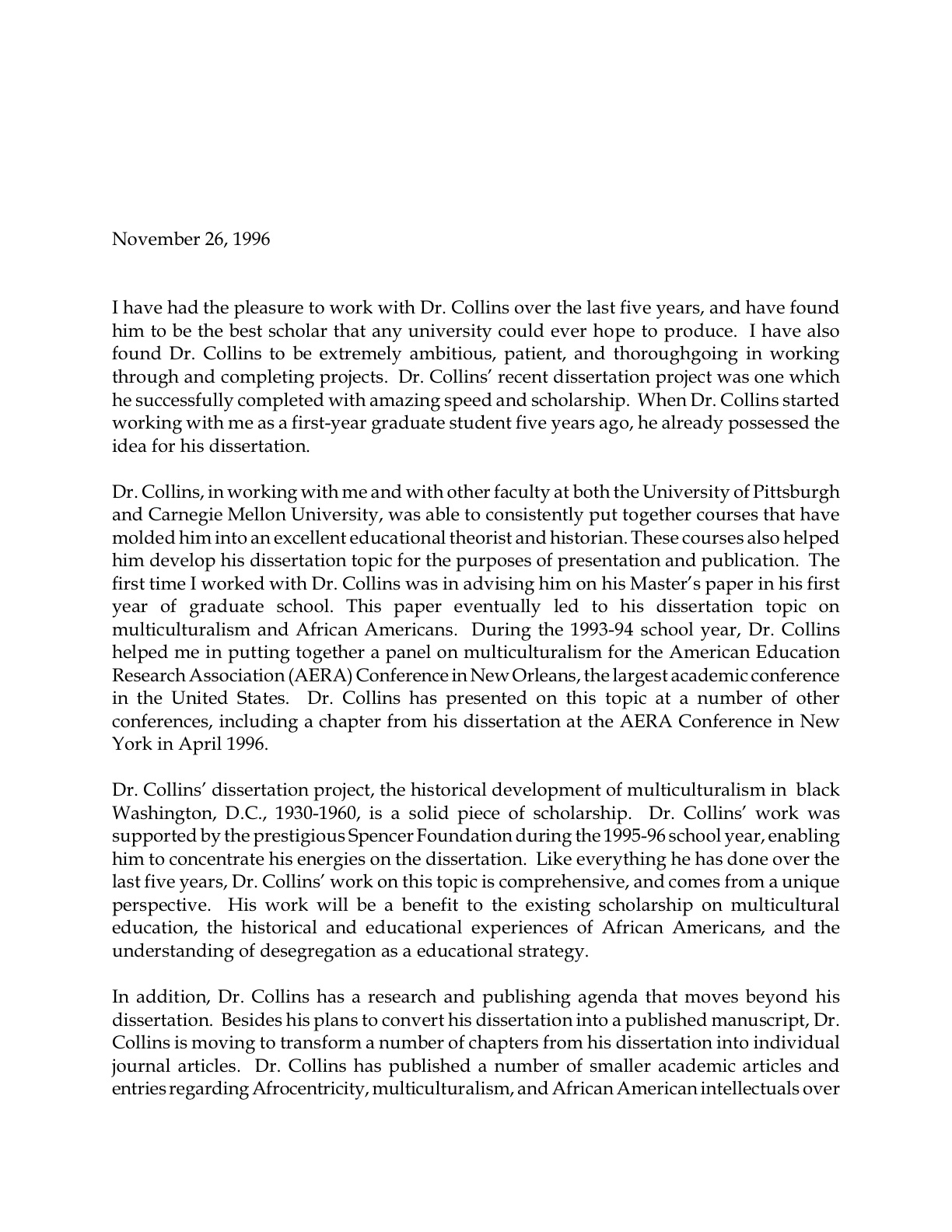
Letter of Recommendation (or Wreck-o-mendation)

23 Thursday Sep 2010

Posted by decollins1969 in 1, Academia, Boy @ The Window, Eclectic, Mount Vernon High School

≈ Leave a comment

Tags

Academia, Carnegie Mellon University, Dan Resnick, Daniel P. Resnick, George Reid Andrews, Joe Trotter, Joe William Trotter Jr., Letters of Recommendation, Pittsburgh, Race, References, Sy Drescher, Transparency, University of Pittsburgh


George Reid Andrews, University of Pittsburgh

About a year and a half ago, I wrote about a string of not-so-wonderful professors I had at Pitt and Carnegie Mellon who were less than fine with me pursuing anything beyond a bachelor’s degrees, much less with me becoming Dr. Collins. I talked about how some of them went so far as to tell me that I wasn’t “graduate material,” as if I were made from parts found at a junk yard instead of in the shop of an Italian tailor.

I’m more than aware of the fact that I didn’t let those doubters stop me from becoming who I am today. Some were undoubtedly ones whose skepticism bordered on racist because of their assumptions about my intelligence and writing ability. Still, it should be noted that there are pitfalls to be avoided, if at all possible, when you’re applying for a job or applying to a college or graduate and professional school.

One, even if a professor or teacher has assigned an A for your performance in one of their courses, that doesn’t mean that think that you’re a great student. I learned that the hard way with George Reid Andrews, my professor for Latin American Revolutions my junior year at Pitt. Twenty years ago this week, I asked him for letters of recommendation for graduate school. Andrews agreed, but only to tell me seven months later what he really thought of my work. My research writing samples were “problematic,” my GRE scores were “barely adequate,” and I should’ve considered myself “lucky” just to get into the master’s program in the history department. That terse conversation told me that Andrews’ letter was lukewarm at best, or had found me seriously deficient at worst.

Two, and related to my interactions with Andrews, the process of providing a letter of recommendation or a reference ought to be transparent, so that the student or employee can be confident that they’re not being back-stabbed by the same people in which they’re placing significant trust. It was never a question I dared asked — to see my letter of recommendation — before I’d reached the final stages of grad school.

It would’ve helped with Andrews, and it would’ve helped with two of my three dissertation committee members, Joe Trotter and Dan Resnick. I found out through my Spencer Fellowship that Trotter had written me a lukewarm letter, while Resnick had rambled on and on about my “close relationship” with my “mentor Sy Drescher,” who had played “an instrumental role” in making me a scholar. Drescher, while one of my best professors at Pitt, played much less of a role in me pursuing grad school than so many other professors and students, including his former student Paul Riggs. It was a Leslie Stahl, “let’s give the poor Black boy a hand” kind of letter.

Later, when I asked to see my letters of recommendation from Resnick before sending them out for jobs, he went on for ten minutes about the “sanctity” of the recommendation process, about how privacy and “anonymity” were critical to provide protection for all parties involved. Needless to say, if someone blusters about privacy when politely asked about a letter of recommendation they’re writing for you, do not use that letter!

Bruce Anthony Jones, University of South Florida

Three, it’s important to get to know a person, to gain some sense of trust from them, before asking for a letter or a reference. You don’t have to become friends with them or meet their family — although that does help. They just have to know that their recommendation or reference will be put to good use by you and that what they say about you matters to both of you, in the most positive light possible. Otherwise, what’s the point of writing a letter or spending fifteen minutes on the phone talking about your qualities as a student or worker, right? This can go a bit too far, of course, as I wrote one of my own recommendations for Bruce Anthony Jones, another dissertation committee member, for him to merely put his signature to. Once he changed jobs for the University of Missouri-Columbia, his, um, my letter became worthless, if it had been worth anything at all to begin with.

I’ve written about two dozen letters of recommendation for high school, college and graduate students, for jobs, school applications and fellowship programs. Not to mention about an equal number of recommendations and references for professional colleagues and friends in academia and the nonprofit world. I’ve always written my own letters, insisted on them being seen by the people I’ve recommended and required that they explain their own rationale for their acceptance in the process. Most importantly, I’ve made sure to say “No” if I didn’t feel I could recommend them well or provide a great reference.

Class Silence

20 Monday Sep 2010

Posted by decollins1969 in 1, culture, Eclectic, Politics, race

≈ Leave a comment

Tags

"Silence Must Be Heard", Affluence, Bill Cosby, Bill Gates, Bill O"Reilly, Class, Enigma, Hard Work, Middle Class, Poverty, Race, Rush Limbaugh, Social Class, Working Class, Working Poor


Mum's the word on class.

One of the things that has driven me nuts over the past three decades is how we in this country walk in silence around issues of wealth and social class. We must never speak of our wealth, or poverty, lest we risk embarrassing ourselves or appearing arrogant. All Americans with an income between $20,000 and $20 million a year are middle class, not upper middle class, not affluent, not rich, just middle class.

Any mention of the top three percent in income (people whose income is more than $250,000 a year) amounts to class warfare, even though they control some 35-40 percent of the nation’s $57 trillion in wealth. No, poverty and affluence are relative, not absolute, and can only be measured subjectively,

Atacama Desert in Chile. Driest desert on Earth and place to stick our heads. (Public Domain)

through one’s own experience. Which is why any mention of our troubles is closer to sacrilege than declaring that there isn’t a God, especially in a nation that prints “In God We Trust” on its money.

There are ways to measure affluence and poverty regardless of cost of living and inflation. And please spare me the comparisons between the poor in the US and the poor in the Global South (Third World to those of you who like making other distinctions between fellow humans that actually dehumanize). I’ve seen too many corrugated roofs in Arkansas and Louisiana (all before Katrina), too many outhouses in rural Arkansas and Mississippi, too many families sleeping in the streets in San Francisco and New York, too many malnourished kids in Oklahoma and in DC to hear that “our poor are the richest poor people in the world” song-and-dance.

It’s simple really. Truly middle class people own a car and a home, or at least, have the option of doing both, with a steady income from a permanent job or from an established niche for work. If folks have one and rent an apartment or home, and aren’t really in a position to buy, they’re right on the borderline of the American middle class, but not quite there.

Of course, this definition does not mean that everything’s all right. Tens of millions of Americans, including yours truly, are struggling to pay car notes, student loans, mortgages and rent — not to mention credit card and other debt — and maintain a middle class or lower middle class lifestyle. Unfortunately, there are millions more who are working toward middle class, but aren’t quite there. They may say they’re middle class, but they’re really working-class or working poor.

Upper middle class or affluent Americans do more than own a house or a car. They own quality homes and quality cars, a Volvo or an Acura, maybe even a Lexus. They take at least one vacation a year with their families or friends, to other parts of the US, and on occasion, international trips. They eat at restaurants with their families at least as often as they eat a home-cooked meal. When shopping for groceries, sales are fine, as long as the sales aren’t on off-brand products like Faygo or Giant, Safeway or Krasdale. They have life insurance on every family member, 529 plans for their kids and contribute at least half as much to their 401K as their employer does in any given year (more than that if self-employed).

I’m certainly not arguing that the lives of the upper middle class or affluent or sub-rich are like being on Real Housewives or Keeping Up With the Kardashians. Yet so many in our public discourse make their lives now and times growing up sound humble, as if they grew up like me or others I’ve known over the past thirty years. People like Bill Cosby, Bill Gates or Bill O’Reilly, Dinesh D’Souza or Rush Limbaugh. It’s well beyond dishonest. It’s disgusting, and it helps to perpetuate the myth that the only reason all of us aren’t affluent is due only to our lack of hard work.

As the richest country on Earth — for the time being, at least — we’ve never reconciled our democratic ideals with our capitalistic obsessions. What helps maintain some sense of order, though, is our silence and quiet, desperate acquiescence to ever-increasing economic divisions in a country full of allegedly middle class people. As a song from Enigma goes, however, we should “question the absurd” here, as “silence must be heard.”

Hard Work and the Human Race

17 Friday Sep 2010

Posted by decollins1969 in 1, Boy @ The Window, culture, Eclectic, New York City, Politics, race, Work, Youth

≈ Leave a comment

Tags

Advantage, Boy @ The Window, Daydreams, Hard Work, Holmes Elementary School, Human Race, Individualism, Mount Vernon New York, New York City Marathon, Race, Social Class


Race card cartoon, no date, August 5, 2015. (Emanu!, http://pinterest.com).

Race card cartoon, no date, August 5, 2015. (Emanu!, http://pinterest.com).

When I was nine years old, my fourth grade teacher at Holmes, Mrs. Pierce — a grouch of an older White woman, really — talked about the human race and attempted to describe our species’ variations. She tried to do what we’d call a discussion of diversity now. It went over our heads, no doubt because she didn’t quite get the concept of diversity herself.

Holmes Elementary. Top left corner was Mrs. Pierce's classroom in 1978-79 year.

Holmes Elementary. Top left corner was Mrs. Pierce’s classroom in 1978-79 year.

Like the fourth-grader I was, I daydreamed about the term, human race. I thought of Whites, Blacks, Asians, Hispanics, young and old, male and female, from all over the world, all on a starting line. It was as if four billion people — that was the world population in ’79 — were lined up to run a race to the top of the world. In my daydream, some were faster than others, or at least appeared to be, while others hobbled along on crutches and in wheelchairs. Still others crawled along, falling farther and farther behind those who were in the lead, the ones that looked like runners in the New York City marathon. Before I could ponder the daydream further, Mrs. Pierce yelled, “Wake up, Donald!.” as if I’d really been asleep.

A high school friend recently gave me some much-needed feedback on my manuscript. Her feedback was helpful and insightful, and very much appreciated. But some of it reminded me of the realities of having someone who’s a character in a story actually read that story. Their perceptions will never fully match up with those of the writer, which is what is so groovy and fascinating about writing in the first place.

One of the things that struck me as a thread in her comments — not to mention in so many conversations I’ve had with my students about race and socioeconomics — was the theme of individual hard work trumping all obstacles and circumstances. As if words, slights, and mindsets in the world around us don’t matter. As if poverty is merely a mirage, and bigotry, race and racism merely words on a page. Sure, a story such as the one I have told in this blog for the past three years is about overcoming roadblocks, especially the ones that we set ourselves up for in life, forget about the ones external to our own fears and doubts.

2009 London Marathon. Source: http://www.newsoftheworld.co.uk/

2009 London Marathon. Source: http://www.newsoftheworld.co.uk/

At the same time, I realized what my weird daydream from thirty-one years ago meant. Some people get a head start — or, in NASCAR terms, the pole — before the race even starts. That certainly doesn’t make what that individual accomplishes in life any less meaningful, but knowing that the person had an advantage that most others didn’t possess does provide perspective and illuminates how much distance the disadvantaged need to cover to make up ground. Those who limp and crawl and somehow are able to compete in this human race have also worked hard, likely at least as hard as those with a head start, and more than likely, harder than most human beings should ever have to work.

Plus, there are intangibles that go with race, class and other variables that determines how the human race unfolds. “Good luck is where hard work meets opportunity,” at least according to former Pittsburgh Penguins goaltender Tom Barrasso. Most human beings work hard, but all need opportunities that may provide a real sprint to catch up or take a lead in the human race. Family status, political influence, social and community networks, religious memberships, being in the right place at the right time, all matter and are connected to race and class, at least in the US.

The moral of this story is, hard work matters, individual accomplishment matters. Yet a panoramic view of the race in which humans are engaged matters more in putting our individual successes and the distance that remains in some reasonable perspective. Without that, we’re all just pretending that individual hard work is the only thing that matters, when that’s only half the battle, or half of half the battle.

Where the Past Meets the Future

15 Wednesday Sep 2010

Posted by decollins1969 in 1, culture, Eclectic, Movies, Politics, race, Religion

≈ 2 Comments

Tags

"Past Tense Part 1", Adrian Fenty, Alexander Siddiq, Avery Brooks, Benjamin Sisko, Bigotry, Carl Paladino, Charles Rangel, Christine O'Donnell, Economic Woes, Election Primary 2010, Julian Bashir, Kevin Powell, Star Trek: Deep Space Nine, Star Trek: DS9, Tea Baggers, Tea Party, Vincent Gray


Star Trek DS9 - Past Tense Pt. 1, Screen Shot

Last night, I was reminded of the power of entertainment, Netflix and how art and life converge. I was watching episodes of Star Trek: Deep Space Nine when a familiar two-part episode, “Past Tense,” began. I had planned to skip it, but once I remembered the story line, I watched it again, for the first time in at least thirteen years.

The crew of the Defiant, in attempting to beam down to 24th-century San Francisco, find themselves in the year 2024, in a San Francisco and an America turned upside down by bad economic times. Two members of the crew, played by Avery Brooks (Cmdr. Benjamin Sisko, or “Hawk” for those of you who remember Spencer For Hire on ABC from the ’80s) and Alexander Siddiq (Dr. Julian Bashir, or more recently, on 24 and in the movie Kingdom of Heaven) find themselves in one of many government-run concentration camps for the homeless and unemployed. This just days before an uprising that exposes the truth of an unjust system of economic neglect and government cover-up to the nation and world.

It’s not that Americans don’t care, according to Brooks’ Sisko and Siddiq’s Bashir, it’s that “they’ve given up,” they’ve “forgotten how to care.” I paused the DVD and thought about that statement as I watched Tea Baggers’ Christine O’Donnell and Carl P. Paladino win in Delaware and New York, Kevin Powell get slaughtered by Ed Towns in Brooklyn, and Charles Rangel paste five other opponents in Harlem. Not to mention young Turk Adrian Fenty losing to the ol’ Blacks network and Vincent Gray in DC.

Last night proved to me that most Americans simply don’t know how to care about anything except for someone who looks and sounds like them, whether that politician represents their interests or not. Some may care, some may not, some may even have forgotten how to care. But way, way too many of us get caught up in style over substance, in grandiose grandstanding over a sensible platform, over a good handshake rather than someone giving us a real hand in our lives.

We are as shortsighted as a roach, running just hard enough to not get stomped on, but not seeing that the person with the size 14-4Es has two feet, not one. As Polyanna-ish as Star Trek is, that two-part episode from season three of Deep Space Nine presents a stark and nasty future that is already beginning to manifest itself right now. All because we’ve allowed our bigotry and fear to lead us in the direction of creating a self-fulfilling prophecy.

And Now, A Plagiarism Moment

13 Monday Sep 2010

Posted by decollins1969 in 1, Academia, Boy @ The Window, Eclectic, race

≈ Leave a comment

Tags

Academia, Black Issues in Higher Education, Carnegie Mellon University, Dan Resnick, Daniel P. Resnick, Department of HIstory, Plagiarism, University of Pittsburgh


Professor Emeritus Daniel P. Resnick. Source: http://www.cmu.edu

I was sitting in the office of the only professor in Carnegie Mellon’s History Department with expertise in the area of history of education one mid-September day in ’93. It was my first semester in the doctoral program there, after transferring from Pitt to finish my PhD. I had already begun to question my decision to do my remaining studies there. My advisor Joe Trotter was “upset” that I’d taken and passed my doctoral written exams the spring before, when I was still technically a Pitt grad student, and had “run interference” to forbid me from publishing any new articles during the ’93-’94 school years. That was after my piece with my friend Marc had come out in Black Issues in Higher Education.

Steve Schlossman, the chair of the history department, was also upset, because I had decided not to take the American history proseminar, a course for first semester grad students. Apparently, even though I had taken the same course at Pitt two years before — and Carnegie Mellon had accepted all of my credits from my master’s program and first year as a doctoral student at Pitt — I had to take this course. I was read the riot act and told that I needed Carnegie Mellon’s “stamp of approval” before becoming a doctoral candidate. I was incensed, because this wasn’t what I’d been promised by my esteemed advisor and the graduate advisor, John Modell.

All this happened before I met Daniel P. Resnick in his office on Tuesday on a cool, but not too cool, and sunny late-summer day. His office was neat, relatively speaking, but spare and spartan in some ways, with books stacked in orderly fashion, and papers in numerous labeled folders. What I noticed the most was the smell, an old person’s not-fully-washed smell, of bagels and lox with some onion cream cheese.

Professor Resnick had gone to the restroom and left the door open for me to sit at a table next to his desk. He had already laid out my writing samples, the ones I’d put in his mailbox the week before. They included the Black Issues in Higher Education piece. After our exchange of greetings, Resnick sat down and said, “Considering your background, your writing is remarkable!” in a way that showed real surprise.

Before I could respond with a defense or process the obvious bigotry in that statement, Resnick then said, “There’s no way you could’ve written all this.” I responded, “Well, I did, and have the grades and degrees to prove it,” preferring not to accuse the only professor in the department with a specialty in the history of education of racism. “What-what I meant was, your papers are well-written…compared to most young scholars,” Resnick stammered. I accepted that response at face value, but kept what he had said before it in mind as I worked with him over the next three years.

Resnick, as it turned out, had lived for a year with his wife, the great Lauren Resnick, on the Mount Vernon-Bronxville border in 1960-61 (one of them was teaching at Sarah Lawrence, I think), so after finding out where I grew up, he had put two and two together and come up with sixteen. I found him patronizing, and about as knowledgeable in the recent developments of educational history as I would be of underground house music in Chelsea right now. Resnick himself had plagiarized, not in terms of his own work, but from the race relations rule book. He had plagiarized in stereotypes, far worse than anything of which he’d accused me.

Was it worth having this man on my dissertation committee? Yes, because I graduated. But, in the final analysis, it would’ve made more sense to transfer to NYU or Stanford School of Education than to spend three minutes, much less three years, working with a man whose belief in my work was minimal at best.

Maybe They’ve Won After All

10 Friday Sep 2010

Posted by decollins1969 in 1, culture, Eclectic, High Rise Buildings, New York City, Patriotism, Politics, race, Religion

≈ 2 Comments

Tags

9-11, Bigotry, Freedom, Ground Zero Mosque, Intolerance, Islam, Islamic Center, Patriotism, Qur'an, Racism, Religion, Terry Jones, Twin Towers, World Trade Center


There’s a Hole in the Bucket (Still) at Ground Zero. Source: http://unambig.com

I wrote this five days after 9-11, after spending three days stuck in Atlanta and a day on a Greyhound bus from Atlanta to DC, after defending a Sikh man against a hostile White male and Black guy because he looked like one of “them.”

———————————-

With much of this week’s focus on the atrocities at the former World Trade Center in New York, the Pentagon, and the airplane crash south of Pittsburgh, there is a disturbing and growing backlash against Americans of Arab descent throughout the nation.  The nation should be outraged because of the wanton destruction of property and life at the hands of suicidal terrorists.  But this in no way should justify the fire bombings of mosques in Texas and marching against Arab communities in Chicago.  This, of course, is among other incidents of hatred and revenge directed at folks who in some cases have been in America for several generations.  And like many Americans, Americans of Arab descent migrated to our multicultural society to escape religious extremism, government persecution, and yes, terrorism.  The backlash against Arab Americans since the attacks on Tuesday sicken me as much as the frightening attacks themselves.

I am a African American male, and I have thought about what the nation’s response might have been if a suicidal group of African American terrorists had done this horrible thing.  Would we be in the midst of race riots in America’s major cities, in which groups of Whites armed with American flags and poles, rocks, guns and whatever else they could find to beat and possibly kill Blacks just because they’re Black?  Would law enforcement agencies search every allegedly suspicious-looking brown-skinned person with kinky hair because they might connect them to an African American terrorist group?

Or what if an Irish terrorist group had hijacked the planes flown into the Twin Towers and the Pentagon?  Would non-Irish Americans then be so quick to lash out at any “Mic” they could find? Would they intimidate Americans of Irish descent to the point where they would be scared out of going to school or attending a prayer vigil with their fellow Americans?  Would we be so willing to engage in the language of bloodlust toward a group of Irish Americans as we have done to our Arab American brothers and sisters?

We can say that the majority of Americans have not engaged in this bigoted and racist behavior.  But our silence is not good enough.  Mainstream journalism acts as if a few prominent Arab Americans denouncing both the terrorist attack and the expected backlash against Arabs by other Americans ends their responsibility.  It does not.  The press must do a better job of discussing this smouldering problem with all Americans, including representatives of the Arab American community.  It also must do better in explaining the differences between the tenets of Islam and the unspeakable acts of terrorists clinging to a warped version of Islam.  It’s not at all much different from the barbaric actions of the Ku Klux Klan, who claim that they act in defense of White Christians.

If we as Americans continue to commit and condone through our silence acts of hatred against Arab Americans, are we much better than the tortured souls who flew four Boeing jets as weapons of mass destruction, all in the name of Allah?  If we are to defeat terrorism as a nation and a world, we must also defeat its roots, fear and hatred.  If we are to be one undivided and multicultural nation united against terrorism, we can no longer tolerate incidents of terrorism against one another, no matter how much we hurt.

——————————–

Needless to say, The Washington Post was engaged in blind, raging patriotism for the next couple of years, so my two cents was ignored. Unfortunately, between the racism and religious hatred directed at the proposed Islamic Center near, but not on, Ground Zero in New York City, and the idiot Terry Jones wanting to burn Qur’ans in Florida, it looks like the nineteen suicidal morons from Saudi Arabia have won after all. We still have a big hole in the ground where the Twin Towers once stood. So much for standing together on the platform of America the brave and the free.

← Older posts
Newer posts →

Boy @ The Window: A Memoir

Boy @ The Window: A Memoir

Places to Buy/Download Boy @ The Window

There's a few ways in which you can read excerpts of, borrow and/or purchase and download Boy @ The Window. There's the trade paperback edition of Boy @ The Window, available for purchase via Amazon.com at http://www.amazon.com/Boy-Window-Donald-Earl-Collins/dp/0989256138/

There's also a Kindle edition on Amazon.com. The enhanced edition can be read only with Kindle Fire, an iPad or a full-color tablet. The links to the enhanced edition through Apple's iBookstore and the Barnes & Noble NOOK edition are below. The link to the Amazon Kindle version is also immediately below:

scr2555-proj697-a-kindle-logo-rgb-lg

Boy @ The Window on Amazon.com: http://www.amazon.com/Boy-The-Window-Memoir-ebook/dp/B00CD95FBU/

iBookstore-logo-300x100

Boy @ The Window on Apple's iBookstore: https://itunes.apple.com/us/book/boy-the-window/id643768275?ls=1

Barnes & Noble (bn.com) logo, June 26, 2013. (http://www.logotypes101.com).

Boy @ The Window on Barnes & Noble: http://www.barnesandnoble.com/w/boy-the-window-donald-earl-collins/1115182183?ean=2940016741567

You can also add, read and review Boy @ The Window on Goodreads.com. Just click on the button below:

Boy @ The Window

Twitter Updates

Tweets by decollins1969
  • RSS - Posts
  • RSS - Comments

Archives

  • June 2025
  • April 2023
  • September 2022
  • August 2022
  • July 2022
  • June 2022
  • May 2022
  • April 2022
  • March 2022
  • January 2022
  • December 2021
  • November 2021
  • October 2021
  • September 2021
  • August 2021
  • July 2021
  • June 2021
  • April 2021
  • March 2021
  • February 2021
  • January 2021
  • December 2020
  • November 2020
  • October 2020
  • September 2020
  • August 2020
  • July 2020
  • May 2020
  • April 2020
  • March 2020
  • January 2020
  • December 2019
  • November 2019
  • August 2019
  • July 2019
  • June 2019
  • May 2019
  • April 2019
  • March 2019
  • February 2019
  • January 2019
  • December 2018
  • November 2018
  • October 2018
  • September 2018
  • August 2018
  • July 2018
  • June 2018
  • May 2018
  • March 2018
  • February 2018
  • January 2018
  • December 2017
  • November 2017
  • October 2017
  • September 2017
  • August 2017
  • July 2017
  • June 2017
  • May 2017
  • April 2017
  • March 2017
  • February 2017
  • January 2017
  • December 2016
  • November 2016
  • October 2016
  • September 2016
  • August 2016
  • July 2016
  • June 2016
  • May 2016
  • April 2016
  • March 2016
  • February 2016
  • January 2016
  • December 2015
  • November 2015
  • October 2015
  • September 2015
  • August 2015
  • July 2015
  • June 2015
  • May 2015
  • April 2015
  • March 2015
  • February 2015
  • January 2015
  • December 2014
  • November 2014
  • October 2014
  • September 2014
  • August 2014
  • July 2014
  • June 2014
  • May 2014
  • April 2014
  • March 2014
  • February 2014
  • January 2014
  • December 2013
  • November 2013
  • October 2013
  • September 2013
  • August 2013
  • July 2013
  • June 2013
  • May 2013
  • April 2013
  • March 2013
  • February 2013
  • January 2013
  • December 2012
  • November 2012
  • October 2012
  • September 2012
  • August 2012
  • July 2012
  • June 2012
  • May 2012
  • April 2012
  • March 2012
  • February 2012
  • January 2012
  • December 2011
  • November 2011
  • October 2011
  • September 2011
  • August 2011
  • July 2011
  • June 2011
  • May 2011
  • April 2011
  • March 2011
  • February 2011
  • January 2011
  • December 2010
  • November 2010
  • October 2010
  • September 2010
  • August 2010
  • July 2010
  • June 2010
  • May 2010
  • April 2010
  • March 2010
  • February 2010
  • January 2010
  • December 2009
  • November 2009
  • October 2009
  • September 2009
  • August 2009
  • July 2009
  • June 2009
  • May 2009
  • April 2009
  • March 2009
  • February 2009
  • January 2009
  • December 2008
  • November 2008
  • October 2008
  • September 2008
  • August 2008
  • July 2008
  • June 2008
  • May 2008
  • April 2008
  • March 2008
  • February 2008
  • January 2008
  • December 2007
  • November 2007
  • October 2007
  • September 2007
  • August 2007
  • July 2007
  • June 2007

Recent Comments

MaryPena's avatarMaryPena on My Day of Atonement/Bitter Hat…
decollins1969's avatardecollins1969 on No Good Teaching Deed Goes…
Mary Rose O’Connell's avatarMary Rose O’Connell on No Good Teaching Deed Goes…

NetworkedBlogs on Facebook

NetworkedBlogs
Blog:
Notes From a Boy @ The Window
Topics:
My Life, Culture & Education, Politics & Goofyness
 
Follow my blog

616 616 East Lincoln Avenue A.B. Davis Middle School Abuse Academia Academy for Educational Development AED Afrocentricity American Narcissism Authenticity Bigotry Blackness Boy @ The Window Carnegie Mellon University Child Abuse Class of 1987 CMU Coping Strategies Crush #1 Crush #2 Death Disillusionment Diversity Domestic Violence Economic Inequality Education Family Friendship Friendships Graduate School Hebrew-Israelites High-Stakes Testing Higher Education History Homelessness Humanities Humanities Program Hypocrisy Internalized Racism Jealousy Joe Trotter Joe William Trotter Jr. K-12 Education Love Manhood Maurice Eugene Washington Maurice Washington Misogyny Mother-Son Relationship Mount Vernon High School Mount Vernon New York Mount Vernon public schools Multiculturalism MVHS Narcissism NFL Pitt Pittsburgh Politics of Education Poverty President Barack Obama Race Racial Stereotypes Racism Relationships Self-Awareness Self-Discovery Self-Reflection Sexism Social Justice Teaching and Learning University of Pittsburgh Violence Whiteness Writing

Top Rated

Blog at WordPress.com.

  • Subscribe Subscribed
    • Notes from a Boy @ The Window
    • Join 103 other subscribers
    • Already have a WordPress.com account? Log in now.
    • Notes from a Boy @ The Window
    • Subscribe Subscribed
    • Sign up
    • Log in
    • Report this content
    • View site in Reader
    • Manage subscriptions
    • Collapse this bar
 

Loading Comments...