• About Me
  • Other Writings
  • Interview Clips
  • All About Me: American Racism, American Narcissism, and the Conversation America Can’t Have
  • Video Clips
  • Boy @ The Window Pictures
  • Boy @ The Window Theme Music

Notes from a Boy @ The Window

~

Notes from a Boy @ The Window

Tag Archives: Writing

Living in the Land of “No!”

23 Wednesday Mar 2011

Posted by decollins1969 in 1, Academia, Boy @ The Window, culture, Eclectic, Politics, race, Youth

≈ Leave a comment

Tags

Academia, Academic Writing, Ageism, Bias, Bigotry, Career Options, Forbes Quadrangle, Historical Dictionary of American Education, History of Education Quarterly, Multiculturalism, No!, Passion, Pitt, Race, Richard J. Altenbaugh, The Second Plate, University of Pittsburgh, Wesley Posvar Hall, Writing, Yes


People forming a "NO" to London's Heathrow Airport Expansion, May 31, 2008. Source: The Daily Mail http://bit.ly/hc0KSP

There was a time in my career and life when I was desperate to publish an article in a scholarly journal. Right after finishing grad school at Carnegie Mellon at the end of ’96, I set out to write a literature review essay on how folks in education foundations and education policy had covered multiculturalism and connected it — or, in most cases, not connected it — to the politics around this controversial topic during the 1980s and 1990s. Of all the things I’d written up to this point in my career, this was a bit ambitious.

I had submitted an article for publication with the History of Education Quarterly in March ’97 and had made several revisions at Richard Altenbaugh’s request. He was the new senior editor of the journal, as it had recently moved from Indiana University to Slippery Rock to be under his direction. Altenbaugh had also been my professor for my education foundations graduate class in the spring of ’92, and I’d done entries for his Historical Dictionary of American Education, which was published in ’99.
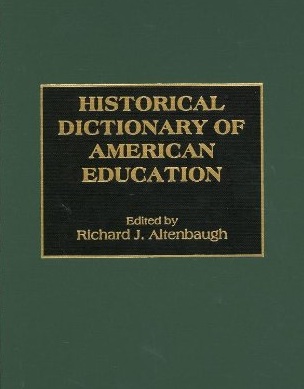
Historical Dictionary of American Education Cover, March 23, 2011. Donald Earl Collins

At Altenbaugh’s behest, I met him and a wildly bearded co-editor at an informal meeting in March ’98. We met at The Second Plate, an eating place on the second floor of Forbes Quadrangle at Pitt, where I’d spent my homeless days in ’88, my history major days, and my first two years of grad school. Over the course of a two-hour lunch that had little to do with the food, Altenbaugh and his assistant grilled me about the contents of my article, my writing in general, and about the publishing business. Now I knew that this essay would need more revisions, but a two-hour inquisition on why a twenty-eight-year-old was too young to make bold conclusions based on existing studies was just a ridiculous argument.

For Altenbaugh and the other editor, I was simply too young to write an essay that reviewed previous scholarly work. Their logic: “even a senior scholar with fifteen years in the field would have trouble pulling this off.” The editors also insisted that the only road to academic Nirvana regarding my work would be through publishing academic articles and books that met the approval of an exclusive scholarly community. Translation: “write something that is interesting to a few other professors — but not so exciting that it would catch the public’s attention — and by all means do not work on something as controversial as multiculturalism.” Oh yeah, they also recommended that get approval for my essay draft from two elderly, nearly-dead White historians before resubmitting to the journal.

Bottom line: my essay was rejected, given a “No!” Not because it didn’t have potential, or because the early drafts weren’t any good. But because I was working on a topic too cutting edge as a Black male who even now at forty-one would be too young — according to these guys — to work on a state of the profession essay on multiculturalism, much less thirteen years ago.

Did their “No!” matter? In one sense it really did. I knew that the topic itself was too controversial for most conservative-thinking (in a topical, not political, sense) editors in scholarly publishing. That there were few venues for me to address multiculturalism in an academic sense. I also knew that their “No!” was about much more than my topic. My age and my race also played a role in their decision to not publish my essay — they said as much by implication. Funny thing is, that in these weird times, I’d probably have a much better shot at publishing this essay now than I did when multiculturalism seemed more relevant.

But in the end, it didn’t matter at all. I was already in the middle of a five-year period of questioning whether I was an academic historian first and a writer second, or was it really the other way around? If the latter was true — and it’s turned out to be — then what did it matter that I pushed to publish on a topic that I cared about, but I was already beginning to lose passion for?

What I learned from that “No!” is that there are times to force a “Yes!” out of the land of “No!” And that there are other times when I should choose to take that “No!” and evaluate my own motives for wanting a “Yes!” In the case of my growth as a writer — both in academic writing and in other kinds of writing — there couldn’t have been a better, more bigoted “No!” than the one I received thirteen years ago.

Mark Twain New Editions: ‘Offensive’ Words To Be Removed

07 Friday Jan 2011

Posted by decollins1969 in 1, Boy @ The Window, culture, Eclectic, music, Politics, Pop Culture, race

≈ Leave a comment

Tags

History, Huckleberry Finn, HuffingtonPost, Mark Twain, N-Word, Nigger, Race, Racial Reconciliation, Racism, Truth & Reconciliation Commissions, Writing


Mark Twain New Editions: ‘Offensive’ Words To Be Removed

Dear HuffingtonPost:

I find your deletion of my comment on the N-word-to-“slave” change in Mark Twain’s Huckleberr­y Finn offensive, Huffington­Post. You can’t erase history by simply erasing a word. Your knee-jerk deletion actually proves the point of my previous comment. That we Americans are willfully dumb and unwilling to have a real, ugly yet conciliato­ry conversati­on about race, racism, and racist behavior and speech. I guess I should’ve written Randall Kennedy’s book [N-word]: The Strange Career of a Troublesom­e Word (2002) or Stevie Wonder’s “Living For The City” (1973), where the warden says “in your cell, [N-word]” or Carl Van Vechten’s [N-word] Heaven (1926) instead of the actual word. We’d spend the next 50 years editing the word out of existence, only having not dealt with the hurt, anger, discrimina­tion, and issues of inferiorit­y contained in the context in which the N-word was and is being used.

Let’s go a step further, and edit Shakespear­e’s Othello or Rudyard Kipling’s “White Man’s Burden” (1899) or any number of other works because they contain potentiall­y offensive attitudes about race. Your deletion explains well why South Africa could do a truth and reconcilia­tion commission on apartheid, and why it will take a cultural revolution for racial reconcilia­tion to happen here in the US.

Mistake No. 3 and Book #2

19 Friday Nov 2010

Posted by decollins1969 in 1, Academia, Boy @ The Window, culture, Eclectic, eclectic music, Marriage

≈ Leave a comment

Tags

"Mistake No. 3", Culture Club, Emotional Support, Harold Meltzer, Humanities, Literary Agents, Marriage, Mount Vernon High School, Mount Vernon New York, Publishing Business, Rosemary Martino, Waking Up With The House On Fire, Writing, Writing Mistakes, Writing Process


Culture Club, "Mistake No. 3" Single, November 19, 2010. Source: http://www.onlineauction.com

I’ve made many more than three mistakes in my walk as a writer. Mistake number three probably came around the same time Culture Club released “Mistake No. 3” off of their Waking Up with the House on Fire album in ’84. So many of them have come because I’ve either been impatient in making a decision or too tentative to make one at all.

Just with Boy @ The Window alone, I’ve probably made at least thirty-three mistakes. I should’ve started working on the book right after my conversation with my late teacher Harold Meltzer about my experiences, in February ’95. Even without Google, Facebook, MySpace, and so many other places to look, it would’ve been much easier to track down my ex-classmates and teachers. Instead, I single-mindedly pursued my doctorate and my doctoral thesis as if it were gold-pressed platinum. All the while asking myself if I was a historian first and a writer second, or a writer that just happened to be an academic historian?

When I finally did begin working on the manuscript, in the summer of ’02, I think that I was writing about four different books. It had an academic side to it, a look at magnet school programs and their inherent arrogance around diversity and race, not to mention intelligence, especially in the 80s. I was also writing narrative nonfiction, ala Eric Schlosser and Adrian Nicole LeBlanc, as well as fitting in bits and piece of memoir. And Meltzer, during my second and what would turn out to be final interview with him, suggested that I might want to turn the project into a novel. Why fiction? Because, in so many words, I wouldn’t piss anyone among the living with a Mount Vernon connection off.

Boy, I had no idea how right he was! Not about making Boy @ The Window a work of fiction. But about how many people I’d turn off or have attack me just during the research phase of the project. More people turned me down for interviews than granted them in the first years. If I sold it to them as a research project, I could hear their eyes glaze over while discussing it on the phone or in their keyboard strokes in an email. I pissed off many more as I started to write, as I did more interviews, as I started my blog in June ’07. I found out that I was defiling sacrosanct ground when writing about “Money Earnin’ Mount Vernon.”

I mistakenly began to shop the manuscript around in looking for an agent almost before I’d finished my first full draft of it. I had an agent for Fear of a “Black” America, but I’d found her in ’99, and the industry had changed so much in the eight years before I started looking for one again. I found myself having to have a well-thought out marketing strategy without having defined Boy @ The Window as a full-fledged

Neil Diamond, "Love On The Rocks" at concert, November 19, 2010. Source: https://www.rockbackingtracks.co.uk/images/neil_diamond.jpg

memoir at this point. It wasn’t a disaster, as I managed to get about thirty percent of the agents I contacted interested enough to look at my unpolished manuscript. Before their standard rejections would come back.

Licking my wounds and being more patient, to continue to revise and re-polish and repeat for most of ’09 and this year was hardly a bad thing. Realizing that my wife never liked the idea of me working on Boy @ The Window was harder, much, much harder than any agent’s multiple-xeroxed form rejection letter. I’d been in denial about it for about three years. It was when I sat down at the end of ’09 to do a long-overdue overhaul of the memoir that she finally made it obvious to me that I’d violated some unwritten rule in our marriage about delving too deeply in my past. It was about a year ago that I realized that — at least on the subject of Boy @ The Window — I’d lost my significant other of fifteen years, who simply wanted and wants me to move on.

There’s no doubt, though, that the biggest mistake I’ve ever made as a writer was to choose to not see myself as a writer for the better part of two decades. That’s probably the reason why it’s taken me years to work on Boy @ The Window, why I’m still a forty-one-year-old late bloomer in this calling of mine. That I’ve made as many mistakes as I have and still remain hopeful about publishing this memoir is, well, both crazy and just the thing I need to get through, I suppose. My former AP English teacher Rosemary Martino was right about one thing. Writing really does take sacrifice.

This Is Why I Write…I Think

09 Tuesday Nov 2010

Posted by decollins1969 in 1, Academia, Boy @ The Window, culture, Eclectic, Pop Culture, race

≈ Leave a comment

Tags

Black Male Narrative, Black Males, Boy @ The Window, Colleges & Universities, Education, Humanities Program, Intellectual Development, K-12 Education, Mount Vernon New York, Prison, Privileging Athletes and Entertainers, Publishing, Writing


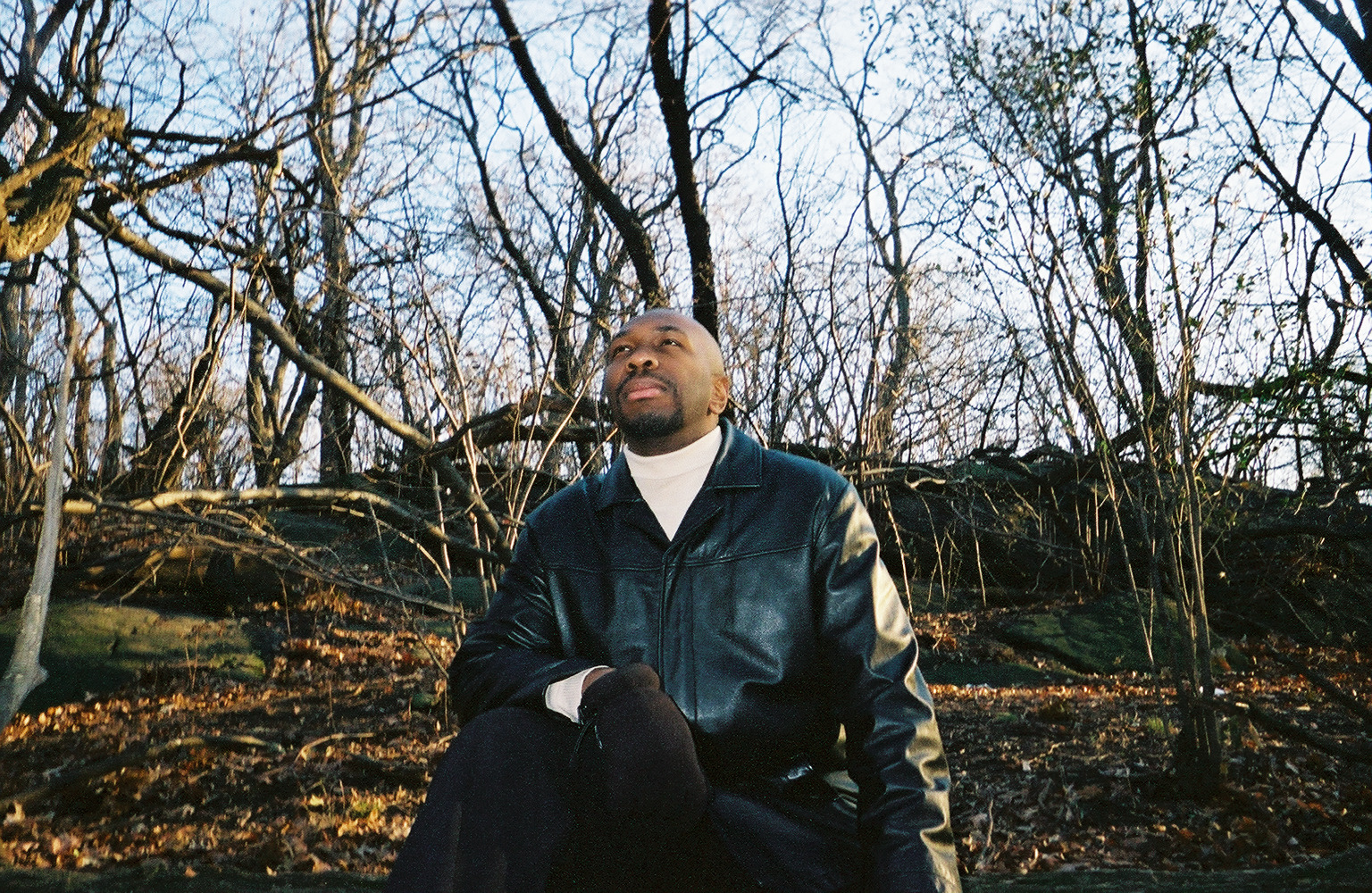
A Younger Me, Thinking, Central Park, New York, NY, December 23, 2002. Angelia N. Levy

In the course of the past half-decade of struggle over a now 360-page manuscript, even I’ve asked myself, why? What am I doing? Why in the world would I want to dredge up and relive twenty-three, twenty-five and thirty-year-old memories? Of all the books I think I have left in me, why a memoir about the years of my life I’ve tried hardest to forget, to not even discuss? Wouldn’t it be easier to write fiction, a novel that includes elements of that life without a detailed account of it? Why take the risk of offending my first hometown, my former classmates and teachers, my family? Why, dummy, why?


Well, it’s not because I get some perverse pleasure out of describing myself as a loser, or torturing myself with unfulfilled love, or because I’m trying to hurt other people’s feelings about Mount Vernon, New York or the Humanities Program. There are lots of reasons. Some of them start with my seven-year-old son. At the very least, I want him to understand his old man as he grows up better than I understood myself

Diary of a Wimpy Kid Book Cover Picture, November 9, 2010. Donald Earl Collins

growing up.


But it’s more than that, much more. I’m tired of sitting in interviews and in on staff meetings (when I worked full-time and had more consulting work) and hearing about the tiny number of highly educated Black males in the pipeline for high-level professional jobs. I’m tired of the narrative that says that Black males — and other males of color, for that matter — have to fuck up their lives in order to find the right path. It makes me groan — in my mind and out of my mouth — when I hear over and over again how few males of color even consider college, much less graduate or go on to advanced degrees.

But that’s not all. It’s disheartening to see these narratives play themselves out in African America, in America writ large, and in the publishing world. Like with my growing-up hometown. For the most part, entertainers and athletes — from the Williams and McCray brothers of the NBA past to Ben Gordon, from Denzel Washington to Al B. Sure — are the only ones with cred. Basketball, music, and occasionally, acting and dance are the ways other Blacks are inspired to have aspirations. Intellectual abilities, especially the ability to retain and then critique knowledge, are discounted. People like me growing up were nerds, or worse, just plain weird.

I write what I write because I know that in communities and in neighborhoods like the one I grew up in, the constant ridicule and the stifling of creative thinking and intellectual development can easily lead to stunted lives. I was lucky in a lot of ways, because I was deliberately naive, because of Humanities, because some of my classmates were almost as weird as me, because we had some wonderful teachers. But that doesn’t represent the Mount Vernon educational experience, not by a long shot.

I’m tired of students of color — especially males of color — falling through the cracks of horrible K-12 education because of bad policies, racial and economic politics, and principals as prison wardens. Not only in Mount Vernon. Pittsburgh. DC. PG County, Maryland. Baltimore, Sacramento, Oakland, New York City, Cleveland, Jackson, Mississippi, Jacksonville, Florida, Atlanta, San Francisco, Philadelphia and so many other schools and school districts I’ve visited for work or research purposes over the years.

The narrative that a Black male can only find their way out of poverty through committing criminal errors that lead to prison time and enlightenment goes all the way back to Richard Wright’s Native Son and Black Boy. The one about Black males finding a niche in the world of entertainment — as athletes, musicians, rap artists, actors and comedians — has its roots in original Black heavyweight champion Jack Johnson. The narrative that involves Black males who used education and their intellectual talents to overcome their circumstances and these stereotypical narratives is seldom heard from in the publishing world.


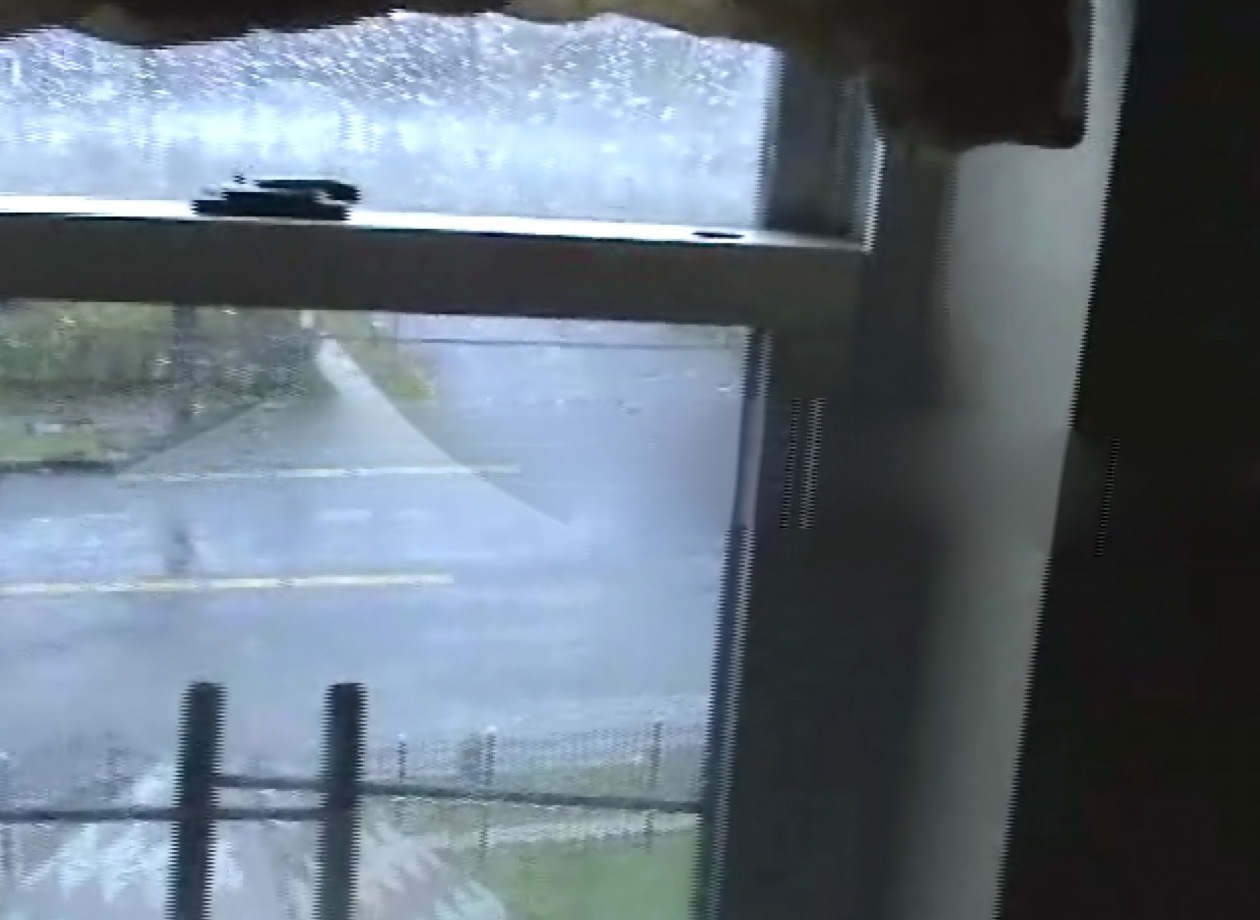
616 Living Room Window Screen Shot, November 23, 2006. Donald Earl Collins

That’s likely because some folks think that this story’s been overdone. Even though anyone can count those memoirs and novels on their fingers and thumbs. Maybe it’s not entertaining enough to describe a life full of violence and psychological torture, but with no crimes committed by the main character, no veins injected with heroin, no women knocked up with kids. I write my manuscript because I lived long enough to have learned that there are tens of thousands of Black boys and other boys of color — not to mention their teachers, parents, principals — who languish in the struggle to succeed because they’re not scoring touchdowns, spittin’ rhymes or dunking on rims. Or trying to live the thug life, for that matter. These are the kids that need to be saved, as much as the kids who are already on the brink of prison life.


For all these reasons, I write Boy @ The Window. For all of these reasons, I post on this blog as much as I do. To say what I’ve thought, but often haven’t said. And to do it without sounding as serious as an academician. Nor as entertaining as a stoned Baby Boomer trying to make the 70s sound cool. It’s a balance, and I’ve made many mistakes along the way. And will likely make more. But in all of this, I’ve found so much more of my humanity than I thought possible. I just hope that it’s really worth it.

Spencer for Higher

23 Saturday Oct 2010

Posted by decollins1969 in 1, Academia, Boy @ The Window, Eclectic

≈ Leave a comment

Tags

Carnegie Mellon University, Dissertation Fellowship, Doctoral Thesis, Finding Purpose, Grant Making, Grant-seeking, Spencer Foundation, Teaching, Writing


Spenser For Hire Title Screen, February 26, 2008. Source: http://www.aolcdn.com/new_promos/dl_spenser_733x270.jpg

Higher education, that is. Sixteen years ago this weekend, I put my application in the mail for a Spencer Foundation Dissertation Fellowship. It was a $15,000, one-year award that would give me time off from teaching or doing grunt work for my advisor and other professors. I’d have a year to do nothing but do work on my doctoral thesis, to travel, do additional research and lock myself in my apartment for week on end to write what would become a 505-page document.


But don’t let me over-glamorize the moment. After all, I’d applied for fellowships and been in search for grants in the years before and after this application. The University of Pittsburgh had made me part of the first class of recipients for their Challenge Scholarship in ’87. I’d been awarded a graduate student assistantship and teaching assistantships throughout grad school. The Ford Foundation Predoctoral Fellowship — I applied for it twice, in ’91 and ’93. Soon after my Spencer application, I also applied for the Ford Foundation Dissertation Fellowship and the NEH (National Endowment for the Humanities) Dissertation Fellowship (which they disbanded the following year).

I’d later apply for a few postdoctoral fellowships in ’96 and ’97. Then, once I became part of the nonprofit sector, grant-seeking became a part of my jobs. Including letters of inquiry, concept papers, about three dozen grant proposals that I worked on in part or in whole. Not to mention meetings with foundation program officers, numerous networking opportunities at the Independent Sector and other conferences. Between them all, I directly or indirectly helped raise about $1.4 million over the past ten years, and played a role in programs that possessed about $11 million in funding overall.


Spencer Foundation Logo, October 23, 2010

But the most satisfied I ever was in putting together a proposal, or in receiving an award, or in participating in a grant-related experienced, was when I applied for the Spencer Foundation Dissertation Fellowship. You see, I’d spent nearly eighteen months preparing myself to apply. I started doing my dissertation topic research a full year before the October ’94 application deadline, months before my advisor and committee were to officially approve my topic and research.


I’d started going through microfilm of Black Washington newspapers from the 1920s, 1930s, and 1940s, looking up Census data, thinking of places to look up old records of DC Public Schools  from the segregation era, and contemplating interviewing former teachers and students who’d worked at or attending DCPS between 1920 and 1970. It was exhausting doing that and taking a full load of classes, struggling with finances so badly that I had no money for new sneakers, that I’d walk in three-year-old sneakers with holes in them to and from campus in ankle-deep snow to push this project forward. Of course, I lined the sneakers with plastic bags from Giant Eagle to keep my socks and feet dry and warm.

Yes, I was committed to the task all right, and probably should’ve been committed in the process. But it was also worth it. I felt — rather, I practically knew — that it would all work out with the Spencer Fellowship somehow. And it did, not just because of the award, and not just because of my friend and mentor, Catherine Lacey (see April 2009 post). It worked, because it helped me find my calling as a writer and teacher. It worked because it helped bring to the fore my ambivalence about academic writing and scholarship as the raison d’etre of an academically-trained historian.

The application, fellowship and that year free from Carnegie Mellon’s clutches helped put me on the right path. Even if I didn’t know it at the time.

The Writing Bug

19 Thursday Aug 2010

Posted by decollins1969 in 1, Boy @ The Window, Eclectic, eclectic music, music, Youth

≈ Leave a comment

Tags

616 East Lincoln Avenue, Abuse, Domestic Violence, Humanities, Mount Vernon New York, Writing


Writing Bug. Source: http://imaginationsoup.net/wp-content/uploads/2009/06/

It’s been twenty-nine years since I first saw myself as a writer and attempted to pursue writing in any form. It was the summer of ’81, the summer before Humanities and seventh grade, the year before the summer of my abuse. For me at least, this was a calm summer, like I was sitting out by a lake with only a slight breeze blowing around me. I was enjoying the peace and quiet of being near still water, of an occasional rustle of trees, of a plop or two of something dropped into the lake. This was a time for me to imagine our lives as better, better than they actually were. I was on an end-of-elementary school and Humanities-acceptance high. I couldn’t have been any higher than if I had snorted coke at one of those drug-fueled parties my mother used to drag us to hang out with her Mount Vernon Hospital buddies when I was five or six (Luckily, my mother didn’t do drugs.)

I spent most of that summer writing my first book. It was a book about the top-secret military hardware the Department of Defense didn’t want the rest of America to know about. I remained consumed with reading about war and military technology in my spare time — I wouldn’t have learned the word “fortnight” otherwise! Everything from the B-1 bomber to the M-1 Abrams tank to the Trident submarine and MX missile was to be in this scoop on the latest in military high-tech. I even wrote a letter to the Pentagon for declassified pictures of these weapons, which I received in mid-July. By the time of my brother Yiscoc’s birth (one form of Hebrew for “Isaac” and pronounced “yizz-co”) later in the month, I’d written nearly fifty pages on these weapons and why they were so cool for the US military to have. Especially in light of the Soviet military threat. Unfortunately, they didn’t declassify the fact that America’s latest tank used depleted uranium in parts of its hull or in its cannon shells. That would’ve been a real scoop at the time.

I also began to keep my own journal as I began to lose interest in America’s military hardware at the end of that summer. Little did I know what was to come at 616 and in seventh grade in Humanities. My journal was an off and on again project of dreadful tales of hunger, humiliation and heartache. By the time of Crush #1 and witnessing my stepfather’s attack of my mother on Memorial Day ’82, I could barely write at all. The last thing I wrote for my journal (which was a spiral notebook) was about my own abuse throughout July ’82. By the time that ended, I didn’t feel like writing anymore.

But that wasn’t the end of the story. My imagination, my constant talking to myself, my eventual fascination with having an eclectic variety of music and rooting for underdog teams and athletes were all part of a writing process that actually didn’t require me to write. All of these coping mechanisms and more gave me more to write about once I went off to college, and especially after my ex-stepfather broke up with my mother after my sophomore. It wasn’t an accident that within a few months of dumb ass moving out in June ’89, I had started my first journal in seven years. I guess that I always had the writing bug, even when I didn’t possess the paper necessary to write.

Writer’s Start

13 Friday Aug 2010

Posted by decollins1969 in 1, Academia, Boy @ The Window, Eclectic

≈ Leave a comment

Tags

Afrocentricity, Writing


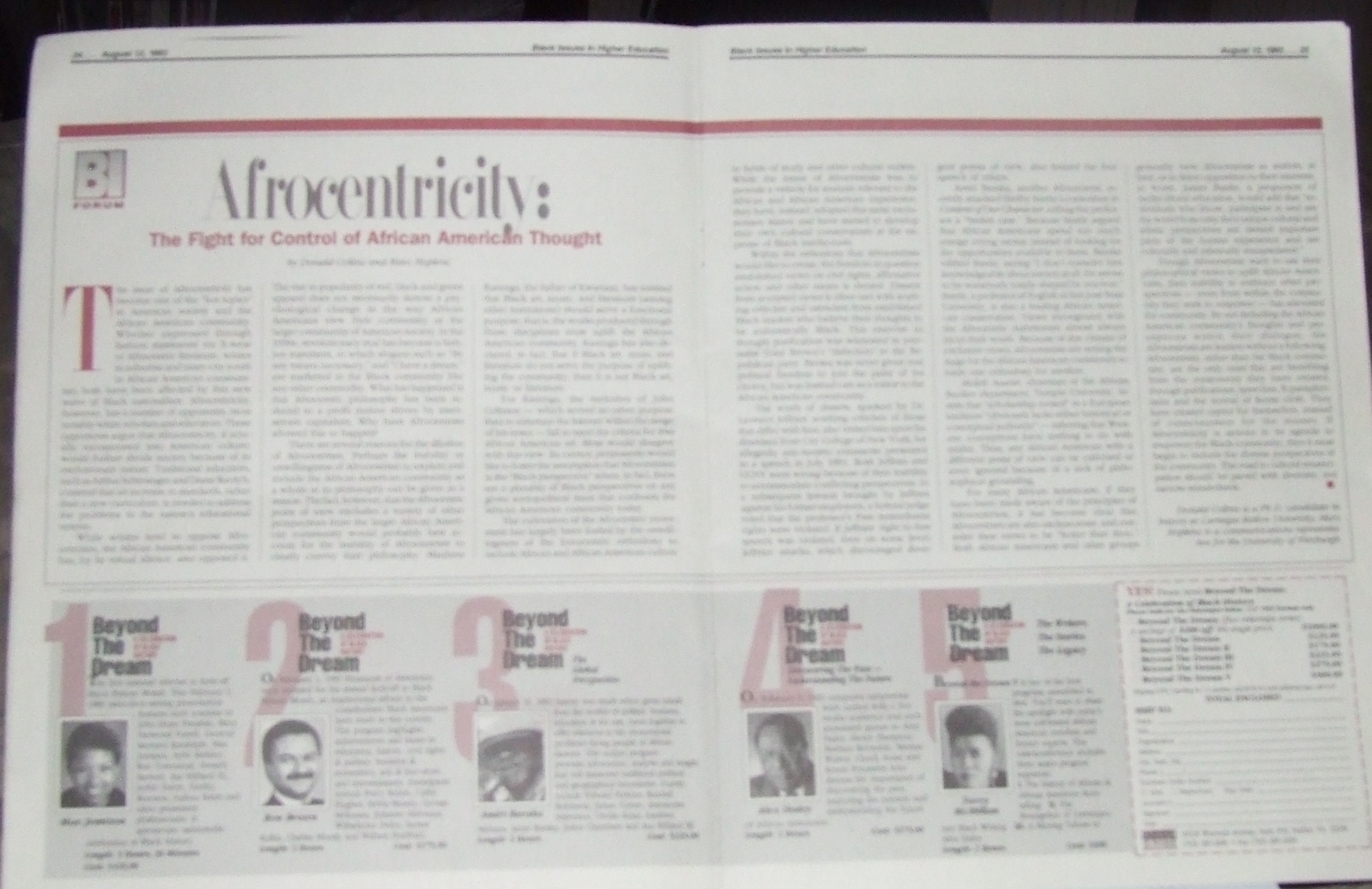
"Afrocentricity" Piece, August 12, 1993

Seventeen years ago today, I found out that an article that I had worked on with my dear friend Marc had been published by Black Issues in Higher Education. It wasn’t the typical process in which an editor or an editorial assistant contacts you to let you know that your piece has made the cut. No, I found out from Marc, who found out from a librarian at Hillman Library at Pitt, that our 1,200-word “Afrocentricity: The Fight for Control of African American Thought” was already published by Black Issues as their central Forum article for their August 12, ’93 issue. We did so many things incorrectly in getting that article published. But in the end, it meant renewing a struggle for a sense of my own purpose in life. At twenty-three years old, I was half my lifetime removed from seeing myself as a writer, and had spent most of the previous eleven years denying that any such yearnings remained in my mind and heart.

It was an article borne out of Marc’s desire to have an impact on a ridiculous debate over what is and isn’t authentically “Black” or “African” and my need for a few extra dollars. Unfortunately, authentic Blackness – along with my need for increased income – remains after so many years. We worked for two weekends in May on this short critique of Black Studies greats such as Maulana Karenga, Molefi Asante and the latter’s cult of Afrocentric followers, including those who would claim that such things as jazz aren’t authentically Black. After we finished the draft, I left it to Marc to compile the contact information for editors and periodicals. I was too busy looking for work and making sure that I wasn’t evicted from my firetrap of an apartment in East Liberty to put much more work beyond the piece into getting it published.

Other than Marc occasionally calling me to let me know that he’d been in contact with Harper’s or had mailed the article to Emerge, I didn’t give the piece much thought until that day in August seventeen years ago. Since our piece was already published, it meant that we’d have to fight to get paid. Based on the number of words, they owed us about $100 a piece. We’d never even received an acknowledgment letter, much less an acceptance or rejection follow-up. In all, Marc contacted some seventeen different magazines about “Afrocentricity,” probably too many to keep up with and police, especially in the case of Black Issues.

We learned later that one of the editors hoped to use our article as a straw man for Molefi Asante and his students/followers to burn in effigy, with one letter after another describing us as “Uncle Toms,” “inauthentic,” and “misguided Negroes.” We were virtually everything except children of God. This went on for two months’ worth of Black Issues issues. I wanted to write a rebuttal letter, one that would at least stick it to our melanin-worshipping, authentically-seasoned-fried-chicken-eating, Afrocentric brothas and sistas. My description, not Marc’s. But Marc refused to partake in a follow-up. “We were just trying to help,” he said more than once, as if we were the 300 Spartans at Thermopylae, about to be killed off by an ignorant swarm.

I learned quite a bit from those days of naiveté. One, that as a writer, that it was just as important for me to be involved in the selling of our article as it was for me to do the actual writing. Two, that mass mailings of articles for publication only work if you don’t care about making money or about how you as a writer are treated. Three, that I as a writer must stand by my work, especially when I know I’m in the right. And four, that even in the midst of my climb into all things PhD, that I was and would always remain a writer. This experience would serve to help me figure out how much of a writer I could and should be as my time pursuing an academic career came and passed.

← Older posts
Newer posts →

Boy @ The Window: A Memoir

Boy @ The Window: A Memoir

Places to Buy/Download Boy @ The Window

There's a few ways in which you can read excerpts of, borrow and/or purchase and download Boy @ The Window. There's the trade paperback edition of Boy @ The Window, available for purchase via Amazon.com at http://www.amazon.com/Boy-Window-Donald-Earl-Collins/dp/0989256138/

There's also a Kindle edition on Amazon.com. The enhanced edition can be read only with Kindle Fire, an iPad or a full-color tablet. The links to the enhanced edition through Apple's iBookstore and the Barnes & Noble NOOK edition are below. The link to the Amazon Kindle version is also immediately below:

scr2555-proj697-a-kindle-logo-rgb-lg

Boy @ The Window on Amazon.com: http://www.amazon.com/Boy-The-Window-Memoir-ebook/dp/B00CD95FBU/

iBookstore-logo-300x100

Boy @ The Window on Apple's iBookstore: https://itunes.apple.com/us/book/boy-the-window/id643768275?ls=1

Barnes & Noble (bn.com) logo, June 26, 2013. (http://www.logotypes101.com).

Boy @ The Window on Barnes & Noble: http://www.barnesandnoble.com/w/boy-the-window-donald-earl-collins/1115182183?ean=2940016741567

You can also add, read and review Boy @ The Window on Goodreads.com. Just click on the button below:

Boy @ The Window

Twitter Updates

Tweets by decollins1969
  • RSS - Posts
  • RSS - Comments

Archives

  • June 2025
  • April 2023
  • September 2022
  • August 2022
  • July 2022
  • June 2022
  • May 2022
  • April 2022
  • March 2022
  • January 2022
  • December 2021
  • November 2021
  • October 2021
  • September 2021
  • August 2021
  • July 2021
  • June 2021
  • April 2021
  • March 2021
  • February 2021
  • January 2021
  • December 2020
  • November 2020
  • October 2020
  • September 2020
  • August 2020
  • July 2020
  • May 2020
  • April 2020
  • March 2020
  • January 2020
  • December 2019
  • November 2019
  • August 2019
  • July 2019
  • June 2019
  • May 2019
  • April 2019
  • March 2019
  • February 2019
  • January 2019
  • December 2018
  • November 2018
  • October 2018
  • September 2018
  • August 2018
  • July 2018
  • June 2018
  • May 2018
  • March 2018
  • February 2018
  • January 2018
  • December 2017
  • November 2017
  • October 2017
  • September 2017
  • August 2017
  • July 2017
  • June 2017
  • May 2017
  • April 2017
  • March 2017
  • February 2017
  • January 2017
  • December 2016
  • November 2016
  • October 2016
  • September 2016
  • August 2016
  • July 2016
  • June 2016
  • May 2016
  • April 2016
  • March 2016
  • February 2016
  • January 2016
  • December 2015
  • November 2015
  • October 2015
  • September 2015
  • August 2015
  • July 2015
  • June 2015
  • May 2015
  • April 2015
  • March 2015
  • February 2015
  • January 2015
  • December 2014
  • November 2014
  • October 2014
  • September 2014
  • August 2014
  • July 2014
  • June 2014
  • May 2014
  • April 2014
  • March 2014
  • February 2014
  • January 2014
  • December 2013
  • November 2013
  • October 2013
  • September 2013
  • August 2013
  • July 2013
  • June 2013
  • May 2013
  • April 2013
  • March 2013
  • February 2013
  • January 2013
  • December 2012
  • November 2012
  • October 2012
  • September 2012
  • August 2012
  • July 2012
  • June 2012
  • May 2012
  • April 2012
  • March 2012
  • February 2012
  • January 2012
  • December 2011
  • November 2011
  • October 2011
  • September 2011
  • August 2011
  • July 2011
  • June 2011
  • May 2011
  • April 2011
  • March 2011
  • February 2011
  • January 2011
  • December 2010
  • November 2010
  • October 2010
  • September 2010
  • August 2010
  • July 2010
  • June 2010
  • May 2010
  • April 2010
  • March 2010
  • February 2010
  • January 2010
  • December 2009
  • November 2009
  • October 2009
  • September 2009
  • August 2009
  • July 2009
  • June 2009
  • May 2009
  • April 2009
  • March 2009
  • February 2009
  • January 2009
  • December 2008
  • November 2008
  • October 2008
  • September 2008
  • August 2008
  • July 2008
  • June 2008
  • May 2008
  • April 2008
  • March 2008
  • February 2008
  • January 2008
  • December 2007
  • November 2007
  • October 2007
  • September 2007
  • August 2007
  • July 2007
  • June 2007

Recent Comments

MaryPena's avatarMaryPena on My Day of Atonement/Bitter Hat…
decollins1969's avatardecollins1969 on No Good Teaching Deed Goes…
Mary Rose O’Connell's avatarMary Rose O’Connell on No Good Teaching Deed Goes…

NetworkedBlogs on Facebook

NetworkedBlogs
Blog:
Notes From a Boy @ The Window
Topics:
My Life, Culture & Education, Politics & Goofyness
 
Follow my blog

616 616 East Lincoln Avenue A.B. Davis Middle School Abuse Academia Academy for Educational Development AED Afrocentricity American Narcissism Authenticity Bigotry Blackness Boy @ The Window Carnegie Mellon University Child Abuse Class of 1987 CMU Coping Strategies Crush #1 Crush #2 Death Disillusionment Diversity Domestic Violence Economic Inequality Education Family Friendship Friendships Graduate School Hebrew-Israelites High-Stakes Testing Higher Education History Homelessness Humanities Humanities Program Hypocrisy Internalized Racism Jealousy Joe Trotter Joe William Trotter Jr. K-12 Education Love Manhood Maurice Eugene Washington Maurice Washington Misogyny Mother-Son Relationship Mount Vernon High School Mount Vernon New York Mount Vernon public schools Multiculturalism MVHS Narcissism NFL Pitt Pittsburgh Politics of Education Poverty President Barack Obama Race Racial Stereotypes Racism Relationships Self-Awareness Self-Discovery Self-Reflection Sexism Social Justice Teaching and Learning University of Pittsburgh Violence Whiteness Writing

Top Rated

Blog at WordPress.com.

  • Subscribe Subscribed
    • Notes from a Boy @ The Window
    • Join 103 other subscribers
    • Already have a WordPress.com account? Log in now.
    • Notes from a Boy @ The Window
    • Subscribe Subscribed
    • Sign up
    • Log in
    • Report this content
    • View site in Reader
    • Manage subscriptions
    • Collapse this bar
 

Loading Comments...