• About Me
  • Other Writings
  • Interview Clips
  • All About Me: American Racism, American Narcissism, and the Conversation America Can’t Have
  • Video Clips
  • Boy @ The Window Pictures
  • Boy @ The Window Theme Music

Notes from a Boy @ The Window

~

Notes from a Boy @ The Window

Tag Archives: Teaching

Rate My Students Dot Dot Dot

09 Wednesday Nov 2011

Posted by decollins1969 in 1, Academia, culture, Eclectic, Politics, race

≈ 1 Comment

Tags

Academia, Communications, Email Exchange, Racism, Rating Systems, Student Evaluations, Students, Teaching, Teaching and Learning, US History


Thumbs Up, Thumbs Down, April 14, 2010. (http://http://teachingjobsportal.com).

Because there’s a website called RateMyProfessors.com, there also ought to be one called Rate My Students.com. Unfortunately, the only thing we have as faculty that indicates student performance is their grade in a course. But student demeanor, attitudes toward learning and their professors, about their level of commitment to being good students? For that, the only thing we have to go on are our communication exchanges with students and their responses, particularly on an evaluation. Below is one such exchange:

—–Original Message—–
From: Anonymous Student
Sent: Sat 9/10/2011 12:45 AM
Subject: Paper feedback question

I mentioned in my paper that the US feared soviet control of the Middle East and you said that it was never a concern. However, on page 61 of “Present Tense” It mentions the soviets backing a separatist movement in Iran and pressed Turkey to give the Soviet’s joint control over the Dardanelles which make some in the US government nervous that “the soviets would make a sweep across Turkey and Iran, which would give it control over much of the Middle East and its oil reserves.” The book then mentions that Truman sent a Naval task force into the Mediterranean as a warning to the Soviets.

My question is, how was the Soviet presence in the Middle East hardly a concern if it made Truman nervous enough to take military action. Granted it wasn’t a concern for long, and I could have gone more in depth, but I’m still getting conflicting information. Thanks

On Sat, Sep 10, 2011 at 6:28 AM, Donald Collins wrote

Thanks for your email. You didn’t get credit for this point because it was a blanket and general statement, without any detail or nuance. You made it sound as if the Middle East was on the same level of concern as Europe, East Asia and the US itself. Plus, Turkey was and is not considered an oil state, and US concern over Greece and Turkey was much more a European concern than a Middle Eastern one — it helped lead to the first installment of what became the Marshall Plan. Only with Iran do you have a small point, but Iran wasn’t mentioned in your paper. And, more to that point, if the Middle East was such a concern, why didn’t Truman send a naval task force into the Persian Gulf in the late 1940s?

Yes there was fear and concern, but the actual decisions and actions that came out of it were so limited that one cannot simply say that the US feared control of the Middle East because of their tremendous oil reserves — in 1947…

But the real issue here is that you lost sight of the forest on this topic question, concentrating instead on this tree regarding the Middle East. You did not do enough to outline and analyze the factors involved in promoting and escalating the Cold War. You talked about events as examples of the Cold War, with some (like the Middle East) lacking in factual detail or explanation as to what, if any, factor or factors they fit in. Like the Soviet’s desire for a buffer zone in Eastern Europe and with eastern Germany. Or the US policy of aggressive containment of communism, as your example of the Middle East could’ve indicated, if it had been more specific — the Korean War or the Berlin Airlift are much better examples of this factor. Or the nuclear weapons and related systems races, including for long-range bombers, missiles, submarines from 1949 onward — bringing both countries ever closer to a possible hot and nuclear war.

The textbooks are just that, textbooks. They are not the Bible, and they are not even ones that I would choose to use if I could order my own textbooks. They are a guide, but, then again, so are my lecture notes, which would have helped clear up much of your confusion on this issue. I hope that this helps.

Professor Collins

From: Anonymous Student
Sent: Sat 9/10/2011 4:09 PM
Subject: Re: Paper feedback question

I figured the main problem was not going in depth enough, but I was worried about lingering for too long on certain subjects.

Anonymous Student’s response via evaluation (received October 27, 2011):

Donald Collins is very well versed in the events of the civil rights movement and not much else. Several times during the course he marked down assignments that I had completed based on what he incorrectly perceived to be factual errors. The one time I brought this up to him via email he wrote it off as “not important enough in the grand scheme of things” ignoring the fact that he stated that an event had never occurred despite being talked about in more than one of the assigned texts for the class….I still received a low grade on that assignment as well as others because of Collins’ seeming insistence that everything be tied into the civil rights movement regardless of how unrelated what I was writing about may have been to it…

—

This isn’t the first time I’ve received a racist response from a student for doing my job, and I’m certain it won’t be the last. But if I could, I’d recommend that this person learn how to be a good student first before pushing his deficiencies and bigotry onto me and other faculty.

Know Food, Know The World

04 Saturday Jun 2011

Posted by decollins1969 in 1, Academia, culture, Eclectic, Mount Vernon High School, race, Religion

≈ Leave a comment

Tags

Carnegie Mellon University, Commodities, Conflict, Cooperation, Exploitation, Food, Ingredients, Jared Diamond, Peter Stearns, Recipes, Resources, Teaching, Teaching and Learning, University of Maryland University College, World History


Chocolate Cake, Vanilla Icing, 2011. Source: http://www.tastebook.com

I don’t really dedicate much of my blogging to what I do these days, my college teaching work. I guess that I kick up enough dust talking about my Mount Vernon years, my Humanities years, my Carnegie Mellon years, and my former jobs and bosses as it is.

But this is a fairly positive post (mostly, anyway). It about something that I learned recently while teaching one of my World History courses. Something so simple that it’s amazing sometimes how stupid I can be.

I realized one day in discussing the age of exploitation, um, well, exploration that one of the best ways to think about this period — heck, any period in world history, really — begins and ends with one word: food. I’d taught this course a couple of times for University of Maryland University College already. Not to mention having served as a teaching assistant under the great Peter Stearns while a grad student at Carnegie Mellon a decade and a half before (see my “Ego Inflation” post from last month).

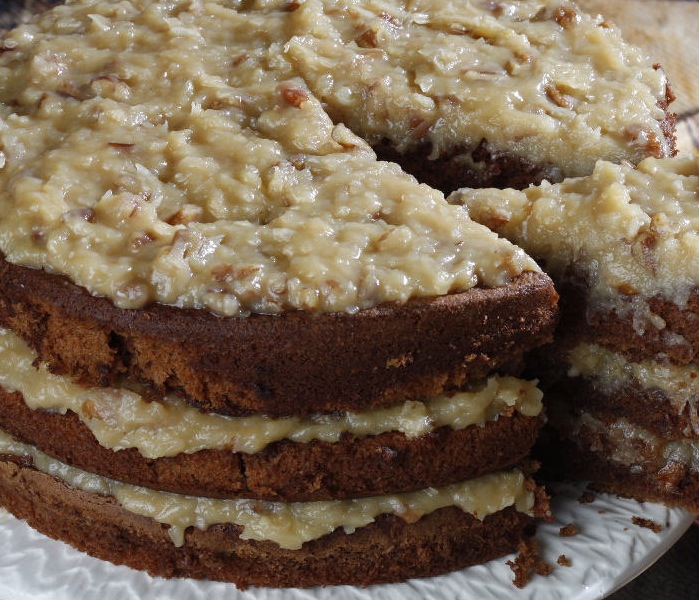
German Chocolate Cake, 2011. Source:http://blogs.courier-journal.com. Meet a cake that was never German, but named by an English guy. And, since when do coconuts grow in Europe or the US?

But on that fall evening in ’09, looking at exploration patterns, commerce patterns and the state of the world circa 1600 CE, it hit me how I could just about reorganize every aspect of the way I’d been teaching World History by just looking at how much food has influenced it. Every bite we take, everything we imbibe, has some history attached to it, and with it, stories of bloody conflict, imperial conquest or rare attempts at true humanity and cooperation.

This is about much more than Jared Diamond’s books on the rise and fall of civilizations because of resources and the lack thereof. Commodities like salt, sugar, black pepper and olive oil have all been written about over the past fifteen years. It’s fairly obvious that these spices and other foodstuffs were fundamental in the histories of the Middle East, ancient Greece and Rome, India, Timbuktu and Western Europe over the past 5,000 years.

Still, I’m not really talking about that kind of history, either. It’s more about something as simple as taking a modern dish and using its ingredients to tell a story. Take something like a chocolate cake with vanilla icing. If the ingredients are natural and not ones cooked up at a chemical plant in northern New Jersey, then they’ve come from all over the world. Cocoa, the main ingredient to mix with the flour, is from the cacao plant, which originally from South America, but is primarily produced in sub-Saharan Africa. Sugar’s needed to sweeten it, and though originally from India, has been grown in Florida, Louisiana and in the Caribbean for centuries. One of the main economic drivers for the enslavement of Africans was the European need to rot out their teeth with the stuff.

Vanilla extract or vanilla beans are originally from Mexico and other parts of Central America. But the largest producers of it are Indonesia and especially Madagascar. There’s history in every gram of devil’s food cake with vanilla icing that we eat.

You could do the same thing with a “traditional” Chinese stir-fry. Especially if ingredients like baby corn or

Sweet-and-sour-chicken, 2011. Source: http://www.foodnetwork.com

sweet and sour sauce are added to the mix. That’s because baby corn and tomatoes (the latter the main ingredient in sweet and sour sauce) are both from the Americas, not Asia or Europe. Both arrived in Ming China nearly 500 years ago.

Every dish, whether invented in 2011 CE or 2011 BCE, has a rich story attached to it. From that story, we can all find important patterns in world history, cultural development, domination and destruction within. It may not be the most profound thing I’ve ever stumbled upon. Still, I didn’t get this from Peter Stearns or Jared Diamond. If anything, I might’ve gotten this from Forrest Gump.

Teachers That “Demon”-ize History

29 Tuesday Mar 2011

Posted by decollins1969 in 1, Academia, Boy @ The Window, Christianity, Eclectic, Politics, Pop Culture, race, Religion

≈ Leave a comment

Tags

A.B. Davis Middle School, Demontravel, History, History Teaching, Humanities, K-12 Education, K-16 Education, Pedagogy, Schools of Education, Teaching, Teaching and Learning


Qin Shihuangdi, China's 1st Emperor, book burner and scholar burier (except for historians of the Qin kingdom), 221-210 BCE. In public domain.

As I promised ten days ago in my “This…Is…Jeopardy?” post, this one continues my thoughts about the inability of most students and teachers to appreciate how to really teach and learn from history. To think that what most in the profession call social history has existed for a half-century, yet few outside of academia actually teach history in this manner. That between the schools of education that prepare them, the curricular paradigms adhered to by state boards of education and the rules and regulations at the district and school building level, few history teachers encourage their students to imagine. Or to think critically. Or  to ask “how” and “why” questions.

And we pay for these educational atrocities every single day, in our public discourse, in journalism, in international politics. Not to mention in our idiotic discussions of race, class, gender, religion, sexual orientation, in just about every endeavor that involves thinking beyond our selfish selves.

Michelle Bachmann Portrait, US Congress, January 14, 2011 - A case in point. In public domain.

The worst example of this for my money was my eighth grade US history teacher, Mr. Demontravel. Or as he preferred in the last three months of eighth grade in the spring of ’83, Dr. Demontravel (he had finished his doctoral thesis on the Civil War. Or as I liked to call him throughout that year, “Demon Travel.”

Beyond the trivia of him finishing his doctorate, Demontravel’s teaching style, while terrible, was also one that remains all too typical in our public school (and unfortunately, some of our colleges as well). His was a class that sucked the life out of history for most of the Humanities students at A.B. Davis. Like most teachers of K-12 social studies or history, it was an important and obscure dates, important names, and key places class.

Unlike most social studies teachers, his teaching methodology was the epitome of lazy. Every class, five days a week, Demontravel would put up five questions on the blackboard for us to copy down and answer using our textbook. At the end of every two-week period, we’d get a fifty-question multiple choice exam made up of those questions written out on the blackboard over the previous two weeks, helping Scan-Tron stay in business.

Demontravel rarely stood up to lecture or do anything else. Lectures for him might as well have been appearances by Halley’s Comet, only the lectures were far less memorable. This process went on unabated for forty-weeks, four marking periods, seventeen exams (counting the final), an entire school year. Calling this boring would only get you into the door of the intellectual famine Demontravel subjected us to in eighth grade.

Over the years, I’ve had hundreds of students complain about various versions of this kind of history teaching. That they hated history, didn’t understand its purpose. Many students have loved my teaching of social history off and on over the past two decades, and have told me so, that there interest in a particular issue or topic was peaked as a result of one of my courses. But there are some, perhaps as many as ten percent of my students (about 200 in all) who would’ve preferred the mind-numbing methodology of teaching history as trivia. For that group, Demontravel would’ve been a preference over being able to

Newt Gingrich, potential 2012 GOP candidate, at CPAC meeting, February 20, 2010. (Irony is that Gingrich, an opponent of social history, was a history professor for eight years before turning to a political career.) Gage Skidmore. Permission granted via Creative Commons and attribution to Gage Skidmore.

understand that, like life, history is full of irony, hurt, passion, hatred, and serendipity.

Maybe this is a losing battle, that most students will never have a teacher with the ability to inspire them to think beyond the trivial when it comes to history. Maybe this is a losing battle because there are far more demons traveling through K-12 as social studies and history teachers than there are people like me, or my late teacher Harold Meltzer, for that matter. I have a feeling, though, that generations from now, future students will look at this aspect of hypocrisy in American education and just shake their heads. They won’t understand why it was so hard to teach the truth of how and why good, bad and ugly things occurred in US and world history.

This…Is…Jeopardy?

18 Friday Mar 2011

Posted by decollins1969 in 1, Academia, Boy @ The Window, culture, Politics, Pop Culture, Youth

≈ Leave a comment

Tags

Alex Trebek, Grading, History Trivial, Humanities, Humanities Program, Instructor, Jeopardy, Mount Vernon High School, Mount Vernon public schools, Pitt, Professor, Students, Teaching, Teaching and Learning, Teaching Assistant, Teaching History, University of Pittsburgh


This Is Jeopardy?

This Is Jeopardy?

The first class I ever taught was as a guest lecturer my first semester of grad school at Pitt. Larry Glasco, my advisor, had me take charge of his History of Black Pittsburgh course one November Thursday in ’91. It was a task made easier by the showing of the documentary Wylie Avenue Days during the two-hour and twenty-minute class. With about a quarter of the class composed of adult learners, including several who’d grown up in the Hill District during the time frame covered in the documentary, it became a real conversation about experiences with racism and inter- and intra-racial relations in Pittsburgh in the first two-thirds of the twentieth century. It was a great introduction to teaching.

In the two decades since, I’ve often wish that all of my classes had the kind of intellectual balance that my first class possessed and I as instructor helped provide. Sadly, many times in my journey as a teacher, instructor and professor, I’ve had students who showed as much interest in discussing the hows and whys of history as Glenn Beck of FOX News Channel has in science and the truth.

These students, about one out of every six I’ve taught over the past two decades (about 300 in all) have taken up an amount of my teaching time. They’ve groused about the assignments I’ve given them to do, the exam questions I’ve created to assess their knowledge. They’ve gnashed their teeth about my grading, about how tough I supposedly can be in assigning grades. With papers, short-answer exams, multiple choice tests, even fill-in-the-blank quizzes. There’s been no pleasing this group of students.

Until now. It occurred to me about a year ago. I was watching yet another episode of Jeopardy, and it swung to a history category, one that I would’ve swept if I’d been on the show that day or anytime since the show came back on the air in ’85. That then reminded me of something one of my Humanities classmates from Mount Vernon High School said to me soon after finding out that I was ranked fourteenth in the Class of ’87. “All you can do with history is play Jeopardy,” he said with derision.

That memory then reminded me of how teachers like our seventh through tenth grade social studies teachers taught us. Whether Court, Demontravel (who I’ll talk about later this year), Flanagan or Zini, the idea was to be able to spit out as many date-connected facts, names and battles as quickly and accurately as possible. With no thought about human nature, empathy with the struggles of individuals and groups, or any attempt to explain the processes behind why something happened, like slavery, Jim Crow or Indian removal, for instance.

To satisfy my students who want a high school version of history, I need to come to class next semester and draw a gigantic box on the chalkboard. In that box, I’ll draw six columns by five rows of smaller boxes within this huge box. In the top box of each column, I’ll write in a topic area, say, “Colonial America,” “Expanding Voting Rights,” “‘Eq’-words,” “Myths & Legends,” “My Founding Fathers,” and “Rebel Yell” (this on the American Revolution and the Civil War) across all six. There wouldn’t be any money values, just number values, from 1 to 5 from the easiest to most difficult questions. Daily Doubles would help struggling students make up points, while Double Jeopardy sessions would help the best students solidify their A’s.

This is a great idea, isn’t it? My least interested students can then pretend that they’re learning history by being entertained and memorizing history trivia. My students who need to learn or sharpen their critical thinking skills will find themselves sorely neglected. And my most interested students would be ready to strangle me.

In the end, it’s not worth it to turn my part in this profession into Sony Entertainment, especially for a minority of the students I’ve taught over the years. Besides, I can’t afford to buy Watson to impress my students, or at least, have someone pretend that they have the artificial intelligence of IBM’s Watson by sounding like a teraflop supercomputer.

Kate Lynch, Annie Lennox & A CMU Education

15 Saturday Jan 2011

Posted by decollins1969 in 1, Academia, Boy @ The Window, culture, Eclectic, eclectic music, Politics

≈ 3 Comments

Tags

" "Here Comes The Rain Again", "Walking On Broken Glass, Academic Politics, Annie Lennox, Carnegie Mellon University, Dress, Eurythmics, Graduate School, Haircut, Kate Lynch, Katherine Lynch, Male-Centered Faculty, Teaching, Teaching Styles


Annie Lennox, Stock Photo, January 15, 2011. Source: http://www.mediabistro.com

Probably the professor that most approximated a teacher in my courses at Carnegie Mellon University (called “CMU” by folks there, in the ‘Burgh) was Katherine Lynch (she usually went by Kate). I took her for two classes in my transfer year to Carnegie Mellon in ’93-’94.


I had Lynch for Historical Methods my first semester because, you know, a student with a master’s degree and a year of doctoral work at the University of Pittsburgh in history would have no idea about historical methodology by his third year of coursework. But the department insisted that I needed to take courses like that in order to earn their stamp of approval — that I was properly prepared for my comprehensive exams and the dissertation stage once this year of hoop-jumping ended (but that’s a blog post for another time). I also took a course with Lynch in Comparative Urban History (read “Western Europe and the US” here).

What I remember most about Professor Lynch was how much of a contradiction she was, and not necessarily in a bad way. She kept her hair short and platinum blond, wore clothes that were professional but fit that near-rocker style. Compared to the tweed jacket, sweater vest and Shaft-suit-wearing crowd of super-stuffy professors in the history department, Kate Lynch reminded me of, well, Annie Lennox in

Annie Lennox, Gaza Protest, January 3, 2009. Source: http://www.topnews.in

Eurythmics and solo (or Sharon Stone, at least in haircut). Even though I was twenty-four years old by my second time in one of her seminars, my mind in class wandered like I was in high school again. I thought of songs like “Would I Lie To You,” “Walking On Broken Glass,” “No More I Love You’s,” and my favorite when it came to Lynch, “Here Comes The Rain Again.”


The contradiction was in Lynch’s teaching style. Cold, dispassionate, and befuddling, a complete opposite of how she presented herself based on her outward appearances. I’m sure the decidedly male history department played a significant role in how she expressed herself in the classroom. I found her off-putting, to say the least. She was moody, happy and energized one class, irritated and impatient another. She’d lecture on a concept in a graduate seminar for an hour, then somehow expect us to have a vigorous discussion for the next two.

All because Lynch’s style was all about us deciphering her cryptic questions, rather than about us debating fine historical points or big historical themes. In many classes, it came down to one of us — and I was fairly good at this — finding a paragraph on page 88 of a 400-page book that addressed one of her cipher questions. My late eleventh-grade AP US History teacher and mentor Harold Meltzer and his weird and meandering stories were easier to figure out. I’ve always said that Humanities prepared me more for grad school than it did for college. In Lynch’s case, I was absolutely right.

Even with all of that, Lynch was undoubtedly the closest thing to a teacher I had in my nine courses at Carnegie Mellon. Joe Trotter was a better professor, but Lynch acted the most like a teacher, reminding me very much of many of my teachers during my Humanities years from seventh grade through high school. On that scale, at least, she was pretty good.

Yet I sensed that Lynch was holding back, not engaging us in ways that would’ve made us better students, better historians, better intellectuals. And I confirmed that sense when I finished my coursework in May ’94. She was a much warmer person and intellectual outside of the classroom, much more interested in discussing ideas — hers and mine — than she showed at any point in the two classes I had with her. In the classroom, most of my classmates felt like they were “walking on broken glass” around her. But for me outside of the classroom, Lynch was easily the most engaging and caring of the professors I took while in the “madhouse asylum” that was Carnegie Mellon’s history department.

If there was anything I learned from Lynch, it was the need to engage students, to be vulnerable (not weak, mind you) to them in order to reach even the ones that might well be unreachable. Because the opposite approach doesn’t work very well, that is, if one wants to teach and not just facilitate a “shape of the river” discussion.

Spencer for Higher

23 Saturday Oct 2010

Posted by decollins1969 in 1, Academia, Boy @ The Window, Eclectic

≈ Leave a comment

Tags

Carnegie Mellon University, Dissertation Fellowship, Doctoral Thesis, Finding Purpose, Grant Making, Grant-seeking, Spencer Foundation, Teaching, Writing


Spenser For Hire Title Screen, February 26, 2008. Source: http://www.aolcdn.com/new_promos/dl_spenser_733x270.jpg

Higher education, that is. Sixteen years ago this weekend, I put my application in the mail for a Spencer Foundation Dissertation Fellowship. It was a $15,000, one-year award that would give me time off from teaching or doing grunt work for my advisor and other professors. I’d have a year to do nothing but do work on my doctoral thesis, to travel, do additional research and lock myself in my apartment for week on end to write what would become a 505-page document.


But don’t let me over-glamorize the moment. After all, I’d applied for fellowships and been in search for grants in the years before and after this application. The University of Pittsburgh had made me part of the first class of recipients for their Challenge Scholarship in ’87. I’d been awarded a graduate student assistantship and teaching assistantships throughout grad school. The Ford Foundation Predoctoral Fellowship — I applied for it twice, in ’91 and ’93. Soon after my Spencer application, I also applied for the Ford Foundation Dissertation Fellowship and the NEH (National Endowment for the Humanities) Dissertation Fellowship (which they disbanded the following year).

I’d later apply for a few postdoctoral fellowships in ’96 and ’97. Then, once I became part of the nonprofit sector, grant-seeking became a part of my jobs. Including letters of inquiry, concept papers, about three dozen grant proposals that I worked on in part or in whole. Not to mention meetings with foundation program officers, numerous networking opportunities at the Independent Sector and other conferences. Between them all, I directly or indirectly helped raise about $1.4 million over the past ten years, and played a role in programs that possessed about $11 million in funding overall.


Spencer Foundation Logo, October 23, 2010

But the most satisfied I ever was in putting together a proposal, or in receiving an award, or in participating in a grant-related experienced, was when I applied for the Spencer Foundation Dissertation Fellowship. You see, I’d spent nearly eighteen months preparing myself to apply. I started doing my dissertation topic research a full year before the October ’94 application deadline, months before my advisor and committee were to officially approve my topic and research.


I’d started going through microfilm of Black Washington newspapers from the 1920s, 1930s, and 1940s, looking up Census data, thinking of places to look up old records of DC Public Schools  from the segregation era, and contemplating interviewing former teachers and students who’d worked at or attending DCPS between 1920 and 1970. It was exhausting doing that and taking a full load of classes, struggling with finances so badly that I had no money for new sneakers, that I’d walk in three-year-old sneakers with holes in them to and from campus in ankle-deep snow to push this project forward. Of course, I lined the sneakers with plastic bags from Giant Eagle to keep my socks and feet dry and warm.

Yes, I was committed to the task all right, and probably should’ve been committed in the process. But it was also worth it. I felt — rather, I practically knew — that it would all work out with the Spencer Fellowship somehow. And it did, not just because of the award, and not just because of my friend and mentor, Catherine Lacey (see April 2009 post). It worked, because it helped me find my calling as a writer and teacher. It worked because it helped bring to the fore my ambivalence about academic writing and scholarship as the raison d’etre of an academically-trained historian.

The application, fellowship and that year free from Carnegie Mellon’s clutches helped put me on the right path. Even if I didn’t know it at the time.

Newer posts →

Boy @ The Window: A Memoir

Boy @ The Window: A Memoir

Places to Buy/Download Boy @ The Window

There's a few ways in which you can read excerpts of, borrow and/or purchase and download Boy @ The Window. There's the trade paperback edition of Boy @ The Window, available for purchase via Amazon.com at http://www.amazon.com/Boy-Window-Donald-Earl-Collins/dp/0989256138/

There's also a Kindle edition on Amazon.com. The enhanced edition can be read only with Kindle Fire, an iPad or a full-color tablet. The links to the enhanced edition through Apple's iBookstore and the Barnes & Noble NOOK edition are below. The link to the Amazon Kindle version is also immediately below:

scr2555-proj697-a-kindle-logo-rgb-lg

Boy @ The Window on Amazon.com: http://www.amazon.com/Boy-The-Window-Memoir-ebook/dp/B00CD95FBU/

iBookstore-logo-300x100

Boy @ The Window on Apple's iBookstore: https://itunes.apple.com/us/book/boy-the-window/id643768275?ls=1

Barnes & Noble (bn.com) logo, June 26, 2013. (http://www.logotypes101.com).

Boy @ The Window on Barnes & Noble: http://www.barnesandnoble.com/w/boy-the-window-donald-earl-collins/1115182183?ean=2940016741567

You can also add, read and review Boy @ The Window on Goodreads.com. Just click on the button below:

Boy @ The Window

Twitter Updates

Tweets by decollins1969
  • RSS - Posts
  • RSS - Comments

Archives

  • June 2025
  • April 2023
  • September 2022
  • August 2022
  • July 2022
  • June 2022
  • May 2022
  • April 2022
  • March 2022
  • January 2022
  • December 2021
  • November 2021
  • October 2021
  • September 2021
  • August 2021
  • July 2021
  • June 2021
  • April 2021
  • March 2021
  • February 2021
  • January 2021
  • December 2020
  • November 2020
  • October 2020
  • September 2020
  • August 2020
  • July 2020
  • May 2020
  • April 2020
  • March 2020
  • January 2020
  • December 2019
  • November 2019
  • August 2019
  • July 2019
  • June 2019
  • May 2019
  • April 2019
  • March 2019
  • February 2019
  • January 2019
  • December 2018
  • November 2018
  • October 2018
  • September 2018
  • August 2018
  • July 2018
  • June 2018
  • May 2018
  • March 2018
  • February 2018
  • January 2018
  • December 2017
  • November 2017
  • October 2017
  • September 2017
  • August 2017
  • July 2017
  • June 2017
  • May 2017
  • April 2017
  • March 2017
  • February 2017
  • January 2017
  • December 2016
  • November 2016
  • October 2016
  • September 2016
  • August 2016
  • July 2016
  • June 2016
  • May 2016
  • April 2016
  • March 2016
  • February 2016
  • January 2016
  • December 2015
  • November 2015
  • October 2015
  • September 2015
  • August 2015
  • July 2015
  • June 2015
  • May 2015
  • April 2015
  • March 2015
  • February 2015
  • January 2015
  • December 2014
  • November 2014
  • October 2014
  • September 2014
  • August 2014
  • July 2014
  • June 2014
  • May 2014
  • April 2014
  • March 2014
  • February 2014
  • January 2014
  • December 2013
  • November 2013
  • October 2013
  • September 2013
  • August 2013
  • July 2013
  • June 2013
  • May 2013
  • April 2013
  • March 2013
  • February 2013
  • January 2013
  • December 2012
  • November 2012
  • October 2012
  • September 2012
  • August 2012
  • July 2012
  • June 2012
  • May 2012
  • April 2012
  • March 2012
  • February 2012
  • January 2012
  • December 2011
  • November 2011
  • October 2011
  • September 2011
  • August 2011
  • July 2011
  • June 2011
  • May 2011
  • April 2011
  • March 2011
  • February 2011
  • January 2011
  • December 2010
  • November 2010
  • October 2010
  • September 2010
  • August 2010
  • July 2010
  • June 2010
  • May 2010
  • April 2010
  • March 2010
  • February 2010
  • January 2010
  • December 2009
  • November 2009
  • October 2009
  • September 2009
  • August 2009
  • July 2009
  • June 2009
  • May 2009
  • April 2009
  • March 2009
  • February 2009
  • January 2009
  • December 2008
  • November 2008
  • October 2008
  • September 2008
  • August 2008
  • July 2008
  • June 2008
  • May 2008
  • April 2008
  • March 2008
  • February 2008
  • January 2008
  • December 2007
  • November 2007
  • October 2007
  • September 2007
  • August 2007
  • July 2007
  • June 2007

Recent Comments

decollins1969's avatardecollins1969 on No Good Teaching Deed Goes…
Mary Rose O’Connell's avatarMary Rose O’Connell on No Good Teaching Deed Goes…
Lyndah McCaskill's avatarLyndah McCaskill on The Raunchiest of Them Al…

NetworkedBlogs on Facebook

NetworkedBlogs
Blog:
Notes From a Boy @ The Window
Topics:
My Life, Culture & Education, Politics & Goofyness
 
Follow my blog

616 616 East Lincoln Avenue A.B. Davis Middle School Abuse Academia Academy for Educational Development AED Afrocentricity American Narcissism Authenticity Bigotry Blackness Boy @ The Window Carnegie Mellon University Child Abuse Class of 1987 CMU Coping Strategies Crush #1 Crush #2 Death Disillusionment Diversity Domestic Violence Economic Inequality Education Family Friendship Friendships Graduate School Hebrew-Israelites High-Stakes Testing Higher Education History Homelessness Humanities Humanities Program Hypocrisy Internalized Racism Jealousy Joe Trotter Joe William Trotter Jr. K-12 Education Love Manhood Maurice Eugene Washington Maurice Washington Misogyny Mother-Son Relationship Mount Vernon High School Mount Vernon New York Mount Vernon public schools Multiculturalism MVHS Narcissism NFL Pitt Pittsburgh Politics of Education Poverty President Barack Obama Race Racial Stereotypes Racism Relationships Self-Awareness Self-Discovery Self-Reflection Sexism Social Justice Teaching and Learning University of Pittsburgh Violence Whiteness Writing

Top Rated

Blog at WordPress.com.

  • Subscribe Subscribed
    • Notes from a Boy @ The Window
    • Join 103 other subscribers
    • Already have a WordPress.com account? Log in now.
    • Notes from a Boy @ The Window
    • Subscribe Subscribed
    • Sign up
    • Log in
    • Report this content
    • View site in Reader
    • Manage subscriptions
    • Collapse this bar
 

Loading Comments...