• About Me
  • Other Writings
  • Interview Clips
  • All About Me: American Racism, American Narcissism, and the Conversation America Can’t Have
  • Video Clips
  • Boy @ The Window Pictures
  • Boy @ The Window Theme Music

Notes from a Boy @ The Window

~

Notes from a Boy @ The Window

Tag Archives: Self-Discovery

Meeting Joe Trotter

10 Thursday May 2012

Posted by decollins1969 in 1, Academia, Boy @ The Window, culture, Eclectic, Mount Vernon New York, Politics, Pop Culture, race, Youth

≈ Leave a comment

Tags

African American History, Afrocentricity, Black History in Pennsylvania, Carnegie Mellon University, HBCUs, Horace Mann Bond, Intercultural Education, Joe Trotter, Joe William Trotter Jr., Julian Bond, Lincoln University, Molefi Asante, Multicultural Education, Multiculturalism, Pitt, Road Trip, Self-Discovery, Trust, University of Pittsburgh, V. P. Franklin, Vincent P. Franklin
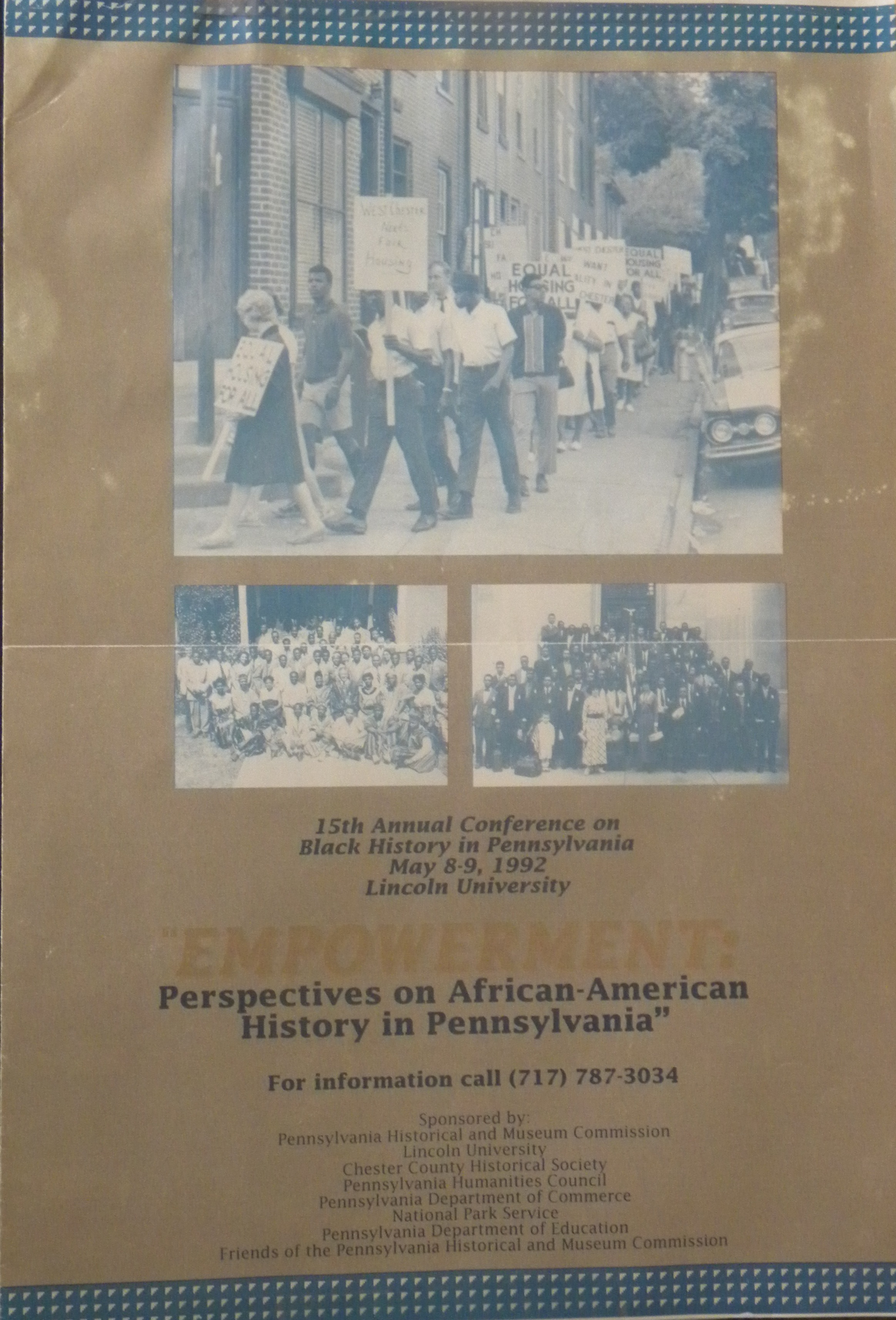

Conference agenda, 15th Annual Conference on Black History in Pennsylvania, Lincoln University (May 8/9 1992), May 10, 2012. (Donald Earl Collins).

This time two decades ago, I was driving my way home from a conference at Lincoln University in southeastern Pennsylvania. It was a week of more firsts that had become a small sample of a year of many firsts for me since getting into graduate school at the University of Pittsburgh in April ’91. It was my first road trip anywhere, and the first time I’d been in a car since earning my driver’s license in January ’92 (see my post “Taking the Long Road: Driver’s Delight” from January ’12). It was part of my first visit to NYC, Mount Vernon, and 616 since finishing my master’s degree.

That’s where my road trip began, Mount Vernon, as I’d wind my way to Yonkers, the Bronx, the GW Bridge, New Jersey and Philly (where I got lost twice) before ending up on the bucolic HBCU campus. I was at Lincoln University to present at my first academic conference, the 15th Annual Conference on Black History in Pennsylvania. The theme for that year’s conference was “Empowerment: Perspectives on African-American History in Pennsylvania. Somehow, the conference organizers approved me to present my paper comparing elements of intercultural education, multicultural education and Afrocentric education in Pittsburgh and Philadelphia during the 1930s and early 1990s.
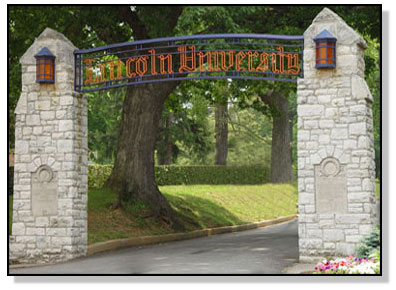
Lincoln University entrance and alumni arch, dedicated in 1921, May 10, 2012. (http://lincoln.edu).

If the road trip and the presentation were the only things important about this conference, that would’ve been plenty for me in May ’92. But there was so much more to this first conference for me than driving a Ford Escort in North Philly or getting on stage for the first time since sixth grade (see my post “Peaking As A Sixth Grader” from June ’11). It was my first time around a large number of Black academicians and activists. I met Julian Bond for the first time (his father, Horace Mann Bond, by the way, had served as president of Lincoln University from 1945 to 1957). Folks from the African American studies department at Temple University attempted to recruit me for their doctoral program. Knowing that Molefi Asante was there, I respectfully declined.

Above all else, I came away with two valuable experiences that would have an effect on me for years to come. One was being in the audience for a presentation from V.P. (or Vincent P.) Franklin, whose work on Black education in Philadelphia in the 1920s and 1930s I already knew. His was an extemporaneous presentation that lasted for well over twenty minutes. It was full of quotes, links between different historians’ research, and stories. It was extremely entertaining, delivered in an engrossing public speaking style, though not like some Southern Baptist preacher, either.

I was blown away by Franklin’s presentation. Especially in comparison to the one that I’d deliver some

Conference agenda (inside pages), 15th Annual Conference on Black History in Pennsylvania, Lincoln University (1992), May 10, 2012 (Donald Earl Collins).

twenty hours later. Mine was a well-studied delivery of ten pages of excerpts from my original paper. It was okay, not exactly a winner compared to anything that I’ve done in the two decades since. For it was with Franklin’s presentation and style from the day before that stuck with me. I decided immediately after my lackluster performance to always present my work extemporaneously, to work on my public speaking skills, to understand that presenting one’s work was a very different task than simply reading from it.

The second takeaway was in meeting my eventual dissertation advisor, Joe William Trotter, Jr. I met him after the first set of presentations on Friday morning, and ended up sitting with him for part of the Friday luncheon. I learned a few things in that first meeting. Up until that day, the only Black historians I knew in the Pittsburgh area were at Pitt or somehow affiliated with Pitt, including my then advisor Larry Glasco. The fact that Joe was across the way at Carnegie Mellon meant that there was at least the hope of gaining a different perspective on African American history than the stiff responses to Whites misconstruing the Black experience.

What made this first meeting even more intriguing was that Joe was in the process of putting together a graduate seminar for the Fall ’92 semester in African American history. It would be the first time that one had been taught at Carnegie Mellon. No such course existed at Pitt, either, at least as a graduate seminar. It meant that I could expect to get something out of my second year of graduate school (and first year as a PhD student) after all. “Where do I sign up?,” I asked after hearing what seemed like wonderful news at the time.

I returned to 616 twenty years ago on this date recharged and ready for another year of intellectual growth. But I should’ve also returned with far more insight into the politics of race, academia, trust, and academic competition than I actually had. The dynamics within the conference were extremely subtle, like an ultrasonic pulse undetected by most human hearing, but there driving the subconscious crazy anyway.

I didn’t see Joe’s invite to his classroom as a competition for me initially because I was obviously all-too-desperate to move on from Pitt, but not desperate enough to join Asante’s Temple of Afrocentricity (see my post “Writer’s Start” from August ’10 for more). Joe got me, all right. I just didn’t know it yet.

The Women In My Brain

28 Saturday Apr 2012

Posted by decollins1969 in 1, Boy @ The Window, Eclectic, eclectic music, Marriage, Mount Vernon New York, Pop Culture, race, Religion, Youth

≈ 2 Comments

Tags

616, 616 East Lincoln Avenue, Battlestar Galactica, Brain, Brain Wiring, Crush #1, Images, Inception, Love, Marriage, Mind's Eye, Muse, My Mother, My Wife, Neurons, Self-Discovery, Self-Reflection, The Cell, Wedding Anniversary, Women, Wonder Woman


Angelia & me on honeymoon, Seattle's Space Needle, May 20, 2001. (Donald Earl Collins)

Today’s my twelfth wedding anniversary. It means that I already have one woman in my brain almost all of the time, mostly around the mundane tasks of running a place of residence, other domestic duties, and watching over/nurturing the midsized human that is our eight-year-old.

Gaius Baltar & Caprica Six, Battlestar Galactica image (2004), June 25, 2009. (http://25fps.cz). Qualifies as fair use under US Copyright laws due to low resolution of picture.

But the reality is, there have always been women in my brain, with images that inspire, voices that encourage, and actions that embolden. This post isn’t about undressing a woman in my mind’s eye every six seconds. Nor is it about putting women on some pedestal so that I can mentally kneel and worship in an empty space. Trust me, I’ve done both and more over the years. No, this is about who gets into my head and how they stay there.

Of course, no one has had more air time on my mind’s screen over the past forty-two years and change than my mother. She did give birth to me, after all, and for better and worse, helped me make it to my preteen years before things in our lives fell apart at 616. For years, I’ve lived with the lessons learned at my mother’s hip, lessons about race, trust, religion and relationships. Many of which I’ve had to revise in order to make better choices in my own life. Still, I can hear my mother’s voice, bad jokes and all, in the things I do with my son, in the mistakes I hope to avoid as a writer and as an educator, in the bills that constantly have to be paid.

I hear my wife’s voice every time I go the grocery store. Or when I’m dealing with my son. Or when I think about our travels over the years. Literal and figurative. I think about all of things we’ve made happen, and all of the things that are still works-in-progress for us, as individuals and as a family. I hear her doubt, her most critical of voices, her scalpel sense of editing in what I write, in how I speak and in the diplomacy I show the folks in my life who otherwise don’t deserve it. Though our marriage is as complicated as astrophysics shows the universe to be when accounting for dark matter, my wife’s voice bounces around my 100 trillion nerve ending almost as much as my own.

Then there’s Crush #1. She’s more insidious than my mother or my wife. The tenacious ballerina of a

Inception (2010), Paris dream construct screen shot, April 27, 2012. (http://dpmlicious.com). Qualifies as fair use under US Copyright laws because of poor resolution of shot, not intended for distribution.

tomboy who one represented my personification of Lynda Carter’s Wonder Woman often will show up when I least expect. Often enough in my dreams, and usually when I’m writing in my head. I hear her giggles and see her smiles under the strangest of circumstances. A pirouette here, a punch to the jaw there, an encouraging word and a thoughtful look will surprise me in my dreams as much as it would’ve in real life thirty years ago.

Are these women anything like the folks I’ve known and learned to know again over the past three decades? Yes and no. They likely represent the many sides of me as much as they each represent themselves. Loving or not, caring or not, forever elusive, and yet always there for me to grasp, love and even despise. They all represent the best and worst in me, the best and worst I’ve seen, endured and overcome in this life. Hard, tough, blood-from-a-turnip love. Unrequited, one-sided love. And deep, conditional, familiar love. They’re all there. They seem to always be there.

Jennifer Lopez in dream sequence in The Cell (2000), April 27, 2012. (http://media.avclub.com). Qualifies as fair use under US Copyright laws because of screen shot's low resolution.

God, my own thoughts — however deep or shallow —  the billions of images of sports and men and women in my head from every walk of life and every song made in the past four centuries also remain constant in my brain. But mother, wife and first love can’t be shut off or out either. I could use some endorphins for the headache I have now.

The Master’s – Too Young, Too Soon

14 Saturday Apr 2012

Posted by decollins1969 in 1, Academia, Boy @ The Window, culture, Eclectic, Politics, race, Youth

≈ 3 Comments

Tags

Academic Politics, Comprehensive Exam, Department of HIstory, Doctoral Research, History Department, Larry Glasco, Lawrence Glasco, Master's Degree, Oral Exam, Paula Baker, Pitt, Self-Discovery, University of Pittsburgh, Van Beck Hall


The Masters 2011, 13th fairway and green, Augusta National Golf Club, Augusta, GA, April 6, 2011. (Ed-supergolfdude via Flickr.com). In public domain.

Twenty years ago today, I took my master’s oral exam and passed, and my committee recommended me into Pitt’s history doctoral program. It should’ve been a day of celebration, as I had knocked out a second degree two weeks shy of two semesters, in just seven and a half months. But, as with many euphoric events in my life, the other shoe dropped, one that led me down a road to a degree and betrayal from my eventual dissertation committee.

The two-hour comprehensive exam was easy enough. My advisor Larry Glasco (see my “Larry Glasco and the Suzy-Q Hypothesis” post from August ’11), along with Paula Baker (see my “Paula Baker and the 4.0 Aftermath” post from February ’12) and Van Beck Hall (department chair) made up my oral examination committee. Most of the questions weren’t about my research and coursework during the 1991-92 school year. They were about my potential dissertation topic and how I’d approach it from a coursework and research perspective. The first question was, in fact, “If we recommend you into the PhD program here, what would your research topic be?”

Needless to say, those questions put me at ease for finishing my master’s and moving forward into the world of the doctoral student. I waited anxiously for ten minutes before my committee came out of the conference room within the department to congratulate me on my performance. I managed to hide my smile as Paula and Hall shook my hand, knowing how easy it would be for professors to misinterpret relief and happiness for cocky arrogance.

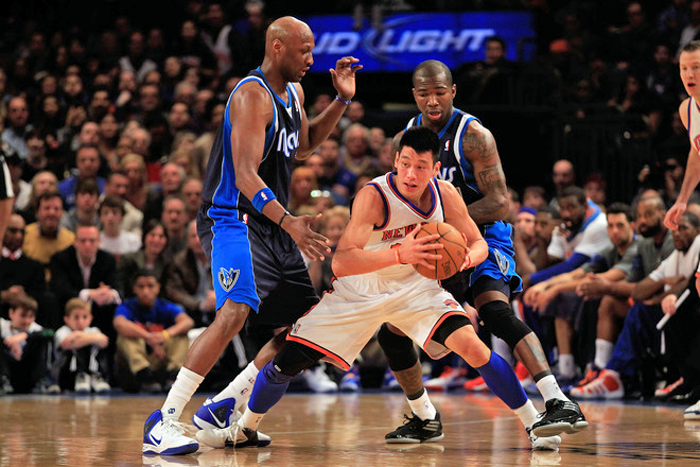
NY Knicks' Jeremy Lin double-teamed by Dallas Mavericks, MSG, New York, February 19, 2012. (Trendsetter via Streetball.com). Qualifies as fair use under US Copyright laws because of limited reproduction/distribution value.

It didn’t take long for Larry to burst my bubble, though. “You passed, but we’re going to have to slow you down,” he said. I was, according to at least one member of the committee, “moving way too fast,” at least that was what Larry followed up with. I was stunned. It was as if I’d done something wrong, as if I’d broken some golden rule around what age I should’ve been and how long I should’ve taken to do my master’s work.

I went home that Tuesday evening and tried not to think about what Larry had said. But that was all I could think about. How was it that I was to blame for knocking out a thirty-credit master’s program — including language proficiency requirement, master’s research and reading papers, and five graduate seminars — in two semesters? Or that I was only twenty-two when I did all of this? It didn’t seem fair that a history program as difficult as Pitt’s had professors who intended to make the path toward a PhD even more difficult for me.

I think that despite my DC trip and Georgetown University visit that March, that the night after my master’s oral exam was the first time I knew that it was time to leave Pitt for greener doctoral pastures. I liked Larry, and I generally trusted him. But given my history with the department (see my post “The Miracle of Dr. Jack Daniel” from May ’11), it seemed suicidal to try to complete a PhD there. I already knew that there were grad students there who had reached the dissertation stage in the early-70s — before I was in kindergarten — and had yet to finish. I also knew that Larry had about as much influence on departmental politics as I did.

Maybe it was too soon. Maybe I was too young. Maybe Larry was attempting to look out for my best interests. What I did know, though, flew in the face of all three of those assumptions. It really was time to move on.

Ivy League Dilemma – Addendum

18 Sunday Mar 2012

Posted by decollins1969 in 1, Academia, Boy @ The Window, Youth

≈ Leave a comment

Tags

College Planning, College Visits, Common Sense Practices, Hindsight, Intimidation, Ivy League Schools, Knowledge, Naivete, Self-Discovery


My addendum to the “Ivy League Dilemma” post, as there are several lessons to learn from my stumbling successfully into college at the University of Pittsburgh:

1. Always do your homework regarding the kinds of schools you want to attend. Easier said than done when you’re sixteen, the Internet didn’t exist, and your family doesn’t have the money to take you to visit schools prior to applying. Even with the disadvantage of poverty and lack of knowledge, I certainly had enough money for the $1.25 fare to catch the 2 to 110th Street and transfer to the 1 to get off at 116th, then walk up the step to find myself on Columbia University’s campus in ’86 or early ’87. That I didn’t see Columbia’s campus until ’90 is inexcusable.

2. Never allow the slights and ridicule of others determine where you should and shouldn’t go to school. I assumed that because my affluent and White (and some Black) Humanities classmates were snobbish, cliquish and entitled that I would see the exact same patterns at places like Columbia and Yale, making me more likely to see the University of Pittsburgh as an oasis from that side of human nature. It turned out that I was right and wrong. Pitt was so big, with so many different kinds of students, that there wasn’t this exaggerated sense of academic entitlement that I’d been a part of in the six years prior to attending. Over the years, I’ve learned that even truly talented and affluent students could be and often are wonderful human beings.

3. Don’t become intimidated by competition just because of the pressures and failures of the past. I don’t think that I was intimidated per se, but I do think that I wanted to not make a fool of myself among other high academic achievers either. My mix of the schools in which I applied in the fall of ’86 reflects this middle-of-the-road and contradictory thinking:

University of Pittsburgh                Columbia University
Rensselaer Polytechnic Institute  Rochester Institute of Technology
Hobart & William Smith Colleges  SUNY Buffalo
Yale University                              University of Rochester

I simply didn’t know enough — or knew anyone who knew enough — about me, my potential, and about the kinds of schools I’d been looking for to apply to the best mix of schools back then. Today, knowing what I was like then, but also knowing what I know now, I can reasonably assume that the list below would’ve been the best one for me to work from a quarter-century ago:

University of Pittsburgh                University of Pennsylvania
Cornell University                         Brown University
University of Toronto                    University of North Carolina
Georgetown University                 New York University

Of course, hindsight in my case is 20/10. This list just means I have a ten-year head start in helping my son figure out his higher education plans.

Reinventing the Writing Wheel

17 Saturday Dec 2011

Posted by decollins1969 in 1, Academia, Boy @ The Window, culture, Eclectic, eclectic music, Hebrew-Israelite, music, Pop Culture, race, Religion, Youth

≈ Leave a comment

Tags

"Children's Crusade", 616, 616 East Lincoln Avenue, Coping Strategies, Historian, Mount Vernon New York, Paul Riggs, Pitt, Re-Discovery, Reinventing the Wheel, Scholar, Self-Discovery, Sting, The Dream of the Blue Turtles, University of Pittsburgh, Western Civilization II, World War I, Writer, Writing


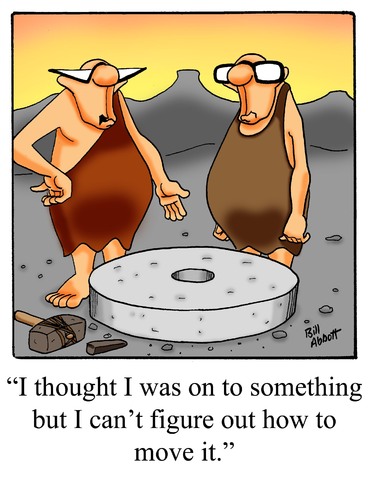
Inventing the Wheel cartoon, October 2, 2009. (Bill Abbott/http://www.toonpool.com/).

One of the side effects of having lived through the hell of my family struggles at 616 in Mount Vernon, New York between ’81 and ’89 was that I’d forgotten about the person I was before we became Hebrew-Israelites. As great as I am at recalling faces, smells, conversations, exact facts and phrases based on images and songs, I’ve been almost equally as good at blocking out whole sections of my personality. All in an effort to cope with the emotional pain and psychological trauma that is betrayal, abuse and neglect.

I have the unfortunate distinction of having seen myself as a writer in ’81 at the age of eleven, only to take nearly twenty years to see myself that way again. There were a few sign posts in the dark forest of confusion about my calling that I found on my way to getting back on the writing road. One of those sign posts was my teaching assistant and friend during my undergraduate years at the University of Pittsburgh in Paul Riggs.

Paul Riggs, Professor and Department Chair, Department of History, Valdosta State University (GA), December 17, 2011. (http://www.valdosta.edu).

Paul was the TA for my section of the Western Civilization II course taught by his advisor in Sy Drescher in the Spring semester of ’88. He was a second-year history grad student, a nice looking White guy for a nerd. Already in his mid-twenties with, his blonde-brown hair and around six-feet, Paul was a rarity on campus. So was his class. Paul found a way to do more than ask us a bunch of questions that were meant to quiz us on the textbook. We debated the significance of things like a richer diet and its impact on population growth and the expansion of European imperialism, the connections between Charles Darwin, evolution, and the advent of scientific racism at the end of the nineteenth century, and so many other things that allowed us to connect the dots.

Paul was also the first teacher I had at Pitt who assumed that I could do the work without acting as if I shouldn’t have been in their classroom. It helped that he occasionally indulged me. When our weekly discussion turned to the killing fields that had been northern France and Belgium for the bulk of the four years of World War I, I allowed my imagination to get the better of me. I made a comment that connected the tragedy of deadly trench warfare to a song by Sting called “Children’s Crusade.” I started quoting lyrics, like “virgins with rifles, a game of charade,” “the flower of England, faced down in the mud, and stained in the blood of a whole generation,” and “corpulent generals safe behind lines.”

I related it all to the documents book and Drescher’s lectures on the war that wiped out a generation of

Sting, The Dream of the Blue Turtle CD Cover (1985), December 17, 2011. (Donald Earl Collins).

young men in Western Europe. It took me two minutes of class time to draw all of the different connections. Paul, shaking his head at the end, got this incredulous smile on his face. All he said was, “um, you know Sting’s overrated?”

But Paul proved to be much more helpful a year and a half later. By then I was in my junior year at Pitt, no longer living in constant worry that I’d have to return to 616 to bury my mother and press charges against my idiot stepfather. By then, Maurice was my ex-stepfather, and thankfully so. For the first time in eight years, I kept a journal, putting together a series of stories based on my worst experiences at 616, on welfare, with my family, and in Mount Vernon.

All of it made me think about writing a book that looked at the sociological and psychological dimensions of the welfare system, for both recipients and for case managers charged with providing benefits. I wanted to make Westchester County Department of Social Services the centerpiece for such a book. I decided to talk to Paul about all of my ideas, not wanting to give away how personal this issue was for me. Paul asked me the questions that it would take another eleven years to answer. “What kind of writer do you want to be?,” and “How is history related to what you want to write about?,” he asked over the course of our conversation.

I really didn’t know the answers to either question. I wasn’t even sure that I wanted to pursue an advanced degree, become a professor, or become a writer. But I knew that I needed to find out.

Still, one thing that I decided to do that would determine most of my career travels over the next decade is to make myself into the semi-dispassionate scholar I knew I needed to become in order to be a better historian, which I presumed would make me a better writer. Only to spend this past decade reconnecting to my emotions and passion, which has made me the writer I once hoped to become.

The Last Mugging

06 Tuesday Dec 2011

Posted by decollins1969 in 1, Boy @ The Window, culture, Hebrew-Israelite, Jimme, Marriage, Mount Vernon New York, Politics, race, Religion, Youth

≈ 1 Comment

Tags

616, 616 East Lincoln Avenue, Acts of Kindness, Arthur Treatcher's Fish & Chips, Disillusionment, Mount Vernon High School, Mount Vernon New York, Mugging, Self-Defense, Self-Discovery, Suicide, Waldbaum's, Welfare


East Prospect, Mount Vernon, New York, where Foodtown (once Waldbaum’s) and Rite Aid (formerly Genovese) are today – about 30m from where I was mugged in ’83. (http://maps.google.com).

Twenty-eight years ago yesterday was the last time I was mugged, the last time I had to fend off wannabe thugs. As important as the challenges I face in my life are now, the ones I faced just before my fourteenth birthday were a thousand times more intense, if for no other reason than I nearly took the path of suicide back then.

For whatever the reason, December ’83 was spent without food at 616, this time in the welfare and food stamps era. My mother hadn’t received her welfare check on time. She went to Maurice for money to buy groceries, a necessarily rare move. I’d rather had gone to A (see “The Legend of ‘Captain Zimbabwe‘” post from May ’09) for grocery money than to my stepfather. He came to me and gave me twenty dollars to go to the store.

“Donald, do not lose this money. I don’t want no excuses. I want all my change back. If you have to, catch the bus,” Maurice said to me. I had already missed the last 7 bus going into Mount Vernon, and I knew that by the time I’d finish shopping that I would miss the last 7 for the return.

After shopping for Great Northern beans and rice and some beef neck bones and spinach at the Waldbaum’s on East Prospect — which cost $6.50 by the way —  I walked out with the intent of cutting down Park Avenue to East Lincoln and avoiding most of the potential for a mugging. But it seemed that Maurice’s God had other plans for me. I barely got to the poorly lit corner of Prospect and Park before I was ambushed by four guys, all around my age and size. Part of it was my fault, as the Arthur Treacher’s Fish & Chips that held that corner had closed the year before, a casualty of the recent recession. I saw other people around, but none came to my aid.

So here it was that I was jumped by a bunch of dumb kids with dumb parents trying to beat me up and take thirteen dollars from me. Apparently I must’ve learned something from my idiot stepfather, because I was able to kick, punch, and bite my way out of the mugging at first. I kicked one dumb ass in the balls, bit another’s arm, punched someone else in the jaw. I kept going until someone was able to hold me long enough to reach into my pocket and take the money. Then they took off, running across one of the bridges into the South Side.

Grocery bag torn to shreds, food on the ground, shirttail hanging out, I took off after them, now thinking only about what I’d face at home if I didn’t come in with Maurice’s money. They went east up First Street, turned right up South Fulton, and then left on East Third. With groceries in tow, I just couldn’t keep up.

It was after 9 by the time I got back from Waldbaum’s and my mugging. Mom was worried, actually worried, while Maurice was just pissed.

My mother was more concerned about what happened during the actual fight. I told her about what happened.

“You see someone you know?”

“I think one of them’s named C,” I said.

C and his older brother lived in the equally impoverished building next door, 630 East Lincoln. C’s older brother was in fourth, fifth, and sixth grade with me at Holmes. I hadn’t seen either of them much since elementary school, but I recognized him immediately as the one who said, “Give me the money, muthafucka!” Those were some ugly kids, inside and out.

In an unbelievable turn, my mother took me the next morning to the Mount Vernon Police Station, its juvenile division, to have me press charges, look at mug shots and ID my attackers. It didn’t take me long to ID C and his henchmen, all of whom had juvenile records. Before I left, they had hauled C into the station for booking. I was glad to see that my fists had done some damage to his face.

I went to school that day with my mother and ended up signing in around sixth period. One of my classmates saw me as I was leaving Vice Principal Carapella’s office, on my way to gym. We talked for several minutes about what had happened. He gave me a high-five. It was maybe the second or third time in three years that anyone cared to ask me about what was going on with me outside of school.

That whole twenty-four-hour period was overwhelming. I spent most of that evening at 616 asleep. I spent the rest of the month until my fourteenth birthday considering how to off myself. I spent part of my birthday standing thirteen feet over the Hutchinson River Parkway, on top of the stone facing looking down at the traffic while tears streamed down my cheeks.

All because I had lost hope, and my life was filled with contradiction. Luckily, I found a reason to live, and a reason to begin to see good in others, at least outside of 616.

The 4.0 Of It All

03 Saturday Dec 2011

Posted by decollins1969 in 1, Academia, Boy @ The Window, Eclectic, race, Youth

≈ 1 Comment

Tags

4.0 GPA, Finding Purpose, History Department, Larry Glasco, Master's Degree, Pitt, Pittsburgh, Self-Discovery, University of Pittsburgh


Larry Fitzgerald pulling away from Steelers Defense, Super Bowl XLIII, February 1, 2009. (http://zimbio.com).

This time twenty years, I was a week or so away from turning in a 4.0 first semester of graduate school at the University of Pittsburgh. It wasn’t exactly first and foremost on my mind at the time. I was just trying to get through the semester, and I was beginning to run out of gas. Between my independent study course with Larry Glasco and my graduate semester in pre-1877 US history, not to mention my third-semester Swahili course and History of Black Pittsburgh class, I’d been too swamped to pay attention to my grades. It was a sure sign that I was no longer in the mindset of a Humanities student, a grinder concerned only with A’s. It was also a sign of how much the gatekeepers in Pitt’s history department had pissed me off.

Black Image in the White Mind (1987), George M. Fredrickson, December 3, 2011. (http://tower.com).

I know for an absolute certainty what I was doing by the end of the first week in December ’91. I was putting together what would become a forty-five page master’s paper comparing the intercultural and multicultural education movements in US history for Larry, while also finalizing my master’s readings paper on African American self-perceptions during an after slavery. It was a counter to George Fredrickson’s book The Black Image in the White Mind (1987). I was also in the midst of doing interviews for a paper on civil rights activists in Pittsburgh and the collaboration (or lack thereof) between Black and White activists in the 1960s. Swahili, really, was easier, as all I had left was to convince my Tanzanian teacher Rashidi that I was proficient in conversational Swahili.

Luckily, I’d already been in a zone since the beginning of November, so none of what I now had left to work on was a last-minute deal. I knocked off all of these tasks and more a full week before the end of the semester. For some odd reason, I was completely confident that I’d done well. I just didn’t know that I’d earned straight-As for only the second time in ten years, or in four semesters.

But that was only about a quarter of what was important at the time. In addition to my actual grades, I’d knocked off two graduate-level seminars that semester (counting my independent studies course), and in the process, knocked off my two master’s papers for the degree. In the middle of the semester, I took and passed my language requirement for my master’s, taking a written proficiency exam in Swahili — despite some initial push-back from Larry to take it in Spanish.

I also used a loophole in the University of Pittsburgh handbook to allow I graduate seminar I took my junior year to be counted toward my master’s degree a year and a half later. Once again, I had to go over the head of our LSD-affected graduate advisor, Joe White and the department chair to the dean of the Faculty of Arts & Sciences at Pitt. I cited the exact code in the handbook that allowed me to count as many as nine credits from my undergraduate courses toward my master’s degree, provided that these were graduate-level courses to begin with. And, they approved the use of my Comparative Slavery course as credit to this degree as well.

Having done all of that, having survived an asthmatic cough — my first sign that I had asthma, really — that had lasted more than a third of the semester, having shaken off all of my doubters in the department. I realized by the beginning of December that with two more graduate seminars and a graduate course in another field, that I could my master’s done by the end of April. That minor epiphany made my head swim for a few minutes, just before I dove back into my intercultural education research paper.

A week or so later, I talked with my mother about what I knew was about to happen and about what could happen by the end of two semesters of graduate school. She said, “Well you showed them! You know, you never liked to be told you can’t do something.” I knew this was true. But as I said in response, “But that wasn’t and can’t be the main reason I continue to do this,” I knew that so much more motivated me than the professors who doubted me or getting straight-As.

The point of all of this was so that I could find a purpose for my life and all of the skills and talent I’d been blessed with. This great first semester was merely the start of the journey, not the end.

← Older posts
Newer posts →

Boy @ The Window: A Memoir

Boy @ The Window: A Memoir

Places to Buy/Download Boy @ The Window

There's a few ways in which you can read excerpts of, borrow and/or purchase and download Boy @ The Window. There's the trade paperback edition of Boy @ The Window, available for purchase via Amazon.com at http://www.amazon.com/Boy-Window-Donald-Earl-Collins/dp/0989256138/

There's also a Kindle edition on Amazon.com. The enhanced edition can be read only with Kindle Fire, an iPad or a full-color tablet. The links to the enhanced edition through Apple's iBookstore and the Barnes & Noble NOOK edition are below. The link to the Amazon Kindle version is also immediately below:

scr2555-proj697-a-kindle-logo-rgb-lg

Boy @ The Window on Amazon.com: http://www.amazon.com/Boy-The-Window-Memoir-ebook/dp/B00CD95FBU/

iBookstore-logo-300x100

Boy @ The Window on Apple's iBookstore: https://itunes.apple.com/us/book/boy-the-window/id643768275?ls=1

Barnes & Noble (bn.com) logo, June 26, 2013. (http://www.logotypes101.com).

Boy @ The Window on Barnes & Noble: http://www.barnesandnoble.com/w/boy-the-window-donald-earl-collins/1115182183?ean=2940016741567

You can also add, read and review Boy @ The Window on Goodreads.com. Just click on the button below:

Boy @ The Window

Twitter Updates

Tweets by decollins1969
  • RSS - Posts
  • RSS - Comments

Archives

  • June 2025
  • April 2023
  • September 2022
  • August 2022
  • July 2022
  • June 2022
  • May 2022
  • April 2022
  • March 2022
  • January 2022
  • December 2021
  • November 2021
  • October 2021
  • September 2021
  • August 2021
  • July 2021
  • June 2021
  • April 2021
  • March 2021
  • February 2021
  • January 2021
  • December 2020
  • November 2020
  • October 2020
  • September 2020
  • August 2020
  • July 2020
  • May 2020
  • April 2020
  • March 2020
  • January 2020
  • December 2019
  • November 2019
  • August 2019
  • July 2019
  • June 2019
  • May 2019
  • April 2019
  • March 2019
  • February 2019
  • January 2019
  • December 2018
  • November 2018
  • October 2018
  • September 2018
  • August 2018
  • July 2018
  • June 2018
  • May 2018
  • March 2018
  • February 2018
  • January 2018
  • December 2017
  • November 2017
  • October 2017
  • September 2017
  • August 2017
  • July 2017
  • June 2017
  • May 2017
  • April 2017
  • March 2017
  • February 2017
  • January 2017
  • December 2016
  • November 2016
  • October 2016
  • September 2016
  • August 2016
  • July 2016
  • June 2016
  • May 2016
  • April 2016
  • March 2016
  • February 2016
  • January 2016
  • December 2015
  • November 2015
  • October 2015
  • September 2015
  • August 2015
  • July 2015
  • June 2015
  • May 2015
  • April 2015
  • March 2015
  • February 2015
  • January 2015
  • December 2014
  • November 2014
  • October 2014
  • September 2014
  • August 2014
  • July 2014
  • June 2014
  • May 2014
  • April 2014
  • March 2014
  • February 2014
  • January 2014
  • December 2013
  • November 2013
  • October 2013
  • September 2013
  • August 2013
  • July 2013
  • June 2013
  • May 2013
  • April 2013
  • March 2013
  • February 2013
  • January 2013
  • December 2012
  • November 2012
  • October 2012
  • September 2012
  • August 2012
  • July 2012
  • June 2012
  • May 2012
  • April 2012
  • March 2012
  • February 2012
  • January 2012
  • December 2011
  • November 2011
  • October 2011
  • September 2011
  • August 2011
  • July 2011
  • June 2011
  • May 2011
  • April 2011
  • March 2011
  • February 2011
  • January 2011
  • December 2010
  • November 2010
  • October 2010
  • September 2010
  • August 2010
  • July 2010
  • June 2010
  • May 2010
  • April 2010
  • March 2010
  • February 2010
  • January 2010
  • December 2009
  • November 2009
  • October 2009
  • September 2009
  • August 2009
  • July 2009
  • June 2009
  • May 2009
  • April 2009
  • March 2009
  • February 2009
  • January 2009
  • December 2008
  • November 2008
  • October 2008
  • September 2008
  • August 2008
  • July 2008
  • June 2008
  • May 2008
  • April 2008
  • March 2008
  • February 2008
  • January 2008
  • December 2007
  • November 2007
  • October 2007
  • September 2007
  • August 2007
  • July 2007
  • June 2007

Recent Comments

decollins1969's avatardecollins1969 on No Good Teaching Deed Goes…
Mary Rose O’Connell's avatarMary Rose O’Connell on No Good Teaching Deed Goes…
Lyndah McCaskill's avatarLyndah McCaskill on The Raunchiest of Them Al…

NetworkedBlogs on Facebook

NetworkedBlogs
Blog:
Notes From a Boy @ The Window
Topics:
My Life, Culture & Education, Politics & Goofyness
 
Follow my blog

616 616 East Lincoln Avenue A.B. Davis Middle School Abuse Academia Academy for Educational Development AED Afrocentricity American Narcissism Authenticity Bigotry Blackness Boy @ The Window Carnegie Mellon University Child Abuse Class of 1987 CMU Coping Strategies Crush #1 Crush #2 Death Disillusionment Diversity Domestic Violence Economic Inequality Education Family Friendship Friendships Graduate School Hebrew-Israelites High-Stakes Testing Higher Education History Homelessness Humanities Humanities Program Hypocrisy Internalized Racism Jealousy Joe Trotter Joe William Trotter Jr. K-12 Education Love Manhood Maurice Eugene Washington Maurice Washington Misogyny Mother-Son Relationship Mount Vernon High School Mount Vernon New York Mount Vernon public schools Multiculturalism MVHS Narcissism NFL Pitt Pittsburgh Politics of Education Poverty President Barack Obama Race Racial Stereotypes Racism Relationships Self-Awareness Self-Discovery Self-Reflection Sexism Social Justice Teaching and Learning University of Pittsburgh Violence Whiteness Writing

Top Rated

Blog at WordPress.com.

  • Subscribe Subscribed
    • Notes from a Boy @ The Window
    • Join 103 other subscribers
    • Already have a WordPress.com account? Log in now.
    • Notes from a Boy @ The Window
    • Subscribe Subscribed
    • Sign up
    • Log in
    • Report this content
    • View site in Reader
    • Manage subscriptions
    • Collapse this bar
 

Loading Comments...