• About Me
  • Other Writings
  • Interview Clips
  • All About Me: American Racism, American Narcissism, and the Conversation America Can’t Have
  • Video Clips
  • Boy @ The Window Pictures
  • Boy @ The Window Theme Music

Notes from a Boy @ The Window

~

Notes from a Boy @ The Window

Tag Archives: Racism

The #45 Mix Tape

28 Sunday May 2017

Posted by decollins1969 in 1, Academia, Boy @ The Window, Christianity, culture, Eclectic, eclectic music, music, Patriotism, Politics, Pop Culture, race, Religion, Youth

≈ Leave a comment

Tags

"White Discussion", #45MixTape, Capone-N-Noreaga, Destruction, Drake, En Vogue, Fleetwood Mac, Greed, Islamophobia, James Blunt, Lies, Live, Madonna, Misogyny, Narcissism, President Donald J. Trump, Racism, Russia, Sarcasm, Sting, Trump Supporters, Xenophobia
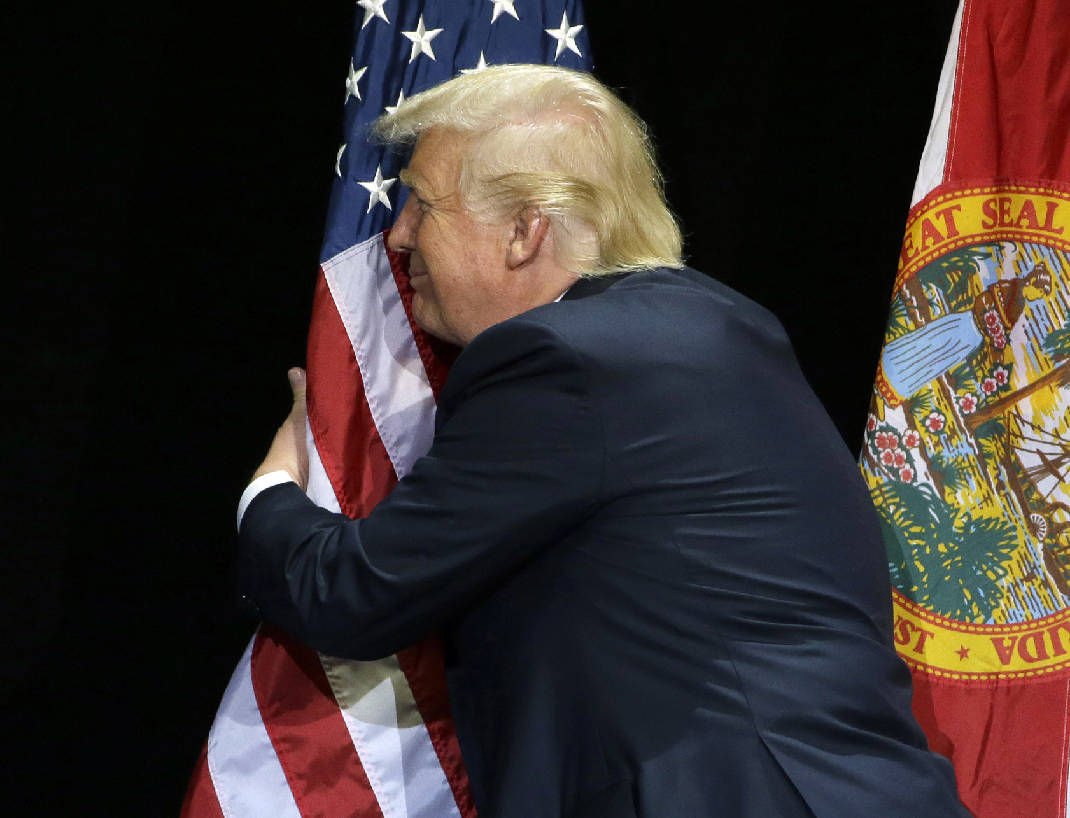

Then candidate 45 hugging US flag at campaign rally (remember, he’s the anti-Midas, everything he touches turns to crap), Tampa, FL, June 11, 2016. (Chris O’Meara/AP, Times Free Press).

I’m changing it up a bit this weekend. With so much focus on the apocalypse that is 45 and his band of greedy, racist, misogynistic, Islamophobia, and Russia-helping yes-men, I have something goofy and meaningful to say. There are already several comprehensive syllabi on Donald J. Trump out, though, so adding my scholarly musings and sources to this almost inexhaustible topic would be a futile exercise. Instead, I have a mix tape (sort of), one that highlights the changes in my music tastes over time and a group of songs that I mostly despise. Just like I loath most of America’s knee-jerk arguments over 45 and his minions from the past two years.

1. “Little Lies” (Fleetwood Mac, 1987). From their Tango In The Night album. Christine McVie sounds like a shot dog on this song (and Lindsey Buckingham doesn’t sound much better). But this was a Top-5 hit on Billboard in 1987, around the same time Trump was likely being turned by Vladimir Putin and the KGB in the former USSR. And, the song’s theme is pretty obvious.

2. “Live to Tell” (Madonna, 1986). Not exactly my favorite artist, but a one-time favorite song from the one-time “Material Girl” for me three decades ago. After several sources quoting the deposed Michael Flynn, “he has a story to tell,” I remembered Madonna’s lyrics, “I have a tale to tell.” Come to think of it, doesn’t Jared Kushner have a tale to tell about his and 45’s “thousand lies?”

3. “Spies Like Us” (Paul McCartney, 1985-86). Proof positive that Baby Boomers will vote for anything, this piece of poop was a Top-10 hit in January 1986. It’s also emblematic of the theme of ineptitude and macabre humor that runs through the song, representing the movie by the same title, and Flynn, Kushner, Carter Page, Roger Stone, and the rest of the monolithic bloc of 45’s White men.

4. “Russians” (Sting, 1985-86). Why? Because Russians (maybe with the exception of Josef Stalin and Putin) “love their children too” — didn’t you know? But they love messing with our corrupt democracy even more.

5. “Oops!…I Did It Again” (Britney Spears, 2000). God, I have no idea why anyone would’ve ever liked this zit-popper. But the then-eighteen-year-old Spears was prescient with the line “I’m not that innocent.” Neither is 45. He made be a narcissistic buffoon who can’t put two coherent sentences together with a pen, two pieces of paper, Scotch tape, and a flashlight. But he knows where his money’s coming from, no?

6. “Just A Friend” (really, “Jus’ a Friend,” Biz Markie, 1989-90). Same theme as Britney Spears’, with a twist of crossover appeal, a ridiculous baroque get-up, and off-key singing that could only be topped by NBA Hall-of-Famer (and internalized racist) Charles Barkley. But it captures perfectly the love affair between ditto-headed supremacist Americans and 45 (it doesn’t go the other way, of course).

7. “White, Discussion” (Live, 1994). A bit of my favorite grunge, which I have used before. It applies to the folks, the so-called American liberals ready to blame non-voters, third-party voters, and Trump supporters for the rise of 45. Still, many of them are to blame also, because most of them aren’t liberal. If you supported Hillary Clinton in 2016 based on principles, and not out of pragmatism, you are not a liberal, and have been voting in center-right candidates for decades. As the song goes, “look where all this talking got us, baby.”

8. “Stranger In Moscow” (Michael Jackson, 1996-97). Jackson’s introspective song applies here as well, because, well, he uses Russia and the theme of isolation throughout. Except in 45’s case, he likes it that way. And apparently, so does Russia.

9. “Lies” (En Vogue, 1990). Trust me, it fits! (s/o to Dawn Robinson).

10. “Thug Paradise” (Capone-N-Noreaga/Tragedy Khadafi, 1997). The lyrics below say it all:

I twist the truth, I rule the world, my crown is called deceit
I am the emperor of lies, you grovel at my feet
I rob you and I slaughter you, your downfall is my gain
And still you play the sycophant and revel in my pain
And all my promises are lies, all my love is hate
I am the politician, and I decide your fate

Supporters and sycophants beware: 45 is coming for you, in a steamroller with a 700-horsepower engine going one hundred.

11. “Fake Love” (Drake, 2017). I’m a Aubrey Graham fan. I can’t stand Drake. Still, this release from More Life should be required listening from 45 supporters who think they’re not racist, misogynistic, xenophobic, or narcissistic. He also has a song on this album titled “Portland,” though I seriously doubt he was thinking about this weekend or Richard Collins III.

12. “Waterfalls” (TLC, 1995). Yep, yep, yep. Both 45 and MAGA-types have been chasing illusory rainbows and torrents off jagged edges, and damning everyone who they perceive as a threat along the way. And they’re both on a one-way trip.

13. “Don’t Forget Me When I’m Gone” (Glass Tiger, 1986). This is the song 45 should play whenever he finally leaves office, whether by resignation, impeachment, and/or force. As everything 45 touches turns into crap, Glass Tiger’s Top-10 schlock cannot be made any worse. Plus, not even Glass Tiger would complain about 45 using their crappy music.

14. (Bonus Track) “No Bravery” (James Blunt, 2006). 45 is part of a continuum, one that stretches through all of American history. On the international stage, though, it has been one of constant chest-thumping while killing innocents in the name of freedom or national security. Though Blunt’s was about fighting for the UK, the song has much more applicability in the US. We have so much blood on our hands, and 45 means to add to this fetid river on the domestic and international frThe #45 Mix Tapeonts.
In·ter·sec·tion·al·i·ty

24 Monday Apr 2017

Posted by decollins1969 in 1, Academia, Carnegie Mellon University, culture, Eclectic, New York City, Pittsburgh, Politics, Pop Culture, race, University of Pittsburgh, Youth

≈ Leave a comment

Tags

Academic Conferences, Afrocentricity, bell hooks, CMU, Critical Race Theory, Diversity, Elsa Barkley Brown, Evelyn Brooks Higginbotham, Intersectionality, Kimberlè Crenshaw, Marginalization, Misogyny, Multiculturalism, OAH, Organization of American Historians, Patricia J. Williams, Paula Giddings, Pitt, Presidential Classroom, Racism, Sexism, Tera Hunter


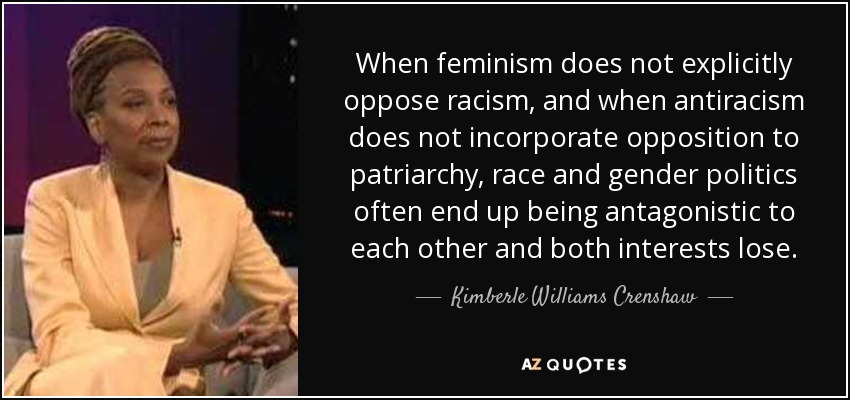
Kimberlè Crenshaw quote, from “Whose Story Is It Anyway?: Feminist and Anti-Racist Appropriations of Anita Hill,” in Toni Morrison’s Race-ing Justice, En-gendering Power, 1992, p. 403. (http://azquotes.com).

In truth, I’ve considered the issue of intersectionality as a historian and writer since 1993, when I wrote my quantitative methods requirement-fulfilling paper, “The Dying of Black Women’s Children.” Except that, for me and for most of my colleagues, the term was barely in use. Matter of fact, in five and half years of graduate school and in my first three years after finishing the doctorate, I may have heard the term used only once or twice. It’s not like I didn’t think about the unique issues facing women of color — especially Black women — in the context of US history and African American history. Sometimes as a historian, how leading Black men and White women marginalized African American women in education movements, in the suffrage movement, and in the Civil Rights Movement was all I could think about. In the context of understanding American education and the role of Black women as teachers and education, it made me reconsider the notion of education as a form of social control versus it as a form of social liberation as an and-both, and not an either-or proposition.

But, as with all other issues, I’m not perfect. I remember getting into an argument with an African American women at a joint Carnegie Mellon-University of Pittsburgh conference on diversity in 1992. She was a second-year master’s student in the public policy program at CMU’s Heinz School (now Heinz College) to my second year as a grad student and first as a PhD student. I had talked about my initial research on multiculturalism and Black education, and what that research could mean in terms of diversity in higher education. Over lunch, I barely got three sentences out about the implications before this student pounced on me for not taking a more Afrocentric approach to my research, all but calling me an Uncle Tom. She also pointed out that while I had accounted for race and gender in my work, I hadn’t accounted for them together. I was already used to middle class Black folk who only radicalized at the ripe young age of twenty-two telling me that my research was too conservative and too White. But on the second part, not accounting enough for Black women in my research, I did take to heart.

In 1999, at my “Black Brahmins” presentation on W. E. B. Du Bois, Carter G. Woodson, and Alain Locke and their ideas around multiculturalism and connections to Harvard at the Organization of American Historians conference in Toronto, I got a cold shoulder from the panel’s moderator, Stephanie Shaw. She barely said a word to me the entire time, and barely commented on my paper. I figured that Shaw thought I should’ve found a way to make the paper more inclusive of Black women graduates of Harvard and multiculturalism, even though Harvard didn’t allow any women to attend. I could’ve included Black women who attended Radcliffe College around the turn of the twentieth century, but even then, those women did not earn graduate degrees or become proponents of pluralism or what we’d call multiculturalism today. I followed up at OAH in Los Angeles in 2001 with my “Multicultural Sisters” paper, but by then, I no longer had an interest in multiculturalism as a historian.

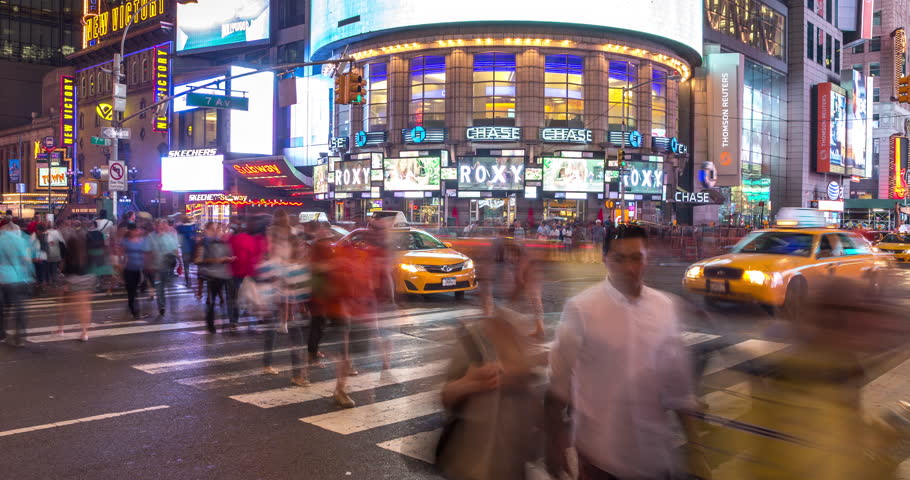
Times Square intersection time-lapse, August 2014. (http://shutterstock.com).

On this day and date in 2000, though, was the argument I had with a colleague at Presidential Classroom, one that would keep me conscious about intersectionality and womanism from that point on. Sev had been brought on by my racist boss Jay Wickliff to help out with the international recruitment for the weekly civic education programs we had for high school juniors and seniors. Sev was Canadian, had been an intern with the program the summer before, and had recently finished up a master’s in history. She had stopped by my office to ask about some revisions I’d been making to parts of our upcoming summer programs, especially the one on media and democracy, which was a new program for Presidential Classroom. Somehow the conversation swung toward women’s rights and issues that Sev thought were important to women. I kept correcting her, saying that some of these issues were “only important to White women.” She took offense, telling me that I shouldn’t be correcting her, that her master’s made her as much an expert on the topic as me. I remember actually chuckling at that assertion, which miffed Sev even more. The common refrain, “Just because you have a PhD…,” was how she responded.

But I did take a few minutes to break down the differences between second-wave and third-wave feminism (or womanism). I went on about the history of exclusion that Black women in particular had faced from Black men in civil rights movements and White women around suffrage and reproductive rights. I said, “maybe it’s because you’re Canadian, but here in the US, these issues you’re bringing up mostly concern middle class White women.” She didn’t like that at all. Before Sev responded, Wickliff, having overheard our argument, came by and said, “Slavery was a hoax” as a joke. That was the moment I knew my days working for this group of Whiteness folks were numbered.

A few months later, in my new job at AED with New Voices, I picked up and read Kimberlè Crenshaw’s essay “Demarginalizing the Intersection of Race and Sex” (1989) for the first time. I knew that I already understood intersectionality for Black women, how misogyny, sexism, and racism constantly confer a double marginalization, discrimination, and violation on Black women. Now, between Crenshaw and my own experiences, I also realized that I could experience intersectionality as a Black man, between White men and White women. Especially middle class ones, where their well-meaning color-blind racism had served to put me in a box as well. It was an and-both box, where I was a historian who didn’t write about intersectionality enough and a professional who had also experienced race and gender-based marginalization, albeit differently from women or color. What I did learn, finally, was that the intersection of race, class, and gender made Times Square look like Walden Pond by comparison.

My Olivia of Our Future

11 Saturday Feb 2017

Posted by decollins1969 in 1, Academia, culture, Eclectic, High Rise Buildings, New York City, Politics, Pop Culture

≈ Leave a comment

Tags

Allegory, Climate Change, Dystopia, End of Western Civilization, Fringe (2008-13), Future, Jasika Nicole, Narcissism, Olivia, Olivia Pope, Racism


Cropped front cover of Olivia Saves the Circus (1994), by Ian Falconer, February 11, 2017. (http://amazon.com).

Cropped front cover of Olivia Saves the Circus (1994), by Ian Falconer, February 11, 2017. (http://amazon.com).

I’m imagining that the year is 2347. My great-great-great-great granddaughter is Olivia Levy-Collins. She’s in her mid-thirties. After reading my only moderately successful manuscript on the history of American narcissism as a preteen, she becomes interested in the social sciences. A resident of Africa’s southern cone, Olivia does her undergrad at the University of Botswana, double majoring in Archaeology and Ecology. She goes off to the world-renown Universidade de São Paulo (University of São Paulo) in the Brazilian zone, where she earns her master’s degree in Western Civilization (with a focus on 20th and 21st-century American history), and a doctorate in cultural anthropology, with a focus on historical social psychology.

Olivia does her dissertation on the causes of the collapse of the Western world. This is not a new topic in the 24th-century world. Every one of the six billion people on the planet knows the broad story. How, after centuries of dominance, the economic and political structures of Western Europe and the United States underwent long-term decline in the midst of growing economic inequality, continued oppression of already vulnerable groups, undue influence of corporations on governance, and climate change beyond their abilities to comprehend. The proxy wars with terrorism and quasi-nation-states that later led to right-wing revolutions within Europe and the US. The full-blown civil wars and climate degradation that followed.

The US destroyed itself, as anarchists launched a cyberattack that took out the one-time superpower’s entire electrical grid. The groups once known as White supremacists retaliated, and used stolen nuclear weapons on six US cities, including the capital, Washington, DC, to take out the cyberterrorists, most of whom had been rumored to be Arab Muslim and Latina. The riots, famine, starvation, and consequences of climate change ensued, and ensured that the US would not be ever again. Europe also went through many of these convolutions. If it were not for the collective work of scientists in Brazil, India, China, Canada, and Southern Africa to remove the buildup of carbon dioxide and methane gases from the atmosphere and oceans, full-blown nuclear war may have occurred.

Kerry Washington as Olivia Pope from Scandal, a show about damage control, controlling the narrative, September 15, 2011. (http://scandal.wikia.com).

Kerry Washington as Olivia Pope from Scandal, a show about damage control, controlling the narrative, September 15, 2011. (http://scandal.wikia.com).

Olivia, though, like a new generation of her colleagues, wanted to understand what would cause people from the most powerful nations on the planet to collectively lose their minds. Why would they, after overwhelming success to subdue the earth, then turn on each other to kill the very things that gave them enormous power in the first place? My book from so many generations ago gave Olivia one possible clue. She found my book on the shelf of an ancient library in Walvis Bay, in the country that used to be Namibia. It was part of a school trip that Olivia was a part of while in primary school, to give students an appreciation for ancient attempts to preserve knowledge in depositories for books made of wood pulp, glue, and toner ink. She’d heard about the book from her great-grandmother, who had heard about it from her grandmother. The latter whom had read the book numerous times, as my son had moved his family from the US to South Africa as the occasional American unrests turned deadlier in the mid-21st century.

But, even after that field trip, even after getting her mother to get her a rare electronic copy of my book from the United Nations’ central archives in Aleppo, even after reading it, Olivia didn’t fully believe it. She couldn’t comprehend a culture that would waste vast quantities of natural resources, including human ones. She’s didn’t understand how a society in which everyone thought that becoming wealthy was their birthright could possibly function. She didn’t get how a nation as powerful as the US was always so fragile as an idea, not to mention in actuality.

Olivia’s dissertation work took her to the abandoned city of New York in 2347. With the exception of its crumbling skyscrapers, most of the city was covered by tens of meters of dirt (some of which remained radioactive). Other parts, like the area once known as Wall Street and Battery Park in Manhattan, or Park Slope in Brooklyn, were also partly underwater. She and her fellow group of two-dozen anthropologists, archaeologists, and other scientists, descended on the abandoned city, along with military commandos, all trained to expect the unexpected. In the case of the military, their training included scenarios for exploring exoplanets, which many saw as less dangerous than the exploration of a relatively recently dead civilization.

They went to two sites to conduct their studies. One, the New York Public Library on West 42nd Street and 5th Avenue. The other, two hundred meters away, was this recently excavated place in the old city, something the world once called Times Square. Olivia’s team explored the unearthed library, or at least, what was left of it. Fighting, flooding, dirt, and earth had left the main branch of one of the largest libraries in the Western world a shell of itself. It did have books and other collections still. Mostly self-help books, political memoirs, and recordings of one of the last US presidents, Donald J. Trump.

A partially buried car on Governor's Island, NY, September 13, 2009. (http://scoutingny.com).

A partially buried car on Governor’s Island, NY, September 13, 2009. (http://scoutingny.com).

Olivia, though, unlike her younger counterparts, knew that as self-centered as the remaining collection appeared, it wasn’t the whole story. She knew from my book and from the other books of the 20th and 21st centuries that there were numerous intellectuals and writers who tried to warn the world that the facade of narcissism would lead billions to their deaths. That cannibalizing selfishness could even possibly destroy the world, certainly the Western world.

But she did find it interesting that after the fall of the West, in one of its greatest cities, only the most narcissistic of preserved materials remained. It told her one thing. The narcissism was real, that millions had fallen prey to it. That in an age in which the world didn’t have the technology to use energy-matter converters to replicate food, clothing, shelter, and medicine for 7.3 billion people, millions once lived as if there was no tomorrow, like life was one big party. To the point where these Westerners made significantly more copies of their homages to themselves than they did of anything else.

So Olivia took this knowledge, and the knowledge gained from the Times Square dig. She titled her dissertation, “How Western Civilization Cannibalized Itself: Reproduction, Capitalism, and Narcissism, 1750-2100.” That same year, Olivia turned it into a book, an interplanetary must-read, Runaway Narcissism and How the Sun Set on the Western World. It raised lots of questions about how humanity overcame its own narcissism, but at great cost. It would be one of the great books of the 24th century. That’s my Olivia!

If Blacks Should “Go Back to Africa,” Whites Should Go to Australia

02 Wednesday Nov 2016

Posted by decollins1969 in 1, culture, Eclectic, Patriotism, Politics, Pop Culture, race

≈ 2 Comments

Tags

"Go Back to Africa!", American Narcissism, American Revolution, Ancestry, Asylum, Australia, Australian Immigration Policies, DNA, Donald Trump, Hyper-Patriotism, Immigration, Islamophobia, Migration, Racism, Systemic Racism, UMUC, White Man's Country, World History, Xenophobia


Go Back to Africa! Go Back to Mexico! cartoon, 2003. (Luis Castellon; http://google.com).

Go Back to Africa! Go Back to Mexico! cartoon, 2003. (Luis Castellón; http://google.com).

It is part of the racism, narcissism, and stupidity of many US Whites to respond to protests, die-ins, boycotts, and even the most minor criticisms of systemic racism and oppression with “Go Back to Africa.” Or, “If you don’t love America, then leave,” as if most Blacks have a real choice. The amount of ignorant cruelty in these knee-jerk responses says as much about the individual racism of these supposedly right-standing Americans as it does about their comfortability with systemic racism and the psychological — if not material — benefits these Whites draw from Black suffering. Or, Native American suffering, as has been the case with the response of Whites to the Dakota Access pipeline protests over the past couple of months. Or Latino suffering, with chants of “Build that wall!,” “Send them back!,” and “Kick them out!” by Donald Trump’s exclusively White supporters for more than a year.

A few years ago, I had a White student in a World History course who was upset by my lecture about the historical consensus that the American Revolution wasn’t as transformational an event as Americans pretend. The student was so caught up that told me to “Go back to Africa” after the class. The lecture was about the nature of revolutions, and per usual, I compared the American, French, and Haitian Revolutions, and used various measures to compare their impact on the social order, on political systems, and on the social mobility of the citizenry after the fact. And as usual, I showed that there was much more change in France and Haiti (the latter the first successful slave-led revolution in modern history) than there would be in the new US until the Civil War.

But I had shattered a student’s worldview of America as always good, and the American Revolution and the US Constitution that followed it as part of some predestined, divinely-inspired, genius-infused plan of greatness. The result was the student yelling at me, “You’re anti-patriotic!,” “You don’t love America!,” and “If you don’t love America, you need to get out!” I mostly ignored the student’s racial Tourette’s, and got to the heart of their issue: a mediocre grade on a paper assignment and their complete misunderstanding of US history in the context of world history.

23andMe sample results, November 2, 2016. (http://ForumBiodiversity.com).

23andMe sample results, November 2, 2016. (http://ForumBiodiversity.com).

The student’s issue, though singularly unusual for me in a classroom setting, is something Blacks hear from Whites in everyday settings literally every day. Like selfish, brattish five-year-olds, many Whites claim everything and everyone as their playthings, and if we disagree, we should leave, we should suffer. But “Go back to Africa?” Even without DNA testing, demographers know half of the 44 million Blacks in the US are partly White, and about one in eight are part Native American. In my case, should I go back to Nigeria, Ghana, or the Ivory Coast, and to what group? Igbo, Yoruba, Wolof? Should I drill down, find that I’m at least one-eighth Choctaw, and apply for tribal membership, so I can live on a reservation in Oklahoma? Or should I sue the estates of the Scotch-Irish assholes who came to the US between 1795 and 1818 for owning my ancestors, for their crimes against humanity and for reparations, and then move to Edinburgh or Dublin?

No, I don’t have to leave at all. As James Baldwin said, “I insist on the right to criticize” the US “perpetually”. But if the White folk who firmly believe Blacks, Latinos, and even Native Americans ought to leave, maybe they should buy a one-way ticket to someplace that will make them feel even more at home than Europe. For these “Leave America [insert racial epithet]” people, they should seriously consider Australia. Seriously. Australia is perhaps the closest America’s Whites-first people can get to a “White man’s country” or a White person’s utopia they can find. Sure, there’s also Europe, but European immigration policies would likely lead to a high-rejection rate, due to lack of skills, higher education, and no need for political asylum.

Then Australian Prime Minister Julia Gillard not welcoming migrants and asylum seekers cartoon, June 30, 2012. (Bill Leak, http://www.theaustralian.com.au/).

Then Australian Prime Minister Julia Gillard not welcoming migrants and asylum seekers cartoon, June 30, 2012. (Bill Leak, http://www.theaustralian.com.au/).

In Australia, the image of the rugged White individual remains in full bloom. Their immigration policies are very much the ones Trump’s almost exclusively White supporters would go for. In Australia’s case, anyone without a passport or a visa coming to their shores by boat finds themselves in detention centers in the remote Southwest Pacific island nation Nauru or on Los Negros Island in Manus Province, off Papua New Guinea. For those with visas who’ve committed minor crimes like a traffic violation, those visas can be revoked automatically, and those people can be sent to deportation centers on Christmas Island (off the southwest coast of Indonesia, but an Australian territory), or in remote parts of Australia (less likely). Everyone from asylum seekers from Iran, Iraq, and Syria to Britons and New Zealanders arrested for misdemeanors have all been caught up in Australia’s Migration Act, its Pacific Solution, and its post-Pacific Solution solution.

Now this is a country for American White folk who want a country mostly in line with their values. You just have to leave for Australia. One caveat, though. In 1996, Australia passed the National Firearms Agreement, which restricted ownership of semi-automatic and automatic weapons. But that shouldn’t matter. Whiteness should trump all for Whites who would take up my offer to leave for Australia, a continent and country of 24 million, a place that is 92 percent White.

Academia’s Racist Expectations

13 Thursday Oct 2016

Posted by decollins1969 in 1, Academia, Boy @ The Window, Carnegie Mellon University, culture, Eclectic, Mount Vernon High School, Pittsburgh, Politics, Pop Culture, race, University of Pittsburgh, Youth

≈ Leave a comment

Tags

Academic Job Market, CMU, Daniel P. Resnick, Hardship, Joe William Trotter Jr., Laurence Glasco, Pitt, Racism, Racism in Academia, Richard Oestreicher


The long wall that separates Morningside Park (and Harlem) from Columbia University, New York, circa 2008. (http://Biking-in-Manhattan.com).

The long wall that separates Morningside Park (and Harlem) from Columbia University, New York, circa 2008. (http://Biking-in-Manhattan.com).

I found myself back again. After reading Marybeth Gasman’s follow-up Washington Post article on her findings about academia’s hostility toward faculty diversity and the low expectations of the mostly White and male search committees in hiring faculty of color, I remembered. Seymour Drescher, George Reid Andrews, Van Beck Hall, Richard Smethurst, Dick Oestreicher, Larry Glasco, Paula Baker, Joe Trotter, John Modell, Steve Schlossman, Wendy Goldman, Kate Lynch, Dan Resnick, Bruce Anthony Jones, and Peter Stearns. Everyone on this list was either my advisor, a professor for a graduate course I took while in the history departments at Pitt and Carnegie Mellon, on my dissertation committee, the department chair, or someone I TA’d for between January 1990 (when I was a junior at Pitt) and May 1997. And nearly all of them either had super-high expectations of me — really, weight-of-the-world expectations — or expected me to choke on my own vomit intellectually while in grad school.

It wasn’t as if I hadn’t seen this before. With select folk while in Humanities in middle school or in high school, like Doris Mann in seventh and eighth grade art, Sylvia Fasulo as my guidance counselor while at Mount Vernon High School, and most notably, with David Wolf in AP Physics my senior year (more on him soon). At Pitt, I had an elderly White professor in a constitutional law class who regularly expressed his displeasure over affirmative action in his lectures and gave all four Black students in the course a C+ on every assignment. But generally, if faculty did have low expectations of me because of their racism, it was more of a feeling, a sense that creeped up on me but couldn’t quite grasp, and not obvious because of their statements and actions.

Headwinds, July 2011. (http://forbes.com).

Headwinds, July 2011. (http://forbes.com).

Until I decided to go for an MA in history in 1990. Everything from discouraging statements to half-baked letters of recommendation brought headwinds meant to slam me up against rocky shoals. Professors like Smethurst or Hall who assumed I didn’t work hard enough because I took time to recharge and hang out with friends. A couple like Oestreicher and Resnick who believed that I actually plagiarized material because the quality of my writing was higher than they had seen from a grad student in years. Some like Andrews, who couldn’t believe I was well into my dissertation, much less having made it into another PhD program at all. That doesn’t even count the assumptions about my basketball prowess, or about what I did in my spare time. Nor does it include the overlooking of alternative perspectives on Marxism, on Whiteness, on multiculturalism, on American poverty, on religion, on a host of historical issues I brought to one seminar after another. Because in my spare time, I read more than what was on a syllabus, and given my upbringing, I had already lived a good portion of what the privileged class had only studied.

Add to this the expectations from Baker and Glasco, or Trotter and Jones. All had high expectations of me. So high, in fact, that their expectations were about more than me. It was about what I should or could represent, a graduate student of color who could compete successfully with the so-called geniuses in the field. With Trotter as my dissertation advisor, of course, it became a balancing act between his paranoia born out of his own experiences with graduate school, the job market, and academic racism, and working with me to make me a better scholar. We never had a conversation about why Trotter was the way he was with me, but as I have noted here over the years, Head Negro In Charge syndrome (HNIC) was certainly part of this equation. It’s one thing to meet one’s own high expectations. It’s another when folks who are pulling for you expect you to outperform yourself because of race.

There were so many expectations of me because of my race and relatively young age that I rebelled, mostly unconsciously, my last two years of graduate school at Carnegie Mellon. I wasn’t sure I wanted a professorship of any kind by 1996. But I was so close to being done with the dissertation, with Trotter, and with my mixed-signals dissertation committee. So I finished, and put myself into a job market, hoping that it wasn’t going to be so bad to look for tenure-track positions.

I was wrong, of course. Search committees couldn’t even meet the minimal expectation of at least evaluating my applications based on my qualifications. I interviewed for seven academic jobs between 1997 and 2000 before my first full-time professorship offer from Howard University. In at least three cases — including Tufts and NYU — the search committee chair’s friend was the person whom ended up with the job. With Teacher’s College, who knows? Slippery Rock canceled their search altogether. I didn’t even care to find out what happened with UNC-Charlotte or Colgate. I can say with absolute certainty, based on yawns, stupid questions, racist comments, and strange looks, that racism played a role in the Slippery Rock cancelation, and in my interviews at NYU and Colgate. Those people simply did not want me there, period.

Israeli armored car patrolling barrier wall between it and Palestinian West Bank, June 17, 2016. (http://presstv.ir).

Israeli armored car patrolling barrier wall between it and Palestinian West Bank, June 17, 2016. (http://presstv.ir).

In all, I have applied for 350 academic positions over the past two decades (keep in mind, I applied for 250 of these between 1997 and 2001, and hardly any during my nonprofit work years between 2001 and 2011). Other than adjunct or term faculty work — sometimes, even well-paying positions — going for academic jobs has confirmed my worst expectations of an institution that prides itself on the myths of meritocracy, scholarship, and objectivity. If I had to do it all over again, I would have not pushed myself through two revisions of my dissertation to get this degree. It wasn’t worth the $24,000 in student loans, the thousands of hours of reading boring ass dense writers, all the stupid hypotheses and theories, and the half-assed people I sat in front of in classrooms who claimed the title professor.

That’s how I feel sometimes. But I’ve also had a full slate of courses at my current gig for the past eight years, worked with thousands of high school, undergraduate, and graduate students since 1996, written dozens of recommendation letters, and worked myself into a writer who has dropped nearly all the trappings of academe. Had I not faced the racist failings of academia head-on, I might have bought into this world’s hypocrisies and reproduced them for my students over the years. In this, at least, I can be thankful for academia’s low expectations of me.

The Meat-Market Society

08 Saturday Oct 2016

Posted by decollins1969 in 1, culture, Eclectic, New York City, Politics, Pop Culture, race

≈ Leave a comment

Tags

Access Hollywood, American Narcissism, Billy Bush, Black Women, Dehumanization, Donald Trump, Facebook, Meat Market, Meat-Market Mentality, Misogyny, Racism, Reading Terminal Market, Washington Post


Slaughtered pigs in a slaughterhouse line, accessed October 8, 2016. (dezeen.com via Pinterest).

Slaughtered pigs in a slaughterhouse line, accessed October 8, 2016. (dezeen.com via Pinterest).

About a year ago, I figured out someone in my Facebook timeline was a bit of a misogynist. He had been posting pics of Black women as if it was his and his followers’ jobs to rate, or rather, berate women based on how “respectable” they looked while out in public. The comments he elicited were so stereotypical and nasty that I will not quote them here. But I can quote part of my own response. “Why do we get to choose? Are we at a grocery store shopping for ass or something?”

It was as if it never dawned on anyone responding that this was far more than objectifying women. (The truth is, we all objectify, regardless of gender, as any form of attraction comes with this as part of the equation. It’s a question of the degree to which we do so). This was a case of putting “good” versus “bad” women on display. It was as if I had gone to Whole Foods, or, more aptly, Reading Terminal Market in Philly. But instead of butchers and mongers and other vendors with stalls selling cuts of boneless/skinless chicken thighs, prime rib, duck breasts, pork tenderloin, and fresh caught salmon, they were selling big butts, round asses, wide hips, perky breasts, and sanded feet. The post was straight up misogyny, and I all but dropped the person as a result of it.

Cuts of beef, lamb, and pork (plus ground beef), Martin's Quality Meats & Sausages, Reading Terminal Market, Philadelphia, PA, March 2013. (http://hobbiesonabudget).

Cuts of beef, lamb, and pork (plus ground beef), Martin’s Quality Meats & Sausages, Reading Terminal Market, Philadelphia, PA, March 2013. (http://hobbiesonabudget).

But it did make me think. The folks who responded acted as if they really were shopping for groceries, as if you could buy a woman at a store for say, $4.99 a pound, or find a sale where “prime rib” goes for $10.89 instead of $12.99 per pound. The key to this frame on misogyny, then, is literally how little the men in question valued women, and more specifically, Black women, physically and otherwise. After all, with an average weight of 140 pounds, $700 or $1550 is a clear-cut and sickening example of cheapening a person, with slavery auction overtones included. At the very least, if these alleged men were truly interested in any kind of relationship or a long-term commitment, a minimum of three additional zeros should be added to this misogynist numbers, no?

Of course this isn’t the point, that no price tag should be put on the value of a human life, and on women specifically. It’s fairly obvious, though, that many, if not most, men and women think, speak, and act on this mindset. Donald Trump has been an example of this for decades. That it took the release of unused footage from an Access Hollywood clip from 2005 to confirm Trump’s meat-market views on White women is both sad and unsurprising. Sad because it’s as if many Americans haven’t paid attention to Trump’s ridiculousness since announcing his candidacy 17 months ago. Unsurprising because the tape reveals what those of us who have been paying attention over the past months — and in my case, years — already knew.

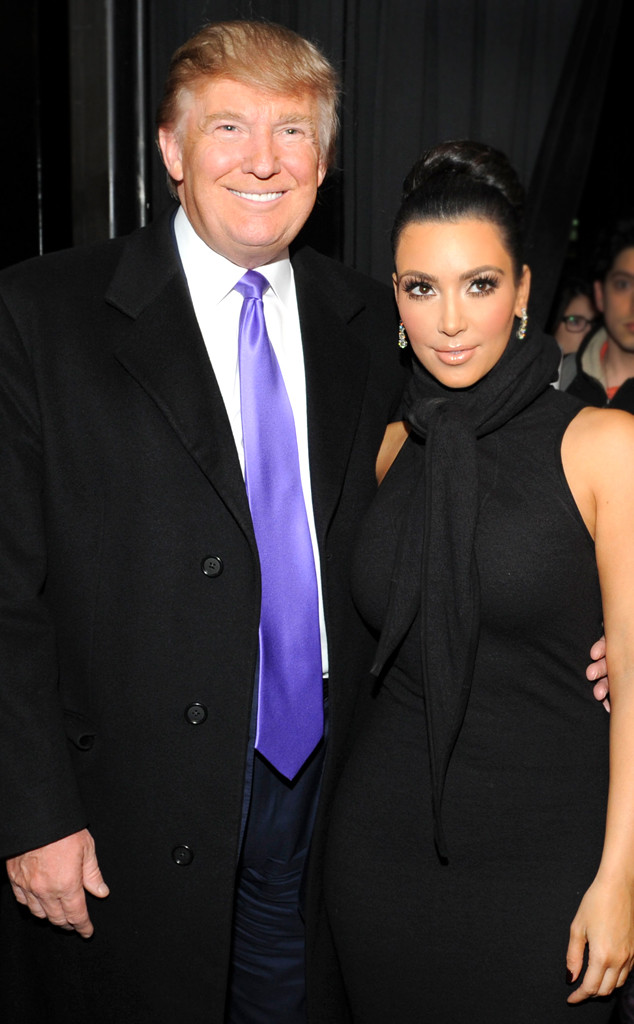
Donald Trump posing with Kim Kardashian at Celebrity Apprentice event, New York, 2010. (Mathew Imaging/WireImage via http://eonline.com).

Donald Trump posing with Kim Kardashian at Celebrity Apprentice event, New York, 2010. (Mathew Imaging/WireImage via http://eonline.com).

Sure, Trump apologized via video on Facebook late last night. But he won’t stop being a misogynist, or seeing people as meat. Heck, the Central Park 5 are still guilty and still deserving of the death penalty in his mind, and the jogger whom had been raped in 1989 is still only a “broken woman” and a “victim.” As far as Trump is concerned, his America consists of 320 million stalls of meat that he “can do anything” with at any time and expect to get away with it.

But if you think that this mindset has merely trickled down from the likes of people like Trump, you would be mistaken. American culture is so rife with a meat-market mentality, that I can smell the lean cuts of animal protein from miles away.

If Racism Is Broadway, Narcissism Is Grand Central

22 Thursday Sep 2016

Posted by decollins1969 in 1, culture, Eclectic, New York City, Politics, Pop Culture, race

≈ Leave a comment

Tags

American Narcissism, American Racism, Barbara Jeanne Fields, Black Reconstruction (1935), David Roediger, Diagnostic and Statistical Manual for Mental Disorders, DSM-V, Narcissism, Racism, W. E. B. Du Bois


Grand Central Terminal Main Concourse in New York City, March 4, 2006. (Janke and Diliff via Wikipedia). Permission granted via cc-Attribution-Share Alike 3.0 license.

Grand Central Terminal Main Concourse in New York City, March 4, 2006. (Janke and Diliff via Wikipedia). Permission granted via cc-Attribution-Share Alike 3.0 license.

This is a subject matter that normally would be too complicated for me to write about here. But then again, the work of explaining any aspect of the human condition is complex work. Especially when addressing American racism, its origins, its subatomic parts, and its effect on humans beyond the material and physical. Ta-Nehisi Coates, Maya Angelou, bell hooks, and so many others have described the Black body and what the Black body has had to endure at the hands of American racism. But perhaps one of the most serious effort to address the psychological impact of American racism on Blacks and Whites was W. E. B. Du Bois’ in Black Reconstruction (1935). It’s a book that is the very definition of tome, covering twenty years of history with a sociological lens determined to cut to the marrow of what occurred during Reconstruction as if the reader was an eyewitness to each day’s happenings between 1860 and 1880.

Thanks in varying measures to Derrick Bell, David Roediger, Patricia Hill Collins, Kimberlé Crenshaw, Michael Eric Dyson, and many, many others, intellectuals and scholars have made much progress with the oft-quoted phrase “the wages of whiteness” over the past quarter-century. But while many have explained the wages of Whiteness, most haven’t tried to define it, especially when it comes to the psychological.

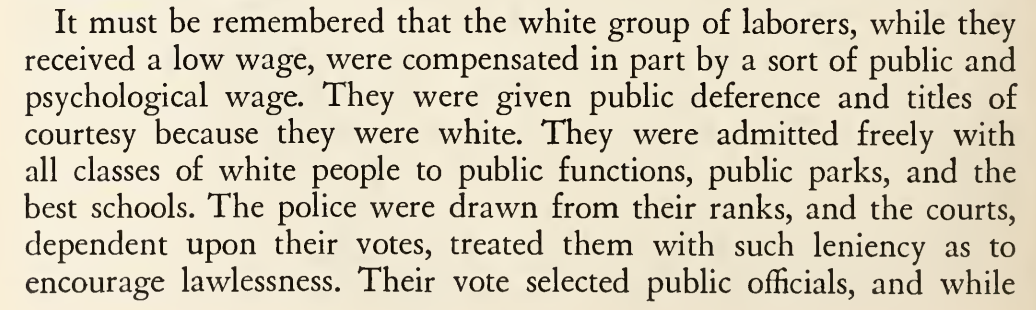
For a refresher, this was what Du Bois actually wrote about Whiteness and wages in Black Reconstruction:

screen-shot-2016-09-22-at-9-01-13-am

“A sort of public and psychological wage,” Du Bois wrote on page 700. Most scholars have explained rather thoroughly the public or material wages of Whiteness, of American racism for Whites on a structural and institutional level. Many have attempted to do so on an individual or internalizing level. But Du Bois was one of a handful who attempted to explain both the collective and individual impetus for being comfortable in racism. A founding member of the field of American sociology, an expert American and Black historian, Du Bois in 1935 discussed with great explanatory power the nature of American racism and how it developed over time to trump class divides.

But this only gets at the material. As for the psychological, Du Bois spent a significant amount of his 760 pages in Black Reconstruction attempting to do so. Except that, as a sociologist, Du Bois explained the psychological wage primarily in terms of group and interpersonal dynamics, and not in terms of group thought or a sort of collective thought.

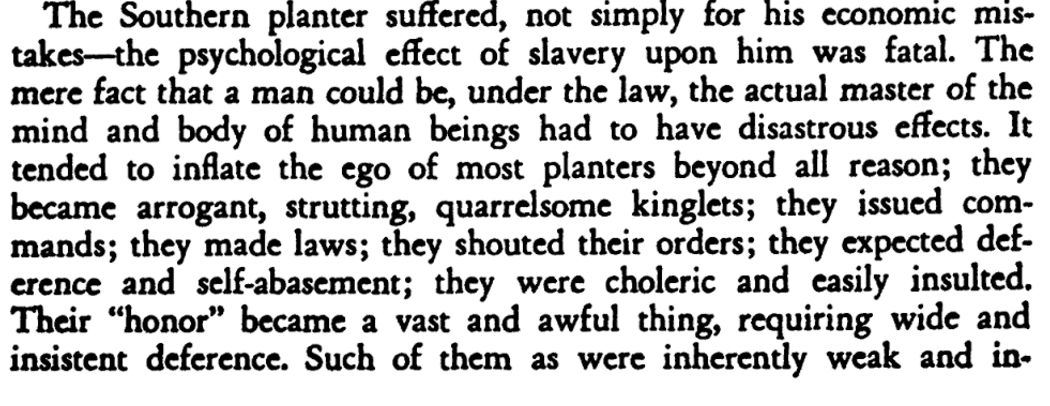
On page 52, though, Du Bois hits home with the following about American racism’s corrosive effect on those practicing it at the individual level:

screen-shot-2016-09-22-at-8-03-27-am

What Du Bois described in 1935 was not just the effect of American racism on the individual Southern planter. If Du Bois had possessed a copy of The Diagnostic and Statistical Manual for Mental Disorders, Fifth Edition (DSM-V), what he described we would call narcissistic personality disorder in 2016. Phrases like “inflate the ego…beyond all reason,” “arrogant, strutting, quarrelsome kinglets,” “expected deference and self-abasement,” and “were choleric and easily insulted.” These could easily be “a persistent manner of grandiosity, a continuous desire for admiration, along with a lack of empathy,” the DSM-V general description of narcissism.

A couple of quotes and a general description of narcissism are likely insufficient to link Du Bois’ prescient nod to social psychology on the issue of American racism. This is what the DSM-V says about narcissistic personality disorder in full:

In order to determine if a patient may have narcissistic personality disorder (NPD), a psychiatrist must determine if that patient meets at least any five (5) of the nine (9) standards below:

  1. A grandiose logic of self-importance
  2. A fixation with fantasies of unlimited success, control, brilliance, beauty, or idyllic love
  3. A credence that he or she is extraordinary and exceptional and can only be understood by, or should connect with, other extraordinary or important people or institutions
  4. A desire for unwarranted admiration
  5. A sense of entitlement
  6. Interpersonally oppressive behavior
  7. No form of empathy
  8. Resentment of others or a conviction that others are resentful of him or her
  9. A display of egotistical and conceited behaviors or attitudes

(American Psychiatric Association, 2013).

Now there are actually far more serious personality disorders that can be part of a larger set of self-destructive, dangerous, or even lethal behaviors, in which narcissistic personality disorder can be entangled. Most individuals with narcissistic personality disorder are not dangerous or self-destructive, and often function as normal human beings. In other words, there are levels of narcissism here, from the ground floor to the edges of the known universe.

Ah, but the DSM-V is describing the behavior of individuals, and not that of a class of people or a society, like what Du Bois attempted to do in Black Reconstruction, right? Yes and no. Du Bois used one individual example after another to build the case that the “white laborer” had come to have the same aspirations for the “public and psychological wages” that the Southern planter class had obtained through generations of owning slaves. Only, Blacks by the time of Reconstruction were slaves no more. The best way for Southern White elites to provide poor Whites all of the amenities of American racism without the latter either revolting against them outright or joining up with Blacks to fight grinding poverty was to codify American racism in the form of Jim Crow.

But where I and Du Bois are not on the same page is in the nature of American racism and narcissism as variables. Du Bois essentially argued that the psychological wage of Whiteness was the effect of American racism on Whites over time. The problem is, where does American racism come out of psychologically and sociologically? The simple yet true answer is out of gaming an advantage through greed and the desire for profit, through fear and the disdain for those whom have been deemed lesser, and through a willful ignorance and ignoring of the condition in which one has left other human beings. And that, for those who are reading, is both racism and narcissism, two separate yet interdependent ideas that help to prop each other up.

Before digging deeper into this, there are two things I want to make clear. One is that to think about American racism and American narcissism as part of the collective culture, think first of an atom. If racism were an atom, narcissism is its neutron. An atom doesn’t necessarily need a neutron to be stable (think Hydrogen atom, for example), and neutrons can be used to split atoms. People can be individually or collectively racist without necessarily being narcissistic, in other words, but the two often go hand-in-hand. Or, one can think about racism as the result of the social construction of race (to slightly quote Barbara Jean Fields), while narcissism is a psychological construction from which socially-constructed racism can spring, and then the former can be reinforced by the latter.

However, do not get it twisted. Just because I am saying that narcissism is a part of racism and vice-versa does not make racism a psychological illness by any means. That narcissists often function normally in nearly all social settings means that the personality disorder is a flaw or weakness of the human condition, not a disease. Racism is the attempt to take as much advantage of this flaw for oneself or for one’s group as better than others, and then use that success to reinforce the belief that one person or one group is better than another by taking even more advantages, materially and otherwise. American racism and American narcissism are two bosom buddies, and intertwine and intermix much more freely in the American context than virtually anywhere else.

← Older posts
Newer posts →

Boy @ The Window: A Memoir

Boy @ The Window: A Memoir

Places to Buy/Download Boy @ The Window

There's a few ways in which you can read excerpts of, borrow and/or purchase and download Boy @ The Window. There's the trade paperback edition of Boy @ The Window, available for purchase via Amazon.com at http://www.amazon.com/Boy-Window-Donald-Earl-Collins/dp/0989256138/

There's also a Kindle edition on Amazon.com. The enhanced edition can be read only with Kindle Fire, an iPad or a full-color tablet. The links to the enhanced edition through Apple's iBookstore and the Barnes & Noble NOOK edition are below. The link to the Amazon Kindle version is also immediately below:

scr2555-proj697-a-kindle-logo-rgb-lg

Boy @ The Window on Amazon.com: http://www.amazon.com/Boy-The-Window-Memoir-ebook/dp/B00CD95FBU/

iBookstore-logo-300x100

Boy @ The Window on Apple's iBookstore: https://itunes.apple.com/us/book/boy-the-window/id643768275?ls=1

Barnes & Noble (bn.com) logo, June 26, 2013. (http://www.logotypes101.com).

Boy @ The Window on Barnes & Noble: http://www.barnesandnoble.com/w/boy-the-window-donald-earl-collins/1115182183?ean=2940016741567

You can also add, read and review Boy @ The Window on Goodreads.com. Just click on the button below:

Boy @ The Window

Twitter Updates

Tweets by decollins1969
  • RSS - Posts
  • RSS - Comments

Archives

  • June 2025
  • April 2023
  • September 2022
  • August 2022
  • July 2022
  • June 2022
  • May 2022
  • April 2022
  • March 2022
  • January 2022
  • December 2021
  • November 2021
  • October 2021
  • September 2021
  • August 2021
  • July 2021
  • June 2021
  • April 2021
  • March 2021
  • February 2021
  • January 2021
  • December 2020
  • November 2020
  • October 2020
  • September 2020
  • August 2020
  • July 2020
  • May 2020
  • April 2020
  • March 2020
  • January 2020
  • December 2019
  • November 2019
  • August 2019
  • July 2019
  • June 2019
  • May 2019
  • April 2019
  • March 2019
  • February 2019
  • January 2019
  • December 2018
  • November 2018
  • October 2018
  • September 2018
  • August 2018
  • July 2018
  • June 2018
  • May 2018
  • March 2018
  • February 2018
  • January 2018
  • December 2017
  • November 2017
  • October 2017
  • September 2017
  • August 2017
  • July 2017
  • June 2017
  • May 2017
  • April 2017
  • March 2017
  • February 2017
  • January 2017
  • December 2016
  • November 2016
  • October 2016
  • September 2016
  • August 2016
  • July 2016
  • June 2016
  • May 2016
  • April 2016
  • March 2016
  • February 2016
  • January 2016
  • December 2015
  • November 2015
  • October 2015
  • September 2015
  • August 2015
  • July 2015
  • June 2015
  • May 2015
  • April 2015
  • March 2015
  • February 2015
  • January 2015
  • December 2014
  • November 2014
  • October 2014
  • September 2014
  • August 2014
  • July 2014
  • June 2014
  • May 2014
  • April 2014
  • March 2014
  • February 2014
  • January 2014
  • December 2013
  • November 2013
  • October 2013
  • September 2013
  • August 2013
  • July 2013
  • June 2013
  • May 2013
  • April 2013
  • March 2013
  • February 2013
  • January 2013
  • December 2012
  • November 2012
  • October 2012
  • September 2012
  • August 2012
  • July 2012
  • June 2012
  • May 2012
  • April 2012
  • March 2012
  • February 2012
  • January 2012
  • December 2011
  • November 2011
  • October 2011
  • September 2011
  • August 2011
  • July 2011
  • June 2011
  • May 2011
  • April 2011
  • March 2011
  • February 2011
  • January 2011
  • December 2010
  • November 2010
  • October 2010
  • September 2010
  • August 2010
  • July 2010
  • June 2010
  • May 2010
  • April 2010
  • March 2010
  • February 2010
  • January 2010
  • December 2009
  • November 2009
  • October 2009
  • September 2009
  • August 2009
  • July 2009
  • June 2009
  • May 2009
  • April 2009
  • March 2009
  • February 2009
  • January 2009
  • December 2008
  • November 2008
  • October 2008
  • September 2008
  • August 2008
  • July 2008
  • June 2008
  • May 2008
  • April 2008
  • March 2008
  • February 2008
  • January 2008
  • December 2007
  • November 2007
  • October 2007
  • September 2007
  • August 2007
  • July 2007
  • June 2007

Recent Comments

MaryPena's avatarMaryPena on My Day of Atonement/Bitter Hat…
decollins1969's avatardecollins1969 on No Good Teaching Deed Goes…
Mary Rose O’Connell's avatarMary Rose O’Connell on No Good Teaching Deed Goes…

NetworkedBlogs on Facebook

NetworkedBlogs
Blog:
Notes From a Boy @ The Window
Topics:
My Life, Culture & Education, Politics & Goofyness
 
Follow my blog

616 616 East Lincoln Avenue A.B. Davis Middle School Abuse Academia Academy for Educational Development AED Afrocentricity American Narcissism Authenticity Bigotry Blackness Boy @ The Window Carnegie Mellon University Child Abuse Class of 1987 CMU Coping Strategies Crush #1 Crush #2 Death Disillusionment Diversity Domestic Violence Economic Inequality Education Family Friendship Friendships Graduate School Hebrew-Israelites High-Stakes Testing Higher Education History Homelessness Humanities Humanities Program Hypocrisy Internalized Racism Jealousy Joe Trotter Joe William Trotter Jr. K-12 Education Love Manhood Maurice Eugene Washington Maurice Washington Misogyny Mother-Son Relationship Mount Vernon High School Mount Vernon New York Mount Vernon public schools Multiculturalism MVHS Narcissism NFL Pitt Pittsburgh Politics of Education Poverty President Barack Obama Race Racial Stereotypes Racism Relationships Self-Awareness Self-Discovery Self-Reflection Sexism Social Justice Teaching and Learning University of Pittsburgh Violence Whiteness Writing

Top Rated

Blog at WordPress.com.

  • Subscribe Subscribed
    • Notes from a Boy @ The Window
    • Join 103 other subscribers
    • Already have a WordPress.com account? Log in now.
    • Notes from a Boy @ The Window
    • Subscribe Subscribed
    • Sign up
    • Log in
    • Report this content
    • View site in Reader
    • Manage subscriptions
    • Collapse this bar
 

Loading Comments...