• Spinning Sage’s Gold: Allegories on the Western-Dominated Present and a Possible Post-Western Future (2025)
  • About Me
  • Other Writings
  • Interview Clips
  • Video Clips
  • Boy @ The Window Pictures
  • Boy @ The Window Theme Music

Notes from a Boy @ The Window

~

Notes from a Boy @ The Window

Tag Archives: Humanities

Mistake No. 3 and Book #2

19 Friday Nov 2010

Posted by decollins1969 in 1, Academia, Boy @ The Window, culture, Eclectic, eclectic music, Marriage

≈ Leave a comment

Tags

"Mistake No. 3", Culture Club, Emotional Support, Harold Meltzer, Humanities, Literary Agents, Marriage, Mount Vernon High School, Mount Vernon New York, Publishing Business, Rosemary Martino, Waking Up With The House On Fire, Writing, Writing Mistakes, Writing Process


Culture Club, "Mistake No. 3" Single, November 19, 2010. Source: http://www.onlineauction.com

I’ve made many more than three mistakes in my walk as a writer. Mistake number three probably came around the same time Culture Club released “Mistake No. 3” off of their Waking Up with the House on Fire album in ’84. So many of them have come because I’ve either been impatient in making a decision or too tentative to make one at all.

Just with Boy @ The Window alone, I’ve probably made at least thirty-three mistakes. I should’ve started working on the book right after my conversation with my late teacher Harold Meltzer about my experiences, in February ’95. Even without Google, Facebook, MySpace, and so many other places to look, it would’ve been much easier to track down my ex-classmates and teachers. Instead, I single-mindedly pursued my doctorate and my doctoral thesis as if it were gold-pressed platinum. All the while asking myself if I was a historian first and a writer second, or a writer that just happened to be an academic historian?

When I finally did begin working on the manuscript, in the summer of ’02, I think that I was writing about four different books. It had an academic side to it, a look at magnet school programs and their inherent arrogance around diversity and race, not to mention intelligence, especially in the 80s. I was also writing narrative nonfiction, ala Eric Schlosser and Adrian Nicole LeBlanc, as well as fitting in bits and piece of memoir. And Meltzer, during my second and what would turn out to be final interview with him, suggested that I might want to turn the project into a novel. Why fiction? Because, in so many words, I wouldn’t piss anyone among the living with a Mount Vernon connection off.

Boy, I had no idea how right he was! Not about making Boy @ The Window a work of fiction. But about how many people I’d turn off or have attack me just during the research phase of the project. More people turned me down for interviews than granted them in the first years. If I sold it to them as a research project, I could hear their eyes glaze over while discussing it on the phone or in their keyboard strokes in an email. I pissed off many more as I started to write, as I did more interviews, as I started my blog in June ’07. I found out that I was defiling sacrosanct ground when writing about “Money Earnin’ Mount Vernon.”

I mistakenly began to shop the manuscript around in looking for an agent almost before I’d finished my first full draft of it. I had an agent for Fear of a “Black” America, but I’d found her in ’99, and the industry had changed so much in the eight years before I started looking for one again. I found myself having to have a well-thought out marketing strategy without having defined Boy @ The Window as a full-fledged

Neil Diamond, "Love On The Rocks" at concert, November 19, 2010. Source: https://www.rockbackingtracks.co.uk/images/neil_diamond.jpg

memoir at this point. It wasn’t a disaster, as I managed to get about thirty percent of the agents I contacted interested enough to look at my unpolished manuscript. Before their standard rejections would come back.

Licking my wounds and being more patient, to continue to revise and re-polish and repeat for most of ’09 and this year was hardly a bad thing. Realizing that my wife never liked the idea of me working on Boy @ The Window was harder, much, much harder than any agent’s multiple-xeroxed form rejection letter. I’d been in denial about it for about three years. It was when I sat down at the end of ’09 to do a long-overdue overhaul of the memoir that she finally made it obvious to me that I’d violated some unwritten rule in our marriage about delving too deeply in my past. It was about a year ago that I realized that — at least on the subject of Boy @ The Window — I’d lost my significant other of fifteen years, who simply wanted and wants me to move on.

There’s no doubt, though, that the biggest mistake I’ve ever made as a writer was to choose to not see myself as a writer for the better part of two decades. That’s probably the reason why it’s taken me years to work on Boy @ The Window, why I’m still a forty-one-year-old late bloomer in this calling of mine. That I’ve made as many mistakes as I have and still remain hopeful about publishing this memoir is, well, both crazy and just the thing I need to get through, I suppose. My former AP English teacher Rosemary Martino was right about one thing. Writing really does take sacrifice.

The Eclectic, Authentic Donald

04 Saturday Sep 2010

Posted by decollins1969 in 1, Boy @ The Window, culture, earth, wind & fire, Eclectic, eclectic music, Mount Vernon High School, Pop Culture, race, Youth

≈ Leave a comment

Tags

"Broken Wings", "What About Love", 616 East Lincoln Avenue, Authenticity, BET, Cable, Heart, Humanities, Mount Vernon High School, Mount Vernon New York, Mr. Mister, MTV, Music, Race, Sade, VH1


Maxwell's Embrya (1997) Album Art

I am, and will always remain, a goofy oddball. I’ve known that for at least twenty-five years, probably closer to thirty. For it was this week in ’85 that we finally got cable at 616. More than four years after MTV, and a few months into VH1, we finally no longer needed antennas to watch TV. My fat, greasy slob of a stepfather hogged the gigantic wood-framed hand-me-down of a nineteen-inch Zenith, along with the living room, most of the time. But I came home from the beginning of the school year — my junior year of Meltzer and AP US History at MVHS — at the end of the first week, with no one home.

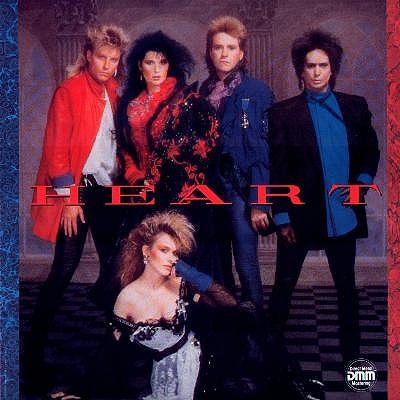
I turned on the TV, found MTV, and boom, I was in the heart of the ’80s. As soon as I hit the channel, a new video began, heavily synthesized and very much over the top. It turned out to be Heart’s “What About Love,” the first release off of their new album. I liked the song immediately. But more importantly, I liked

Heart, 1985. (Look at that hair!?!)

the fact that I could now also put faces and styles to voices and lyrics. I was late, four years too late in understanding the jokes, the fashion motifs and consumerism concerns of my more socioeconomically- blessed classmates. As the saying goes, though, better late than never.

That afternoon, I ended up seeing videos from Sade, Tears for Fears, Dire

Mr. Mister (1985) Welcome To The Real World

Straits, Sting, and Mr. Mister’s “Broken Wings.” The last one was a weird video, but very heartfelt, and one that has stayed with as long as any song I’ve heard or video I’ve seen since (more on that in December). I eventually checked out some boring Alexander O’Neal videos on BET before my mother and younger siblings came home from school and grocery shopping.

It wasn’t as if I hadn’t listened to music before September ’85. I was already well aware of the fact that my music tastes weren’t stereotypically Black, weren’t all that White, and certainly weren’t all that old and mature. Having played the trombone in fifth grade, the fife for Hebrew-Israelite stuff all through ’82, and sang in school choirs sixth, seventh and eighth grade (until my voice started cracking), it wasn’t as if I didn’t know when someone was off key or timing their drum sequences.

Still, I found music that didn’t have the voice of Luther (Vandross) or Patti (Austin or LaBelle) or the beats of Doug E. Fresh, Grandmaster Flash or Run-D.M.C. appealing. It reached me because I had moments I needed to be reached, to be serious, to focus on the pain that was my life in the mid-80s, a pain that few artists sang or wrote about in any direct way. I could relate to the lyrics of rejection, redemption and

The Best of Sade (1992) Album Art

resolution more than I could relate to someone stepping on my brand new sneakers and getting attitude. Songs that could reach me because I had moments I needed to feel and be goofy, to laugh at myself for feeling as pathetic as I did back then. Nothing, and I mean nothing, in the R&B and early hip-hop repertoire of ’85 did that for me.

So I branched out, almost immediately after that MTV afternoon in early-fall early-September. I became even more interested in what some of my classmates called “that White music,” even deliberately listening to WPLJ and Z-100, adding that to WBLS. I also took the occasional turn to WCBS-101 (oldies station of Sinatra, Nat King Cole and Dean Martin), had a brief foray into Phillip Glass and ’80s new age, a rare stumble into jazz, and yes, for those who believe I embody the rejection of all things “Black,” found my need for R&B and some rap in my eyes and ears.That first week in September ’85 pretty much sealed my fate as an eclectic music listener. Many who know me and my Mount Vernon past would say that Humanities and being around all those White kids had something to do with this. Some, including my mother, would say that my education has led to some sense of racial self-loathing, that I deliberately gave up my heritage to chase some false sense of Whiteness — or,

Seal (1994) Album Art

that I’m “acting White.”

I’d say that I was a goofy and serious late-bloomer, who listened to music and lyrics for meaning, for a kernel of wisdom and hope. Some or all of those things can be found in any genre of music, anywhere, anytime, under any circumstance. Music, like people, can’t be separated into races unless people choose to be separate, a truth I understand now and guessed at intuitively then.

The Writing Bug

19 Thursday Aug 2010

Posted by decollins1969 in 1, Boy @ The Window, Eclectic, eclectic music, music, Youth

≈ Leave a comment

Tags

616 East Lincoln Avenue, Abuse, Domestic Violence, Humanities, Mount Vernon New York, Writing


Writing Bug. Source: http://imaginationsoup.net/wp-content/uploads/2009/06/

It’s been twenty-nine years since I first saw myself as a writer and attempted to pursue writing in any form. It was the summer of ’81, the summer before Humanities and seventh grade, the year before the summer of my abuse. For me at least, this was a calm summer, like I was sitting out by a lake with only a slight breeze blowing around me. I was enjoying the peace and quiet of being near still water, of an occasional rustle of trees, of a plop or two of something dropped into the lake. This was a time for me to imagine our lives as better, better than they actually were. I was on an end-of-elementary school and Humanities-acceptance high. I couldn’t have been any higher than if I had snorted coke at one of those drug-fueled parties my mother used to drag us to hang out with her Mount Vernon Hospital buddies when I was five or six (Luckily, my mother didn’t do drugs.)

I spent most of that summer writing my first book. It was a book about the top-secret military hardware the Department of Defense didn’t want the rest of America to know about. I remained consumed with reading about war and military technology in my spare time — I wouldn’t have learned the word “fortnight” otherwise! Everything from the B-1 bomber to the M-1 Abrams tank to the Trident submarine and MX missile was to be in this scoop on the latest in military high-tech. I even wrote a letter to the Pentagon for declassified pictures of these weapons, which I received in mid-July. By the time of my brother Yiscoc’s birth (one form of Hebrew for “Isaac” and pronounced “yizz-co”) later in the month, I’d written nearly fifty pages on these weapons and why they were so cool for the US military to have. Especially in light of the Soviet military threat. Unfortunately, they didn’t declassify the fact that America’s latest tank used depleted uranium in parts of its hull or in its cannon shells. That would’ve been a real scoop at the time.

I also began to keep my own journal as I began to lose interest in America’s military hardware at the end of that summer. Little did I know what was to come at 616 and in seventh grade in Humanities. My journal was an off and on again project of dreadful tales of hunger, humiliation and heartache. By the time of Crush #1 and witnessing my stepfather’s attack of my mother on Memorial Day ’82, I could barely write at all. The last thing I wrote for my journal (which was a spiral notebook) was about my own abuse throughout July ’82. By the time that ended, I didn’t feel like writing anymore.

But that wasn’t the end of the story. My imagination, my constant talking to myself, my eventual fascination with having an eclectic variety of music and rooting for underdog teams and athletes were all part of a writing process that actually didn’t require me to write. All of these coping mechanisms and more gave me more to write about once I went off to college, and especially after my ex-stepfather broke up with my mother after my sophomore. It wasn’t an accident that within a few months of dumb ass moving out in June ’89, I had started my first journal in seven years. I guess that I always had the writing bug, even when I didn’t possess the paper necessary to write.

Crush #1 and Other Bedtime Stories

10 Saturday Jul 2010

Posted by decollins1969 in 1, Boy @ The Window, Eclectic, Jimme, Mount Vernon High School, Sports, Youth

≈ Leave a comment

Tags

616 East Lincoln Avenue, A.B. Davis Middle School, Bedtime Stories, Characters, Class of 1987, Classmates, Holmes ES, Humanities, Mount Vernon High School, Mount Vernon New York, Stories


Noah Sleeping, September 2009

For about the past year and a half, me and my wife have spent some of our time at the end of the day with our son Noah telling him bedtime stories. Actually, it’s been mostly me, since my wife doesn’t like making up stuff. At first, it was just about every night, with me telling Noah true stories about family, friends, former classmates and my school experiences.

I’d often put Noah in those stories, especially the ones I knew he’d laugh at. Like the science teacher who came in one day smelling like a skunk had sprayed him because a skunk actually did. Or the story about my second day of high school, where I had to fight a class hipster because he thought that I was a wimpy push-over.

With me injecting Noah into these stories — usually as the character Ben 10 turning into Big Chill or Humongousaur — I realized I had to embellish a bit, making some of my real-life encounters less like real-life. I told stories about my father where I changed almost all of the wording because the real stories involved more profanity and bigotry than a five or six-year-old should ever have to hear. I’d leave out parts of stories about how mean some of my classmates or teachers were just to make sure Noah was ready to go to sleep happy and without asking me a lot of questions about my past.

About six months ago, I started making up stories, about eighty-five percent fictional in nature. The names

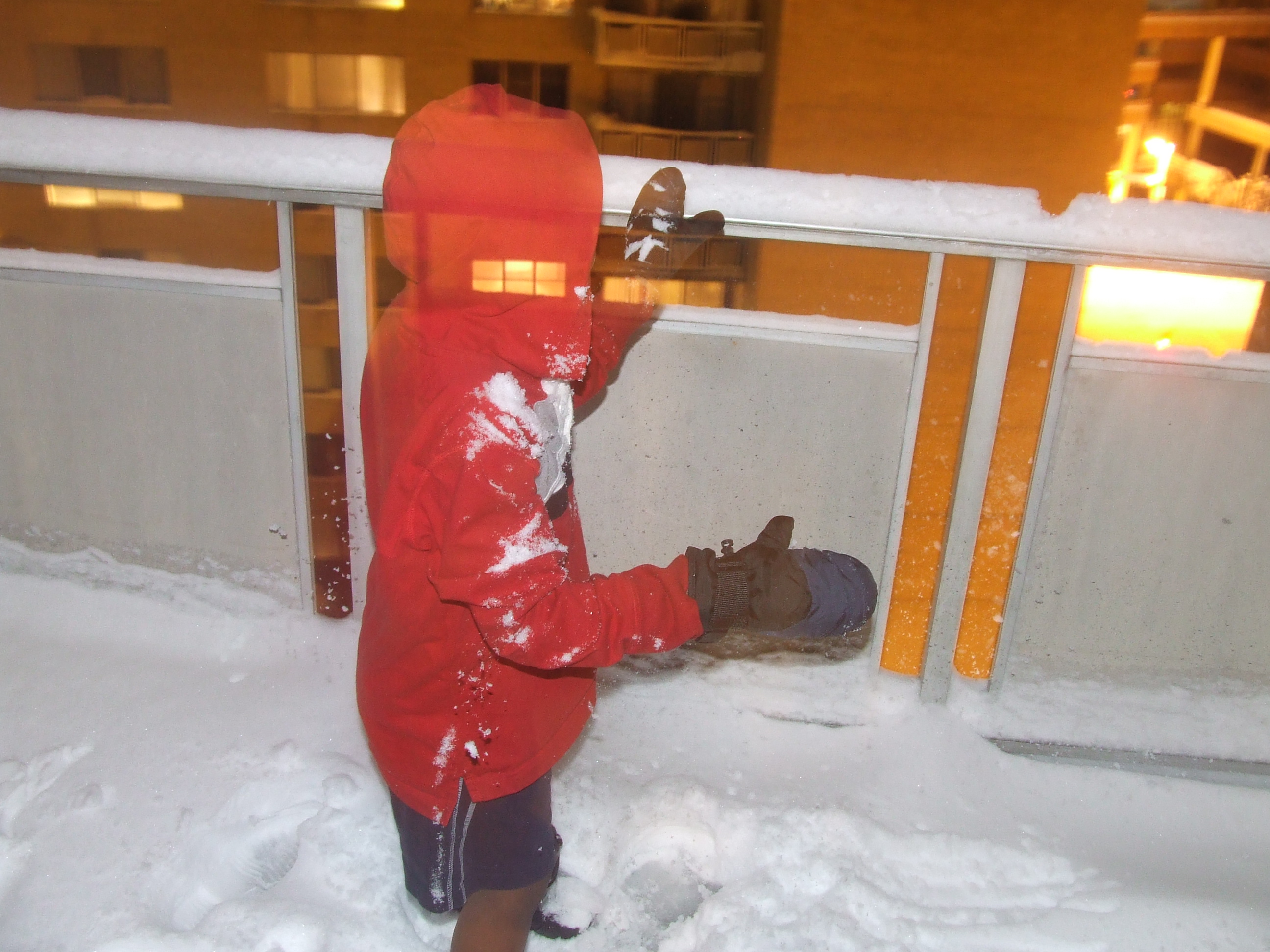
Noah in Snowaggedon (on balcony), February 2010

and places remained the same, but the incidences and their improbable outcomes didn’t. I figured out that Noah mostly enjoyed a few choice characters: a fictionalized ’80s version of my father, a singing, wise-cracking fictional classmate, a super-smart classmate who’d get a case of the “ums” and “uhs” under duress, a friend from my elementary school days who’d fart when under pressure, and an even more tomboyish version of my Crush #1. Noah has since asked for those characters in my stories over and over again.

He’s also asked a lot of questions about my real-life classmates, teachers and family. Like, “Did you really have a classmate who sings ‘Roxanne’ all the time?” Or “Did [your friend] really fart all the time?” “Are you still friends with [super-smart boy]?” So I pulled out the MVHS Class of ’87 yearbook that I had borrowed from a former classmate when revising drafts of Boy @ The Window to show Noah pictures of them so that he could see that these weren’t the larger-than-life, made-up characters I used in my bedtime stories. Not to mention using the power of Facebook to bring home that fact as well.

This past week, Noah’s asked a few more questions. “Do you still like [Crush #1] a lot?,” Noah asked me a couple of days ago. “I still like her, but not the way I liked her when I was twelve,” I said in response, kind of shocked that he asked me that question out of the blue. I then thought for a moment, “Maybe I should keep the twelve-year-old in me to myself until he’s older.”

Noah Salutes

Then I realized. I have to tell Noah these stories. At the very least, it’ll help him not make the same mistakes I made growing up. That way, he won’t have to spend most of his time growing up without good friends, without an eleven-year gap between kisses, with mostly stories that would make most six-year-olds cry. Or, at the least, sad. He can read all about it when he’s older and Boy @ The Window’s published.

My AP US History Story

06 Thursday May 2010

Posted by decollins1969 in 1, Eclectic, Mount Vernon High School

≈ Leave a comment

Tags

AP US History, Class of 1987, Harold Meltzer, Humanities, Mount Vernon High School, Mount Vernon New York, Teaching and Learning


In honor of all the students I’ve taught who are in the midst of AP exams the next two weeks — especially the ones who are due to take the AP US History or APUSH exam Friday — the following is my APUSH story. It’s about the weeks and days from early April to May 13 of ’86. Unlike my other mediocre and bittersweet stories of AP crash-and-burn, this one’s about academic triumph. But, it’s from a kid-like perspective, so buckle up.

***************************

In the weeks before the APUSH exam, Meltzer practically locked us in his classroom, sweeping through nearly a century of American history. We covered Reconstruction, industrialization and Woodrow Wilson, both World Wars, FDR and the Great Depression as if we were in a time machine with a warp drive engine. The last week before the exam was critical for everyone in the class, except for me of course. God had created a mind and imagination such as mine for this moment, where analysis was as important as knowledge for this kind of exam. After school that week was one of Meltzer ordering pizza and buying sodas for us so that we could grasp how to tackle the AP exam using his methods. I stayed because I loved Meltzer’s stories and because of five days of free food.

Watching my classmates sweat it out while asking Meltzer every conceivable question on American history, especially the parts he didn’t cover, was the most entertaining part of the week. They grilled him to the point where Meltzer had walked them through the exam point-by-point. All while telling us “Not to worry, kiddos! You’re all gonna do just fine!” Our soon-to-be-valedictorian and one other classmate were probably the most anxious and most diligent in their inquisition of Meltzer. They had all but outlined our textbook Morison and Commager page by page to get answers to issues and events they didn’t understand. We covered the women’s suffrage movement, immigration, the Great Depression and the New Deal, the League of Nations, the Cold War and McCarthyism, and so many other events that I was tired just listening to them ask. All this time with Meltzer and they still didn’t fully comprehend Meltzer’s master plan for preparing us for the exam.

Even in my calmness, I knew that this was the most significant exam I’d take going into college, one certainly more reflective of my skills than New York State Regents exams or the SAT. Of all things, my only concern was making sure I had a good breakfast before taking the exam. The weekend before, I scored over a hundred dollars off my father Jimme, and after distributing the spoils to Darren and my mother, I still had fifty left. The night before the exam, I went to the store and deli and bought all my little morning snacks, yogurt included. I slept well that night, dreaming about the exam and how well I thought I’d do.

Tapes prepared and Walkman somewhat in working order, I walked to school the next morning fully charged and as well-fed as my boney butt could be. It was the thirteenth of May, a brisk and overcast Tuesday that felt more like early November. I made sure not to go into MVHS’ library, our exam room for the morning, until about a minute before we were going to start. If I learned anything from being around my classmates, it was to be as calm and cool as a cup of ice. They still generally ran around acting all nervous and stressed out before a major test, turning colors and breaking out in hives, which sometimes drove me nuts. Why couldn’t they just chill? So my solution was to avoid their stress for as long as I could before coming into the room.

Once I sat down, I didn’t even remember what the proctor or Meltzer had said. Once they said “Go,” I hit the multiple choice section and just blew through it. The only problem I had during the exam was understanding what the word “pluralism” meant. And when I saw the term “cultural pluralism,” I felt slightly more baffled. What I did in response was read the questions and answers to form context, which seemed to me to be around American society having groups of people from different races and parts of the world living in the same country. About fifteen or twenty of my one hundred bubble questions was on pluralism or cultural pluralism.

Then we began the essay portion of the exam. Two essays to write and we had forty-five minutes to write each one. The first one was also on the topic of pluralism. “This must be the word of the day,” I thought. It dawned on me that there might’ve been a relationship between these pluralism questions and the century anniversary of the Statue of Liberty’s opening on Liberty Island. I don’t know, I think that this may have been my document-based essay question. The other essay, by comparison, was a piece of cake. By the time we finished they exam, I was tired but pretty happy with my performance. It was basketball season, and I felt like I’d been knocking down jumpers left and right in going after these questions, like Isiah Thomas or Bernard King wouldn’t know by how much until sometime in July.

I looked at my classmates. They all seemed tired and bent out of shape by the exam. Some looked a little frustrated and angry. I was a bit surprised. I knew that most of them had done well, and I assumed that valedictorian and salutatorian had done at least as well as me. Yet they weren’t at all happy. Their moods varied from relieved to downright surly after the exam was over. Meltzer was happy for us all.

My AP score arrived in the mail just after the fourth of July. I scored my coveted 5, meaning that I had earned six college credits before choosing my school. I expected this score, but what I didn’t expect was how perfectly I performed. The College Board’s breakdown showed that I’d gotten ninety-four out of one hundred multiple choice questions correct and that two of my three essays had received the highest possible score — I scored a 4 on one of the free-response essays. I wasn’t just happy. It was like winning the lottery. I was in another world the rest of the day.

***********************************

What makes this story interesting is that I took the approach that as long as I stayed calm, away from my classmates and well fed, everything would work the way I wanted them to. All too often, we make big moments even bigger in our heads and hearts than necessary, causing ourselves more stress, and, ironically, guaranteeing ourselves poor or mediocre performances. I don’t want to hear the all-too-often-used-phrase, “I work well under pressure.” We think we do, but twenty years of teaching and even more as a student have proven to me otherwise. So, please folks, eat a good meal, take a chill pill and a deep breath before sitting down and cutting open your test booklets over the next week or so. Sixteen’s too young to have ulcers.

Doctoring History

25 Thursday Mar 2010

Posted by decollins1969 in 1, Boy @ The Window, Eclectic

≈ Leave a comment

Tags

A.B. Davis Middle School, American History, Class of 1987, Demontravel, Humanities, Teachers, Teaching and Learning


One of the worst teachers I ever had was my eighth grade history teacher. There were a few others in my Mount Vernon K-12 days — and certainly in my times at Pitt and Carnegie Mellon — who were worse. But the absolute worst history teacher or professor I ever had between ’74 and ’96 was in a classroom in the corner of the new wing at A.B. Davis Middle School from September ’82 through June ’83.

His name was Mr. Demontravel, our American history teacher. Or as he preferred in the last three months of eighth grade, Dr. Demontravel (he had finished his doctoral thesis on the Civil War, on what beyond that, I wasn’t sure, and, given the way he was to me and us, I didn’t care either). Or as I liked to call him throughout that year, “Demon Travel.” His was a class that sucked the life out of history for most of us. Like most teachers of K-12 social studies or history, it was a dates, names, and places class. Unlike most social studies teachers, his teaching methodology was the epitome of lazy. Every class, five days a week, Demontravel would put up five questions on the blackboard for us to copy down and answer using our textbook. At the end of every two-week period, we’d get a fifty-question multiple choice exam, helping Scan-Tron stay in business.

Demontravel rarely stood up to lecture or do anything else. Lectures for him might as well have been appearances by Halley’s Comet, only the lectures were far less memorable. This process went on unabated for forty-weeks, four marking periods, an entire school year. Calling this boring would only get you into the door of the intellectual famine Demontravel subjected us to in eighth grade.

He wasn’t particularly helpful on the rare occasions when someone did have a question. When a classmate did ask him something, the portly Demontravel would stand up from his desk, which was to our right as we faced the chalkboard, slowly walk toward it, point to a question on the board, tell us in his best Teddy Roosevelt voice what page to turn to in looking for the answer, and then, just as slowly, return to his seat at his desk. Of course, the page numbers he gave us were usually wrong. Demontravel was truly an unremarkable man, virtually bald in all of his pink salmon-headedness, skinny and potbellied beyond belief. His shiny bald head had a Gorbachev-like spot on it. In his early fifties, Demontravel was so boring that it was a wonder that I noticed him at all.

But there was the fact that there was a prize on the line for us nerdy middle-schoolers—the eighth-grade History Award. “Something I could actually win,” I thought. And Demontravel was the sole arbiter over the award. My favorite and easiest subject was in the hands of this hack of a teacher. That made me downright angry whenever I thought about it.

What made it worse was that I was in competition with a classmate who cared for history in the same way that a semi-suburban boy like me cared for milking cows. For most of the year, we were separated by less than a point in our overall grades as we fought for the award. I guess I should’ve known that I wasn’t going to get it, regardless of my grades in Demon Travel’s course. My competitor, female and White as she was, was doted on by Demontravel for most of the year. I guess my near-exact same grade just meant that I was slumming in the A+ zone.

Then there was Demontravel’s demand for a typewritten three- to five-page essay on a World War II topic of our choosing, at the beginning of April ’83. It wasn’t something I could just write at my leisure and in my own handwriting. My father Jimme had to go buy a typewriter for me, one of those where you have to punch the keys to leave lettered ink on a page. I didn’t know how to type, and I knew no one else at home did either. So I used the two-index finger method, gradually figuring out how to type in double-space, to add footnotes and references, to write without using a pen. I chose to look at the Battle of the Philippines and the almost comical errors of both the Japanese and the U.S. there in 1942 and again in 1944-45. Demontravel gave me a 95 or 96 on it, helping me pull away of my friendly competitor at the beginning of May.

This was when we had our little incident, me and “Demon Travel,” in which I showed up the newly-minted PhD in his classroom. Ours was a discussion of World War I, one of the few times he actually attempted to lecture. He somehow managed to get wrong a key treaty on the Eastern Front that declared Germany a victor, gave them parts of Belarus and the Ukraine, and took Russia out of the war. Demontravel managed to get the parties involved in the treaty incorrect as well. I raised my hand, and when called upon I politely pointed out his error. He immediately became angry and told me that he couldn’t be wrong. Since I also could never be wrong, especially about an historical fact, I quoted the book directly, pointed out the name and date of the treaty, the parties involved, and the significance of the treaty to boot.

At that point he told me that if I ever corrected him like that again I would go Assistant Principal Gentile’s office. Gentile, a hard ass, would’ve been better off as a correction’s officer in Shawshank Redemption or in the HBO series Oz than as an administrator at Davis. I still didn’t want to see him, so I got quiet, quiet but fuming. Demontravel looked like a redneck after a day of labor in the hot Mississippi sun. All he needed was a shotgun in one hand and a bottle of beer in the other. My classmates were cracking up, excited even because they saw me as having put Demontravel in his place. I kind of knew then that it wouldn’t matter if I did finish ahead of my competitor. I wasn’t going to get my much-deserved award.

The lesson that it would take me until my thirties to learn was that life and learning isn’t just about how much you know and how well you exhibit such knowledge and wisdom. It’s much more about politics and being able to read people and situations before speaking and acting in such situations. I knew, but pretty much didn’t care, that Demontravel didn’t like me. He probably knew, but didn’t need to care, that I thought that his class was a joke, a cheap version of the short-lived contest show on NBC, Sale of the Century. Bottom line — especially in having gone through the experience of earning my own doctorate in history — you don’t mess with a boring yet overworked teacher who just finished earning a Ph.D. Even if his reach has exceeded his grasp of it.

Strange Days

24 Wednesday Jun 2009

Posted by decollins1969 in 1, Boy @ The Window, Christianity, culture, Eclectic, Jimme, Marriage, Mount Vernon High School, Mount Vernon New York, Movies, music, race, Youth

≈ Leave a comment

Tags

616 East Lincoln Avenue, Black Male Identity, College Years, Crush #1, Humanities, Identity, Mount Venron HIgh School, Popularity, Salutatorian, Self-Reflection


Cover for the album Strange Days by The Doors, September 1967, scanned June 27, 2008. (Father McKenzie via Wikipedia). Qualifies as fair use because of low resolution of scanned album cover.

Being on campus at Princeton teaching for a few weeks and working with college-ready high school students sometimes takes me back into my past. It’s funny really, realizing that the “best and the brightest” were hardly the best and weren’t quite so bright, even at the time I went to school with them. That’s not to say that the students I’ve had or have now at Princeton or the classmates I graduated with didn’t or don’t have loads of potential. They did and do. It’s more about what can happen when teachers, administrators and parents fill our heads full with delusions of grandeur, with ideas of intellectual greatness based on signs of academic excellence. It’s what can happen when students spend more time trying to keep up with the image of high academic achievement that others have created for them rather than finding their own path, one that allows them to be themselves and to tap into their potential.

I know, I know, some students strive and thrive even with the pressures from their parents, the doting of teachers, and the turning-the-other-way of administrators. I could also be accused of playa hatin’, I suppose. After all, I was far from popular in my glory days of high school, and only found myself in the last two and a half years of college. But that’s just it. Even I had to come to grips with my family’s expectations — especially the lack of them — in high school and college. I needed to find myself in order to be all that I could be in college and in grad school. I needed to make a clean break from the doubters in my life — including of course, my teachers and administrators.

That’s the unfortunate truth I faced in my last two years at Mount Vernon High School. Especially when the class rankings came out a month into our senior year. Out of 545 potential graduates, I was ranked fourteenth. I was a little disappointed because I didn’t crack the top ten, mostly because I knew I needed scholarship money and a good financial aid package to help pay for college, wherever I went. I had already learned that my performance wasn’t good enough for my teachers in eleventh grade. They kept reminding me that I was doing nothing in comparison to the salutatorian in our class, an involved-in-everything Black male. I guess I could’ve argued that they should’ve been comparing me to our Class of ’87 valedictorian, but my teachers saw the second in our class as a much more well-rounded student. At the very least, I knew from the comparisons that the person I was supposed to be more like had a charming way with our teachers.

I saw this particular classmate as more of an enigma than many of the other ones I had done time with in Humanities. I genuinely felt both in awe of and disheartened by his presence in my life during the Humanities years. I thought it was amazing that he was able to do as much as he did. The high school band. The mock trial team. The school newspaper. Our yearbook. An appearance on Phil Donahue! At least he wasn’t a star basketball player too, especially in Mount Vernon.

Yet I saw the results of all of that involvement on his part, and not just in terms of how teachers saw me. As far as teachers were concerned, it was as if I was this classmate’s younger, underachieving brother. But I also saw how the young man occasionally worked his reputation to his advantage, cashing in on his built-up academic capital to give himself more time to work on assignments no one else got a second of overtime to do. I don’t think I ever wanted to be him or become close friends with him, though. Something about his need to be well-liked by our peers and teachers bothered me. So I was happy in more ways than one to see our salutatorian gallop into the sunset with his diploma, a law firm job in Manhattan, and his ticket to Harvard punched some twenty-two years ago.
Ralph Fiennes and Angela Bassett in Strange Days (1995), screen shot, November 12, 2009. (http://ugo.com via Fox Entertainment). Qualifies as fair use because of low resolution of screen shot, not meant for redistribution.

Something strange happened in the days after the final fight between my mother and ex-stepfather in June ’89 (see my “The Miracle of Divorce” post from earlier this month). It was a week after idiot Maurice had moved out for the last time. Me and my older brother Darren were on our way to my father Jimme’s for money and because Darren was in the process of moving out of 616 — God knows he needed to. Along the way, we bumped into Crush #1, which is a story unto itself, a good one that is. Ten minutes later we bumped into salutatorian off The Avenue and West First, still trekking toward Jimme’s. This surprise meeting trumped my Crush #1 conversation and made a lasting impression on my understanding of myself as a Black male. So much so that I had a long conversation with my late teacher Harold Meltzer about it years later.

When I bumped into the man en route to Jimme’s with Darren, he’d just gotten off work at his summer law firm job in the city, his third summer working there. He was wearing a hideous green-and-white-checkered dress shirt with dark green suspenders and even darker green slacks. Why hideous? Because on a hot and hazy day in late-June ’89, a day in which batting an eyelash required some degree of sweat, the guy was dressed like it was the middle of March. The color scheme didn’t blend at all with his dark chocolate skin, and his face was both greasy and sweaty from a long, hard day. But the biggest shock was his hair. It was conked — or fried as some folks say — ala Miles Davis or Malcolm Little before he became Malcolm X. This was the first thing I noticed, even before the Green Giant getup. Since I was already in a pissy mood, one only mildly moderated by my Crush #1 sighting and conversation, I didn’t outwardly react to it.

I realized as I stood there with Darren talking to my former classmate what had bothered me about him

Jolly Green Giant statue in Blue Earth, Minnesota, May 20, 2006. (Jonathunder via Wikipedia). Released into public domain via CC and & GFDL.

during all of our years together in Humanities. I had called him an “Oreo Cookie “—Black on the outside, White in the middle — in my head and under my breath on a few occasions during our Humanities years. Yet this sighting and conversation let me know that I was wrong. Sadly, I realized that our salutatorian didn’t have any identity at all. He made himself into whomever others wanted him to be. To his family, he was the mild-mannered and religiously faithful kid who just happened to be smart. To our teachers, he was super-intelligent, an overstretched overachiever whom teachers gave the benefit of the doubt if his assignment was late and he needed an extra day. To many of us, he was the polar opposite of our eventual valedictorian, a talented competitor who was far more worthy of our school’s number one status. I’m sure to a fair number of his Harvard classmates saw him as a marvel, either not “Black” enough or too much of a “credit to his race.”

The person I saw that day wasn’t the confident, take-on-the-world with a-smile-on-his-face person I’d seen in action for six years in Humanities. He was confident enough to attempt to act that way toward me, though. I got the story about how life at Harvard was good, that he was succeeding academically and that he’d found a way to fit in with his mostly White, six-figure and two-comma classmates. He also still intended to go to law school. And though his job at the law firm was difficult, he said that he enjoyed that also. My former classmate must’ve thought that he was talking to the uncultured twelve-year-old I once had been. His utter lack of details about classes, people, majors or professors let me know right away that life for his at America’s preeminent university was somewhere between rocky and a living hell.

My conversation with the person folks thought I should be much more like was a major revelation. It explained why it took until I was a sophomore in college to find my footing. We all had significant identity issues, exaggerated by our competitive conditioning as Humanities students. These weren’t typical teenage struggles over being cool or not. Especially when being cool meant being “Black” or “Italian” or “anti-intellectual” or a “brainiac,” not just “cool” in general. You could say that our grades and ranks—or shunning them as the case might’ve been—were as much a part of our individual identities as being affluent or Jewish or Black. Our salutatorian may well have been an extreme example of this, but he was hardly alone. Everyone in Humanities, even the “cool” cliques within had their share of identity issues to reconcile or struggle with.

My own identity issues were many and varied. In my case, though, I’d been working on reconciling mine since the middle of seventh grade. I realized that the battle I’d been waging for so long came out of my identity crisis, one that started as a spiritual disconnect between being a Hebrew-Israelite and watching my stepfather break every rule in the Talmud while attempting to break me and my mother. That battle didn’t even begin to subside until I decided to embrace myself for who I was, good, bad and ugly. Once I took that proactive step, shooting for the best person I could be and small miracles like real friendships were only a matter of time. It’s a lesson that I hope the high-potential students I’ve taught the past couple of years learn, and learn well.

← Older posts
Newer posts →

Boy @ The Window: A Memoir

Boy @ The Window: A Memoir

Places to Buy/Download Boy @ The Window

There's a few ways in which you can read excerpts of, borrow and/or purchase and download Boy @ The Window. There's the trade paperback edition of Boy @ The Window, available for purchase via Amazon.com at http://www.amazon.com/Boy-Window-Donald-Earl-Collins/dp/0989256138/

There's also a Kindle edition on Amazon.com. The enhanced edition can be read only with Kindle Fire, an iPad or a full-color tablet. The links to the enhanced edition through Apple's iBookstore and the Barnes & Noble NOOK edition are below. The link to the Amazon Kindle version is also immediately below:

scr2555-proj697-a-kindle-logo-rgb-lg

Boy @ The Window on Amazon.com: http://www.amazon.com/Boy-The-Window-Memoir-ebook/dp/B00CD95FBU/

iBookstore-logo-300x100

Boy @ The Window on Apple's iBookstore: https://itunes.apple.com/us/book/boy-the-window/id643768275?ls=1

Barnes & Noble (bn.com) logo, June 26, 2013. (http://www.logotypes101.com).

Boy @ The Window on Barnes & Noble: http://www.barnesandnoble.com/w/boy-the-window-donald-earl-collins/1115182183?ean=2940016741567

You can also add, read and review Boy @ The Window on Goodreads.com. Just click on the button below:

Boy @ The Window

Twitter Updates

Tweets by decollins1969
  • RSS - Posts
  • RSS - Comments

Archives

  • June 2025
  • April 2023
  • September 2022
  • August 2022
  • July 2022
  • June 2022
  • May 2022
  • April 2022
  • March 2022
  • January 2022
  • December 2021
  • November 2021
  • October 2021
  • September 2021
  • August 2021
  • July 2021
  • June 2021
  • April 2021
  • March 2021
  • February 2021
  • January 2021
  • December 2020
  • November 2020
  • October 2020
  • September 2020
  • August 2020
  • July 2020
  • May 2020
  • April 2020
  • March 2020
  • January 2020
  • December 2019
  • November 2019
  • August 2019
  • July 2019
  • June 2019
  • May 2019
  • April 2019
  • March 2019
  • February 2019
  • January 2019
  • December 2018
  • November 2018
  • October 2018
  • September 2018
  • August 2018
  • July 2018
  • June 2018
  • May 2018
  • March 2018
  • February 2018
  • January 2018
  • December 2017
  • November 2017
  • October 2017
  • September 2017
  • August 2017
  • July 2017
  • June 2017
  • May 2017
  • April 2017
  • March 2017
  • February 2017
  • January 2017
  • December 2016
  • November 2016
  • October 2016
  • September 2016
  • August 2016
  • July 2016
  • June 2016
  • May 2016
  • April 2016
  • March 2016
  • February 2016
  • January 2016
  • December 2015
  • November 2015
  • October 2015
  • September 2015
  • August 2015
  • July 2015
  • June 2015
  • May 2015
  • April 2015
  • March 2015
  • February 2015
  • January 2015
  • December 2014
  • November 2014
  • October 2014
  • September 2014
  • August 2014
  • July 2014
  • June 2014
  • May 2014
  • April 2014
  • March 2014
  • February 2014
  • January 2014
  • December 2013
  • November 2013
  • October 2013
  • September 2013
  • August 2013
  • July 2013
  • June 2013
  • May 2013
  • April 2013
  • March 2013
  • February 2013
  • January 2013
  • December 2012
  • November 2012
  • October 2012
  • September 2012
  • August 2012
  • July 2012
  • June 2012
  • May 2012
  • April 2012
  • March 2012
  • February 2012
  • January 2012
  • December 2011
  • November 2011
  • October 2011
  • September 2011
  • August 2011
  • July 2011
  • June 2011
  • May 2011
  • April 2011
  • March 2011
  • February 2011
  • January 2011
  • December 2010
  • November 2010
  • October 2010
  • September 2010
  • August 2010
  • July 2010
  • June 2010
  • May 2010
  • April 2010
  • March 2010
  • February 2010
  • January 2010
  • December 2009
  • November 2009
  • October 2009
  • September 2009
  • August 2009
  • July 2009
  • June 2009
  • May 2009
  • April 2009
  • March 2009
  • February 2009
  • January 2009
  • December 2008
  • November 2008
  • October 2008
  • September 2008
  • August 2008
  • July 2008
  • June 2008
  • May 2008
  • April 2008
  • March 2008
  • February 2008
  • January 2008
  • December 2007
  • November 2007
  • October 2007
  • September 2007
  • August 2007
  • July 2007
  • June 2007

Recent Comments

MaryPena's avatarMaryPena on My Day of Atonement/Bitter Hat…
decollins1969's avatardecollins1969 on No Good Teaching Deed Goes…
Mary Rose O’Connell's avatarMary Rose O’Connell on No Good Teaching Deed Goes…

NetworkedBlogs on Facebook

NetworkedBlogs
Blog:
Notes From a Boy @ The Window
Topics:
My Life, Culture & Education, Politics & Goofyness
 
Follow my blog

616 616 East Lincoln Avenue A.B. Davis Middle School Abuse Academia Academy for Educational Development AED Afrocentricity American Narcissism Authenticity Bigotry Blackness Boy @ The Window Carnegie Mellon University Child Abuse Class of 1987 CMU Coping Strategies Crush #1 Crush #2 Death Disillusionment Diversity Domestic Violence Economic Inequality Education Family Friendship Friendships Graduate School Hebrew-Israelites High-Stakes Testing Higher Education History Homelessness Humanities Humanities Program Hypocrisy Internalized Racism Jealousy Joe Trotter Joe William Trotter Jr. K-12 Education Love Manhood Maurice Eugene Washington Maurice Washington Misogyny Mother-Son Relationship Mount Vernon High School Mount Vernon New York Mount Vernon public schools Multiculturalism MVHS Narcissism NFL Pitt Pittsburgh Politics of Education Poverty President Barack Obama Race Racial Stereotypes Racism Relationships Self-Awareness Self-Discovery Self-Reflection Sexism Social Justice Teaching and Learning University of Pittsburgh Violence Whiteness Writing

Top Rated

Blog at WordPress.com.

  • Subscribe Subscribed
    • Notes from a Boy @ The Window
    • Join 103 other subscribers
    • Already have a WordPress.com account? Log in now.
    • Notes from a Boy @ The Window
    • Subscribe Subscribed
    • Sign up
    • Log in
    • Report this content
    • View site in Reader
    • Manage subscriptions
    • Collapse this bar
 

Loading Comments...