• About Me
  • Other Writings
  • Interview Clips
  • All About Me: American Racism, American Narcissism, and the Conversation America Can’t Have
  • Video Clips
  • Boy @ The Window Pictures
  • Boy @ The Window Theme Music

Notes from a Boy @ The Window

~

Notes from a Boy @ The Window

Tag Archives: Higher Education

K-16 Education Reform and the Unlevel Playing Field

23 Friday Aug 2013

Posted by decollins1969 in 1, Academia, culture, Eclectic, Politics, Pop Culture, race

≈ Leave a comment

Tags

Adult Learners, College Affordability, College Success, Degree Attainment, Dr. Steve Perry, Economic Inequality, Education Inequality, Employability, First-Generation Students, High-Stakes Testing, Higher Education, K-16 Education Reform, Michelle Rhee, Poor Students, Private Foundations, Student Loans, Students of Color, Teacher Accountability, Two-Tiered System, US Department of Education, Wendy Kopp
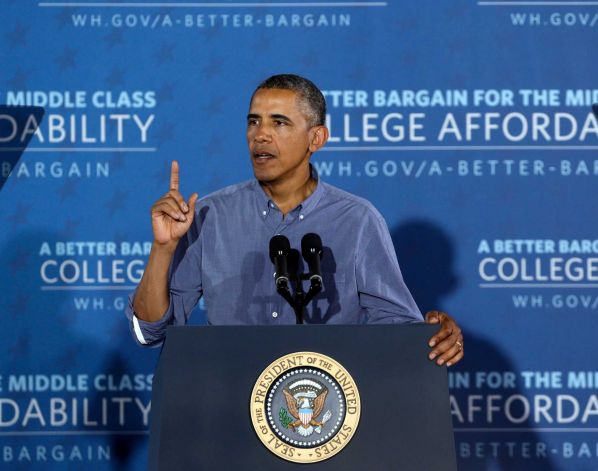

President Barack Obama speaking college affordability and a rating system, University of Buffalo (NY), August 22, 2013. (http://sfgate.com).

President Barack Obama speaking college affordability and a rating system, University of Buffalo (NY), August 22, 2013. (http://sfgate.com).

The shape and direction of education reform in America’s public schools and in US higher education is such that one can only conclude that this is the century in which social mobility will be limited to a precious and lucky few. With high-stakes testing and No Child Left Behind on the K-12 side, and the rise of for-profit online institutions in postsecondary education, we’re well on our way to a two-tiered system of education. One tier for the affluent, who will attend private schools and elite colleges, and a much lower tier for the rest of us, who will increasingly receive a watered down public education and have ever more limited higher education options.

The Problem With Mainstream K-16 Reformers:

The problem is, though, most reformers actually believe that their efforts at reform will result in a fairer and more level playing field for our kids and for first-generation college students of every stripe. They have an unwavering desire to make testing the cornerstone of curriculum revisions and the key determinant in measuring teacher effectiveness, and thus, tying future funds to school performance levels. Or, in the case of for-profit online higher education, they believe that financial aid in the form of student loans, accelerated classes with a curriculum strictly geared for current job market trends and lack of academic support is the shape of their river. Leaving vulnerable millions of first-generation students — particularly low-income adult learners (many of whom are of color) — to dropping out of college with tens of thousands of dollars of student loans to pay off and with few good career prospects.

Mock Time Magazine cover with Michelle Rhee alleging her full knowledge of cheating scandal in DC Public Schools, April 14, 2013.  (By a college student whose mom is a 7th grade teacher -http://www.susanohanian.org/)

Mock Time Magazine cover with Michelle Rhee alleging her full knowledge of cheating scandal in DC Public Schools, April 14, 2013. (By a college student whose mom is a 7th grade teacher -http://www.susanohanian.org/)

These reforms go further in providing an unlevel playing field. One where only a privileged few get to go down Mount Everest in a helicopter. The rest of us, meanwhile, must climb up Everest, ill-equipped for the climate while dodging rock slides, avalanches and other land mines all along the way.

An Unasked Question About K-12 Reform:

That reformers don’t see this is one thing. That they don’t even ask the questions that they should about their reform endgame has been the real problem for years. For example, they don’t ask the simple question, “Will high-stakes testing and teacher effectiveness measures close the achievement gap and make it so that students regardless of race and family income will be well prepared after graduating high school for college or for workforce training?”

The answer to this, of course, is no. High-stakes testing cannot and will not close the achievement gap or lead to students graduating high school better prepared for college and the 21st century working world. Teachers and administrators will continue to devote more of their time and efforts to testing than to other aspects of their jobs, for fear of losing their jobs. Reformers will continue to use the mantra of testing to siphon those precious and limited taxpayer dollars out of state legislatures and school boards to cover the costs of test development and test-based teacher evaluations. And students attending the allegedly worst performing schools will continue to lose good teachers and move from school to school in search of the promise — but not the reality — of a quality K-12 education.

Reformers like Michelle Rhee, Wendy Kopp and Dr. Steve Perry (not to be confused with Journey’s lead singer) don’t ask this question. They are too busy procuring funds from the Bill & Melinda Gates Foundation, Lumina Foundation for Education, the Wallace Foundation and the US Department of Education to discuss the shape of their reform river. They are much more interested in proving a strong correlation between teacher effectiveness and student achievement via test scores, because they believe this is the way, truth and life for K-12 reform. And pretty soon, we will know that this correlation either doesn’t exist or is a weak one at best, under some rather ideal circumstances.

An Unasked Question About Higher Education Reform:

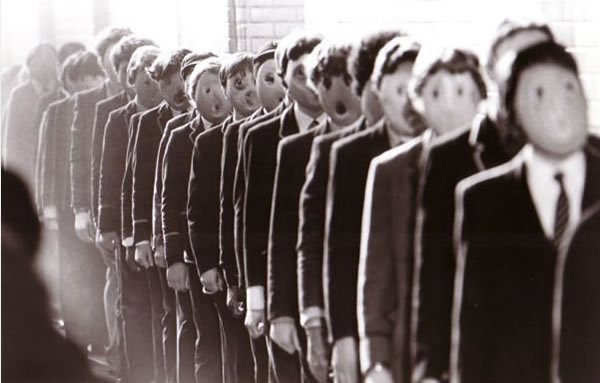
Futurama poster "A Mindless Worker Is A Happy Worker," August 23, 2013. (http://d3.ru)

Futurama poster “A Mindless Worker Is A Happy Worker,” August 23, 2013. (http://d3.ru)

For-profit institutions involved in online higher education do no better in asking fundamental questions about their endgame. University of Phoenix, Kaplan University and Capella University don’t ask, “Is an accelerated online college format that is highly dependent on underprepared first-generation college students, provides few or no academic support services and is heavily subsidized by federal student loans the best possible postsecondary education for these students?” Of course it isn’t. Over the past 20 years, these institutions have been too busy figuring out ways to increase the enrollment of low-income students to ask this question. They have been more interested in drawing in as much federal student loan aid as possible to cover the costs of student enrollment to ask whether they are providing the best services.

For those not-so-lucky students attending these institutions, they face a great distance between the promises of this new higher education regime and its brutal reality. For-profits promise an online education that is tailor-made for students’ job and career aspirations, one even more alluring because it is an allegedly convenient fit for the demands of any adult lifestyle. For-profits seem to be proud of the fact that fewer than 20 percent of their students complete a degree eight years after they first enroll in one of their courses. For those few students who do manage to complete a degree, many are finding that their narrowly focused degrees don’t match up with their career aspirations.

Irony and Shame:

The irony is that for-profit online higher education has all but moved away from testing at a time when the only thing that matters in K-12 education is testing, from a child’s first week in kindergarten to his or her last day of 12th grade. The ironic shame of it all is that reformers in both K-12 and higher education never ask the question of what we should expect at the end of the reforming rainbow. Their reform efforts are purely about making a profit, for themselves or for others. The rest of us, meanwhile, can’t wait for Superman, with reformers stealing his powers on both ends of the K-16 spectrum, and placing kryptonite for real reform at every turn.

—-

I wrote all this months ago. Now, with President Barack Obama offering a formalized version of accountability for higher education institutions that connects market-relevant degrees and employment to college success, him and his administration are pushing the two-tiered agenda even further. Private elite colleges can easily opt out of this Race to the Top-esque rating system for higher education costs-to-employability ratios, and create their own measures around affordability, degree-attainment and career pathways. Or not, for that matter.

Public institutions — the ones tied most directly to US Department of Education funds — will have little choice but to go down this money-wasting path. One that in the end will do nothing for first-generation students, students of color, older students, heck, any student who comes from a humble background. “It’s a shame and a pitiful,” as my father would say.
The Myth of the Earnest Adult Learner

15 Monday Jul 2013

Posted by decollins1969 in 1, Academia, culture, Eclectic, Politics, Pop Culture, race, Work, Youth

≈ Leave a comment

Tags

Adult Learners, Higher Education, K-16 Reform, MOOCs, Myth, Reality, Teacher-Student Relationship, University of Phoenix


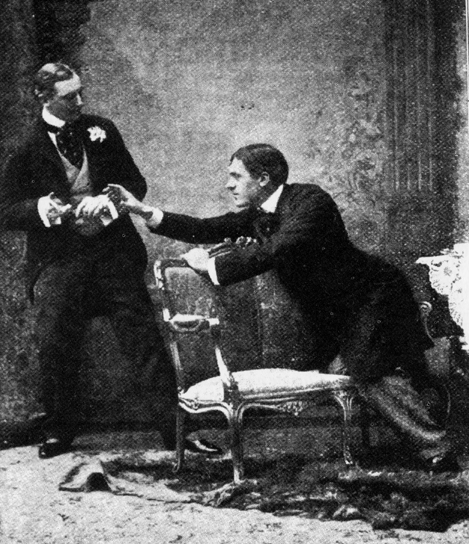
Oscar Wilde's The Importance of Being Earnest, with Allan Aynesworth as Algernon (left) and George Alexander as John (right), St. James Theatre, London, UK, February 14, 1895. (Ramac via Wikipedia). In public domain.

Oscar Wilde’s The Importance of Being Earnest, with Allan Aynesworth as Algernon (left) and George Alexander as John (right), St. James Theatre, London, UK, February 14, 1895. (Ramac via Wikipedia). In public domain.

One of the great myths in higher education is that of the adult learner as earnest student. Aside from the fairly obvious differences in lifestyle between a high-achieving, straight-to-college seventeen-year-old and a 34-year-old mother of two who works as a paralegal, the fact is that most adult learners act in the classroom like many traditional college students. Except that they are often academically and socially unprepared for college, not likely to attend a traditional college — with the resources necessary to help them become successful students — and are much more susceptible to dropping out of college because of the challenges they face in the classroom and in their own lives.

Myth vs. Reality:

This myth of the earnest adult learner has become a big one over the past thirty years, especially in light of the rise of for-profit postsecondary institutions like University of Phoenix and DeVry Institute. Anyone who has seen an ad on TV, in a newspaper or online can describe the mythical adult learner. Someone who’s 24 years old or older, often a paraprofessional or attempting to rise in a white-collar occupation like nursing, accounting, or information technology. A person who may be married or a parent or in the military. A potential student that has somehow been let down by traditional two-year colleges and four-year institutions, because the 10-week quarter-system and 16-week semester-system didn’t fit their real-world schedule.

The myth doesn’t fit at all with my own experience. As someone who has taught hundreds of adult learners off and on over the past 15 years – especially the past five – the behavior of older students in the classroom is really no different that than of traditional college-age students. Like 17 to 24-year-olds, the over-24 crowd is typically disorganized and lack the reading, note-taking and study skills needed to keep up with the pace of a college course. Like students who attend more traditional college settings such as Princeton, the University of Pittsburgh or Howard University, the adult learners I have taught miss deadlines, plagiarize their papers and cheat on final exams.

One of multitude of "I Am A Phoenix" ads, July 15, 2013. (University of Phoenix).

One of multitude of “I Am A Phoenix” ads, July 15, 2013. (University of Phoenix).

This shouldn’t be a surprise to anyone in higher education. Ad after ad sells college to adult learners as a service or a product that will lead them to a higher paying job. Period. College for them is hardly about forming new friendships or discovering themselves or their calling in life. The mythical adult learner is way too busy for such trifling pursuits. No, it is all about a piece of paper that they can wave around to get a promotion from junior accountant to accountant or from nurse’s aide to nurse.

Yet this too is a myth. Most adult learners are not really paraprofessionals or in low-level white-collar careers, poised for career advancement. They work at Walmart or Dunkin Donuts, as tellers at Wachovia Bank or as security guards with G4S. Some are active military or ex-Armed Forces, but many more are underemployed or even unemployed. Most are part of America’s rising welfare and working poor, or struggling to stay working-class or lower-middle class. At best, finishing a four-year degree would make them more employable than they would be otherwise, but not to the point that they should expect to become a doctor or an architect.

This background leaves most adult learners socially unprepared for college, but not because they cannot relate to college students between the ages of 17 and 24. They simply do not see school as a personal journey or even as an opportunity for educational advancement. It is a means to a new career and a higher income. Relationship-building to find a potential employer would not make any sense to most adult learners, as they are often segregated in virtual or physical classrooms with other adult learners, and not in classes with the sons and daughters of potential employers. Forming a bond with a professor would seem ridiculous, because they tend to see their often part-time instructors as customer-service representatives.

Adult Learners vs. Traditional College-Age Students:

This isn’t much different than the mindset of most traditional college students. I have taught a couple thousand of them over the past two decades, and in my experience, most of them view college as the means to the start of a great career making good money. The difference, really, is that there remains a wider diversity of thought about the higher education experience among younger college students than among those over 24. The quality of their education, the bonds of friendship or relationship they form with each other and with their professors, what they are able to take away from their college experience beyond their degree. All matter much more to so-called traditional students than they do to adult learners.

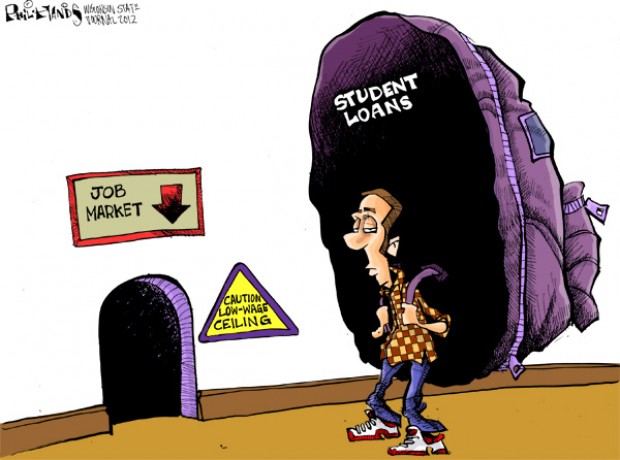
Student debt cartoon (although this is hardly the only stressor adult learners and other nontraditional-traditional students face), May 2, 2012. (Phil Hands/Wisconsin State Journal).

Student debt cartoon (although this is hardly the only stressor adult learners and other nontraditional-traditional students face), May 2, 2012. (Phil Hands/Wisconsin State Journal).

What is also similar is the idea that college is 13th, 14th, 15th and 16th grade for both groups of students. Both are just as apt to come up with myriad excuses for missing a paper submission deadline or for failing an exam. They had a big project at work that took up all of their spare time. They had a bad cold or the flu or strep throat or mononucleosis. Their computer crashed at the last minute, or they lost electricity or their Internet access went down. What I don’t often hear from traditional higher education students — but do expect to hear from adult learners — are excuses about children in emergency rooms, bad marriages, sick spouses and older parents, foreclosures on homes and cars breaking down on highways. For some, sometimes more than once in the same semester. Adult learners are as good at whining as traditional students.

The biggest myth on this end, though, is that younger college students face fewer obstacles to a degree than adult learners because 17-to-24 year-olds don’t have real-world problems. That’s completely false. Nearly two-thirds of traditional college students work part-time or full-time to cover everything from beer costs to their student loans and college tuition. Less advantaged students have pressures from parents and family around income loss, poverty and healthcare. Though most younger college students aren’t married, don’t have kids or work at the bottom rung of a career ladder, they do confront many of the same real-world financial and familial pressures.

Ending the Myth of the Traditional:

Are there any new innovations, such as Massive Open Online Courses (MOOCs), that would help adult learners achieve their degree — if not educational or academic — aspirations? It is really too early to tell with MOOCs. What is safe to say, though, is that adult learners as a group need to break out of mindset that higher education owes them flexibility without them taking responsibility for their own education. Higher education institutions, meanwhile, do need to recognize that adult learners have never been traditional, and traditional college students aren’t traditional anymore. Myth-busting on both the student side and instructor side would be a good place to start to make college aspirations and success a reality for adult learners.

38.990666 -77.026088

Sports and “The -tions”

22 Saturday Dec 2012

Posted by decollins1969 in 1, Academia, culture, Eclectic, High Rise Buildings, Politics, Pop Culture, race, Sports, Work

≈ Leave a comment

Tags

"Social Political Economic", African American History, De-industrialization, Declining Cities, Economic Inequality, Gentrification, High School Social Studies Teaching Formula, Higher Education, History, History of American Sports, History of Education, Immigration, Industrialization, Migration, social mobility, Suburbanization, Teaching History, The -tions, Urbanization, US History, World History


Gentrification via sports collage, December 22, 2012. [Includes aerial view of location of new DC baseball stadium site, June 22, 2006, http://www.wreckingcorp.com; Nationals Park Greeting Card; Baseball Stadium Price Tag cartoon, March 27, 2008 (Nate Beeler/Washington Examiner)]

Gentrification via sports collage, December 22, 2012. [Includes aerial view of location of new DC baseball stadium site, June 22, 2006, http://www.wreckingcorp.com; Nationals Park Greeting Card; Baseball Stadium Price Tag cartoon, March 27, 2008 (Nate Beeler/Washington Examiner)]

Off and on for the past twenty years, I’ve attempted to wean my students off the ridiculous high school social studies formula for addressing an essay question or writing a history paper. Thinking about history — particularly modern world history or US history — purely in social, political and economic terms misses so much. History is about patterns, trends and dynamic processes involving people and human tendencies. So in my discussion sections for US History Since 1877 in the fall of ’92, I began to discuss the idea that you can better understand history through applying what I started to call “the -tions” as a series of trends, processes and patterns.

I did this because I’d already grown tired of students who had adopted “the formula.” The formula goes something like this. First, write an introduction (usually, without mention of the need for a clear thesis statement). Then, put facts, events, ideas and evidence in the social, political and economic changes silos (it always has to be these three). Then, write a conclusion that restates the introduction, with a “my essay/paper has proven” sentence.

Steel grain silos, Ralls, Texas, October 12, 2010. (Leaflet via Wikipedia). In public domain.

Steel grain silos, Ralls, Texas, October 12, 2010. (Leaflet via Wikipedia). In public domain.

It’s a terrible way to teach history, and a terrible way to write about it. It leaves so much out, including the idea that history is a constantly evolving process, not a static picture of events involving larger-than-life individuals herding billions of people through one period of history or another. So I decided to make immigration, industrialization, urbanization, and migration (sometimes called internal migration) a bigger focus with my students my second year of graduate school at Pitt. Some liked it, some didn’t, and some just kept writing their formulaic five-paragraph essays for their midterm and final exams. Oh well.

So, in expanding my list of -tions to include de-industrialization, suburbanization, globalization and gentrification over the years, I’ve begun to see patterns beyond what I typically teach or even write about. The rise and decline of American cities are a case in point. Especially if one compares this to the rise and decline of mainstream American team sports over time. That baseball, football and basketball have all been the nation’s first or second most popular sports at one point or another since the 1890s is a reflection of the leisure activities available to ordinary Americans living in growing or declining cities.

Of course, I could also include boxing (as this was America’s most popular sport through the first four decades of the twentieth century). But as an individual sport wrought with even more racial overtones than baseball, boxing deserves a separate discussion. For team sports, though, their rise or decline in popularity seems to have followed a number of trends related to the -tions.

Baseball was the nation’s most popular team sport from the 1890s through the 1950s, mirroring the growth of American cities (urbanization) during the same period. Immigrants from Southern and Eastern Europe helped grow these cities, as they left behind rural poverty, religious persecution and pogroms for industrial exploitation here in the US. Native-born Whites, already enamored with baseball, essentially introduced these immigrant groups to the sport, which in turn made it more popular. Of course, many sons of these immigrants became great baseball players. Blacks migrating to cities such as New York, Pittsburgh, Kansas City and Chicago also adopted the pastime. Every -tion is involved, at least, that’s my argument.

As we well know, though, baseball has declined in popularity since the 1950s, as the professional game became an integrated sport, and as millions of Whites began moving to the suburbs, taking millions of jobs with them. Blacks underwent a second massive wave of migration after 1940 that grew during the 1950s and 1960s.

During this transition, basketball and football (especially the latter) became more popular sports. Both were sports whose history and records were less revered than those in baseball, and at least appeared to be more welcoming of athletes of color than baseball. In the migration of Whites from cities to suburbs and Blacks to cities, the shuffling of team sports’ popularity and their locations began.

Pittsburgh's Civic Arena under demolitiion, March 11, 2012 (AVPHOTOGRAPHICS PGH via Flickr.com). In public domain. The "Igloo" (home of the Pittsburgh Penguins) itself was built after the demolition of the Lower Hill District between 1958 and 1961, displacing thousands of Blacks in the process.

Pittsburgh’s Civic Arena under demolition, March 11, 2012. (AVPHOTOGRAPHICS PGH via Flickr.com). In public domain. The “Igloo” (home of the Pittsburgh Penguins) itself was built after the demolition of the Lower Hill District between 1958 and 1961, displacing thousands of Blacks.

Once the US economy began to decline, and then de-industrialize, in the 1970s, 1980s, and 1990, the role of declining cities attempting to hold on to their sports franchises became a new theme. Declining post-industrial cities like Baltimore, Detroit and Cleveland lost their teams entirely to other cities, or lost them to the suburbs. While Sunbelt cities like Dallas-Fort Worth, Atlanta, Phoenix, Denver and Houston have picked up some of these pieces.

Gentrification, backed by a politically conservative model for economic growth and nary a concern for the declining income of city residents, has led to a return of professional sports teams to city centers. Billions of taxpayer dollars have gone into sports arenas and stadiums in Washington, DC, Brooklyn, Seattle, Detroit, Boston, San Jose, and so many other places across the country. But with little to no benefit for the people living in these cities, especially the poor. As a result of the inflation that came with gentrification and these commercial building ventures, millions of America’s poor have been forced to move out into poorer suburban communities that often border major cities.

Maybe it’s just me. I just don’t find much to celebrate about the business side of sports today, because it reflects the trends of growing economic inequality and much more difficult social mobility. It shows how desperate the mayors of declining cities are for growing their municipalities, without regard for its poor and working-class residents. It’s emblematic of our culture’s inability to see that the shift from industrial work to service industry work has left millions without the ability to live decent lives in city or suburb, whether they migrate to Houston or stay in New York. Sports is a reflection of these trends, but they also exacerbate them as well.

Providing the Wrong Frame for Higher Education

12 Wednesday Dec 2012

Posted by decollins1969 in 1, Academia, culture, Eclectic, Politics, race, Work, Youth

≈ Leave a comment

Tags

"Investing in the Future", American Competitiveness, Center for American Progress, Critical Thinking, Drew Gilpin Faust, Educational Attainment, Efficiency, Gene Sperling, Glenn Hutchins, Harvard University, Higher Education, Innovation, K-12 Education, Neera Tanden, Philosophy of Education, Poverty, Purpose of Education, social mobility, STEM Fields, Technocrats, Workforce Development


Neera Tanden and Drew Gilpin Faust, Center for American Progress' "Investing in the Future" event (screen shot), Washington, DC, December 10, 2012. (http://americanprogress.org).

Neera Tanden and Drew Gilpin Faust, Center for American Progress’ “Investing in the Future” event (screen shot), Washington, DC, December 10, 2012. (http://americanprogress.org).

I was supposed to attend the Center for American Progress event “Investing in the Future: Higher Education, Innovation, and American Competitiveness” yesterday morning (who does a two-and-a-half-hour event two Mondays before Christmas, really?). But my son happened to have his worst night of sleep in his nine and a third years of life, compounded by a minor asthma attack. So I didn’t get to go.

I’m glad that I didn’t attend, though, as the above link to the site and video will indicate to even an educator with the patience of Jesus. After watching and skipping through the 138-minute recording today, I realized that passing a kidney stone (which I’ve actually done) would be preferable to hearing the drivel that the Center for American Progress, Harvard University and Google sponsored yesterday.

It was a tour-de-force of K-16 education as preparation for practical careers and scientific/technological innovation. Period. Not education to formulate a critical mind. Not education for the betterment of society, for social justice, for changing the world. No, Americans, our very future depends purely on the willingness of Harvard (and other elite universities), corporations and government to work together to turn out millions of students to work in STEM fields, apparently the only fields that matter in the twenty-first century.

Yesterday’s Center for American Progress event proves, more than anything else, that K-12 public education has lost the battle for educational equity and US higher education is in the process of becoming a two-tiered system. The comments and answers from Neera Tanden, Harvard President Drew Gilpin Faust, Glenn Hutchins, Gene Sperling, et al. were indicative of a class of folks who hold little interest in providing the resources necessary to level the educational playing field for poor and struggling working class students.  Or, when they did address K-12 education, it was purely in technocratic scales-of-efficiency terms, as they gave K-12 most of the blame for America’s reduced economic competitiveness.

Box of Cracker Jack bags, December 11, 2012. (http://crackerjackpopcorn.com).

Box of Cracker Jack bags, December 11, 2012. (http://crackerjackpopcorn.com).

But this is the problem with leaders involved in American education these days. Instead of opening up K-12 education to real innovations in philosophy, curriculum, a teacher’s ability to use all of their skills (measurable and intangible) in a student-centered classroom, critical thinking and neuroscience, we were given the typical mantra of testing, teacher effectiveness and cost-cutting. It means that even among our alleged best thinkers — apparently still White, mostly male and over fifty years of age — the best ideas involve an expansive education for the well-off and a Cracker Jack education for the growing numbers of the poor and those struggling to remain above the poverty line.

As for higher education, I’ve already noted that we are well on the way to a two-tiered system in the US (see my post “edX and Ex-lax (& Higher Education’s Future)” from September ’12). One tier will consist of group of schools that will remain elite and near elite, the top 500 or so colleges and universities in the country. The other group of colleges (public, HBCU and for-profit) will struggle mightily with the weight of providing a specialized education for the masses of unprepared and underprepared low-income first generation students, of color and otherwise. They will increasingly lose out to the elite university/corporate/government partnership that will lead to a cheaper, streamlined college education, and mostly online. And all without the complications of providing a well-rounded, liberal arts education.

Ben & Jerry's half baked ice cream flavor, December 11, 2012. (http://bestuff.com/).

Ben & Jerry’s half baked ice cream flavor, December 11, 2012. (http://bestuff.com/).

The speakers at “Investing in the Future: Higher Education, Innovation, and American Competitiveness” also discussed the need to make higher education cheaper. Their solutions of cheaper loans and more stringent requirements for students to meet in order to obtain merit-based aid is nothing new, and in fact reflects trends that date back to the late-1970s. Even Faust’s encouragement of spreading the Harvard solution of providing need-based aid for low-income students only works for high-achieving students, the “low-hanging fruit” strategy that allows the other grapes on the trees to rot.

To be sure, the speakers at this event also talked about comprehensive immigration reform, green jobs/economy and universal health care. But without sufficient attention to the millions and millions of poor and of color people affected by their words and deeds, the Center for American Progress event might as well have been called “Investing in the Oligarchic Past.” Same new-old solutions, same half-baked ideas that show that as long as American education and industry leaders try to force solutions on our poor, we’ll be about as competitive as the USSR was between Stalin and Glasnost/Perestroika.

My Take On K-12 & Higher Education & Corporatism

08 Monday Oct 2012

Posted by decollins1969 in 1, Academia, Boy @ The Window, culture, Eclectic, Mount Vernon High School, Mount Vernon New York, Movies, New York City, Politics, Pop Culture, race, Youth

≈ Leave a comment

Tags

Adult Learners, Bill & Melinda Gates Foundation, Corporatized Education Reform, Education, For-Profit Colleges, Future of American Education, High-Stakes Testing, Higher Education, Higher Education Access and Success, K-12 Education, K-12 Education Reform, KIPP, Knowledge Is Power Program, Low-Income Students, Poverty, Privatization, Self-Discovery, Students of Color, Teach for America, Technocrats, The New Teacher Project, University of Phoenix


Pink Floyd–The Wall (1982), February 16, 2012. (http://free-education.info). Qualifies as fair use under US Copyright laws – low res and related to blog subject.

We often treat K-12 education and higher education as if they have nothing in common, as if they possess completely separate values and have developed in complete isolation from each other. But in this age where the American technocratic and the plutocratic elites want to privatize everything, there are clear connections behind and between emerging trends in corporatized K-12 education reform and with the rise of for-profit colleges and universities. These trends and connections aren’t good ones for the mass of American students, particularly for those who are poor and of color.

It’s pretty simply really. Both public education and postsecondary education have been under attack from profiteers and the politicians who do their bidding for at least a quarter century. In particular, the issues have been how to improve public schools so that poor Black and Latino kids can graduate high school on the one hand, and how to modify higher education so that the adult version of these kids can obtain a serviceable certificate or degree on the other. With these changes comes the theme of a watered-down education for the poorest twenty-five percent of Americans. It’s the new pathway to a sub-living wage job and tens of thousand of dollars of student loan debt.

A better way of presenting this reality, though, would be to overlay my own educational journey as a poor African American growing up in Mount Vernon, New York onto this corporatized educational insanity. I would’ve gone to public school to be sure. But instead of the SRA exam test that I took every year between third and sixth grade (not a high-stakes test evaluating teaching effectiveness, by the way), I would’ve seen some sort of comprehensive reading/mathematics test from at least second grade on.

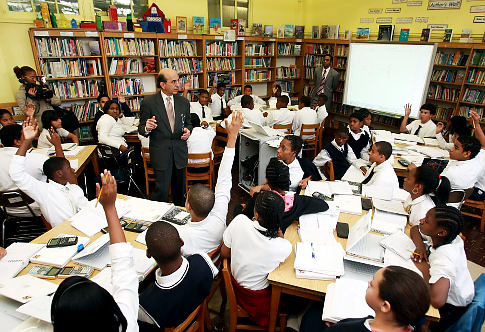
Overcrowded classroom (with DOE Chancellor Joel Klein) with two teachers, PS 189, Brooklyn, NY, September 16, 2009. (Craig Warga/NY Daily News). Qualifies as fair use – blog subject with no comparable picture.

Given where I grew up, instead of having a group of veteran Black teachers for most of elementary schools, I would’ve ended up with some teachers from Teach for America or The New Teacher Project. For the technocrats surely would’ve held my teachers responsible for the sixty-percent poverty rate at my elementary schools, um, I mean, the low test scores. Teachers from these alternate certification programs tend to be well-meaning, perhaps even extremely smart, but not passionate or fully trained teachers. Certainly not like the highly dedicated African American teachers I had at Nathan Hale (now Cecil Cooper) and William H. Holmes Elementary, who held us all to high enough standards to prepare me for a gifted-talented magnet school program known as Humanities.

Of course, given the resources devoted to high-stakes testing, and the constant practice tests, there would’ve been the virtual elimination of music, art, PE, and creative writing. With that shift, there wouldn’t have been a Humanities Program, just a few classes for the best and brightest students. Instead, the option of a private charter school or a KIPP program may have been a possibility. With an average cost of $10,000, however, I doubt a $1,000 or $2,500 voucher would’ve made it possible for me to attend the one, and with KIPP schools being all about discipline, I would’ve thrived there about as much as fish thrive in the desert.

I would’ve moved on to middle school and high school, received algebra in ninth or tenth grade (if at all), struggled to enhance my reading, writing, science, math and other skills, and otherwise would’ve goofed my way to a high school diploma. Would I have taken an AP class, or had a Meltzer as a history teacher, or taken the PSAT or SAT? I’m not sure, but highly unlikely. Still, I would’ve graded with a diploma, with proof that my education was the equivalent of an average ninth or tenth grader’s, confirmed by a decade of standardized state tests!

Then, after three to five years of struggling to find full-time work above minimum wage, or after several years in the military, I’d make the choice between  a University of Phoenix, Kaplan University, DeVry University or some other for-profit college. I’d discover quite quickly that I was wholly unprepared for even the most watered-down online college curriculum, taking courses in a four, six or eight-week format (instead of the typical ten or sixteen-week semester format).

Romanian Army POWs from Battle of Stalingrad, February 3, 1943. (http://ww2incolor.com).

There would’ve been no agonizing choice between Columbia University and the University of Pittsburgh, no switch of majors from computer science to history, no big moment in my development as a person. All because I wouldn’t have had the kind of earth-shattering experience that attending college full-time and in-person often can be.

Somehow, if I’d somehow survived the first semester or first year, I might’ve eventually graduated, albeit with a degree that will be of limited use in obtaining a good living wage. And with $70,000 in student loan debt and a degree from a disreputable for-profit college, forget about me going to graduate school to be a professor.

That’s what this K-16 system will lead to. Money flowing into the hands of illegitimate technocrats, testing companies, charter schools and for-profit institutions. Money and influence flowing from entities like the Bill & Melinda Gates Foundation and Teach for America. A permanent, if slightly better educated, low-wage underclass. That’s the now and future construction of K-16 education if we allow these trends to continue.

edX and Ex-lax (& Higher Education’s Future)

26 Wednesday Sep 2012

Posted by decollins1969 in 1, Academia, culture, Eclectic, Movies, Politics, Pop Culture

≈ 1 Comment

Tags

Affordability, College Access, College Success, Education, Education Reform, edX, Elite Universities, Ex-lax, Future of Higher Education, Harvard, Higher Education, iCollege, K-16 Education, MIT, Online Education, Sebastian Thrun


Ex-lax Chocolated Laxative, September 26, 2012. (http://overstockdrugstore.com).

Last May, Harvard and MIT announced a $60 million partnership that would provide free online courses to 600,000 students worldwide. That this came on the heels of an experiment in which former Stanford professor (and now co-founder of the Udacity.com online classroom platform) Sebastian Thrun made his “Introduction to AI” course available for free online in the fall of 2011 says something. The current model of providing a college education or postsecondary training – for-profit, public, community college or otherwise – will be dead for most students by 2030.

What will this new form of higher education look like? Will students who can now take a couple of Harvard or MIT online courses for free so overwhelm these schools that paying customers will also demand a free online education, and lead to the disintegration of higher education as we know it?

The answer lies somewhere in between higher education feast and famine. For the selected few, Ivy League and other elite institutions will continue to thrive, no matter the costs. Parents will continue to send their kids to Harvard, Stanford and Georgetown – and students will enthusiastically attend them – for far more than a degree. The social networks that students will build at these universities and use as alumni for jobs, careers and even marriages easily outweigh the high cost of tuition. Just ask the Obamas.

For most college students, though, edX is but the tip of the spear. Ultimately, a decade or so from now, going to college will be as simple as clicking on an app on your iPhone, iPad, or whatever an Apple, a Google or some other corporation comes up with next.

edX logo, May 2, 2012. (http://news.harvard.edu). Qualifies as fair use under US copyright laws – main subject of post.

No one institution or single university collaboration can take charge of this transition to a national and international online higher education experience, even with edX’s implementation. But with an Apple or a Google’s history of collaboration, technical expertise, and innovative vision, they can pull off the moving of the higher education platform to an accredited application. One that even Harvard, MIT and Oxford could get behind – though they may have to hold their noses at first.

By the time this transition is complete, online college – or, dare I say, iCollege – will look more like a combination of EA Sports’ Madden NFL ’13, Skype, Twitter and Facebook than the standard threaded discussions and video recordings we have today. It will be a process where any professor could be put in a lab with sensors and a classroom full of students asking every possible question and providing every possible answer to a series of topics that would add up to a course. And an Apple or a Google could do this over and over again for the thousands of possible courses an undergraduate student could take, in the US or anywhere in the world.

That alone would make this a decent revolution, at least technologically. Combining it with Apple’s or Google’s ability to negotiate agreements with accrediting agencies and with universities across the country, though, would make iCollege an all-out revolution. Because of these partnerships, the future iCollege would be light-years beyond the new edX, as this would enable students to transfer their credits to a UC Berkeley, Harvard or New York University if they so chose to take an in-person course whenever necessary.

Corridor in code, The Matrix (1999) screen shot, September 26, 2012. (http://luisangelv.wordpress.com).

This could be a one-time $500 million investment that could yield tens of billions in profits annually. In the process, it would make higher education much cheaper, more democratic and less exploitive of students and government resources. For an industry or job-related certificate: $5,000. For a two-year or associate’s degree: $10,000. For a four-year degree: $24,000.

There would be casualties, of course. Testing entities like the College Board, Educational Testing Service, and ACT will somehow have to adapt to this democratization of higher education or die out. The current set of for-profit institutions, community colleges and large state public institutions will have to become specialists in specific career training activities, partner within an iCollege consortium, or go out of business. Like it or not, this is the road that American and international higher education is on, one rapid stride after another. But it’s all for the better. Or at least, it could be?

Grading and the 21st Century Professor

03 Monday Sep 2012

Posted by decollins1969 in 1, Academia, culture, Eclectic, Politics, race, Work

≈ 3 Comments

Tags

Academic Integrity, Adult Learners, Duquesne University College of Education, Ethical Dilemma, Excuses, Grade Inflation, Grading, Higher Education, Job Security, Plagiarism, Student Entitlement, Students, Teaching, UMUC, University of Pittsburgh


Between a rock and a hard place, The Simpsons (movie), September 2, 2012. (http://clubsnap.com). Qualifies as fair use under US copyright laws –  low resolution.

The Chronicle of Higher Education and other prominent periodicals have been talking about the precarious rise of grade inflation for more than two decades now. Article after article and story after story has shown professors at elite and public institutions lowering their standards and bending into advanced yoga positions to give students higher grades than they’ve earned. All to ensure a minimum of contention over grades and maximum scores in student evaluations of their courses.

But what of the many professors who don’t want to lower their standards but so far, who can’t ignore a student’s lack of attendance or participation, their late assignments or attempts at plagiarism? For those college instructors, they can expect more grief and stupid ass excuses from students, not to mention lower evaluation scores.

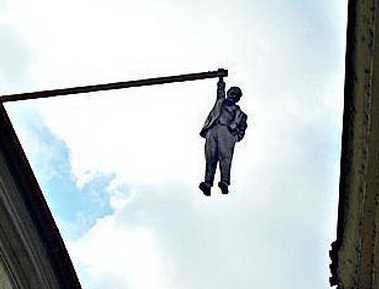
Sigmund Freud hanging by one hand by David Cerney (1997), Prague, September 2, 2012. (http://swick.co.uk/). Qualifies as fair use – pic has low resolution.

For tenured professors, particularly those at research universities, this doesn’t matter at all. For some tenure-track professors, instructors at teaching-focused liberal arts colleges, and the army of adjuncts that are the majority of instructors at the college level, this could mean the difference between steady employment and homelessness. It’s a sad situation when folks aren’t secure enough in their jobs to actually do the most difficult parts of their jobs, to evaluate a student’s performance accurately and to confront students whenever they violate an academic code of conduct.

It was part of the deal that I made with myself when I began teaching my own sections and then course as a graduate student twenty years ago at the University of Pittsburgh. To be fair and flexible, to be tough when necessary, but to be compassionate when the circumstances called for it. For the vast majority of the 2,000 or so high school, undergraduate and graduate students I’ve taught since ’92, that has been a workable philosophy. It’s even gotten me the occasional praise and recognition for being a very good professor.

Of course, I faced the occasional student who complained to me about their grade. Most of those students were C students looking for a C+ or a B, or a B+/A- student hoping for an A. Really, prior to my current faculty position, I had only had three complaints of any major consequence. One was from a student who managed to never show up for my US History to 1877 sections the spring semester of ’93, who failed the final exam so badly that I let him get away with his attempts at cheating — his cheat notes were that bad!

The other two came from two students in my History of American Education graduate course in the summer of ’98 at Duquesne University. One thought that someone as young (and as Black) as me could give her a grade lower than an A, while another harassed me with emails for a month because her A- in my course ruined her 4.0 average. Though an adjunct, I stood my ground, knowing that I had the support of my department chair.

Since starting my current teaching position in January ’08, I’ve faced a couple of dozen situations in which students have complained about their grades. I think I’ve only taught three courses out of about twenty in the past four years in which I haven’t fielded any complaints from students about their grades.

Most of these complaints have been really ones about me not accepting every cockamamie excuse for a late assignment or plagiarism. Excuses like their Internet or their access to the university’s online classroom platform being down. Or not knowing that cutting and pasting ten pages’ worth of other people’s words for a ten-page history research paper was in fact blatant plagiarism. Or that their jobs, last-minute deployments (which were hardly last-minute), children (who in many cases were teenagers), three car accidents in two weeks or other life challenges managed to get in the way of them submitting multiple assignments on time, even with extensions. But somehow, when I’ve held these students accountable and assigned an appropriate grade, I’m the bad guy.

That the students I teach these days are technically adult learners (I say “technically” because they don’t act like adults when they complain about their grading) actually makes this matter worse. Whether in the military, married with children, or working a full-time job, these students in their twenties, thirties and older tend to complain, beg, threaten me and then beg again. It’s exhausting to constantly have to persuade students to read my syllabus in order to make them understand that the rules and rubrics I’ve laid out are the reasons for their F, D, C or B.

But no matter the vitriol I provoke from assigning a grade, I also have to be careful in my language, emotions and tone. That is the reality that is teaching in many higher education institutions today. It is unfortunate, for there are many students who don’t understand that being a student requires being a responsible and ethical adult. Whether seventeen or seventy, whining, complaining and threatening your professor for a higher grade is completely unacceptable, and deserves at least a little sarcasm in response.

← Older posts
Newer posts →

Boy @ The Window: A Memoir

Boy @ The Window: A Memoir

Places to Buy/Download Boy @ The Window

There's a few ways in which you can read excerpts of, borrow and/or purchase and download Boy @ The Window. There's the trade paperback edition of Boy @ The Window, available for purchase via Amazon.com at http://www.amazon.com/Boy-Window-Donald-Earl-Collins/dp/0989256138/

There's also a Kindle edition on Amazon.com. The enhanced edition can be read only with Kindle Fire, an iPad or a full-color tablet. The links to the enhanced edition through Apple's iBookstore and the Barnes & Noble NOOK edition are below. The link to the Amazon Kindle version is also immediately below:

scr2555-proj697-a-kindle-logo-rgb-lg

Boy @ The Window on Amazon.com: http://www.amazon.com/Boy-The-Window-Memoir-ebook/dp/B00CD95FBU/

iBookstore-logo-300x100

Boy @ The Window on Apple's iBookstore: https://itunes.apple.com/us/book/boy-the-window/id643768275?ls=1

Barnes & Noble (bn.com) logo, June 26, 2013. (http://www.logotypes101.com).

Boy @ The Window on Barnes & Noble: http://www.barnesandnoble.com/w/boy-the-window-donald-earl-collins/1115182183?ean=2940016741567

You can also add, read and review Boy @ The Window on Goodreads.com. Just click on the button below:

Boy @ The Window

Twitter Updates

Tweets by decollins1969
  • RSS - Posts
  • RSS - Comments

Archives

  • June 2025
  • April 2023
  • September 2022
  • August 2022
  • July 2022
  • June 2022
  • May 2022
  • April 2022
  • March 2022
  • January 2022
  • December 2021
  • November 2021
  • October 2021
  • September 2021
  • August 2021
  • July 2021
  • June 2021
  • April 2021
  • March 2021
  • February 2021
  • January 2021
  • December 2020
  • November 2020
  • October 2020
  • September 2020
  • August 2020
  • July 2020
  • May 2020
  • April 2020
  • March 2020
  • January 2020
  • December 2019
  • November 2019
  • August 2019
  • July 2019
  • June 2019
  • May 2019
  • April 2019
  • March 2019
  • February 2019
  • January 2019
  • December 2018
  • November 2018
  • October 2018
  • September 2018
  • August 2018
  • July 2018
  • June 2018
  • May 2018
  • March 2018
  • February 2018
  • January 2018
  • December 2017
  • November 2017
  • October 2017
  • September 2017
  • August 2017
  • July 2017
  • June 2017
  • May 2017
  • April 2017
  • March 2017
  • February 2017
  • January 2017
  • December 2016
  • November 2016
  • October 2016
  • September 2016
  • August 2016
  • July 2016
  • June 2016
  • May 2016
  • April 2016
  • March 2016
  • February 2016
  • January 2016
  • December 2015
  • November 2015
  • October 2015
  • September 2015
  • August 2015
  • July 2015
  • June 2015
  • May 2015
  • April 2015
  • March 2015
  • February 2015
  • January 2015
  • December 2014
  • November 2014
  • October 2014
  • September 2014
  • August 2014
  • July 2014
  • June 2014
  • May 2014
  • April 2014
  • March 2014
  • February 2014
  • January 2014
  • December 2013
  • November 2013
  • October 2013
  • September 2013
  • August 2013
  • July 2013
  • June 2013
  • May 2013
  • April 2013
  • March 2013
  • February 2013
  • January 2013
  • December 2012
  • November 2012
  • October 2012
  • September 2012
  • August 2012
  • July 2012
  • June 2012
  • May 2012
  • April 2012
  • March 2012
  • February 2012
  • January 2012
  • December 2011
  • November 2011
  • October 2011
  • September 2011
  • August 2011
  • July 2011
  • June 2011
  • May 2011
  • April 2011
  • March 2011
  • February 2011
  • January 2011
  • December 2010
  • November 2010
  • October 2010
  • September 2010
  • August 2010
  • July 2010
  • June 2010
  • May 2010
  • April 2010
  • March 2010
  • February 2010
  • January 2010
  • December 2009
  • November 2009
  • October 2009
  • September 2009
  • August 2009
  • July 2009
  • June 2009
  • May 2009
  • April 2009
  • March 2009
  • February 2009
  • January 2009
  • December 2008
  • November 2008
  • October 2008
  • September 2008
  • August 2008
  • July 2008
  • June 2008
  • May 2008
  • April 2008
  • March 2008
  • February 2008
  • January 2008
  • December 2007
  • November 2007
  • October 2007
  • September 2007
  • August 2007
  • July 2007
  • June 2007

Recent Comments

MaryPena's avatarMaryPena on My Day of Atonement/Bitter Hat…
decollins1969's avatardecollins1969 on No Good Teaching Deed Goes…
Mary Rose O’Connell's avatarMary Rose O’Connell on No Good Teaching Deed Goes…

NetworkedBlogs on Facebook

NetworkedBlogs
Blog:
Notes From a Boy @ The Window
Topics:
My Life, Culture & Education, Politics & Goofyness
 
Follow my blog

616 616 East Lincoln Avenue A.B. Davis Middle School Abuse Academia Academy for Educational Development AED Afrocentricity American Narcissism Authenticity Bigotry Blackness Boy @ The Window Carnegie Mellon University Child Abuse Class of 1987 CMU Coping Strategies Crush #1 Crush #2 Death Disillusionment Diversity Domestic Violence Economic Inequality Education Family Friendship Friendships Graduate School Hebrew-Israelites High-Stakes Testing Higher Education History Homelessness Humanities Humanities Program Hypocrisy Internalized Racism Jealousy Joe Trotter Joe William Trotter Jr. K-12 Education Love Manhood Maurice Eugene Washington Maurice Washington Misogyny Mother-Son Relationship Mount Vernon High School Mount Vernon New York Mount Vernon public schools Multiculturalism MVHS Narcissism NFL Pitt Pittsburgh Politics of Education Poverty President Barack Obama Race Racial Stereotypes Racism Relationships Self-Awareness Self-Discovery Self-Reflection Sexism Social Justice Teaching and Learning University of Pittsburgh Violence Whiteness Writing

Top Rated

Blog at WordPress.com.

  • Subscribe Subscribed
    • Notes from a Boy @ The Window
    • Join 103 other subscribers
    • Already have a WordPress.com account? Log in now.
    • Notes from a Boy @ The Window
    • Subscribe Subscribed
    • Sign up
    • Log in
    • Report this content
    • View site in Reader
    • Manage subscriptions
    • Collapse this bar
 

Loading Comments...