• About Me
  • Other Writings
  • Interview Clips
  • All About Me: American Racism, American Narcissism, and the Conversation America Can’t Have
  • Video Clips
  • Boy @ The Window Pictures
  • Boy @ The Window Theme Music

Notes from a Boy @ The Window

~

Notes from a Boy @ The Window

Tag Archives: 616

Mr. Mister’s “Kyrie”

01 Tuesday Mar 2011

Posted by decollins1969 in 1, Boy @ The Window, Christianity, culture, Eclectic, eclectic music, Mount Vernon High School, music, New York City, Pop Culture, race, Religion, Youth

≈ Leave a comment

Tags

"Kyrie", #1 Hit, 1986, 616, 616 East Lincoln Avenue, Academic Achievement, Billboard Pop Chart, Christianity, Crazy Eddie's, Faith, Imagination, Kyrie Eleison, Lyrics, Manhattan, Mount Vernon High School, Mount Vernon New York, Mr. Mister, Pop Culture, Pop Music, Race, Richard Page, Walkman


Mr. Mister, “Kyrie” Single Cover, August 8, 2010. Vanjagenije. Qualifies as fair use under US Copyright laws because of the image’s low resolution and because image illustrates subject of this blog post.

Twenty-five years ago this week, Mr. Mister’s “Kyrie” made it to the top of the Billboard pop charts, making me goofy and giddy beyond belief. March ’86 was the beginning of a great month of music for me. I bought my first Walkman — a Walkman-knockoff really — from Crazy Eddie’s on 47th and Fifth in Manhattan, as well as the first of what would be about 200 cassettes of my favorite music. Not to mention a ton of musical experimentation — most of it bad, goofy and un-listen-able for even the musically impaired.

For many of you, Mr. Mister’s “Kyrie” would likely fall into that last category. It was semi-religious rock at a time when the closest thing to that was Amy Grant. It was Creed a whole decade before Creed, but with better musicians. It was a group of studio musicians putting out a breakout album that actually stood apart from the super-serious or super-sugary music of the mid-80s. It was a perfect storm for a sixteen-year-old in search of inspiration beyond the chaos of 616 and the lonely march toward college via Humanities and Mount Vernon High School.

“Kyrie” was one of two songs that kept me in overdrive in and out of the classroom through most of my junior year at Mount Vernon High School. Simple Minds’ “Alive and Kicking” was the other song. It almost became my mantra in the months that straddled ’85 and ’86. Every time I heard that song, especially the album version, was like going on a game-winning touchdown drive at the end of the fourth quarter. Studying was time to throw screen passes or seven-yard slants, to run the ball on a power sweep or on a draw play. It was methodical, the drums and synthesizers, and put me in a determined, methodical mood as I prepared for a test.

But Mr. Mister’s “Kyrie” was magical. Short for “Kyrie Eleison” Latin/Greek for “Lord have mercy,” it became my go-to song for every big academic play I needed to make for the rest of the year, even for the rest of high school. “Kyrie” combined all of the elements that my vivid imagination relied on. My faith in The One, my hope for a better future, lyrics that made me think, music that evoked a big play, like throwing it deep and completing it for a game-changing score. It was as methodical as “Alive and Kicking,” but the bigger bass guitar and heavier synthesizers as the background gave me the feeling that God’s grace was with me wherever I went and whatever I did. It was a true underdog’s song.

It was like I was singing a high-falsetto, four-and-a half-minute prayer whenever I played “Kyrie.” Some of my classmates, as usual, didn’t appreciate whatever deeper meaning I saw in the song or in its lyrics. See, my being Black and high-pitched singing to it was another obvious sign of my weirdness. Yet somehow, when it came to music, I didn’t really care what any of them thought.

As I went off to college and became more sophisticated in my understanding of music, I realized that there were some songs I couldn’t completely part with, no matter how goofy or out-of-date the music video was. “Kyrie” was one of those songs for me. I didn’t play it regularly by the time I’d reached my mid-twenties, but that didn’t mean that I didn’t sing to it in high-falsetto while shopping at Giant Eagle in Pittsburgh when the song would come on over the PA system.

Once iPod and iTunes technology became part of my household in ’06, I uploaded the old song and listened to it regularly again. I’ve wondered from time to time what would the sixteen-year-old version of me would think about me at forty-one. I’ve achieved more, and been hurt and lost more, than I could’ve possibly imagined a quarter-century ago.

It’s taken me more than twenty years to fully understand Richard Page’s lyrics about “would I have followed down my chosen road, or only wish what I could be?” The answer is both. Life is a funny and winding journey, even when on the path of the straight and narrow. Christian or atheist or of some other faith, it’s always good to hope that someone is there to watch over us, to protect us, even our younger selves from our older and allegedly wiser versions of ourselves. And that’s what I here now when I listen to — and sing high-falsetto still to — “Kyrie.”

Sarai, A Poet In My Heart

09 Wednesday Feb 2011

Posted by decollins1969 in 1, Boy @ The Window, Eclectic, eclectic music, music, Youth

≈ Leave a comment

Tags

28th Birthday, 616, 616 East Lincoln Avenue, Brother-Sister Relationship, Coping With Death, Death, Fleetwood Mac, Mount Vernon New York, Muse, Sara, Sarah, Sarai, Sarai Washington, Sickle Cell Anemia, Sister, Starship


Sarai, circa 2009. Unknown.

Today, if she were still alive, my sister Sarai would’ve turned twenty-eight years old. To think that I was only six weeks past my thirteenth birthday when she was born. Sarai was the one sibling I didn’t want because she was born in the middle of our plunge into welfare, my ex-stepfather’s abuse, and my mother’s inability to make any good decisions for herself and for the family.

But her life was a miracle in and of itself. Sarai was born a sickly sickle-cell anemia child, another sign of my mother’s indecisiveness and the collective stupidity of adults in my life. None of that really mattered after the first few months, though. From the time she was six months old until I went off to the University of Pittsburgh four years later, I made a point of looking after her, of getting her extra food, of making sure that everything she ate was fortified with iron.

Sarai was my little princess, the only girl I could relate to, the one I could dress and attempt to comb hair for (I say “attempt” because she didn’t have much hair before she became a teenage and my hair-doing skills were mediocre most days). I didn’t want to love her, but I did anyway.

As she grew older, her status as my little baby changed too. But only in a few ways. Whenever I came home

Sarai, Yonkers Apartment, December 23, 1995. Donald Earl Collins

to 616 for the holidays or visits, Sarai would say “hi,” give me a hug, and hold out her right hand for some money. Sometimes I gave her some walking around money, other times I didn’t — I was a poor student for most of the ’90s. It took awhile, but the little girl who was my sister grew up enough to live on her own a few short years before she died. That’s part of how I’d like to remember Sarai.

The first song I ever sang to her outside of lullabies was Starship’s “Sara.” It was the winter of ’86, a quarter-century ago, and Sarai didn’t care too much for my rendition of the song, with my high-falsetto flourishes and adjustments of “Sara” to “Sarai” throughout. (By the way, for those of you who aren’t practicing religious Jews or Judeo-Christian scholars, Sarai was the name of Abram’s wife before God ordained that their names would become Sarah and Abraham.) Of course, I usually sang it to her when she became petulant or when she was teasing her older brothers.

But what I should’ve been singing to her was Fleetwood Mac’s “Sara.” I should’ve been singing “wait a minute baby, stay a little while…” It would’ve been so much more appropriate. Sarai was a “poet in my heart.” She never really changed, and luckily, she never stopped living her life. And now she’s gone, and has been gone for more than seven months now. My life seems more empty, my family even less of a family, than it was before. Hopefully, I’ll see her again, whenever I’m finally called home.

On Broken Wings

02 Thursday Dec 2010

Posted by decollins1969 in 1, Boy @ The Window, culture, Eclectic, eclectic music, Mount Vernon High School, Pop Culture, race, Youth

≈ Leave a comment

Tags

"Broken Wings", 616, 616 East Lincoln Avenue, Billboard Pop Chart, Eclectic Music, Forgiveness, Healing, Hip-Hop, Humanities, Mending Hearts, Mount Vernon High School, Mount Vernon New York, Mr. Mister, Musical Tastes, Race, Rap, Top 40, Welcome To The Real World


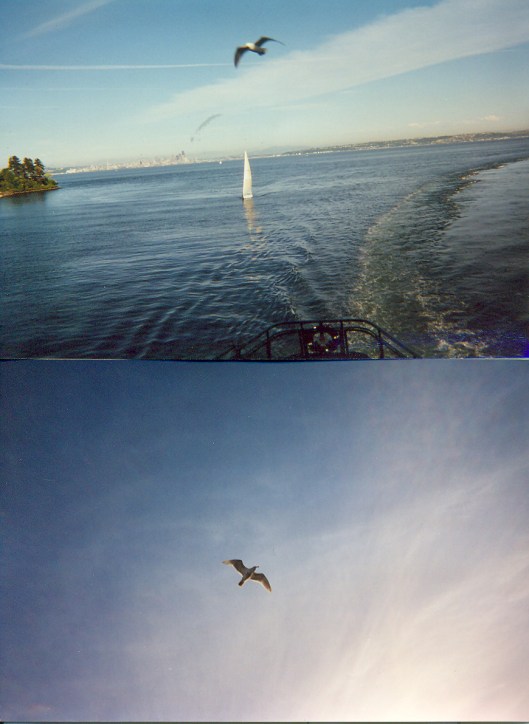
Two pictures of a seagull that eventually soared, Puget Sound off Bainbridge Island, WA, May 21, 2001. (Donald Earl Collins).

Two pictures of a seagull that eventually soared, Puget Sound off Bainbridge Island, WA, May 21, 2001. (Donald Earl Collins).

It was thirty years ago on this date that Mr. Mister’s “Broken Wings” Broken Wings was #1 on Billboard’s Top 40 pop charts. Twenty-five years, another time, another person, I was in and was. Somehow in a world dominated by hip-hop and rap, it seems like it’s been way more than a quarter-century since a bunch of studio musicians in their mid-thirties got together to create the album Welcome To The Real World.

What I remember most about my fifteen-year-old self in ’85 what how music served as an escape from the violence — or the potential of it — at 616 and from my loneliness at school. I could find myself in another world through song, where no one could touch or hurt me in any way, where life seemed more worthwhile. The sounds, images and smells that lyrics and notes could conjure gave me a place to find myself, a confidence that I otherwise didn’t have.

I liked a lot of crap in those days of my renewed interest in music. I liked Mr. Mister, Tears for Fears, some Heart, Sting, Simple Minds, some Madonna or a-ha, and U2 even before I knew who U2 was. I also liked Kool In The Gang, Billy Ocean, Lisa Lisa and Cult Jam (with Full Force), Run DMC, early Whitney Houston, some Freddy Jackson, Sade, and Luther. The problem was, I had trouble combining these divergent interests in music. Sade would make me feel sad. “Another woman out of my reach,” I often thought. While I liked Run-DMC (especially “My Adidas”), the lyrics were sometimes silly, and I couldn’t be silly all the time. Kool In The Gang had gone from cool to wack in the last year or so. For me, most of the R&B from the mid-’80s was boring, romantic yet stiff. I wasn’t feelin’ it.

Sunset Over Clouds (feeling of soaring), December 2, 2010. Source: http://www.writeideaonleadership.com

Sunset Over Clouds (feeling of soaring), December 2, 2010. Source: http://www.writeideaonleadership.com

Certainly the pop of ’85 wasn’t exactly full of passion, pride, or pain. It often had the feel of folks working off a high in a recording studio, which has turned out to be true in many cases. But it was easier to listen to. Keep in mind that the music world had just started to recover from seven or eight years of music that was without social conscience and virtually pain-free — and that’s even accounting for Phyllis Hyman, Miki Howard and U2.

Mr. Mister’s “Broken Wings” met me at a place where I needed to be met in ’85. My own “wings” needed some mending. I wanted to be free of my family’s so-called love, and I wanted to know what love as an emotion really felt like. I needed inspiration on a weekly basis because of what I saw at home and at Mount Vernon High School. R&B rarely provided that kind of fuel for my mind and spirit.

I found it in the lyrics, the liner notes, the pace of the music, the ability of a voice or synthesizer (as the case often was) to make a song soar. Given my situation, it was a no-brainer for me to choose lyrics like “take these broken wings and learn to fly again, learn to live so free . . .” over “rock . . . steady . . . steady rockin’ all night long . . .” in the mid-’80s.

I certainly don’t walk the streets of Mount Vernon with $20 Walkman knockoff singing in high falsetto to Mr. Mister like I did twenty-five (or thirty) years ago (I do that in DC and Maryland running 10Ks, with my iPod or iPhone instead). But I do still find songs like “Broken Wings” appealing. At almost forty-one (now almost forty-six), I understand much better the need to mend broken relationships, to heal bruised and broken hearts, to want to make yourself and those you love whole again. From my wife to my mother to my late sister Sarai and older brother Darren, I really do understand. I sometimes can’t believe I got this much out of one song from so long ago. Especially when I was so young and so injured myself.

Great Northern Beans and Rice

25 Friday Jun 2010

Posted by decollins1969 in 1, Boy @ The Window, Eclectic

≈ Leave a comment

Tags

616, Abuse, Domestic Violence, Food, Great Northern Beans, Healthy Food, Irony, Mount Vernon New York, Poverty, Rice, Vegans


Great Northern Beans (they never looked this good growing up)

I wrote this six years ago, but I realized this week that the thirtieth anniversary of my last bout of physical abuse at the hands of my now deceased stepfather was upcoming (which I didn’t include in Boy @ The Window). Wow! There are moments that I can’t believe I survived all that.

====================================================

It’s been twenty-eight years since I unwittingly carried a $10 bill halfway hanging out of my right hand for a hoodlum named “Pookie” to steal at Wilson Woods Pool in Mount Vernon, leading to so many evil things occurring in my life. But I’ve talked about this already. I’ve talked about my idiot ex-stepfather Maurice Washington and his equally idiotic attempt at making me a man in his own decrepit image. I’ve even talked about the domestic violence that I was exposed to first and second-hand by him. What I talk about now is a variation on a theme, and a story that won’t be in Boy @ The Window — it would disrupt the flow of the period of time in question.

It all started with the usual at 616. It was the end of January ’86, and we were short on money. It was the middle of the week, so it wasn’t as if I could track down my father Jimme for a couple of extra bucks. So my mother, out of a rare sense of desperation — since there wasn’t any food to eat at 616 — turned to my then stepfather for help. As par for the course since ’83, his response was to call me over. “Boy, go get some Great Northern Beans and rice,” he said. It was the eighth occasion in five years that he had paid for a meal for the family — which only happened to include four of his kids, and he chose the cheapest thing he could think of.

“That’s it? That’s all we get?,” I said in response to his wonderful act of generosity. “Boy, I feed my family,” the lipid-laden idiot said. Being an idiot myself for a moment, I said back, “All you’ve ever done is just buy a couple of meals!,” as I turned around to go to the store.

Maurice jumped me from behind, knocking me head-first into the kitchen wall, and just kept punching me. He got me twice in the mouth. I obliged by covering up and then biting down on his knuckles on the second mouth punch, which caused some cuts and bleeding. My mother walked in and got between us. For once, the dumb ass had nothing else to say. He was angry and breathing hard, as if he’d been in a three-rounder with Mike Tyson. I was stunned, but I stood my ground, with my fists balled up. After scowling at the fool for a few seconds, I left for the store.

The damage that this last incident of physical abuse caused is with me to

My front teeth, including slightly darker lower tooth (right/my left), two root canals later, May 14, 2012, (Donald Earl Collins).

My front teeth, including slightly darker lower tooth (right/my left), two root canals later, May 14, 2012, (Donald Earl Collins).

this day. My stepfather chipped my upper front tooth on my right in two places, and caused enough damage to one of my lower front teeth that I would eventually need a root canal done on it seven years later. So yeah,  I should’ve kept my mouth shut — literally — when it came to issues with my abuser.

On the other hand, given our unhealthy obesity times today, Great Northern beans and rice isn’t such a bad meal, right? For vegans, I’d imagine that this is a very good meal. But not when the person you despised most in your world when you were a teenager’s buying it, and buying it in a begrudging and miserly way.  Of course, now beans and rice are actually expensive and considered healthy food by the arugula-eating sector of our society. Go figure!

=====================================================

The kicker, though, came the Monday after this last incident. I’d completely forget that I was supposed to do an oral presentation in my 11th grade English class, first period. Completely. And this, I did write about in Boy @ The Window:

For Mrs. Warns’ class, we had a presentation assignment that I didn’t even remember existed. The first day of presentations came, and she designated me as the first presenter. I was caught completely off-guard. I didn’t have time to whip up something, so I did the only thing I could think of. I balled up a piece of paper like I normally did a few times a day, stood up and walked to the front of the classroom. I took a shot at the garbage can and missed like I usually did, this time deliberately, and proceeded to ramble for a couple of minutes about how to recover from mistakes when you make them or something. Mrs. Warns was so cross with me. “I’m very disappointed in you. You obviously didn’t prepare at all for your assignment,” she said in her Brooklyn accent. She gave me a D for my presentation, adding “and you should feel lucky to get that.

I found out later that our eventual salutatorian had gotten an extension for his presentation. I was more mad with myself than anything else, knowing unfair things had always been in my life to that point. Today, I could take the garbage can and put it upside my teacher’s head, take the balled-up paper and throw it at my former classmate, and find my ex-stepfather’s grave and piss on it. Of course, I’d have to have some Great Northern beans and rice first, so that I could give the obese idiot a good fart as well.

The Silent Treatment

21 Monday Jun 2010

Posted by decollins1969 in 1, Boy @ The Window, culture, Mount Vernon High School, Pop Culture, race, Youth

≈ Leave a comment

Tags

616, Class of 1987, Coolness, Culture, Mount Vernon High School, Mount Vernon New York, Pop Culture, Race, Silent Treatment, The Roots, Westchester County Department of Community Mental Health


Source: Screen Shot from The Roots, “Silent Treatment” Music Video, Geffen, 1995

Right after the MVHS graduation ceremony at Memorial Field in June ’87, it started. I’d walk down the street to the store, and bump into one of my suddenly former classmates, say “Hi,” and get no response at all. The few times I bumped into a certain Ms. Red Bone, she’d stare straight at me, then straight through me, all as I said “Hi.” She just kept on walking, as if I had phased out of our space-time continuum into a parallel universe. By the beginning of August, I honestly thought that these people, my classmates for so long, were showing their true colors. They just didn’t like me, not me because I’d been a Hebrew-Israelite or me because I was poor or me because I listened to Mr. Mister. It was all about me, something within me that they detested.

“You can’t pay any attention to that. They’re all just jealous,” my new friend E (see “The Power of E” posting from August ’08) said when I told her about the ghost treatment over lunch one day. She and I worked for General Foods in Tarrytown that summer.

“Of what? Of me?,” I asked in disbelief.

“It’s because you’re not trying to be anybody except yourself,” she said.

“That’s a good theory,” I thought, but I didn’t really believe it. E was fully in my corner, and much more obvious about it than anyone else.

This pattern of treatment had only occurred two other times. Once was in sixth grade, after I came to Holmes with my kufi for the first time. My best friend Starling stopped talking to me, and refused to even acknowledge my presence for nearly two weeks before our second and last fight. The other was earlier in my senior year, in the weeks after the final class rankings were posted. Some in the Class of ’87 were upset with me because I was ranked fourteenth in our class. Three of them responded by not talking to me at all. They’d walk by me in the hallways, looked at and through me, and kept going without so much as a nod. That went on from mid-December through the beginning of March.

The Black “Party All The Time” folks in my class, the popular and dapper folks, snickered whenever they saw me. So I guess that they decided that to acknowledge me after graduation would me contaminating themselves with the knowledge that I was still alive, still figuring things out, still not cool enough to be bothered with.

Three years later, I bumped into one of these folks on my way home from my summer job with Westchester County Department of Community Mental Health in White Plains. I was walking home to 616 on East Lincoln, having just gotten off the 41 Beeline Express. It was after 6:30, and I was beat from another day of database work and my research preparations for my senior year at Pitt. Coming in the opposite direction toward North Columbus was a party-all-the-timer, a popular, slightly light-skinned dude named J. Since I assumed that he would walk by me as if I were thin air, I started to walk by him as if he weren’t there.

Surprisingly, J stopped me and said, “Hi, Donald.” He said that he needed to talk to me, to tell me that the path that I walked in high school, while weird, was a better path than the one that he was on. He told me about his mind-bending experiences at Howard, about his dropping out and need to take care of some serious emotional and mental health issues. After a year of work at Pitt and in Westchester County, I could tell, too.

At first, I was taken aback. I mean, this was a guy who laughed at me for nearly six years, who’d never lowered himself to so much as to give me a thumbs-up while in school. Now J was sharing the most intimate of details about his life with me? I asked him, “Why are you telling me this?” Among the other things he said, the thing that stuck with me was, “Because you’re true to yourself.” I gave him a handshake, and wished him well.

That was nearly twenty years ago. I guess that J and others were under a lot of pressure — peer pressure, girl pressure, family pressures — to be cool, to be successful, to be something other than themselves. None of this justified how they treated me back then. Nor does it justify how any of them may see me now. I’m just glad the only silent treatment I get now is from my wife when I’ve taken a joke too far. At least I know that she’ll talk to me again, eventually.

Trip to the ‘Burgh

26 Wednesday Aug 2009

Posted by decollins1969 in 1, Academia, Boy @ The Window, culture, Eclectic, Jimme, Mount Vernon High School, Mount Vernon New York, My Father, New York City, Politics, Pop Culture, race, Youth

≈ Leave a comment

Tags

616, 616 East Lincoln Avenue, Amtrak, Leaving Home, NAACP, Pittsburgh, Racism, The Pennsylvanian, University of Pittsburgh, Yellow Cab


My years as a full-fledged adult now number twenty-two. On this day and date, I left 616, Humanities, MVHS, Mount Vernon public schools, Mount Vernon and NYC behind for the first time. Even though I’d call New York City and Grand Central Station “the third armpit of hell” for the next seven years, I had plenty of times during my undergraduate days in which I missed the sights and smells of New York, the constant buzz. Not to mention quality deli meats, good pizza, Clover Donuts, the noise of Subway cars and Metro-North trains. But from the moment I started getting ready, truly ready to go, I had already left these things behind.

It was the last Wednesday in August when I took my five suitcases, Army bag, and two boxes by cab from 616 to 241st. But not before a long and tearful good-bye with my mother, Eri, Sarai, and Maurice. Yiscoc didn’t wake up to say good-bye until I was practically out the door. My stepfather insisted on giving me an extra fifty dollars for my college journey. I thought for a second about turning it down, and decided against it. “This was the least he owed me,” I thought. I felt bad about leaving, especially for Eri, who was just a little more than three years old. Darren and I took my stuff downstairs to the Reliable Taxi cab at five in the morning, got to the Subway stop and met Jimme there. We quietly rode the train to Penn Station on West 34th, where I’d catch the 7:50 am Amtrak for Pittsburgh. Once it was time to catch the train, Darren and Jimme helped with getting all of my stuff on the train, most of which I half-realized I probably wouldn’t need. We hugged, and Jimme actually teared up. This was the second time in a row I’d seen him sober, and he seemed happy for me.

The train ride to Pittsburgh was much longer than I expected. My assumption was that since Philly and Pittsburgh were in the same state that the ride wouldn’t last more than a couple of hours. What I didn’t know was that once we pulled into the City of Brotherly Love that the engineers would have to uncouple the electric engine and connect a diesel one. What I didn’t know was that the trip across the state of Pennsylvania was a long and windy one, with hills and mountains, small towns and tunnels. What I didn’t know was that there would be a boring recording describing the construction of track through the Allegheny Mountains which led to the creation of Horseshoe Lake. I took two naps, listened to five tapes, and with all of that, still had an hour and a half to spare. I ended up talking with a young Catholic priest during that time about the nuances of Christian faith and how Christians often misapply their faith in secular situations.

We pulled in about thirty minutes late, just before 5 pm. I immediately found a phone book and called for a Yellow Cab. I waited, and waited, and waited, all while about six cabs came up and picked up other passengers from my train. I looked at the downtown skyline and thought, “It doesn’t look like a hick town so far.” Yet the cab drivers sure acted like it was. They refused to make eye contact with me, much less pick me up. After an hour, I called Yellow Cab again, this time threatening them with a lawsuit. “If I don’t see a cab real soon, I’m contacting the NAACP and filing a discrimination lawsuit!,” I yelled to the dispatcher over the phone. Within three minutes I got my taxi. I was already beginning to think that Pittsburgh wasn’t my best choice for pursuing higher education.

My first drive through the heart of Pittsburgh reminded me of what people had been saying for years about New York and how great it was. Once we passed through downtown, which took less time than driving through Mount Vernon, we went through these decidedly working-class neighborhoods and Black communities that looked at least they belonged in South Side Mount Vernon. Then we reached the Oakland section of the ’Burgh. School buildings, college dorms that looked like silos, shops and restaurants abounded. Just before we turned left off of Forbes Avenue, I saw it, the Cathedral of Learning, for the first time. I was starting to feel better about my decision.

The driver turned left again, off Atwood and onto Fifth Avenue, then a right onto Lothrop, where, of course, Lothrop Hall was. It was an eleven-story dirty uranium-brown building, where years of coke soot had built up. There were few students or staff around. I went through security, using my high school ID for the last time, and the guard gave me a temporary dorm pass that I could use until I got my Pitt ID. My dorm room was on the third floor. It overlooked a drab and empty yet clean courtyard. I was lucky, since there was a good chance I might’ve ended up with a roommate. The dorm rooms at Lothrop went to one student apiece. I was so exhausted from all of the emotions and stresses of the day. I grabbed some junk food from the vending machine in the lobby, called my mother to tell her I was fine, somehow found the Mets game on my portable radio, and fell asleep in my twin bed.

Despite all that had happened at 616, in Humanities, MVHS and in Mount Vernon, I was homesick the last third of the semester. Not homesick because I missed having my ex-stepfather say, “take that base out of ya voice before I cave ya chest in.” Not homesick because I missed spending my Friday evenings and Saturdays tracking down Jimme at some dive in the Bronx or in Manhattan. I think that I was homesick because I was still reeling from crush #2, which made me realize that I never really had a home in the first place.

It took me a bit longer — about a year or so — to realize that despite the ‘Burgh’s lack of almost anything I’d normally describe as city or city-suburban life, I could still make the place my home. At the very least, the University of Pittsburgh was relatively more diverse, urban, and exciting than compared to the rest of the area. That was the reason I was there, after all. Still, I gave myself the room necessary to criticize the university and the city when I saw fit. But I also took time to look around, to see that whatever else was or wasn’t going on, I was in charge of my life now, and safe from the slights, hurts and abuses of my past.

Top Cook

25 Monday May 2009

Posted by decollins1969 in 1, Boy @ The Window, culture, Eclectic, Hebrew-Israelite, Mount Vernon New York, Pop Culture, race, Religion, Youth

≈ Leave a comment

Tags

616, 616 East Lincoln Avenue, Bad Cooking, Balkis Makeda, Cabbage, Eri Washington, Fried Chicken, Good Cooking, Maurice Eugene Washington, Self-Discovery, Tom Colicchio, Top Chef, Unclean Issues of Blood


I’m sure that many of you are familiar with the Bravo show Top Chef, hosted by Padma Lakshmi and with head Italiano judge Tom Colicchio. It’s been a reality-series-mainstay for five years, with chefs in constant competition over the quality of their dishes and the ambiance with which they present them. When I do watch — it’s one of my wife’s shows, not so much mine — I find myself thinking, “I can out-cook most of these people, no problem!”

But as the mafioso-like Colicchio has said numerous times, “the show’s called Top Chef, not Top Cook.” Given the fact that most of the contestants don’t even bother to taste what they cook, I don’t think that they should be in competition for either title. I should know. I have twenty-five years of experience to prove it.
One of the consequences of my youngest brother Eri’s birth in the spring of ’84 was that I learned how to cook, at least enough to make sure that seven people actually gained weight and enjoyed eating my food for the next two months. It was a time of irony and hypocrisy (as if any other time during my Boy At The Window years wasn’t), putting another nail in the Hebrew-Israelite coffin in which my stepfather was prepared to bury himself. It also gave me the opportunity to see myself as an adult beyond my academic abilities. It provided a level of confidence that would be helpful in my Pitt years.
—————————————————————————
My conversion to Christianity and my developing interests in sports, music and girls in the spring of ’84 couldn’t have come at a better time. The week before Memorial Day ’84 was when my mother gave birth to my baby brother Eri. The little porker came in at just under seven pounds. Two weeks before that, my stupid stepfather invited his Hebrew-Israelite matriarch “Balkis Makeda” (she believed that she was the reincarnation of the Queen of Sheba, the one who would marry King Solomon of ancient Israel) to stay with us. She was moved in before my mother could seriously object. What a situation! Six kids, including me, plus Mom, Maurice, and an old woman living together in a 1,200-square-foot, two-bedroom apartment. We now needed to behave like good little Hebrew-Israelites with this woman in our house, so as to not embarrass my stepfather.
One of the wonderful rules of our absurdly orthodox practice was that my mother couldn’t cook or do any familial tasks for the next three months. She was “unclean” because she’d just given birth to Eri. This might’ve made sense in the deserts of ancient Canaan, with no antibiotics and drugs to deal with unclean “issues of blood” and other bodily fluids. It didn’t now. Plus I didn’t remember my mother not cooking for three months after Yiscoc and Sarai were born. This was suck-up time, plain and simple.Maurice made what was an abyss-of-bad even worse by cooking dinner for three days. Three straight nights of overboiled and under-ripened cabbage drenched in its own juices and seasoned to high heaven with red and black pepper. My stepfather could’ve been the founder of the cabbage soup diet if he’d actually eaten his own cooking. Man, a week of cabbage like his would’ve left skinny me in an emergency room in need of an IV. As it was, my younger siblings couldn’t even eat a mouthful of the gruel. We needed someone else to cook, and soon. My mother knew just who to ask.So from the end of May until mid-July, I cooked dinner night after night for my family of eight. Makeda refused to eat my food on principle — the man of the house or a female servant was supposed to cook, not me. Before this crisis, I’d only cooked a few things, like baked chicken leg quarters, fried and boiled eggs, sticky-bad grits, and toast with butter. I immediately learned to control temperatures on our gas stove to fry chicken Southern-style, started making spaghetti and meat sauce, and figured out how to season meats and the difference between that and seasoning veggies. All while still doing my other chores, helping out with my siblings and getting ready for Regents and final exams.

I learned how to make the five-dollar-spaghetti meal for eight. For that amount of money, I’d shop at C-Town, buy a pound of ground beef (two dollars), a box of Ronzoni spaghetti (eighty-nine cents, often on sale for fifty cents), a can of Hunt’s spaghetti sauce (ninety-nine cents), and a box of frozen chopped broccoli (fifty-nine cents). With the fifty-four cents left over, I could buy two packs of grape and lemon Kool-Aid or a pack of Wise Crunchy Cheese Doodles as payment for my shopping expertise and culinary services. Sometimes I’d even squeeze a Twix candy bar out of the remaining change.

It was a sharp learning curve, but I wanted to learn. I’d been asking my mother to teach me how to cook since I was nine or ten. Now I was learning under a bit of pressure. Our health and my continued psychological wellness depended on me making food we not only could eat but enjoy as well. By the middle of my second week as 616’s master chef, even Maurice was complimenting me on my skills at the stove and oven. My mother was the only holdout, constantly saying that my food was only “okay,” or “It needs more seasoning,” or that my gravy was “oily and lumpy.”

I did the best I could under these difficult circumstances. My grades remained consistent all year and remained that way even through Regents and finals the third week in June. I managed an 86 on the Geometry Regents despite seeing too many proofs, a 91 on the Biology Regents, and scores in the high-80s and 90s on my Literature and History exams. I got a 73 on my Italian final, a sure sign of things to come with me and Romance languages. My fourth semester GPA was a 4.48, and for the year it was a 4.26. If I could keep this pace up, Humanities in high school would be “as smooth as a milkshake,” as a former classmate would’ve said.

——————————————————————-
I’ve added quite a few dishes to my repertoire since ’84. I can make everything from broiled salmon to  veal stew, from wine-drenched pork tenderloin to wok-cooked vegetable fried rice. The most important thing I’ve learned as a cook is the ability to walk in a kitchen, look at a bunch of raw ingredients, and come up with something to cook, without a recipe or without it being something I normally make. I figured out how to make good gravy from scratch one time in ’93 when the only thing I had to work with was water, oil, flour and seasoning. I combined ketchup, soy sauce and chili sauce to make barbeque sauce one day in ’99 when we had only $10 to work with while living in Pittsburgh. Learning this, and that my palate is pretty good in discerning seasonings and tastes, is what makes me as good a cook as I am.
None of this would’ve likely happened, though, without going through those years of malnourishment and wanting for food. None of my ability to cook would’ve been converted to actual cooking without those weeks of cooking in volume for hungry mouths at the end of my freshman year of high school. I likely wouldn’t have finished college or grad school without the ability to cook my own food — it would’ve been too expensive to go to school otherwise. Like reading, critical thinking and creativity, cooking to the point of chef-like ability is a skill that always comes in handy, that makes the most boring of meals worth eating. It also revealed a lot about my character and my sense of initiative than I knew before, especially outside of the classroom.
← Older posts
Newer posts →

Boy @ The Window: A Memoir

Boy @ The Window: A Memoir

Places to Buy/Download Boy @ The Window

There's a few ways in which you can read excerpts of, borrow and/or purchase and download Boy @ The Window. There's the trade paperback edition of Boy @ The Window, available for purchase via Amazon.com at http://www.amazon.com/Boy-Window-Donald-Earl-Collins/dp/0989256138/

There's also a Kindle edition on Amazon.com. The enhanced edition can be read only with Kindle Fire, an iPad or a full-color tablet. The links to the enhanced edition through Apple's iBookstore and the Barnes & Noble NOOK edition are below. The link to the Amazon Kindle version is also immediately below:

scr2555-proj697-a-kindle-logo-rgb-lg

Boy @ The Window on Amazon.com: http://www.amazon.com/Boy-The-Window-Memoir-ebook/dp/B00CD95FBU/

iBookstore-logo-300x100

Boy @ The Window on Apple's iBookstore: https://itunes.apple.com/us/book/boy-the-window/id643768275?ls=1

Barnes & Noble (bn.com) logo, June 26, 2013. (http://www.logotypes101.com).

Boy @ The Window on Barnes & Noble: http://www.barnesandnoble.com/w/boy-the-window-donald-earl-collins/1115182183?ean=2940016741567

You can also add, read and review Boy @ The Window on Goodreads.com. Just click on the button below:

Boy @ The Window

Twitter Updates

Tweets by decollins1969
  • RSS - Posts
  • RSS - Comments

Archives

  • June 2025
  • April 2023
  • September 2022
  • August 2022
  • July 2022
  • June 2022
  • May 2022
  • April 2022
  • March 2022
  • January 2022
  • December 2021
  • November 2021
  • October 2021
  • September 2021
  • August 2021
  • July 2021
  • June 2021
  • April 2021
  • March 2021
  • February 2021
  • January 2021
  • December 2020
  • November 2020
  • October 2020
  • September 2020
  • August 2020
  • July 2020
  • May 2020
  • April 2020
  • March 2020
  • January 2020
  • December 2019
  • November 2019
  • August 2019
  • July 2019
  • June 2019
  • May 2019
  • April 2019
  • March 2019
  • February 2019
  • January 2019
  • December 2018
  • November 2018
  • October 2018
  • September 2018
  • August 2018
  • July 2018
  • June 2018
  • May 2018
  • March 2018
  • February 2018
  • January 2018
  • December 2017
  • November 2017
  • October 2017
  • September 2017
  • August 2017
  • July 2017
  • June 2017
  • May 2017
  • April 2017
  • March 2017
  • February 2017
  • January 2017
  • December 2016
  • November 2016
  • October 2016
  • September 2016
  • August 2016
  • July 2016
  • June 2016
  • May 2016
  • April 2016
  • March 2016
  • February 2016
  • January 2016
  • December 2015
  • November 2015
  • October 2015
  • September 2015
  • August 2015
  • July 2015
  • June 2015
  • May 2015
  • April 2015
  • March 2015
  • February 2015
  • January 2015
  • December 2014
  • November 2014
  • October 2014
  • September 2014
  • August 2014
  • July 2014
  • June 2014
  • May 2014
  • April 2014
  • March 2014
  • February 2014
  • January 2014
  • December 2013
  • November 2013
  • October 2013
  • September 2013
  • August 2013
  • July 2013
  • June 2013
  • May 2013
  • April 2013
  • March 2013
  • February 2013
  • January 2013
  • December 2012
  • November 2012
  • October 2012
  • September 2012
  • August 2012
  • July 2012
  • June 2012
  • May 2012
  • April 2012
  • March 2012
  • February 2012
  • January 2012
  • December 2011
  • November 2011
  • October 2011
  • September 2011
  • August 2011
  • July 2011
  • June 2011
  • May 2011
  • April 2011
  • March 2011
  • February 2011
  • January 2011
  • December 2010
  • November 2010
  • October 2010
  • September 2010
  • August 2010
  • July 2010
  • June 2010
  • May 2010
  • April 2010
  • March 2010
  • February 2010
  • January 2010
  • December 2009
  • November 2009
  • October 2009
  • September 2009
  • August 2009
  • July 2009
  • June 2009
  • May 2009
  • April 2009
  • March 2009
  • February 2009
  • January 2009
  • December 2008
  • November 2008
  • October 2008
  • September 2008
  • August 2008
  • July 2008
  • June 2008
  • May 2008
  • April 2008
  • March 2008
  • February 2008
  • January 2008
  • December 2007
  • November 2007
  • October 2007
  • September 2007
  • August 2007
  • July 2007
  • June 2007

Recent Comments

MaryPena's avatarMaryPena on My Day of Atonement/Bitter Hat…
decollins1969's avatardecollins1969 on No Good Teaching Deed Goes…
Mary Rose O’Connell's avatarMary Rose O’Connell on No Good Teaching Deed Goes…

NetworkedBlogs on Facebook

NetworkedBlogs
Blog:
Notes From a Boy @ The Window
Topics:
My Life, Culture & Education, Politics & Goofyness
 
Follow my blog

616 616 East Lincoln Avenue A.B. Davis Middle School Abuse Academia Academy for Educational Development AED Afrocentricity American Narcissism Authenticity Bigotry Blackness Boy @ The Window Carnegie Mellon University Child Abuse Class of 1987 CMU Coping Strategies Crush #1 Crush #2 Death Disillusionment Diversity Domestic Violence Economic Inequality Education Family Friendship Friendships Graduate School Hebrew-Israelites High-Stakes Testing Higher Education History Homelessness Humanities Humanities Program Hypocrisy Internalized Racism Jealousy Joe Trotter Joe William Trotter Jr. K-12 Education Love Manhood Maurice Eugene Washington Maurice Washington Misogyny Mother-Son Relationship Mount Vernon High School Mount Vernon New York Mount Vernon public schools Multiculturalism MVHS Narcissism NFL Pitt Pittsburgh Politics of Education Poverty President Barack Obama Race Racial Stereotypes Racism Relationships Self-Awareness Self-Discovery Self-Reflection Sexism Social Justice Teaching and Learning University of Pittsburgh Violence Whiteness Writing

Top Rated

Blog at WordPress.com.

  • Subscribe Subscribed
    • Notes from a Boy @ The Window
    • Join 103 other subscribers
    • Already have a WordPress.com account? Log in now.
    • Notes from a Boy @ The Window
    • Subscribe Subscribed
    • Sign up
    • Log in
    • Report this content
    • View site in Reader
    • Manage subscriptions
    • Collapse this bar
 

Loading Comments...