• About Me
  • Other Writings
  • Interview Clips
  • All About Me: American Racism, American Narcissism, and the Conversation America Can’t Have
  • Video Clips
  • Boy @ The Window Pictures
  • Boy @ The Window Theme Music

Notes from a Boy @ The Window

~

Notes from a Boy @ The Window

Category Archives: Religion

Fife and Shalom

12 Tuesday Jul 2016

Posted by decollins1969 in 1, Boy @ The Window, culture, Eclectic, eclectic music, Hebrew-Israelite, Mount Vernon New York, music, New York City, Pop Culture, race, Religion, Youth

≈ Leave a comment

Tags

A.B. Davis Middle School, Black Male Identity, Black Masculinity, Chorus, Domestic Violence, Fife, Judah ben Israel, Manhood, Maurice Eugene Washington, Mentoring, Music Lessons, Oppression, Poverty, Pulaski Day Parade, Summer of Abuse, Tamrin, Trombone, Type 2 Diabetes, William H. Holmes Elementary


Civil War-era wooden fife, May 19, 2004. (Kevin Saff/National Parks Service via Wikipedia). In public domain.

Civil War-era wooden fife, May 19, 2004. (Kevin Saff/National Parks Service via Wikipedia). In public domain.

One thing I never discussed here or in Boy @ The Window were the handful of “leisure” activities I had during the Hebrew-Israelite years. The world in which we lived back in the ’81-to-’84 period had precious few resources and even less room for things like summer camps, overseas travel, baseball games, amusement parks, or even a free impromptu rap battle at Van Cortlandt or Hartley Park. Heck, the Kool cigarettes’ music series that sponsored “Teddy Pendergast” or “Rufus and Chaka Khan” in those days might as well have been a trip to see the World Cup in France compared to our pitiful roach-and-belt circumstances.

One of my idiot stepfather Maurice’s Hebrew-Israelite friends, though, did provide a free service for us males in ’81 and ’82. His name was Tamrin. He was a heavy-set dude, probably about five-foot-eight, maybe 120 or 125 kilos (between 245-260 pounds), and likely in his late-thirties. Unlike so many of the Hebrew-Israelite men I had the curse to meet in those naiveté-shattering years, Tamrin had a lighter touch. His idea was to put together a boy’s band of fifes, drums, bugles, and other marching instruments to lead us Hebrew-Israelites in marches through the street of Mount Vernon, as well as temple sites in the Bronx, in Harlem, and in Brooklyn (specifically, Bed-Stuy and Flatbush, if memory serves). Even at twelve, I knew how ridiculously uncool that idea sounded.

That was his plan, anyway. So off and on, between August ’81 through the second week in July ’82, Tamrin gave me and other kids music lessons to play overly bombastic marching band music. These were the kind of joyless songs which one was mostly likely to hear at Moscow’s May Day parade of soldiers and nuclear missiles than hear anywhere in ancient Israel. I was picked out because I had musical training in my immediate pass. I played the trombone in fifth grade. Or rather, I had six months of trombone-playing lessons at William H. Holmes ES before my music teacher had a heart attack and died in March ’80. I sang in chorus all through sixth, seven, and eventually, eighth grade. I could read music, though I struggled in transition between half-notes and quarter-notes.

Pulaski Day Parade on Fifth Avenue in Manhattan, October 6, 2013. (http://www.posteaglenewspaper.com).

Pulaski Day Parade on Fifth Avenue in Manhattan, October 6, 2013. (http://www.posteaglenewspaper.com).

So Tamrin would come over about twice a month, usually on Saturday afternoons, and spend a couple of hours with me playing the fife. (Can you imagine that? A twelve-year-old, kufi-wearing Donald playing such a small and delicate reed instrument? Really? Really!) Tamrin took us to the Pulaski Day Parade down in Manhattan the first Sunday in October ’81 to see how the pros do the fife-and-drum thing. The costumes I found fascinating, but I dreamed of food, not of marching around with fife.

Once Mom’s already pitiful funds got down to a disposal income of $5 per day — that was in December ’81 — Tamrin didn’t come around as much. Though he wasn’t getting paid much, I think he still expected $10 per lesson. Still, he came around even when he wasn’t getting paid, though it was only once a month during the ’81-’82 winter. That’s when I noticed, though just barely, that Tamrin had diabetes. His fingers had swelled during the winter, and he moved slower, too.

From mid-April to the beginning of July, Tamrin was around nearly every Saturday for an hour at a time, working with me on marching while playing fife, polishing up fife-ful flourishes, and getting me to learn more bombastic music. There were a couple of times I played with the other preteen and teenage Hebrew-Israelite kids. They seemed about as cool with this fife-and-drum band as I was with having an abusive stepfather.

And that’s who stopped my participation in Tamrin’s pet project. After my summer of abuse began in earnest on July 6, ’82, Tamrin came around that Saturday, July 10. I played my fife to some music, but the knot on my head, the bruises to my left cheek and jaw, and my busted lip would’ve been obvious to any observer in the week after Maurice tried to beat me into submission. I kept playing my music, but I knew that Tamrin and Maurice were jawing at each other about something or other, hopefully not me. All I know was, that was Tamrin’s last time working with me to play the fife. I’d continue to see Tamrin at temple. But that second Saturday in July ’82 would be the last he’d come over to 616 to teach me terrible music for the fife.
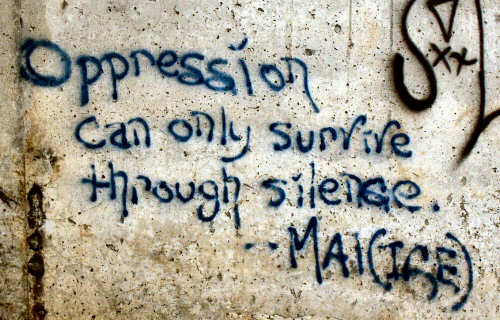
Oppression graffiti, January 15, 2013. (Students for Liberty via http://genderlitutopiadystopia.wikia.com).

Oppression graffiti, January 15, 2013. (Students for Liberty via http://genderlitutopiadystopia.wikia.com).

Did I play a good fife? Tamrin thought so. Compared to my Hebrew-Israelite comrades, I’m pretty sure I did. But like with so many things Hebrew-Israelite during those years, it was a bitter march to nowhere. The fife was part of a Hebrew-Israelite physical and spiritual gulag that put me into more chains, rather than freeing me to be me. Despite Tamrin’s intentions, the idea of molding me and others into men in conditions that would make most “men” contemplate homelessness or running away was a ridiculous pipe-dream.

That Tamrin was likely the only adult male in the Hebrew-Israelite camp who saw Maurice for the lying, abusive, womanizing asshole he was made me realize not everyone in this world was against me. But in a religion that when practiced helped oppress me and others more than the outside world, what was any Tamrin to do?

“Fear of The Unknown” or “Other” = Inhumanity

09 Saturday Jul 2016

Posted by decollins1969 in 1, Academia, culture, Eclectic, Politics, Pop Culture, race, Religion, Work, Youth

≈ Leave a comment

Tags

"Fear of the Other", "Fear of the Unknown", #AltonSterling, #PhiladoCastile, American Narcissism, Black Box, Dallas, Duquesne University College of Education, Empathy, History of American Education, Humanity, Inhumanity, Islamophobia, Racism, Southern and Eastern European Immigrants, Teaching and Learning, Xenophobia


A black box with question mark, a certain "fear of the unknown," July 9, 2016. (http://socialcapitalmarkets.net).

A black box with question mark, a certain “fear of the unknown,” July 9, 2016. (http://socialcapitalmarkets.net).

The phrases “fear of the unknown” or “fear of the other” has been something that I’ve been familiar with as long as I’ve been in the classroom. So many essays, so many discussions, so many presentations where these stock phrases have greeted me in my capacity as instructor, professor, facilitator, administrator, and public speaker. Ultimately, the use of these all-too-often used phrases reflects the inability of the people who speak and write them to see other people as Homo sapiens, thus diminishing their humanity in the process.

The first time I seriously encountered either phrase, though, was in my second semester of teaching History of American Education in the College of Education at Duquesne University for MAT students. It was the fall of 1998, and I was teaching a required education foundations course (I was also doing Multicultural Education that semester). To be sure, there were a couple of veteran teachers who didn’t like having a twenty-eight year-old Black man telling them about the marbled history of their profession and the institutions for which they served as K-12 teachers. Some of their bigoted evaluation responses disclosed as much.

It was the week I lectured on the Southern and Eastern European immigrant experience in America’s emerging public school systems between roughly 1880 and 1930. In going through the efforts of educators to literally beat out of these children the language of their mother countries (e.g., Italian, Yiddish, Greek, Polish, etc.) while sorting them into lower intellectual tracks within public schools, I noted the anti-immigrant xenophobia among WASPs at that time. One of my students during discussion tried to explain it away as a WASP “fear of the unknown.” I asked, “What was the unknown? Were these immigrants aliens?” — in this case, I meant “extraterrestrials.”

Data Mining/Fear of the Unknown cartoon, Adam Zyglis, Buffalo News, July 6, 2013. (http://adamzyglis.buffalonews.com/2013/07/06/data-mining/).

Data Mining/Fear of the Unknown cartoon, Adam Zyglis, Buffalo News, July 6, 2013. (http://adamzyglis.buffalonews.com/2013/07/06/data-mining/).

The student didn’t really answer my question, as if “fear of the unknown” needed no explanation. But on the paper related to the experiences of the children of Southern and Eastern European immigrants, Black migrants, and working-class women, over and over again, the phrase “fear of the unknown” kept showing up. What made this use of phrase even more disappointing was an even more sobering Western Pennsylvanian reality. Most of my students were the descendants of Southern and Eastern European immigrants, some of whom were old enough to have had contact with grandparents who must have recounted their experiences with xenophobia in public education. That these students couldn’t possibly see the inhumanity of the phrase “fear of the unknown” made me question whether these current and future teachers should be in a classroom at all.

Luckily, I did manage to reach a few of my more skeptical students around these sorts of issues as this course progressed. After all, most teachers really do want to help their students. A couple even wrote me notes after slamming me in their evaluations about how my History of American Education course had opened their eyes to inequality and social reproduction in K-12 education.

Since then, I have remained keenly aware of when students, colleagues, public speakers, and fellow administrators (specifically in the context of the nonprofit world) have said or written the “fear of the unknown” or “fear of others” phrases. Mostly, it’s not in the context of White ethnics from an era in which “White” mostly meant “White Anglo-Saxon Protestants.” Over the past fifteen years, I’ve seen and heard “fear of the unknown” in reference to Blacks, Latinos viewed only as free-loading immigrants, and Arab-Muslim Americans as US-hating terrorists. There have been students who have justified the race riots of the not-so-recent past (the ones where White mobs stormed into Black neighborhoods and burned them out while maiming and killing Black men, women, and children) with the phrase “fear of the unknown.” Or co-workers who’ve explained away their xenophobia or homophobia as a natural “fear of the other.” Or public speakers who’ve explained Islam as if it were a magical black box that churns out terrorists the way Detroit used to turn out automobiles.

Caravaggio's Narcissus (1594-96) , May 15, 2011. (Masur via Wikipedia). In public domain.

Caravaggio’s Narcissus (1594-96) , May 15, 2011. (Masur via Wikipedia). In public domain.

Stop it. Just stop it. What does “fear of the unknown” really mean? That you didn’t know that Black Americans were human beings with a need for work, education, housing, sleep, air to breathe, and food to eat? That you couldn’t conceive of Latinos as a group of folks who’ve been part of the American landscape (specifically Texas and the southwestern US) for far longer than there has been a US? That you can’t contemplate the idea that Arab Muslims have just as much right to exercise their First Amendment rights to freedom of speech, religion, and assembly as any “red-blooded American?”

Using the phrase “fear of the unknown” says more about the people using it than it does about the “others” they attempt to describe as “unknowns.” All anyone really needs to know is that the so-called others are human beings. To say “unknown” or “other” means than you think you are superior to these “unknowns.” Or, conversely, that these “other” humans are not “normal,” that they are defective or not quite your equals. When groups of humans attempt to justify inequality or their fear with phrases like “fear of the unknown” or “fear of the other,” it means they have little or no empathy for the “unknown” or “other.” And when we as humans can cut ourselves off from other humans in this way, doesn’t that make us less humane, more “other” because we believe ourselves to be normal, even special, and therefore, better, than these “unknown others?”

Of course, there are tremendous psychological and material advantages to seeing other humans as “unknowns” and “others.” This week of #AltonSterling, #PhiladoCastile, and #Dallas has been proof positive of the value of some lives versus “unknown others.” The truth is, no Homo sapiens live in black holes. Unless those with the power to cut off empathy to their psychological and material advantage make a mental home for us there.

The Mountaintop of Sixth Grade

22 Wednesday Jun 2016

Posted by decollins1969 in 1, Boy @ The Window, culture, Eclectic, Hebrew-Israelite, Mount Vernon New York, Pop Culture, race, Religion, Youth

≈ Leave a comment

Tags

Arrogance, Hubris, Humanities, Intelligence, Narcissism, Public Speaking, Reggie Jackson, Sixth Grade Graduation, Straight-A Student, William H. Holmes Elementary


William H. Holmes Elementary, Mount Vernon, NY, November 23, 2006. Donald Earl Collins

Thirty-five years ago this week, I finished elementary school. Thirty-five years since I first felt that feeling of reaching the mountaintop, as if I’d accomplished something in my life. Three-and-a-half decades since the last time I was unknowingly naive and unnecessarily arrogant.

It was a finish with a flourish, though. Combined with having become a part of a bizarre religion, I had a new point of view on my life by the time graduation day on Friday, June 26 of ’81 rolled around. My family was now two months into our serving Yahweh, and I was six weeks removed from losing my best friend Starling because of this nutty religion. It was a time in which I felt overwhelmed about my present and immediate future. Yet I acted as if I’d published a book that was both a New York Times Bestseller and a Pulitzer Prize winner. I couldn’t have been more pumped up if I’d been on Walter White’s blue crystal meth from Breaking Bad.

The Sun setting behind the Statue of Liberty, New York, July 4, 2003. (http://science.nasa.gov/).

The Sun setting behind the Statue of Liberty (kind of how I saw my life back in 1981), New York, July 4, 2003. (http://science.nasa.gov/).

But I had some basis for seeing myself as great. As far as I was concerned, I was the unofficial valedictorian of my elementary school class at William H. Holmes Elementary, the ’50s structure next to the big Presbyterian church on North Columbus and East Lincoln Avenue. My teachers had chosen me out of all of my classmates to speak at our graduation ceremony. On that last Friday in June ’81, I served as the opening speaker, introducing the city councilman who served as our keynote. I even wrote the short introduction that I delivered on that wonderful day.

I firmly believed no one in the world was smarter than me. In the three years prior to graduation, I had straight A’s. Still, that paled in comparison to my performance my last year of elementary school. I figured out that I earned an A on forty-eight out of fifty-two quizzes and tests in sixth grade. The lowest grade I earned that year was an 88 on a spelling quiz. I’d won a Dental Awareness Month award for Best Poster and came in second in a city-wide writing contest that included essays from high school students. If anyone had known how big my head had grown that year, they would’ve stuck a pin in my temple just to let the air out.

It wouldn’t have been any funnier if I’d pretended I was Mr. October himself, Reggie Jackson, saying his words, “Sometimes I underestimate the magnitude of me.” I wanted so badly to see myself and to be seen by others as special that I forgot about the work it had taken to move my reading and writing skills up eight grade levels in a little more than two and a half years.

Yankees/Oakland A's/California Angels HOF Reggie Jackson at bat, 1980, accessed June 21, 2016. (AP Photo).

Yankees/Oakland A’s/California Angels HOF Reggie Jackson at bat, 1980, accessed June 21, 2016. (AP Photo).

It was a great day, sunny and low-eighties with cumulus clouds and low humidity. But knowing what life at 616, Mount Vernon and Humanities had in store for me over the next eight years, I should’ve smelled the ozone in the air. I should’ve looked more closely at my sky, to see the flocks of seagulls flying away from the shoreline. I should’ve sensed — and did, on a very low-frequency — the hurricane gaining strength in my life. I chose to ignore it, hoping that I could fake my way through it while resting on my laurels.

To think that it would’ve been another nine years before I felt like I could take on the world again. If someone had told me in June ’81 that I’d have to wait until my junior year at the University of Pittsburgh to have a straight-A semester, I would’ve grabbed a gun and shot myself through the temple with a Colt .45. And I would’ve made sure the bullet I used had a hollow tip. If I’d known that I’d have to wait a full decade to be comfortable with myself as myself in all of my goofiness again, I probably would’ve cried on the spot.

All I can hope these days is that my nearly teenage son can strike a balance between being cool and being cool with himself. I don’t want him spending a decade trying to figure himself out all by himself.

Where Everything Equals “Radical Islam” Terrorism

14 Tuesday Jun 2016

Posted by decollins1969 in 1, culture, Eclectic, Politics, Pop Culture, race, Religion, Youth

≈ Leave a comment

Tags

"Radical Islamism", #Orlando, #PulseShooting, Fairies, Fairly Odd Parents, Hillary Clinton, Internalized Homophobia, Internalized Racism, Islamic State, LGBT rights, Misdirected Hatred, Mr. Crocker, NickToons, Omar Mateen, Terrorists


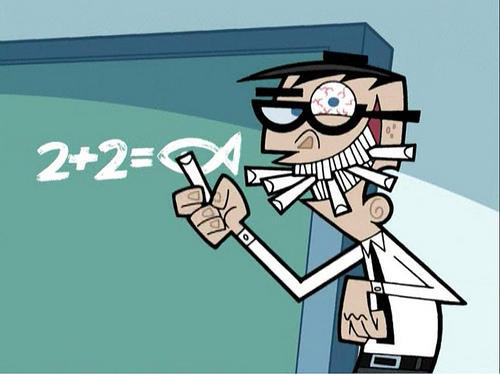
Mr. Crocker from The Fairly Odd Parents, June 14, 2016. (http://cdn.smosh.com/).

Mr. Crocker from The Fairly Odd Parents, June 14, 2016. (http://cdn.smosh.com/).

The tragic shame of fifty dead and fifty-three wounded because of one Omar Mateen’s anti-Black, anti-Puerto Rican, anti-gay, and anti-Islam hatred. The attack on an LGBT sanctuary in Orlando, Florida will continue to make news as the world learns more about the deceased attacker, his family and friends, as well as about the dozens of living and dead victims of Mateen’s venom.

While there is much to learn about all of this, there is one thing Americans and the world already know. That we as Americans — politicians, media, and ordinary citizens — are incredibly quick at jumping to conclusions before we have any facts at all. Declaring Omar Mateen an example of “radical Islamism” when he barely brushed an arm of anyone even remotely connected to terrorism in the name of Islam? Thanks a lot, Hillary (you’re supposed to be the sensible choice of the two presidential candidates, right?)!

Really, our reaction as a nation is no different from Mr. Crocker’s to unexplainable phenomenon on NickToon’s The Fairly Odd Parents – a play on the words “fairy godparents.” Until my son hit his preteens, I’d been subjected to six years of this ridiculous show about a permanent ten-year-old with fairies granting his every wish, all to his and the world’s detriment. Mr. Crocker, his permanent elementary school teacher, once had fairies when he himself was a kid. Upon suspecting that his charge has fairies of his own, Mr. Crocker became obsessed, building gadgets and devising plans to prove to himself and the world that fairies exist. Or, even more extreme, to steal the ten-year-old’s fairies and use their power to dominate the world.

But instead of yelling “FAIRIES!!! FAIRIES!!! FAIRIES!!!” every time a mass killing occurs in the US, we scream “TERRORISTS!!! TERRORISTS!!! TERRORISTS!!!” To be sure, what Mateen did was an act of terror. In our use of the term, though, Americans always mean terrorists who are of Arab descent, terrorists who claim Islam as their religion. We don’t do this for White “Christians” like Dylann Roof or, going back two decades, Timothy McVeigh. Why is that? Because we Americans are so obsessed with IS (Islamic State), that we never deal with our own -isms. Which ultimately may be why Mateen could take his internalized homophobia, racism, and misogyny and explode it into taking and harming the lives of so many innocents.

Addendum to “My Muhammad Ali:” Open Agendas

11 Saturday Jun 2016

Posted by decollins1969 in 1, culture, Eclectic, Patriotism, Politics, Pop Culture, race, Religion, Sports, Work, Youth

≈ Leave a comment

Tags

American Exceptionalism, American Individualism, American Narcissism, Anti-Racism, Attallah Shabazz, Billy Crystal, Bryant Gumbel, Economic Inequality, Funeral, Hypocrisy, Interfaith Service, Joe Rapport, KFC Center, Louisville Kentucky, Muhammad Ali, President Barack Obama, President Bill Clinton, Public Funeral, Religious Acceptance, Religious Bigotry, Structural Racism, Valerie Jarrett


Ambassador Attallach Shabazz (eldest daughter of Malcolm X) speaking at Muhammad Ali's public funeral, KFC Yum! Center, Louisville, KY, June 10, 2016. (http://www.odt.co.nz/).

Ambassador Attallah Shabazz (eldest daughter of Malcolm X) speaking at Muhammad Ali’s public funeral, KFC Yum! Center, Louisville, KY, June 10, 2016. (http://www.odt.co.nz/).

Public spectacles, if not properly processed and analyzed, are like champagne and wedding cake at a reception. Without a filter, a spectacle can easily become empty calories and shiny objects, lacking in context and devoid of implications.

The hours-long coverage of both Muhammad Ali’s ride to his grave and the public funeral service that followed the private one in Louisville, Kentucky on Friday had its moments. Ambasador Attallah Shabazz’s heartbreak, joy, and eloquence regarding her lifelong relationship with Ali and the connections between him, her, and her father, Malcolm X. Bryant Gumbel’s somber and bittersweet speech about Ali the man and athlete, so imperfect, so flawed, and yet, nearly as great as Ali said he himself was. Billy Crystal’s ability to mix comedy and sorrow, so typical of the great comedian when he was in his heyday. Rabbi Joe Rapport’s ability to keep his words and stories simple, to make his message plain. They were the highlight of the public interfaith spectacle that despite all objections to the contrary (including my own), was all that Ali wanted in the aftermath of his death.

"Ali Wins Decision" on 8-0 Supreme Court decision to "Kayo Draft Rap," June 29, 1971. (http://www.nydailynews.com).

“Ali Wins Decision” with SCOTUS decision to “Kayo Draft Rap,” June 29, 1971. (http://www.nydailynews.com).

If the service had only consisted of this group of men and women, the service would’ve been over in under an hour, and would have accomplished all Ali apparently wanted. Sadly, other people had the opportunity to speak for Ali and on his behalf, imbuing their own selfish and whitewashing stamps on the man and his public funeral. Valerie Jarrett, one of the powers behind President Barack Obama’s Oval Office chair, read Obama’s statement commemorating Ali at the funeral. Except that Valerie Jarrett’s reading of the president’s commemorative letter sounded more like a call to America as a great and exceptional nation.

He’d have everything stripped from him – his titles, his standing, his money, his passion, very nearly his freedom.  But Ali still chose America. I imagine he knew that only here, in this country, could he win it all back.

Where else was Ali going to go to continue his career? Ali was going through the courts in order to keep from going to prison for draft dodging, no? Running away would’ve made his predicament worse, not better. Ali may have chosen America between 1967 and 1970. But let’s not pretend as if Saudi Arabia, Australia, Sweden, and the USSR had invited him to live and fight heavyweight championship fights abroad as an alternative.

President 42, William Jefferson Clinton, ended the four (or was it five?) hour public funeral with his standard “I feel your pain” speech. Clinton had been crying for at least twenty minutes before he walked up the steps to the podium. His face was flush and a bright pink from grief. Clinton began with a few choked words as he stifled tears. Now, I am not saying that any of this was Clinton fakery. He has always been in the moment as long as he’s been in the public eye. And in that moment on Friday, the former president was as heartbroken as anyone in that 18,000-seat arena.

Still, Clinton managed a select choice of words that conjured up America the beautiful and the message of American individualism.

We have all seen the beautiful pictures of the humble Muhammad Ali with a boy and people visiting and driving by. I think he decided something I hope every young person here will decide. I think he decided very young, to write his own life story. I think he decided, before he could possibly have worked it all out, and before fate and time could work their will on him, he decided he would not be ever be disempowered. He decided that not his race nor his place, the expectations of others, positive negative or otherwise would strip from him the power to write his own story.

See how Clinton just slipped that in his eulogy, as if structural racism, economic inequality, the chaos of one’s family or community can be overcome by sheer force of will? (Or, as the researchers call it these days, “grit” and “resilience?”) Clinton snuck that American rugged individualism in there faster than a twenty-seven year-old Ali could turn out the lights and jump into bed. Or, rather, the way a sneaky teenager can spike a bowl of punch with whisky or rum.

How much grit does one need to overcome society's barriers?, June 11, 2016. (http://shop.takachpress.com).

How much grit does one need to overcome society’s barriers?, June 11, 2016. (http://shop.takachpress.com).

For Ali, it wasn’t just grit or determination that was critical. He had skills that only a handful of people on the entire planet have ever possessed in any generation. The kind of skills that made him a three-time heavyweight champion. His family was working-class in the Jim Crow South, a major achievement in the 1940s and 1950s. A Louisville police officer who also happened to train boxers “discovered” Ali in 1954, when the latter was twelve years old. Maybe Ali, like me at twelve, had discovered some sense of his calling and pursued it fully. But opportunities matter. Talent matters. A background that incubates and nurtures that talent matters. Sheer will alone only gets individuals so far. Thanks for continuing to spread the American mythology, Clinton.

Clinton also said

I have spent a lot of time now, as I get older and older, trying to figure out what makes people tick, how do they turn out the way they are, how do some people refuse to become victims and rise from every defeat.

The answer isn’t merely in individual struggle, but in dismantling structures that stifle the ability of individuals to overcome. Or really, dismantling structures so that there is no need to overcome racism and inequality in the first place. The idea that it’s just the individual’s fault that they do not overcome being victims. This could just as easily be the argument that rapist Brock Turner’s father made against “Emily Poe” after his son was sentenced to only six months in county jail for sexual assault in California.

The Trials of Muhammad Ali (2013) poster, June 11, 2016. (http://www.kartemquin.com).

The Trials of Muhammad Ali (2013) poster, June 11, 2016. (http://www.kartemquin.com).

Maybe President Obama’s right. “Muhammad Ali was America. He will always be America.” But what America was he? Was he a narcissistic megalomaniac who had no empathy for the plight of the poor and vulnerable and didn’t understand structural racism and religious intolerance as fundamental obstacles to freedom? Or was he the unapologetic Black man who stood for what America ought to be, rather than the hypocrisy that America often is? Or, perhaps, Ali represents both strands of this bipolar and narcissistic American identity after all?

What this means is that while Ali can forever rest in peace, for America, peace will remain elusive.

My Muhammad Ali

05 Sunday Jun 2016

Posted by decollins1969 in 1, Boy @ The Window, culture, Eclectic, High Rise Buildings, Jimme, Mount Vernon New York, My Father, New York City, Politics, Pop Culture, race, Religion, Youth

≈ Leave a comment

Tags

"Impact", Blackness, Bonds, Boxing, Closed-Circuit TV, Death, HBO, Legacy, Life, Maurice Eugene Washington, Meaning, Muhammad Ali, Parkinson's Disease, Robert Farmer, Roots (1977), Self-Awareness, Self-Discovery, The Greatest (1977)


Meme of Muhammad Ali quote on "impossible" combined with iconic photo of Ali in 1st Round of first fight with Sonny Liston, February 25, 1964. (Getty Images via Twitter).

Meme of Muhammad Ali quote on “impossible” combined with iconic photo of Ali in 1st Round of first fight with Sonny Liston, February 25, 1964. (Getty Images via Twitter).

There is so much I could say about Muhammad Ali. His greatness. His contradictions. His imperfections and frailness. And all of them would be true. He was both a great man and a deeply flawed man at the same time. But, from 1964 through 1980, Muhammad Ali was the most recognizable person on the planet, with every aspect of his complicated onion on display in every corner of the world.

I have a few childhood memories of Ali’s headier days and nights. One was in ’74. It was the “Rumble in the Jungle” fight between Ali and George Forman. My father Jimme took me and my brother Darren over to his drinking buddy Robert Farmer’s house to watch the fight on closed-circuit TV (yep, Mr. Farmer spent good money on this fight). I do remember seeing bits and pieces of the fight, with Ali using the ropes around the ring like they were a trampoline. But mostly, I remember my dad and Farmer and Lo and others drinking and smoking away while watching the fight. October 30, 1974 was also the night that I learned my first colloquialism, the “rope-a-dope.” I know that the “dope” was Foreman, but I’ve seen lots of people as dopes in the four decades since that fight.

The Rumble in the Jungle poster, October 29, 1974. (Armbrust via Wikipedia). Qualifies as fair use because of low resolution for reproduction.

The Rumble in the Jungle poster, October 29, 1974. (Armbrust via Wikipedia). Qualifies as fair use because of low resolution for reproduction.

I remember watching the “Thrilla in Manila” nearly a year later between Ali and Joe Frazier, either at Mr. Farmer’s place or at a bar, I’m not sure. Again, smoke, drinks, beer cans, sunflower seeds and cigars, all in the midst of two fellas knocking the hella outta each other. My father sure knew how to show his two young sons (I was five and Darren was seven at the time) a good time.

These two fights became vague but embedded memories, perhaps two of the greatest bouts of all time. Although, Jack Johnson-James Jeffries, Joe Louis-Max Schmeling I and II, and Ali (née Cassius Clay)-Sonny Lister also come to mind in terms of historical significance.

But where I remember seeing Ali in a context beyond the right was in this movie The Greatest in May 1977. Believe it or not, my soon-to-be idiot stepfather Maurice took us to see this mediocre docudrama of a biopic on Muhammad Ali’s through 1974. (So I guess I was wrong when I said my stepfather had only done two good things for me growing up). At seven, there was no way I could know how bad the film was, between scenery chewers Ernest Borgnine and James Earl Jones. Still, the movie put those hazy memories from ages four and five in better perspective. After having seen Roots a few months earlier, I was really conscious of the wider world, of race, and of Muhammad Ali’s importance for the first time.

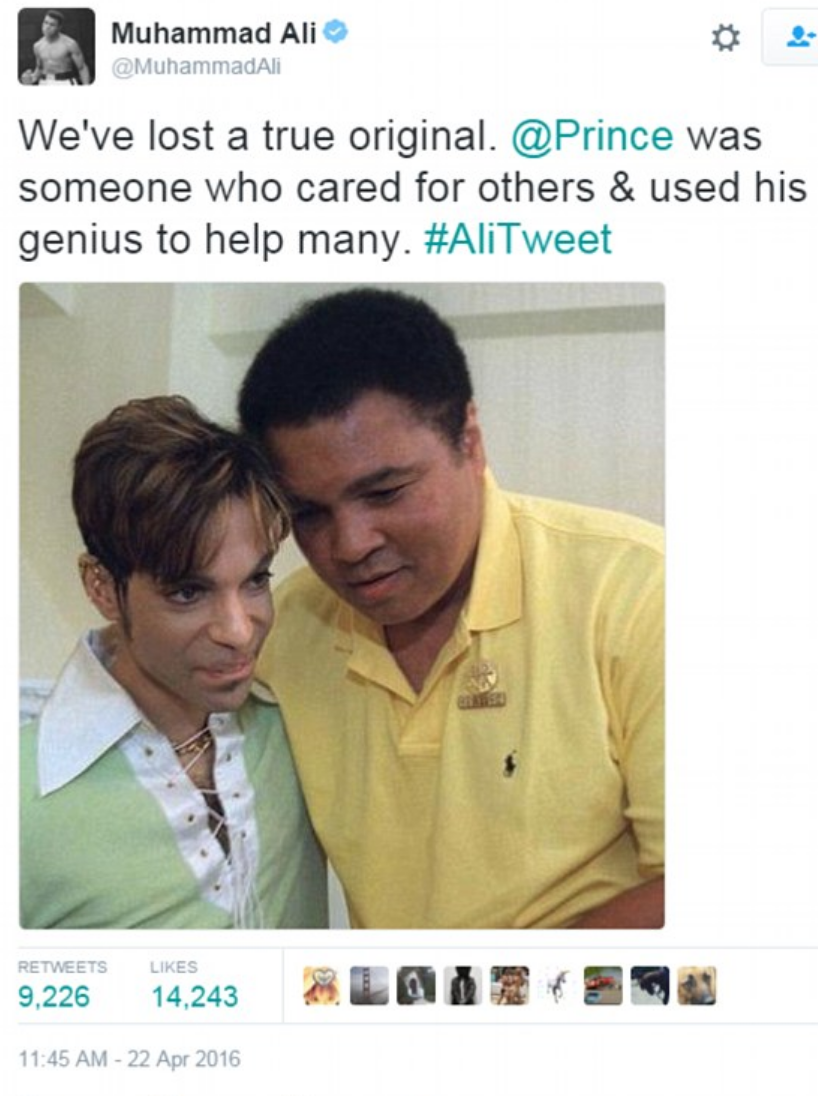
Muhammad Ali tweet re: Prince's death (pic is from their first meeting in 1997), April 22, 2016. (Twitter).

Muhammad Ali tweet re: Prince’s death (pic is from their first meeting in 1997), April 22, 2016. (Twitter).

Unlike Natalie Cole, David Bowie, Prince, and going back before 2016, Michael Jackson, I’ve been expecting Ali’s death for quite some time. His Parkinson’s wasn’t just Parkinson’s, but likely brain damage the likes of which NFL players have come to fear. That it took Ali until 1984 to announce what millions had suspected as far back as 1978 told us that he had taken a long time to come to grips with what would become his second act, his new reality. That Ali became a symbol of philanthropy, activism, and humanitarianism during this second act suggests that his strong will and support system deserves way more credit for the quality of his life than anything he did in the ring.

“Show me a hero, and I’ll write you a tragedy” comes from the 1920 mind of F. Scott Fitzgerald. If he were to write Muhammad Ali’s story, it would likely read as a tragedy. Luckily for us, Fitzgerald isn’t around to do so.

We have glossed over a few things in our millions of small eulogies for Ali this weekend. His sexism and occasional misogyny and abuse, both in words and deeds. His obvious colorism, calling Joe Foreman a “gorilla” and most of his somewhat darker skinned opponents “ugly” as a euphemism for their failure to pass the brown-paper-bag test. His rejection of Malcolm X at the very time when Malcolm needed him the most. Ali in the years between his biggest bouts and his mostly silent second life expressed regret about these -ism words and actions.

Despite this, Ali was still a father, a husband, a Muslim, a three-time heavyweight champion of the world, an author, a poet, an actor, an anti-war activist, a civil rights advocate, a social justice leader, a humanitarian, a hostage negotiator, and a Parkinson’s survivor. Ali was a fighter, in the most panoramic sense of the word. And yes, he was a Black man, in the narrowest and most intersectional senses of that two-word phrase. And all of that made him an icon. RIP.

Striking members of Memphis Local 1733 hold signs whose slogan symbolized the sanitation workers' 1968 campaign, March 1968. (Richard L. Copley/http://dlxs.lib.wayne.edu/).

Striking members of Memphis Local 1733 hold signs whose slogan symbolized the sanitation workers’ 1968 campaign, March
1968. (Richard L. Copley/http://dlxs.lib.wayne.edu/).

Fights and Friendships

05 Thursday May 2016

Posted by decollins1969 in 1, Boy @ The Window, Christianity, culture, Eclectic, eclectic music, Hebrew-Israelite, Mount Vernon New York, Politics, Pop Culture, race, Religion, Youth

≈ 2 Comments

Tags

"Friends" (1984), "Scream" (1995), 616, 616 East Lincoln Avenue, Child Abuse, Ego Inflation, Friendships, Hip-Hop, Hubris, Humanities, Intolerance, Janet Jackson, Michael Jackson, Rap, Salvation, Shunning, Starling Churn, Teenage Angst, Whodini, William H. Holmes Elementary


My friendship with my one-time best friend Starling ended on this week thirty-five years ago. It was a friendship that “began with a fight and ended with a fight,” as I wrote in Boy @ The Window. The second fight had as much to do with inflated preteen egos as it did with intolerance and ignorance. But that couldn’t be helped, given the way we were, the way our families had been back in the first days of the Reagan Years.

We’d been friends since the last third of fourth grade at William H. Holmes Elementary Most of our conversations the first year or so of our friendship had been about music, politics, history, and other things related to school or pop culture. By the time we reached Mrs. Bryant and sixth grade, a good portion of our conversations turned to Christianity. I guess that this was inevitable. Starling was the “son of a preacher man,” a Southern Baptist pastor. Starling wanted to see me become an official child of God and brother in Christ. My search was one of truth and God, and if Jesus was the one who could get me there then so be it. I didn’t feel the same sense of urgency for water immersion and John 3:16 as Starling did for me.

Back area behind William H. Holmes ES (where my two fights with Starling occurred), Mount Vernon, NY, November 22, 2006 (Donald Earl Collins).

Back area behind William H. Holmes ES (where my two fights with Starling occurred), Mount Vernon, NY, November 22, 2006 (Donald Earl Collins).

The return of my prodigal stepfather Maurice Washington/Judah ben Israel and his bringing the whole Hebrew-Israelite thing to 616 put a temporary end to my Christian enlightenment in April ’81. Him and my Mom had been separated for about six months. During that time, my idiot stepfather had discovered the ways of Yahweh and Torah and alleged that he was a changed man. So we all had to change, to stop eating pork and bloody meats, to start wearing kufis, and to somehow see this fool as our dad.

Starling stopped speaking to me immediately and entirely when I showed up on a mid-April Monday with a white kufi on my head. on the last Friday in March. Our friendship was suddenly over. This was what our second fight was about, our friendship, my bizarre religion and my acceptance of it. At least it was for me.

As I wrote in the memoir,

I guess that Starling at twelve was definitely his father’s son. I could certainly understand Starling’s perspective on this. I’d betrayed him when I came to school and professed that I was a Hebrew-Israelite. Starling had been talking to me for months about becoming a Christian, a Baptist, and now here I was embracing Afrocentric Judaism, similar in many ways to the Nation of Islam and its variants in terms of its racial politics. The practitioners I’d been around tended to see Black Christians as “weak,” out of touch with “their heritage,” and as “worshiping the wrong God.” Starling couldn’t accept this. We ended up in our second and final fight. I was fighting for our friendship, literally. Starling beat me to end it.

I felt betrayed myself. Starling had turned his back on me at a time in which I needed his input the most. I still cared about the same things, thought about the same issues, and wanted someone whom I could banter with about music and politics and religion. But given Starling’s background, even back then I realized that he thought that I was well on my way to hell. Starling and I saw ourselves as adults in many ways, so he assumed that I had made a free-will adult decision for becoming a Hebrew-Israelite when I walked into Mrs. Bryant’s class with a kufi on my head. He had no idea how much I was struggling with my mother and stepfather’s decision to make our family a Hebrew-Israelite one.

Screen Shot from Michael Jackson and Janet Jackson's "Scream" (1995) video, May 5, 2016. (http://www.vidivodo.com).

Screen Shot from Michael Jackson and Janet Jackson’s “Scream” (1995) video, May 5, 2016. (http://www.vidivodo.com).

So I projected the outward appearance of supreme confidence and faith in Jehovah and this slant on the ten Lost Tribes of Israel, to protect myself from being hurt and to see if this whole Hebrew-Israelite thing really was for me. Not a good move going into middle school and the Humanities Program later that year. I had no idea how much worse my life was about to become in the two years between the end of my friendship with Starling and my family’s fall into welfare poverty, bumps, bruises, babies and concussions along the way.

It wasn’t until the end of eighth grade that Starling and I began exchanging “Hi’s” again. Even then, this was often forced. The only conversation I had with Starling after our fight was at the end of ninth grade, with him letting me know that he was moving with his family down South. Starling Churn left with his family for Wilmington, North Carolina in the summer of ’84, still believing I was well on my way to eternal damnation.

That friendship’s rise and fall has helped me understand who friends really are. Ultimately a friend is someone who isn’t a relative but you gravitate toward and have shared interests with, a person who has sympathy and empathy for you and your life. A person who isn’t afraid to tell you when you’re fucking up and who doesn’t shun you when you lose your way. That’s a real friend. I’ve had and still have, thankfully, a core group of ride-and-thrive friends who fit (or at least come close to it) this definition.

Starling and I couldn’t. We were tweeners, after all, and pseudo-intellectual ones with inflated egos from straight-As at that. And in a country that barely tolerates anything other than blind, unthinking Christianity and a false sense of patriotism, maintaining a friendship in the midst of a major religious shift — even a childhood one — was and is nearly impossible.

← Older posts
Newer posts →

Boy @ The Window: A Memoir

Boy @ The Window: A Memoir

Places to Buy/Download Boy @ The Window

There's a few ways in which you can read excerpts of, borrow and/or purchase and download Boy @ The Window. There's the trade paperback edition of Boy @ The Window, available for purchase via Amazon.com at http://www.amazon.com/Boy-Window-Donald-Earl-Collins/dp/0989256138/

There's also a Kindle edition on Amazon.com. The enhanced edition can be read only with Kindle Fire, an iPad or a full-color tablet. The links to the enhanced edition through Apple's iBookstore and the Barnes & Noble NOOK edition are below. The link to the Amazon Kindle version is also immediately below:

scr2555-proj697-a-kindle-logo-rgb-lg

Boy @ The Window on Amazon.com: http://www.amazon.com/Boy-The-Window-Memoir-ebook/dp/B00CD95FBU/

iBookstore-logo-300x100

Boy @ The Window on Apple's iBookstore: https://itunes.apple.com/us/book/boy-the-window/id643768275?ls=1

Barnes & Noble (bn.com) logo, June 26, 2013. (http://www.logotypes101.com).

Boy @ The Window on Barnes & Noble: http://www.barnesandnoble.com/w/boy-the-window-donald-earl-collins/1115182183?ean=2940016741567

You can also add, read and review Boy @ The Window on Goodreads.com. Just click on the button below:

Boy @ The Window

Twitter Updates

Tweets by decollins1969
  • RSS - Posts
  • RSS - Comments

Archives

  • June 2025
  • April 2023
  • September 2022
  • August 2022
  • July 2022
  • June 2022
  • May 2022
  • April 2022
  • March 2022
  • January 2022
  • December 2021
  • November 2021
  • October 2021
  • September 2021
  • August 2021
  • July 2021
  • June 2021
  • April 2021
  • March 2021
  • February 2021
  • January 2021
  • December 2020
  • November 2020
  • October 2020
  • September 2020
  • August 2020
  • July 2020
  • May 2020
  • April 2020
  • March 2020
  • January 2020
  • December 2019
  • November 2019
  • August 2019
  • July 2019
  • June 2019
  • May 2019
  • April 2019
  • March 2019
  • February 2019
  • January 2019
  • December 2018
  • November 2018
  • October 2018
  • September 2018
  • August 2018
  • July 2018
  • June 2018
  • May 2018
  • March 2018
  • February 2018
  • January 2018
  • December 2017
  • November 2017
  • October 2017
  • September 2017
  • August 2017
  • July 2017
  • June 2017
  • May 2017
  • April 2017
  • March 2017
  • February 2017
  • January 2017
  • December 2016
  • November 2016
  • October 2016
  • September 2016
  • August 2016
  • July 2016
  • June 2016
  • May 2016
  • April 2016
  • March 2016
  • February 2016
  • January 2016
  • December 2015
  • November 2015
  • October 2015
  • September 2015
  • August 2015
  • July 2015
  • June 2015
  • May 2015
  • April 2015
  • March 2015
  • February 2015
  • January 2015
  • December 2014
  • November 2014
  • October 2014
  • September 2014
  • August 2014
  • July 2014
  • June 2014
  • May 2014
  • April 2014
  • March 2014
  • February 2014
  • January 2014
  • December 2013
  • November 2013
  • October 2013
  • September 2013
  • August 2013
  • July 2013
  • June 2013
  • May 2013
  • April 2013
  • March 2013
  • February 2013
  • January 2013
  • December 2012
  • November 2012
  • October 2012
  • September 2012
  • August 2012
  • July 2012
  • June 2012
  • May 2012
  • April 2012
  • March 2012
  • February 2012
  • January 2012
  • December 2011
  • November 2011
  • October 2011
  • September 2011
  • August 2011
  • July 2011
  • June 2011
  • May 2011
  • April 2011
  • March 2011
  • February 2011
  • January 2011
  • December 2010
  • November 2010
  • October 2010
  • September 2010
  • August 2010
  • July 2010
  • June 2010
  • May 2010
  • April 2010
  • March 2010
  • February 2010
  • January 2010
  • December 2009
  • November 2009
  • October 2009
  • September 2009
  • August 2009
  • July 2009
  • June 2009
  • May 2009
  • April 2009
  • March 2009
  • February 2009
  • January 2009
  • December 2008
  • November 2008
  • October 2008
  • September 2008
  • August 2008
  • July 2008
  • June 2008
  • May 2008
  • April 2008
  • March 2008
  • February 2008
  • January 2008
  • December 2007
  • November 2007
  • October 2007
  • September 2007
  • August 2007
  • July 2007
  • June 2007

Recent Comments

MaryPena's avatarMaryPena on My Day of Atonement/Bitter Hat…
decollins1969's avatardecollins1969 on No Good Teaching Deed Goes…
Mary Rose O’Connell's avatarMary Rose O’Connell on No Good Teaching Deed Goes…

NetworkedBlogs on Facebook

NetworkedBlogs
Blog:
Notes From a Boy @ The Window
Topics:
My Life, Culture & Education, Politics & Goofyness
 
Follow my blog

616 616 East Lincoln Avenue A.B. Davis Middle School Abuse Academia Academy for Educational Development AED Afrocentricity American Narcissism Authenticity Bigotry Blackness Boy @ The Window Carnegie Mellon University Child Abuse Class of 1987 CMU Coping Strategies Crush #1 Crush #2 Death Disillusionment Diversity Domestic Violence Economic Inequality Education Family Friendship Friendships Graduate School Hebrew-Israelites High-Stakes Testing Higher Education History Homelessness Humanities Humanities Program Hypocrisy Internalized Racism Jealousy Joe Trotter Joe William Trotter Jr. K-12 Education Love Manhood Maurice Eugene Washington Maurice Washington Misogyny Mother-Son Relationship Mount Vernon High School Mount Vernon New York Mount Vernon public schools Multiculturalism MVHS Narcissism NFL Pitt Pittsburgh Politics of Education Poverty President Barack Obama Race Racial Stereotypes Racism Relationships Self-Awareness Self-Discovery Self-Reflection Sexism Social Justice Teaching and Learning University of Pittsburgh Violence Whiteness Writing

Top Rated

Blog at WordPress.com.

  • Subscribe Subscribed
    • Notes from a Boy @ The Window
    • Join 103 other subscribers
    • Already have a WordPress.com account? Log in now.
    • Notes from a Boy @ The Window
    • Subscribe Subscribed
    • Sign up
    • Log in
    • Report this content
    • View site in Reader
    • Manage subscriptions
    • Collapse this bar
 

Loading Comments...