• About Me
  • Other Writings
  • Interview Clips
  • All About Me: American Racism, American Narcissism, and the Conversation America Can’t Have
  • Video Clips
  • Boy @ The Window Pictures
  • Boy @ The Window Theme Music

Notes from a Boy @ The Window

~

Notes from a Boy @ The Window

Category Archives: Christianity

The Contrarian One

15 Tuesday Feb 2011

Posted by decollins1969 in 1, Boy @ The Window, Christianity, culture, Eclectic, eclectic music, Mount Vernon High School, Politics, race, Religion, Youth

≈ Leave a comment

Tags

A.B. Davis Middle School, Anonymity, Contrarian, Dune, Humanities, MacGyver, Mount Vernon High School, Mount Vernon New York, Mount Vernon public schools, Privacy, Richard Dean Anderson, Sting, troubled youth


Sting as Feyd-Rautha in David Lynch's Dune, July 20, 2007. TAnthony. Qualifies as fair use under US Copyright laws because this is a low-resolution screenshot illustrating a character which is a subject in the article that uses it, and by nature no free version exists.

For the most part, I have protected the privacy of my childhood classmates and friends by not calling them by their actual names in this blog. I have used pseudonyms, code names like “Crush #1” or “Crush #2,” code letters based on their position in my cohort or how I saw them growing up. I don’t apply these rules to the adults I interacted with because they were public figures, authority figures really. That’s been one of my unofficial journalist-esque rules for this blog, and I’m sticking to it.

In this case, however, I’m pushing the envelope a bit. Even though I have no plans on using a name today, I’m using some initials of a former classmate that almost none of my readers will know. But for those that went through Humanities with me and read this post, the initials may make this person obvious. This classmate — and friend, I guess — was one of the few free thinkers I knew in my Humanities days. He wasn’t just smart — we were all smart. He fashioned himself an intellectual, someone who either thought against the grain or refused to get caught up in what he considered the daily stupid stress sandwich of grades, awards, and more grades that was our magnet program. Most of all, the kid was a contrarian, the one and only JD.

Just like with most of my classmates, I didn’t get along with him at first. He immediate came off to me as someone who saw himself above the fray, maybe even better than the rest of us. It didn’t help that JD introduced himself as “half-Russian, one-quarter French and one-quarter English” that first day of seventh grade nearly thirty years ago. For most of the first year, I thought that his persona was an act, an attempt at upper-crust coolness. I didn’t understand how girls — White and Black — liked this guy, zits and all.

Richard Dean Anderson as MacGyver, May 18, 2007. Source: http://www.just-whatever.com/2007/05/18/what-would-macgyver-do/

At various times during our Humanities days, his looks were compared to Sting, and later, MacGyver — actor Richard Dean Anderson’s most famous character. I’m sure that he liked the comparisons. If you meshed the two, you’d maybe end up with a JD, but probably about two inches shorter than the real life person.

At first, I didn’t think that he was all that smart. After all, we ended up in a fight over my outburst of laughter because he said Australians spoke “Australian” instead of English. I always wondered why we fought this week, of all weeks (twenty-nine years ago this week, by the way). It wasn’t as if we hadn’t annoyed each other before. Eventually I did begin to get Mr. OshKosh, as I called JD in my mind — and occasionally, out loud — during our Davis years. He was a deliberate individual, often trying too hard to be one. It was obvious to me that he thought the whole Humanities thing was a joke, that he found school a Sisyphean effort.

Still, even though we had fought — and I somehow managed to win against the karate kid — we’d get caught up in weird intellectual conversations about communism versus capitalism, or about America’s endless cultural corruption. JD would always take the most extreme view of America the ugly, leaving me no choice other than to argue with him or to agree with him, depending on the severity of his argument. He was a devout atheist, at least in argument, indirectly questioning my Hebrew-Israelite and, later on, early Christian beliefs. That he made me question what I thought I believed and what I actually did believe, I appreciated even at the time. I also got the sense that he was constantly questioning his world while casting doubt in my direction.

It was part of the dissatisfaction that I sensed in him all during our six years together in Mount Vernon’s schools. I didn’t know how much of it came from his home life, but my guess by the middle of high school was that we only saw a tip of a very large iceberg for six and half hours a day and five days a week. What was more obvious, at least to me, was that he seemed comfortable in his uncomfortability at Mount Vernon High School, with the flight of his White classmates in ninth and tenth grade, with the hypocrisy of Humanities as academic light in a sea of ignorance while ignoring the elephants in the room.

Despite holding many of his most private cards to his vest, JD was probably one of the five most honest people I knew in all of my education. His body language, his lack of interest in most things in the classroom, his varied cultural and intellectual interests outside of the classroom, his dating habits all but betrayed his closed-mouthness when it came to who he understood himself to be. He was, and has remained, my favorite contrarian.

Sweet and Sour 16

27 Monday Dec 2010

Posted by decollins1969 in 1, Boy @ The Window, Christianity, Eclectic, Religion, Youth

≈ Leave a comment

Tags

16th Birthday, 616 East Lincoln Avenue, Birthday Celebrations, Birthdays, Carvel Ice Cream, Ice Cream Cake, Mount Vernon New York, Stories


Slice of cake nicer looking, but similar in style to cake I had 25 years ago, December 27, 2010. Source: http://www.cake-decorating-corner.com

Happy forty-first birthday to me! Competing with the savior of humanity on the last week of the year has never been easy. Most years, there’s been no contest between the observed celebration of Jesus’ birth and the date of my actual birth. But the second half of my growing up years were the worst in terms of how I saw my birthday. From ’78 to ’87, there were two Happy Birthdays for me: one in ’79, and one in ’85. The one that occurred twenty-five years ago, I’d rather forget.

My sixteenth birthday, the twenty-seventh of December, was the first time since I turned nine that anyone bothered to give me a cake. This was a spontaneous decision, as I sat around 616 all day with little to do but watch after my younger siblings. Mom and Maurice agreed to buy me a birthday cake. Since it was my abusive stepfather’s money, I didn’t want any cake. I especially didn’t want the Carvel ice cream cake he thought I should have. I mean, it was a cold last Friday in December day, and all he could come up with was ice cream cake?

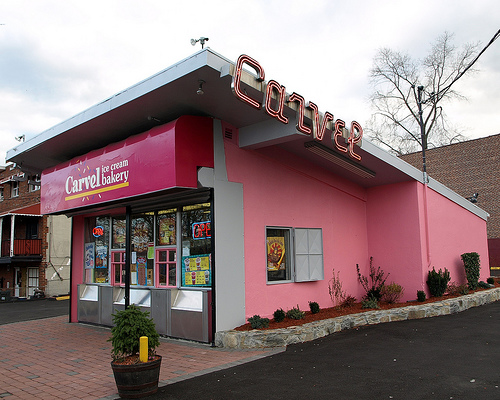
Carvel Ice Cream Store, Edenwald, East 233rd Street & Paulding Avenue, Bronx, New York, December 27, 2010. jag9889 at http://www.flickr.com/photos/jag9889

The kicker was that I had to go get the cake. It was my birthday, but I had to leave 616, catch the 7 bus to Prospect, get off at Waldbaum’s and walk over to the empty Carvel store to buy a chocolate ice cream cake with a huge vanilla ice cream coating. I bought it and brought it home so we could celebrate me turning sixteen.

I wasn’t thankful for this assignment, and it showed. I had two bites before my older brother Darren and my younger siblings devoured the rock-hard dessert. I wished that Maurice would just go somewhere and die. Not a violent death or one that I had to be the cause of. Just a death that he deserved, like a massive coronary blockage due to a diet rich in saturated fats.

About a week ago, I told my seven-year-old son this story. Or at least, an exaggerated, funny and much less painful fictionalized version of it. I made my ex-stepfather into Jabba the Hutt, and my Carvel ice cream cake into a small square boulder that was painted white. At one point in the story, I told Noah that I hit my stepfather in the head with a piece of the cake, “knocking him out cold.” I made it so that my siblings ate the cake like Shaggy and Scooby ate Scooby Snacks after solving a case, with tongues circling their faces and licking off the excess to boot.

Noah just laughed and laughed throughout. I just hope that he finds something to laugh about when he finally hears the real story.

My Mom, Birthday 63

27 Wednesday Oct 2010

Posted by decollins1969 in 1, Academia, Boy @ The Window, Christianity, culture, Eclectic, Marriage, New York City, Religion, Youth

≈ Leave a comment

Tags

Bradley Arkansas, Death, Finding Peace, Funeral Arrangements, Happy Birthday, Mother-Son Relationship, Mount Vernon New York, New York City, Regrets


My Mother, Thanksgiving Day 2006. Donald Earl Collins

This has been a rough year for my family. But even with my financial difficulties and writing struggles, teaching, looking for additional work, my wife in grad school and Noah turning seven, nothing compares to what my mother’s gone through in the past few months. In July, my only sister Sarai passed away at twenty-seven after a lifelong struggle with sickle-cell anemia. Earlier this month, my grandmother — my mother’s mother — died after a battle with cancer and dementia at the age of eighty-three.


That’s difficult enough, to lose your only daughter and your mother three months apart. It became a hardship almost immediately. Neither my sister nor my mother made any preparations for Sarai’s death, funeral or burial. “It cost too much,” my mother said after I asked about next steps the morning Sarai passed. It took three days’ worth of work to get Sarai’s afterlife arrangements done. In the case of my mother’s-side grandmother, they were never close. My mother had been back to Bradley, Arkansas to visit her father and mother only two times since she left for the Bronx and Mount Vernon in ’66. Once in the summer of ’69, when she was pregnant with me. The other was in ’04.

Because my mother married and remarried at an early age, I’ve had a front-row seat for watching her in her twenties, thirties, forties and fifties. My mother has always avoided looking back in her life, reflecting on her mistakes or triumphs, or talking about anything that matters other than God. But one thing that was obvious to me when I went home to 616 and Mount Vernon to help with my late sister’s funeral and cremation arrangements was the sense of regret that I could feel coming out of her body. It wasn’t just grief, mourning, the rage that I’ve seen and felt when others dear to me have died. No, there was a sense of deep, repressed regret, about all the things that could’ve and should’ve happened, but never did.

I heard that same sense of missed opportunity in my mother’s voice a few weeks ago, after my mother called to let me know that my grandmother had passed. I’d only met my grandmother once, when I made arrangements during what I called “my Southern poverty tour” as part of my social justice fellowship job to visit Shreveport, Louisiana and Bradley, Arkansas. So while I didn’t feel much for the woman, I did feel for my mother.

I felt for her because unlike my mother, I’ve said everything that I could’ve left unsaid to her years ago. The family intervention (see “The Intervention,” January 21, 2008) I orchestrated nearly nine years ago. All of the arguments we had when I was growing up. My PhD graduation ceremony at Carnegie Mellon in ’97. My I love you’s to her now.

I may regret that our relationship isn’t closer, but at least I know why. I certainly regret how I’ve said some of the things I’ve said to my mother over the years, but not the meaning of my words. The only serious regret I have now is not being in a financial position to do more for my mother than I have over the past quarter-century, to make some aspects of her life easier. Still, all I can wish for her is a Happy Birthday, or at least, a day in which she can find peace. Hopefully, one birthday, she’ll have both.

Half-Baked Z and Christian Zeal

27 Monday Sep 2010

Posted by decollins1969 in 1, Boy @ The Window, Christianity, culture, Eclectic, Jimme, Mount Vernon High School, New York City, Religion, Youth

≈ Leave a comment

Tags

Arrogance, Baked Ziti, Christian Zeal, Kufi, Religion, Religious Zeal, Teaching and Learning, Wisdom


Baked Ziti. Source: http://culinariaitalia.files.wordpress.com/

Sometimes I’ve let my enthusiasm for good things in my life get the better of me. Perhaps that’s because there have been few periods in my life where nearly everything has gone the way I’d expect, especially in my Humanities years. One of those times had been in the months before, during and after my conversion to Christianity in ’84. After I outed myself at the beginning of tenth grade as a Christian and stood up (for once) to my idiot stepfather by refusing to wear my kufi ever again, things in my mind had improved. So much so that I was ready for my life to change, as if my conversion were a magic wand and I was Cinderella.

My conversion became a badge of honor, my Bible my new crutch in the first few months after becoming a Christian and the beginning of tenth grade. I read it every chance I had. At lunch, in my trips into New York with my father Jimme and my brother Darren, before I went to bed at night. Like a nine-year-old, I so wanted my life to change that I forgot that I still had work to do in order to change it. Prayer and fasting (deliberate, of course, and not the empty refrigerator kind) wouldn’t be enough. But I acted like it was.

Torture & the Spanish Inquisition (the direction of unchecked zeal).

It didn’t help that I had Z as a history teacher, one who almost automatically rubbed me the wrong way. She assumed that she was right about everything and looked like an older, worn-out, schoolmarmish version of Madonna to me, a woman whose best days were long past. She was about average height with blonde-gray hair, which looked like it had been freeze-dried. She dressed like a woman who didn’t realize we were in a public school and who didn’t see herself as a real person. Her voice was a slow-whine Brooklyn-accented version of Cyndi Lauper’s, the kind that made me think that she was talking down to us. It irritated the heck out of me when she’d call one of us “Peaches” or when she’d say, “When they’re slow they’re slow,” a reference to how long it would take us to answer one of her idiotic, non-history history questions. A personable person with emotions and empathy, the kind of person equipped to teach a diverse student body, Z was not.

After finishing one of Z’s bubble tests early, fifteen minutes early, as a matter of fact, I handed it in and pulled out my Bible. When she noticed what I was reading, she panicked. “Put that away! Put that away now!,” she yelled from her gray steel desk, exasperated. The exchange we had occurred while other classmates were finishing their exams.

“I’m just reading my Bible.”

“You can’t read that in school!”

“I know my rights! I have a First Amendment right to read the Bible in school, and you’re not teaching right now anyway!”

She threatened to send me to the principal’s office. I called her an “atheist” and put my Bible away. It was the start of a confrontational relationship between me and her.

We got into it quite a few times. One time was over what she was teaching in class, what exactly I don’t remember. What I did in response to it was to blurt out “Is this what you call history? All you talk about is art and music!” She banished me to the hallway outside of class for that one. I called her a “stupid atheist” on my way out.

We were both right and both wrong, both arrogant in our own way. Z was a teacher without an appreciation for student development and socialization. I was a new Christian on a high, believing that my spiritual status would by itself put me in right standing whatever I did. In the end, Z should’ve allow me to read my Bible, and I shouldn’t have confronted her based on her religious or non-religious beliefs. Our perspectives were half-baked, our stances too inflexible. I’m just glad that I’ve become a better person and Christian since those first days.

Anger Issues and Management, Inc

25 Saturday Sep 2010

Posted by decollins1969 in 1, Boy @ The Window, Christianity, Mount Vernon High School, Religion, Youth

≈ Leave a comment

Tags

7S, A.B. Davis Middle School, Anger, Anger Management, Christianity, Envy, Fights, Jealousy, Mount Vernon High School, Mount Vernon New York, MVHS, Patience, Pittsburgh, Race, Ridicule, Righteous Indignation, Scorn, University of Pittsburgh, Wisdom


Rage of the Incredible Hulk. Source:http://www.ramasscreen.com

Exposure to abuse, ridicule and scorn in fairly large dosages when you’re young will leave you with anger issues to manage. I should know. Don’t believe the impressions that my classmates from Humanities and MVHS and my friends from my first two years at Pitt have of me. I may have appeared to smile, to be happy-go-lucky, to be sober and monk-like. But mostly, I was angry, not in a raging, vengeful way, but in a depressed way, a constant, gnawing, sometimes envious, sometimes ironic and sarcastic way. My anger was the kind of anger that I chewed on and swallowed, simmered at low heat for a while in the pit of my belly, then I’d regurgitate it into my mouth, and then chewed on it and swallowed it again.

But, despite what some folks in certain religious circles may say, not all anger is bad, evil or sinful. In fact, sometimes anger is necessary, even if and when it’s dangerous as an emotion or a state of mind. Why, you may ask? Because without anger, you take what life gives to you, even when most of what good you get out of life comes in a miserly and begrudging way. Everything else that comes, if indeed bad or evil for you, isn’t taken in stride or taken with difficulty. You simply don’t take it at all. You become so emotionless that whatever happens doesn’t matter at all, as if your purpose for existing is merely to exist, not to succeed, not to do good works or make yourself a better person because of or despite your circumstances.

That, by the way, is what I’ve heard over the years when some of my former classmates from Mount Vernon — and a few people who knew me in my early days at the University of Pittsburgh — describe me. It was as if I was Porgy in Porgy and Bess, Louis Armstrong or Paul Robeson singing, “I’ve got plenty of nothin’, and nothin’s plenty for me.” That would and did piss me off, but I reminded myself that this was how I had to be to deal with the anger I had within. With emotion, I could’ve easily flown into a rage many

In Treatment Screen Shot. Source: http://sepinwall.blogspot.com

a day between ’81 and ’89.

At the same time, I had the wisdom to allow my anger to rise up, to channel it many more times than not into what I needed to have happen at a particular moment in time. It’s amazing how much you can get done with a sense of righteous anger and indignation, a feeling of got-to-get-it-done-or-else anger. It came at the right time, usually when I felt that my back was up against a concrete wall, with no way out except to fight my way out.

Like in February ’82, the middle of seventh grade, when I just got tired of my 7S classmates thinking that they could say and do anything to me without me getting angry, and tired of days on end at 616 without food to eat. After a fight in the boy’s locker room with one of my classmates — which I won, by the way — I channeled the energy unleashed by that rage and fight into two things. Improving my mediocre grades, and my infatuation over Crush #1. It was three months of relative bliss in the middle of the worst eighteen months of my life.

Richard Marx, 1987.

Or in January ’88, after recovering from the crash-and-burn of my first semester at Pitt. I was mad and disappointed with myself over allowing my obsession with Crush #2 hijack the final six weeks of my semester, not to mention my generally hopeful and creative imagination. After an incident with a couple of my more evil and drunken dorm mates — one in which I cracked a broom handle on the crowns of their heads (no injuries or investigation, luckily) — I summoned some discipline and theme music to get through that second semester. From Richard Marx’s “Should’ve Known Better” to Paul Carrick’s “Don’t Shed A Tear,” I spent fifteen weeks turning anger into A’s and jadedness into new friendships.

I’ve had other periods in my life — in ’93, ’98, and ’03 — where the circumstances dictated that anger, with some patience and understanding, was absolutely necessary in my overcoming of them. The lesson here is that anger — like fire, electricity and nuclear fusion — can be and is often dangerous. Yet it’s also necessary, a potential evil that can be an actual good, if channeled, allowed to dissipate, if tempered by wisdom and patience. At the least, anger allows those of us under stress to know that we are very much alive.

Ex-Stepfather’s Balance Sheet

03 Tuesday Aug 2010

Posted by decollins1969 in 1, Boy @ The Window, Christianity, Eclectic, Religion

≈ 2 Comments

Tags

616 East Lincoln Avenue, Ex-stepfather, Fatherhood, Manhood, Maurice Eugene Washington, Mount Vernon New York, Sarai, St. Joseph's Hospital


Scales of Justice. No Copyright.

Today marks my idiot ex-stepfather’s sixtieth birthday. Like monsters and other things that go bump in the night, I remember Maurice Washington’s birthday for no other reason than because he made my life — all of our lives at 616, really — a living hell between ’81 and ’89. Of course, the years between ’77 and ’81 weren’t exactly a picnic themselves. The balance sheet of his time as my stepfather would make the national debt look like pocket change by comparison.

The days and weeks since the death of my sister Sarai — and my ex-stepfather’s daughter — have proven how little some people want to change. Four days after I arrived in Mount Vernon and at 616 to help my mother with Sarai’s funeral arrangements, my mother’s telephone rang. It was around 10:30 pm on that muggy, mid-July night, with fans blowing hot air through the otherwise quiet apartment. Quiet because my brothers Maurice and Yiscoc were out and about, and my youngest brother Eri had taken his son to see others on the Washington side of his family. The caller ID showed that the call was coming from St. Joseph’s Hospital in Yonkers, and with my younger siblings out roaming the streets, I immediately became concerned.

I picked up the telephone, said “Hello?,” anticipating some bad news. “How DARE you, YOU BASTARD!,” a man yelled. I had no idea who it was at first. Then, when I heard, “How dare you plan MY daughter’s funeral!,” I suspected that it was my ex-stepfather, but I wasn’t sure. I hadn’t heard his bellowing and bombastic voice in nearly sixteen years. “Who the heck is this?,” I asked. “Who do you THINK this is? Who’s Sarai’s father? Who’s Sarai’s father?” the idiot yelled, as if I were still sixteen and living under the same roof with him.

I ignored the question, and with about a five-second delay as my ex-stepfather reloaded, I said, “I’m not planning Sarai’s funeral. I’m helping my mother plan it.” After that, the dumb ass continued to yell. “A funeral on a Saturday? A Saturday?!?,” he said, as if Sarai was a Hebrew-Israelite, as if any of us cared what he wanted, really.

“Put your mother on the phone! Put your mother on the phone!” he continued. My mother was fully asleep for the first time in nearly five days. I wasn’t about to wake her up. I said, “No. No I’m not.” As he continued yelling, I said, “Until you calm down and start talking rationally, I’m not letting you talk to my mother.” My ex-stepfather paused, then found some more bullets for his yelling gun. “Rational? How I’m supposed to be rational. Put your mother on the phone, boy!,” he yelled as I hung up the telephone. I turned the ringer off, knowing that the fool would continue to call until what was left of his brain would explode, or at least until the nurses drugged him up to make him sleep.

Why was my ex-stepfather in the hospital? Besides his daily need for dialysis, he managed to break his one remaining leg in two places. The broken leg became infected, turned gangrene, and was amputated, at or above the knee I believe. All this apparently happened in June. My ex-stepfather, a fourth-degree black belt in Isshin-ryu Karate, a man who could lift the sixteen-year-old version of myself and the eighteen-year-old version of my older brother Darren with each arm, was now fully wheelchair bound. This, of course, is irony that often can only be found in fiction books like Catch-22, Crime and Punishment or The Kite Runner.

I remember my ex-stepfather giving me two pieces of good advice in the twelve years he was officially with

Balance Sheet.

my mother, either living together or married. Once, when I was fourteen, he caught me walking down the street with my head down, looking at my feet instead of holding my head up. He said, “Donald, your tall, be proud of your height. Don’t ever hang your head. Hold it up straight.” A few months later, when I was just about ready to move in with my father Jimme, he convinced me to stay with my mother at 616. The latter piece of advice was extremely self-serving, but it was good advice anyway.

On balance, though, the man did virtually nothing that could be considered fatherly by anyone outside of Idi Amin or Josef Stalin. Yes, there are worse men and women in the world, but most of them have substantially more power, money and influence than Maurice Eugene Washington. Still, few have literally paid the price for their evils the way he has in the past twenty years. A horribly bad back, Type-2 diabetes, an almost complete loss of kidney function, and a double amputee. That makes me feel sorry for him, even though a part of me doesn’t want to.

Bittersweet Symphony

03 Saturday Apr 2010

Posted by decollins1969 in 1, Christianity, Eclectic, Religion

≈ 2 Comments

Tags

Atheism, Bigotry, Bill Maher, Christianity, Creflo Dollar, Frederick K.C. Price, Gospel of Prosperity, Hebrew-Israelites, Jimmy Swaggert, Kenneth Copeland, Liberation Theology, Pat Robertson, Televangelism


This weekend marks twenty-six years since I became a Christian. Given how torturous my nearly three and a half years of wearing a kufi and walking in the beliefs of the Hebrew-Israelites (at least nominally) were, I dare say that the turning point for all of my life occurred in April ’84. I’m grateful every day — and I mean, every day — for finding my way to God and Jesus. But, as I’m come to understand myself and Christianity over the years, I’ve also come to regret the religious and anti-religious narcissism that is infused in all of our conversations about Christianity, God, Atheism, evolution and so many other things that require more than scientific knowledge and absolute certainty.

For better and for worse, I have to start with the people who helped me get on the Christian path in the first place. If not for televangelists like Frederick K.C. Price and Kenneth Copeland, my understanding of Christianity would’ve been limited to conversations with my best friend in elementary school and my pedestrian attempts at understanding the New Testament. So I have to thank both for opening my eyes to the endless possibilities that all people have through faith and redemption, salvation and grace.

Still, their work, and the work of others like Benny Hinn, Jimmy Swaggert, Robert Tilton, Pat Robertson, Oral and Richard Roberts and others has revolved into a form of narcissism. Their gospel — and the gospel of the megachurches that now populate our nation — should be remembered by historians as the Gospel of Prosperity. There’s absolutely nothing wrong with taking control over your finances, giving to a church to provide community and social services or even using principles of faith (beyond the religious or spiritual) in order to make one’s life better materially. There is something vitally wrong, though, when this is almost all your ministry is about. I must admit, I was inspired by Price when I was a teenager, listening to his story about how he grew up in Alabama, about the poverty he had to overcome in order to become an ordained minister and establish his church in L.A. It was much later that I learned how enriching a Gospel of Prosperity could be for those with the power of the pulpit and the will to wield that power.

Seeing it firsthand at my church outside Pittsburgh (in Wilkinsburg for those of you familiar with Western Pennsylvania) was what made me realize how incredibly shallow this kind of preaching is for a church and its flock. The leadership began a campaign to raise something in the order of $1 million toward building a new church, as this church now boasted over 3,000 members. That was in December of ’96.

Within a couple of months, we had easily exceeded this amount, which was on top of the amount church member normally gave. Within a week, the pastor announced that God had given him a vision that another $3 million would be needed to help with the costs of building a new church and maintaining the current church building. A vision? Really? I think even God realizes that most of us, with help, can decipher a budget sheet to know what’s needed to build a building the size of a 3,000-seat church. What made this particularly dishonest was that the leadership should’ve let us sheep know what was needed from jump street, not a staggered campaign of visions in order to build the congregation’s confidence in giving. Not to mention the tapping into our American obsession with getting rich or becoming well-off.

Around the same time, Price was doing the same thing via his TV program. A whole series on Jesus as a materially rich Jew living in Galilee, and not as the relatively poor son of a carpenter and fisherman as portrayed in the Gospels. “How could he be poor and feed 5,000 people? Why would a poor man need to hire an accountant?,” Price asked at one point in his series in ’97. Although I think you could argue that Jesus’ ministry was doing well enough to keep him and his disciples in food, olive oil and sandals for three years, I’m not sure what this means for the average Christian or average person. The implication of all of this, of course, is that if you end up in debt, or without significant upward changes in income, or somehow become unemployed, that you somehow didn’t display enough faith. Or give your full tithe to your local pastor or church. Or for that matter, give beyond the tithing to pastors like Price, Copeland, and numerous others.

It couldn’t be about education, the kinds of job individuals have, or the wrecked state of the American economy, right? Or that, no matter how much faith we have, it’s our acting on that faith, having the skills necessary to make our dreams real possibilities, and of course, meeting people who are well positioned in our lives to help us (and oddly enough, vice-versa)? No, our lack of faith in The One is to blame. Need I mention that folks like Price have been saying for at least thirty years that we as Christians shouldn’t worry about the world’s oil reserves running out, as there’s more than enough to carry us all the way to the Rapture?

Before those in Bill Maher’s camp laugh in wild glee, I’ve found in my academic and spiritual walk narcissistic intolerance among many atheists as well. As if all Christians — and all people who believe in a higher power in general — are delusional, are absolutely orgasmic about seeing the world go up in flames and think science is something to be discarded. Theirs may well be the Gospel of Scientific Absolutism, as if science and the scientific method alone holds all of the answers in the Cosmos. I’m not arguing against evolution, the Big Bang, or String Theory. What I am standing up against are overly simplistic answers for the “why” questions — questions that come with weird and somewhat unscientific explanations — that can confound many a biologist or astrophysicist. Or, for the purposes of this post, atheists who refuse the acknowledge the myriad examples of intelligence in the supposedly random universe. While I stand in almost all respects on the side on science, complete randomness isn’t something that I choose to believe in.

So where does this leave me after twenty-six Christian years? In a very lonely place, where I’m both a complicated Christian and a less-than-scientific scientist in a broad sense. I stopped watching Price in ’98, and the other televangelists between ’88 and ’01. Christianity is about so much more than prosperity and pontificating pastors, learning about much more than science. Social justice, wealth redistribution, speaking truth to power, fighting for equality in this life and the next. Both religion and science have this possibility and have provided this for many people over the course of human history.

Unfortunately, folks like Price think that this is about speaking power to truth, and people like Maher already believe they know everything they need to know. Both have missed the point that faith, or belief, is important in every endeavor, and serves as a catalyst for great human achievement and for great human atrocities. So, for me, this Easter truly is a bittersweet one, where my salvation is real, and my doubt almost as much.

← Older posts
Newer posts →

Boy @ The Window: A Memoir

Boy @ The Window: A Memoir

Places to Buy/Download Boy @ The Window

There's a few ways in which you can read excerpts of, borrow and/or purchase and download Boy @ The Window. There's the trade paperback edition of Boy @ The Window, available for purchase via Amazon.com at http://www.amazon.com/Boy-Window-Donald-Earl-Collins/dp/0989256138/

There's also a Kindle edition on Amazon.com. The enhanced edition can be read only with Kindle Fire, an iPad or a full-color tablet. The links to the enhanced edition through Apple's iBookstore and the Barnes & Noble NOOK edition are below. The link to the Amazon Kindle version is also immediately below:

scr2555-proj697-a-kindle-logo-rgb-lg

Boy @ The Window on Amazon.com: http://www.amazon.com/Boy-The-Window-Memoir-ebook/dp/B00CD95FBU/

iBookstore-logo-300x100

Boy @ The Window on Apple's iBookstore: https://itunes.apple.com/us/book/boy-the-window/id643768275?ls=1

Barnes & Noble (bn.com) logo, June 26, 2013. (http://www.logotypes101.com).

Boy @ The Window on Barnes & Noble: http://www.barnesandnoble.com/w/boy-the-window-donald-earl-collins/1115182183?ean=2940016741567

You can also add, read and review Boy @ The Window on Goodreads.com. Just click on the button below:

Boy @ The Window

Twitter Updates

Tweets by decollins1969
  • RSS - Posts
  • RSS - Comments

Archives

  • June 2025
  • April 2023
  • September 2022
  • August 2022
  • July 2022
  • June 2022
  • May 2022
  • April 2022
  • March 2022
  • January 2022
  • December 2021
  • November 2021
  • October 2021
  • September 2021
  • August 2021
  • July 2021
  • June 2021
  • April 2021
  • March 2021
  • February 2021
  • January 2021
  • December 2020
  • November 2020
  • October 2020
  • September 2020
  • August 2020
  • July 2020
  • May 2020
  • April 2020
  • March 2020
  • January 2020
  • December 2019
  • November 2019
  • August 2019
  • July 2019
  • June 2019
  • May 2019
  • April 2019
  • March 2019
  • February 2019
  • January 2019
  • December 2018
  • November 2018
  • October 2018
  • September 2018
  • August 2018
  • July 2018
  • June 2018
  • May 2018
  • March 2018
  • February 2018
  • January 2018
  • December 2017
  • November 2017
  • October 2017
  • September 2017
  • August 2017
  • July 2017
  • June 2017
  • May 2017
  • April 2017
  • March 2017
  • February 2017
  • January 2017
  • December 2016
  • November 2016
  • October 2016
  • September 2016
  • August 2016
  • July 2016
  • June 2016
  • May 2016
  • April 2016
  • March 2016
  • February 2016
  • January 2016
  • December 2015
  • November 2015
  • October 2015
  • September 2015
  • August 2015
  • July 2015
  • June 2015
  • May 2015
  • April 2015
  • March 2015
  • February 2015
  • January 2015
  • December 2014
  • November 2014
  • October 2014
  • September 2014
  • August 2014
  • July 2014
  • June 2014
  • May 2014
  • April 2014
  • March 2014
  • February 2014
  • January 2014
  • December 2013
  • November 2013
  • October 2013
  • September 2013
  • August 2013
  • July 2013
  • June 2013
  • May 2013
  • April 2013
  • March 2013
  • February 2013
  • January 2013
  • December 2012
  • November 2012
  • October 2012
  • September 2012
  • August 2012
  • July 2012
  • June 2012
  • May 2012
  • April 2012
  • March 2012
  • February 2012
  • January 2012
  • December 2011
  • November 2011
  • October 2011
  • September 2011
  • August 2011
  • July 2011
  • June 2011
  • May 2011
  • April 2011
  • March 2011
  • February 2011
  • January 2011
  • December 2010
  • November 2010
  • October 2010
  • September 2010
  • August 2010
  • July 2010
  • June 2010
  • May 2010
  • April 2010
  • March 2010
  • February 2010
  • January 2010
  • December 2009
  • November 2009
  • October 2009
  • September 2009
  • August 2009
  • July 2009
  • June 2009
  • May 2009
  • April 2009
  • March 2009
  • February 2009
  • January 2009
  • December 2008
  • November 2008
  • October 2008
  • September 2008
  • August 2008
  • July 2008
  • June 2008
  • May 2008
  • April 2008
  • March 2008
  • February 2008
  • January 2008
  • December 2007
  • November 2007
  • October 2007
  • September 2007
  • August 2007
  • July 2007
  • June 2007

Recent Comments

MaryPena's avatarMaryPena on My Day of Atonement/Bitter Hat…
decollins1969's avatardecollins1969 on No Good Teaching Deed Goes…
Mary Rose O’Connell's avatarMary Rose O’Connell on No Good Teaching Deed Goes…

NetworkedBlogs on Facebook

NetworkedBlogs
Blog:
Notes From a Boy @ The Window
Topics:
My Life, Culture & Education, Politics & Goofyness
 
Follow my blog

616 616 East Lincoln Avenue A.B. Davis Middle School Abuse Academia Academy for Educational Development AED Afrocentricity American Narcissism Authenticity Bigotry Blackness Boy @ The Window Carnegie Mellon University Child Abuse Class of 1987 CMU Coping Strategies Crush #1 Crush #2 Death Disillusionment Diversity Domestic Violence Economic Inequality Education Family Friendship Friendships Graduate School Hebrew-Israelites High-Stakes Testing Higher Education History Homelessness Humanities Humanities Program Hypocrisy Internalized Racism Jealousy Joe Trotter Joe William Trotter Jr. K-12 Education Love Manhood Maurice Eugene Washington Maurice Washington Misogyny Mother-Son Relationship Mount Vernon High School Mount Vernon New York Mount Vernon public schools Multiculturalism MVHS Narcissism NFL Pitt Pittsburgh Politics of Education Poverty President Barack Obama Race Racial Stereotypes Racism Relationships Self-Awareness Self-Discovery Self-Reflection Sexism Social Justice Teaching and Learning University of Pittsburgh Violence Whiteness Writing

Top Rated

Blog at WordPress.com.

  • Subscribe Subscribed
    • Notes from a Boy @ The Window
    • Join 103 other subscribers
    • Already have a WordPress.com account? Log in now.
    • Notes from a Boy @ The Window
    • Subscribe Subscribed
    • Sign up
    • Log in
    • Report this content
    • View site in Reader
    • Manage subscriptions
    • Collapse this bar
 

Loading Comments...