• About Me
  • Other Writings
  • Interview Clips
  • All About Me: American Racism, American Narcissism, and the Conversation America Can’t Have
  • Video Clips
  • Boy @ The Window Pictures
  • Boy @ The Window Theme Music

Notes from a Boy @ The Window

~

Notes from a Boy @ The Window

Category Archives: Politics

The Messiah Complex At Work, Part 1

12 Saturday Nov 2011

Posted by decollins1969 in 1, Boy @ The Window, Eclectic, Politics, race, Work

≈ 1 Comment

Tags

Academy for Educational Development, AED, Bipolar Disorder, Driving Miss Daisy, False Accusations, Jealousy, Ken, Managing Your Boss, Manic Depression, Messiah Complex, Micromanagement, New Voices, New Voices Fellowship Program, Paternaiism, Race, Racism, Washington DC


Heinrich Himmler, ala Messiah Complex, 1938. (German Federal Archive via Wikipedia).

Today marks eight years since my former immediate supervisor Ken (see my “Working At AED: Alternate Sources of Fear” post from June ’11) forced me into a meeting with the head of HR and his “all-wise” boss Sandra “Driving Miss Daisy” in an effort to strip me of my Assistant Director of New Voices title at the now defunct Academy for Educational Development. All because I did my job while he was out of the office tacking on a couple of extra days after we’d attended the Independent Sector Conference in San Francisco the week before.

But this wasn’t about me or me doing my job as I’d been doing it for three years. No, this was about Ken in the middle of a period of emotional and psychological instability, and about me no longer trying to work around his moments of mania and depression. After all, I had a newborn son to worry about, a job search to keep secret, and a book I was determined to publish. Couple that with a fifteen percent cut in funding from the Ford Foundation for the New Voices program, and there was no way I’d make it through my last months with New Voices without Ken reacting irrationally.

Anglo Corned Beef, November 11, 2011. (cgi.ebay.com).

It didn’t help that Ken suddenly wanted to do a New Voices conference in Mumbai, India as part of the World Social Forum with no significant planning that August, while I was out on maternity leave. It also didn’t help that Yvonne, our center director, chose early retirement in June over being kept into “Driving Miss Daisy’s” box of highly talented and experienced but underutilized managers of color.

Most of all, it didn’t help that I was completely honest, for once, in my assessment of my performance in my annual review that October. I dutifully reported my recent publications in The Washington Post and a semi-scholarly journal, presentations, teaching of graduate courses at George Washington University, and so on. During that meeting, Ken all but told me he was jealous of the kind of year I was having professionally. He even asked me where I wanted to be in five years. “I want to be director of my own project, of something like New Voices,” I said, again being all too honest.

So, during a week in which we had zero babysitter coverage, where I’d taken the week off to take care of my three-month-old son, Ken insisted that I come into the office. All so I could listen to an hour of accusations, insinuations and wild speculations. He accused me of undermining his authority because I relayed State Department travel warnings for Mumbai to New Voices Fellows. He told me how “amusing it was” that I had titled my position Assistant Director, even though that was the title of my position when I applied for it, interviewed for it, and accepted the position three years earlier. And even though he’d been introducing me as his assistant director for three years.

He accused me of sexually harassing a New Voices Fellow and two staff members back in ’01 over two conversations that he had heard about third hand, and not from a staff member. One was about a strange site visit conversation that had nothing to do with anything approaching sexual harassment. The other conversation, it turned out, was about me and a former staff member’s gastrointestinal illnesses, something we had in common. Ken also accused me of wanting to take his job, of believing that I could do his job better than he could. Only on that last part I agreed, with a definitive nod of my head.

So when he asked me to accept having my title as Assistant Director stripped, along with the commensurate duties that went with that title (including supervisory authority), I said, “No, I think it’s time for me to move on from New Voices.” It left Ken in shock. Heck, it left me in shock, thinking about how we’d make it without my income if I couldn’t find another job over the next three months. The HR director and “Driving Miss Daisy,” though, weren’t surprised at all.

The meeting Ken had forced made my secret decision to move on an open one. Either way, it was inevitable. As I’d written in my journal after my annual review with Ken a couple of weeks before the meeting:
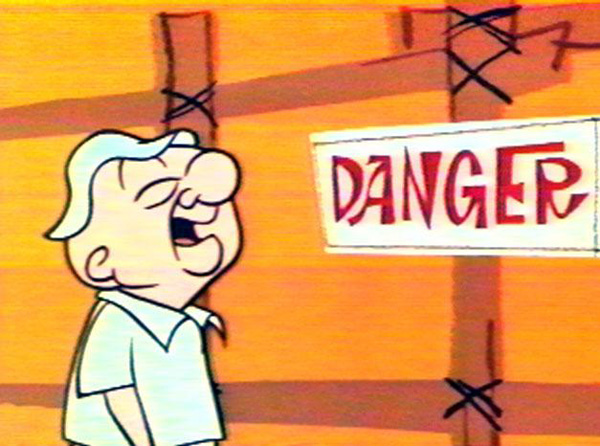
Mr. Magoo screen shot (and a serious lack of vision), June 23, 2011. (http://tumeke.blogspot.com).

“The most telling comment that my Director made during our fundraising effort came when I asked about his vision for our project. ‘I don’t know what the project’s vision should be,’ he said. I realized at that moment that everything we had worked for would fail, no matter how sound our ideas. My Director’s vision for the project did not extend beyond his need to feel needed, to feel as if he alone could keep our project – and by extension, himself – alive. I concluded that this was a dangerous position to find myself in professionally, and that it was beyond time to go.”


Rate My Students Dot Dot Dot

09 Wednesday Nov 2011

Posted by decollins1969 in 1, Academia, culture, Eclectic, Politics, race

≈ 1 Comment

Tags

Academia, Communications, Email Exchange, Racism, Rating Systems, Student Evaluations, Students, Teaching, Teaching and Learning, US History


Thumbs Up, Thumbs Down, April 14, 2010. (http://http://teachingjobsportal.com).

Because there’s a website called RateMyProfessors.com, there also ought to be one called Rate My Students.com. Unfortunately, the only thing we have as faculty that indicates student performance is their grade in a course. But student demeanor, attitudes toward learning and their professors, about their level of commitment to being good students? For that, the only thing we have to go on are our communication exchanges with students and their responses, particularly on an evaluation. Below is one such exchange:

—–Original Message—–
From: Anonymous Student
Sent: Sat 9/10/2011 12:45 AM
Subject: Paper feedback question

I mentioned in my paper that the US feared soviet control of the Middle East and you said that it was never a concern. However, on page 61 of “Present Tense” It mentions the soviets backing a separatist movement in Iran and pressed Turkey to give the Soviet’s joint control over the Dardanelles which make some in the US government nervous that “the soviets would make a sweep across Turkey and Iran, which would give it control over much of the Middle East and its oil reserves.” The book then mentions that Truman sent a Naval task force into the Mediterranean as a warning to the Soviets.

My question is, how was the Soviet presence in the Middle East hardly a concern if it made Truman nervous enough to take military action. Granted it wasn’t a concern for long, and I could have gone more in depth, but I’m still getting conflicting information. Thanks

On Sat, Sep 10, 2011 at 6:28 AM, Donald Collins wrote

Thanks for your email. You didn’t get credit for this point because it was a blanket and general statement, without any detail or nuance. You made it sound as if the Middle East was on the same level of concern as Europe, East Asia and the US itself. Plus, Turkey was and is not considered an oil state, and US concern over Greece and Turkey was much more a European concern than a Middle Eastern one — it helped lead to the first installment of what became the Marshall Plan. Only with Iran do you have a small point, but Iran wasn’t mentioned in your paper. And, more to that point, if the Middle East was such a concern, why didn’t Truman send a naval task force into the Persian Gulf in the late 1940s?

Yes there was fear and concern, but the actual decisions and actions that came out of it were so limited that one cannot simply say that the US feared control of the Middle East because of their tremendous oil reserves — in 1947…

But the real issue here is that you lost sight of the forest on this topic question, concentrating instead on this tree regarding the Middle East. You did not do enough to outline and analyze the factors involved in promoting and escalating the Cold War. You talked about events as examples of the Cold War, with some (like the Middle East) lacking in factual detail or explanation as to what, if any, factor or factors they fit in. Like the Soviet’s desire for a buffer zone in Eastern Europe and with eastern Germany. Or the US policy of aggressive containment of communism, as your example of the Middle East could’ve indicated, if it had been more specific — the Korean War or the Berlin Airlift are much better examples of this factor. Or the nuclear weapons and related systems races, including for long-range bombers, missiles, submarines from 1949 onward — bringing both countries ever closer to a possible hot and nuclear war.

The textbooks are just that, textbooks. They are not the Bible, and they are not even ones that I would choose to use if I could order my own textbooks. They are a guide, but, then again, so are my lecture notes, which would have helped clear up much of your confusion on this issue. I hope that this helps.

Professor Collins

From: Anonymous Student
Sent: Sat 9/10/2011 4:09 PM
Subject: Re: Paper feedback question

I figured the main problem was not going in depth enough, but I was worried about lingering for too long on certain subjects.

Anonymous Student’s response via evaluation (received October 27, 2011):

Donald Collins is very well versed in the events of the civil rights movement and not much else. Several times during the course he marked down assignments that I had completed based on what he incorrectly perceived to be factual errors. The one time I brought this up to him via email he wrote it off as “not important enough in the grand scheme of things” ignoring the fact that he stated that an event had never occurred despite being talked about in more than one of the assigned texts for the class….I still received a low grade on that assignment as well as others because of Collins’ seeming insistence that everything be tied into the civil rights movement regardless of how unrelated what I was writing about may have been to it…

—

This isn’t the first time I’ve received a racist response from a student for doing my job, and I’m certain it won’t be the last. But if I could, I’d recommend that this person learn how to be a good student first before pushing his deficiencies and bigotry onto me and other faculty.

Holes in Foundation Shield of Education Funding

03 Thursday Nov 2011

Posted by decollins1969 in 1, Academia, Boy @ The Window, Eclectic, Politics, race

≈ Leave a comment

Tags

Academia, Bill Gates. Makin' It Rain, Collaboration, Early College High Schools, Education, Education Reform. K-16 Education, Foundations, Funding, Higher Education, K-12 Education, K-8 Schools, Linkages, P-20 Education, Race, Real Reform. Overhaul of P-20 Education, Social Justice, Synergy


Leather knight shield with holes, November 2, 2011. (http://paulssupplies.com)

As an educator and someone who has worked in the nonprofit world on education reform issues for slightly less than half of my life (I turn forty-two next month), it’s curious and disappointing to continue to see a scatter-shot and tweaking approach to education reform. An approach that often gets the bulk of the funding from private and corporate foundations.

If what Bill Gates said at the National Education Summit in Washington, DC in February 2005 is correct, that “American high schools are obsolete in their current form” — and I believe he is — then why does his foundation and others fund mostly small-scale projects? Especially ones that have few, if any, possibilities for replication or for making American high school more relevant to the twenty-first century?

But let me not pick on the Bill & Melinda Gates Foundation as being neglectful of seeing the big, panoramic picture on K-12, K-16 or even P-20 education. Below, in general, are the parts of education process the big foundations have tended to fund over the past five to ten years:

Preschool, Pre-K Education = Annie E. Casey Foundation, Pew Trusts

K-12 Education = Gates Foundation, Hewlett Foundation

Higher Education, Education Research = Spencer Foundation (most $$$ now via AERA/NAE), Mellon Foundation

Higher Education Access/Success = Lumina Foundation for Education, Ford Foundation, Gates Foundation, Jack Kent Cooke Foundation

Student Financial Aid = Lumina Foundation for Education, Gates Foundation

Teacher Effectiveness = Gates Foundation, Hewlett Foundation, Ford Foundation

Poverty, Community Development, Race = W.K. Kellogg Foundation, MacArthur Foundation, Pew Trusts, Ford Foundation, Annie E. Casey Foundation, Gates Foundation.

They have funded and still do fund everything from early childhood education programming, credentials for early childhood educators, small schools, research for curriculum realignment, online education options for K-12, leadership programs for principals and school superintendents, to student and teacher incentive programs, fiscal and human resources allocation, early and middle college high schools, and assessments for teacher effectiveness. (By the way, that is the longest sentence I’ve ever written, at least without editing into

Ed Harris as Jackson Pollock in Pollock (2000), spreading and throwing paint, August 6, 2009. (http://www.totalfilm.com).

smaller sentences).

Seems like everything in the P-20 education universe is covered, right? Except, I’d defy anyone in or out of the education field to try to add all of this up into a comprehensive overhaul of early childhood and K-12 education that would then force reform in higher education.

The reason that we can’t assume that all of this adds up to real reform is simple. A dozen or so foundations pouring billions of dollars into a quarter-trillion dollar a year system through tens of thousands of grants, each working on a separate problem? By definition, a comprehensive overhaul isn’t possible. It’s as unlikely as Wall Street disengaging itself from American politics without a decade of Occupy Wall Street.

We could start, conceivably, with the idea of early and middle college high schools. One where school districts and the colleges and universities adopting these high schools collaborate on creating a system that would leave high school graduates with the equivalent of two years of college training or an associate’s degree. Or in the case of students who made plans to not go to college, two years of training that would make them employable in the twenty-first century workforce.

Only, these early and middle college high schools would be without the additional burden of providing remediation to ninth graders not ready for what we now call high school. Bottom line: we need a single-track college/career ready system that begins its work in preschool and pre-K programs, one in which these programs are tied to elementary schools, so that it doesn’t take the poorest of students three years to catch up. We need linkages between elementary and middle schools — or as many researchers suggest, K-8 schools — where the work to make students ready for algebra, critical thinking through writing and the arts could take shape in a more supportive and coherent environment.

More direct linkages between schools and community organizations and services — health clinics, psychological services, nonprofit organizations focused on the arts, writing, sports, science and math — are

Crane removing part of Berlin Wall at Brandenburg Gate, December 21, 1989. (SSGT F. Lee Corkran/US Dept of Defense). In public domain.

necessity to build communities that are committed to large-scale education reform. For if these organizations and systems continue to work in parallel series rather than in collaboration, all these attempts at reform are for naught.

But foundations have always been leery to link their work, to fund for the long-term, to think in ways that encourage collaboration — kind of like corporations, Wall Street bankers and the GOP. They also tend not to hire deep thinkers on issues like education. Or at least, the linkages between education, race, class, gender, community and the workforce.

Though they are doing a better job these days, especially in the case of the Kellogg Foundation on race, we need a more solid shield. One that is truly about transforming P-20 education, and not just tweak it with data and pilot programs. Funding programs without a grander vision might as well be a “make it rain” party at a strip club.

Herman Cain’s Greatest Hits

01 Tuesday Nov 2011

Posted by decollins1969 in 1, Eclectic, eclectic music, Patriotism, Politics, Pop Culture, race, Work

≈ Leave a comment

Tags

Bruce Hornsby and The Range, Class Warfare, Dean Martin, Herman Cain, Naughty By Nature, Opposition, Otis Redding, Phil Collins, Politics, Popular Music, Racial Denial, Racial Stereotypes, Republicans, Sexism, Singing


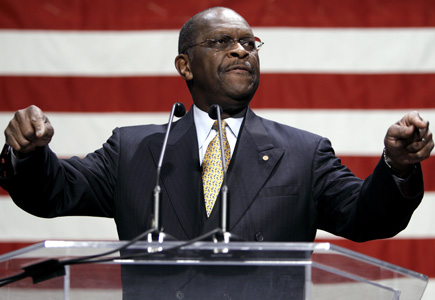
Mr. Herman "Get A Job!" Cain, at Republican Party of Florida Presidency 5 Convention, Orlando, FL , September 24, 2011. (AP).

Since the allegedly sexually harassing, racism and classism denying, Republican presidential candidate leader of the moment Herman Cain likes to sing, I decided to make a short list of Cain’s greatest hits. Trust me, they’re all doozies. They draw on the experiences of a man about as in touch with average Americans as Marie Antoinette was with French peasants on the eve of the French Revolution.

1. “The Way It Is” (1986) — Bruce Hornsby and The Range: Here, he puts special emphasis on the line, “Just for fun he says, ‘Get a job!,” not out of sarcasm, but out of sincerity.

2. “Another Day In Paradise” (1989) — Phil Collins: Cain tries to get a bit of social consciousness, at least, in emphathizing with “the man on the street,” the poor guy subjected to a worn-out homeless women begging for help.

She calls out to the man on the street
“Sir, can you help me?
It’s cold and I’ve nowhere to sleep
Is there somewhere you can tell me?”

He walks on, doesn’t look back
He pretends he can’t hear her
He starts to whistle as he crosses the street
She’s embarrassed to be there

The real test with this song would be whether Cain’s whistling is as good as his crooning.

3. “O.P.P.” (1991) — Naughty By Nature: Here Cain would need help from ex-RNC head Michael Steele to get his rap game together, as well as from Supreme Court Justice Clarence Thomas in interpreting the sexual laden lyrics. But in light of the accusations — and in Justice Thomas’ case, evidence — of sexual harassment and general insensitivity of Cain, Steele and Thomas, figuring out “who’s down with O.P.P.?” is an appropriate question in their bubble.

4. “Cigarettes And Coffee” (1966) — Otis Redding: Cain’s tribute to his campaign manager in his recent commercial as he slows down the pace a bit. “And please, darling, help me smoke this one more cigarette,” Cain baritones to Mark Block.

5. “Ain’t That A Kick In The Head” (1960) — Dean Martin: Cain’s theme song for his campaign. The main lyrical refrain for him would be as much about his rise to the top of the Republican heap as it would be about the people he’s stereotyped, vilified, denigrated and ultimately exploited over the course of his career and campaign.

My head keeps spinning;
I go to sleep and keep grinning;
If this is just the beginning,
My life’s gonna be beautiful.
I’ve sun- shine enough to spread;
It’s like the fella said…

“Ain’t [I] like a kick in the head?” And the 99 percent of us say, “Hell, yeah, where’s the aspirin?”

When Will Apple Come Out With Its iCollege App?

27 Thursday Oct 2011

Posted by decollins1969 in 1, Academia, culture, Eclectic, Politics, Pop Culture

≈ Leave a comment

Tags

Apple, Apps, College Access and Success, College Education, Colleges & Universities, For-Profit Colleges, Future of Higher Education, Higher Education, iCollege, iUniversity, Online Classroom, Postsecondary Education, Postsecondary Education Access and Success, Public Colleges, Virtual Classroom


Modified image of Apple iPad 2 with college cap, tassle and diploma, October 27, 2011. (http://digitaltrends.com/Donald Earl Collins). Qualifies as fair use under US Copyright laws because of the low resolution, alterations and subject of this blog post.

When I attended the Center for American Progress’ two-hour conference on Anya Kamenetz’s Gates Foundation-funded ebook The Edupunks Guide to a DIY Credential last month (see my recent post “Education Incorporated“), there was one thing that the experts on the panel kept bringing up. All of them agreed that the Information Age and the possibilities of online education are so great that the days of the traditional university are numbered. Like the dismantling of the traditional newsroom model of newspapers and magazines over the past fifteen years, the traditional university model was within ten years of becoming obsolete, at least according to this not-so-objective group of commentators.

Student loan debt the equivalent of an American house in 1980, questions about the usefulness of a four-year degree in the world of work, and the relevance of academic coursework to the “real world” will be the biggest reasons for why hundreds of higher education institutions could be out of business by the 2020s.

Despite my background, I am not some apologist for the state of American higher education today. There are quite a few things wrong with the current model, especially for standard state and regional public institutions, historically-Black colleges and universities, and most two- and four-year community colleges. But, for a variety of reasons, I’m not completely sold on the brave-new world of online education, currently dominated by for-profit colleges and technical postsecondary schools either. Like University of Phoenix, most charge as much for tuition as traditional four-year institutions, minus the academic and social supports necessary to retain and graduate students.

Still, this doesn’t mean that there won’t be a new kind of higher education for those millions of us who won’t have the grades and/or can’t afford to attend an elite or near elite institution. You know, somewhere between

Apple iPhone 3G, January 13, 2009. (Apple via Wikipedia). Qualifies as fair use via Creative Commons 3.0.

Harvard, UC Berkeley and the University of Pittsburgh. I think, ultimately, that ten years from now, going to college will be as simple as clicking on the iCollege or iUniversity app on your iPhone, iPad, iTV, or whatever Apple, Inc. comes up with next.

Of University of Phoenix, DeVry Institute, Kaplan University, Capella University and ITT Technical Institute, and I picked Apple? Why, pray tell? Because, believe it or not, Apple has the history of collaboration, technical expertise, and innovative vision — even without the great Steve Jobs — to pull off the moving of the higher education platform to an accredited application that even Harvard, Yale, Princeton and Oxford couldn’t thumb their noses at (though they may have to hold their noses, at least at first). After all, Apple has moved into the mainstream music arena and into the land of Hollywood and made it work to their advantage. Not to mention, to our advantage as consumers. Why not higher education?

How would this work? For starters, Apple could work with a slew of professors and teachers in fields as varied as astronomy, construction engineering, history, medicine, psychology and theater arts to put together adaptive virtual classrooms. The key word here is adaptive. It would be like EA Sports’ Madden NFL ’12,where each teacher or professor would be put in a lab with sensors attached to them and a classroom full of students asking every possible question and providing every possible answer to a given topic or series of topics that would add up to a course. And Apple would do this over and over again for, say, the 3,000 or so possible courses that an undergraduate student would take, not only in the US, but anywhere in the world.

That alone would make this a decent idea. But combining it with Apple’s ability to negotiate contracts and agreements — in this case, with accrediting agencies and with major universities across the country — will make iCollege or iUniversity a great idea. Because of these deals, iCollege or iUniversity students could transfer their credits to a UC Berkeley, Harvard or University of Maryland if they so chose. More

Star Trek: TNG Holodeck Screen Shot, October 26, 2011. The ultimate expression of a virtual classroom (Donald Earl Collins).

importantly, since acting in a play, shooting film projects or doing a laser light show can’t necessarily be done online, deals with schools, technical institutes and even major corporations would make it possible for any student’s iCollege or iUniversity experience to be well-rounded and tailored to their needs.

What’s more, once Apple makes the $100 or $200 million investment to set this up, they can put up reasonable prices for postsecondary credentials. For an industry or job-related certificate: $5,000. For a two-year or associate’s degree: $10,000. For a four-year degree: $30,000. The extra costs for the degrees would cover technical changes, the consulting fees for using professors and teachers as part of the iCollege or iUniversity app, and to cover the costs of students taking face-to-face courses as part of the process. But with five million, ten million, even a hundred million students enrolled around the world, Apple could make $50 billion in profits from such an app. Every single year.

Yet I know there are numerous faculty and administrators in academia who’d throw a fit upon reading this (or any similar) idea. The fact is, we’ve had a corporatized sort of education at the college level for at least fifty years now. Our scientific and engineering communities are fully entrenched in the military-industrial complex. Even history professors fight for endowed chairs. Between capital campaigns, as well as corporations and dying CEOs investing in schools and having buildings named after them, we’re past the point of no return. We in higher education need to get ahead of the tide before being drowned by it. For once.

Fans of Delusion

25 Tuesday Oct 2011

Posted by decollins1969 in 1, Boy @ The Window, culture, Eclectic, Mount Vernon New York, New York City, Politics, Pop Culture, Sports, Youth

≈ Leave a comment

Tags

Deadskins, Delusions, Economy, ESPN 980, Great Recession, Mount Vernon New York, New York City, New York Giants, Pittsburgh, Pittsburgh Steelers, Politics, Sports Fans, Washington DC, Washington Redskins


Redskins Country Stop Sign display, October 25, 2011. (http://www.amazon.com).

In the past couple of years, in my down time between teaching and occasional consulting, I sometimes listen to ESPN 980 Washington, DC. I get a perverse pleasure out of it, especially this time of the year. With football season on, there’s nothing better than hearing Washington Redskins (hereafter known in this blog as Deadskins) fans whine and complain and kvetch after a loss. It’s not just because I became a New York Giants fan when I was a teenager. Nor is it because I’m also a Pittsburgh Steelers fan. No, there’s something different about these Deadskins fans, something that might be related to the personality of this area.

To those who don’t read my blog regularly, I’ve only been a DC/Maryland resident consistently since August ’99 (I did live in DC briefly in ’95 while doing my doctoral thesis research). I grew up in Mount Vernon, New York — the greater NYC metropolitan area, not upstate, just in case — for the first seventeen years and eight months of my life. I went to school and lived and taught in Pittsburgh for twelve other years. Not to mention spent the equivalent of five weeks in the Bay Area, three weeks in Atlanta, and two weeks apiece in Chicago and Boston. From a sports perspective, none of these areas and cities have fans as delusional as Deadskins fans, at least, not on a game-by-game or week-to-week basis.

The best way to show the difference is to take the same scenario and apply it to each city or area in which I’ve lived. The hometown team has just lost a game, in the ugliest possible way. Tune into a sports talk show or read the headlines for each team in their respective cities/areas, and this is what you’d read or see:

After a Giants loss:

“They suck! They suck! Did you see what Eli did with that throw! I’m tired of these guys screwin’ up! I want Coughlin’s head on a f–ing pike!”

That would go on for a day, maybe two, and if it’s really bad, maybe for three or four days. Then eventually, the Giants fan base settles down to, “What do we have to do to win this week?”

After a Steelers loss:

“My God, man, what happened out there today? Maybe we’re gettin’ too old, maybe Ben’s still playin’ hurt. You know, maybe this just ain’t our year.”

This would go on for a couple of days. Then, like the little engine building up momentum, the Stiller’s talk would turn to, “What do we have to do to win this week?”

After a Deadskins loss:

Deadskins Fans

Deadskins Fans

And this goes on all week long, every week they lose, and through every off-season. Until talk show hosts like the great former Georgetown coach John Thompson literally cuts callers off due to their “high levels of ignorance.”

It’s not as if the other places I’ve lived and the teams I’ve rooted for haven’t seen any hardship. Heck, the Steelers went through a twelve-year decline between their fourth Super Bowl win in ’80 and the hiring of Bill Cowher in January ’92, the last five seasons I witnessed first-hand. Not a single fan jumped off a bridge because of a loss, or took a rocket up to the moon over a victory. Maybe the realism that Pittsburgh as a city had to live with, including the loss of their industrial base for jobs, had something to do with their realism around the Steelers.

As a Giants fan, I appreciated their realism, and it helped make me a Stillers fan, too. Coming from an area where my team had one their first Super Bowl in ’87, only three years removed from a 3-12-1 season in ’83, I thought that some Johnny-Come-Lately types expected too much in a strike/scab-shortened season. But, even with that, the cycle of Jackie Gleason-esque fits of rage, followed by calm rationalism, were a reflection of the New York City I knew in the ’80s, sometimes ugly, but usually manageable. Even in troubled times.

This cycle also made the Giants fans of the ’80s more psychologically stable than the average Deadskins fan, then and now. Yes, it’s a reflection of an area of the nation that is also out of touch, as the worst effects of the Great Recession aren’t equally felt. As the expectations of Deadskins fans are as realistic as it was to believe that Mayor Vincent Gray could move DC government in the same way as Adrian Fenty, only without the ruffled feathers.

This form of delusion, though, otherwise known as bipolar disorder, where the highs are euphoric and lows can make you suicidal, may be catching on. For it shows our expectations of the economy and our politics.

Education Incorporated

13 Thursday Oct 2011

Posted by decollins1969 in 1, Academia, culture, Eclectic, Politics, race, Work, Youth

≈ 1 Comment

Tags

"genius" award, Anya Kamenetz, Bill & Melinda Gates Foundation, Brookings Institution, Center for American Progress, Corporate Interests, Corporate Models, DIYu, Early College High Schools, Education, Education Reform, Edupunks Guide, Higher Education, K-12 Education, MacArthur Foundation Award, Michelle Rhee, No Child Left Behind, Roland Fryer Jr., Single-Track College Prep School Systems, Teach for America, The Hamilton Project, The New Teacher Project, Wendy Kopp, Workforce Development


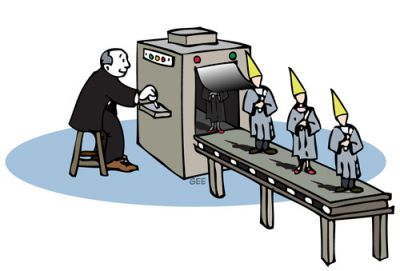
Capitalist Education Factory, November 1, 2010. (Source/http://communiststudents.org.uk).

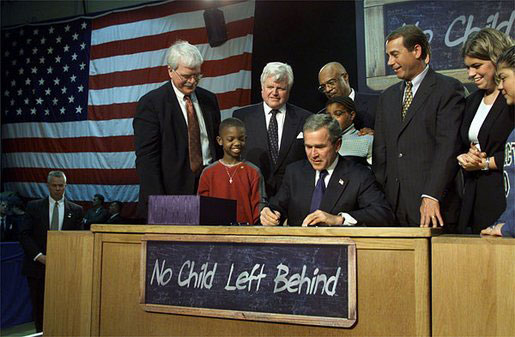
A generation ago, most of us in education worried about a federal government takeover of America’s 15,000 school districts with mandated standards. Wow, that prediction was way off, wasn’t it? (Oh, wait, the No Child Left Behind Act, passed in 2001, created a new era of national standards for accountability, not to mention high-stakes testing).

President George W. Bush signs into law the No Child Left Behind Act, Hamilton HS, Hamilton, Ohio, January 8, 2002. (http://www.whitehouse.gov). In public domain.

Now, we worry with good reason, as corporate interests inject themselves into education reform at every level. This has brought an imbalance to the education reform conversation that hasn’t existed since the days of Andrew Carnegie and the height of immigration of swarthy peoples from Southern and Eastern Europe. Now, as it was a century ago, it was the inclusion-vs.-exclusion debate. Whether to provide the best possible education for all comers, or sort and kick out as many “dull-minded” “undesirables” (both literally from 1911 to describe the learning disabled, immigrants and Black migrants) in K-12 schools as possible.

But this debate today — if we can really call it that — includes higher education. Of course, we know better than to call the millions of potential students who need some sort of post-high school training and education “morons” (also a 1911 term used by White psychologists who assumed anyone not WASP didn’t have the mental capacity to make use of a high school education). Yet we do attempt to sort these students and potential students into categories, like “adult learners,” “non-traditional students,” even “Edupunks,” a term

Anya Kamenetz, author of Edupunks Guide, at University of South Dakota, August 27, 2010. (http://www.usd.edu). In public domain.

coined by author Anya Kamenetz.

None of this has eliminated a common refrain in our field. That a four-year degree “isn’t for everyone,” as Kamenetz said to me after I asked her a tough question regarding the accessibility of her ideas for a Do-It-Yourself-university (DIYu) process of pursuing a college degree. It was a conference hosted by the Center for American Progress, but paid for by the Bill & Melinda Gates Foundation. Her idea, while helpful to 18-30 year-olds who are tech-savvy and with enough income to make this piecemeal education process work, was unhelpful to low-income students, and students of color over the age of thirty. And Kamenetz’s response was the typical exclusionary one.

Apparently, in our current economic climate, a full-time job isn’t for everyone either. Still, despite this reality, the Gates Foundation, Lumina Foundation for Education, and the Hewlett Foundation have all adopted similar models of thought around K-12 and higher education reform that have legitimized the work of people like Wendy Kopp and Michelle Rhee (Teach for America and The New Teacher Project, respectively) and institutions like University of Phoenix and Kaplan University. Models which draw heavily from corporate paradigms for success, including the punishment of failure. But they haven’t led millions of us to jobs in the new economy.

I recently attended a meeting hosted by the Brookings Institution’s Hamilton Project, in which authors presented a series of papers on K-12 education reform. Supposedly with cutting-edge ideas. Like one presented by MacArthur Foundation “genius” (emphasis on the quotation marks) Award winner Roland Fryer on providing student incentives linked to immediate and long-term educational goals for those most at risk of

Professor Roland Fryer, Harvard University Department of Economics, September 2011. (http://economics.harvard.edu).

dropping out of school, like low-income boys of color. Examples of paying fifth graders in Houston and New York $2 for every book they read or for completing their homework wasn’t so much cutting-edge as it was unremarkable. Incentives are fine, if you can pay for them or show how they nurture a passion for learning beyond the goal of completing individual tasks. This, of course, the “genius” couldn’t show.

The ridiculous assumption that Fryer made, arguing that because money in K-12 education had doubled since 1970, that funding wasn’t the issue, would’ve made me laugh as a high school senior. When you account for inflation, K-12 funding has declined, and not by a small amount, since the 1970s, and by the way, the millennial generation has created a new demand for schools, as the number of new schools or schools in need of renovations adds to this doubling in four decades. Fryer’s exclusion of data that a first-year graduate student wouldn’t have missed made me realize that most people in the field are so desperate for ideas that anything that sounds new must be good or cutting-edge. Especially if it’s funded by the Gates Foundation.

It’s not just the Gates Foundation, per se. It’s the idea that since things aren’t working for millions of students and undereducated workers, a model that concentrates on teacher effectiveness and treating students as customers — whether in fifth grade or in college — is the best way to go. This attitude has become so pervasive among well-funded education reformers that the idea of increasing funding for schools, or of making schools from pre-K on focus on all students in need of college/workforce readiness is about as welcome as Michael Moore at a Koch Brothers fundraiser.

Early college high schools and single-track, college-prep K-12 school districts, two of the great secrets of K-12 and higher education reform, remain such because these are difficult to bring to scale, and require more upfront investment than most philanthropists and businesses are willing to make. Not to mention, these represent the hard work of real reform, but ones that won’t make people like Kamenetz, Fryer, Kopp and Rhee stars. But by all means, let’s continue to fund every hair-brained idea as if tweaking our education system will yield results like a nuclear fusion plant on steroids.

← Older posts
Newer posts →

Boy @ The Window: A Memoir

Boy @ The Window: A Memoir

Places to Buy/Download Boy @ The Window

There's a few ways in which you can read excerpts of, borrow and/or purchase and download Boy @ The Window. There's the trade paperback edition of Boy @ The Window, available for purchase via Amazon.com at http://www.amazon.com/Boy-Window-Donald-Earl-Collins/dp/0989256138/

There's also a Kindle edition on Amazon.com. The enhanced edition can be read only with Kindle Fire, an iPad or a full-color tablet. The links to the enhanced edition through Apple's iBookstore and the Barnes & Noble NOOK edition are below. The link to the Amazon Kindle version is also immediately below:

scr2555-proj697-a-kindle-logo-rgb-lg

Boy @ The Window on Amazon.com: http://www.amazon.com/Boy-The-Window-Memoir-ebook/dp/B00CD95FBU/

iBookstore-logo-300x100

Boy @ The Window on Apple's iBookstore: https://itunes.apple.com/us/book/boy-the-window/id643768275?ls=1

Barnes & Noble (bn.com) logo, June 26, 2013. (http://www.logotypes101.com).

Boy @ The Window on Barnes & Noble: http://www.barnesandnoble.com/w/boy-the-window-donald-earl-collins/1115182183?ean=2940016741567

You can also add, read and review Boy @ The Window on Goodreads.com. Just click on the button below:

Boy @ The Window

Twitter Updates

Tweets by decollins1969
  • RSS - Posts
  • RSS - Comments

Archives

  • June 2025
  • April 2023
  • September 2022
  • August 2022
  • July 2022
  • June 2022
  • May 2022
  • April 2022
  • March 2022
  • January 2022
  • December 2021
  • November 2021
  • October 2021
  • September 2021
  • August 2021
  • July 2021
  • June 2021
  • April 2021
  • March 2021
  • February 2021
  • January 2021
  • December 2020
  • November 2020
  • October 2020
  • September 2020
  • August 2020
  • July 2020
  • May 2020
  • April 2020
  • March 2020
  • January 2020
  • December 2019
  • November 2019
  • August 2019
  • July 2019
  • June 2019
  • May 2019
  • April 2019
  • March 2019
  • February 2019
  • January 2019
  • December 2018
  • November 2018
  • October 2018
  • September 2018
  • August 2018
  • July 2018
  • June 2018
  • May 2018
  • March 2018
  • February 2018
  • January 2018
  • December 2017
  • November 2017
  • October 2017
  • September 2017
  • August 2017
  • July 2017
  • June 2017
  • May 2017
  • April 2017
  • March 2017
  • February 2017
  • January 2017
  • December 2016
  • November 2016
  • October 2016
  • September 2016
  • August 2016
  • July 2016
  • June 2016
  • May 2016
  • April 2016
  • March 2016
  • February 2016
  • January 2016
  • December 2015
  • November 2015
  • October 2015
  • September 2015
  • August 2015
  • July 2015
  • June 2015
  • May 2015
  • April 2015
  • March 2015
  • February 2015
  • January 2015
  • December 2014
  • November 2014
  • October 2014
  • September 2014
  • August 2014
  • July 2014
  • June 2014
  • May 2014
  • April 2014
  • March 2014
  • February 2014
  • January 2014
  • December 2013
  • November 2013
  • October 2013
  • September 2013
  • August 2013
  • July 2013
  • June 2013
  • May 2013
  • April 2013
  • March 2013
  • February 2013
  • January 2013
  • December 2012
  • November 2012
  • October 2012
  • September 2012
  • August 2012
  • July 2012
  • June 2012
  • May 2012
  • April 2012
  • March 2012
  • February 2012
  • January 2012
  • December 2011
  • November 2011
  • October 2011
  • September 2011
  • August 2011
  • July 2011
  • June 2011
  • May 2011
  • April 2011
  • March 2011
  • February 2011
  • January 2011
  • December 2010
  • November 2010
  • October 2010
  • September 2010
  • August 2010
  • July 2010
  • June 2010
  • May 2010
  • April 2010
  • March 2010
  • February 2010
  • January 2010
  • December 2009
  • November 2009
  • October 2009
  • September 2009
  • August 2009
  • July 2009
  • June 2009
  • May 2009
  • April 2009
  • March 2009
  • February 2009
  • January 2009
  • December 2008
  • November 2008
  • October 2008
  • September 2008
  • August 2008
  • July 2008
  • June 2008
  • May 2008
  • April 2008
  • March 2008
  • February 2008
  • January 2008
  • December 2007
  • November 2007
  • October 2007
  • September 2007
  • August 2007
  • July 2007
  • June 2007

Recent Comments

MaryPena's avatarMaryPena on My Day of Atonement/Bitter Hat…
decollins1969's avatardecollins1969 on No Good Teaching Deed Goes…
Mary Rose O’Connell's avatarMary Rose O’Connell on No Good Teaching Deed Goes…

NetworkedBlogs on Facebook

NetworkedBlogs
Blog:
Notes From a Boy @ The Window
Topics:
My Life, Culture & Education, Politics & Goofyness
 
Follow my blog

616 616 East Lincoln Avenue A.B. Davis Middle School Abuse Academia Academy for Educational Development AED Afrocentricity American Narcissism Authenticity Bigotry Blackness Boy @ The Window Carnegie Mellon University Child Abuse Class of 1987 CMU Coping Strategies Crush #1 Crush #2 Death Disillusionment Diversity Domestic Violence Economic Inequality Education Family Friendship Friendships Graduate School Hebrew-Israelites High-Stakes Testing Higher Education History Homelessness Humanities Humanities Program Hypocrisy Internalized Racism Jealousy Joe Trotter Joe William Trotter Jr. K-12 Education Love Manhood Maurice Eugene Washington Maurice Washington Misogyny Mother-Son Relationship Mount Vernon High School Mount Vernon New York Mount Vernon public schools Multiculturalism MVHS Narcissism NFL Pitt Pittsburgh Politics of Education Poverty President Barack Obama Race Racial Stereotypes Racism Relationships Self-Awareness Self-Discovery Self-Reflection Sexism Social Justice Teaching and Learning University of Pittsburgh Violence Whiteness Writing

Top Rated

Blog at WordPress.com.

  • Subscribe Subscribed
    • Notes from a Boy @ The Window
    • Join 103 other subscribers
    • Already have a WordPress.com account? Log in now.
    • Notes from a Boy @ The Window
    • Subscribe Subscribed
    • Sign up
    • Log in
    • Report this content
    • View site in Reader
    • Manage subscriptions
    • Collapse this bar
 

Loading Comments...