• About Me
  • Other Writings
  • Interview Clips
  • All About Me: American Racism, American Narcissism, and the Conversation America Can’t Have
  • Video Clips
  • Boy @ The Window Pictures
  • Boy @ The Window Theme Music

Notes from a Boy @ The Window

~

Notes from a Boy @ The Window

Category Archives: Mount Vernon New York

The Falsehoods of a Civil Rights Movement Legacy

15 Tuesday Jan 2013

Posted by decollins1969 in 1, Academia, Boy @ The Window, culture, Eclectic, Mount Vernon High School, Mount Vernon New York, New York City, Patriotism, Politics, Pop Culture, race, Youth

≈ Leave a comment

Tags

Birthday, Civil Rights, Civil Rights Movement, Class Divide, Educational Aspirations, Estelle Abel, Generation X, Generation Y, Generational Divide, Generational Prejudice, Legacy, Martin Luther King Jr., Mythology, Myths, Police Brutality, Post-Civil Rights Generation, Poverty, Racism, Stop and Frisk


Martin Luther King, Jr. Memorial statue, National Parks Service, Washington, DC, August 2, 2012. (NPS via Wikipedia). Qualifies as fair use under US Copyright laws, as this is a 2D picture of a 3D sculpture.

Martin Luther King, Jr. Memorial statue, National Parks Service, Washington, DC, August 2, 2012. (NPS via Wikipedia). Qualifies as fair use under US Copyright laws, as this is a 2D picture of a 3D sculpture.

Well, it’s not officially Martin Luther King Day yet, but since Dr. King was actually born on January 15, 1929, better for me to talk about him today than next week. Especially with President Obama’s second inaugural going on at the same time. But what a legacy! Yet his generation of civil rights activists and righteous protesters have done as much harm to his legacy as have conservatives invoking his “I Have a Dream” speech every time they’re called out on their bigotry.

Yeah, that’s right, I said it! One of the benefits — if you want to call it that — of being born in ’69 is that I’ve witnessed the devolution of the Civil Rights Movement and its leaders and followers into a gauntlet of gatekeepers who expect everyone from my generation to start every sentence paying homage to their sacrifices. I have no problems with that, at least in theory. But the reality is that most folks from the Civil Rights generation — at least the successful ones — made few if any sacrifices for “the cause.” They were in the right place at the right time with the right education and managed to find jobs, careers and positions of influence while the least fortunate of us all saw few material or psychological benefits from Dr. King’s ultimate sacrifice.

I’ve already talked at length about Estelle Abel, a former Mount Vernon High School Science Department chair (see my posts “My Last Day” from June ’11 and “In-Abel-ed” from June ’12 for much more). Her soliloquy about sacrifice and the Civil Rights Movement was supposed to make me feel bad about letting Black Mount Vernon, New York down because I only graduated fourteenth in my class out of over five hundred students. There are others, former and current teachers, professors, librarians, politicians, writers, producers, editors, pastors, politicians, bosses and charlatans who’ve made a point to discuss their elitist notions of the Civil Rights Movement and generation with me.

Hundreds of thousands descended on Washington, DC's Lincoln Memorial August 28, 1963. (Marines' Photo via Wikipedia). In public domain.

Hundreds of thousands descend on Lincoln Memorial August 28, 1963. (Marines’ Photo via Wikipedia). In public domain.

But most — if not all — of these folks are wrong about their glorified view of the Movement and its legacy four and a half decades later. For college educated, middle class African Americans, life has gotten better, even with bigotry, glass ceilings, DWB, a less stable economy, and the conservative backlash that has gone on unabated since the three years before Dr. King’s assassination. For Blacks not as fortunate, almost nothing has changed, at least not for the better.

Some of it, to be sure (and to cut Bill Cosby some slack), is because of individual choices and poor decision-making. Folks, however, can rarely make decisions outside of their own context and circumstances — think outside of the box, in other words — without a significant amount of help. Poverty in all of its forms is just as grinding now as it was a half-century ago. To expect people from the generations since Dr. King to suddenly forget their poverty, abuse, neglect and exploitation and give praise to a generation where many but far from most made sacrifices for the Movement is ludicrous.

I’m certain that had Dr. King lived over the past forty-five years, he wouldn’t have stood by to allow his generation to constantly criticize the under-forty-five as slackers and immature and unfocused, as folks more concerned with money than equality. King likely would’ve made the point that the post-Civil Rights Generations X and Y are merely a reflection of their upbringing, of their parents and teachers and mentors’ nurturing and training. He would’ve made the same point that others from his generation like the late law professor and scholar-activist Derrick Bell has made over the years. That fighting racism, educational neglect and economic exploitation requires more tools than the moral high-ground, protests, marches, a sympathetic media and obvious redneck tactics. The Movement is itself a shifting terrain that requires new tools and tactics to achieve small victories over a long period of time, longer than most folks from the era are willing to admit.

I actually don’t have a strong ax to grind against the Civil Rights generation. Without folks like Dr. King or Jesse Jackson, Medgar Evers or Ella Baker, I wouldn’t have found myself in a gifted-track program in middle school or high school in the ’80s. But let’s not act as if my life was a walk in the park. The legacy of the Civil Rights era never stopped a fist from being thrown into my face by my now ex-stepfather. It never kept us from going on welfare or kept two of my siblings from bring diagnosed as mentally retarded.

NYPD Stop and Frisk caption (actual details for photo unknown), August 2012. (http://thinkprogress.org).

NYPD Stop and Frisk caption (actual details for photo unknown), August 2012. (http://thinkprogress.org).

Nor did the Civil Rights Movement’s legacy stop teachers and professors from putting up barriers to my success as a student or employers from putting up a glass ceiling in an attempt to slow my career advance. It never stopped me from being followed and frisked by police or harassed by overzealous security guards. It’s never paid one of my bills, kept food on my plate or kept me from experiencing homelessness. It’s never even been a source of pride, because that would mean that the Civil Rights Movement and its legacy would belong to me as much as it does to the people who allegedly marched with Dr. King.

I can’t wait for those who cling almost in desperation to the idyllic legacy of Dr. King and the cause to retire and fade away, for the ’60s to truly be over. Maybe that’s when folks from the post-’60s generation — folks like me who care about economic and educational equity, social justice and spiritual transformation — will be able to make an impact on our nation’s sorry state of consciousness without pouring libations to folks who gave up on Dr. King’s work ages ago.
Remembering Harold Meltzer

09 Wednesday Jan 2013

Posted by decollins1969 in 1, Academia, Boy @ The Window, culture, Eclectic, eclectic music, Mount Vernon High School, Mount Vernon New York, Politics, Pop Culture, race, Youth

≈ 5 Comments

Tags

AP US History, Bitterness, Confirmed Bachelor, Death, Dedication, Egalitarianism, Eulogy, Friendship, Harold I. Meltzer, Harold Meltzer, Homophobia, Humanities, Humanities Program, Learning, Life, Mentoring, Metropolitan Opera House, Morison & Commanger, Perseverance, Politics of Education, Self-Discovery, Teaching


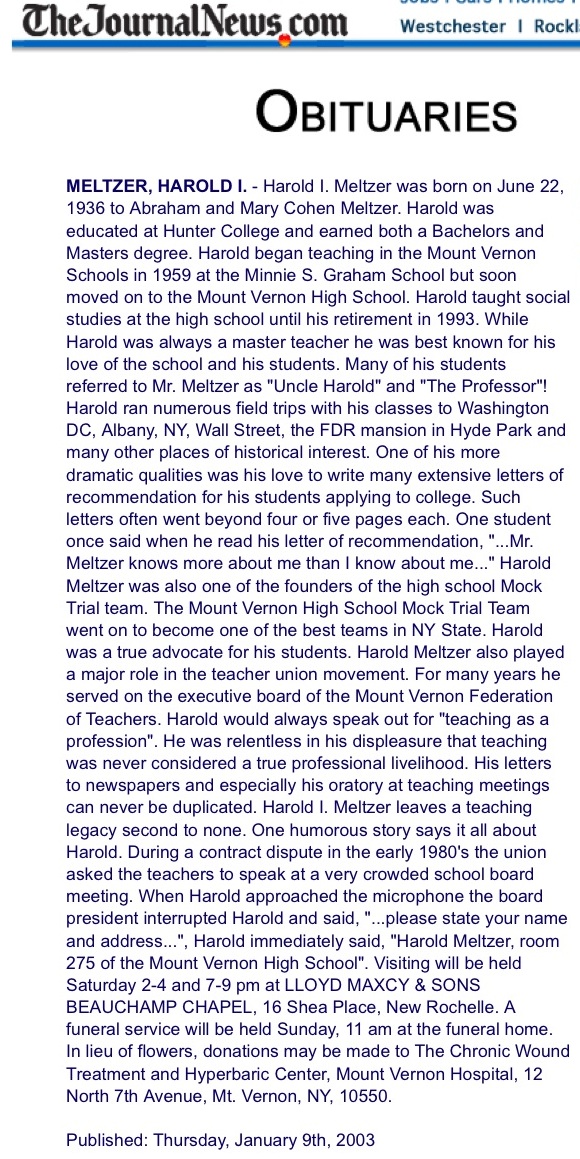
Harold Meltzer obituary (via Frank Pandolfo), January 9, 2003. (Westchester Journal News).

Harold Meltzer obituary (via Frank Pandolfo), January 9, 2003. (The Journal News).

Harold Meltzer, my favorite and best teacher of all, died on January 2, 2003 at the age of sixty-six, ten years ago last week. He was all too young and all too bitter about his years as a history teacher at Mount Vernon High School. But then, dealing with entitled parents and unrepentant administrators in Mount Vernon, New York for thirty-five years would do that to most people. Despite that, Meltzer was a rock, the first teacher since my elementary school years that I genuinely trusted with my family secrets and my inner self. He was the first and maybe only teacher I had in my six years of Humanities who actually seemed like he wanted to teach us (see my post “No Good Teaching Deed Goes Unpunished” from May ’11).

I met Meltzer on our last day of tenth grade, after three days of finals and Regents exams, on June 21, ’85. He had summoned fourteen of us to “Room 275 of Mount Vernon High School,” as the invitation read. We had all registered to take Meltzer’s AP American History class in eleventh grade, our first opportunity to earn college credit while in high school.

Meltzer started off talking to us about Morison and Commager — who I now know as the great consensus historians of the ’50s, until the social history revolution made their textbooks irrelevant by the ’80s — as we sat in this classroom of old history books and even older dust and chalk. Meltzer himself looked to be in his late-fifties (he was actually a day away from his forty-ninth birthday), tall and lanky except for the protruding pouch in the tummy section. His hair was a mutt-like mixture of silver, white and dull gray, and his beard was a long, tangled mess.

Met Logo and A full house, seen from rear of stage, at the Metropolitan Opera House (former bldg, 39th Street), for a concert by pianist Josef Hofmann, November 28, 1937. (National Archives via Wikimedia). In public domain.

Met Logo and A full house, seen from rear of stage, at the Metropolitan Opera House (former bldg, 39th Street), for a concert by pianist Josef Hofmann, November 28, 1937. (National Archives via Wikimedia). In public domain.

The way he spoke, and the way his eyes looked when he spoke made me see him as a yarmulke-wearing preteen on his way to temple. The force with which his words would leave his mouth hit me immediately. As much as I noticed how frequently spit would spew out of Meltzer’s mouth, the rhythm of his speech was slow and sing-song, like an elder or grandfather taking you on a long, winding, roller-coaster-ride of a story. Most of all, I knew that he cared — about history, about teaching, about us learning, about each of us as people. Maybe, just maybe, for some of us, he cared too much.

But for at least for me, Meltzer’s eccentric space in which he told Metropolitan Opera House stories and talked about egalitarianism extended beyond the historical. He was the first teacher I had since before Humanities who’d ask me if things at home were all right, and knew intuitively that things weren’t. He was the first to ask me about how poor my family was and about hunger. And he was the first teacher ever to ask if I had a girlfriend. Needless to say, these questions were unexpected. Yet through these questions, Meltzer had begun to crack my thin, hard wall of separation between school and family.

Because Meltzer cared deeply about reaching students — about reaching me — our student-teacher relationship because a friendship after high school and a mentoring one as well. I wasn’t looking for a mentor, and Meltzer was only being Meltzer. Still, his stories about his battles with MVHS administrators, Board of Education folk, and with upper-crust parents who believed their kids were entitled to A’s just for showing up, were filled with lessons of perseverance, patience, and looking beyond everyday headaches in order to reach people. While this wasn’t a factor in my going to graduate school and spending a significant part of my life as a history professor and educator, these stories have helped me over the years.

1972 Dodge Dart Dark Green (similar to '74 Dodge Dart Meltzer owned when I was at MVHS), December 25, 2009. (http://www.fotosdecarros.com).

1972 Dodge Dart Dark Green (similar to ’74 Dodge Dart Meltzer owned when I was at MVHS), December 25, 2009. (http://www.fotosdecarros.com).

But unfortunately, it was a factor in why Meltzer became embittered and took early retirement in June ’93. The end of the Humanities Program, the intolerance of some administrators toward Meltzer as a “confirmed bachelor,” the lack of decency — forget about gratitude — from many of his most successful students. Those changes, these things, all would take a toll on any teacher who’d stay after school day after day to run Mock Trial, to facilitate study groups, to work on letters of recommendation for students. But no, most of my former classmates who had Meltzer between ’85 and ’87, all they could say was that “Meltzer was weird” or that “I didn’t understand” his lessons.

I’m thankful that I did have Meltzer as a teacher, friend and mentor between ’85 and ’02. I’m thankful that I had a chance to interview him for what is now my Boy @ The Window manuscript in August and November ’02, just a couple of months before he passed (see my post “Mr. Meltzer” from June ’09). I’m glad that despite his physical and psychological pain, Meltzer welcomed me with open arms and answered my questions about his life and his career. I just wish that my former classmates and some of Meltzer’s more cut-throat colleagues had taken the time to really know the man.

The New Gameplan for Boy @ The Window

05 Saturday Jan 2013

Posted by decollins1969 in 1, Boy @ The Window, culture, Eclectic, Mount Vernon New York, Pop Culture, Youth

≈ 2 Comments

Tags

Book Publishing, Commercial Publishing, Editors, Fear of a "Black" America, Gameplan, Independent Publishers, Literary Agents, Manuscript Development, Marketing, Revising, self-publishing, Siege Mentality, Stubbornness, Writers, Writing


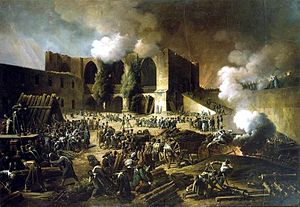
Siege of Burgos (Spain), 1813, by François Joseph Heim. Pic taken December 23, 2012. (1970gemini via Wikipedia). In public domain.

Siege of Burgos (Spain), 1813, by François Joseph Heim. Pic taken December 23, 2012. (1970gemini via Wikipedia). In public domain.

It’s a new year, and with the beginning of all years is a chance to execute new plans, or for most people, to make resolutions they often don’t keep. Such is the case for me regarding my coming-of-age memoir Boy @ The Window. Hopefully I’ll be in the first category of plans for my new year and not in the latter. After five years of beating my fists on the walls of literary agents, acquisition editors and commercial publishers, I have to do far more than hope.

And my fists have needed a few months to heal after the past few years. In all, I contacted somewhere around 140 agents, editors and publishers since the end of ’07 about Boy @ The Window. One in four asked to look at either the first few pages, the first couple of chapters or the entire manuscript. Only two of those agents agreed to represent the manuscript, and then, with major conditions. One went as far as to suggest that I only focus on my family life, as if my preteen and teenage years in Humanities had no impact on my development at all. The other thought I could sell Boy @ The Window better if I turned it into a work of commercial fiction.

I should’ve seen the writing on the proverbial commercial book industry wall long before today. Between the shifts in the commercial publishing marketplace since my experiences with Fear of a “Black” America between ’99 and ’04, the Great Recession’s impact on the industry since ’08, and the rise of the ebook in the past decade. All three pointed to one simple fact. If one wasn’t already a successful author prior to a decade ago, or famous, or with a significant connection to commercial publishing (e.g., a journalist, an editor, or even an editorial assistant), one would face a long, hard walk through the traditional route of publishing a book.

Boxer David Haye displays his bruised knuckles, January 12, 2011. (http://www.thesun.co.uk/)

Boxer David Haye displays his bruised knuckles (cropped), January 12, 2011. (http://www.thesun.co.uk/)

But I’d made up my mind the moment I began working on Boy @ The Window in earnest in the summer of ’06. I didn’t want to self-publish my second book, not after a year and four months of promoting Fear of a “Black” America. While on some level I successfully promoted my first book (I have receipts of my royalty checks to prove that), selling a thousand copies while spending $3,500 to do so for a semi-academic book on multiculturalism was nothing like I had envisioned the process back in ’99.

I persisted in the idea of traditional commercial publishing for the manuscript. I dutifully attended writers conferences, book fairs and other opportunities to meet other authors, potential agents and a few editors. I wrote and rewrote my query letter and proposal, with more revisions than I probably did on the Boy @ The Window manuscript itself. I sent out my letters, took phone calls when they came, reached out to folks for help. And all to end up concluding that I would be in need of dentures by the time a commercial publisher would lukewarmly pick up my manuscript for its list.

Now, even my harshest critics (myself included) consider Boy @ The Window a solid manuscript. So the issue has never really been the quality of the story or the writing. The issues come down to an industry in seismic flux and to me as a person. With my own career in transition and without the obvious examples of success (I’m not regularly booked for TV programs, I have yet to make my first $1 million), I can’t say that I’m in the public eye enough to sell 10,000 copies of my book per week for three weeks, and at least 5,000 a week for three months. That’s the industry threshold for groundbreaking nonfiction success these days.

So dreams of sugar plums or $100,000 advances aren’t exactly dancing in my head these days. But much has changed since I published Fear of a “Black” America in the past eight and a half years. For one, ebooks rule the book publishing marketplace, enabling any aspiring (if not talented) writer to self-publish or to publish independently. Add to this the mix social media, like my blog, Twitter, Facebook and other connections, and nontraditional publishing may well make as much sense as working with an agent.

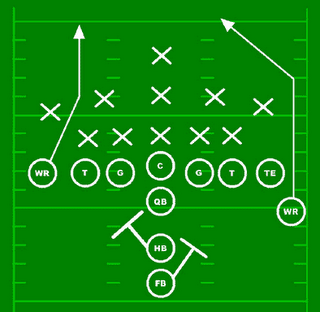
Intermediate pass route game plan (with at least one running back as blocker), November 2011. (http://www.npengage.com).

Intermediate pass route game plan (with at least one running back as blocker), November 2011. (http://www.npengage.com).

This means much more work — and money — on my part, though. I’ll need to hire a copy editor, figure out artwork, finalize pictures, implement my proposed marketing strategy, plan a date for publishing to coincide with marketing, and so on. But I also realize that few commercial publishers do this work for authors anymore, anyway, as they’ve slashed their promotion and marketing budgets. The advantage, then, goes to people like me, with some means for publication and enthusiasm for my book.

I realized all of this at least two years ago. Apparently, so did my wife. When I finally decided to go this route for Boy @ The Window a few weeks ago, she said “I thought you should’ve done it two years ago, but you weren’t ready.” Meaning that I wasn’t ready to dismantle my siege guns and remove my land minds around the commercial publishing castle. Now that I have, I can say with a high degree of certainty that I will publish Boy @ The Window this year, 2013, short of an apocalyptic event.

Newtown Calling

19 Wednesday Dec 2012

Posted by decollins1969 in 1, Boy @ The Window, culture, Eclectic, Mount Vernon New York, Politics, race, Youth

≈ Leave a comment

Tags

Adam Lanza, Bryan Ferry, Entitlement, Gun Control Debate, Gun Obsession, Gun Violence, Handguns, Mass Murder, Mass Shootings, Media Coverage, Mental Illness, Misconceptions, Newtown Connecticut, Newtown Shooting, President Barack Obama, Sandy Hook Elementary School, Second Amendment, Tragedy, Video Games


President Barack Obama tears up during White House press conference on Newtown, CT mass shooting, December 14, 2012. (UPI)

President Barack Obama tears up during White House press conference on Newtown, CT mass shooting, December 14, 2012. (UPI)

One thing that I can say about myself with confidence is that I’ve had some experience with violence and tragedy. A witness to domestic violence, a victim of child abuse, an observer of violent assaults involving knives and baseball bats. Knowing a couple of folks who committed suicide — one who jumped on my side of the office building in which I worked a decade ago — and watching a former boss flip out from a manic-depressive episode right in front of me.

Still, even with all of that experience, I don’t know anything about being the parent of a child killed in the midst of a mass shooting like the one at Sandy Hook Elementary School in Newtown, Connecticut. I can only begin to imagine that kind of grief, pain and anger.

So, it’s with that in mind that I write about the things that have been said by journalists, parents, politicians and others about this latest tragedy that have really bothered me. Despite the core-shaking event in Newtown last week, apparently there are people in this country who believe in guns more than people, who believe that some lives are worth more than others, that people with mental health issues are the perpetrators of most violent crimes. These people are wrong, wrong-headed, and the kind of people who seemingly want to steal my hope that we’ll do something serious about guns and gun violence in the US.

Mogadishu (Somalia) suicide bomb victims, January 24, 2009. (Ontdek Islam website).

Mogadishu (Somalia) suicide bomb victims, January 24, 2009. (Ontdek Islam website).

1. The “I can’t believe that this happened here” response. Every time I hear someone say something like this, I think, “So it’s all right if a mass shooting happens in Mogadishu, Harlem or Southeast DC?” It’s one of the most entitled, elitist and bigoted things I’ve heard over the years. Tragedy happens everywhere, especially in a nation as fearful, violent, imperialistic and gun-obsessed as ours. And people’s lives are invariably screwed up by tragic events, regardless of race or location. Whether in a mostly White bedroom suburb like Newtown or on the South Side of Chicago.

2. “If the teachers and principal had been armed, this wouldn’t have happened” response. Really now? Folks whose job it is to teach should walk around with or have handy a handgun on the rare chance someone like Adam Lanza shows up? Gun enthusiasts can say this a billion times a day. But more people with guns doesn’t make anyone any safer. There’s about a generation’s worth of research showing this very fact. End of discussion.

3. “We need to get rid of violent video games” response. This is ludicrous. American history is replete with mass murders and mass shootings, from White “settlers” decimating American Indians to the Rosewood, Florida race riot of 1923 to Charles Whitman shooting and killing fourteen during his University of Texas clock tower rampage in 1966. Last I checked, Mortal Kombat and Halo 4 didn’t exist in 1877, 1923 or 1966. Violent video games aren’t the problem. Our violent obsession with guns and supremacy in life is the problem.

4. “We need a better mental health system in this country” response. This one is actually correct. At least, it mostly is. The assumption here, of course, is that people somehow snap in the process of taking their own and others lives without a coherent rationale. Psychological screenings (see my post “A Call for Psychological Screenings” from September ’12) and backgrounds checks with 100 hours of mandatory gun training would definitely help. But the vast majority of people with mental illness are NOT violent. There are plenty of “normal” folks who are anti-social, have borderline personalities, are psychotic, but function normally in our society. Until the day they get a hold of a gun or some other weapon, that is. Those folks, though, would likely not test as having a mental illness.

Sidewalk memorial with 26 stuffed animals representing 26 shooting victims, Newtown, CT, December 16, 2012. (David Goldman/AP).

Sidewalk memorial with 26 stuffed animals representing 26 shooting victims (cropped), Newtown, CT, December 16, 2012. (David Goldman/AP).

We need much tougher gun control laws, a total assault weapons ban, regulations on bullets sales, maybe even a repeal of the Second Amendment. We certainly need a system that promotes comprehensive mental health services from birth through death. But right now, we also need to stop engaging in clichés, to get the story right before reporting it first (hint, CNN), to step outside of our cloistered and entitled way of viewing the world. Newtown’s calling, but for me, so is Mount Vernon, New York, Littleton, Colorado, New Orleans, Washington, DC, Silver Spring, Maryland, Aurora, Colorado, Norway, Afghanistan, Pakistan and so many other parts of this world that have experienced violent tragedies.

My Beef With Cory Booker’s Food Stamps Experiment

05 Wednesday Dec 2012

Posted by decollins1969 in 1, Boy @ The Window, culture, Eclectic, Jimme, Marriage, Mount Vernon New York, My Father, New York City, Politics, Pop Culture, race, Work, Youth

≈ Leave a comment

Tags

616, 616 East Lincoln Avenue, Academy for Educational Development, C-Town, Cory Booker, Food Stamps, Food Stamps Experiment, hunger, Newark New Jersey, Nutrition, Omar Wasow, Poverty, Social Safety Net, Social Welfare, Stanford University, Welfare


Cory Booker at the 2011 Time 100 Gala, April 27, 2011. (David Shankbone via Wikipedia). Released to public domain via  Creative Commons Attribution 3.0 license.

Cory Booker at the 2011 Time 100 Gala, April 27, 2011. (David Shankbone via Wikipedia). Released to public domain via Creative Commons Attribution 3.0 license.

I like Cory Booker. I worked with someone at Academy for Educational Development in the mid-00s who told me stories about Booker while she knew him at Stanford and her contact with him over the years. I’ve admired his work in Newark, for the most part, and the fact that he’s been a personable, in-your-face Twitter-accessible mayor who has fought hard for his city over the past decade.

But this week-long “I feel your pain” publicity stunt through living on $30 in food stamps (the SNAP program) seems a bad idea at best, and just plain disingenuous otherwise. Booker’s argument has been the need to raise awareness of how difficult it is to live on food stamps for the most impoverished of us, in Newark or anywhere else in the US. After being critical of Booker’s slumming it via food stamps on Twitter a couple of weeks ago, I received this response from Booker through tech guru and Princeton doctoral candidate Omar Wasow:

“@decollins1969 @corybooker said you can’t love your neighbor if you don’t understand them & you can’t understand w/out shared experience”

Really? I didn’t know that Franklin D. Roosevelt had been homeless, old and sick and out of work before ramming through the Social Security Act of 1935! Or that Lyndon Johnson had been a sharecropper or beaten up for marching to Selma before pushing through the Civil Rights Act of 1964 and Voting Rights Act of 1965!

President Bill Clinton (in context of "I feel your pain" quote), July 23, 2009. (http://dailybail.com).

President Bill Clinton (in context of “I feel your pain” quote), July 23, 2009. (http://dailybail.com).

What worries me, though, more than anything else, is how messiah-like this tweet sounds. It would be a different story if so many politicians and journalists hadn’t run this experiment before (see my post “Slumming Lords Spinning Stories Out Of Suffering” from October ’10). It would be even more different if this experiment really opened up a dialogue on the paltry social safety net and deep poverty. Not to mention the working poor and the millions from the struggling middle class who have fallen into poverty since the start of the Great Recession more than four years ago.

But as someone who’s had way more than one week or one month’s worth of experience with poverty, WIC, welfare checks, case workers with Westchester County Department of Social Services, and of course, food stamps, I actually find these attempts to walk in the shoes of my youth — among millions of others who’ve lived in welfare poverty — insulting on so many levels (see my posts “The Five Sense of Poverty,” “Hunger,” and “Shopping at C-Town“).
Here’s what I lived with between ages twelve and seventeen (October ’82 through August ’87). As the second-oldest child and only other sane person in a household of six, then seven, then eight persons (including my four younger siblings, born between ’79 and ’84), I had many adult responsibilities. I negotiated over the phone with Con Edison and NYNEX/Bell Atlantic when we fell behind on the heat bill or the telephone bill. I walked my mom’s $275 rent check (often three weeks late in ’82 and ’83) over to the super’s office for payment, and usually was at the receiving end of verbal insults and threats for being late.
I went to Waldbaum’s, C-Town and other grocery stores almost every day after school, sometimes three times in one evening (because my mom often forgot items). I also washed clothes with my older brother Darren once a week, watched over my siblings, cooked about one out of every five meals from ’84 until I went off to college in ’87.
Lab mice "Avatars" implanted with cancer to treat cancer, October 5, 2012. (http://danisfoundation.org).

Lab mice “Avatars” implanted with cancer to treat cancer, October 5, 2012. (http://danisfoundation.org).

This is the short list. In doing all of this, especially once we went on welfare in April ’83 (after the birth of my now deceased sister Sarai), I learned a lot about how little Americans thought of the poor, and how little the federal government thought of people like me and my family. The average budget for my mom to raise a family of six kids with a consistently unemployed and wayward idiot (now late) stepfather was a monthly welfare check of $558, $75 in food stamps, and about $50 in WIC benefits.
Even in the best months, it meant a week to ten days with little or no food in the house. Great Northern beans and rice, $5 spaghetti and meat sauce dinners, and days without was a typical month. Unless, of course, my weekly weekend excursions to track down my father Jimme in Mount Vernon, the Bronx and sometimes in Midtown Manhattan at his favorite watering holes yielded enough extra funds to keep me, Darren and my family in food and clean clothes during the leaner times each month at 616.

So, you see Cory Booker, your publicity endeavor really teaches us little about the realities of poverty, hunger and nutrition for the poorest among us, whether in Newark, Mount Vernon, New York or the rest of the US. (Except that you have no experience stretching a dollar). Your food stamps experiment will do what it always does – get the media’s attention. But to understand the embarrassment, the cold stares, the harshness of what I went through and millions like me are going through now? One week and $30 isn’t even close to good enough.

We Called Him Mr. Lewis

03 Monday Dec 2012

Posted by decollins1969 in 1, Academia, Boy @ The Window, culture, Eclectic, Jimme, Mount Vernon High School, Mount Vernon New York, My Father, Politics, Pop Culture, race, Youth

≈ Leave a comment

Tags

Arne Duncan, Bill & Melinda Gates Foundation, Chemistry, Cigarettes, Disllusionment, ExxonMobil, Family Income, High-Stakes Testing, Humanities, Low-Income Students, Michelle Rhee, New York State Regents Exam, Nicotine, Organic Chemistry, Politics of Education, Poverty, Steve Perry, Students of Color, Teacher Effectiveness, Tenth Grade, US Department of Education, Wendy Kopp


Screenshot from To Sir, with Love (1967), December 3, 2012. (http://movies.tvguide.com). Qualifies as fair use under US Copyright laws - pic's low resolution/subject matter for blog.

Screenshot from To Sir, with Love (1967), December 3, 2012. (http://movies.tvguide.com). Qualifies as fair use under US Copyright laws – pic’s low resolution/subject matter for blog.

The dumb technocratic class (Wendy Kopp, Michelle Rhee, Steve Perry, Arne Duncan) and the assholes who fund them (Bill & Melinda Gates Foundation, ExxonMobil, US Department of Education) continue to pump out the mantra that effective teachers are the single most important variable in student performance, retention and graduation. This despite a half-century’s worth of research showing that family income was the far more important piece of data.

But even if Kopp, Rhee and Perry’s snake oil somehow turned out to be true, the fact is, the high-stakes testing movement and No Child Left Behind (and now Race to the Top) has turned effective teachers into lab leaders teaching to state-wide tests. Our current K-12 regime makes it so that ineffective teachers can be seen as effective because they’re only concerned with higher test scores, not actual learning. And some of them, not even concerned with that.

About this time thirty years ago, I had a group of wholly ineffective teachers in my tenth grade Humanities classes at Mount Vernon High School (see my posts “Half-Baked Z and Christian Zeal” from September ’10 and “This…Is…Jeopardy” from March ’11). Mr. Lewis was but one example of an unimaginative instructor. He was our Level 1 Chemistry teacher. We started his class in a very tense situation. There were fifty-one students in our class to start the year because the school administrators had failed to hire a new Level 0 (the highest level for the highest of the high-performing students) teacher for Chemistry. Our future valedictorian and other Level 0 folks spent a month protesting to the head of the Science Department, Estelle Abel, about the overcrowding and the mixing of the two levels. It took nearly two months before the situation was resolved. By that time, November ’84, none of us wanted Lewis for a teacher.

His was a class that could be fun and entertaining, but not usually educational. Sometimes our chemistry education came with errors and miscalculations. Perhaps his mistakes piled up because it was seventh period and near the end of the school day. Or maybe we were tired and inattentive.

Marlboro cigarette butts, September 19, 2007. (bachmont via Wikipedia/Flickr.com). In public domain.

Marlboro cigarette butts, September 19, 2007. (bachmont via Wikipedia/Flickr.com). In public domain.

The truth was that Lewis was a teacher with a serious chemical addiction. His was a chain-smoking world. When he opened up the door to the storage room where the test tubes and Pyrex jars were, stale cigarette smoke entered the room. His teeth were a pasty yellow, and they had a film that seemed to build up on them and in his mouth by the time we had him at the end of the day. On more than one occasion, Lewis would get phlegm caught in his mouth while in the middle of one of his lectures. Then he’d pause as he gulped the phlegm, and then he kept going. It was absolutely disgusting.

One day I met with Mr. Lewis after class to discuss my struggles with the material. He was at the front lab table sitting on a stool. In front of him on the table were fifteen Marlboro cigarettes, all lit and neatly lined up in a row. During our ten minutes together, he smoked one cigarette after another, sucking them down so fast that he had to pause to clear his throat from time to time. By the time I left, he’d gone through twelve out of fifteen, and I smelled like I’d been at one of my father Jimme’s bars. I was more than sure that Lewis’ nicotine dependency was a factor in his inability to teach Chemistry to us well (Cigarettes And Coffee, by Otis Redding).

My grades for the year going into the last weeks of the school year had ranged between an unimpressive 70 and an 87. But with the New York State Regents Exam in Chemistry coming up, Lewis was nonchalant in his attempts to prepare us for the Regents. Lewis went as far as to say, “There’s nothing to worry about” on the subject of organic chemistry. “There will be hardly any organic chemistry on the exam, anyway,” he said. After eight months of listening to his blathering, I thought “That’s it!” The next time I got money from Jimme, I  bought the Barron’s Chemistry Regents exam prep book. It was just before Memorial Day, and I had a month before the exam.

Barron's Regents Exams & Answers Chemistry (2011), December 3, 2012 (http://barnesandnoble.com).

Barron’s Regents Exams & Answers Chemistry (2011), December 3, 2012 (http://barnesandnoble.com).

On my Chemistry Regents I scored a 95, the third or fourth highest grade in the school (the highest grades were a 99 and 97 that year). My score raised my final grade in Lewis’ class six points, from a 79 to an 85. My score left me feeling jaded and disillusioned. “Wow,” I thought. “My teachers really don’t know much more than I do!” I knew that a lot of my Level 1 Chemistry classmates didn’t fare so well on the exams, because they believed Lewis when he said that there wouldn’t be much organic chemistry on the exam. By my own count during the exam, between thirty-five and forty of the 100 questions were organic chemistry ones.

It took having Meltzer for AP US History in eleventh grade for me to trust teachers again. I didn’t need anyone to teach tests to me. I needed a teacher who could help me open up a door into myself and into a world I hadn’t explored before. And millions of students — especially of color and from impoverished backgrounds — need teachers free to do that, without the threat of high-stakes tests hanging over them like a boulder.

Thanksgiving Family Drama

23 Friday Nov 2012

Posted by decollins1969 in 1, Boy @ The Window, culture, Eclectic, Marriage, Mount Vernon New York, Pop Culture

≈ Leave a comment

Tags

7440 Monticello Street. Turkey Day, Eat'n Park, Family Drama, Father-Son Relationships, German Chocolate Cake, Pittsburgh, Sister-in-Law, Thanksgiving, Thanksgiving 2001


German Chocolate Cake, Thanksgiving Dessert, November 22, 2012. (Donald Earl Collins).

Thanksgiving Day ’12 will go down as the year I finally managed to balance quality and volume for me and my small family of wife and finicky nine-year-old son. I did nearly all of the cooking on Wednesday, starting with the turkey and stuffing at 7:30 am, and ending with mushroom gravy at 11:45 pm. In between, I dropped my son off for school, ran some errands, finished the turkey and stuffing, went for a 5.4-mile run, made the mac and cheese — as well as steak and butternut squash soup (from scratch) for dunch — and finally showered.

Then I made the collard/turnip greens mixture, seasoned ham with brown sugar and butter, super sugary Kool-Aid (first time I’ve made it in two years), iced tea with lemon and German chocolate cake in quick succession. In between, I also made dinner for my son, sorted and wrapped fifteen pounds of meat for the freezer, and did another round of grading for one of my classes. All in all, a very busy day, but it made the mashed potatoes and setting the table yesterday look like nothing by comparison.

Most of my Thanksgivings as an adult have been pretty peaceful. I’ve actually only been back to Mount Vernon for three — count them, three — Thanksgivings since I left for college and Pittsburgh in ’87. One was in ’87, then after the 616 fire in ’95 (see my post “The Fire This Time” from April ’08), and then with me and my family in ’06. At these gatherings, folks were too busy eating to get into serious issues like acne problems of whether someone’s cake was made from scratch or not.

But at my wife’s family’s Thanksgiving gatherings — which I attended or served as sous chef from ’96-’99 and in ’01 — the above issues and more became part of the annual Turkey Day in Pittsburgh. The most elaborate and long-winded of such dinners in Homewood-Brushton was in ’01. It was going to be a doozy right from the start, as I’d agreed to cook virtually all of the Thanksgiving dinner for an estimated twenty-five guests (it turned out to be twenty-eight in all). Me and my wife flew in from DC that Tuesday and wasted no time in buying everything we’d need to make her family’s version of a Thanksgiving meal possible.

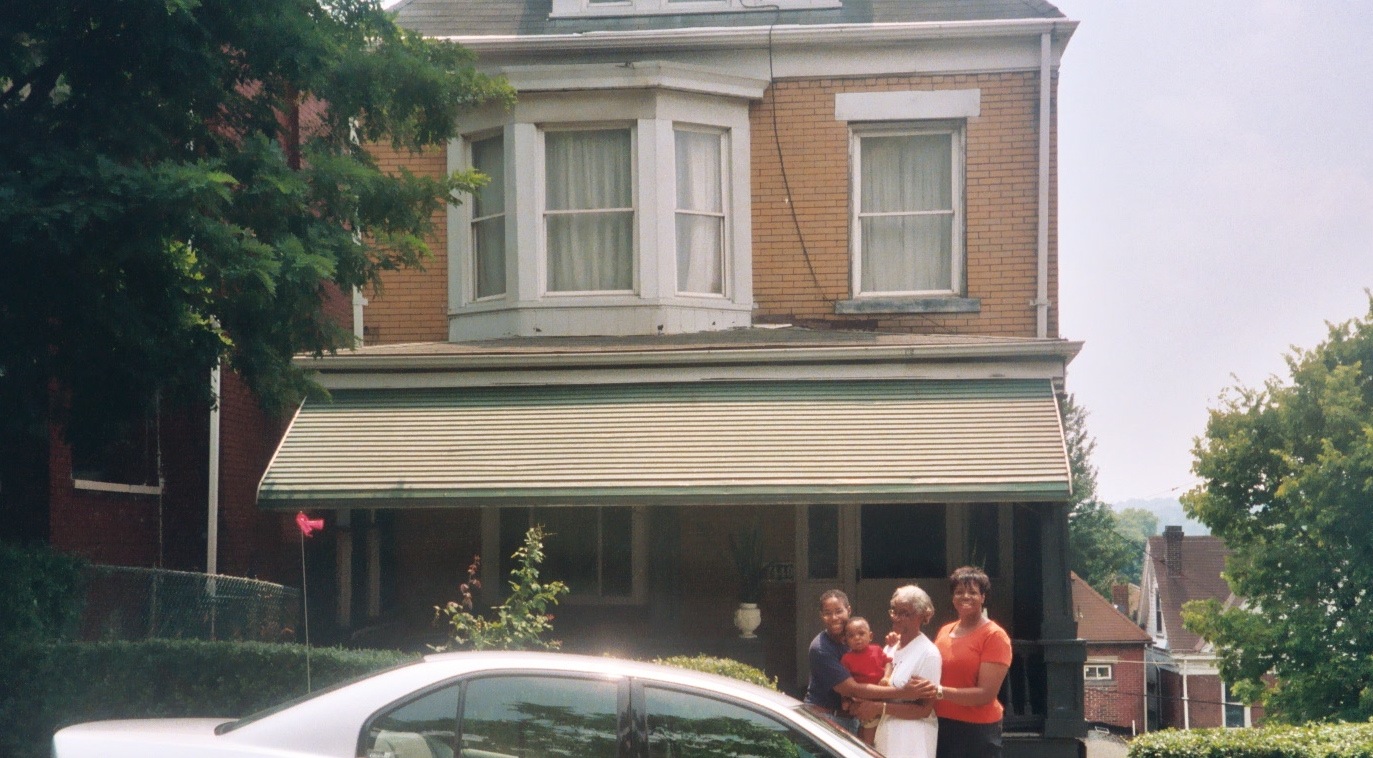
Wife’s family and Noah in Pittsburgh, July 15, 2004. (Donald Earl Collins).

My sister-in-law flew in from San Diego the following day, and wasn’t exactly to see us. Or at least, was standoff-ish with me. It was only the third time we’d ever met, and the first time me and my wife had seen her since ’96 (and since we’d married in April ’00). She wasn’t happy having to share her sister with me, among the other issues she had back then.

She found fault with me making a chocolate cake via Duncan Hines instead of completely from scratch, even though I’d also made a twenty-two pound turkey, corn bread, five pounds of collard and turnip greens, five pounds of potatoes, a gallon’s worth of turkey mushroom gravy and stuffing with sausage that Wednesday. It was one of a series of not-so-charming comments from her that week.

Thanksgiving Day wasn’t much better, for us, for my sister-in-law, or for my wife’s extended family. Just after 12:30 pm, “G,” one of my wife’s cousin-in-laws, showed up with his two teenage kids, four hours before we had scheduled ourselves to serve dinner. He reminded me of my now late ex-stepfather, loud, out-of-shape, and ready to eat or fight at a moment’s notice. Between him and my brooding sister-in-law, I was happy to be in a hot kitchen or down in the basement getting furniture while finishing the preparations for dinner.

The dinner itself was a hit, as in-laws, cousins, nieces and nephews went for seconds and thirds between 4:45 and 6:30-ish. Then G suddenly became really loud and obviously angry while watching the Dallas game in the crowded living room. One of his kids had said as a joke to the then forty-nine year-old, “You’re so old, you were born before they built the railroads!” You know, stuff anyone over thirty hears from their kids at least once a week. But for nearly an hour and a half, G smouldered, then yelled, then smouldered some more, as cousins and in-laws tried to step in. He disowned his kids right in front of at least a dozen family members.

The crescendo was between G and his nephew “AA,” the third family member who had attempted to end the situation. AA was telling G to go home, and even offered to take him there. The rest is family strife gold and history.

“Don’t you EVER come to my house!,” G yelled.

“I love you, and…” AA responded.

“If you come to MY house, I’m gonna put you in a body bag!,” G hollered with a death stare.

“Then I’m gonna be in the back of your mind for the rest of your life!,” AA yelled, a bit hurt.

Eat’n Park logo, March 2011. (http://www.printablecoupons.us/).

While that was going on, my sister-in-law suddenly complained to the female contingent at the dining room table, “They never pick up the phone! They screen all of their calls!” That was in reference to me and my wife.

By 9 pm, it was all over, with two disowned kids, a crazy middle-aged man and a gloomy sister-in-law as part of the package deal that was Thanksgiving ’01. All that was left was an awkward Eat’n Park lunch with my sister-in-law that Friday — not exactly “the place for smiles” that day — and her suddenly booking an early return ticket for San Diego for Saturday morning. We had paid for her original round-trip flight, and her new flight cost more than the original ticket. She really wanted to get away!

So despite how tired I’ve been since Thanksgiving morning, I’ll take the peace of mind that comes with a small family and a thankful gathering any day over Thanksgiving ’01 and family drama.

← Older posts
Newer posts →

Boy @ The Window: A Memoir

Boy @ The Window: A Memoir

Places to Buy/Download Boy @ The Window

There's a few ways in which you can read excerpts of, borrow and/or purchase and download Boy @ The Window. There's the trade paperback edition of Boy @ The Window, available for purchase via Amazon.com at http://www.amazon.com/Boy-Window-Donald-Earl-Collins/dp/0989256138/

There's also a Kindle edition on Amazon.com. The enhanced edition can be read only with Kindle Fire, an iPad or a full-color tablet. The links to the enhanced edition through Apple's iBookstore and the Barnes & Noble NOOK edition are below. The link to the Amazon Kindle version is also immediately below:

scr2555-proj697-a-kindle-logo-rgb-lg

Boy @ The Window on Amazon.com: http://www.amazon.com/Boy-The-Window-Memoir-ebook/dp/B00CD95FBU/

iBookstore-logo-300x100

Boy @ The Window on Apple's iBookstore: https://itunes.apple.com/us/book/boy-the-window/id643768275?ls=1

Barnes & Noble (bn.com) logo, June 26, 2013. (http://www.logotypes101.com).

Boy @ The Window on Barnes & Noble: http://www.barnesandnoble.com/w/boy-the-window-donald-earl-collins/1115182183?ean=2940016741567

You can also add, read and review Boy @ The Window on Goodreads.com. Just click on the button below:

Boy @ The Window

Twitter Updates

Tweets by decollins1969
  • RSS - Posts
  • RSS - Comments

Archives

  • June 2025
  • April 2023
  • September 2022
  • August 2022
  • July 2022
  • June 2022
  • May 2022
  • April 2022
  • March 2022
  • January 2022
  • December 2021
  • November 2021
  • October 2021
  • September 2021
  • August 2021
  • July 2021
  • June 2021
  • April 2021
  • March 2021
  • February 2021
  • January 2021
  • December 2020
  • November 2020
  • October 2020
  • September 2020
  • August 2020
  • July 2020
  • May 2020
  • April 2020
  • March 2020
  • January 2020
  • December 2019
  • November 2019
  • August 2019
  • July 2019
  • June 2019
  • May 2019
  • April 2019
  • March 2019
  • February 2019
  • January 2019
  • December 2018
  • November 2018
  • October 2018
  • September 2018
  • August 2018
  • July 2018
  • June 2018
  • May 2018
  • March 2018
  • February 2018
  • January 2018
  • December 2017
  • November 2017
  • October 2017
  • September 2017
  • August 2017
  • July 2017
  • June 2017
  • May 2017
  • April 2017
  • March 2017
  • February 2017
  • January 2017
  • December 2016
  • November 2016
  • October 2016
  • September 2016
  • August 2016
  • July 2016
  • June 2016
  • May 2016
  • April 2016
  • March 2016
  • February 2016
  • January 2016
  • December 2015
  • November 2015
  • October 2015
  • September 2015
  • August 2015
  • July 2015
  • June 2015
  • May 2015
  • April 2015
  • March 2015
  • February 2015
  • January 2015
  • December 2014
  • November 2014
  • October 2014
  • September 2014
  • August 2014
  • July 2014
  • June 2014
  • May 2014
  • April 2014
  • March 2014
  • February 2014
  • January 2014
  • December 2013
  • November 2013
  • October 2013
  • September 2013
  • August 2013
  • July 2013
  • June 2013
  • May 2013
  • April 2013
  • March 2013
  • February 2013
  • January 2013
  • December 2012
  • November 2012
  • October 2012
  • September 2012
  • August 2012
  • July 2012
  • June 2012
  • May 2012
  • April 2012
  • March 2012
  • February 2012
  • January 2012
  • December 2011
  • November 2011
  • October 2011
  • September 2011
  • August 2011
  • July 2011
  • June 2011
  • May 2011
  • April 2011
  • March 2011
  • February 2011
  • January 2011
  • December 2010
  • November 2010
  • October 2010
  • September 2010
  • August 2010
  • July 2010
  • June 2010
  • May 2010
  • April 2010
  • March 2010
  • February 2010
  • January 2010
  • December 2009
  • November 2009
  • October 2009
  • September 2009
  • August 2009
  • July 2009
  • June 2009
  • May 2009
  • April 2009
  • March 2009
  • February 2009
  • January 2009
  • December 2008
  • November 2008
  • October 2008
  • September 2008
  • August 2008
  • July 2008
  • June 2008
  • May 2008
  • April 2008
  • March 2008
  • February 2008
  • January 2008
  • December 2007
  • November 2007
  • October 2007
  • September 2007
  • August 2007
  • July 2007
  • June 2007

Recent Comments

MaryPena's avatarMaryPena on My Day of Atonement/Bitter Hat…
decollins1969's avatardecollins1969 on No Good Teaching Deed Goes…
Mary Rose O’Connell's avatarMary Rose O’Connell on No Good Teaching Deed Goes…

NetworkedBlogs on Facebook

NetworkedBlogs
Blog:
Notes From a Boy @ The Window
Topics:
My Life, Culture & Education, Politics & Goofyness
 
Follow my blog

616 616 East Lincoln Avenue A.B. Davis Middle School Abuse Academia Academy for Educational Development AED Afrocentricity American Narcissism Authenticity Bigotry Blackness Boy @ The Window Carnegie Mellon University Child Abuse Class of 1987 CMU Coping Strategies Crush #1 Crush #2 Death Disillusionment Diversity Domestic Violence Economic Inequality Education Family Friendship Friendships Graduate School Hebrew-Israelites High-Stakes Testing Higher Education History Homelessness Humanities Humanities Program Hypocrisy Internalized Racism Jealousy Joe Trotter Joe William Trotter Jr. K-12 Education Love Manhood Maurice Eugene Washington Maurice Washington Misogyny Mother-Son Relationship Mount Vernon High School Mount Vernon New York Mount Vernon public schools Multiculturalism MVHS Narcissism NFL Pitt Pittsburgh Politics of Education Poverty President Barack Obama Race Racial Stereotypes Racism Relationships Self-Awareness Self-Discovery Self-Reflection Sexism Social Justice Teaching and Learning University of Pittsburgh Violence Whiteness Writing

Top Rated

Blog at WordPress.com.

  • Subscribe Subscribed
    • Notes from a Boy @ The Window
    • Join 103 other subscribers
    • Already have a WordPress.com account? Log in now.
    • Notes from a Boy @ The Window
    • Subscribe Subscribed
    • Sign up
    • Log in
    • Report this content
    • View site in Reader
    • Manage subscriptions
    • Collapse this bar
 

Loading Comments...