• Spinning Sage’s Gold: Allegories on the Western-Dominated Present and a Possible Post-Western Future (2025)
  • About Me
  • Other Writings
  • Interview Clips
  • Video Clips
  • Boy @ The Window Pictures
  • Boy @ The Window Theme Music

Notes from a Boy @ The Window

~

Notes from a Boy @ The Window

Category Archives: 1

An Honest & Open Conversation on Race?

26 Monday Jul 2010

Posted by decollins1969 in 1, culture, Eclectic, Politics, Pop Culture, race

≈ Leave a comment

Tags

Conversations on Race, FOX News, John Hope Franklin, Kerner Commission, NAACP, Obama Administration, One America Initiative, President Bill Clinton, President's Initiative on Race, Prop 209, Race, Shirley Sherrod, Truth & Reconciliation Commissions, USDA, Ward Connerly


“The Chase” Screenshot from Avatar: The Last Airbender. Source: Donald Earl Collins

A few days ago, in the midst of the NAACP-Tea Party-FOX News-Shirley Sherrod-USDA-White House-Obama Administration scandals, one of my Facebook friends asked the question, “Can’t we ever have an open and honest conversation about race?” I didn’t give her a direct reply, mostly because I spent the better part of a decade attempting to answer that question through my first book Fear of a “Black” America.

But I also didn’t feel like being bothered. Though I remain hopeful, my level of optimism is nowhere near where it was in ’94, when I started work on the doctoral thesis that turned into my first book six years ago. Still, it’s an important question, to which the answer’s generally “No!,” mostly because that level of honesty is hard to come by in a nation like ours, so full of itself, so rich and imperialistic, “smiling, crying in celebrity,” as U2 would say.

About thirteen years ago, former President Bill Clinton attempted to open up an open and honest and
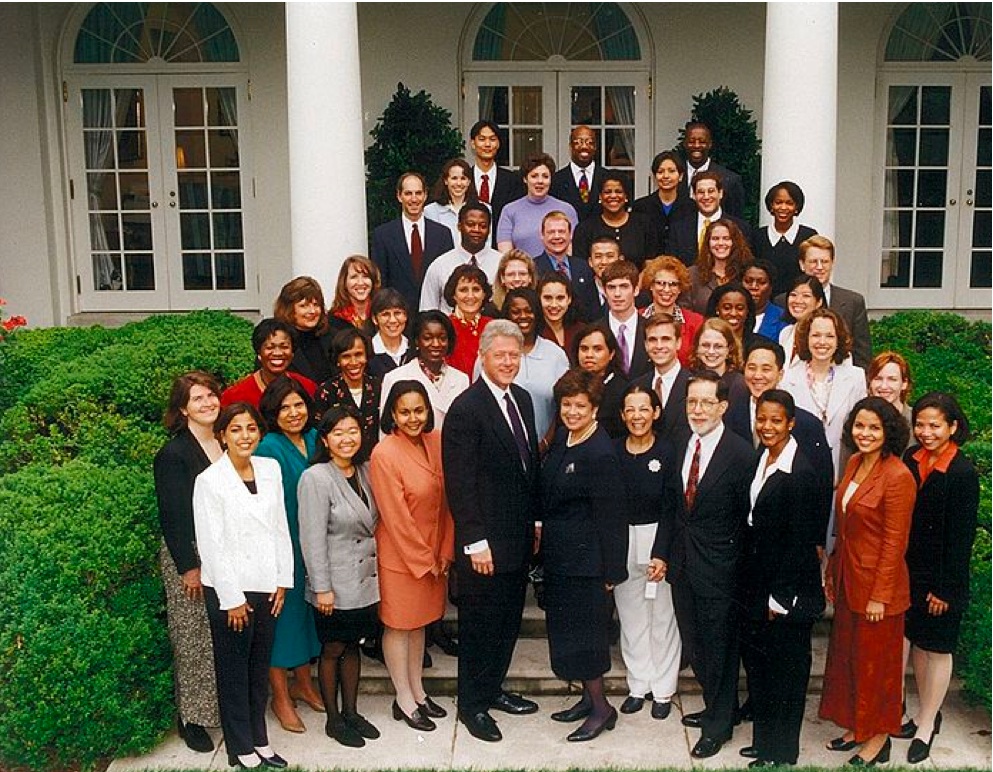
Staff of President Clinton’s Initiative on Race, June 1997.

bipartisan discussion of race. President Clinton’s Initiative on Race, which started with widespread media coverage of the President’s speech at the University of California, San Diego commencement on June 14, 1997, ended with a report buried in Monicagate obscurity on September 18, 1998. President Clinton stated that the Initiative on Race was about making out “of our many different strands one America — a nation at peace with itself bound together by shared values and aspirations and opportunities and real respect for our differences.”

The seven-member Advisory Board included the late trailblazing Black historian John Hope Franklin, former New Jersey governor Thomas Kean, former Mississippi governor William Winter, former CEO of Nissan Motor U.S.A. Robert Thomas, lawyer Angela Oh, Linda Chavez-Thompson, and Bronx, New York minister Suzan Johnson Cook. Three White men, one African American man, one African American woman, one Hispanic woman, and one Asian American woman, all born between 1915 and 1957, made up the Advisory Board that would give America the blueprint for beginning a sincere dialogue on race.

To say the least, the Advisory Board was not entirely representative of late-twentieth-century America. Despite each individual member’s prior accomplishments, there were a host of other scholars, ministers, CEOs, lawyers, union organizers, and former governors who should’ve been considered for this task. Beyond that, the Advisory Board’s lack of ideological (six liberals and one moderate) and age balance (the youngest person on the board was 41 in 1997) would make anyone wonder if they possessed broad enough perspectives to address race issues in 1968, much less during their 1997-98 tour on race.

The late John Hope Franklin, circa 2006.

The Advisory Board on Race – led by John Hope Franklin – traveled the nation in search of consensus but instead found controversy throughout their fifteen-month tenure. For example, Franklin refused to invite anti-affirmative action advocate Ward Connerly to an Advisory Board meeting regarding racial diversity on college campuses on November 20, 1997, which violated the spirit of the President’s Initiative. Franklin stated that Connerly had “nothing to contribute” to the discussion on cultural differences. Connerly, as many of you already know, was a University of California regent who campaigned in 1996 for the passage of Proposition 209, which led directly to the repeal of all affirmative action programs for the state of California.

Regardless of what people like me think of Connerly, Clinton had created this mandate “so that we can better understand the causes of racial tension” — not to increase them. Not only
Ward Connerly, circa 2006.

that. It proved that the Greatest Generation and the Baby Boom Generation couldn’t find a way to do what South Africa, Chile, Spain, Australia, Liberia and so many other countries have been able to do in the past half-century. Have an open and honest dialogue — a Truth and Reconciliation Commission — on issues like apartheid, political repression, ethnic cleansing, genocide and civil war. Maybe it rests with our generations — Gens X and Y — to make this so, to “make it plain,” as Malcolm X would’ve said.

The Advisory Board asserted in its final report that in crisscrossing the country, they had “engage[d] the American people in a focused examination of how racial differences have affected our society and how to meet the racial challenges that face us.” That was a bald-faced lie, and not just obfuscation. The Commission instead reflected in subtle ways the previous three decades of racial divisive and political exploitation thereof. Not much has changed since ’97 and ’98, and as long as Whites feel they have something to lose — and Blacks merely four centuries of things to get off their chests — I’m afraid not much will either.

On Abusers and White Anxieties

22 Thursday Jul 2010

Posted by decollins1969 in 1, Boy @ The Window, culture, Eclectic, Politics, Pop Culture, race

≈ Leave a comment

Tags

Abuse, Bigotry, Domestic Violence, FOX News, NAACP, New Black Panther Party, Race, Racism, Roger Ailes, Ross Douthat, Shirley Sherrod, Tea Baggers, Tea Party, USDA


Source: http://www.fordogtrainers.com/

I realized it early on in the five years between my ex-stepfather’s beating up of my mother, my summer of abuse, and my departing for the greener pastures of the University of Pittsburgh in August ’87. It wasn’t just about being whipped with a belt so that it would leave welts. Nor was it merely about the kicks, the punches, the constant threats to take me “out of this world.”

No, my ex-stepfather wanted something more, even more than me calling him “Dad.” It was about shutting me up, about keeping me from ever speaking the truth of our calamity and of his monstrosity. It was all about making sure that I never resisted, protested, questioned or stood up to him. Fortunately for me, I did. I have the scars and chipped tooth to prove it, too.

For people like Atlantic Monthly editor and New York Times columnist Ross Douthat, neo-con and true- believer Roger Ailes of FOX News, as well as entities like FOX (or Faux, or Fix) News and the so-called Tea Party, it isn’t much different. They claim reverse racism by Blacks against Whites at every turn. Come up with cockamamie versions of the truth with regard to anything involving race. And refuse to believe that any person of color experiences any instance of racial discrimination, a racial epithet or any bigotry whatsoever. It doesn’t matter if there’s an audio recording, a video stream or an affidavit, racism died with the passage of the Civil Rights Act of 1964, at least according to these folk.

The embodiment of all that ails America today, for FOX News and Tea Baggers alike, is President Barack Obama. His very name, his father’s nationality, his birth certificate, all have come under more scrutiny than the stain on Monica Lewinsky’s blue dress. Somehow, POTUS 44 is a socialist, communist, biracial man who sometimes hates Whites, too thoughtful, not commanding enough, scared of the military, too hasty in his decision-making, a Hitler-mustache-wearing-Nazi, a foreigner who has usurped the presidency, among the myriad of inconsistent insults these folks have hurled, and with pride.

That’s what has made the news around the so-called New Black Panther Party on FOX News over the past week disturbing. That’s what has made the news about the response to the NAACP’s tired but accurate claim that the Tea Party supports bigoted rhetoric so unnerving. This is what’s made the news the past three days about Shirley Sherrod being fired and then re-offered a job at the USDA over something that wasn’t racial so ludicrous. All of these are efforts by racial conservatives — people who refuse to accept a multicultural society in which all things White aren’t necessarily the things that determine who is and isn’t a winner — to put White progressives, people of color and other deviants in their place.

All in the Family Screen Shot

Douthat, Ailes, FOX News and the Tea Party all want to turn back the clock, to somewhere between 1945 and 1954. To a time when few cared what anyone who wasn’t a middle-class WASP male thought about anything. To a place in which “girls were girls and men were men,” as Archie Bunker would’ve sang on All in the Family. To a world in which race, bigotry and racism didn’t exist at all, or at least, could easily be swept under the rug, and the N-word an acceptable part of the American lexicon.

That’s what they want. Let’s make sure that they never get it.

The Five Senses of Poverty

20 Tuesday Jul 2010

Posted by decollins1969 in 1, Eclectic, High Rise Buildings

≈ Leave a comment

Tags

crime, environmental pollution, five senses, garbage, Homelessness, hunger, impoverished, material lack, poor, Poverty, urban blight, urban noise pollution, Violence


Abandoned Building, November 2006

Being poor isn’t just a relative thing or simply a state of material lack. It can be measured by far more than the amount of money in someone’s savings account or by the gut-wrenching feeling at the bottom of one’s stomach when it’s time to choose between the telephone bill and the electric bill. Beyond the material and the emotional, the relative state between a lack of money and a lack of a spiritual center isn’t completely measurable. But, poverty, in its most general, community, and familial sense, can be experienced through all five of our physical senses.

1. Smell — This is perhaps the most powerful sense of poverty for any of us. Stairwell in project high-rises full of garbage. The tell-tale scent of overused cooking grease in an apartment or other impoverished living space. The odor of rotting animal flesh, of expelled farts, of roach spray and borax and cheap pine oil. The smell of clothes that have been exposed to all of these smells. Or,

Source: http://www.watchmojo.com/blogs/images/garbage.jpg

better still, a smell of lingering cooking oil from frying chicken the night before, combined with the body odor and sweat of numerous people, combined with basura and excrement. Not to mention the release of flatulence and the drawing in of exhaust fumes from the outside world by fans running on high because of the lack of air conditioning.  There isn’t enough Febreeze in the world to cover up the smell of poverty.

2. Sight — We can all be fooled by what we see with our own eyes. At least by all but the poorest of the poor in the world and in the US. But children and their faces tell the truth of their lot in life more than any pair of Jordans or dress clothes can hide. The tired, almost dead looks of children, whether in the Bronx or in Burkina Faso. Their eyes detail a sense of hopelessness, a momentary glance that gives away their suspicion that there is no future for which they should be ready for. Of course, there are more commonplace signs around us. Homeless folk in their old, wrinkled, tattered, oily, soiled clothes, with aluminum cans and liter soda bottles in beat-up shopping carts. Women and children looking a bit older than the few years they’ve spent in this world. Unkempt hair, chipped and worn fingernails, dirty faces in public places, can all be signs. But the eyes are the key window into someone else’s poverty.

3. Hearing — The sound of poverty is deafening. It cannot be hidden by clothes, nor covered up by an aerosol can. Take any urban community in which poverty has taken a firm grip. The sounds of living have been disrupted. Adults are out and about, conversing and cursing, foaming and fighting in the middle of the day, the time in which they should be hard at work, in an office or factory or somewhere else. The cries of children out with their mothers at all hours of the night. The constant beeping of cars, the sirens of ambulances and police cars, the screams of mothers, fathers and siblings at hours well past club-closing times. Poverty disables the need for a schedule, the need for a bedtime and a wake-up time, for a rhythm that requires sleep and renewal.

4. Taste & Touch — Though underappreciated, these senses can also be used to deduce poverty, or at least, the lack of things. Taste and smell go together, so many of the smells of poverty find their way to the taste buds on our tongues. The taste of bile, of acid reflux, even of blood usually come with the violent smells of being in an impoverished environment. The rough touch of clothes unwashed, or at least, washed in hard water and without fabric softener, is another indication.

But there’s also the lack of variety that’s typical of being poor that are told to us by taste and touch. Eating almost nothing but processed foods, fast food, or aid food, and the tongue becomes as a dull knife, unable to appreciate the subtle differences between onion and garlic, or the more distinctive flavors of paprika, nutmeg or cinnamon. Wearing nothing but hand-me-downs or hip-hop gear makes one’s sense of touch as rough as a jagged boulder, as unfeeling as stainless steel. Even a close hug in this kind of environment can be jolting and disconcerting.

Through our five senses, it becomes easier to understand why fighting our way out of poverty is so difficult, why being poor can disable and debilitate so many. That so many don’t have to breathe, taste, hear or touch it is the very reason why so many of us don’t understand it.

My Father Jimme — Happy Birthday!

17 Saturday Jul 2010

Posted by decollins1969 in 1, Boy @ The Window, Eclectic, Jimme, My Father, New York City, Work, Youth

≈ Leave a comment

Tags

Alcoholism, Boy @ The Window, Forgiveness, Jimme, Mount Vernon New York, My Father, New York City, Reconciliation, Work


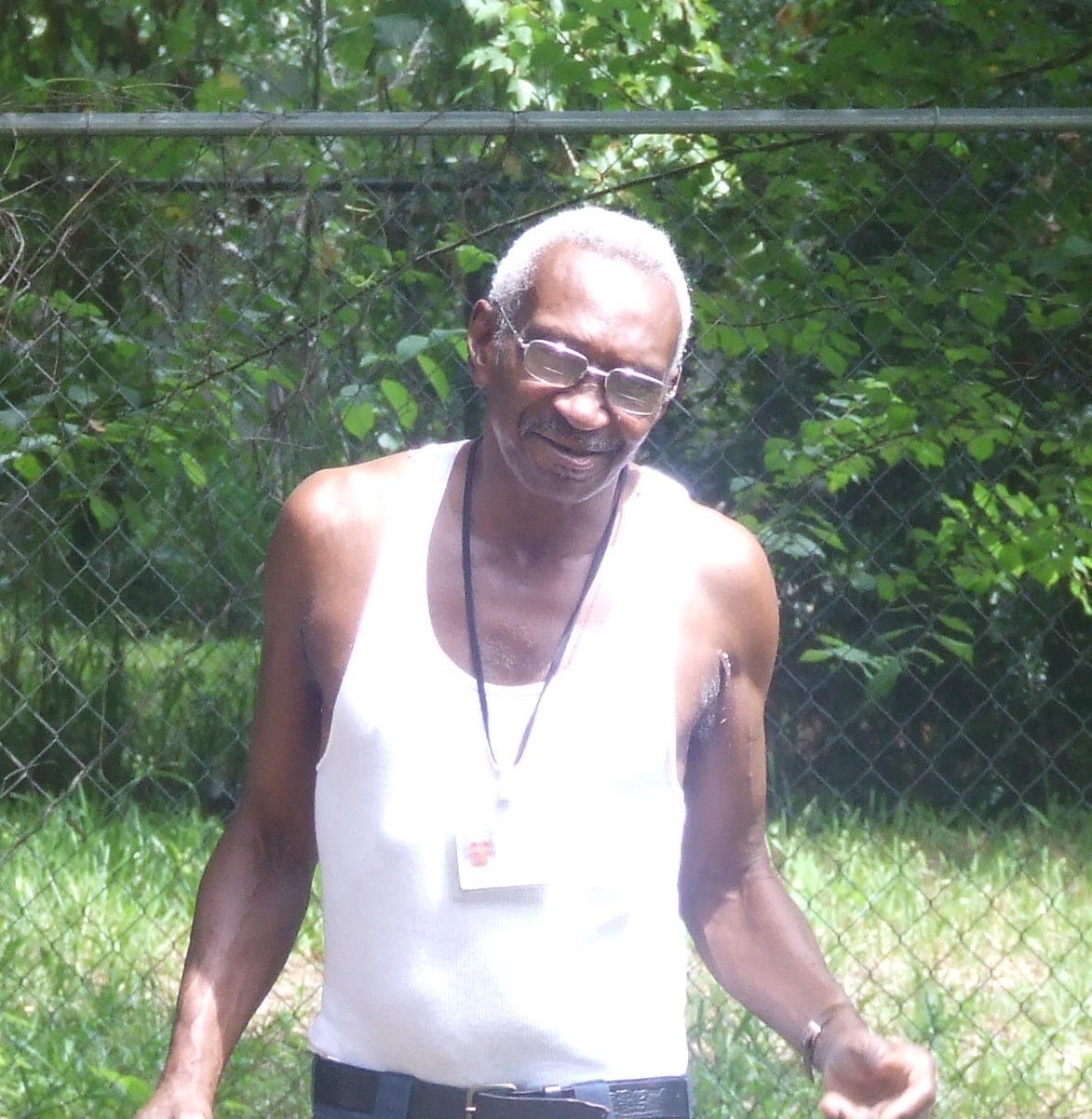
My Father, August 2007

On Monday, my father Jimme turns seventy years old. Seventy, 70, 7-oh! Amazing! Given the years of alcohol abuse, so much loss, so much pain, so much rage, and to recover and make it to the age of seventy? That’s a big-M miracle, the kind that you can only attribute to sheer strength of will and the grace of God.

I must admit, after the summer of ’92, I had my doubts about my father’s future. The few times I saw him that summer, he was drinking like he had never drank before. The first time I saw him, he accused me of lying about having my master’s degree. “No college gonna giv’ you a degree afta a year,” he said. Only when his Jewish bosses told him it was possible for someone to finish a master’s in a year did he believe me.

The second time I went to see him, his landlord Mrs. Smalls was about to evict him. But my father wasn’t there. Or, I guess he was, in a way. He had made plops of defecation, from the front gate and blue slate walk up to the front steps and porch, into the entrance way and foyer, up the gloomy carpeted steps, all the way to the attic bathroom next to his room. They’d been cleaning for hours, according to Mrs. Smalls, but it sure didn’t smell like it.

Fast-forward two years to Christmas Eve ’94. My mother and my younger siblings and I went on a bus trip to Cross County Mall and Toys ‘R Us in Yonkers. Jimme showed up at the last minute to join us and to regale us with his “po’ ass muddafuccas” and his other favorite Jimme-isms. We were on the 7 bus to Yonkers, packed with parents who were shopping late for toys and Christmas trees. Jimme was so drunk that he fell over on some people on the bus once, and fell into the rear stairwell one other time. I wasn’t embarrassed as much as I was disappointed and saddened.

So by the time I finished my doctorate at the end of ’96, I’d all but given up on my father turning things

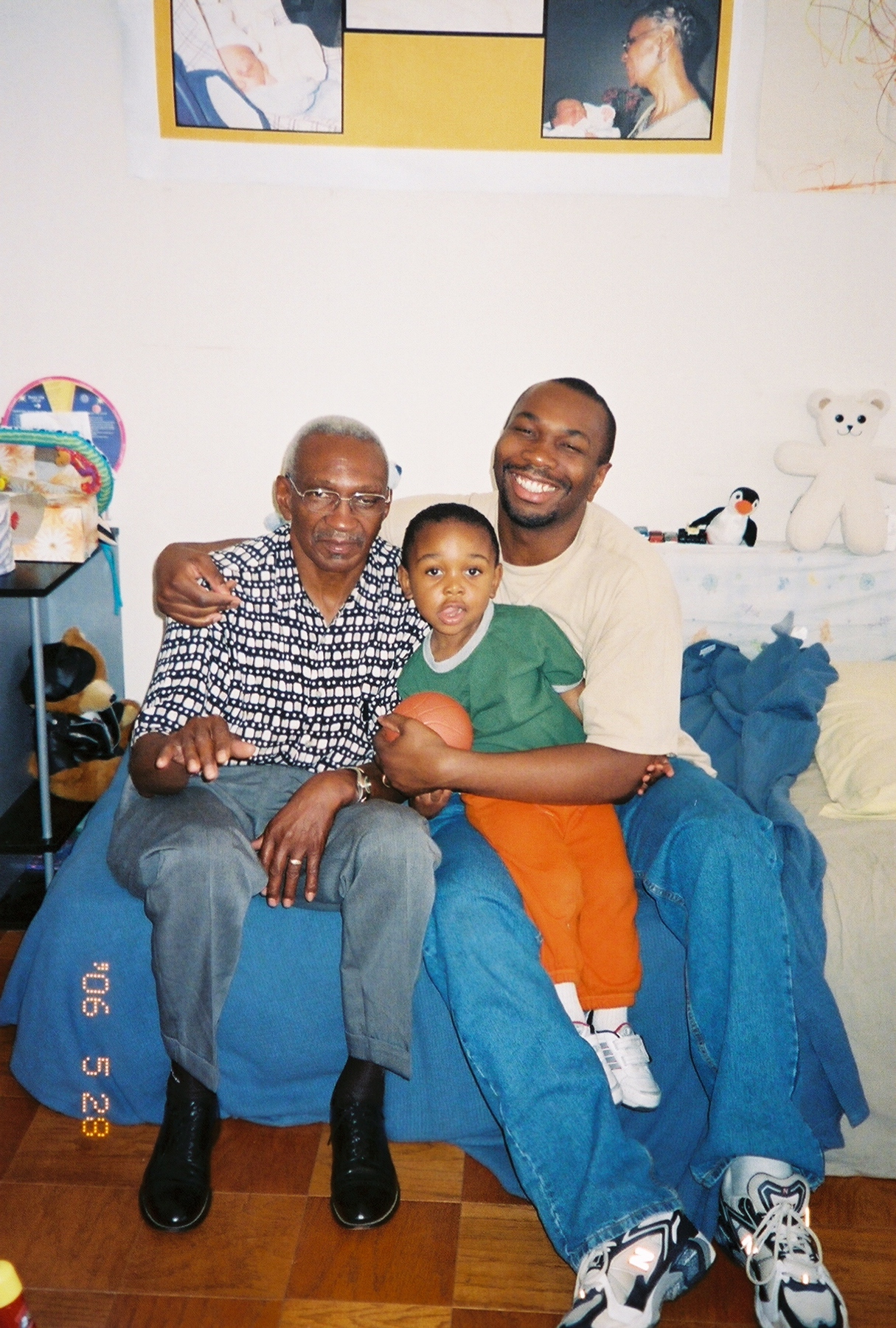
Three Generations, May 2006

around. A few months later, my father, unemployed and no longer enabled by his former bosses, finally left New York for the family home in Georgia at the invitation of one of his sisters. By the end of ’97, I heard that he had cleaned up his act and moved to Jacksonville. Throughout ’98 and into ’99, I began to get calls from Jimme about how he was finally sober, had found God, and was getting married, to another woman named Mary.

I thought long and hard about blowing him off. All my life, and certainly all of my older brother Darren’s, Jimme had been an evil drunk, verbally abusive and incapable of staying sober for more than three weeks at a time. But he had also been there for me growing up during my Humanities and Hebrew-Israelite years. He helped keep Darren and me from starving or walking around barefoot in ’82 and ’83. He kept the example of hard work in front of us even as the other parent figures in our lives went on dreaded welfare and laid around as if our lives were over. His money was the reason I was able to stay in school after five days of homelessness my sophomore year at Pitt.

So I called him, deciding to give him a second chance. That was February ’99, a two-hour conversation about how he managed to become a recovering alcoholic, a church-goer, and a married man. He admitted that he had made many mistakes, that he was an alcoholic, that he loved me and my brother. It was a conversation, a real conversation, an unbelievable change of relationship. After twenty-nine years and two months, I finally had a father that I really could call father.

That was eleven and a half years ago. I’m still amazed that I’m able to talk to my father as my father, and not as the person I used to have to drag out of bars on 241st Street or in Midtown Manhattan growing up. But most of all, I’m amazed how much I love him and care about him. Happy Birthday…Dad!

My Sister Sarai (Partial Repost)

13 Tuesday Jul 2010

Posted by decollins1969 in 1, Boy @ The Window, Eclectic, Marriage

≈ 3 Comments

Tags

Boy @ The Window, Death, Mount Vernon New York, Sarai Washington, Sickle Cell Anemia


Sarai & Noah, November 2003

Yesterday, my only sister Sarai passed away at twenty-seven from complications from sickle-cell anemia. It’s a disease that can often claim one’s life before they reach adulthood. Even with our advanced medicine, the average life expectancy of someone with sickle-cell anemia is forty-five years. Not to mention the pain and infections involved in having such a body-draining disease.

As much as I love her, the fact is that Sarai probably shouldn’t have been here. Between the disease and what we were going through as a family in ’82, it’s hard to believe that Sarai managed to survive in the worst of our worst times. I had just gone through my summer of abuse at the hands of her father, my mother had struggled through picket lines because she didn’t want to lose her job (only to get her hours cut in half anyway), and we were eating as if there was a global famine crisis. By the time I found out that my mother was pregnant with Sarai, with my mother working part-time, I knew we were up crap’s creek without a lifeline. My cold and adult-like argument with my mother about aborting my future sister left me even more in search of escape than I had been (see February 9, ’09 post “Sister Sarai”).

For some reason my mother didn’t listen to me, giving birth to my only sister, Sarai Adar Washington on the ninth of February ’83, born in the middle of a snowstorm. I refused to visit my mother in the hospital in New Rochelle. I didn’t want Sarai, and was tired of watching my mother make incredibly bad decisions.

Sarai came home a couple of days later, obviously stricken with the disease, as she looked like she was in pain then. I was so mad whenever I was home in Sarai’s first days. Not mad at her. Mad with my mother. Even at part-time, she could’ve seen a doctor about her sickle-cell trait, and screened to see if her idiot husband had the trait also.

Even in ’82, even without his participation, through my brothers Maurice and Yiscoc, my mother could’ve learned early on whether both her and my then stepfather Maurice had the sickle-cell trait. She long knew that she had it, and I’d known about my trait since I was seven. I’d learn about a year later, in ninth grade Biology with Mr. Graviano, that with two parents, there was a one-in-four-chance with every pregnancy that full-blown sickle-cell anemia would be passed to a child. For the first time in my life, I saw my mother as an idiot.

By the middle of the summer of ’83, Sarai was obviously in trouble. She hardly gained any weight, all of her food had to be fortified with iron, and she only had “three strands of hair,”as my mother put it. It was more like a few dozen in three spots on Sarai’s scalp. She always needed help. Sarai even then was in and out of the hospital, in need of the occasional blood transfusion, and at time in excruciating pain.

With all of this, my mother would say to me, “See, that why you shouldn’t wish for an abortion,” as if I was supposed to feel guilty about what I said to her the year before because Sarai was sick. As if I had anything to do with her being here. I just gave my mother a weak smile whenever she’d say something like that, trying not to reveal my disdain for her path-of-least-resistance decision-making.

Despite all of this, I grew to love my sister, if only because there was nothing else to do. It wasn’t her fault that her parents had about as much common sense as a wino on South Fulton Avenue in Mount Vernon on a hot day in August. Sarai wasn’t to blame for her own condition. And me suggesting that my mother get an abortion — it was obviously too late to get one by the time I yelled the idea at my mother — didn’t make Sarai one sickle-cell sicker than she already was.

Over the years, Sarai did get better, then worse, then better again. I stopped babying her by the time she was a teenager, but my mother didn’t know how to stop treating her like she was a toddler. By the time of the family intervention in ’02, Sarai was obviously ready to leave 616. She moved to Alabama for three and a half years, between ’05 and ’09, to live with her high school friends and to live a slower life away from my mother and the rest of us. Even though she still had many days with pain, and more in the hospital during those years, Sarai lived her life her way. I’m happy for her that she had those years away from 616, from Mount Vernon.

Of course, the story didn’t end there. Sarai’s sickle-cell anemia complications got worse, so bad that she ended up quitting her job and moving back to Mount Vernon from Alabama, where the medical facilities were allegedly better. The last week or two before her death, while far from pleasant, and somewhat expected, was still a shock to the family. For me, most of the shock occurred months before Sarai was born.

I only hope that someone somewhere finds a cure or at least a way to help people like my sister experience less pain and a richer, more vibrant life because of this disease. The good news was, that for most of her last years, Sarai carried on as if she didn’t have a disease.

Crush #1 and Other Bedtime Stories

10 Saturday Jul 2010

Posted by decollins1969 in 1, Boy @ The Window, Eclectic, Jimme, Mount Vernon High School, Sports, Youth

≈ Leave a comment

Tags

616 East Lincoln Avenue, A.B. Davis Middle School, Bedtime Stories, Characters, Class of 1987, Classmates, Holmes ES, Humanities, Mount Vernon High School, Mount Vernon New York, Stories


Noah Sleeping, September 2009

For about the past year and a half, me and my wife have spent some of our time at the end of the day with our son Noah telling him bedtime stories. Actually, it’s been mostly me, since my wife doesn’t like making up stuff. At first, it was just about every night, with me telling Noah true stories about family, friends, former classmates and my school experiences.

I’d often put Noah in those stories, especially the ones I knew he’d laugh at. Like the science teacher who came in one day smelling like a skunk had sprayed him because a skunk actually did. Or the story about my second day of high school, where I had to fight a class hipster because he thought that I was a wimpy push-over.

With me injecting Noah into these stories — usually as the character Ben 10 turning into Big Chill or Humongousaur — I realized I had to embellish a bit, making some of my real-life encounters less like real-life. I told stories about my father where I changed almost all of the wording because the real stories involved more profanity and bigotry than a five or six-year-old should ever have to hear. I’d leave out parts of stories about how mean some of my classmates or teachers were just to make sure Noah was ready to go to sleep happy and without asking me a lot of questions about my past.

About six months ago, I started making up stories, about eighty-five percent fictional in nature. The names

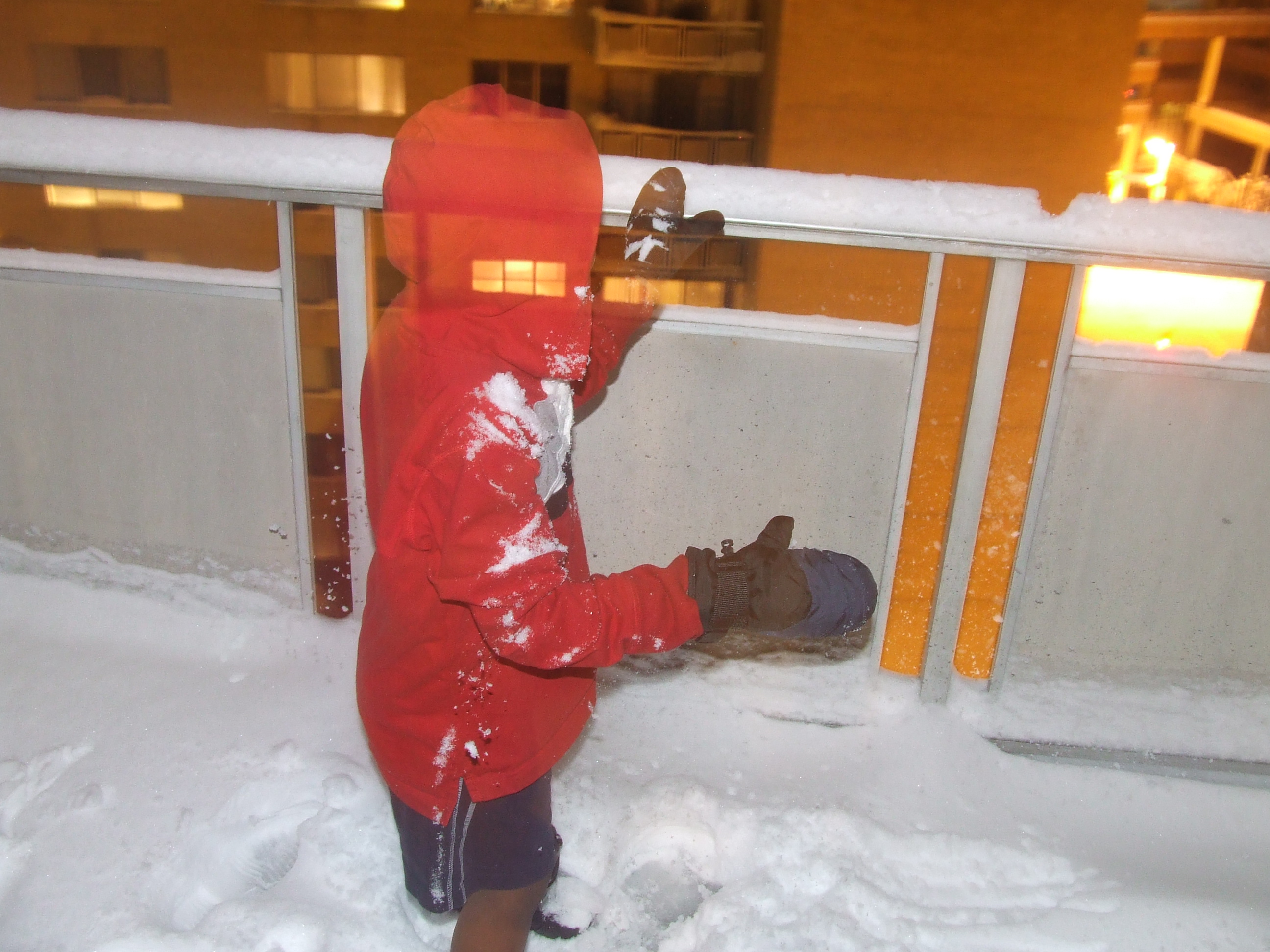
Noah in Snowaggedon (on balcony), February 2010

and places remained the same, but the incidences and their improbable outcomes didn’t. I figured out that Noah mostly enjoyed a few choice characters: a fictionalized ’80s version of my father, a singing, wise-cracking fictional classmate, a super-smart classmate who’d get a case of the “ums” and “uhs” under duress, a friend from my elementary school days who’d fart when under pressure, and an even more tomboyish version of my Crush #1. Noah has since asked for those characters in my stories over and over again.

He’s also asked a lot of questions about my real-life classmates, teachers and family. Like, “Did you really have a classmate who sings ‘Roxanne’ all the time?” Or “Did [your friend] really fart all the time?” “Are you still friends with [super-smart boy]?” So I pulled out the MVHS Class of ’87 yearbook that I had borrowed from a former classmate when revising drafts of Boy @ The Window to show Noah pictures of them so that he could see that these weren’t the larger-than-life, made-up characters I used in my bedtime stories. Not to mention using the power of Facebook to bring home that fact as well.

This past week, Noah’s asked a few more questions. “Do you still like [Crush #1] a lot?,” Noah asked me a couple of days ago. “I still like her, but not the way I liked her when I was twelve,” I said in response, kind of shocked that he asked me that question out of the blue. I then thought for a moment, “Maybe I should keep the twelve-year-old in me to myself until he’s older.”

Noah Salutes

Then I realized. I have to tell Noah these stories. At the very least, it’ll help him not make the same mistakes I made growing up. That way, he won’t have to spend most of his time growing up without good friends, without an eleven-year gap between kisses, with mostly stories that would make most six-year-olds cry. Or, at the least, sad. He can read all about it when he’s older and Boy @ The Window’s published.

Working for My Father

08 Thursday Jul 2010

Posted by decollins1969 in 1, Boy @ The Window, Eclectic, Work

≈ 1 Comment

Tags

Cleaning, Condos, High Rise Apartments, Jimme, My Father, New York City, Office Buildings, Upper East Side, Upper West Side, Work, Working


Me and My Father, August 2007

The first job outside of 616 I ever had was working for my father Jimme. Off and on from September ’84 through the early part of July ’85, me and my older brother Darren schlepped our way between 616, Jimme’s place on South 10th Avenue, the 2 Subway and the Upper West and Upper East Side. We cleaned high-rise offices, high-rise condos, and high-rise co-ops in the process. The last of those jobs was twenty-five years ago this week. This was Jimme’s way of making us earn the money he’d been giving us (really me) since the end of ’82.

Whenever anyone asked me what Jimme did — which was really rare — I usually said, “Oh, my dad’s a carpet cleaner.” I didn’t see him as a simple janitor, although it was true that he cleaned stuff. But Jimme didn’t clean toilets or latrines or bathroom sinks and tubs. He cleaned the floors of office buildings — carpeted, wooden, or otherwise — thoroughly treating any surface he encountered with industrial cleaning machines. He cleaned high-rise co-ops and condos where the mortgage or rent payment per month was more than our rent at 616 for a year. It was an important job in his eyes, and I wasn’t going to diminish it because other folks couldn’t understand or wouldn’t have a clue as to the amount of labor involved in Jimme’s work.

155 West 68th - One of Many Cleaning Jobs in '84 and '85

I didn’t have much of an idea beyond seeing him mop a floor at Salesian High School until I started working for him on a Friday night or a Saturday or Sunday morning. This wasn’t an easy task. We saw Jimme almost everyday for the first three weeks of the summer of ’85, cleaning the carpets and floors of one high-rise after another on the Upper West Side, especially between 67th and 72nd near Broadway. We did mostly night work, in office buildings and in condos. We also had a couple of stints on the Upper East Side around 86th. We carted the industrial carpet cleaning and floor equipment for stripping, buffing, and waxing on the 2, 5, and 6 trains at three in the morning.

Jimme didn’t drink much during these weeks of withering toil and sweat. He was constantly irritated with us, though. “Got no reason to be tired, bo’,” he’d say. “Hurry up an’ dump out that water!,” Jimme would yell. And with a killer’s cold, strangled look, he’d say to us, “I dun told you how to do dis shit right, now I got to do it my gotdamn self!”

It was fascinating seeing Jimme work and work us as hard as he did. Darren didn’t complain much, but then again, he didn’t do much work either. It was up to me and Jimme, and with my dad in a perpetual state of irritation, I was getting pissed too.

“I feel sorry for the people who work for you during the day! I hope I never have to work for you again!,” I yelled over the roaring machines on several occasions.

“Shut up ya faggat!,” Jimme would yell back. Or he’d just mutter in anger, and look at me as if he were ready to stab me in the neck.

In some of the condos we’d clean, Jimme would help himself to whatever he thought wouldn’t be missed — sport coats, shoes and socks mostly. Sometimes we’d take breaks to go to this Jewish deli that used to be on 65th and Broadway/Columbus, across from the Lincoln Center. They made turkey, hot pastrami and corned beef sandwiches stuffed with meat and loaded with every ingredient you could think of — all for five dollars. That, a bag of Doritos, their blondie desserts and a sixteen-ounce carton of Hershey’s chocolate milk made the torture of working for my dad during his brief period of sobriety more bearable. Otherwise we’d tune the radio we had with us to the Mets game while we were working, broadcast by WHN, an AM country oldies station (as in ’40s and ’50s oldies) that was obviously on its last legs.

We’d work these high-rises at night, sleep during only part of the day, with siblings Maurice, Yiscoc, Sarai, and Eri at home, after all, and catch the Subway for another night of work. Until the week after the fourth of July. Jimme decided that it was now all right to have some of his Miller Beer “pep up” while we were working. Besides the usual “I make fitty million dollas a week” and “I buy an’ sell muddafuccas,” Jimme decided that a Subway car was a good place to relieve himself at two in the morning one night.

The lack of sleep, my dad’s crankiness, and now his verbal abuse and drinking while working had all caught up with me. After that week, I quit. I told Jimme, “I’m not doing this anymore. You’ll have to find someone else to drink with.” Those were good times, good times. At least when compared to living at 616.

← Older posts
Newer posts →

Boy @ The Window: A Memoir

Boy @ The Window: A Memoir

Places to Buy/Download Boy @ The Window

There's a few ways in which you can read excerpts of, borrow and/or purchase and download Boy @ The Window. There's the trade paperback edition of Boy @ The Window, available for purchase via Amazon.com at http://www.amazon.com/Boy-Window-Donald-Earl-Collins/dp/0989256138/

There's also a Kindle edition on Amazon.com. The enhanced edition can be read only with Kindle Fire, an iPad or a full-color tablet. The links to the enhanced edition through Apple's iBookstore and the Barnes & Noble NOOK edition are below. The link to the Amazon Kindle version is also immediately below:

scr2555-proj697-a-kindle-logo-rgb-lg

Boy @ The Window on Amazon.com: http://www.amazon.com/Boy-The-Window-Memoir-ebook/dp/B00CD95FBU/

iBookstore-logo-300x100

Boy @ The Window on Apple's iBookstore: https://itunes.apple.com/us/book/boy-the-window/id643768275?ls=1

Barnes & Noble (bn.com) logo, June 26, 2013. (http://www.logotypes101.com).

Boy @ The Window on Barnes & Noble: http://www.barnesandnoble.com/w/boy-the-window-donald-earl-collins/1115182183?ean=2940016741567

You can also add, read and review Boy @ The Window on Goodreads.com. Just click on the button below:

Boy @ The Window

Twitter Updates

Tweets by decollins1969
  • RSS - Posts
  • RSS - Comments

Archives

  • July 2026
  • June 2025
  • April 2023
  • September 2022
  • August 2022
  • July 2022
  • June 2022
  • May 2022
  • April 2022
  • March 2022
  • January 2022
  • December 2021
  • November 2021
  • October 2021
  • September 2021
  • August 2021
  • July 2021
  • June 2021
  • April 2021
  • March 2021
  • February 2021
  • January 2021
  • December 2020
  • November 2020
  • October 2020
  • September 2020
  • August 2020
  • July 2020
  • May 2020
  • April 2020
  • March 2020
  • January 2020
  • December 2019
  • November 2019
  • August 2019
  • July 2019
  • June 2019
  • May 2019
  • April 2019
  • March 2019
  • February 2019
  • January 2019
  • December 2018
  • November 2018
  • October 2018
  • September 2018
  • August 2018
  • July 2018
  • June 2018
  • May 2018
  • March 2018
  • February 2018
  • January 2018
  • December 2017
  • November 2017
  • October 2017
  • September 2017
  • August 2017
  • July 2017
  • June 2017
  • May 2017
  • April 2017
  • March 2017
  • February 2017
  • January 2017
  • December 2016
  • November 2016
  • October 2016
  • September 2016
  • August 2016
  • July 2016
  • June 2016
  • May 2016
  • April 2016
  • March 2016
  • February 2016
  • January 2016
  • December 2015
  • November 2015
  • October 2015
  • September 2015
  • August 2015
  • July 2015
  • June 2015
  • May 2015
  • April 2015
  • March 2015
  • February 2015
  • January 2015
  • December 2014
  • November 2014
  • October 2014
  • September 2014
  • August 2014
  • July 2014
  • June 2014
  • May 2014
  • April 2014
  • March 2014
  • February 2014
  • January 2014
  • December 2013
  • November 2013
  • October 2013
  • September 2013
  • August 2013
  • July 2013
  • June 2013
  • May 2013
  • April 2013
  • March 2013
  • February 2013
  • January 2013
  • December 2012
  • November 2012
  • October 2012
  • September 2012
  • August 2012
  • July 2012
  • June 2012
  • May 2012
  • April 2012
  • March 2012
  • February 2012
  • January 2012
  • December 2011
  • November 2011
  • October 2011
  • September 2011
  • August 2011
  • July 2011
  • June 2011
  • May 2011
  • April 2011
  • March 2011
  • February 2011
  • January 2011
  • December 2010
  • November 2010
  • October 2010
  • September 2010
  • August 2010
  • July 2010
  • June 2010
  • May 2010
  • April 2010
  • March 2010
  • February 2010
  • January 2010
  • December 2009
  • November 2009
  • October 2009
  • September 2009
  • August 2009
  • July 2009
  • June 2009
  • May 2009
  • April 2009
  • March 2009
  • February 2009
  • January 2009
  • December 2008
  • November 2008
  • October 2008
  • September 2008
  • August 2008
  • July 2008
  • June 2008
  • May 2008
  • April 2008
  • March 2008
  • February 2008
  • January 2008
  • December 2007
  • November 2007
  • October 2007
  • September 2007
  • August 2007
  • July 2007
  • June 2007

Recent Comments

decollins1969's avatardecollins1969 on Washington, DC – Where B…
P Crawford's avatarP Crawford on Washington, DC – Where B…
MaryPena's avatarMaryPena on My Day of Atonement/Bitter Hat…

NetworkedBlogs on Facebook

NetworkedBlogs
Blog:
Notes From a Boy @ The Window
Topics:
My Life, Culture & Education, Politics & Goofyness
 
Follow my blog

616 616 East Lincoln Avenue A.B. Davis Middle School Abuse Academia Academy for Educational Development AED Afrocentricity American Narcissism Authenticity Bigotry Blackness Boy @ The Window Carnegie Mellon University Child Abuse Class of 1987 CMU Coping Strategies Crush #1 Crush #2 Death Disillusionment Diversity Domestic Violence Economic Inequality Education Family Friendship Friendships Graduate School Hebrew-Israelites High-Stakes Testing Higher Education History Homelessness Humanities Humanities Program Hypocrisy Internalized Racism Jealousy Joe Trotter Joe William Trotter Jr. K-12 Education Love Manhood Maurice Eugene Washington Maurice Washington Misogyny Mother-Son Relationship Mount Vernon High School Mount Vernon New York Mount Vernon public schools Multiculturalism MVHS Narcissism NFL Pitt Pittsburgh Politics of Education Poverty President Barack Obama Race Racial Stereotypes Racism Relationships Self-Awareness Self-Discovery Self-Reflection Sexism Social Justice Teaching and Learning University of Pittsburgh Violence Whiteness Writing

Top Rated

Blog at WordPress.com.

  • Subscribe Subscribed
    • Notes from a Boy @ The Window
    • Join 103 other subscribers
    • Already have a WordPress.com account? Log in now.
    • Notes from a Boy @ The Window
    • Subscribe Subscribed
    • Sign up
    • Log in
    • Report this content
    • View site in Reader
    • Manage subscriptions
    • Collapse this bar
Loading Comments...