• About Me
  • Other Writings
  • Interview Clips
  • All About Me: American Racism, American Narcissism, and the Conversation America Can’t Have
  • Video Clips
  • Boy @ The Window Pictures
  • Boy @ The Window Theme Music

Notes from a Boy @ The Window

~

Notes from a Boy @ The Window

Monthly Archives: July 2013

The Myth of the Earnest Adult Learner

15 Monday Jul 2013

Posted by decollins1969 in 1, Academia, culture, Eclectic, Politics, Pop Culture, race, Work, Youth

≈ Leave a comment

Tags

Adult Learners, Higher Education, K-16 Reform, MOOCs, Myth, Reality, Teacher-Student Relationship, University of Phoenix
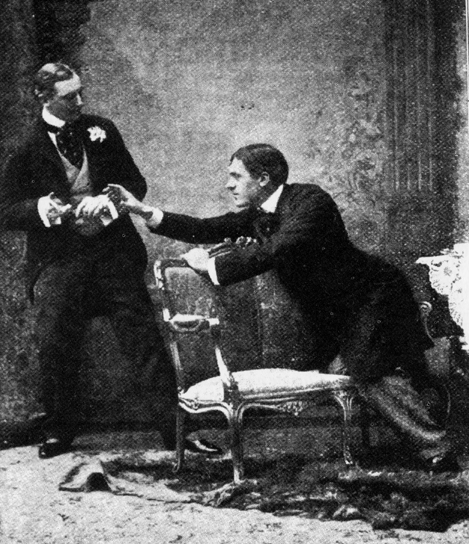

Oscar Wilde's The Importance of Being Earnest, with Allan Aynesworth as Algernon (left) and George Alexander as John (right), St. James Theatre, London, UK, February 14, 1895. (Ramac via Wikipedia). In public domain.

Oscar Wilde’s The Importance of Being Earnest, with Allan Aynesworth as Algernon (left) and George Alexander as John (right), St. James Theatre, London, UK, February 14, 1895. (Ramac via Wikipedia). In public domain.

One of the great myths in higher education is that of the adult learner as earnest student. Aside from the fairly obvious differences in lifestyle between a high-achieving, straight-to-college seventeen-year-old and a 34-year-old mother of two who works as a paralegal, the fact is that most adult learners act in the classroom like many traditional college students. Except that they are often academically and socially unprepared for college, not likely to attend a traditional college — with the resources necessary to help them become successful students — and are much more susceptible to dropping out of college because of the challenges they face in the classroom and in their own lives.

Myth vs. Reality:

This myth of the earnest adult learner has become a big one over the past thirty years, especially in light of the rise of for-profit postsecondary institutions like University of Phoenix and DeVry Institute. Anyone who has seen an ad on TV, in a newspaper or online can describe the mythical adult learner. Someone who’s 24 years old or older, often a paraprofessional or attempting to rise in a white-collar occupation like nursing, accounting, or information technology. A person who may be married or a parent or in the military. A potential student that has somehow been let down by traditional two-year colleges and four-year institutions, because the 10-week quarter-system and 16-week semester-system didn’t fit their real-world schedule.

The myth doesn’t fit at all with my own experience. As someone who has taught hundreds of adult learners off and on over the past 15 years – especially the past five – the behavior of older students in the classroom is really no different that than of traditional college-age students. Like 17 to 24-year-olds, the over-24 crowd is typically disorganized and lack the reading, note-taking and study skills needed to keep up with the pace of a college course. Like students who attend more traditional college settings such as Princeton, the University of Pittsburgh or Howard University, the adult learners I have taught miss deadlines, plagiarize their papers and cheat on final exams.

One of multitude of "I Am A Phoenix" ads, July 15, 2013. (University of Phoenix).

One of multitude of “I Am A Phoenix” ads, July 15, 2013. (University of Phoenix).

This shouldn’t be a surprise to anyone in higher education. Ad after ad sells college to adult learners as a service or a product that will lead them to a higher paying job. Period. College for them is hardly about forming new friendships or discovering themselves or their calling in life. The mythical adult learner is way too busy for such trifling pursuits. No, it is all about a piece of paper that they can wave around to get a promotion from junior accountant to accountant or from nurse’s aide to nurse.

Yet this too is a myth. Most adult learners are not really paraprofessionals or in low-level white-collar careers, poised for career advancement. They work at Walmart or Dunkin Donuts, as tellers at Wachovia Bank or as security guards with G4S. Some are active military or ex-Armed Forces, but many more are underemployed or even unemployed. Most are part of America’s rising welfare and working poor, or struggling to stay working-class or lower-middle class. At best, finishing a four-year degree would make them more employable than they would be otherwise, but not to the point that they should expect to become a doctor or an architect.

This background leaves most adult learners socially unprepared for college, but not because they cannot relate to college students between the ages of 17 and 24. They simply do not see school as a personal journey or even as an opportunity for educational advancement. It is a means to a new career and a higher income. Relationship-building to find a potential employer would not make any sense to most adult learners, as they are often segregated in virtual or physical classrooms with other adult learners, and not in classes with the sons and daughters of potential employers. Forming a bond with a professor would seem ridiculous, because they tend to see their often part-time instructors as customer-service representatives.

Adult Learners vs. Traditional College-Age Students:

This isn’t much different than the mindset of most traditional college students. I have taught a couple thousand of them over the past two decades, and in my experience, most of them view college as the means to the start of a great career making good money. The difference, really, is that there remains a wider diversity of thought about the higher education experience among younger college students than among those over 24. The quality of their education, the bonds of friendship or relationship they form with each other and with their professors, what they are able to take away from their college experience beyond their degree. All matter much more to so-called traditional students than they do to adult learners.

Student debt cartoon (although this is hardly the only stressor adult learners and other nontraditional-traditional students face), May 2, 2012. (Phil Hands/Wisconsin State Journal).

Student debt cartoon (although this is hardly the only stressor adult learners and other nontraditional-traditional students face), May 2, 2012. (Phil Hands/Wisconsin State Journal).

What is also similar is the idea that college is 13th, 14th, 15th and 16th grade for both groups of students. Both are just as apt to come up with myriad excuses for missing a paper submission deadline or for failing an exam. They had a big project at work that took up all of their spare time. They had a bad cold or the flu or strep throat or mononucleosis. Their computer crashed at the last minute, or they lost electricity or their Internet access went down. What I don’t often hear from traditional higher education students — but do expect to hear from adult learners — are excuses about children in emergency rooms, bad marriages, sick spouses and older parents, foreclosures on homes and cars breaking down on highways. For some, sometimes more than once in the same semester. Adult learners are as good at whining as traditional students.

The biggest myth on this end, though, is that younger college students face fewer obstacles to a degree than adult learners because 17-to-24 year-olds don’t have real-world problems. That’s completely false. Nearly two-thirds of traditional college students work part-time or full-time to cover everything from beer costs to their student loans and college tuition. Less advantaged students have pressures from parents and family around income loss, poverty and healthcare. Though most younger college students aren’t married, don’t have kids or work at the bottom rung of a career ladder, they do confront many of the same real-world financial and familial pressures.

Ending the Myth of the Traditional:

Are there any new innovations, such as Massive Open Online Courses (MOOCs), that would help adult learners achieve their degree — if not educational or academic — aspirations? It is really too early to tell with MOOCs. What is safe to say, though, is that adult learners as a group need to break out of mindset that higher education owes them flexibility without them taking responsibility for their own education. Higher education institutions, meanwhile, do need to recognize that adult learners have never been traditional, and traditional college students aren’t traditional anymore. Myth-busting on both the student side and instructor side would be a good place to start to make college aspirations and success a reality for adult learners.


38.990666 -77.026088

The Walking Danger

12 Friday Jul 2013

Posted by decollins1969 in 1, Boy @ The Window, culture, Eclectic, Hebrew-Israelite, Jimme, Mount Vernon New York, music, My Father, New York City, Pop Culture, race, Upper West Side, Youth

≈ Leave a comment

Tags

Abuse, Black Males, Distrust, Escape, Exploration, Life, Racial Stereotypes, Stigma of Criminality, Value, Walking, Walking While Black


blackbox1-290x160

Justice4Trayvon blackout box, July 12, 2013. (http://jet.com).

Regardless of the verdict in the Florida v. Zimmerman (a.k.a. Justice4Trayvon) trial, there’s one sad and terrifying lesson to take away from the past seventeen months. No Black male past puberty can assume themselves to be safe once they leave their homes to do so much as to cross the street. It doesn’t matter if you’re 6’1″ and 173 pounds, like I was my senior year of high school, or 6’6″ and 300 pounds, like a good- sized high school offensive lineman. We’re not just assumed guilty. We’re assumed to have a value the equivalent of a quart of recycled cooking oil.

It amazes me that with as much walking as I did while growing up in Mount Vernon and in walking all through the city, I only faced a handful of Walking While Black incidents. From the time my Mom and my late idiot ex-stepfather Maurice moved me and my older brother Darren into 616, I was a frequent walker. At seven, my Mom sent us to the store for groceries, for soda, for cigarettes and pork rinds. Yeah, the store was a block and a half away on East Lincoln, but that block and a half led to my first mugging at nine.

By then, my walks to the store went into Pelham and Milk ‘n Things, a three-block walk, as well as stores within three blocks of the Pelham border. That led to the first weird stares from Italian store owners. At the same time, when my father Jimme came back into our lives in ’79, we’d walk to Mount Vernon’s South Side. We’d walk to East Third Street and Wino Park on Fulton and Third, to the rib shack across the street from the park, to Sanford Blvd, even into the Bronx depending on Jimme’s alcohol level. That would lead to confrontations with street folks, and even occasional stares from cops.

Wise Cheez Doodles, one of my favorites to buy as a teenager, July 12, 2013. (http://twitter.com).

Wise Cheez Doodles, one of my favorites to buy as a teenager, July 12, 2013. (http://twitter.com).

By the time I hit puberty in the spring and summer of ’82, in no small part because of the collapse of anything resembling a family at Hebrew-Israelite 616, I began to walk everywhere. Some of my walks were because my Mom’s marriage had given her more mouths to feed and no time to go to the store. So me (mostly) and Darren (on occasion) would walk from 616 to stores like C-Town in Pelham (a mile or so away), Waldbaum’s on East Prospect (a mile and a quarter away) or stores in between for food. This became part of an eventual everyday routine, one that would last until well after I began college at the University of Pittsburgh (at least, when I was home for the holidays or the summer).

We also walked to get my younger brothers and sister Sarai out of the stifling apartment, especially because it was quite literally so during the summer months. We walked from 616 to Pelham, Pelham Manor, the Bronx, Bronxville and New Rochelle in those first couple of summers after puberty. The kids helped us look less suspicious, I suppose, because two teenage Black males had no business being anywhere near the six-figure-income-set’s communities in the mid-80s (or even now) otherwise.

I also began walking to explore, escape and think. It was next to impossible to think at home, with the constant noise, threats of abuse and actual abuse and domestic violence. So by the time I’d reached tenth grade, I needed to walk, by myself and with no agenda other than to make plans for my future while clearing my head. I did get followed by Bronxville PD a couple of times. But mostly, lost Whites from out-of-state would stop and ask for directions to the Bronx River Parkway or I-87.

Hershey's Chocolate Milk (at 17, a 16oz was my favorite store-bought drink), July 12, 2013. (http://www.gifarmer.com).

Hershey’s Chocolate Milk (at 17, a 16oz was my favorite store-bought drink), July 12, 2013. (http://www.gifarmer.com).

It wasn’t until after my seventeenth birthday — when I finally began to put on a little weight (muscle, I guess) — that walking around New York, Mount Vernon and nearby environs began to feel dangerous. Or at least, others began to act as if I was the danger. I’d become a regular weekend strap-hanger on the 2 out of 241st Street headed either to the Upper West Side, Midtown or Downtown, as well as parts of the Bronx. To hunt for the latest tapes, to go to a museum or a library, to just walk around and take the city in. But I also knew to be careful, to be leery of the NYPD, to keep my hands out of my pockets whenever I went to Tower Records or Crazy Eddie’s or even Gray’s Papaya.

Still, there were incidents at Milk-N-Things and Tower Records and a general feeling that folks, older, often White but also frequently Black were genuinely afraid that I — a person who’d been mugged four times before my fourteenth birthday — would hurt them.

Walking was how I learned how different I was from a societal perspective. That though a teenage, I was the dangerous Black male, to be treated as if I just escaped the plantation, as if I hope to find a store to knock over and a White girl to knock up against her will.

I’d hoped to spare my son this lesson. Sadly, because of George Zimmerman killing Trayvon Martin, I can’t. But at least he won’t have to learn this lesson from scratch like I did. And luckily, I knew and did enough to avoid danger — or being seen as the danger — long before I turned seventeen.

Writing That Leaves Readers With Headaches

10 Wednesday Jul 2013

Posted by decollins1969 in 1, Academia, Boy @ The Window, culture, Eclectic, eclectic music, music, Politics, race

≈ 1 Comment

Tags

Academic Writing, Analogies, Audiences, Baratunde, Golf, Jared Diamond, Looking for Leroy (2013), Mark Anthony Neal, Reading Public, Touré, Turgid Writing, Writing Styles


Excedrin Migraine caplets, July 10, 2013. (http://commons.wikimedia.org).

Excedrin Migraine caplets, July 10, 2013. (http://commons.wikimedia.org).

I’m a well-practiced academic writer, and can put together a multitude of erudite compound sentences with the best of them. I can even use words like “fait accompli,” “historiography,” “teleological,” and “anachronistic” practically on demand. But writing for a group of a few hundred academic historians, educationalists or African American studies scholars has become a very limiting chore for me over the years. To the point where I find the style of writing torturous, and reading academic writing about as much fun as having the flu on a hot and humid summer day.

There are times and places where I as a writer who also is an academic historian and educator need to “take out my driver” intellectually and slam home a twenty or twenty-five page article for publication in a scholarly journal. The golfing analogy works because writing for a scholarly audience requires lengthy sentences, tons of citations, a deep knowledge of scholarly literature, a high level of analytical power, and a form of writing that is much more about discipline than creativity. Even print journalists limited to 300 words have more wiggle-room than an academic writer.

In this era of public intellectuals and easier access to the broad American reading public through multimedia and online platforms, however, the academic writer is no longer writing for colleagues with deep knowledge and sufficient patience for the turgid. Yet far too many of my more famous and successful colleagues continue to write as if their books are destined to go straight to university and major city libraries.

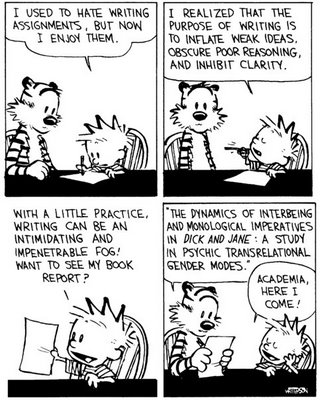
Calvin and Hobbes by Bill Waterson, on academic writing, July 10, 2013. (http://humorinamerica.wordpress.com).

Calvin and Hobbes by Bill Waterson, on academic writing, July 10, 2013. (http://humorinamerica.wordpress.com).

In the past few months, I’ve read Baratunde Thurston’s How To Be Black, Touré’s Who’s Afraid of Post-Blackness?, Jared Diamond’s Collapse and Mark Anthony Neal’s Looking for Leroy. I can say for certainty that all of these books have good qualities as well as flaws. Baratunde’s is one that’s repetitive and too often going for the easy laugh, though somewhat thought-provoking on the many ways all of us can be “Black.” Touré’s reads like the man himself, a book that takes itself too seriously, that purports to be a higher level of thinking on race when it ultimately gets lost in its own argument. Diamond’s Collapse is a very good introduction to the calamities of human civilizations and world history for nonacademic readers, but also doesn’t provide enough nuance to show variations in patterns of decline or collapse across civilizations.

The one thing the first three books have in common is that their authors attempt to write for an audience beyond comedians, journalists and interdisciplinary academicians. For the most part, all three succeed in making their books legible to an educated reading public. Neal’s Looking for Leroy (2013), though, is pretty unsuccessful in this regard. Neal critiqued the ways in which individuals like Jay Z, Avery Brooks and Luther Vandross have navigated the rocky terrain of public stereotypes toward Black males and how they turned those stereotypes on their head with the way lived their lives and conducted their careers.

Sounds thought-provoking, except for some issues with language and audience. From the Preface on, Neal’s Looking for Leroy read as if he’d only conceived it for an academic audience. Take his chapter on Jay-Z, where Neal wrote

It is in this spirit of these observations that I’d like to suggest that hip-hop cosmopolitanism represents a fertile location to challenge the larger society’s desire to impose constraints on how hip-hop constituencies choose to embody themselves, as well as a site to challenge stridently parochial notions of masculine identity (and gender) in hip-hop, particularly those solely rooted in the local.

Neal followed up this sixty-plus word sentence with his Jay-Z chapter’s thesis, where he posits “that the constraints placed on hip-hop infused identities are analogous to the historical difficulties experienced by those blacks desiring to be read as cosmopolitan — legitimate citizens of the world.”

Mark Anthony Neal, Looking for Leroy: Illegible Black Masculinities (2013) cover, July 10, 2013. (http://nyupress.edu).

Mark Anthony Neal, Looking for Leroy (2013) cover, July 10, 2013. (http://nyupress.edu).

There are important nuggets to be gleaned in this chapter and in Neal’s argument. But even I as an American and African American historian had to find a shovel and dig for it as if I was part of an excavation team in the Valley of the Kings in Egypt. That’s a real shame, as Neal has tenure, and this is his fifth book. I’d think someone whose platform for writing is as secure as Neal’s, whose audience includes readers outside of academia could’ve easily written Looking for Leroy to be more inclusive and engaging of them.

I’ve worked very hard over the past thirteen years to break myself of the horrid habit of academic writing when it isn’t necessary, which is most of the time. My goal has always been to engage, educate and even entertain with what I write. I’ve always wanted to be thought-provoking, not headache-inducing.

Too bad many of my more famous colleagues continue down the primrose path of writing for academia with the firm belief that the rest of the reading public must catch up to them. They don’t realize — or maybe even care — that the harder path is to write to include, and not exclude.

Get Rich, Or Whine Trying

08 Monday Jul 2013

Posted by decollins1969 in 1, Boy @ The Window, culture, Eclectic, eclectic music, Hebrew-Israelite, Marriage, Mount Vernon New York, Pop Culture, race, Religion, Work, Youth

≈ Leave a comment

Tags

Afrocentric, Business Ideas, Communications Business, Get-Rich-Quick Schemes, Half-Baked Ideas, Limo Business, Ponzi Scheme, Poverty, Pyramid Scheme, Sun-Lion Communications, Underemployment, unemployment, Whining


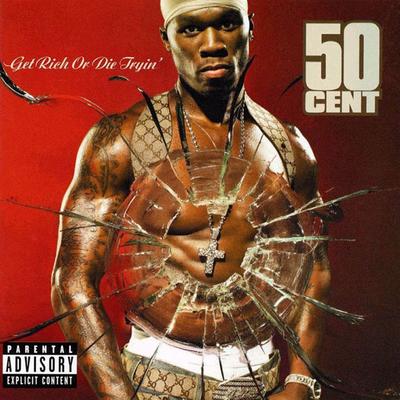
50 Cent, Get Rich or Die Tryin' album cover art (2003), June 27, 2007. (Hundredalexander via Wikipedia). Qualifies as fair use because of picture's low resolution.

50 Cent, Get Rich Or Die Tryin’ album cover art (2003), June 27, 2007. (Hundredalexander via Wikipedia). Qualifies as fair use because of picture’s low resolution.

When people grow up impoverished, there’s a strong impulse to come up with all kinds of scenarios for becoming rich. Some of these ideas require hard work, some require the fulfillment of dreams through tapping into one’s individual potential. Many ideas, though, remain half-baked shortcuts, ones that never reach fruition. Ideas like winning the lottery or Powerball, becoming a professional athlete or a singer or a rap artist. Others involve get-rich-quick schemes, ones that often take advantage of desperate wish of those in poverty to no longer be poor.

I’ve had plenty of experience observing examples of this last point. Especially in growing up at 616. My late idiot ex-stepfather Maurice Washington was susceptible to all kinds of ideas for making money, particularly schemes that required others to invest. I guess I can understand. As the fledgling writer and author I am, I can certainly see the appeal of finding shortcuts to, say, selling 100,000 copies of Boy @ The Window in a month. If only I could somehow get Oprah to endorse my book on her website and on the air!

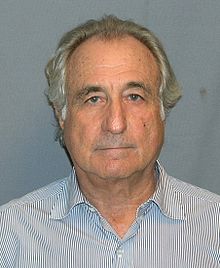
Bernie Madoff (mugshot), the ultimate get-rich-quick scam artist, March 16, 2009. (US Department of Justice via Wikipedia). In public domain.

Bernie Madoff (mugshot), the ultimate get-rich-quick scam artist, March 16, 2009. (US Department of Justice via Wikipedia). In public domain.

But I digress, as my scheme at least has a least a puncher’s chance at working (I have written a book, after all). My then stepfather, having held the jobs of Air Force MP, hospital orderly and taxicab driver, spent most of the ’80s trying to find ways to make easy money without putting forth any effort at all. In ’82, his grand scheme was Sun-Lion Corporation, which later turned into Sun-Lion Communications, the latter his attempt to do the equivalent of Bob Johnson’s Black Entertainment Television. My idiot ex-stepfather intended both the overall corporation and the communications arm to have what we would now call an Afrocentric slant. His vision was to be an emphasis on Hebrew-Israelite or similar foods, clothing, and other products and services meant for Black folks in the New York City area.

Maurice did everything he could to get my Mom involved in these schemes. My Mom went so far as to buy a corporation’s license for $2,500 in March ’82 for Sun-Lion. In the meantime, they argued and fought, and my ex-stepfather beat my mother up once in part over her lukewarm support for his grandiose schemes. At one point, they argued because Maurice wanted to raise $100 million in capital to put Sun-Lion Communications together! God, that man was an idiot!

After getting back on his feet after three years and three months of unemployment as a part-time security guard of an empty Vicks building in August ’82, Maurice came up with more schemes. He went to trucking school for four months between October ’86 and February ’87 outside of Scranton, Pennsylvania, but never spent a day as a truck driver. Then Maurice was a car salesman for a few months in ’87, actually making commissions while selling Cadillacs. But of course he couldn’t hold on to a job he was tailor-made for, a gift-of-gab con man!

Finally, in the spring and summer of ’88, Maurice tried to talk his way into the limo business by attempting to get a fellow 616 resident to give him access to a limo or capital. They laughed. My Mom laughed. I laughed. Maurice cried and whined about how no one ever supported his get-rich-quick efforts, not realizing that most of his so-called effort came in the form of getting others to give him something he either already.

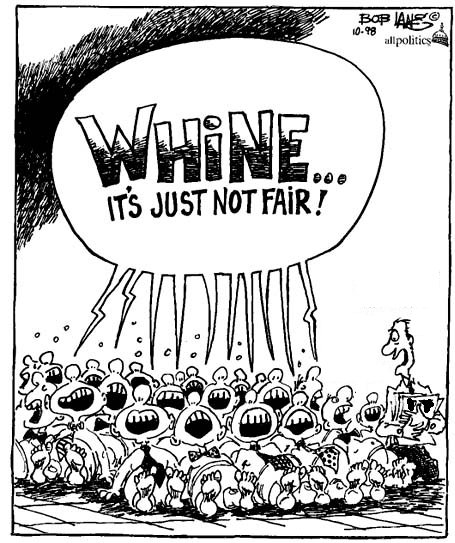
"Whine...it's just not fair!" cartoon, October 1998. (http://allpolitics.com).

“Whine…it’s just not fair!” cartoon, October 1998. (http://allpolitics.com).

When Maurice finally left 616 in June ’89, I thought all those days of ludicrous schemes and bullshit ideas for making lots of money were over. But when you’re poor, you’re vulnerable, and others looking to take advantage sense that vulnerability. In the two periods of my adult life in which I’ve been unemployed or significantly underemployed, people have approached me about selling Amway products. My younger siblings have proven themselves to be susceptible to alleged golden opportunities that were much closer to rust than gold.

This is not a screed in which I’m crapping on pursuing dreams or long shots. What I’m saying, though, is that dreams and long shots need to be tethered to serious plans, hard work, maximized gifts and talents, prayer and even some good luck. Yes, reaching out for help will help, but not in a spirit of draining others in order to help yourself first and only. That’s what my deceased ex-stepfather never learned.

“Early Was Late,” at Gettysburg & Elsewhere

03 Wednesday Jul 2013

Posted by decollins1969 in 1, Academia, culture, Eclectic, New York City, Patriotism, Politics, Pop Culture, race

≈ 2 Comments

Tags

American Civil War, Battle of Gettysburg, Civil War, David John Marotta, Democracy, Draft Riots, Equality, Freedom, Jubal Early, Lost Cause, Pickett's Charge, Robert E. Lee, Slavery, States' Rights, Union Army


"A Harvest of Death," Gettysburg, PA, July 5-6, 1863. (Timothy O'Sullivan). In public domain.

“A Harvest of Death,” Gettysburg, PA, July 5-6, 1863. (Timothy O’Sullivan). In public domain.

Google might be celebrating Franz Kafka’s 130th birthday today. But for us Americans, today’s a bit more significant than Kafka’s The Metamorphosis (1915).  No, today’s the 150th anniversary of the height of the Battle of Gettysburg, the three-day battle that involved nearly 165,000 Union and Confederate troops at the beginning of July, 1863. During the battle, almost 8,000 soldiers died, and more than 46,000 were wounded or maimed. Thousands of Confederates were wounded on the third day, the day of Pickett’s Charge, when Gen. Jubal Early’s troops never arrived to reinforce the charge to take the high ground away from the Union Army.

Of course, there are thousands of enthusiasts who are recreating the battle this week, along with the battles at Vicksburg, Petersburg, and other burghs throughout the South and Mason-Dixon borderlands. Let’s not forget why these battles were fought, though. They weren’t fought over high protective tariffs for Northern industrial interests, as David John Marotta ridiculously asserted in his Forbes article a couple of weeks ago. Nor was the Civil War fought simply over the grandiose ideal of states’ rights from a Confederate perspective or the mere preservation of the Union from a Northern perspective.

Ultimately, this was a civil war to settle the question of a democratic nation with slavery as its central economic and social underpinnings. Southerners were fighting for states’ rights, all right — the right of states to keep slavery legal, a “way of life” that had made White men fortunes. Northerners were fighting to preserve the Union, but one that would be free of slavery as an institution. Any other arguments are ones made by people who have no understanding of the centrality of slavery and freedom to the very identity on which the US had been founded in 1776.

Later that month, in part as a result of the Battle of Gettysburg, there were draft riots in New York, with Five Points Irish mobs beating up and lynching Blacks in the process of destroying their homes and businesses. So we know that there was at least one group unhappy about the real-life rationale behind fighting the Civil War.

Jubal Early depiction, circa 1911. (Wikipedia.com). In public domain.

Jubal Early depiction, circa 1911. (Wikipedia.com). In public domain.

What most Americans don’t understand was the incredible distance between believing that slavery was an evil, archaic and hypocritical institution and believing that African slaves were ones worthy of American democracy and equality. Most Whites fighting in the Battle of Gettysburg believed that Blacks had about as many rights to American equality as most of us would believe in a path to American citizenship for Al-Qaeda terrorists today.

Thank God Jubal Early “was late,” or really, had refused a direct order from Gen. Robert E. Lee to be part of some suicidal charge on July 3rd, 1863. Unfortunately, we still have many “Jubal Early” types who are really, really late in recognizing Blacks as equal human beings, American democracy as imperfect, and the South as a supporter of an evil and profit-maximizing institution.

The Road to Boy @ The Window, Part 3: Spencer Fellowship

01 Monday Jul 2013

Posted by decollins1969 in 1, Academia, Boy @ The Window, Carnegie Mellon University, culture, Eclectic, Pittsburgh, Politics, Pop Culture, race, Religion, University of Pittsburgh, Youth

≈ Leave a comment

Tags

Ambivalence, Berkeley California, Catherine Lacey, Chicago, Disillusionment, Dissertation Fellowship, Epiphany, George Boudreau, Oakland California, Personal Insights, Personal Stories, Revelations, Sandra Stein, Scholarship, Self-Discovery, Spencer Foundation, Writing, Writing Craft


Why Boy @ The Window, Part 3

Why Boy @ The Window, Part 3

I’ve written before about the epiphanies that came with my status as a Spencer Foundation Dissertation  Fellow during the 1995-96 year, particularly during our retreat in the Bay Area in February ’96. What that time as a fellow and at this retreat revealed was that I had pushed much of what I thought of as ambivalence toward academia into my mind’s subconscious. But that splinter in the back of my head driving me crazy was about much more than academia and my pursuit of a doctorate and a job as a history/education professor. No, it was as much about my purpose in life, my writing gift and the need to pursue this calling despite my being within a year of becoming “Dr. Collins.”

You see, there was a civil war of sorts going on in my soul and spirit over the very nature of who I was and wanted to be. I’d spent more than four years in resistance to the idea that every sentence I wrote in academia needed to be a compound sentence. I fought over the idea of making my writing more accessible to readers who weren’t history majors, graduate students or actual history professors. I wanted to write so that what I wrote wouldn’t be forgotten in five minutes because my writing required a cryptographer’s chart to decipher its meaning.

Whether Dan Resnick or Joe Trotter, Paula Baker and a few other professors, their overarching criticism of my writing was that it didn’t sound scholarly enough. It didn’t have the heft of words like “posits,” “tropes,” “archetypes,” “eschatology,” and a thousand other words that required a minimum of a master’s degree to fully understand their meaning. I tried in my dissertation to address those concerns. But after the first few chapters, I decided to write first, and then rewrite second, third and fourth to mold my language into scholar-speak.

Luckily I had the Spencer Foundation Dissertation Fellowship by then. It saved me at least a year — and possibly as many as three — in terms of completing my doctoral thesis and degree. I didn’t have to teach for a full year, do research or work for Joe Trotter or anyone else for a year.

And it gave me time to think about the kind of career and future I wanted. Maybe too much time. For the first time, I realized the question that had been on my mind for years was about my competing interests in academia and in writing. Was I a writer first? Was I an academic historian? Would it be possible to do both? And if it were, how would I do both?

The Spencer Fellows retreat in Berkeley/Oakland in February ’96 helped broaden my horizons. Some of my fellow Spencer Fellows were struggling with the issue of their career moves as well. I had only considered teaching in schools of education in passing prior to that retreat. I knew that with my interests in diversity in education, in educational equity, in the process of getting into and through college, a traditional history program would be an uncomfortable fit for my interests and talents. The retreat revealed that much to me, at least.

It revealed far more than that, though. I realized that out of the thirty-three Fellows, I was the only one who actually understood on a personal level how difficult issues of race, poverty and the politics of education made it for someone like me to go to college, graduate, get into a grad program, and eventually finish a doctorate. Oh, my fellow Fellows knew all too well the harassment and hazing and jealousies of their professors and dissertation advisors. Still, issues like welfare poverty and magnet school programs like the one I attended in Humanities were abstractions for them. Most of them hadn’t experienced what they were actually studying. The ones who had some experiences approximating my own became my favorite Spencer Fellows to be around, for those were the greatest of conversations.

So the seed of thinking about my work in more personal terms was planted on a conscious level by the time my Spencer Fellowship ended in June ’96. I hadn’t figured out yet that I was a writer first, an academic historian and educator second, but clearly both in the end. I was too invested in earning the degree and getting away from Joe Trotter as fast as I could back then.

I did think incorporating my experiences around the importance of education, of race, of poverty, of family dynamics in my writing would make what I wrote about much more meaningful. It wouldn’t diminish the scholarship, and would provide a creative outlet beyond the mundane world of academic writing.

Newer posts →

Boy @ The Window: A Memoir

Boy @ The Window: A Memoir

Places to Buy/Download Boy @ The Window

There's a few ways in which you can read excerpts of, borrow and/or purchase and download Boy @ The Window. There's the trade paperback edition of Boy @ The Window, available for purchase via Amazon.com at http://www.amazon.com/Boy-Window-Donald-Earl-Collins/dp/0989256138/

There's also a Kindle edition on Amazon.com. The enhanced edition can be read only with Kindle Fire, an iPad or a full-color tablet. The links to the enhanced edition through Apple's iBookstore and the Barnes & Noble NOOK edition are below. The link to the Amazon Kindle version is also immediately below:

scr2555-proj697-a-kindle-logo-rgb-lg

Boy @ The Window on Amazon.com: http://www.amazon.com/Boy-The-Window-Memoir-ebook/dp/B00CD95FBU/

iBookstore-logo-300x100

Boy @ The Window on Apple's iBookstore: https://itunes.apple.com/us/book/boy-the-window/id643768275?ls=1

Barnes & Noble (bn.com) logo, June 26, 2013. (http://www.logotypes101.com).

Boy @ The Window on Barnes & Noble: http://www.barnesandnoble.com/w/boy-the-window-donald-earl-collins/1115182183?ean=2940016741567

You can also add, read and review Boy @ The Window on Goodreads.com. Just click on the button below:

Boy @ The Window

Twitter Updates

Tweets by decollins1969
  • RSS - Posts
  • RSS - Comments

Archives

  • June 2025
  • April 2023
  • September 2022
  • August 2022
  • July 2022
  • June 2022
  • May 2022
  • April 2022
  • March 2022
  • January 2022
  • December 2021
  • November 2021
  • October 2021
  • September 2021
  • August 2021
  • July 2021
  • June 2021
  • April 2021
  • March 2021
  • February 2021
  • January 2021
  • December 2020
  • November 2020
  • October 2020
  • September 2020
  • August 2020
  • July 2020
  • May 2020
  • April 2020
  • March 2020
  • January 2020
  • December 2019
  • November 2019
  • August 2019
  • July 2019
  • June 2019
  • May 2019
  • April 2019
  • March 2019
  • February 2019
  • January 2019
  • December 2018
  • November 2018
  • October 2018
  • September 2018
  • August 2018
  • July 2018
  • June 2018
  • May 2018
  • March 2018
  • February 2018
  • January 2018
  • December 2017
  • November 2017
  • October 2017
  • September 2017
  • August 2017
  • July 2017
  • June 2017
  • May 2017
  • April 2017
  • March 2017
  • February 2017
  • January 2017
  • December 2016
  • November 2016
  • October 2016
  • September 2016
  • August 2016
  • July 2016
  • June 2016
  • May 2016
  • April 2016
  • March 2016
  • February 2016
  • January 2016
  • December 2015
  • November 2015
  • October 2015
  • September 2015
  • August 2015
  • July 2015
  • June 2015
  • May 2015
  • April 2015
  • March 2015
  • February 2015
  • January 2015
  • December 2014
  • November 2014
  • October 2014
  • September 2014
  • August 2014
  • July 2014
  • June 2014
  • May 2014
  • April 2014
  • March 2014
  • February 2014
  • January 2014
  • December 2013
  • November 2013
  • October 2013
  • September 2013
  • August 2013
  • July 2013
  • June 2013
  • May 2013
  • April 2013
  • March 2013
  • February 2013
  • January 2013
  • December 2012
  • November 2012
  • October 2012
  • September 2012
  • August 2012
  • July 2012
  • June 2012
  • May 2012
  • April 2012
  • March 2012
  • February 2012
  • January 2012
  • December 2011
  • November 2011
  • October 2011
  • September 2011
  • August 2011
  • July 2011
  • June 2011
  • May 2011
  • April 2011
  • March 2011
  • February 2011
  • January 2011
  • December 2010
  • November 2010
  • October 2010
  • September 2010
  • August 2010
  • July 2010
  • June 2010
  • May 2010
  • April 2010
  • March 2010
  • February 2010
  • January 2010
  • December 2009
  • November 2009
  • October 2009
  • September 2009
  • August 2009
  • July 2009
  • June 2009
  • May 2009
  • April 2009
  • March 2009
  • February 2009
  • January 2009
  • December 2008
  • November 2008
  • October 2008
  • September 2008
  • August 2008
  • July 2008
  • June 2008
  • May 2008
  • April 2008
  • March 2008
  • February 2008
  • January 2008
  • December 2007
  • November 2007
  • October 2007
  • September 2007
  • August 2007
  • July 2007
  • June 2007

Recent Comments

decollins1969's avatardecollins1969 on No Good Teaching Deed Goes…
Mary Rose O’Connell's avatarMary Rose O’Connell on No Good Teaching Deed Goes…
Lyndah McCaskill's avatarLyndah McCaskill on The Raunchiest of Them Al…

NetworkedBlogs on Facebook

NetworkedBlogs
Blog:
Notes From a Boy @ The Window
Topics:
My Life, Culture & Education, Politics & Goofyness
 
Follow my blog

616 616 East Lincoln Avenue A.B. Davis Middle School Abuse Academia Academy for Educational Development AED Afrocentricity American Narcissism Authenticity Bigotry Blackness Boy @ The Window Carnegie Mellon University Child Abuse Class of 1987 CMU Coping Strategies Crush #1 Crush #2 Death Disillusionment Diversity Domestic Violence Economic Inequality Education Family Friendship Friendships Graduate School Hebrew-Israelites High-Stakes Testing Higher Education History Homelessness Humanities Humanities Program Hypocrisy Internalized Racism Jealousy Joe Trotter Joe William Trotter Jr. K-12 Education Love Manhood Maurice Eugene Washington Maurice Washington Misogyny Mother-Son Relationship Mount Vernon High School Mount Vernon New York Mount Vernon public schools Multiculturalism MVHS Narcissism NFL Pitt Pittsburgh Politics of Education Poverty President Barack Obama Race Racial Stereotypes Racism Relationships Self-Awareness Self-Discovery Self-Reflection Sexism Social Justice Teaching and Learning University of Pittsburgh Violence Whiteness Writing

Top Rated

Blog at WordPress.com.

  • Subscribe Subscribed
    • Notes from a Boy @ The Window
    • Join 103 other subscribers
    • Already have a WordPress.com account? Log in now.
    • Notes from a Boy @ The Window
    • Subscribe Subscribed
    • Sign up
    • Log in
    • Report this content
    • View site in Reader
    • Manage subscriptions
    • Collapse this bar
 

Loading Comments...