• About Me
  • Other Writings
  • Interview Clips
  • All About Me: American Racism, American Narcissism, and the Conversation America Can’t Have
  • Video Clips
  • Boy @ The Window Pictures
  • Boy @ The Window Theme Music

Notes from a Boy @ The Window

~

Notes from a Boy @ The Window

Tag Archives: Slavery

“Early Was Late,” at Gettysburg & Elsewhere

03 Wednesday Jul 2013

Posted by decollins1969 in 1, Academia, culture, Eclectic, New York City, Patriotism, Politics, Pop Culture, race

≈ 2 Comments

Tags

American Civil War, Battle of Gettysburg, Civil War, David John Marotta, Democracy, Draft Riots, Equality, Freedom, Jubal Early, Lost Cause, Pickett's Charge, Robert E. Lee, Slavery, States' Rights, Union Army


"A Harvest of Death," Gettysburg, PA, July 5-6, 1863. (Timothy O'Sullivan). In public domain.

“A Harvest of Death,” Gettysburg, PA, July 5-6, 1863. (Timothy O’Sullivan). In public domain.

Google might be celebrating Franz Kafka’s 130th birthday today. But for us Americans, today’s a bit more significant than Kafka’s The Metamorphosis (1915).  No, today’s the 150th anniversary of the height of the Battle of Gettysburg, the three-day battle that involved nearly 165,000 Union and Confederate troops at the beginning of July, 1863. During the battle, almost 8,000 soldiers died, and more than 46,000 were wounded or maimed. Thousands of Confederates were wounded on the third day, the day of Pickett’s Charge, when Gen. Jubal Early’s troops never arrived to reinforce the charge to take the high ground away from the Union Army.

Of course, there are thousands of enthusiasts who are recreating the battle this week, along with the battles at Vicksburg, Petersburg, and other burghs throughout the South and Mason-Dixon borderlands. Let’s not forget why these battles were fought, though. They weren’t fought over high protective tariffs for Northern industrial interests, as David John Marotta ridiculously asserted in his Forbes article a couple of weeks ago. Nor was the Civil War fought simply over the grandiose ideal of states’ rights from a Confederate perspective or the mere preservation of the Union from a Northern perspective.

Ultimately, this was a civil war to settle the question of a democratic nation with slavery as its central economic and social underpinnings. Southerners were fighting for states’ rights, all right — the right of states to keep slavery legal, a “way of life” that had made White men fortunes. Northerners were fighting to preserve the Union, but one that would be free of slavery as an institution. Any other arguments are ones made by people who have no understanding of the centrality of slavery and freedom to the very identity on which the US had been founded in 1776.

Later that month, in part as a result of the Battle of Gettysburg, there were draft riots in New York, with Five Points Irish mobs beating up and lynching Blacks in the process of destroying their homes and businesses. So we know that there was at least one group unhappy about the real-life rationale behind fighting the Civil War.

Jubal Early depiction, circa 1911. (Wikipedia.com). In public domain.

Jubal Early depiction, circa 1911. (Wikipedia.com). In public domain.

What most Americans don’t understand was the incredible distance between believing that slavery was an evil, archaic and hypocritical institution and believing that African slaves were ones worthy of American democracy and equality. Most Whites fighting in the Battle of Gettysburg believed that Blacks had about as many rights to American equality as most of us would believe in a path to American citizenship for Al-Qaeda terrorists today.

Thank God Jubal Early “was late,” or really, had refused a direct order from Gen. Robert E. Lee to be part of some suicidal charge on July 3rd, 1863. Unfortunately, we still have many “Jubal Early” types who are really, really late in recognizing Blacks as equal human beings, American democracy as imperfect, and the South as a supporter of an evil and profit-maximizing institution.

The Emotional, The Personal and Black History

01 Friday Feb 2013

Posted by decollins1969 in 1, Academia, Boy @ The Window, culture, Eclectic, Movies, Patriotism, Politics, Pop Culture, race, Youth

≈ 3 Comments

Tags

A Lynching in Marion, African American History, Anger, Black History, Black History Month, Carnegie Mellon University, Comparative Slavery, Emotions, Fear, Fogel and Engerman, Grief, Indiana (1995), Irony, Jim Crow, Larry Glasco, Laurence Glasco, Learning, Lynching, Pitt, Racism, Rage, Roots (1977), Sarcasm, Seymore Drescher, Slavery, Students, Sy Drescher, Teaching and Learning, Time on the Cross (1974), UMUC, University of Pittsburgh


Black History Month 2013 electronic poster, February 1, 2013. (http://dclibrary.org).

Black History Month 2013 electronic poster, February 1, 2013. (http://dclibrary.org).

After all of these years — and thirty-seven years’ worth of Black History Months — I sometimes forget how emotionally charged Black history can be. After all, I’m an academically trained historian, one whose emotional range varies from sarcastic to ironic with most things US, World and African American history. But ever so often, I’m reminded by my students about the sadness and pain involved in learning history. I surprise myself sometimes at how passionate or angry I can become in revisiting a piece of history that I otherwise would show no emotion for on most days.

Black history, though, can bring out both the water works and the daggered eyes. My African American history students at Carnegie Mellon University surprised me one day in October ’96 during a discussion I tried to have about lynching and the KKK. It was based on the Indiana PBS documentary, A Lynching in Marion, Indiana, about the lynching of two Black men and the almost lynching of a young Black male for allegedly killing and robbing a White male and raping a young White female in 1930.

The forty-five minute documentary showed clips of defaced and emasculated Black men hung from trees, beaten beyond recognition and even burned postmortem. It also showed films of KKK rallies in the 1920s and early 1930s Indianapolis and other towns in the state, as well as pictures from the Marion lynching itself. The young Black man in Marion, one James Cameron, was only saved from lynching because a member of White mob actually protected him. It turned out, per usual, that the alleged murder and rape was a false accusation, but Cameron still had to spend four years in jail for a crime he didn’t commit.

Thomas Shipp and Abram Smith, lynched in Marion, IN, August 7, 1930. (Lawrence H. Beitler). Qualifies as fair use under US Copyright laws, as It is the only image known to depict this hanging, and is used here to illustrate the event.

Thomas Shipp and Abram Smith, lynched in Marion, IN, August 7, 1930. (Lawrence H. Beitler via Wikipedia). Qualifies as fair use under US Copyright laws, as It is the only image known to depict this hanging, and is used here to illustrate the event.

My students could barely speak to me or each other after the film, much less be part of a dispassionate discussion of the film. My Black students were tearful and angry, and my White students were pale and scared. I let them express their emotions for about ten minutes, but waited until the next class to draw out a more comprehensive discussion. As this was the first standalone class I’d taught as an adjunct professor, I was a bit unprepared for the how emotional my students became, how personally they took the film and its content.

But I should’ve been better prepared, especially given my own emotions about Black and other histories over the years. I remember the first time I watched Roots, along with millions of other Americans, in February ’77. I cried or was stunned that whole week. Twelve years later, in my undergraduate readings seminar for History majors at Pitt, I found myself angry with my classmates. My eventual first graduate advisor Larry Glasco was leading a discussion on slavery and the Middle Passage. I didn’t know why, but I was angry that whole class. It wasn’t just a knee-jerk anger. It was a low-heat rage, beyond anything my idiotic classmates were saying about slavery in the eventual US not being as brutal as slavery in the Caribbean or Brazil.

The following semester, I took my first graduate course as a Pitt junior, Comparative Slavery with Sy Drescher. We got into a discussion of Fogel and Engerman’s Time on the Cross (1974), a study in which the authors tried to show scientifically that slavery wasn’t as bad for Africans in the US as it was for Africans in the Caribbean and Brazil. Using records from one plantation, Fogel and Engerman tried to show that since few slaves were whipped, that therefore slavery wasn’t brutal for my African ancestors. I was pissed when some of the grad students in my class defended Time on the Cross  idea that 1,800 calories a day was sufficient for the average slave. It pissed me off so much that I had to leave the seminar room for five minutes to make sure I didn’t punch someone.

Me really pissed, at CMU PhD graduation, Pittsburgh, PA, May 18, 1997. (Angelia N. Levy).

Me really pissed, at CMU PhD graduation, Pittsburgh, PA, May 18, 1997. (Angelia N. Levy).

I see some of this in my UMUC students sometimes. Students who turn every issue in US history into a referendum on race. “Immigrants exploited? Well, not compared to African Americans as sharecroppers!” Or “Jim Crow was really a second slavery,” some of my students have said emphatically, as if Blacks did nothing during Reconstruction or Jim Crow to make their lives better. They feel, and rightfully so for the most part, that Blacks have gotten a raw deal throughout American history, and that it is my job to expose the hypocrisy of racism in every lecture and discussion.

It’s emotional and it’s personal. But it’s also historical, which means not so much putting emotions or personal investment aside as much as it does putting these emotions and personal investments in perspective. I’ve never been dispassionate about history – I’ve just learned how to use my New York-style sarcasm to hide my passion pretty well.

Emancipation and Compromise

01 Tuesday Jan 2013

Posted by decollins1969 in 1, culture, Eclectic, Patriotism, Politics, Pop Culture, race

≈ 3 Comments

Tags

American Civil War, Compromise, Economic Inequality, Emancipation Proclamation, Fiscal Cliff, Fiscal Cliff Deal, Harry Reid, President Abraham Lincoln, President Barack Obama, President Lincoln, President Obama, Racism, Sen. Mitch McConnell, Slavery, Social Justice, social mobility, Social Safety Net, The Great Emancipator, US Civil War


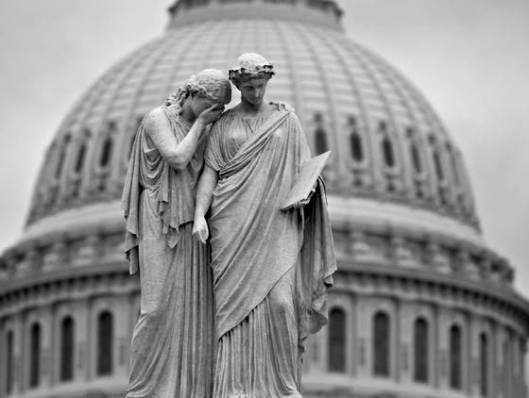
Statuary by the US Capitol, Washington, DC, December 25, 2012. (J. Scott Applewhite/AP).

Statuary by the US Capitol, Washington, DC, December 25, 2012. (J. Scott Applewhite/AP).

Today marks 150 years since President Abraham Lincoln issued an order as Commander-in-Chief that granted freedom to slaves in territories that remained in rebellion against the Union. It enabled Lincoln to become know as the Great Emancipation, and paved the road for the passage and ratification of the 13th Amendment to the Constitution, outlawing slavery in the US, nearly three years later. This is a great thing to remember on this New Years Day, and yet, the Emancipation Proclamation exemplifies flaws in the political tactics of our leaders.

We seldom see real, lasting changes in our nation. Our Founding Fathers wrote our very Constitution with the expressed purpose of protecting “life, liberty, and property,” specifically the property of rich White male slaveowners and merchants. Lincoln used his office to strip the Southern one-percenters of the Civil War period of the one thing that was central to their “way of life,” the liberty of owning African slaves, of treating humans as property.

But even Lincoln’s proclamation was as much political posturing as it was an order on the road to emancipation and abolition. It would take the bulk of 1863, 1864 and 1865 to bring enough of the Confederate states under Union Army control to make emancipation a reality for three out of four million slaves. Border states and areas already under Union Army would only be forced to free the other one million slaves with the ratification of the 13th Amendment on December 6, 1865. This wasn’t exactly a great compromise, especially for the slaves and for abolitionists.

Fast-forward a century and a half to our tumultuous Congress and jelly boned White House. They’re fighting over tax cuts that should’ve never been enacted in ’01, or expanded in ’03. The cuts should’ve expired two years ago instead of fourteen hours ago. The compromise that the Senate passed at 2 am today is weaker than the Emancipation Proclamation. At least Lincoln knew that he had an Army and Navy that could enforce it over time. In the case of President Barack Obama, Senators Harry Reid and Mitch McConnell, the compromise deal is worth about as much as Neville Chamberlain’s “peace in our time” Munich Agreement with Hitler in September 1938, and led indirectly to World War II less than a year later.

"Kicking the can down the road" cartoon, September 23, 2012. (Clay Bennett/ Chattanooga Times Free Press).

“Kicking the can down the road” cartoon, September 23, 2012. (Clay Bennett/ Chattanooga Times Free Press).

The media loves to say that “both sides need to compromise to make a deal.” President Obama loves to say that “no side can get a hundred percent of what they want.” Let’s follow this line of thought by looking at the compromises that led to the Civil War and Lincoln’s proclamation. Here’s seventy-six years of compromise (starting with the US Constitution):

  • Kicking can of end of US participation in international slave trade to 1808;
  • African slaves (not term used) equated to three-fifths of a person for political representation purposes;
  • Missouri Compromise of 1819 (creating distinction between slave and free states at the 36°30′ parallel);
  • Gag Resolution (forbade Congress from debating anti-slavery bills on the floor of the House and (essentially) the Senate between 1836 and 1844);
  • The Compromise of 1850, which tore up the Missouri Compromise, opening up new territories for slavery’s expansion, while allowing California into the Union as a free state; and
  • Kansas-Nebraska Act (1854) officially declared policy of “popular sovereignty,” that each territory in its petition for statehood could determine to be a state that allowed or did not allow slavery.

Years of compromise led to increasing violence to protect or destroy slavery (including “Bleeding Kansas” and John Brown’s Harper’s Ferry raid in 1859), and of course, to the Civil War. So while Lincoln’s Emancipation Proclamation was itself a compromise, it might as well have been an ultimatum compared to the previous seven decades of inaction and negotiation.

Emancipation Proclamation reproduction, National Underground Railroad Freedom Center,  Cincinnati, OH, (photo taken November 15, 2009). (Wikipedia). In public domain.

Emancipation Proclamation reproduction, National Underground Railroad Freedom Center, Cincinnati, OH, (photo taken November 15, 2009). (Wikipedia). In public domain.

Not that taxes, spending and the social safety net are the same as slavery. But after nearly four decades of declining social mobility, expanding economic inequality and every conceivable break in favor of the wealthy and corporations, isn’t it time to stop compromising our lives and our children’s lives?

Unless we consider the reality that Congress is only doing what its greedy Civil War-era predecessors did a century and a half ago. That the White House is too beholden to moneyed interests to stand for anything that truly helps ordinary Americans. That it will take something far more serious than the Great Recession (or even something potentially as violent as the Civil War) to make this group finally find religion.

The Great “Original Sin” Debate

03 Wednesday Oct 2012

Posted by decollins1969 in 1, Academia, Boy @ The Window, culture, Eclectic, eclectic music, music, Politics, Pop Culture, race, Youth

≈ Leave a comment

Tags

"Moment of Surrender" (2009), Black Reconstruction (1935), Carnegie Mellon University, Chants Democratic (1984), David Roediger, Marcus Rediker, Media's Game Mentality, Obama-Romney Debate, Original Sin, Pitt, Race, Sean Wilentz, Slavery, U2, University of Pittsburgh, W. E. B. Du Bois, Wages of Whiteness (1991), Wendy Goldman


Obama-McCain Third Debate (post-debate picture), Hofstra University, Hempstead, NY, October 15, 2008. (Jim Bourg/Reuters).

We’ve finally meandered our way into the presidential debate cycle portion of our Election ’12 cycle. I’m grateful to finally see what the media has built up to be a match between the Pittsburgh Steelers and the New York Giants! Not really, of course. But from standpoint of political reporters and pundits alike, tonight’s first debate between President Barack Obama and Mitt Romney might as well be a sports event.

In the end, though, this isn’t as much a presidential debate as it is a personality contest with questions and psychologists’ interpretations of nonverbal communication. It will be more hype than substance, more stiff than an overbaked souffle. One of the men — most likely President Obama — will win this first debate, though it won’t be clear how significant this “win” will be, given the trends for the past couple of months.

Professor Wendy Goldman, Carnegie Mellon University, circa 2012, October 3, 2012. (http://www.history.cmu.edu).

I am reminded of another debate, one that occurred in my Comparative Working-Class Formation graduate seminar at Carnegie Mellon University in the fall of ’93. It was taught by Professor Wendy Goldman, wife of Marcus Rediker, both decidedly Marxist, but in Goldman’s case, Marxist without any considerations of race at all. It was a course that turned into a debate because I’d already grown tired of professors at Pitt who believed race and gender to be identities subsumed under the long, hard human battle over class inequality (see my post “Dairy Queens, Dick Oestreicher and Race” from February ’11).

All semester-long, there had been a three-way tug-of-war between me (and occasionally, my former Pitt grad school colleague who decided to hop across the bridge to Carnegie Mellon to take this course), ten brown-nosing students who’d agree with her despite the evidence (led by Mike and Mark, the “M&M Boys,” as I labeled them for my friends and colleagues) and Goldman. I didn’t expect my now fellow Carnegie Mellon grad students to take my side. But I did expect them to read E.P. Thompson and Sean Wilentz and other folks with a critical eye and not just to get an A out of our professor. There may have been one or two other classes I dreaded more in three years of grad school. Yet I’d never been around a professor more unaware of their own biases than Goldman (see my “Crying Over E.P. Thompson” post from September ’09).

It all came to a head when it was time to discuss David Roediger’s Wages of Whiteness (1991) and, indirectly, Sean Wilentz’s Chants Democratic (1984) on the last Thursday in October ’93, which happened to be my mother’s forty-sixth birthday. Both authors looked at the formation of the White American (and male) working-class in the first half of the nineteenth century. Goldman, as usual, took the stance that the only ideology of significance was one that proclaimed class inequalities the predominant issue explaining the radicalization of the American working-class.

Michelangelo’s sin of Adam and Eve painting, Sistine Chapel ceiling, Vatican City (1508-1512), May 20, 2005. (The Yorck Project via Wikipedia). In public domain.

Finding this a bit laughable (a mistake on my part), I pressed my argument that at least in the case of US history, race and class distinctions have been and remain intertwined. So much so that a typical neo-Marxist analysis of the American working-class couldn’t apply. The next two hours were me and my Pitt colleague against the M&M Boys, the other brown-nosers and Professor Goldman. Luckily in my case, I could not only quote Roediger and Wilentz, but Herbert Gutmann, W.E.B. Du Bois, and a host of other scholars to press home my counterargument. At the end, our professor said to me, in utter exasperation, “I guess we should just go back to original sin.” It meant that I was being a racial determinist, which I guess was supposed to be an insult as well as her version of “No mas, no mas!”

Aside from the fact that America’s “original sin” really was the taking of Native American lands and the systemic destruction of Native American peoples and culture, I really didn’t have much of a response to Goldman’s excited utterance. I finished my argument with a final volley that included Du Bois’ Black Reconstruction (1935) and Roediger, and class adjourned sooner thereafter.

My brown-nosing classmates looked pretty beat from the class session, while me and my colleague from Pitt were both energized from the three-hour class. Still, we couldn’t help but discuss Goldman’s Moment of Surrender at the end of the class. Of course we knew what her “original sin” comment meant when it came to race and slavery. The comment, though, seemed small and petty coming from a professor, one that was too personal, and not professional.

Still, the worst thing I learned is that it took Roediger’s Wages of Whiteness to confirm ideas that Du Bois had begun writing about in 1903 and 1935. That, for me, made me apprehensive about wanting to work with scholars who may well see me and my work as well-intentioned, but inferior to theirs. At the same time, I learned that, for better and for worse, that not going along to get along can be a good thing, especially after years of ridicule from people of all stripes for doing so.

My “original sin” of not going along with whatever Goldman said forced a debate, one of the more exciting times I had in grad school, certainly at Carnegie Mellon. How could that be bad?

Newer posts →

Boy @ The Window: A Memoir

Boy @ The Window: A Memoir

Places to Buy/Download Boy @ The Window

There's a few ways in which you can read excerpts of, borrow and/or purchase and download Boy @ The Window. There's the trade paperback edition of Boy @ The Window, available for purchase via Amazon.com at http://www.amazon.com/Boy-Window-Donald-Earl-Collins/dp/0989256138/

There's also a Kindle edition on Amazon.com. The enhanced edition can be read only with Kindle Fire, an iPad or a full-color tablet. The links to the enhanced edition through Apple's iBookstore and the Barnes & Noble NOOK edition are below. The link to the Amazon Kindle version is also immediately below:

scr2555-proj697-a-kindle-logo-rgb-lg

Boy @ The Window on Amazon.com: http://www.amazon.com/Boy-The-Window-Memoir-ebook/dp/B00CD95FBU/

iBookstore-logo-300x100

Boy @ The Window on Apple's iBookstore: https://itunes.apple.com/us/book/boy-the-window/id643768275?ls=1

Barnes & Noble (bn.com) logo, June 26, 2013. (http://www.logotypes101.com).

Boy @ The Window on Barnes & Noble: http://www.barnesandnoble.com/w/boy-the-window-donald-earl-collins/1115182183?ean=2940016741567

You can also add, read and review Boy @ The Window on Goodreads.com. Just click on the button below:

Boy @ The Window

Twitter Updates

Tweets by decollins1969
  • RSS - Posts
  • RSS - Comments

Archives

  • June 2025
  • April 2023
  • September 2022
  • August 2022
  • July 2022
  • June 2022
  • May 2022
  • April 2022
  • March 2022
  • January 2022
  • December 2021
  • November 2021
  • October 2021
  • September 2021
  • August 2021
  • July 2021
  • June 2021
  • April 2021
  • March 2021
  • February 2021
  • January 2021
  • December 2020
  • November 2020
  • October 2020
  • September 2020
  • August 2020
  • July 2020
  • May 2020
  • April 2020
  • March 2020
  • January 2020
  • December 2019
  • November 2019
  • August 2019
  • July 2019
  • June 2019
  • May 2019
  • April 2019
  • March 2019
  • February 2019
  • January 2019
  • December 2018
  • November 2018
  • October 2018
  • September 2018
  • August 2018
  • July 2018
  • June 2018
  • May 2018
  • March 2018
  • February 2018
  • January 2018
  • December 2017
  • November 2017
  • October 2017
  • September 2017
  • August 2017
  • July 2017
  • June 2017
  • May 2017
  • April 2017
  • March 2017
  • February 2017
  • January 2017
  • December 2016
  • November 2016
  • October 2016
  • September 2016
  • August 2016
  • July 2016
  • June 2016
  • May 2016
  • April 2016
  • March 2016
  • February 2016
  • January 2016
  • December 2015
  • November 2015
  • October 2015
  • September 2015
  • August 2015
  • July 2015
  • June 2015
  • May 2015
  • April 2015
  • March 2015
  • February 2015
  • January 2015
  • December 2014
  • November 2014
  • October 2014
  • September 2014
  • August 2014
  • July 2014
  • June 2014
  • May 2014
  • April 2014
  • March 2014
  • February 2014
  • January 2014
  • December 2013
  • November 2013
  • October 2013
  • September 2013
  • August 2013
  • July 2013
  • June 2013
  • May 2013
  • April 2013
  • March 2013
  • February 2013
  • January 2013
  • December 2012
  • November 2012
  • October 2012
  • September 2012
  • August 2012
  • July 2012
  • June 2012
  • May 2012
  • April 2012
  • March 2012
  • February 2012
  • January 2012
  • December 2011
  • November 2011
  • October 2011
  • September 2011
  • August 2011
  • July 2011
  • June 2011
  • May 2011
  • April 2011
  • March 2011
  • February 2011
  • January 2011
  • December 2010
  • November 2010
  • October 2010
  • September 2010
  • August 2010
  • July 2010
  • June 2010
  • May 2010
  • April 2010
  • March 2010
  • February 2010
  • January 2010
  • December 2009
  • November 2009
  • October 2009
  • September 2009
  • August 2009
  • July 2009
  • June 2009
  • May 2009
  • April 2009
  • March 2009
  • February 2009
  • January 2009
  • December 2008
  • November 2008
  • October 2008
  • September 2008
  • August 2008
  • July 2008
  • June 2008
  • May 2008
  • April 2008
  • March 2008
  • February 2008
  • January 2008
  • December 2007
  • November 2007
  • October 2007
  • September 2007
  • August 2007
  • July 2007
  • June 2007

Recent Comments

decollins1969's avatardecollins1969 on No Good Teaching Deed Goes…
Mary Rose O’Connell's avatarMary Rose O’Connell on No Good Teaching Deed Goes…
Lyndah McCaskill's avatarLyndah McCaskill on The Raunchiest of Them Al…

NetworkedBlogs on Facebook

NetworkedBlogs
Blog:
Notes From a Boy @ The Window
Topics:
My Life, Culture & Education, Politics & Goofyness
 
Follow my blog

616 616 East Lincoln Avenue A.B. Davis Middle School Abuse Academia Academy for Educational Development AED Afrocentricity American Narcissism Authenticity Bigotry Blackness Boy @ The Window Carnegie Mellon University Child Abuse Class of 1987 CMU Coping Strategies Crush #1 Crush #2 Death Disillusionment Diversity Domestic Violence Economic Inequality Education Family Friendship Friendships Graduate School Hebrew-Israelites High-Stakes Testing Higher Education History Homelessness Humanities Humanities Program Hypocrisy Internalized Racism Jealousy Joe Trotter Joe William Trotter Jr. K-12 Education Love Manhood Maurice Eugene Washington Maurice Washington Misogyny Mother-Son Relationship Mount Vernon High School Mount Vernon New York Mount Vernon public schools Multiculturalism MVHS Narcissism NFL Pitt Pittsburgh Politics of Education Poverty President Barack Obama Race Racial Stereotypes Racism Relationships Self-Awareness Self-Discovery Self-Reflection Sexism Social Justice Teaching and Learning University of Pittsburgh Violence Whiteness Writing

Top Rated

Blog at WordPress.com.

  • Subscribe Subscribed
    • Notes from a Boy @ The Window
    • Join 103 other subscribers
    • Already have a WordPress.com account? Log in now.
    • Notes from a Boy @ The Window
    • Subscribe Subscribed
    • Sign up
    • Log in
    • Report this content
    • View site in Reader
    • Manage subscriptions
    • Collapse this bar
 

Loading Comments...