• About Me
  • Other Writings
  • Interview Clips
  • All About Me: American Racism, American Narcissism, and the Conversation America Can’t Have
  • Video Clips
  • Boy @ The Window Pictures
  • Boy @ The Window Theme Music

Notes from a Boy @ The Window

~

Notes from a Boy @ The Window

Tag Archives: Pitt

James and the PAGPSA

29 Thursday Nov 2012

Posted by decollins1969 in 1, Academia, Boy @ The Window, culture, Eclectic, eclectic music, Hebrew-Israelite, Politics, Pop Culture, race, Religion, Youth

≈ 1 Comment

Tags

Activism, Afrocentric, Afrocentricity, Authentic Blackness, Black Action Society, Campus Climate, Carnegie Mellon University, Community, Diversity, Friendships, Graduate School, GSPIA, Isolation, PAGPSA, Pan African Graduate and Professional Student Association, Pitt, Pittsburgh, Politics of Graduate School, Retention, Self-Discovery, University of Pittsburgh


James and the Giant Peach photo art (1996), November 29, 2012. (http://disneymania.com.br).

About this time twenty years ago, perhaps for the first time in my life, I found myself around like-minded individuals, folks who seemed to understand me on an intellectual level. The fact that these were fellow graduate students, all at Pitt and all willing to form an association that would enable us to develop real connections across the campus, was inspiring to me. After four years of off-and-on involvement in the Black Action Society, not to mention my first year in the History grad program, I’d almost given up on the idea that I could form good friendships and acquaintance-ships through any formal gatherings.

But this was especially true regarding my thinking about my fellow Black students and other students of color. For the most part, I’d been around two kinds of students of color during my first five years at the University of Pittsburgh. One group was the semi-nerdy set, folks who cared deeply about their academic performance, but were also late-bloomers socially — people like me in more than a few ways. They tended to care little, though, about campus activism around diversity, retention or campus climate issues.

The other group was the Afrocentric set, people who often reminded me of my one-time Hebrew-Israelite brethren, whose views of Blackness were so limiting that I would’ve been a traitor just for listening to Chicago or Phil Collins. Those folks had virtually taken over the Black Action Society by my senior year. Forget mentioning popular folks, like sorors, frat guys, football, basketball and track guys and gals, or those fully invested in Pitt’s Honors College. I mingled with them all, and found little in common with them, intellectually or economically.
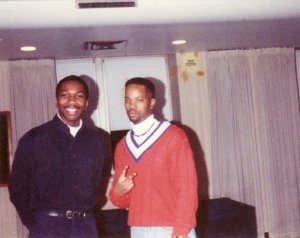
Me with Mark James, PAGPSA meeting, GSPH building, University of Pittsburgh, February 26, 1993 (Lois Nembhard).

That changed a bit my first year of grad school. Often in my walking and running across campus, I’d bump into a Black grad student here or there. At Hillman Library, the Cathedral of Learning, William Pitt Union, the SLIS building or other places. We’d recognize each other, we said hello, we even exchanged our names. Two of them in particular — Ed and Hayley — reached out to me at the end of the Spring ’92 semester, because they wanted to put together an organization that would represent our interests as grad students of color.

In mid-August, the emails began to go back and forth in earnest to establish what we’d end up calling the Pan African Graduate and Professional Student Association (PAGPSA) that fall. Through Jack Daniel’s office (see my post “The Miracle of Dr. Jack Daniel” from May ’11), we obtained the start-up funds necessary to make the new association go.

At our founding meeting that September, there were eight of us, all highly motivated to be as inclusive as possible, all feeling suddenly less isolated than we had felt a week, month or semester earlier. We decided on the “Pan African” part of the association’s name because we wanted to welcome as many graduate students of color as possible, particularly African and Afro-Caribbean students. The terms “Black” and “African American,” we agreed, wouldn’t be inclusive enough.

We also decided that despite the political implications of our new name, that this association would primarily be about bringing students together for social gatherings, for additional information and education beyond their course work and dissertations, but not to be campus activists. So many of the Black, African and Afro-Caribbean grad students at Pitt were in fact working on master’s or other professional degrees, and wouldn’t be on campus long enough to make lasting changes through activism, strictly speaking. Plus, there was the risk that activism would be so all-consuming — especially on issues like campus climate, long-term support for research and retention rates — that folks would fail to complete the work they came to Pitt to do in the first place.
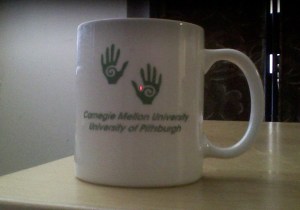
CMU-Pitt mug, from joint PAGPSA/BGSO meeting on diversity and grad school, October 1992, November 29, 2012. (Donald Earl Collins).

By the time that first meeting broke up, I was content to have met folks like Mark, Hayley, Lois, Errol, Ed, and a couple of others, to find us all on the same page about something as serious as starting a new association of a significant cross-section of Pitt’s graduate students of color. But in the process, I’d made a new friend that fall through our meetings and our joint gatherings with Carnegie Mellon’s Black Graduate Student Organization (BGSO).

James came along and challenged PAGPSA in October and November regarding our campus activism stance, arguing that being a part of any organization of students of color meant being active. Of course the leadership disagreed, but that’s how I met the man. He was a charismatic Black Iowan preacher’s son, and more politically active than anyone I’d known under the age of thirty. James had ideas about everything, from the future of hip-hop to the implications of my research on multiculturalism and Black Washington, DC.

Though he was a GSPIA (Graduate School of Public and International Affairs) master’s student and ultimately finished his degree in ’94, we would remain friends through the rest of the ’90s. Between him and Matt (see my post “My Friend Matt” from September) and PAGPSA, I remained grounded even as I became buried in the minutia of US, African American and educational policy historiography over the next half-decade. Thankfully, I no longer felt like a lone wolf. Thankfully, I knew that I wasn’t alone in a sea of graduate school and faculty White maleness after that fall.
My Take on Carnegie Mellon University

23 Tuesday Oct 2012

Posted by decollins1969 in 1, Academia, Boy @ The Window, Eclectic, Politics, Pop Culture, race, Youth

≈ Leave a comment

Tags

47 Percent Video, Affirmative Action, Alumni Association, Barbara Lazarus, Carnegie Mellon, Carnegie Mellon University, CMU, Conservatism, Disappointment, Exclusion, Fundraising, History Department, Isolation, Joe Trotter, Mitt Romney, Pitt, Silent Treatment, University of Pittsburgh


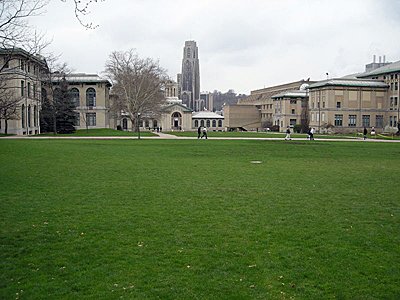
View of Pitt’s Cathedral of Learning from Carnegie Mellon lawn, Pittsburgh, PA, October 22, 2012. (http://www.broadwayspotted.com/).

It’s with extreme disappointment in which I write my latest post, this one on Carnegie Mellon University, or as the locals and attendees call it, CMU (sorry, Central Michigan University folks). But I feel I have little choice, given the amount of crap I’ve received over the past few months from my doctoral institution. The alumni association and the fundraising people at Carnegie Mellon ask me for money at least twice a week, and don’t seem to get it when I say “no” or “never” or even “when Hell freezes over.” I’ve known creditors less persistent about getting money out of people than the fundraising arm of Carnegie Mellon.

The last straw for me, though, was last week. I received three emails on the same day, not to mention a letter in the mail, all asking for donations. One also included an alumni survey, which I dutifully filled out and rated Carnegie Mellon at the low-end of every category in the survey. “Not only do I not mentor my students or aspiring college students about Carnegie Mellon,” I said. “I go out of my way to make sure that they do not ever consider applying to or attending Carnegie Mellon,” I added at the end of the survey.

Romney in 47 Percent Video, September 18, 2012. (Joe Pompeo/http://capitalnewyork.com). Qualifies as fair use under US Copyright Laws – cropped/low resolution.

I don’t think that the alumni association or the fundraisers really understand the depths of my disappointment regarding my four years at CMU between ’93 and ’97. I found the university culture about as welcoming as going to a Mitt Romney fundraiser in Boca Raton, and with many folks from the same crowd as well. Anytime your campus refuses to recognize Martin Luther King, Jr. Day as a holiday, or insists on having Dinesh D’Souza give a two-hour talk on race without an opposing viewpoint, it’s a stifling place. A campus in which the College Republicans stage marches while not having a strong College Democrats or progressive group in place is a bastion of conservatism, not just politically, but socially as well.

In four years, I became friends with a very small group of students and professors. I would’ve made more of an effort, if I hadn’t been told practically from day one that my master’s degree from the University of Pittsburgh and my other achievements meant little because, well, I had a degree from Pitt. And these sentiments came from my professors!

From my fellow students — who often walked by me as if I were a ghost until I forced them to say “Hi” — there was the impression that I must’ve gotten into the History program under some “special dispensation,” as one White guy put it. Yeah, my M.A. — earned in two semesters with a real committee examination — and a year of PhD work had nothing to do with my ability to write rings around my fellow students!

All in all, my Carnegie Mellon experience only worked out as well as it did because I reached out beyond my department and beyond the university to maintain connections and friendships with real people. My list of good folks at Carnegie Mellon is pretty short. The late Barbara Lazarus (see my post “Ladies and Gentlemen, Dr. Barbara B. Lazarus” from July ’09), Susan McElroy, John Hinshaw (who himself didn’t talk to me for two years after I’d gotten a Spencer Fellowship), and “My Friend Matt” (September ’12). The Black Graduate Student Organization (or BGSO), the graduate students of color/women graduate students working group that Barbara headed, and our group of fourteen doctoral students of color (the total number of non-White and non-Asian PhD students at Carnegie Mellon). That and playing intramural and pick-up basketball as much as three times a week were the sum total of my positive people and experiences at CMU.

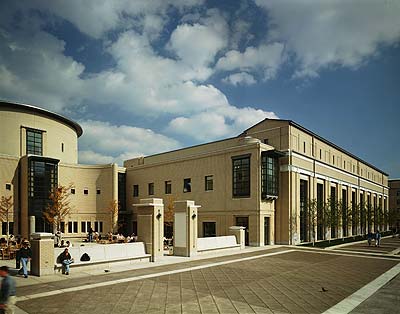
Carnegie Mellon’s University Center, or “the new sanitarium,” October 22, 2012. (via Wikipedia).

I spent the majority of my non-classroom time on Pitt’s campus hanging out with friends there, working on my dissertation, meeting with some of my former professors, or otherwise enjoying my status as an alumnus. If anything, I needed to walk across that bridge between Carnegie Mellon, Schenley Park and Pitt as much as I did in order to keep my sanity, to make sure that I was essentially the same person I’d been while going to grad school with comparatively less uptight folk.

Of course, I could also go on about how my experiences with Joe Trotter as my advisor (see my “Outrage, Maybe” post from May ’10) turned me into an anti-Carnegie Mellon advocate, or how the sanitarium look of the university buildings could leave Polyanna depressed. But for those involved in alumni fundraising and related tasks at Carnegie Mellon, get this. I will never, ever, ever, give CMU one penny of my hard-earned dollars. I’d sooner give my idiot ex-stepfather a penny at his grave before you could pry a cold copper piece out of my hands, alive or dead. As far as I’m concerned, you owe me for four years of unnecessary anguish in the midst of my determined success.

The Great “Original Sin” Debate

03 Wednesday Oct 2012

Posted by decollins1969 in 1, Academia, Boy @ The Window, culture, Eclectic, eclectic music, music, Politics, Pop Culture, race, Youth

≈ Leave a comment

Tags

"Moment of Surrender" (2009), Black Reconstruction (1935), Carnegie Mellon University, Chants Democratic (1984), David Roediger, Marcus Rediker, Media's Game Mentality, Obama-Romney Debate, Original Sin, Pitt, Race, Sean Wilentz, Slavery, U2, University of Pittsburgh, W. E. B. Du Bois, Wages of Whiteness (1991), Wendy Goldman


Obama-McCain Third Debate (post-debate picture), Hofstra University, Hempstead, NY, October 15, 2008. (Jim Bourg/Reuters).

We’ve finally meandered our way into the presidential debate cycle portion of our Election ’12 cycle. I’m grateful to finally see what the media has built up to be a match between the Pittsburgh Steelers and the New York Giants! Not really, of course. But from standpoint of political reporters and pundits alike, tonight’s first debate between President Barack Obama and Mitt Romney might as well be a sports event.

In the end, though, this isn’t as much a presidential debate as it is a personality contest with questions and psychologists’ interpretations of nonverbal communication. It will be more hype than substance, more stiff than an overbaked souffle. One of the men — most likely President Obama — will win this first debate, though it won’t be clear how significant this “win” will be, given the trends for the past couple of months.

Professor Wendy Goldman, Carnegie Mellon University, circa 2012, October 3, 2012. (http://www.history.cmu.edu).

I am reminded of another debate, one that occurred in my Comparative Working-Class Formation graduate seminar at Carnegie Mellon University in the fall of ’93. It was taught by Professor Wendy Goldman, wife of Marcus Rediker, both decidedly Marxist, but in Goldman’s case, Marxist without any considerations of race at all. It was a course that turned into a debate because I’d already grown tired of professors at Pitt who believed race and gender to be identities subsumed under the long, hard human battle over class inequality (see my post “Dairy Queens, Dick Oestreicher and Race” from February ’11).

All semester-long, there had been a three-way tug-of-war between me (and occasionally, my former Pitt grad school colleague who decided to hop across the bridge to Carnegie Mellon to take this course), ten brown-nosing students who’d agree with her despite the evidence (led by Mike and Mark, the “M&M Boys,” as I labeled them for my friends and colleagues) and Goldman. I didn’t expect my now fellow Carnegie Mellon grad students to take my side. But I did expect them to read E.P. Thompson and Sean Wilentz and other folks with a critical eye and not just to get an A out of our professor. There may have been one or two other classes I dreaded more in three years of grad school. Yet I’d never been around a professor more unaware of their own biases than Goldman (see my “Crying Over E.P. Thompson” post from September ’09).

It all came to a head when it was time to discuss David Roediger’s Wages of Whiteness (1991) and, indirectly, Sean Wilentz’s Chants Democratic (1984) on the last Thursday in October ’93, which happened to be my mother’s forty-sixth birthday. Both authors looked at the formation of the White American (and male) working-class in the first half of the nineteenth century. Goldman, as usual, took the stance that the only ideology of significance was one that proclaimed class inequalities the predominant issue explaining the radicalization of the American working-class.

Michelangelo’s sin of Adam and Eve painting, Sistine Chapel ceiling, Vatican City (1508-1512), May 20, 2005. (The Yorck Project via Wikipedia). In public domain.

Finding this a bit laughable (a mistake on my part), I pressed my argument that at least in the case of US history, race and class distinctions have been and remain intertwined. So much so that a typical neo-Marxist analysis of the American working-class couldn’t apply. The next two hours were me and my Pitt colleague against the M&M Boys, the other brown-nosers and Professor Goldman. Luckily in my case, I could not only quote Roediger and Wilentz, but Herbert Gutmann, W.E.B. Du Bois, and a host of other scholars to press home my counterargument. At the end, our professor said to me, in utter exasperation, “I guess we should just go back to original sin.” It meant that I was being a racial determinist, which I guess was supposed to be an insult as well as her version of “No mas, no mas!”

Aside from the fact that America’s “original sin” really was the taking of Native American lands and the systemic destruction of Native American peoples and culture, I really didn’t have much of a response to Goldman’s excited utterance. I finished my argument with a final volley that included Du Bois’ Black Reconstruction (1935) and Roediger, and class adjourned sooner thereafter.

My brown-nosing classmates looked pretty beat from the class session, while me and my colleague from Pitt were both energized from the three-hour class. Still, we couldn’t help but discuss Goldman’s Moment of Surrender at the end of the class. Of course we knew what her “original sin” comment meant when it came to race and slavery. The comment, though, seemed small and petty coming from a professor, one that was too personal, and not professional.

Still, the worst thing I learned is that it took Roediger’s Wages of Whiteness to confirm ideas that Du Bois had begun writing about in 1903 and 1935. That, for me, made me apprehensive about wanting to work with scholars who may well see me and my work as well-intentioned, but inferior to theirs. At the same time, I learned that, for better and for worse, that not going along to get along can be a good thing, especially after years of ridicule from people of all stripes for doing so.

My “original sin” of not going along with whatever Goldman said forced a debate, one of the more exciting times I had in grad school, certainly at Carnegie Mellon. How could that be bad?

My Friend Matt

07 Friday Sep 2012

Posted by decollins1969 in 1, Academia, Boy @ The Window, culture, Eclectic, Politics, Pop Culture, race, Youth

≈ 2 Comments

Tags

African American History, Beavis and Butt-head, Bedtime Stories, Boston Market, Burden of Success, Canasta, Carnegie Mellon University, Friendship, Graduate School, Joe Trotter, Matt, Pitt, Pressures, University of Pittsburgh


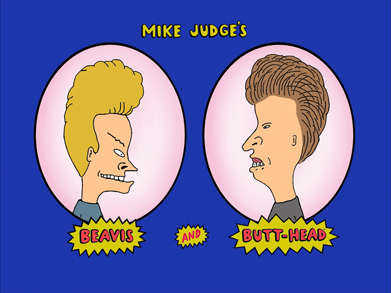
Beavis and Butt-head titlecard, May 21, 2012. (Nerd 101 via Wikipedia). Qualifies as fair use under US Copyright laws due to image’s low resolution.

Over the past couple of years, one of my son’s favorite bedtime stories has been about a character I named Matt (see my post “Crush #1 and Other Bedtime Stories” from July ’10). Having a friend with superhuman farts or a friend who belts out ’80s pop tunes while beating up some of the other characters isn’t exactly based on my growing up experience. In the case of Matt, his character was one that always over-explained things — like why 2+2=4 — and wanted to play Canasta in the middle of a basketball game.

Buried in all the ridiculousness and hyperbole around the character was a real-life friend named Matt, whom I met twenty years ago this month. Matt was in my African American History graduate seminar at Carnegie Mellon University in the fall of ’92. I took the course on the advice of my eventual advisor Joe Trotter, whom I had met that spring at my first academic conference at Lincoln University (see my “Meeting Joe Trotter” post from May ’12). I decided to take the course because my history grad program at Pitt didn’t have anything close to a course on Black historiography. In fact, I couldn’t find a course that would even approximate a graduate seminar in African American studies at the University of Pittsburgh in ’92.

I was one of seven students in the course, with two women (one of whom was Black and in her thirties) and three young White males, though not as young as twenty-two year-old me. And there was Matt, the first Black male I’d seen in either my own or Carnegie Mellon’s History PhD who wasn’t me. What I noticed immediately was the fact that in our Tuesday 9:30-12:30 course, Matt was the only one who spent the first two hours leafing through the one or two books and five articles we were to read every single week. Leafing, because as it turned out, Matt had already finished all of his coursework for the doctorate. He was auditing the course, and rarely read anything for the seminar in advance.

Carnegie Mellon University logo, June 27, 2012. (Abrio via Wikipedia). In public domain.

That’s what I learned when we had our first lunch together in the cafeteria of University of Pittsburgh Medical Center, where I could get a cheap lunch before or after shooting hoops. It was then that I also noticed something peculiar about Matt. He chewed his food with his mouth half-open, where if I looked too closely, I’d notice the mix of saliva, wild rice, green beans and chicken breast being crushed by his raptor-like teeth. I never knew anyone over twelve, much less someone approaching forty, who didn’t know how to chew with their mouth closed until I’d met Matt.

Despite my observation of some weird tendencies, I found my first conversations with Matt to be exhilarating. I simply hadn’t been around anyone in my graduate school experience aside from a professor or two who was as knowledgeable about American and African American history, politics and culture as Matt. That, and the fact that he had worked in the community development corporation world as a community organizer made him an atypical graduate student, even compared to the other older perpetual-student-graduates I’d known over the previous five years.

I learned from our eatery outings — especially after the first Boston Market in Pittsburgh opened in Squirrel Hill in mid-September — that Matt was the younger son of two prominent Black/Afro-Caribbean parents, both of whom were in the social work field, both of whom had doctorates, both of whom were prominent on Pitt’s campus. His father, of course, was also an ordained minister. I could only imagine the kind of pressure that would’ve put on Matt over the years to do something meaningful with his life.

Canasta, May 31, 2007. (Roland Scheicher via Wikipedia). Released to public domain by author.

The one political argument that Matt made during the fall presidential election cycle in ’92 was the need for serious campaign finance reform. Remember, this was a good four years before McCain-Feingold, which has since of course been shredded by the Supreme Court’s Citizens United decision. Aside from that, most of what we agreed on were issues of interpretation in African American historiography and the fact that two of our classmates, Mark and Mike, were the ultimate brown-nosers. They kissed butt at times like their lives depended on it, leading to heated arguments in our seminar every week. The fact that they thought Fogel and Engelmann’s Time on the Cross (1974) was a great work on slavery said it all on these future neo-cons.

Still, while I found Matt’s contrarian Beavis and Butt-head view of the world interesting at times, I also realized that Matt spent an amazing amount of time talking. At Hillman Library, in front of William Pitt Union, in the halls of Baker Hall, at Boston Market. And as I’d learn later on, there was a great distance between Matt’s interesting and sometimes great ideas and the hard work needed to put them on paper for a committee or to put them in action in his own life.

Moving (On) To Pittsburgh

26 Sunday Aug 2012

Posted by decollins1969 in 1, Academia, Boy @ The Window, culture, Eclectic, Hebrew-Israelite, Mount Vernon New York, New York City, Politics, race, Religion, Youth

≈ Leave a comment

Tags

241st Street Subway, 616, 616 East Lincoln Avenue, Abuse, Alternative History, Alternative Universe, Amtrak, Darren Gill, Eri Washington, Fighting Demons, Hebrew-Israelites, Maurice Eugene Washington, Maurice Washington, Pitt, Pittsburgh, Poverty, Self-Discovery, Subway, University of Pittsburgh


241st Street-Wakefield Subway Station, Bronx, NY, August 25, 2012. (jag9889 via http://flickr.com). In public domain.

I’m now a quarter-century removed from leaving my original hometown, Mount Vernon, New York, for Pittsburgh and the University of Pittsburgh. Wednesday, August 26, ’87 wasn’t my first day of adulthood, but it turned into my first day of freedom from the disappointment that my years in Mount Vernon and at 616 East Lincoln Avenue had turned into. It’s been a long road of triumphs and setbacks, of mistakes and sins, of excellence and miracles (see my post “Trip to the ‘Burgh” from August ’09).

But I’ve frequently wondered what would’ve happened if I’d stayed in Mount Vernon, or, at least, somewhere in or near New York City. Would I have turned out like my older brother Darren, a forty-four year-old who’s never been able to shake off the years of psychological torture he endured at 616? He was caught between my mother believing him to be retarded and being in a school for the mentally retarded as a kid with an above-average IQ for fourteen years. Darren never had a chance to build on him teaching himself to read at three and teaching me how to read at five (see post “About My Brother” from December ’07).

Outside of the upper-crust lily-Whiteness that was his Clear View School experience, Darren’s never known a middle-class adult life, a middle-class education or people he could talk to about his experience in order to move on from it. My brother lives around 233rd Street in the Bronx, as isolated now as he was at 616, trapped in our 616 past and in the warped thinking that has retarded his growth as a human being for nearly forty years.

Or would I have turned into my youngest brother Eri, a twenty-eight year-old frequently angry with the world? He’s been taking solace in a father (my ex-stepfather) who was never there for him and in his father’s twisted sense of Afrocentric Judaism? Unlike me and my older brother Darren, who at least knew what it was like to live in a time when even we experienced some sense of the old American Dream, Eri never had that chance.

Poverty, the grinding-with-millstones kind, and joblessness are really all that Eri’s seen the past three decades. Job Corp and the Army National Guard have really been his only times away from the daily anguish of 616 and Mount Vernon. And with the death of our sister Sarai two years ago, I know that he’s felt even more angst and isolation. Leading Eri to begin the process of re-upping with Uncle Sam for this fall.

Amtrak’s Pennsylvanian passing the 1895 Bryn Mawr Interlocking Control Towerat Bryn Mawr, PA, en route from New York to Pittsburgh, June 6, 2011. (Centpacrr via Wikipedia). Permission granted via cc-by-sa-3.0.

If I had stayed, my story would likely have ended up somewhere between Darren’s and Eri’s. I would’ve somehow gone to college, maybe Westchester Community College, Hunter or possibly Fordham. But the drama of living at 616 and the constant reminders of the worst years of my life all around me would’ve made demon-slaying a near-impossible task.

It was bad enough occasionally bumping into Crush #1, Crush #2 or one of my silent treatment classmates during the holidays and summers I was away from Pittsburgh between ’87 and ’92. Seeing them regularly and knowing that they only saw me as a twelve-year-old asshole or socially-inept seventeen-year-old? That would’ve stunted me (see my post “The Silent Treatment” from June ’10). I simply wouldn’t have felt that I had the space — geographically or psychologically — to move on from those morbid times.

Even if I somehow found the focus of Tiger Woods and Michael Jordan combined to complete a bachelor’s degree, I would’ve needed to make the decision to leave the area anyway. Especially if I had any other aspirations besides helping my mother take care of my younger siblings, including going to graduate school.

All the decisions I made after August 26, ’87, in fact, wouldn’t have occurred if I had stayed at 616, in Mount Vernon, even anywhere in the New York City area. I would’ve been too close to allow my mother to be beaten by my ex-stepfather again. I would’ve been too embarrassed by my father’s increasing alcoholism. And I would’ve been too angry with myself for all of the fun I’d denied myself while my former high school classmates were living what I assumed was the equivalent of Sheila E’s “Fabulous Life.”

Moving (On) To Pittsburgh

Moving (On) To Pittsburgh

There would’ve been no decision to even risk being homeless my sophomore year for a degree — much less actually being homeless for nearly a week. There then wouldn’t have been a decision to change my major to history, much less rediscovering myself as a writer years later. I wouldn’t have ever seen myself as worthy of happiness, or seen myself as handsome, or seen myself through the eyes of others as funny or charming or goofy. Instead, I could’ve counted on anger, rage, disappointment and misery to be my four emotional companions, ever ready to introduce themselves to the New York City area.

We often need change to move on from the demons of our past and present. Thank God I made the decision to literally leave 616 and Mount Vernon for Pittsburgh. That decision has enabled me to remember the past without wallowing in it.

The Arrogance of Youth, Grad School Style

05 Tuesday Jun 2012

Posted by decollins1969 in 1, Academia, Boy @ The Window, culture, Eclectic, eclectic music, Mount Vernon New York, music, Politics, Pop Culture, race, Work, Youth

≈ 1 Comment

Tags

6007 Penn Circle South, 616, 616 East Lincoln Avenue, Academic Arrogance, Allegheny County Department of Federal Programs, Americn Arrogance, Arrogance, Assumptions, Carnegie Mellon University, East Liberty, Graduate Fellowships, Graduate School, Independence, Pitt, Self-Discovery, Self-Reflection, unemployment, University of Pittsburgh, Westchester County Department of Community Mental Health


Me taking the most thuggishly-goofy-arrogant picture I could, June 5, 2012. (Donald Earl Collins).

I’m sure that there are plenty of folks I’ve met and known over the past three decades who think that they could sum me up in one word – arrogant. I know beyond a doubt that’s what Crush #1 thought of me back in ’82. I know that some my grad school classmates and friends varied between seeing me as “aloof,” “arrogant,” “cocky,” and “focused” in my five and a half years of master’s and doctoral work. And I know that one person I worked with in the past fifteen years thought of me as arrogant, even though I doubt that he would know what arrogance looked like if he saw it in the mirror every day, which he did (see my post “The Messiah Complex At Work, Part 1” from November ’11).

Former Sen. John Edwards [and new symbol of arrogance], after acquittal/mistrial, Greensboro, NC, May 31, 2012. (AP/Chuck Burton via Salon.com).

But arrogance isn’t simply cockiness run amok, or people bragging about what they intend to do without doing it, or doing it and then showing off with a Tiger Woods’ fist pump or my occasional cross-kick. It’s making assumptions about the things of life as if the march to success is a given, as if victory is guaranteed, like taking the next breath or being able to stand upright.

I did that in the spring and summer of ’93, in the transition between my grad school days at the University of Pittsburgh and my more successful yet gloomy times at Carnegie Mellon. I was a year removed from my great first year of master’s work (see my post “The 4.0 Of It All” from December ’11), and a summer removed from working for Westchester Country Department of Community Mental Health in Mount Vernon for the last time (which I will discuss later this summer). The way I saw things, I knew that God was on my side, that my hard work would pay off, that everything I did led to more success, or more money in my pocket.

I acted on those beliefs that March, April and May. I wanted to move out of my crappy studio and drug-infested apartment building on Penn Circle South in East Liberty, to what I called grad student’s row — Stratford Avenue — off North Negley and Penn Avenue between East Liberty and Friendship. I even put a deposit down on a one-bedroom apartment at the beginning of March, anticipating that I’d find something work-wise for the summer. “Something would come up,” I often thought and said. So typically American of me!

Terrell Owens, somewhere between arrogant and suicidal, 2012. (http://queensofkings.com).

I had applied for three fellowships that year, including a summer fellowship through Pitt and the Ford Foundation’s Predoctoral Fellowship Program (via the National Academies). I just knew that I’d get at least one. But the least laid plans of the arrogant often lead to the land of losses. Throughout April and May, I received rejections for all of my well-received, coming-in-second or “Honorable Mention” applications. Not to mention that my soon-to-be former grad program wouldn’t allow me to teach a US history course, though they didn’t have anyone else to teach it other than me at the time.

I realized after my mid-May root canal (see my “Facing The Tooth” post from May ’12) that I was about to enter a tough summer financially. I managed to get back my deposit for my dream apartment two weeks before I was due to move in, paying my Penn Circle South studio rent in the process. Then, with $350 to work with until further notice, I waited.

It wasn’t until the end of the first week in June that, after some qualms about my over-qualifications, Randy Brockington and the Allegheny County Department of Federal Programs hired me to work on a report. They wanted me to assess the work of their staff on the Job Training Partnership Act portion of their department. And all to the tune of $6 an hour. My mother spent the next four years teasing me about it. As if I had another option, as if coming back to 616 for the summer would be less torturous than falling six weeks behind on my rent and receiving an eviction notice.

I made one minor adjustment in my halcyon days of grad school that in-between summer of ’93. To simply not assume anything to be a sure thing, even when it was, to make Richard Marx’s “Don’t Mean Nothing” my mantra when it came to anything around money. Who knew that a little more than two months later, me and my friend Marc would have a controversial article in Black Issues in Higher Education? Who knew that less than two years later, I’d have a Spencer Foundation Dissertation Fellowship, this despite my advisor? Life is a funny, ironic walk.

Facing The Tooth

14 Monday May 2012

Posted by decollins1969 in 1, Academia, Boy @ The Window, culture, Eclectic, Politics, race, Work, Youth

≈ 1 Comment

Tags

6007 Penn Circle South, Advil, Carnegie Mellon University, Comps, Dentistry, Department of HIstory, Departmental Politics, Doctoral, Drug, East Liberty, History Department, Joe Trotter, Joe William Trotter, John Modell, Jr., Motrin, Naivete, PhD, Pitt, Pittsburgh, Root Canal, Stress, Toothache, unemployment, University of Pittsburgh, Written Comprehensives


My front teeth, including slightly darker lower tooth (right/my left), two root canals later, May 14, 2012, (Donald Earl Collins).

A funny series of events occurred on the transition from Pitt PhD student to Carnegie Mellon doctoral student in the spring and summer of ’93. Well, not really funny at the time. Nineteen years later, the months between April and October ’93 look like a semi-hilarious blip on my screen of life compared to what I’d gone through before and have faced since. But for a three-week period in April and May of that year, one of my teeth helped me both begin grad school at Carnegie Mellon and brought home the truth of my impoverished existence at the same time.

The week before the end of spring semester at the University of Pittsburgh — as well as the end of six years of undergraduate, master’s and doctoral work there — I woke up with a throbbing that went around the left side of my jaw. It radiated up through my left cheekbone, ear and temple. It was a toothache, one that I assumed was stress-related. Between the transfer to Carnegie Mellon, my efforts to move out of my crappy studio in East Liberty, and my search for summer work, I assume that it was just me grinding my teeth.

I relieved my stress and pain the way any normal twenty-three year-old male would. I took some Advil, went to sleep, hung out with friends and at hole-in-the-wall bars once the semester was over, and had myself a pretty good time. I took the approach that “everything will work itself out” to all the worries I had.

I also met with Carnegie Mellon’s History department’s graduate advisor that first week, John Modell (I learned later that he had been Joe Trotter’s dissertation advisor back in the mid-1970s). Modell cleared me to take the written part of the PhD comprehensive examination that the department’s second year students could take at the end of the year, which in ’93 was on May 14. Modell cleared me despite the fact that my first course as a Carnegie Mellon student wouldn’t begin until the end of August.

Then, after a week or so pain-free, I woke up a little after 5 am. I snapped up in my bed, knowing that

Severe premolar tooth decay (abscess), December 17, 2006. (Lycaon via Wikipedia). Released to public domain via Creative Commons 3.0 license.

something was wrong. Then, the pain came. It was like Mike Tyson had punched me in the left side of my jaw and I’d fallen head-first onto a boulder. The pain shot up and around like a puck in an NHL playoff game in overtime. The toothache was back, and it wasn’t going away.

Dumb-ass me, who rarely took meds for headaches, much less a rare toothache, tried to gut it out for a couple of days without much medicine at all. I went to Pitt that Monday and Tuesday to see if there was any chance to pick up a course to teach for the summer. There, I discovered how cold the History department administrators were regarding my time there. It turned out that there were two courses available. Even though I technically could’ve taught those courses, they held my transfer to the “other program” against me.

That made my pain worse. I couldn’t eat without a construction team of bacteria pounding my jaw. I couldn’t have a conversation without feeling brass knuckles punch my face in. I certainly couldn’t sleep more than four or five hours, and then only sitting up in a chair. By Wednesday afternoon, I couldn’t think straight anymore.

I finally walked across the bridge on South Highland Avenue to a dentist’s office next to the local neighborhood laundromat, and after an hour, scheduled an appointment for 2 pm that Friday, and picked up a prescription for 800 mg Motrin pills. For someone as drug adverse as me, it might as well have been heroin. I was taking two at a time — the equivalent of eight Advil tablets — between Wednesday evening and Friday morning. In doing so, it became obvious that my lower left front tooth was the culprit, and that my dentist was correct. I needed a root canal procedure to drain the abscess.

Second floor of Baker Hall, Carnegie Mellon University, Pittsburgh, PA, December 2, 2010. (Daderot via Wikimedia). In public domain.

So it was that on that fateful May 14, with three more horse-sized Motrin pills in my system, that I took my written comprehensives on the second floor of dark and factory-like (with its sloped floors) Baker Hall. I hadn’t studied at all, and all I really wanted to do was sleep. I chose two questions: one on women’s history/rights and historiography, the other on immigration history. From 9 am until about 12:30 pm, I wrote page after page on both subjects and conjured all the books and articles that I knew on both topics, which turned out to be quite considerable. I found the comps quite easy. Easier than any hoop that I had to jump through while at Pitt.

Still, I felt the throbbing of my tooth. Not the pain — the Motrin did its job — just the nerve in the tooth and the blood supply pushing pass the well of abscess in that tooth. I handed in my essays (I filled out four booklets’ worth of essays) and meandered my way to my dentist’s office. The root canal surgery took about two hours, but it only seemed like a dream, as I fell asleep off and on throughout.

I floated the two blocks home to 6007 Penn Circle South, secure in the fact that I passed my comps (as it turned out, with high distinction, although one of the examiners was puzzled by the fact that I had used sources not taught by any of the professors in the department). Just before I hit my pillow, ready to snore for the next fifteen hours, I thought, “Boy, is this going to be a long summer!”

← Older posts
Newer posts →

Boy @ The Window: A Memoir

Boy @ The Window: A Memoir

Places to Buy/Download Boy @ The Window

There's a few ways in which you can read excerpts of, borrow and/or purchase and download Boy @ The Window. There's the trade paperback edition of Boy @ The Window, available for purchase via Amazon.com at http://www.amazon.com/Boy-Window-Donald-Earl-Collins/dp/0989256138/

There's also a Kindle edition on Amazon.com. The enhanced edition can be read only with Kindle Fire, an iPad or a full-color tablet. The links to the enhanced edition through Apple's iBookstore and the Barnes & Noble NOOK edition are below. The link to the Amazon Kindle version is also immediately below:

scr2555-proj697-a-kindle-logo-rgb-lg

Boy @ The Window on Amazon.com: http://www.amazon.com/Boy-The-Window-Memoir-ebook/dp/B00CD95FBU/

iBookstore-logo-300x100

Boy @ The Window on Apple's iBookstore: https://itunes.apple.com/us/book/boy-the-window/id643768275?ls=1

Barnes & Noble (bn.com) logo, June 26, 2013. (http://www.logotypes101.com).

Boy @ The Window on Barnes & Noble: http://www.barnesandnoble.com/w/boy-the-window-donald-earl-collins/1115182183?ean=2940016741567

You can also add, read and review Boy @ The Window on Goodreads.com. Just click on the button below:

Boy @ The Window

Twitter Updates

Tweets by decollins1969
  • RSS - Posts
  • RSS - Comments

Archives

  • June 2025
  • April 2023
  • September 2022
  • August 2022
  • July 2022
  • June 2022
  • May 2022
  • April 2022
  • March 2022
  • January 2022
  • December 2021
  • November 2021
  • October 2021
  • September 2021
  • August 2021
  • July 2021
  • June 2021
  • April 2021
  • March 2021
  • February 2021
  • January 2021
  • December 2020
  • November 2020
  • October 2020
  • September 2020
  • August 2020
  • July 2020
  • May 2020
  • April 2020
  • March 2020
  • January 2020
  • December 2019
  • November 2019
  • August 2019
  • July 2019
  • June 2019
  • May 2019
  • April 2019
  • March 2019
  • February 2019
  • January 2019
  • December 2018
  • November 2018
  • October 2018
  • September 2018
  • August 2018
  • July 2018
  • June 2018
  • May 2018
  • March 2018
  • February 2018
  • January 2018
  • December 2017
  • November 2017
  • October 2017
  • September 2017
  • August 2017
  • July 2017
  • June 2017
  • May 2017
  • April 2017
  • March 2017
  • February 2017
  • January 2017
  • December 2016
  • November 2016
  • October 2016
  • September 2016
  • August 2016
  • July 2016
  • June 2016
  • May 2016
  • April 2016
  • March 2016
  • February 2016
  • January 2016
  • December 2015
  • November 2015
  • October 2015
  • September 2015
  • August 2015
  • July 2015
  • June 2015
  • May 2015
  • April 2015
  • March 2015
  • February 2015
  • January 2015
  • December 2014
  • November 2014
  • October 2014
  • September 2014
  • August 2014
  • July 2014
  • June 2014
  • May 2014
  • April 2014
  • March 2014
  • February 2014
  • January 2014
  • December 2013
  • November 2013
  • October 2013
  • September 2013
  • August 2013
  • July 2013
  • June 2013
  • May 2013
  • April 2013
  • March 2013
  • February 2013
  • January 2013
  • December 2012
  • November 2012
  • October 2012
  • September 2012
  • August 2012
  • July 2012
  • June 2012
  • May 2012
  • April 2012
  • March 2012
  • February 2012
  • January 2012
  • December 2011
  • November 2011
  • October 2011
  • September 2011
  • August 2011
  • July 2011
  • June 2011
  • May 2011
  • April 2011
  • March 2011
  • February 2011
  • January 2011
  • December 2010
  • November 2010
  • October 2010
  • September 2010
  • August 2010
  • July 2010
  • June 2010
  • May 2010
  • April 2010
  • March 2010
  • February 2010
  • January 2010
  • December 2009
  • November 2009
  • October 2009
  • September 2009
  • August 2009
  • July 2009
  • June 2009
  • May 2009
  • April 2009
  • March 2009
  • February 2009
  • January 2009
  • December 2008
  • November 2008
  • October 2008
  • September 2008
  • August 2008
  • July 2008
  • June 2008
  • May 2008
  • April 2008
  • March 2008
  • February 2008
  • January 2008
  • December 2007
  • November 2007
  • October 2007
  • September 2007
  • August 2007
  • July 2007
  • June 2007

Recent Comments

MaryPena's avatarMaryPena on My Day of Atonement/Bitter Hat…
decollins1969's avatardecollins1969 on No Good Teaching Deed Goes…
Mary Rose O’Connell's avatarMary Rose O’Connell on No Good Teaching Deed Goes…

NetworkedBlogs on Facebook

NetworkedBlogs
Blog:
Notes From a Boy @ The Window
Topics:
My Life, Culture & Education, Politics & Goofyness
 
Follow my blog

616 616 East Lincoln Avenue A.B. Davis Middle School Abuse Academia Academy for Educational Development AED Afrocentricity American Narcissism Authenticity Bigotry Blackness Boy @ The Window Carnegie Mellon University Child Abuse Class of 1987 CMU Coping Strategies Crush #1 Crush #2 Death Disillusionment Diversity Domestic Violence Economic Inequality Education Family Friendship Friendships Graduate School Hebrew-Israelites High-Stakes Testing Higher Education History Homelessness Humanities Humanities Program Hypocrisy Internalized Racism Jealousy Joe Trotter Joe William Trotter Jr. K-12 Education Love Manhood Maurice Eugene Washington Maurice Washington Misogyny Mother-Son Relationship Mount Vernon High School Mount Vernon New York Mount Vernon public schools Multiculturalism MVHS Narcissism NFL Pitt Pittsburgh Politics of Education Poverty President Barack Obama Race Racial Stereotypes Racism Relationships Self-Awareness Self-Discovery Self-Reflection Sexism Social Justice Teaching and Learning University of Pittsburgh Violence Whiteness Writing

Top Rated

Blog at WordPress.com.

  • Subscribe Subscribed
    • Notes from a Boy @ The Window
    • Join 103 other subscribers
    • Already have a WordPress.com account? Log in now.
    • Notes from a Boy @ The Window
    • Subscribe Subscribed
    • Sign up
    • Log in
    • Report this content
    • View site in Reader
    • Manage subscriptions
    • Collapse this bar
 

Loading Comments...