• About Me
  • Other Writings
  • Interview Clips
  • All About Me: American Racism, American Narcissism, and the Conversation America Can’t Have
  • Video Clips
  • Boy @ The Window Pictures
  • Boy @ The Window Theme Music

Notes from a Boy @ The Window

~

Notes from a Boy @ The Window

Tag Archives: K-12 Education

Providing the Wrong Frame for Higher Education

12 Wednesday Dec 2012

Posted by decollins1969 in 1, Academia, culture, Eclectic, Politics, race, Work, Youth

≈ Leave a comment

Tags

"Investing in the Future", American Competitiveness, Center for American Progress, Critical Thinking, Drew Gilpin Faust, Educational Attainment, Efficiency, Gene Sperling, Glenn Hutchins, Harvard University, Higher Education, Innovation, K-12 Education, Neera Tanden, Philosophy of Education, Poverty, Purpose of Education, social mobility, STEM Fields, Technocrats, Workforce Development


Neera Tanden and Drew Gilpin Faust, Center for American Progress' "Investing in the Future" event (screen shot), Washington, DC, December 10, 2012. (http://americanprogress.org).

Neera Tanden and Drew Gilpin Faust, Center for American Progress’ “Investing in the Future” event (screen shot), Washington, DC, December 10, 2012. (http://americanprogress.org).

I was supposed to attend the Center for American Progress event “Investing in the Future: Higher Education, Innovation, and American Competitiveness” yesterday morning (who does a two-and-a-half-hour event two Mondays before Christmas, really?). But my son happened to have his worst night of sleep in his nine and a third years of life, compounded by a minor asthma attack. So I didn’t get to go.

I’m glad that I didn’t attend, though, as the above link to the site and video will indicate to even an educator with the patience of Jesus. After watching and skipping through the 138-minute recording today, I realized that passing a kidney stone (which I’ve actually done) would be preferable to hearing the drivel that the Center for American Progress, Harvard University and Google sponsored yesterday.

It was a tour-de-force of K-16 education as preparation for practical careers and scientific/technological innovation. Period. Not education to formulate a critical mind. Not education for the betterment of society, for social justice, for changing the world. No, Americans, our very future depends purely on the willingness of Harvard (and other elite universities), corporations and government to work together to turn out millions of students to work in STEM fields, apparently the only fields that matter in the twenty-first century.

Yesterday’s Center for American Progress event proves, more than anything else, that K-12 public education has lost the battle for educational equity and US higher education is in the process of becoming a two-tiered system. The comments and answers from Neera Tanden, Harvard President Drew Gilpin Faust, Glenn Hutchins, Gene Sperling, et al. were indicative of a class of folks who hold little interest in providing the resources necessary to level the educational playing field for poor and struggling working class students.  Or, when they did address K-12 education, it was purely in technocratic scales-of-efficiency terms, as they gave K-12 most of the blame for America’s reduced economic competitiveness.

Box of Cracker Jack bags, December 11, 2012. (http://crackerjackpopcorn.com).

Box of Cracker Jack bags, December 11, 2012. (http://crackerjackpopcorn.com).

But this is the problem with leaders involved in American education these days. Instead of opening up K-12 education to real innovations in philosophy, curriculum, a teacher’s ability to use all of their skills (measurable and intangible) in a student-centered classroom, critical thinking and neuroscience, we were given the typical mantra of testing, teacher effectiveness and cost-cutting. It means that even among our alleged best thinkers — apparently still White, mostly male and over fifty years of age — the best ideas involve an expansive education for the well-off and a Cracker Jack education for the growing numbers of the poor and those struggling to remain above the poverty line.

As for higher education, I’ve already noted that we are well on the way to a two-tiered system in the US (see my post “edX and Ex-lax (& Higher Education’s Future)” from September ’12). One tier will consist of group of schools that will remain elite and near elite, the top 500 or so colleges and universities in the country. The other group of colleges (public, HBCU and for-profit) will struggle mightily with the weight of providing a specialized education for the masses of unprepared and underprepared low-income first generation students, of color and otherwise. They will increasingly lose out to the elite university/corporate/government partnership that will lead to a cheaper, streamlined college education, and mostly online. And all without the complications of providing a well-rounded, liberal arts education.

Ben & Jerry's half baked ice cream flavor, December 11, 2012. (http://bestuff.com/).

Ben & Jerry’s half baked ice cream flavor, December 11, 2012. (http://bestuff.com/).

The speakers at “Investing in the Future: Higher Education, Innovation, and American Competitiveness” also discussed the need to make higher education cheaper. Their solutions of cheaper loans and more stringent requirements for students to meet in order to obtain merit-based aid is nothing new, and in fact reflects trends that date back to the late-1970s. Even Faust’s encouragement of spreading the Harvard solution of providing need-based aid for low-income students only works for high-achieving students, the “low-hanging fruit” strategy that allows the other grapes on the trees to rot.

To be sure, the speakers at this event also talked about comprehensive immigration reform, green jobs/economy and universal health care. But without sufficient attention to the millions and millions of poor and of color people affected by their words and deeds, the Center for American Progress event might as well have been called “Investing in the Oligarchic Past.” Same new-old solutions, same half-baked ideas that show that as long as American education and industry leaders try to force solutions on our poor, we’ll be about as competitive as the USSR was between Stalin and Glasnost/Perestroika.
My Take On K-12 & Higher Education & Corporatism

08 Monday Oct 2012

Posted by decollins1969 in 1, Academia, Boy @ The Window, culture, Eclectic, Mount Vernon High School, Mount Vernon New York, Movies, New York City, Politics, Pop Culture, race, Youth

≈ Leave a comment

Tags

Adult Learners, Bill & Melinda Gates Foundation, Corporatized Education Reform, Education, For-Profit Colleges, Future of American Education, High-Stakes Testing, Higher Education, Higher Education Access and Success, K-12 Education, K-12 Education Reform, KIPP, Knowledge Is Power Program, Low-Income Students, Poverty, Privatization, Self-Discovery, Students of Color, Teach for America, Technocrats, The New Teacher Project, University of Phoenix


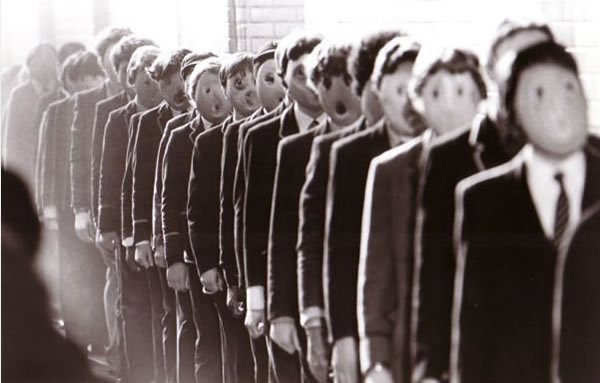
Pink Floyd–The Wall (1982), February 16, 2012. (http://free-education.info). Qualifies as fair use under US Copyright laws – low res and related to blog subject.

We often treat K-12 education and higher education as if they have nothing in common, as if they possess completely separate values and have developed in complete isolation from each other. But in this age where the American technocratic and the plutocratic elites want to privatize everything, there are clear connections behind and between emerging trends in corporatized K-12 education reform and with the rise of for-profit colleges and universities. These trends and connections aren’t good ones for the mass of American students, particularly for those who are poor and of color.

It’s pretty simply really. Both public education and postsecondary education have been under attack from profiteers and the politicians who do their bidding for at least a quarter century. In particular, the issues have been how to improve public schools so that poor Black and Latino kids can graduate high school on the one hand, and how to modify higher education so that the adult version of these kids can obtain a serviceable certificate or degree on the other. With these changes comes the theme of a watered-down education for the poorest twenty-five percent of Americans. It’s the new pathway to a sub-living wage job and tens of thousand of dollars of student loan debt.

A better way of presenting this reality, though, would be to overlay my own educational journey as a poor African American growing up in Mount Vernon, New York onto this corporatized educational insanity. I would’ve gone to public school to be sure. But instead of the SRA exam test that I took every year between third and sixth grade (not a high-stakes test evaluating teaching effectiveness, by the way), I would’ve seen some sort of comprehensive reading/mathematics test from at least second grade on.

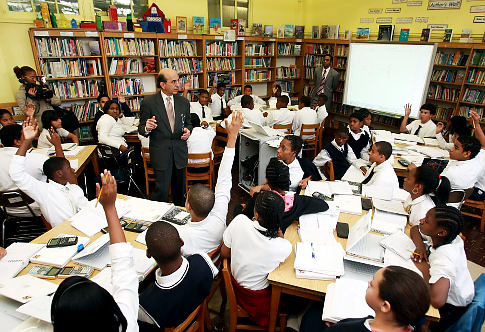
Overcrowded classroom (with DOE Chancellor Joel Klein) with two teachers, PS 189, Brooklyn, NY, September 16, 2009. (Craig Warga/NY Daily News). Qualifies as fair use – blog subject with no comparable picture.

Given where I grew up, instead of having a group of veteran Black teachers for most of elementary schools, I would’ve ended up with some teachers from Teach for America or The New Teacher Project. For the technocrats surely would’ve held my teachers responsible for the sixty-percent poverty rate at my elementary schools, um, I mean, the low test scores. Teachers from these alternate certification programs tend to be well-meaning, perhaps even extremely smart, but not passionate or fully trained teachers. Certainly not like the highly dedicated African American teachers I had at Nathan Hale (now Cecil Cooper) and William H. Holmes Elementary, who held us all to high enough standards to prepare me for a gifted-talented magnet school program known as Humanities.

Of course, given the resources devoted to high-stakes testing, and the constant practice tests, there would’ve been the virtual elimination of music, art, PE, and creative writing. With that shift, there wouldn’t have been a Humanities Program, just a few classes for the best and brightest students. Instead, the option of a private charter school or a KIPP program may have been a possibility. With an average cost of $10,000, however, I doubt a $1,000 or $2,500 voucher would’ve made it possible for me to attend the one, and with KIPP schools being all about discipline, I would’ve thrived there about as much as fish thrive in the desert.

I would’ve moved on to middle school and high school, received algebra in ninth or tenth grade (if at all), struggled to enhance my reading, writing, science, math and other skills, and otherwise would’ve goofed my way to a high school diploma. Would I have taken an AP class, or had a Meltzer as a history teacher, or taken the PSAT or SAT? I’m not sure, but highly unlikely. Still, I would’ve graded with a diploma, with proof that my education was the equivalent of an average ninth or tenth grader’s, confirmed by a decade of standardized state tests!

Then, after three to five years of struggling to find full-time work above minimum wage, or after several years in the military, I’d make the choice between  a University of Phoenix, Kaplan University, DeVry University or some other for-profit college. I’d discover quite quickly that I was wholly unprepared for even the most watered-down online college curriculum, taking courses in a four, six or eight-week format (instead of the typical ten or sixteen-week semester format).

Romanian Army POWs from Battle of Stalingrad, February 3, 1943. (http://ww2incolor.com).

There would’ve been no agonizing choice between Columbia University and the University of Pittsburgh, no switch of majors from computer science to history, no big moment in my development as a person. All because I wouldn’t have had the kind of earth-shattering experience that attending college full-time and in-person often can be.

Somehow, if I’d somehow survived the first semester or first year, I might’ve eventually graduated, albeit with a degree that will be of limited use in obtaining a good living wage. And with $70,000 in student loan debt and a degree from a disreputable for-profit college, forget about me going to graduate school to be a professor.

That’s what this K-16 system will lead to. Money flowing into the hands of illegitimate technocrats, testing companies, charter schools and for-profit institutions. Money and influence flowing from entities like the Bill & Melinda Gates Foundation and Teach for America. A permanent, if slightly better educated, low-wage underclass. That’s the now and future construction of K-16 education if we allow these trends to continue.

Anthony Cody, Gates Foundation in Ed Reform Debate

13 Thursday Sep 2012

Posted by decollins1969 in 1, Academia, Politics, race

≈ 2 Comments

Tags

"Letter From Birmingham Jail" (1963), 21st Century Education, Anthony Cody, Bill & Melinda Gates Foundation, Charter Schools, Education, Education Reform, Impatient Optimists, Irvin Scott, K-12 Education, K-16 Education, Marketplace, Stacey Childress


The below is my response to Irvin Scott and Stacey Childress’ (of the Bill & Melinda Gates Foundation) “Response to Anthony Cody: The Role of the Marketplace in Education.” Given their corporatist, technocratic stance on education reform, I guess I should stop applying for jobs with Gates, since I don’t think they do much in the way of good work in education.

========================================

The use of MLK’s “Letter From Birmingham Jail” is self-serving and sanctimonious here at best, along with the idea that charter schools are public schools, as if the two are interchangeable. King’s letter wasn’t just about the growing impatience of African Americans on the long road to equality. It’s also about how to walk the road, the tools necessary to walk the road, as well as the urgency with which we should walk the road. In my dealings with the Gates Foundation over the years as a nonprofit manager for various projects and initiatives, speed has often been more valuable than getting it right. From the first funding of community-based computer labs in libraries (like Carnegie Library of Pittsburgh) to small schools collaborations with nonprofits and NYC DOE, moving from thought to finish was typically at warp factor five or higher. Even program officers I’ve met or known at Gates have admitted over the years that not every multi-million dollar expenditure for small schools, teacher effectiveness, or teacher evaluations has come with plenty of setbacks and mistakes, as well as inconclusive or minimally positive results.

To argue that charter schools are public schools is technically correct, but in practice, hardly so. Charter schools have their own boards, often do not draw their teachers from the same pool as traditional public schools, and many have selection criteria for students. Charter schools — particularly ones with higher levels of success — often have board members with deep pockets or are able to raise funds through those kinds of connections. They may have by-laws that enable them to hire non-union teachers, non-traditional teachers, even college instructors, in ways that traditional public schools simply cannot. And though the selection criteria for students varies from one charter school to the next, traditional public schools don’t have that option.

Yes, we need a twenty-first century education system in the US. But we’re not going to get there with more high-stakes standardized testing, with curriculum and teacher evaluations that are tied to test scores, with the funding of every half-baked idea that has its roots in the twentieth century. Real reform requires more than smart people entrusted with a portfolio of $5 or $10 million. It comes with real cooperation with educators, a commitment to engage parents, a curriculum that is about education beyond a test, a full-fledged effort at human development, not just job training. One thing that would be a place to start would be to focus on K-16 education, instead of separating the K-12 and post-secondary spheres, you know, to break free of our twentieth-century thinking about American education.

Irvin Scott and Stacey Childress should know all of this already. If they do not, shame on them for not doing the research and outreach that is a necessary part of grantmaking. However, since they do, it seems to me they need to do less defending of the Gates Foundation’s record and more work and real collaboration to move forward. “We don’t need no education” reform, so long as it continues to come out of elite money and thinking that dictates to the rest of us what reform will look like.

A Call for Psychological Screenings

13 Thursday Sep 2012

Posted by decollins1969 in 1, Academia, culture, eclectic music, Movies, Politics, Pop Culture

≈ 1 Comment

Tags

Aurora Colorado, College Admissions, Colleges & Universities, Community Engagement, Community Responsibility, Counseling, Gun Control Debate, James Holmes, K-12 Education, K-16 Education, Mass Shootings, Mental Health Screenings, Psychological Profiles, Psychological Testing, Second Amendment, The Dark Knight Rises


Fourth blot of the Rorschach inkblot test, 1921, February 21, 2008. (Bryan Derksen via Wikipedia). In public domain.

Given that it’s the start of a new school year, and in the wake of so many shootings over the summer, it’s time to reformulate how we deal with violence and mass shootings. The saddening eruption of yet another mass shooting by former graduate student James Holmes at the The Dark Knight Rises opening in Aurora, Colorado in July is a case that makes clear my point. It’s time for colleges and universities to do psychological profiles as a requirement for admissions and attendance, and for public schools to be more proactive in providing psychological services.

James Holmes in court in Aurora, July 23, 2012. (Peterson/AP/CBS News).

There’s been much discussion of gun laws, assault weapons bans, and polls that show that a majority of Americans are anti-gun control. But there hasn’t been nearly enough dialogue about how to detect potential domestic threats to our safety to begin with. The majority of domestic threats in the past generation have come from young and mostly White males, either in high school or in higher education. We as a nation are either sympathetic — as in “how could they have turned out so wrong?” — or vengeful toward these perpetrators. We give so much thought to the Second Amendment that we completely neglect the root cause, the one thing the sympathetic and the vengeful do agree on. That someone like James Holmes would have to be psychologically unstable or “crazy” to do what he did.

The list of school and college-related mass murders and shootings goes something like this since 1996. San Diego State University, Pearl, Mississippi, West Paducah, Kentucky, Jonesboro, Arkansas, Littleton, Colorado,  University of Arkansas, University of Arizona School of Nursing, Virginia Tech (twice, in 2007 and 2011), Chardon, Ohio and Oikos University. Though Holmes technically didn’t unload his 100 or so bullets on a college, high school or middle school campus, he lived in the Aurora, Colorado community in part because he was a one-time University of Colorado graduate student.

It’s beyond time for schools and especially colleges and universities to remember that they are very much a part of communities, not just gigantic entities unto themselves. Part of the responsibility of being a significant member of a community is to play a significant role in ensuring the safety of the community. Not just on the actual middle school, high school or a higher education institution campus, but in the surrounding community as well.

Part of taking all necessary actions to ensure the safety of students, teachers, professors, administrators and community members is providing services that could identify behavioral or psychological issues among students. We’ve learned in the cases of Eric Harris and Dylan Klebold — the Columbine High School shooters — and in the case of Seung-Hui Cho — the Virginia Tech shooter — that consistent psychological services may have prevented these murders and injuries. Had psychological screening been performed and other related steps — including barring these individuals from contact with the campus and reporting potential threats to law enforcement — these students might well have become productive citizens.

Peanuts’ Lucy Van Pelt as psychiatrist, September 12, 2012. (http://digitalcitizen.ca). Qualifies as fair use under US Copyright laws due to blog post’s subject matter.

Of course, there’s no way to know for sure if readily available psychological services at the K-12 level and required screenings at the college level would lead to a reduction in student-related mass shootings. But it would allow for the opportunity for students at an early age to discuss their delusions of grandeur, their feelings of isolation or ostracism, their rage and their need to strike out against fellow students and community members alike. It would give colleges and universities the opportunity to truly get to know potential students beyond their grades and community service opportunities, and to understand how first-year students respond to stresses and pressures of college long before they become a threat.

Most importantly, mental health screening would allow a college or university to identify psychological issues with a students before accepting them into their institutions. While this proscription may make university administrators and school district superintendents squeamish, it is certainly a conversation worth having. After all, it’s not as if the debate about gun control has gotten any of us anywhere in the past 50 years.

The Wussification of Grading

29 Wednesday Aug 2012

Posted by decollins1969 in 1, culture, Eclectic, Politics, Youth

≈ Leave a comment

Tags

Core Curriculum, Education, Elementary School, Grading Systems, K-12 Education, MCPS, Montgomery County Public Schools, Politics of Education, Psychology of Grading, Test Teaching, Testing, Wussification


Grades Collage, January 24, 2010. (http://hopkins.typepad.com).

Montgomery County Public Schools opened its doors to students for the start of the 2012-13 school year on Monday, August 27. With the start of the school year came some new changes to the report card and grading system, at least for MCPS’ elementary schools. Starting this year, the school district has dropped the old grading system of O, S and N (Outstanding, Satisfactory and Needs Improvement) for first and second graders, and the old A, B, C, D and E system for third, fourth and fifth graders. Instead, they’ve introduced a new grading system for all 1st-5th graders:

Score Description
ES Exceptional at the grade-level standard
P Meets the grade-level standard by demonstrating proficiency of the content or processes for the measurement topic
I In progress toward meeting the grade-level standard
N Not yet making progress or making minimal progress toward meeting the grade-level standard
M Missing data – no grade recorded
NEP Not English Proficient; may be used for a level 1 or 2 ESOL student for no more than two marking periods.

According to MCPS, “[t]he goal of this grading format is to give families a clear understanding of your child’s progress toward end of year grade level expectations.”

Now, I’ve been an educator of some sort now for the better part of two decades, and have worked with several grading systems as a college professor. Not to mention having to learn different grading systems as a student even before that. Trust me when I say that this new grading system isn’t a clear one, and isn’t easy to understand.

But the overall goal is clear. MCPS wants to tie grades to their new yet only partially implemented integrated Curriculum 2.0, adopted as part of the new Core Curriculum for the state of Maryland. It is an integrated, standards-based curriculum that introduces a variety of interrelated themes across the various subjects for K-5 (although fourth and fifth grade will not see any of this curriculum until 2013, when my son is in fifth grade). In theory, this grading system will be more directly tied to students’ proficiency levels in achieving or exceeding state-level standards in reading, mathematics, writing and other subjects for their grade level.

Sounds reasonable, doesn’t it? After all, if a child is proficient in say, the fourth-grade standard for reading, then they would receive a P grade. This is unreasonable, though, and for at least a couple of reasons. For one, it means the entire MCPS elementary school curriculum has become about meeting standards that will be tested at the state-level on the MSA, and at the county level on MAP-R. The curriculum itself has now become integrated into the testing game at the elementary school level.

Second, and maybe even more important here, is the idea that grading-to-a-testing-based-curriculum is a better and more accurate way to assess children. I’m not sure how this helps kids, though. If a student does well enough to score multiple “ES'” on their report card, they’ve exceeded the standard for their grade level. But this doesn’t necessarily mean they are ready for the next grade level. If a student has multiple N’s on their report card, does that mean that they have failed to meet the standards in several subjects at their grade level, that they aren’t making progress?

ESPN logo, August 29, 2012. (http://thebiglead.com). In public domain.

It seems to me that beyond understanding the grading system and the tensions in its methodology is the fact that, in the end, these grades aren’t going to mean much to MCPS’ K-5 students. Or to students across the state of Maryland, for that matter. After all, an A, C, or E is much easier to interpret than an ES, P, I or N (or ESP(i)N, as I’ll begin to call it from now on). Psychologically speaking, while this grading system takes some symbolic pressure off of performance via state and county test scores, it also means that kids won’t have a full appreciation for success, mixed success or failure beyond a curriculum of testing.

It would’ve been smarter to go to a qualitative grading system — something that I know some schools and universities have used over the years — than to this one that ties curriculum and grading systems to testing. At least with a descriptive system of grading, you can get in a single paragraph a fairly focused analysis from a teacher about a student’s progress, their strengths, weaknesses and where they’ve had good or great success. This new MCPS grading system, though, is the academic equivalent of giving every team in a children’s soccer league a trophy, whether their record was 10-0 or 0-10. It pretty much renders grading meaningless, as everything is about standards and measurements, and ultimately, testing.

Holes in Foundation Shield of Education Funding

03 Thursday Nov 2011

Posted by decollins1969 in 1, Academia, Boy @ The Window, Eclectic, Politics, race

≈ Leave a comment

Tags

Academia, Bill Gates. Makin' It Rain, Collaboration, Early College High Schools, Education, Education Reform. K-16 Education, Foundations, Funding, Higher Education, K-12 Education, K-8 Schools, Linkages, P-20 Education, Race, Real Reform. Overhaul of P-20 Education, Social Justice, Synergy


Leather knight shield with holes, November 2, 2011. (http://paulssupplies.com)

As an educator and someone who has worked in the nonprofit world on education reform issues for slightly less than half of my life (I turn forty-two next month), it’s curious and disappointing to continue to see a scatter-shot and tweaking approach to education reform. An approach that often gets the bulk of the funding from private and corporate foundations.

If what Bill Gates said at the National Education Summit in Washington, DC in February 2005 is correct, that “American high schools are obsolete in their current form” — and I believe he is — then why does his foundation and others fund mostly small-scale projects? Especially ones that have few, if any, possibilities for replication or for making American high school more relevant to the twenty-first century?

But let me not pick on the Bill & Melinda Gates Foundation as being neglectful of seeing the big, panoramic picture on K-12, K-16 or even P-20 education. Below, in general, are the parts of education process the big foundations have tended to fund over the past five to ten years:

Preschool, Pre-K Education = Annie E. Casey Foundation, Pew Trusts

K-12 Education = Gates Foundation, Hewlett Foundation

Higher Education, Education Research = Spencer Foundation (most $$$ now via AERA/NAE), Mellon Foundation

Higher Education Access/Success = Lumina Foundation for Education, Ford Foundation, Gates Foundation, Jack Kent Cooke Foundation

Student Financial Aid = Lumina Foundation for Education, Gates Foundation

Teacher Effectiveness = Gates Foundation, Hewlett Foundation, Ford Foundation

Poverty, Community Development, Race = W.K. Kellogg Foundation, MacArthur Foundation, Pew Trusts, Ford Foundation, Annie E. Casey Foundation, Gates Foundation.

They have funded and still do fund everything from early childhood education programming, credentials for early childhood educators, small schools, research for curriculum realignment, online education options for K-12, leadership programs for principals and school superintendents, to student and teacher incentive programs, fiscal and human resources allocation, early and middle college high schools, and assessments for teacher effectiveness. (By the way, that is the longest sentence I’ve ever written, at least without editing into

Ed Harris as Jackson Pollock in Pollock (2000), spreading and throwing paint, August 6, 2009. (http://www.totalfilm.com).

smaller sentences).

Seems like everything in the P-20 education universe is covered, right? Except, I’d defy anyone in or out of the education field to try to add all of this up into a comprehensive overhaul of early childhood and K-12 education that would then force reform in higher education.

The reason that we can’t assume that all of this adds up to real reform is simple. A dozen or so foundations pouring billions of dollars into a quarter-trillion dollar a year system through tens of thousands of grants, each working on a separate problem? By definition, a comprehensive overhaul isn’t possible. It’s as unlikely as Wall Street disengaging itself from American politics without a decade of Occupy Wall Street.

We could start, conceivably, with the idea of early and middle college high schools. One where school districts and the colleges and universities adopting these high schools collaborate on creating a system that would leave high school graduates with the equivalent of two years of college training or an associate’s degree. Or in the case of students who made plans to not go to college, two years of training that would make them employable in the twenty-first century workforce.

Only, these early and middle college high schools would be without the additional burden of providing remediation to ninth graders not ready for what we now call high school. Bottom line: we need a single-track college/career ready system that begins its work in preschool and pre-K programs, one in which these programs are tied to elementary schools, so that it doesn’t take the poorest of students three years to catch up. We need linkages between elementary and middle schools — or as many researchers suggest, K-8 schools — where the work to make students ready for algebra, critical thinking through writing and the arts could take shape in a more supportive and coherent environment.

More direct linkages between schools and community organizations and services — health clinics, psychological services, nonprofit organizations focused on the arts, writing, sports, science and math — are

Crane removing part of Berlin Wall at Brandenburg Gate, December 21, 1989. (SSGT F. Lee Corkran/US Dept of Defense). In public domain.

necessity to build communities that are committed to large-scale education reform. For if these organizations and systems continue to work in parallel series rather than in collaboration, all these attempts at reform are for naught.

But foundations have always been leery to link their work, to fund for the long-term, to think in ways that encourage collaboration — kind of like corporations, Wall Street bankers and the GOP. They also tend not to hire deep thinkers on issues like education. Or at least, the linkages between education, race, class, gender, community and the workforce.

Though they are doing a better job these days, especially in the case of the Kellogg Foundation on race, we need a more solid shield. One that is truly about transforming P-20 education, and not just tweak it with data and pilot programs. Funding programs without a grander vision might as well be a “make it rain” party at a strip club.

Education Incorporated

13 Thursday Oct 2011

Posted by decollins1969 in 1, Academia, culture, Eclectic, Politics, race, Work, Youth

≈ 1 Comment

Tags

"genius" award, Anya Kamenetz, Bill & Melinda Gates Foundation, Brookings Institution, Center for American Progress, Corporate Interests, Corporate Models, DIYu, Early College High Schools, Education, Education Reform, Edupunks Guide, Higher Education, K-12 Education, MacArthur Foundation Award, Michelle Rhee, No Child Left Behind, Roland Fryer Jr., Single-Track College Prep School Systems, Teach for America, The Hamilton Project, The New Teacher Project, Wendy Kopp, Workforce Development


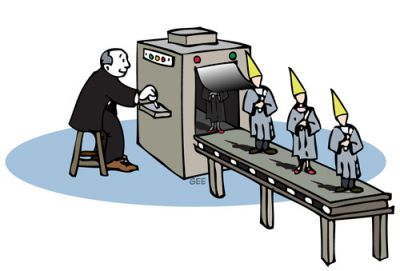
Capitalist Education Factory, November 1, 2010. (Source/http://communiststudents.org.uk).

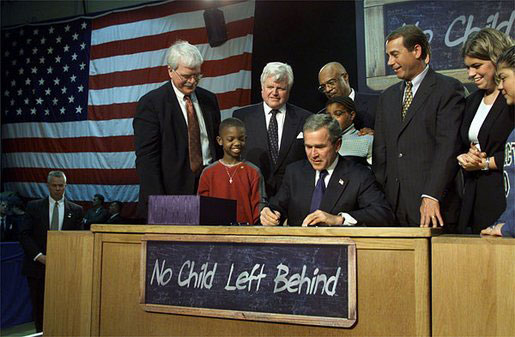
A generation ago, most of us in education worried about a federal government takeover of America’s 15,000 school districts with mandated standards. Wow, that prediction was way off, wasn’t it? (Oh, wait, the No Child Left Behind Act, passed in 2001, created a new era of national standards for accountability, not to mention high-stakes testing).

President George W. Bush signs into law the No Child Left Behind Act, Hamilton HS, Hamilton, Ohio, January 8, 2002. (http://www.whitehouse.gov). In public domain.

Now, we worry with good reason, as corporate interests inject themselves into education reform at every level. This has brought an imbalance to the education reform conversation that hasn’t existed since the days of Andrew Carnegie and the height of immigration of swarthy peoples from Southern and Eastern Europe. Now, as it was a century ago, it was the inclusion-vs.-exclusion debate. Whether to provide the best possible education for all comers, or sort and kick out as many “dull-minded” “undesirables” (both literally from 1911 to describe the learning disabled, immigrants and Black migrants) in K-12 schools as possible.

But this debate today — if we can really call it that — includes higher education. Of course, we know better than to call the millions of potential students who need some sort of post-high school training and education “morons” (also a 1911 term used by White psychologists who assumed anyone not WASP didn’t have the mental capacity to make use of a high school education). Yet we do attempt to sort these students and potential students into categories, like “adult learners,” “non-traditional students,” even “Edupunks,” a term

Anya Kamenetz, author of Edupunks Guide, at University of South Dakota, August 27, 2010. (http://www.usd.edu). In public domain.

coined by author Anya Kamenetz.

None of this has eliminated a common refrain in our field. That a four-year degree “isn’t for everyone,” as Kamenetz said to me after I asked her a tough question regarding the accessibility of her ideas for a Do-It-Yourself-university (DIYu) process of pursuing a college degree. It was a conference hosted by the Center for American Progress, but paid for by the Bill & Melinda Gates Foundation. Her idea, while helpful to 18-30 year-olds who are tech-savvy and with enough income to make this piecemeal education process work, was unhelpful to low-income students, and students of color over the age of thirty. And Kamenetz’s response was the typical exclusionary one.

Apparently, in our current economic climate, a full-time job isn’t for everyone either. Still, despite this reality, the Gates Foundation, Lumina Foundation for Education, and the Hewlett Foundation have all adopted similar models of thought around K-12 and higher education reform that have legitimized the work of people like Wendy Kopp and Michelle Rhee (Teach for America and The New Teacher Project, respectively) and institutions like University of Phoenix and Kaplan University. Models which draw heavily from corporate paradigms for success, including the punishment of failure. But they haven’t led millions of us to jobs in the new economy.

I recently attended a meeting hosted by the Brookings Institution’s Hamilton Project, in which authors presented a series of papers on K-12 education reform. Supposedly with cutting-edge ideas. Like one presented by MacArthur Foundation “genius” (emphasis on the quotation marks) Award winner Roland Fryer on providing student incentives linked to immediate and long-term educational goals for those most at risk of

Professor Roland Fryer, Harvard University Department of Economics, September 2011. (http://economics.harvard.edu).

dropping out of school, like low-income boys of color. Examples of paying fifth graders in Houston and New York $2 for every book they read or for completing their homework wasn’t so much cutting-edge as it was unremarkable. Incentives are fine, if you can pay for them or show how they nurture a passion for learning beyond the goal of completing individual tasks. This, of course, the “genius” couldn’t show.

The ridiculous assumption that Fryer made, arguing that because money in K-12 education had doubled since 1970, that funding wasn’t the issue, would’ve made me laugh as a high school senior. When you account for inflation, K-12 funding has declined, and not by a small amount, since the 1970s, and by the way, the millennial generation has created a new demand for schools, as the number of new schools or schools in need of renovations adds to this doubling in four decades. Fryer’s exclusion of data that a first-year graduate student wouldn’t have missed made me realize that most people in the field are so desperate for ideas that anything that sounds new must be good or cutting-edge. Especially if it’s funded by the Gates Foundation.

It’s not just the Gates Foundation, per se. It’s the idea that since things aren’t working for millions of students and undereducated workers, a model that concentrates on teacher effectiveness and treating students as customers — whether in fifth grade or in college — is the best way to go. This attitude has become so pervasive among well-funded education reformers that the idea of increasing funding for schools, or of making schools from pre-K on focus on all students in need of college/workforce readiness is about as welcome as Michael Moore at a Koch Brothers fundraiser.

Early college high schools and single-track, college-prep K-12 school districts, two of the great secrets of K-12 and higher education reform, remain such because these are difficult to bring to scale, and require more upfront investment than most philanthropists and businesses are willing to make. Not to mention, these represent the hard work of real reform, but ones that won’t make people like Kamenetz, Fryer, Kopp and Rhee stars. But by all means, let’s continue to fund every hair-brained idea as if tweaking our education system will yield results like a nuclear fusion plant on steroids.

← Older posts
Newer posts →

Boy @ The Window: A Memoir

Boy @ The Window: A Memoir

Places to Buy/Download Boy @ The Window

There's a few ways in which you can read excerpts of, borrow and/or purchase and download Boy @ The Window. There's the trade paperback edition of Boy @ The Window, available for purchase via Amazon.com at http://www.amazon.com/Boy-Window-Donald-Earl-Collins/dp/0989256138/

There's also a Kindle edition on Amazon.com. The enhanced edition can be read only with Kindle Fire, an iPad or a full-color tablet. The links to the enhanced edition through Apple's iBookstore and the Barnes & Noble NOOK edition are below. The link to the Amazon Kindle version is also immediately below:

scr2555-proj697-a-kindle-logo-rgb-lg

Boy @ The Window on Amazon.com: http://www.amazon.com/Boy-The-Window-Memoir-ebook/dp/B00CD95FBU/

iBookstore-logo-300x100

Boy @ The Window on Apple's iBookstore: https://itunes.apple.com/us/book/boy-the-window/id643768275?ls=1

Barnes & Noble (bn.com) logo, June 26, 2013. (http://www.logotypes101.com).

Boy @ The Window on Barnes & Noble: http://www.barnesandnoble.com/w/boy-the-window-donald-earl-collins/1115182183?ean=2940016741567

You can also add, read and review Boy @ The Window on Goodreads.com. Just click on the button below:

Boy @ The Window

Twitter Updates

Tweets by decollins1969
  • RSS - Posts
  • RSS - Comments

Archives

  • June 2025
  • April 2023
  • September 2022
  • August 2022
  • July 2022
  • June 2022
  • May 2022
  • April 2022
  • March 2022
  • January 2022
  • December 2021
  • November 2021
  • October 2021
  • September 2021
  • August 2021
  • July 2021
  • June 2021
  • April 2021
  • March 2021
  • February 2021
  • January 2021
  • December 2020
  • November 2020
  • October 2020
  • September 2020
  • August 2020
  • July 2020
  • May 2020
  • April 2020
  • March 2020
  • January 2020
  • December 2019
  • November 2019
  • August 2019
  • July 2019
  • June 2019
  • May 2019
  • April 2019
  • March 2019
  • February 2019
  • January 2019
  • December 2018
  • November 2018
  • October 2018
  • September 2018
  • August 2018
  • July 2018
  • June 2018
  • May 2018
  • March 2018
  • February 2018
  • January 2018
  • December 2017
  • November 2017
  • October 2017
  • September 2017
  • August 2017
  • July 2017
  • June 2017
  • May 2017
  • April 2017
  • March 2017
  • February 2017
  • January 2017
  • December 2016
  • November 2016
  • October 2016
  • September 2016
  • August 2016
  • July 2016
  • June 2016
  • May 2016
  • April 2016
  • March 2016
  • February 2016
  • January 2016
  • December 2015
  • November 2015
  • October 2015
  • September 2015
  • August 2015
  • July 2015
  • June 2015
  • May 2015
  • April 2015
  • March 2015
  • February 2015
  • January 2015
  • December 2014
  • November 2014
  • October 2014
  • September 2014
  • August 2014
  • July 2014
  • June 2014
  • May 2014
  • April 2014
  • March 2014
  • February 2014
  • January 2014
  • December 2013
  • November 2013
  • October 2013
  • September 2013
  • August 2013
  • July 2013
  • June 2013
  • May 2013
  • April 2013
  • March 2013
  • February 2013
  • January 2013
  • December 2012
  • November 2012
  • October 2012
  • September 2012
  • August 2012
  • July 2012
  • June 2012
  • May 2012
  • April 2012
  • March 2012
  • February 2012
  • January 2012
  • December 2011
  • November 2011
  • October 2011
  • September 2011
  • August 2011
  • July 2011
  • June 2011
  • May 2011
  • April 2011
  • March 2011
  • February 2011
  • January 2011
  • December 2010
  • November 2010
  • October 2010
  • September 2010
  • August 2010
  • July 2010
  • June 2010
  • May 2010
  • April 2010
  • March 2010
  • February 2010
  • January 2010
  • December 2009
  • November 2009
  • October 2009
  • September 2009
  • August 2009
  • July 2009
  • June 2009
  • May 2009
  • April 2009
  • March 2009
  • February 2009
  • January 2009
  • December 2008
  • November 2008
  • October 2008
  • September 2008
  • August 2008
  • July 2008
  • June 2008
  • May 2008
  • April 2008
  • March 2008
  • February 2008
  • January 2008
  • December 2007
  • November 2007
  • October 2007
  • September 2007
  • August 2007
  • July 2007
  • June 2007

Recent Comments

decollins1969's avatardecollins1969 on No Good Teaching Deed Goes…
Mary Rose O’Connell's avatarMary Rose O’Connell on No Good Teaching Deed Goes…
Lyndah McCaskill's avatarLyndah McCaskill on The Raunchiest of Them Al…

NetworkedBlogs on Facebook

NetworkedBlogs
Blog:
Notes From a Boy @ The Window
Topics:
My Life, Culture & Education, Politics & Goofyness
 
Follow my blog

616 616 East Lincoln Avenue A.B. Davis Middle School Abuse Academia Academy for Educational Development AED Afrocentricity American Narcissism Authenticity Bigotry Blackness Boy @ The Window Carnegie Mellon University Child Abuse Class of 1987 CMU Coping Strategies Crush #1 Crush #2 Death Disillusionment Diversity Domestic Violence Economic Inequality Education Family Friendship Friendships Graduate School Hebrew-Israelites High-Stakes Testing Higher Education History Homelessness Humanities Humanities Program Hypocrisy Internalized Racism Jealousy Joe Trotter Joe William Trotter Jr. K-12 Education Love Manhood Maurice Eugene Washington Maurice Washington Misogyny Mother-Son Relationship Mount Vernon High School Mount Vernon New York Mount Vernon public schools Multiculturalism MVHS Narcissism NFL Pitt Pittsburgh Politics of Education Poverty President Barack Obama Race Racial Stereotypes Racism Relationships Self-Awareness Self-Discovery Self-Reflection Sexism Social Justice Teaching and Learning University of Pittsburgh Violence Whiteness Writing

Top Rated

Blog at WordPress.com.

  • Subscribe Subscribed
    • Notes from a Boy @ The Window
    • Join 103 other subscribers
    • Already have a WordPress.com account? Log in now.
    • Notes from a Boy @ The Window
    • Subscribe Subscribed
    • Sign up
    • Log in
    • Report this content
    • View site in Reader
    • Manage subscriptions
    • Collapse this bar
 

Loading Comments...