• About Me
  • Other Writings
  • Interview Clips
  • All About Me: American Racism, American Narcissism, and the Conversation America Can’t Have
  • Video Clips
  • Boy @ The Window Pictures
  • Boy @ The Window Theme Music

Notes from a Boy @ The Window

~

Notes from a Boy @ The Window

Tag Archives: Academia

“It Is Done” – 15 Years Later

21 Monday Nov 2011

Posted by decollins1969 in 1, Academia, Boy @ The Window, culture, Eclectic, race, Youth

≈ Leave a comment

Tags

Academia, Barbara Lazarus, Barbara Sizemore, Betrayal, Calling, Careers, Carnegie Mellon University, Catherine Lugg, Dan Resnick, Daniel P. Resnick, Dissertation, Distrust, Education, Epiphany, Joe Trotter, Joe William Trotter Jr., Self-Discovery, Writing
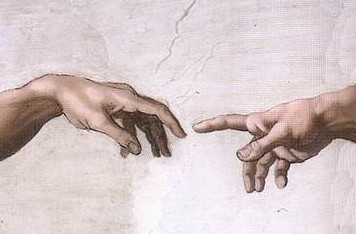

Hands of God & Adam, fingers about to touch, Sistine Chapel ceiling, Vatican, Michelangelo, 1508-1512 (via Wikipedia). In public domain.

The next twenty-four hours will mark a decade and a half since my former dissertation advisor Joe Trotter wrote today’s title quote in a God-like-pronouncement of an email to me regarding my final content-based revisions to my doctoral thesis. With those revisions following my committee meetings in October, I was now officially Dr. Collins. I knew that. I just didn’t feel it.

Working on a book-length research project with an abusive advisor and disinterested committee members at a school as conservative and isolating as Carnegie Mellon University left me exhausted. For I never felt I could ever be all of myself there. I made myself into the scholar I hoped that I wouldn’t become. At least, the twenty-one version of me that began graduate school back in ’91 held that hope. Five years later, I felt alienated from my own purpose and calling, and was more than unsure about becoming a full-time professor and historian. Especially given the wonderful examples of scholarly inhumanity and hypocrisy that Trotter, Dan Resnick and so many others had proven themselves to be (see “You’re Not Ready” post from November ’08 and “And Now, A Plagiarism Moment” post from September ’10).

I was burned out. I felt numb, with a boiling mantle of rage underneath the surface. If Trotter had said the

Arching fountain of a Pahoehoe (like my post-PhD rage) approximately 10 m high issuing from the western end of the 0740 vents, a series of spatter cones 170 m long, south of Pu‘u Kahaualea, September 10, 2007. (USGS via Wikipedia). In public domain.

wrong thing to me at the wrong time in ’96, I probably would’ve laid him out with a right hook to the jaw. And Resnick’s lucky that I didn’t own a car, because I might’ve run him down with it.

As it was, when Trotter attempted to meet with me a few weeks later to discuss “my future,” I refused. Especially given his suggestions for job applications. One, a one-year position at a University of Nebraska branch campus. The other, a CUNY school in Queens with a proposed position that wouldn’t begin until July ’98. I told him, “You don’t get to determine my future, certainly not without me.”

What should’ve been a period of rest and repair between Thanksgiving Week ’96 and graduation day in May ’97 was hardly that at all. It took me, really and truly, six months to recover from the dissertation process, and probably close to two years to not pass by or go on Carnegie Mellon’s campus without wanting to strangle my dissertation committee with piano wire. By then, I’d moved on to the rather mundane task of figuring out how to cobble together a career that wasn’t dependent on a full-time faculty position in academia.

And over the past fifteen years, I have pieced together several careers. As a part-time college professor, as a nonprofit program officer and as a consultant. It helped to have people like the late Barbara Lazarus and my dear friend Cath Lugg in my corner in those first years after I’d finished my doctorate. It helped that I expanded my career options from merely pursuing a history professorship wherever Joe Trotter’s winds could’ve taken me.

But it helped, most of all, for me to start trusting my instincts, my own heart, again. The irony of my complete disillusionment at the end of my degree-earning journey was that it left me with the time to contemplate whom I thought I really was, what I really wanted to do in life, and how I wanted to do it.

It was far from an immediate process of epiphanies and revelation. It took me nearly six years after finishing my dissertation to see myself as a writer, cutting through twenty years of denial and abuse in the process. It took me a little longer to see myself as a writer first and foremost, with all of my other professional hats second, third, and so forth. To understand that mine was a concern far greater than multiculturalism in education. My role as a writer and educator was also about aspirations, academic pathways to success, racial and ethnic equity in education, access to and success in college.

Barbara Sizemore, 1927-2004, circa mid-1990s. (http://sesp.northwestern.edu).

Now, that doesn’t mean that I haven’t looked back to wonder what could’ve been. If I were a White male with my credentials, I’d long ago been doing what I’ve been fighting to do as a writer and educator for years. If my advisors had been someone like a Cornel West or Henry Louis Gates. Or if I had attended an Ivy League school in undergrad. Or if I’d earned a master’s degree in journalism or communications, or a doctorate in a school of education or in psychology.

The late Barbara Sizemore once warned me about earning my doctorate in history some two decades ago. “You always have to do things the hard way, don’t you?,” she said to me with disapproval when she learned of my acceptance into Pitt’s history PhD program. I should’ve said, “Yes, I do.” Because the last fifteen years have been a hard road, as all roads to enlightenment are.


Rate My Students Dot Dot Dot

09 Wednesday Nov 2011

Posted by decollins1969 in 1, Academia, culture, Eclectic, Politics, race

≈ 1 Comment

Tags

Academia, Communications, Email Exchange, Racism, Rating Systems, Student Evaluations, Students, Teaching, Teaching and Learning, US History


Thumbs Up, Thumbs Down, April 14, 2010. (http://http://teachingjobsportal.com).

Because there’s a website called RateMyProfessors.com, there also ought to be one called Rate My Students.com. Unfortunately, the only thing we have as faculty that indicates student performance is their grade in a course. But student demeanor, attitudes toward learning and their professors, about their level of commitment to being good students? For that, the only thing we have to go on are our communication exchanges with students and their responses, particularly on an evaluation. Below is one such exchange:

—–Original Message—–
From: Anonymous Student
Sent: Sat 9/10/2011 12:45 AM
Subject: Paper feedback question

I mentioned in my paper that the US feared soviet control of the Middle East and you said that it was never a concern. However, on page 61 of “Present Tense” It mentions the soviets backing a separatist movement in Iran and pressed Turkey to give the Soviet’s joint control over the Dardanelles which make some in the US government nervous that “the soviets would make a sweep across Turkey and Iran, which would give it control over much of the Middle East and its oil reserves.” The book then mentions that Truman sent a Naval task force into the Mediterranean as a warning to the Soviets.

My question is, how was the Soviet presence in the Middle East hardly a concern if it made Truman nervous enough to take military action. Granted it wasn’t a concern for long, and I could have gone more in depth, but I’m still getting conflicting information. Thanks

On Sat, Sep 10, 2011 at 6:28 AM, Donald Collins wrote

Thanks for your email. You didn’t get credit for this point because it was a blanket and general statement, without any detail or nuance. You made it sound as if the Middle East was on the same level of concern as Europe, East Asia and the US itself. Plus, Turkey was and is not considered an oil state, and US concern over Greece and Turkey was much more a European concern than a Middle Eastern one — it helped lead to the first installment of what became the Marshall Plan. Only with Iran do you have a small point, but Iran wasn’t mentioned in your paper. And, more to that point, if the Middle East was such a concern, why didn’t Truman send a naval task force into the Persian Gulf in the late 1940s?

Yes there was fear and concern, but the actual decisions and actions that came out of it were so limited that one cannot simply say that the US feared control of the Middle East because of their tremendous oil reserves — in 1947…

But the real issue here is that you lost sight of the forest on this topic question, concentrating instead on this tree regarding the Middle East. You did not do enough to outline and analyze the factors involved in promoting and escalating the Cold War. You talked about events as examples of the Cold War, with some (like the Middle East) lacking in factual detail or explanation as to what, if any, factor or factors they fit in. Like the Soviet’s desire for a buffer zone in Eastern Europe and with eastern Germany. Or the US policy of aggressive containment of communism, as your example of the Middle East could’ve indicated, if it had been more specific — the Korean War or the Berlin Airlift are much better examples of this factor. Or the nuclear weapons and related systems races, including for long-range bombers, missiles, submarines from 1949 onward — bringing both countries ever closer to a possible hot and nuclear war.

The textbooks are just that, textbooks. They are not the Bible, and they are not even ones that I would choose to use if I could order my own textbooks. They are a guide, but, then again, so are my lecture notes, which would have helped clear up much of your confusion on this issue. I hope that this helps.

Professor Collins

From: Anonymous Student
Sent: Sat 9/10/2011 4:09 PM
Subject: Re: Paper feedback question

I figured the main problem was not going in depth enough, but I was worried about lingering for too long on certain subjects.

Anonymous Student’s response via evaluation (received October 27, 2011):

Donald Collins is very well versed in the events of the civil rights movement and not much else. Several times during the course he marked down assignments that I had completed based on what he incorrectly perceived to be factual errors. The one time I brought this up to him via email he wrote it off as “not important enough in the grand scheme of things” ignoring the fact that he stated that an event had never occurred despite being talked about in more than one of the assigned texts for the class….I still received a low grade on that assignment as well as others because of Collins’ seeming insistence that everything be tied into the civil rights movement regardless of how unrelated what I was writing about may have been to it…

—

This isn’t the first time I’ve received a racist response from a student for doing my job, and I’m certain it won’t be the last. But if I could, I’d recommend that this person learn how to be a good student first before pushing his deficiencies and bigotry onto me and other faculty.

Holes in Foundation Shield of Education Funding

03 Thursday Nov 2011

Posted by decollins1969 in 1, Academia, Boy @ The Window, Eclectic, Politics, race

≈ Leave a comment

Tags

Academia, Bill Gates. Makin' It Rain, Collaboration, Early College High Schools, Education, Education Reform. K-16 Education, Foundations, Funding, Higher Education, K-12 Education, K-8 Schools, Linkages, P-20 Education, Race, Real Reform. Overhaul of P-20 Education, Social Justice, Synergy


Leather knight shield with holes, November 2, 2011. (http://paulssupplies.com)

As an educator and someone who has worked in the nonprofit world on education reform issues for slightly less than half of my life (I turn forty-two next month), it’s curious and disappointing to continue to see a scatter-shot and tweaking approach to education reform. An approach that often gets the bulk of the funding from private and corporate foundations.

If what Bill Gates said at the National Education Summit in Washington, DC in February 2005 is correct, that “American high schools are obsolete in their current form” — and I believe he is — then why does his foundation and others fund mostly small-scale projects? Especially ones that have few, if any, possibilities for replication or for making American high school more relevant to the twenty-first century?

But let me not pick on the Bill & Melinda Gates Foundation as being neglectful of seeing the big, panoramic picture on K-12, K-16 or even P-20 education. Below, in general, are the parts of education process the big foundations have tended to fund over the past five to ten years:

Preschool, Pre-K Education = Annie E. Casey Foundation, Pew Trusts

K-12 Education = Gates Foundation, Hewlett Foundation

Higher Education, Education Research = Spencer Foundation (most $$$ now via AERA/NAE), Mellon Foundation

Higher Education Access/Success = Lumina Foundation for Education, Ford Foundation, Gates Foundation, Jack Kent Cooke Foundation

Student Financial Aid = Lumina Foundation for Education, Gates Foundation

Teacher Effectiveness = Gates Foundation, Hewlett Foundation, Ford Foundation

Poverty, Community Development, Race = W.K. Kellogg Foundation, MacArthur Foundation, Pew Trusts, Ford Foundation, Annie E. Casey Foundation, Gates Foundation.

They have funded and still do fund everything from early childhood education programming, credentials for early childhood educators, small schools, research for curriculum realignment, online education options for K-12, leadership programs for principals and school superintendents, to student and teacher incentive programs, fiscal and human resources allocation, early and middle college high schools, and assessments for teacher effectiveness. (By the way, that is the longest sentence I’ve ever written, at least without editing into

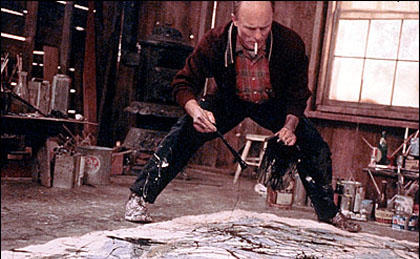
Ed Harris as Jackson Pollock in Pollock (2000), spreading and throwing paint, August 6, 2009. (http://www.totalfilm.com).

smaller sentences).

Seems like everything in the P-20 education universe is covered, right? Except, I’d defy anyone in or out of the education field to try to add all of this up into a comprehensive overhaul of early childhood and K-12 education that would then force reform in higher education.

The reason that we can’t assume that all of this adds up to real reform is simple. A dozen or so foundations pouring billions of dollars into a quarter-trillion dollar a year system through tens of thousands of grants, each working on a separate problem? By definition, a comprehensive overhaul isn’t possible. It’s as unlikely as Wall Street disengaging itself from American politics without a decade of Occupy Wall Street.

We could start, conceivably, with the idea of early and middle college high schools. One where school districts and the colleges and universities adopting these high schools collaborate on creating a system that would leave high school graduates with the equivalent of two years of college training or an associate’s degree. Or in the case of students who made plans to not go to college, two years of training that would make them employable in the twenty-first century workforce.

Only, these early and middle college high schools would be without the additional burden of providing remediation to ninth graders not ready for what we now call high school. Bottom line: we need a single-track college/career ready system that begins its work in preschool and pre-K programs, one in which these programs are tied to elementary schools, so that it doesn’t take the poorest of students three years to catch up. We need linkages between elementary and middle schools — or as many researchers suggest, K-8 schools — where the work to make students ready for algebra, critical thinking through writing and the arts could take shape in a more supportive and coherent environment.

More direct linkages between schools and community organizations and services — health clinics, psychological services, nonprofit organizations focused on the arts, writing, sports, science and math — are

Crane removing part of Berlin Wall at Brandenburg Gate, December 21, 1989. (SSGT F. Lee Corkran/US Dept of Defense). In public domain.

necessity to build communities that are committed to large-scale education reform. For if these organizations and systems continue to work in parallel series rather than in collaboration, all these attempts at reform are for naught.

But foundations have always been leery to link their work, to fund for the long-term, to think in ways that encourage collaboration — kind of like corporations, Wall Street bankers and the GOP. They also tend not to hire deep thinkers on issues like education. Or at least, the linkages between education, race, class, gender, community and the workforce.

Though they are doing a better job these days, especially in the case of the Kellogg Foundation on race, we need a more solid shield. One that is truly about transforming P-20 education, and not just tweak it with data and pilot programs. Funding programs without a grander vision might as well be a “make it rain” party at a strip club.

When Being An American Equals Never Having to Say Sorry

08 Friday Jul 2011

Posted by decollins1969 in 1, Academia, Boy @ The Window, culture, Eclectic, Mount Vernon High School, Politics, race, Religion

≈ Leave a comment

Tags

"Another E", A Curriculum of Inclusion, Academia, Afrocentricity, Arthur Schlesinger Jr., Asa Hilliard III, Blackness, Commissioner's Task Force on Minorities: Equity and Excellence, Cultural Pluralism, Culture Wars, Davis Middle School, Diane Ravitch, Diversity, Ethnic Studies, Ethnicity, Humanities, Humanities Program, K-12 Curriculum, K-12 Educaiton, Leonard Jeffries, Mount Vernon High School, Multicultural Education, Multiculturalism, New York State Department of Education, Race, University of Pittsburgh, Whiteness, Writing


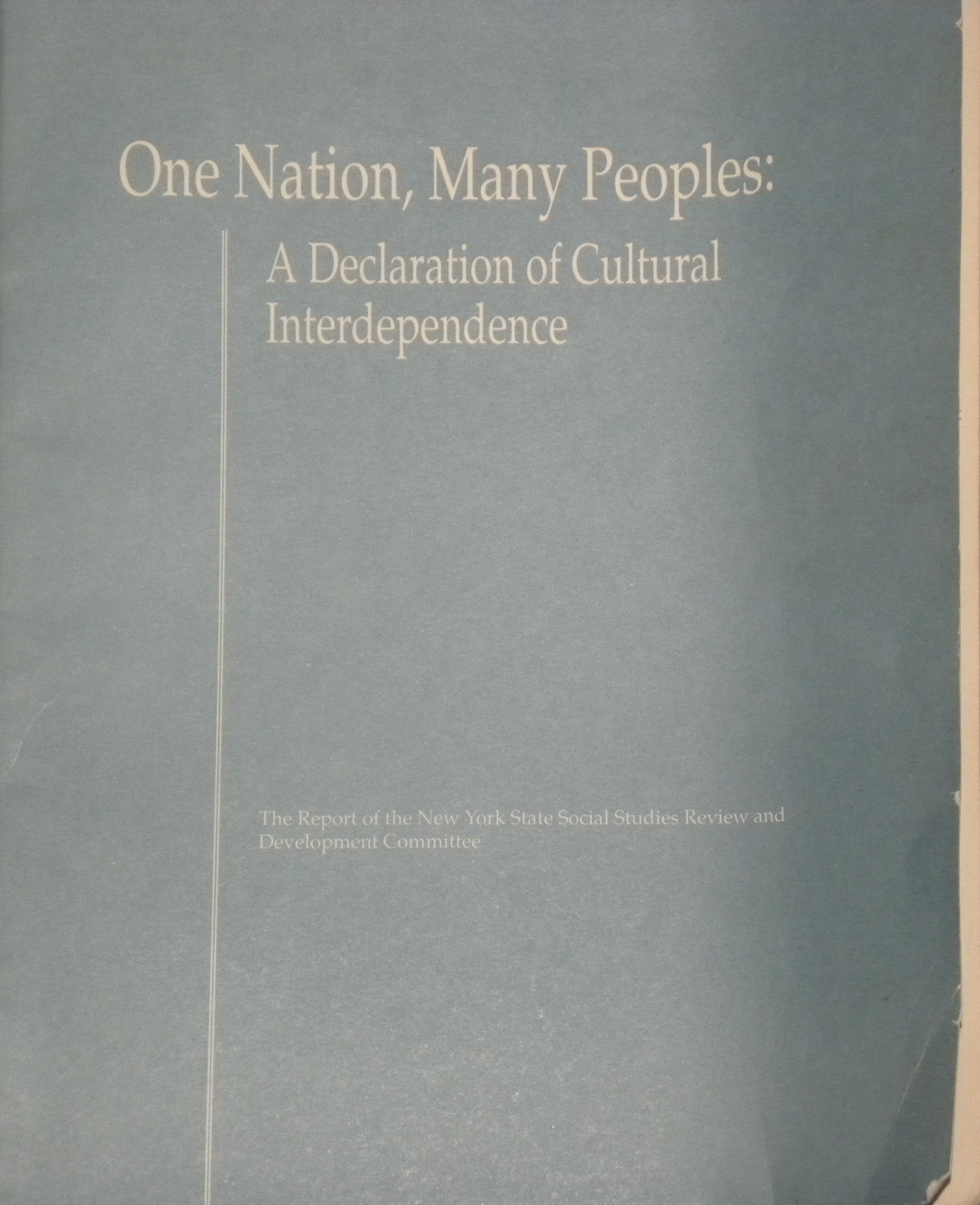
New York State Social Studies Review and Development Committee Report, June 1991 (Picture/Donald Earl Collins). One of several reports produced for the New York State Education Department and Commissioner, as part of the Commissioner's Task Force on Minorities: Equity and Excellence

Twenty years ago this week, I began writing an academic piece that would lead to my dissertation topic, doctorate and first book Fear of a “Black” America (2004). It was a topic that I’d fall in and then out of love with. Ironically, I pursued this topic because of my academic experiences in Humanities at Davis Middle and Mount Vernon High School. The topic was multiculturalism, and more specifically, multicultural education, and how to achieve this kind of curriculum reform in K-12 education. Just writing these words makes me feel both young and naive at the same time.

This whole quest started with a girl. Actually, with the young woman “Another E” (see “The Power of Another E” from April ’09 and “Beyond the Asexual Me” from last month”). She wanted to put an article together for publication, in response to what was then a major controversy involving research into the revision of New York State’s social studies and other curricula. The New York State Department of Education had given a committee the task of figuring out how to make the state’s K-12 curriculum more inclusive and representative of the state’s tremendous racial, ethnic and other forms of diversity.

By the end of September ’91, it would produce A Curriculum of Inclusion: Report of the Commissioner’s Task Force on Minorities: Equity and Excellence. But that deliverable was far from my mind when, tired from my weeks of near starvation post-graduation that April (see “Sometimes Starvation” from May ’11), I reluctantly said okay to working on this article.

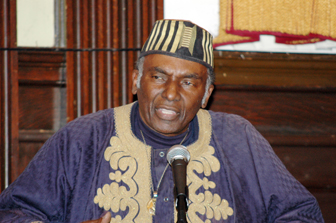
Leonard Jeffries, Newark Public Library, February 1, 2007. (http://npl.org)

Now here I was, minus the young woman in whom I no longer had an interest, now working on a piece that had become more academic than either of us had originally intended. By the time I’d written my first words on multiculturalism, I’d already learned the names Leonard Jeffries, Asa Hilliard III and Arthur Schlesinger, Jr. I’d read articles from the New York Times and the Wall Street Journal about Jeffries’ name-calling, Schlesinger’s incredulousness about calling slaves “enslaved persons,” and about the committee in general getting along like hyenas tearing at a dead wildebeest.

If I’d been just a tad bit smarter, I would’ve done an investigative piece and called and emailed the people on this task force. I would’ve asked them to divulge to me what they would eventually tell the world about their dislike of each other and of anything “multicultural,” which was in quotes for them. For Schlesinger, multicultural was the equivalent of bad ethnic studies or a kind of Afrocentrism that blamed Whites for all that has ailed America and the world for the past 500 years. For Jeffries, it was a racist attempt at appeasing Blacks and other groups of color while maintaining the main theme of Whites on top.

Although this is an oversimplification, it’s not by much. There really wasn’t anyone from the task force, the

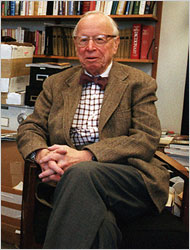
Arthur Schlesinger, Jr., CUNY, circa 2006, months before his death on February 28, 2007. (http://www.nytimes.com)

NYS Department of Education, or anyone who spoke on the Himalayas-out-of-a-termite-mound controversy over a more inclusive K-12 curriculum without taking one of those two views. That’s what interested me the most. Schlesinger, and eventually, folks like Diane Ravitch, Mario Cuomo and others completely against revision that even approached cultural pluralism, versus Jeffries, Hilliard and others arguing beyond what they called a White multiculturalism.

I didn’t have the capacity at that stage of my life to see myself as a writer or a journalist in any way. Just two years removed from the end of my mother’s marriage to my now idiot ex-stepfather, I only saw the piece that I’d turn into a Master’s research paper, doctoral thesis and first book as an academic exercise, one where I found the philosophical middle. I hadn’t a clue as to how to make myself part of the Ground Zero issue of the first seven years of the ’90s, the Culture Wars.

But I did have one experience that provided unique insight into multiculturalism and the arguments made by scholars and pols on all sides. Six years in Humanities in Mount Vernon, New York’s public schools. A place where cultural diversity and how to deal with it within the curriculum was the elephant in the classroom. Some teachers and classes addressed it, and many didn’t, to the detriment of what was a solid program, not to mention me and the others who were my classmates.

Either way, I saw more issues of diversity crop up where a multiculturalist approach would’ve been helpful all during my time in Humanities, including with my kufi and my Hebrew-Israelite years. It was a missed opportunity, one that I unconsciously wanted to address with my research of and writing on multiculturalism.

Elephant in School, retrieved July 7, 2011. (http://teachhub.com)

Ego Inflation

18 Wednesday May 2011

Posted by decollins1969 in 1, Academia, Boy @ The Window, culture, Eclectic, Politics, race

≈ 2 Comments

Tags

A Room With A View, Academia, Academic Politics, Carnegie Mellon University, College of Humanities & Social Sciences, Denholm Elliott, Dune, Ego Inflation, Egocentrism, Elite Institution, Elitist Institutions, George Mason University, Grade Inflation, Jace Nance, Mercurial, Napoleonic Complex, Nefud, Peter N. Stearns, Peter Stearns, PhD Graduation, Provost, Race, World History, World Stereotypes


My PhD Graduation, Thackeray Club, Pittsburgh, PA, May 18, 1997. Angelia N. Levy

May 18th. Another year, fourteen years now, in fact. I’ve been Dr. Collins to my students and the world of academia officially for that long. I’ve learned a lot of lessons about the values and limits of having a doctorate in history over the course of the past decade and a half. One of them is how easily egos are inflated by it. And everything else gets inflated in the process of having an ego that could challenge the Himalayas for supremacy.

One of the more stunning and thoughtful moments I had during the graduation ceremony at Carnegie Mellon on that hot and sticky Sunday in ’97 — besides the dreadful realization that my own mother was jealous of me — was shaking Peter Stearns‘ hand on stage. The Napoleonic red-and-white-haired Stearns — currently the university provost at George Mason — was the Dean of Humanities & Social Sciences at

Provost Peter N. Stearns, George Mason University, 2008. Source: http://provost.gmu.edu.

Carnegie Mellon at the time. Having to touch his rough yet clammy right hand as they read off the names of the doctorates that afternoon brought back quite a few not-so-pleasant memories of why I found Carnegie Mellon a terrible elitist (as opposed to elite) school to attend for four years.

I’d most recently co-presented with Stearns on how to successfully finish a doctorate that March, which wasn’t so unpleasant. Except for the fact that most of his presentation was off-the-cuff ego-stroking. Except that the lessons learned from writing a dissertation in six weeks in ’64 were mostly irrelevant to the students in front of us that day. Except that I already knew that Stearns was equally polite and dismissive of my presentation by proxy.

Too bad hand sanitizers — or as my son Noah calls them, hanitizers — were in their infancy in ’97. For as I shook Stearns’ hand, the memory that crept to the fore was my other experience working with the man, when I was a teaching assistant for two sections of his world-famous World Stereotypes, oops, World History course in the fall of ’94. He spent lecture after lecture entertaining mostly White college freshman with dirty jokes about beer and sex in covering World History Plato-to-NATO style. I spent most of my teaching time attempting to refocus my group of students away from stereotyping South Asian women as “demur” and Arab men as horn dogs.

Then the end of that semester came, and I turned in all of my grades. I had a few students with D’s and F’s because they had failed their exams, or hadn’t shown up for class really, or both. One of those students was a White male freshman who’d only been to class twice, had failed one exam and barely passed his final. I received an email from Stearns two days before the end of the semester ordering me to change the student’s grade from an F to a C. The reason: “[h]e’s a good kid…he showed up for a couple of my sections…” [emphasis added]. I send an email back that basically read, “So?” Stearns repeated his order to change the grade, in person, which meant that I needed to change the grades of five other students so that their grades weren’t worse than the student that Stearns had coddled.

It was the one and only time I found myself inflating grades. That exchange confirmed so much that I heard and suspected about the father of college-level World History. Stearns was mercurial, egotistical and played favorites, who somehow were usually White and often male. I knew of at least one former grad student who’d all but been blackballed from finding academic jobs because of him. I also knew that he arbitrarily provided vastly different pay levels to grad students and instructors when he was the history department chair.

Denholm Elliott in A Room With A View, 1985. Source: http://content8.flixster.com/photo/13/52/75/13527526_gal.jpg

When my future wife first saw Stearns in ’96 at some history department conference in which my then advisor Joe Trotter forced me to do a presentation, she said that the five-foot-four man looked like the late British actor Denholm Elliott, especially from the movie A Room With A View (1985). That’s really an insult to Elliott. A better comparison would be between the actor who played the emperor in the Star Wars prequel trilogy. Or, more specifically, like the late actor Jack Nance’s character Nefud from Dune (1984). Very mean of me, I suppose, not to mention, a digression.

As I began to walk off the stage after shaking Stearns’ hand, I felt agitated, and thought of all that I’d gone through with him and with Carnegie Mellon in general. Ultimately, like the characters I mentioned above, Stearns was and remains an imperialist, building an academic empire in his image and crushing all opposition (real and imagined) along the way. His legacy will be the multiplication of inflated student egos who believe they understand the world but instead really only understand how to see the world in their own egocentric ways.

Jack Nance as Nefud in Dune, 1984. Source: http://www.aveleyman.com/FilmCredit.aspx?FilmID=5459

Running Interference

04 Monday Apr 2011

Posted by decollins1969 in 1, Academia, Boy @ The Window, Carnegie Mellon University, culture, Eclectic, race

≈ Leave a comment

Tags

Academia, Academic Suicide, Advising, Advisor, April 4th, Bad Mentoring, CMU, David Montgomery, Dissertation, Doctoral Thesis, Joe Trotter, Joe William Trotter Jr., Manning Marable, Mentoring, Michael Nettles, MLK Assassination, Spencer Foundation Dissertation Fellowship Program


Joe Trotter, circa 2008.

Joe Trotter, circa 2008.

Today is the forty-third anniversary of Martin Luther King’s assassination by James Earl Ray in Memphis, Tennessee. But for the past fifteen years, April 4th has also had the dubious distinction of reminding me of a big argument between me and Joe Trotter. He was my doctoral thesis advisor at Carnegie Mellon and, until that day, someone I considered a mentor in my becoming an academic historian.

Below is an excerpt from my book Fear of a “Black” America (with some minor additions) in which I recount what happened that day:

‘I’m looking out for your best interests’ was what my dissertation advisor typically said in discussing my future with me. As far as Trotter was concerned, he was in charge of the rest of my academic career, determining everything from whether I would finish my doctorate to where I would live and work after I graduated. But as I’d already discovered in the months leading to this moment, he was not nurturing my career at all. Virtually all of my achievements as a graduate student occurred despite my advisor rather than because of him.

This was because my advisor discouraged my attempts to publish, to obtain grants for my research, to participate in major conferences, and to apply for jobs when it was apparent I had nearly completed my doctoral thesis. My advisor would frequently say ‘You’re not ready’ to take on a particular project or to apply for a grant or job to hinder my efforts. Yet Trotter never pointed out what he thought I needed to do to be “ready.”

One of our last official meetings as advisor and student covered this particular issue. Six chapters into an eight-chapter dissertation, I was still being told that I was ‘not ready’ to apply for jobs or to attend major conferences. Trotter had in fact contradicted some of what he had said about my work in a previous meeting. So when he declared for the eighteenth time in this particular meeting that he was not giving me his support because he was ‘looking out for my best interests,’ I sarcastically replied ‘Yeah, right! I don’t believe you!’ I decided that I could not abide the hypocrisy of an advisor who cared little for my future while at the same time professing to care very deeply.”

There was an eerie silence. Trotter actually didn’t know what to say. Neither did I. Mostly because I wanted to strangle him with his own blue neck tie. So I did something less dramatic but far more legal. I said, “I don’t have anything else to say to you,” picked up my stuff, walked out his heavy dark wood door, and slammed it as hard as I could. “Stupid ass,” I said under my breath as I walked out of Baker Hall that day. I was talking about myself as much as I was talking about Trotter.

For any academic scholar who reads this, they’ll likely conclude that I committed academic suicide by exhibiting such defiance to my advisor that day. Not true — I have a doctorate and years teaching in academia to prove otherwise. Not having the support of an advisor — whether that support’s official or in the reality of a friendship or a mentorship — does make building a career harder. But given what I’d learned about Trotter’s lack of support for a Spencer Fellowship that I ended up receiving as an award anyway, despite him, I knew that even if everything had been okay, it wouldn’t have been after graduation.

The reality is that my former advisor and thousands like him commit a form of academic suicide every day by refusing to promote at least one student’s career development. Besides having one’s work published and obtaining grants, developing new talent is key to creating a legacy as a successful professor. It’s why I can go to any history conference and hear stories about David Montgomery, or to an education conference and hear folks discuss their wonderful mentoring relationships with Michael Nettles. Or why so many responded across all of the social networks after learning that Manning Marable had passed away on Friday, April 1st.

I’m not holding these examples up because these professors were saints. Hardly. Just pointing out the fact that when a professor maliciously and deliberately attempts to hold back students otherwise deserving of moving on out of jealousy or some other reason, it puts a pox on their house as well.

Living in the Land of “No!”

23 Wednesday Mar 2011

Posted by decollins1969 in 1, Academia, Boy @ The Window, culture, Eclectic, Politics, race, Youth

≈ Leave a comment

Tags

Academia, Academic Writing, Ageism, Bias, Bigotry, Career Options, Forbes Quadrangle, Historical Dictionary of American Education, History of Education Quarterly, Multiculturalism, No!, Passion, Pitt, Race, Richard J. Altenbaugh, The Second Plate, University of Pittsburgh, Wesley Posvar Hall, Writing, Yes


People forming a "NO" to London's Heathrow Airport Expansion, May 31, 2008. Source: The Daily Mail http://bit.ly/hc0KSP

There was a time in my career and life when I was desperate to publish an article in a scholarly journal. Right after finishing grad school at Carnegie Mellon at the end of ’96, I set out to write a literature review essay on how folks in education foundations and education policy had covered multiculturalism and connected it — or, in most cases, not connected it — to the politics around this controversial topic during the 1980s and 1990s. Of all the things I’d written up to this point in my career, this was a bit ambitious.

I had submitted an article for publication with the History of Education Quarterly in March ’97 and had made several revisions at Richard Altenbaugh’s request. He was the new senior editor of the journal, as it had recently moved from Indiana University to Slippery Rock to be under his direction. Altenbaugh had also been my professor for my education foundations graduate class in the spring of ’92, and I’d done entries for his Historical Dictionary of American Education, which was published in ’99.

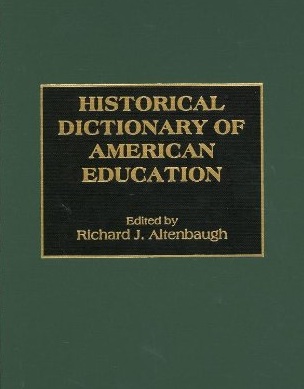
Historical Dictionary of American Education Cover, March 23, 2011. Donald Earl Collins

At Altenbaugh’s behest, I met him and a wildly bearded co-editor at an informal meeting in March ’98. We met at The Second Plate, an eating place on the second floor of Forbes Quadrangle at Pitt, where I’d spent my homeless days in ’88, my history major days, and my first two years of grad school. Over the course of a two-hour lunch that had little to do with the food, Altenbaugh and his assistant grilled me about the contents of my article, my writing in general, and about the publishing business. Now I knew that this essay would need more revisions, but a two-hour inquisition on why a twenty-eight-year-old was too young to make bold conclusions based on existing studies was just a ridiculous argument.

For Altenbaugh and the other editor, I was simply too young to write an essay that reviewed previous scholarly work. Their logic: “even a senior scholar with fifteen years in the field would have trouble pulling this off.” The editors also insisted that the only road to academic Nirvana regarding my work would be through publishing academic articles and books that met the approval of an exclusive scholarly community. Translation: “write something that is interesting to a few other professors — but not so exciting that it would catch the public’s attention — and by all means do not work on something as controversial as multiculturalism.” Oh yeah, they also recommended that get approval for my essay draft from two elderly, nearly-dead White historians before resubmitting to the journal.

Bottom line: my essay was rejected, given a “No!” Not because it didn’t have potential, or because the early drafts weren’t any good. But because I was working on a topic too cutting edge as a Black male who even now at forty-one would be too young — according to these guys — to work on a state of the profession essay on multiculturalism, much less thirteen years ago.

Did their “No!” matter? In one sense it really did. I knew that the topic itself was too controversial for most conservative-thinking (in a topical, not political, sense) editors in scholarly publishing. That there were few venues for me to address multiculturalism in an academic sense. I also knew that their “No!” was about much more than my topic. My age and my race also played a role in their decision to not publish my essay — they said as much by implication. Funny thing is, that in these weird times, I’d probably have a much better shot at publishing this essay now than I did when multiculturalism seemed more relevant.

But in the end, it didn’t matter at all. I was already in the middle of a five-year period of questioning whether I was an academic historian first and a writer second, or was it really the other way around? If the latter was true — and it’s turned out to be — then what did it matter that I pushed to publish on a topic that I cared about, but I was already beginning to lose passion for?

What I learned from that “No!” is that there are times to force a “Yes!” out of the land of “No!” And that there are other times when I should choose to take that “No!” and evaluate my own motives for wanting a “Yes!” In the case of my growth as a writer — both in academic writing and in other kinds of writing — there couldn’t have been a better, more bigoted “No!” than the one I received thirteen years ago.

← Older posts
Newer posts →

Boy @ The Window: A Memoir

Boy @ The Window: A Memoir

Places to Buy/Download Boy @ The Window

There's a few ways in which you can read excerpts of, borrow and/or purchase and download Boy @ The Window. There's the trade paperback edition of Boy @ The Window, available for purchase via Amazon.com at http://www.amazon.com/Boy-Window-Donald-Earl-Collins/dp/0989256138/

There's also a Kindle edition on Amazon.com. The enhanced edition can be read only with Kindle Fire, an iPad or a full-color tablet. The links to the enhanced edition through Apple's iBookstore and the Barnes & Noble NOOK edition are below. The link to the Amazon Kindle version is also immediately below:

scr2555-proj697-a-kindle-logo-rgb-lg

Boy @ The Window on Amazon.com: http://www.amazon.com/Boy-The-Window-Memoir-ebook/dp/B00CD95FBU/

iBookstore-logo-300x100

Boy @ The Window on Apple's iBookstore: https://itunes.apple.com/us/book/boy-the-window/id643768275?ls=1

Barnes & Noble (bn.com) logo, June 26, 2013. (http://www.logotypes101.com).

Boy @ The Window on Barnes & Noble: http://www.barnesandnoble.com/w/boy-the-window-donald-earl-collins/1115182183?ean=2940016741567

You can also add, read and review Boy @ The Window on Goodreads.com. Just click on the button below:

Boy @ The Window

Twitter Updates

Tweets by decollins1969
  • RSS - Posts
  • RSS - Comments

Archives

  • June 2025
  • April 2023
  • September 2022
  • August 2022
  • July 2022
  • June 2022
  • May 2022
  • April 2022
  • March 2022
  • January 2022
  • December 2021
  • November 2021
  • October 2021
  • September 2021
  • August 2021
  • July 2021
  • June 2021
  • April 2021
  • March 2021
  • February 2021
  • January 2021
  • December 2020
  • November 2020
  • October 2020
  • September 2020
  • August 2020
  • July 2020
  • May 2020
  • April 2020
  • March 2020
  • January 2020
  • December 2019
  • November 2019
  • August 2019
  • July 2019
  • June 2019
  • May 2019
  • April 2019
  • March 2019
  • February 2019
  • January 2019
  • December 2018
  • November 2018
  • October 2018
  • September 2018
  • August 2018
  • July 2018
  • June 2018
  • May 2018
  • March 2018
  • February 2018
  • January 2018
  • December 2017
  • November 2017
  • October 2017
  • September 2017
  • August 2017
  • July 2017
  • June 2017
  • May 2017
  • April 2017
  • March 2017
  • February 2017
  • January 2017
  • December 2016
  • November 2016
  • October 2016
  • September 2016
  • August 2016
  • July 2016
  • June 2016
  • May 2016
  • April 2016
  • March 2016
  • February 2016
  • January 2016
  • December 2015
  • November 2015
  • October 2015
  • September 2015
  • August 2015
  • July 2015
  • June 2015
  • May 2015
  • April 2015
  • March 2015
  • February 2015
  • January 2015
  • December 2014
  • November 2014
  • October 2014
  • September 2014
  • August 2014
  • July 2014
  • June 2014
  • May 2014
  • April 2014
  • March 2014
  • February 2014
  • January 2014
  • December 2013
  • November 2013
  • October 2013
  • September 2013
  • August 2013
  • July 2013
  • June 2013
  • May 2013
  • April 2013
  • March 2013
  • February 2013
  • January 2013
  • December 2012
  • November 2012
  • October 2012
  • September 2012
  • August 2012
  • July 2012
  • June 2012
  • May 2012
  • April 2012
  • March 2012
  • February 2012
  • January 2012
  • December 2011
  • November 2011
  • October 2011
  • September 2011
  • August 2011
  • July 2011
  • June 2011
  • May 2011
  • April 2011
  • March 2011
  • February 2011
  • January 2011
  • December 2010
  • November 2010
  • October 2010
  • September 2010
  • August 2010
  • July 2010
  • June 2010
  • May 2010
  • April 2010
  • March 2010
  • February 2010
  • January 2010
  • December 2009
  • November 2009
  • October 2009
  • September 2009
  • August 2009
  • July 2009
  • June 2009
  • May 2009
  • April 2009
  • March 2009
  • February 2009
  • January 2009
  • December 2008
  • November 2008
  • October 2008
  • September 2008
  • August 2008
  • July 2008
  • June 2008
  • May 2008
  • April 2008
  • March 2008
  • February 2008
  • January 2008
  • December 2007
  • November 2007
  • October 2007
  • September 2007
  • August 2007
  • July 2007
  • June 2007

Recent Comments

MaryPena's avatarMaryPena on My Day of Atonement/Bitter Hat…
decollins1969's avatardecollins1969 on No Good Teaching Deed Goes…
Mary Rose O’Connell's avatarMary Rose O’Connell on No Good Teaching Deed Goes…

NetworkedBlogs on Facebook

NetworkedBlogs
Blog:
Notes From a Boy @ The Window
Topics:
My Life, Culture & Education, Politics & Goofyness
 
Follow my blog

616 616 East Lincoln Avenue A.B. Davis Middle School Abuse Academia Academy for Educational Development AED Afrocentricity American Narcissism Authenticity Bigotry Blackness Boy @ The Window Carnegie Mellon University Child Abuse Class of 1987 CMU Coping Strategies Crush #1 Crush #2 Death Disillusionment Diversity Domestic Violence Economic Inequality Education Family Friendship Friendships Graduate School Hebrew-Israelites High-Stakes Testing Higher Education History Homelessness Humanities Humanities Program Hypocrisy Internalized Racism Jealousy Joe Trotter Joe William Trotter Jr. K-12 Education Love Manhood Maurice Eugene Washington Maurice Washington Misogyny Mother-Son Relationship Mount Vernon High School Mount Vernon New York Mount Vernon public schools Multiculturalism MVHS Narcissism NFL Pitt Pittsburgh Politics of Education Poverty President Barack Obama Race Racial Stereotypes Racism Relationships Self-Awareness Self-Discovery Self-Reflection Sexism Social Justice Teaching and Learning University of Pittsburgh Violence Whiteness Writing

Top Rated

Blog at WordPress.com.

  • Subscribe Subscribed
    • Notes from a Boy @ The Window
    • Join 103 other subscribers
    • Already have a WordPress.com account? Log in now.
    • Notes from a Boy @ The Window
    • Subscribe Subscribed
    • Sign up
    • Log in
    • Report this content
    • View site in Reader
    • Manage subscriptions
    • Collapse this bar
 

Loading Comments...