Standing at the Crossroads

Tags

, , , , , , , , , , , , , , , , ,


Cast Away movie (2000) screen shot, August 27, 2011. (Source/Donald Earl Collins). Qualifies as fair use under US copyright laws because it is of low resolution and is in no way being used to reproduce the original film.

It’s funny how things in our lives happen in cycles. Sometimes it’s because we haven’t heeded the wisdom we’ve accumulated in our lives to keep us from following that same bad habits, ones that lead to serious problems for much of our lives. Relationships with men and women, addictions and other vices, behaviors that lead to indecision. That last one has been a big one for me to overcome in my life, and it still has the power to keep me for achieving all that I know I can do in life.

It has led to several crossroads in my life. They usually occur in August or December. August, because of the twenty-two years I spent as a student (not to mention fourteen off and on as a professor). And December, because of Christmas, Jesus and my birthday. But Augusts, especially the last five days in August, tend to stand out as times of contemplation and revelation. August ’91 was the start of grad school, while August ’93 made me rethink how to approach grad school. August ’97 left me with bitterness about being unemployed, while August ’99 gave me a new appreciation for having a job, any job.

But, aside from now, no August was more revealing about my character than the one in ’88. About two weeks before I needed to go back to Pittsburgh for my sophomore year, I went to search for Jimme. I was still steamed with him for not getting me the money I needed to secure a dorm room for the upcoming school year. I hardly swung by to see him that summer, too busy taking care of my siblings and recovering from my second roughest year in the decade, one of four months of unemployment. So on the next to last Friday before I needed to get back, I bummed ten dollars from Mom and took the Metro-North down from Pelham to the city. I got off, took the shuttle over to Times Square and the 2 to 72nd before walking over the Levi brothers’ office on West 64th. Jimme wasn’t there, but Glen was. “He’s over at my brother’s on East 59th,” he said. I’d forgotten that Bruce Levi had his own cleaners and business on the East Side.

I walked the dozen or so blocks there. And there Jimme was. I caught him just as he was getting paid for the week. “Bo’ whatcha doin’ up here?,” he said with complete disbelief. We talked for just a few minutes, with me mentioning more than once how I needed money to secure some sort of apartment at school. “Donal’, I done messed up too much money dis summer,” Jimme said. Apparently my father had spent most of Summer ’88 going through one of his drinking binges. The Levi’s had bailed him out several times, as his landlord Mrs. Smalls had toyed with the idea of evicting him. Jimme gave me $100 on the spot, and promised to get me more money before I left. When I went to see him at work the following week, he’d given me $300 more.

In rapid succession, I packed up my stuff in the five-suitcase set Mom had bought me the year before. Two suitcases, two duffel bags, and a garment bag, all of which she’d ordered from a catalog for a measly eighty bucks. I went down to a travel agency that was down the street from the Pelham Metro-North station and C-Town and found a cheap one-way ticket on USAir for $35. I couldn’t buy a good steak dinner in midtown Manhattan for $35! I got myself mentally ready for finding an apartment, ideally a one-bedroom.

By that last Sunday in August, everything was ready, and I had everything I needed. I played songs with my siblings for almost two hours before I left. I gave them my Michael Jackson tapes and my radio cassette player, taking my beat-up Walkman with me. We all hugged and cried, much more so than we had the year before. Part of me really didn’t want to leave, and part of me knew that I wouldn’t be whole again if I didn’t.

I had no idea how tough the next five days would be, between that Sunday evening, August 28 and that Friday, September 2. I was homeless for five days, and within three days of heading back to New York and Mount Vernon when I finally found a one-room death-trap in a row house in which to live.
Fork in the road, August 27, 2011. (Source/http://optimumsportsperformance.com).

I was within three days of becoming a college dropout because I didn’t trust anybody. I was so close to losing something I’d dedicated seven years of my life to achieving because I had spent the previous year indecisive about whether what I wanted out of life was more important than helping out my mother and my younger siblings at 616. It made me think. What meaning could I draw from putting up with all the put-downs and disapprovals of classmates, teachers and families if things hadn’t worked out? The answer would’ve been, none at all.

Now, as then, I face a crossroads in many areas of my life. One where I have to decide, which part of me is most important in achieving my dreams, fulfilling my calling, providing for my son and family, possibly even in maintaining a marriage? Whatever decisions I do make, I need to stand firmly in them, to be decisive, to see them through. That formula has guided me for twenty-three years. And it has yet to let me down.

The Whore of Babylon (and other wacko comments)

Tags

, , , , , , , , , , , , , , , , , , ,


Televangelist John Hagee sans glasses compares Texas Gov. Rick Perry to Abraham Lincoln, The Response, Reliant Stadium, Houston, August 6, 2011. (Source/http://www.businessinsider.com).

I used to be one of them. One of those evangelized Christians. Coming off of three years as a Hebrew-Israelite, I became a Christian in the spring of ’84, without a church, and without an immediate family member who had any real experience as part of a Christian family or community.

So naturally, when my mother — who still appeared to be a practicing Hebrew-Israelite — would tune our one working stereo radio to the Christian AM stations in the New York City area in the summer that followed my secret conversion, I’d listen. I’d hear everything from Amy Grant’s “Angels Watching Over Me” to folks like Jimmy Swaggert and Kenneth Copeland on those two stations. Plus, there was the 700 Club, Oral Roberts and Frederick K.C. Price on our TV at 10 am Monday-Friday, and Sunday mornings between 8 and 11 am.

With the exception of Price, a good portion of what these televangelists and radio preachers would talk about was the Book of Revelation of St. John. They’d outline in detail everything from the Four Horsemen of the Apocalypse to the gigantic sucking sounds of great death as the Lord opened one seal after another. As a fourteen-year-old and brand-new Christian, it was scary listening to them. So scary that it seemed unlikely that I’d make it to thirty before the entire world was on fire.

The Whore of Babylon, from a 1800s Russian engraving. (Source/Wikipedia). In public domain.

When Swaggert or Roberts or Robertson would get to the part of Revelations that talked about “the whore of Babylon,” they’d lament about how America was the “whore” that John of Patmos had described in his letters to the Christian churches in what is now Turkey — 2,000 years ago. But for Swaggert, Roberts, Robertson, et al., it was because of gay rights, or because of Blacks having kids out-of-wedlock while collecting welfare, or because women were on an assembly line to have abortions, or because of out-of-control government spending that America had become the ultimate harlot.

I put much of what they said aside even then, because my life at 616 and in Mount Vernon was scary enough without thinking about the fate of four or five billion humans. But all of this came up again, especially once my mother revealed herself as an evangelical Christian in ’89, in the last days of her marriage to my idiot (ex-) stepfather. In the years that followed, whenever I visited over the holidays or came home to work for the summer, I’d see more of Kenneth Copeland, Oral and Richard Roberts, Pat Robertson than I’d see of regular television.

In particular, a “new” guy, Jack Van Impe, along with his wife, was on. Every week in the summer of ’90, my

Jack Van Impe, circa 2010, predicting an Apocalypse via Iran. (Source/http://wn.com).

mother would make me sit in front of the TV to hear this guy relate things like the Iraqi invasion of Kuwait in August of that year to the Rapture and the Apocalypse. Somehow, the evil spiritual forces intent on world domination and human corruption were unleashed by Iraq and the US response to Iraq that summer. Van Impe was so worried about the rebuilding of the Roman Empire via the expanding European Union that he looked like he was about to collapse from a brain aneurysm.

My mother once said, “You think they crazy, but when the Rapture comes and you’re stuck here, you won’t.” I didn’t think that they were crazy — I knew they were. But more importantly, what I was really thinking was, why is she watching this, and making me watch this stuff, too? It’s not as if anyone, whether an atheist or a Zen Buddhist, didn’t or doesn’t really know that our world faces a multitude of challenges that could lead to a perfect storm of global crises, causing immense destruction and death. That’s true. Still, I couldn’t see how any of us could make sense of what we face as a planet by using the Book of Revelation as a guide.

So, when Rachel Maddow decided to go after Governor Rick Perry and “The Response” party down in Houston earlier this month on her show, I, unlike most Americans uninvolved in mind-bending forms of Christianity, wasn’t surprised. I didn’t feel shock that there was such a thing as the New Apostolic Reformation, because there isn’t anything new about it. I wasn’t even surprised that the likes of John Hagee would consider Oprah Winfrey the “Whore of Babylon” because of her ability to use verbal voodoo on the millions of people who worship everything she does. And I was unsurprised, unfortunately, that a snake-oil salesman like Perry would fall into their camp.

Oprah Winfrey at her 50th birthday party at Hotel Bel Air 2004. (Source/Alan Light/http://www.flickr.com/photos/alan-light/216012860/). In public domain, cc-by-2.0.

Quite frankly, there are only two things that surprise me. One is that there are millions of people like me who could find more holes in the evangelical apocalyptic paradigm in one nanosecond than Maddow could in one day, yet we’re never called on to refute and inform. The other is that it’s taken this long for mainstream media to really pick up on what has been a four-decade long trend in the meshing of the wackiest of “Christian” ideas with politics that exploit America’s imperial fears. That our days as #1 are at an end.

Larry Glasco and the Suzy-Q Hypothesis

Tags

, , , , , , , , , , , , , , , , ,


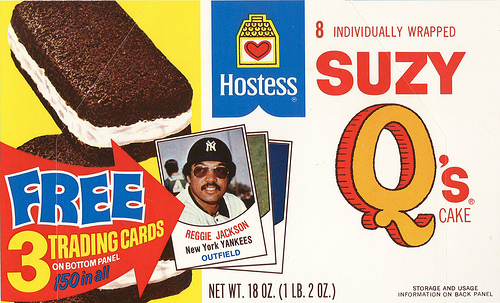
Hostess Suzy-Q's 8-pack with Reggie Jackson baseball cards, circa 1979, just the way I remember them (made with lard), September 24, 2007. (Source/http://www.flickr.com/photos/wafflewhiffer/1436601166)

I sometimes think that me being a weird dude — because I often spend my time in contemplation — often attracts people in my life of all types. Including people weirder or more eccentric than me. As those closest to me can attest, I’ve awaken many a morning with ideas to write down, with dreams to interpret and deep epiphanies to discuss. All while still needing to pee and brush my teeth — so I multitask!

Twenty years ago, I was in deep thought almost every day going into my first semester of grad school. I couldn’t help it. It wasn’t part of my original plan to earn a master’s degree. And it was obvious from dealing with the folks in the Department of History at the University of Pittsburgh that many didn’t want me there (see “The Miracle of Dr. Jack Daniel” from May ’11). Either because of my familiarity with them, or because I was Black, or because I was still only twenty-one, or because they knew I’d study race more than class and neo-Marxist theory.

Whatever the case, I knew one thing for certain. That Professor Larry Glasco would end up being my advisor. Glasco was the only professor out of twenty-nine in the department who specialized in African American history, and he’d been there since the year I was born, ’69. He was likely hired in the midst of universities, fearful of black student groups and their protests over mistreatment and lack of diversity — hiring one Black here and one Black there to meet the protesters demands. Actually, not likely. Glasco, like the start of the

Larry Glasco delivering a special lecture at Carnegie Mellon University, October 12, 2007. (Source/http://www.chronicle.pitt.edu/?p=1002).

Black Studies (now Africana Studies) Department and the hiring of Dr. Jack Daniel, was all a response to protests and a major sit-in by the Black Action Society in the 1968-69 school year.

But I digress. I’d taken a history majors reading course with Glasco my junior year, and we occasionally talked. Other than that, I didn’t know much about the fifty-year old, six-foot-five and very light man.

Though I did begin to find out. Mid-August then and now is big in Western Pennsylvania, as it’s football preseason. Since my NY Giants had won the Super Bowl that January, I was satisfied and not at all in a football mood. I’d gone out that third Sunday in August to go to Hillman Library, continue my work on my multicultural education article, grab cheap grub at 7-Eleven, and sit at one of the benches outside of William Pitt (Student) Union to eat and smell the sulfuric air.

Glasco walked up and greeted me. We talked, mostly about how I planned to fulfill requirements like proficiency in a foreign language (I decided on Swahili, much to Glasco’s chagrin) and what my master’s paper should be about. I didn’t understand — and quite frankly, I still don’t now — why many professors practice this opaque way of giving advice to students, advice that can easily come off as commands.

Anyway, Glasco then chatted me up about the upcoming ’91 NFL season, about the Steelers and the injury bug. Some major draft pick had blown out his knee, torn ACL and MCL. Between that and what happened to then LA Raiders great Bo Jackson in the ’90 playoffs against Cincinnati, Glasco said, “Maybe it’s their diet. Maybe they’re eating too many Suzy-Q’s.”

My mouth fell to the table attached to the bench where I was sitting, keeping it from hitting the sidewalk three feet below. Over-trained muscles, steroids, Astroturf, vicious hits, and your answer is “Suzy-Q’s,” I thought? Really? I didn’t think that what Glasco had suggested was dumb, just weird. Really weird. I said, with a post-gasp chuckle, “Well, I don’t think that eating Suzy-Q’s has much to do with a ligament tear…” Before I could complete that thought, Glasco continued for another ten minutes about diet and how these athletes don’t watch what they eat compared to the guys in football in the ’60s and ’70s. I thought and said, “Really? Because I remember guys who’d smoke during these games, not to mention drinking and eating hot dogs.”

Of course, years of sports research and Sports Illustrated articles confirmed everything I learned from watching and playing sports by the naive old age of twenty-one. Not to mention a former wide receiver by the name of Marvin Harrison, who for years made a point of eating a pack of Suzy-Q’s before a game, only to turn in one of the all-time great NFL careers with the Indianapolis Colts.

But the bigger point from my conversation with Glasco was that I’d found a professor and advisor who was a nice guy, but actually weirder than me. And made me feel strangely comfortable with him and with being at Pitt for my master’s. Still, I sensed that I’d eventually need to go someplace else if I wanted to start and finish a doctorate or do something else educationally. A Suzy-Q hypothesis could only take me so far.

Follow Up: Montgomery County Parks & Poorly Maintained Basketball Courts

Tags

, , , , , , , , ,


I-495 wall adjacent to Forest Glen Park basketball courts, Silver Spring, MD, May 27, 2011. (Source/Donald Earl Collins).

One of my most popular posts is the one I did last October on the sad state of Montgomery County, Maryland’s parks, especially the basketball (see “Montgomery County Parks & Its Poorly Maintained Basketball Courts”). Well, this spring and early summer, Montgomery County Parks did renovate Forest Glen Park’s two full-length basketball courts. The workers put down fresh asphalt, new hoops and lines, and even managed to paint over the graffiti that kids had tagged on the wall that separates the park from I-495, the DC beltway.

This is good news. But this is hardly enough. Not for the children’s play area adjacent to the courts. Nor for the other basketball courts I discussed in my post last year. None of the other courts have been redone. No new plans are in the pipeline to improve the conditions of the basketball courts or other facilities that are part of the county’s parks.

In any case, below are my most recent photos of Forest Glen Park, taken May 27 and August 10, showing much improvement to these basketball courts since April. Still much more work to be done here, though.

When Politicians Say, “The American People…”

Tags

, , , , , , , , , , , , , , , , , , , ,


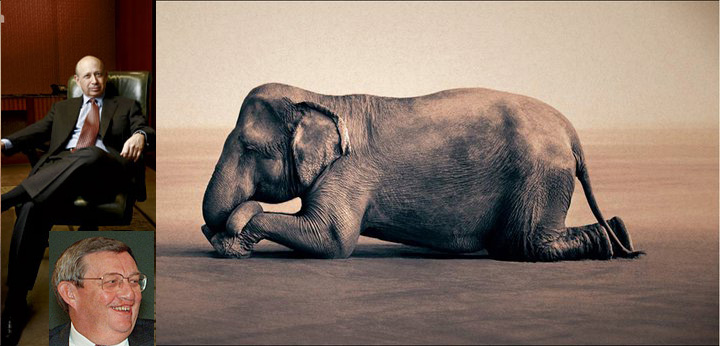
Elephant, as image of Republican Party, bowing to their "American people," the CEOs of Goldman Sachs ans Exxon Mobil, August 13, 2011. (Source/Donald Earl Collins)

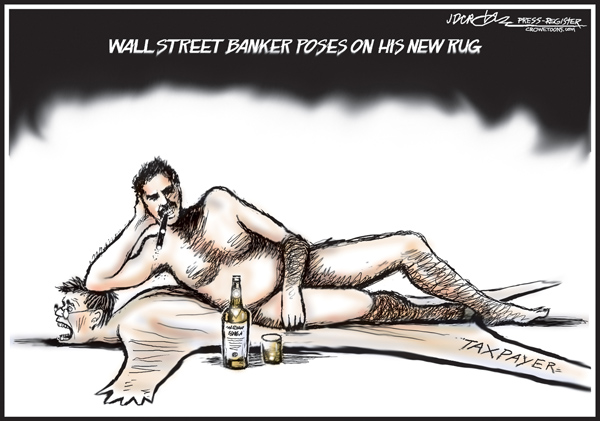
Wall Street banker poses on his new rug, February 3, 2009. (Source/JD Crowe, Alabama Press Register). Qualifies as fair use under US copyright laws, as cartoon is of low resolution and is used for illustrative purposes only.

We should all roll our eyes, pick up a snowball we’ve stashed in our freezers since the middle of February, and hit the politician in his forehead whenever we hear one of them start a statement with, “The American people.” Because as many of us have realized for years, they’re not talking about us. As we discovered with the Supreme Court decision about corporate and foreign contributions to campaigns last year, corporations and the wealthy define whom most of our leaders think of when they’re saying “The American people.” Especially since Goldman Sachs, Exxon Mobil and NBC Comcast collectively count as “American people.”

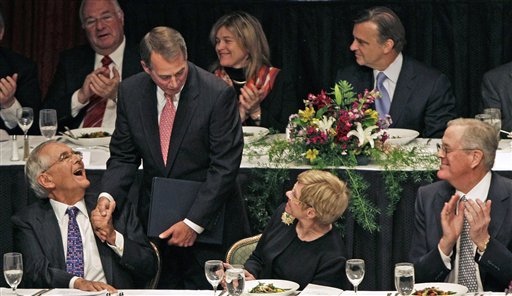
When Speaker John Boehner says, “The American people don’t want us to raise taxes,” as he did on June 24 during the debt ceiling-blackmail meetings, who is he talking about? Not me. And not most Americans, I’d assume. But, in Boehner’s mind and actual life experience, “most Americans” are people whose last concern is “job creation” or “economic growth.” In fact, they’re the ones who want “government off our backs,” who seem to think “entitlement reform” is good for the country, because it saves them money for another yacht.

Because of people like Boehner, it’s hard to believe President Obama when he claims that eighty percent of “American people want higher taxes” on the wealthy. Why? Not because Obama might not be telling the truth via multiple polls. It’s more because his actions of capitulation let the rest of us know who’s really in charge – lobbyists and wealthy people who are as patriotic as Judas was loyal to Jesus. And corporations who as people might be as evil as Stalin and Pol Pot put together.

My question is, does the Comcast Center in Philadelphia now get the right to vote under the 14th

Comcast Center, tallest building in Philadelphia (58 stories), and physical representation of an American person, January 3, 2011. (Source/Smallbones/Wikipedia Commons).

Amendment, as well as the right to pay federal income tax, as under the 16th Amendment? Really, what is the end game here? Do we each have to incorporate ourselves in order for a politician or some leader beholden to the wealthy notices the rest of us?

No, the end game is a pre-New Deal America. One where the majority of us work the way our grandparents and great-grandparents did in the 1910s, 1920s and 1930s. Where there wasn’t anything close to a guarantee of social mobility. Where the average person’s income was $1,500 a year ($15,000 a year in today’s dollars). With no unemployment insurance, retirement, health care system or insurance. Without unions, or government regulation curtailing corporate monopolies or excess, environmental damage or employee abuse.

Ultimately, the wealthy and the greedy corporations want to beat 300 million people here into subservience and submission. They want to do what they as people accuse the federal government of doing — controlling every aspect of our lives. Including every breathe we take. And make no mistake. The Supreme Court, most of the Congress, many a state and local politician and leader, maybe even the President himself, represents the interests of those “American people.” We may have to move to a more progressive nation for our interests as human beings to be fully represented. Because even as foreigners, we’ll be better off in the UK or China than here.

Boehner Shares Stage With David Koch At Wall Street Club, May 9, 2011. (Source/AP/ThinkProgress.org).

Crazy

Tags

, , , , , , , , ,


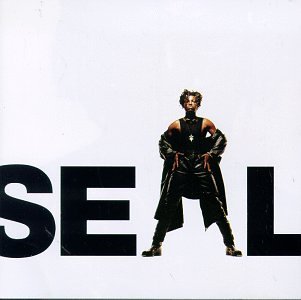
Seal, CD Cover (1991), August 13, 2011. (Source/Donald Earl Collins).

There’s no doubt in my mind that I’m a late bloomer. I came to find myself a teenager in a twenty-one year old’s body twenty years ago, just as I’m a thirty-five year-old in a forty-one-and-a-half year-old’s body now. As the summer of ’91 began to wind down, though, I realized that I needed to go into my first year of grad school at Pitt with some inspiration, with a chip on my shoulder, really.

It didn’t take more than a simple thought to find that inspiration and chip, either. Between working for a bunch of folks at my Western Psych job who still thought that hunting down half-and-half was the extent of my work there on the one hand. And professors like Reid Andrews telling me after I’d received my grad school stipend award letter that I wasn’t “graduate school material” on the other hand. Livid is the minimal word I’d use to describe my mood in the three weeks before the start of my five-and-half-year odyssey. One of doing cartwheels at least three times better than my colleagues to prove that I was as good as anyone.

But I’m jumping ahead of the story here. I found some inspiration from music, as usual, in this case, on one of my daily walks home from work in Oakland to my studio apartment in East Liberty. Still searching for more new music for my ’90s collection, I found a radio station playing Seal’s first big hit, “Crazy.” I’d heard parts of the song before, all during that summer, but never from start to finish. As I reached the end of Ellsworth Avenue, where I’d walk up the steps to a bridge on Highland Avenue, one that went over the train tracks and busway into East Liberty, I heard the lyrics, really for the first time.

“In a sky full of people only some want to fly/Isn’t that crazy
In a world full of people only some want to fly/Isn’t that crazy/Crazy
In a heaven of people there’s only some want to fly/Ain’t that crazy”

Seal, "Crazy" 45 Single Cover (UK), January 8, 2009. (Source/http://cover6.cduniverse.com/MuzeAudioArt/140/141811.jpg). Qualifies as fair use under US copyright laws, as version is of low resolution for reproduction, and is part of larger commentary.

And yes, I wanted to fly. Besides, as far as most people were concerned, I was crazy anyway. For wearing that godforsaken kufi to school for three years. For becoming a newborn and sanctimonious Christian after that. For trying out for football, and later, baseball instead of basketball. For listening to Mr. Mister and Tears for Fears and Sting instead of bopping to Run-D.M.C. For walking way too fast, and talking a little too slow. For going off to college out-of-state, to a no-name school no less. For taking a grad course my junior year at Pitt. For deciding to go to grad school in history instead of law school or Black studies.

The list is as long as an introspective Eminem rap sequence, airing every negative ever tossed my way. I was crazy, and still am. But, as far as my first year of grad school was concerned, I made two deals with myself about the process. One was to not compare myself, my abilities, my limitations, to anyone else in the program. The other was to put aside all of my preconceptions about my professors, or the difficult courses ahead, or whether I would complete the master’s degree and move on to the doctoral portion of the program.

I didn’t want to limit myself to what others may have expected of me, or to what I could’ve possibly expected of myself at the time. I didn’t even like my friends saying that “the sky’s the limit,” because I didn’t want to limit myself to the sky. I simply wanted to be crazy enough, humble yet arrogant enough to know my limits, but push the envelope as hard as I could in order to make graduate school work for me.

Howard Hughes standing in front of his new Boeing Army Pursuit Plane, Inglewood, California in the 1940s, May 31, 2005. (Source/Library of Congress, LC-USZ62-63333 - In public domain). One of the craziest, yet great, innovators of the 20th century. Guess it works better when you're a rich White male.

That kind of thinking affords a very single-minded intensity — to the point of a near-psychotic passion — that leads to excellence, miracles and the exceeding of what may have been your craziest expectations. I know it was that way for me. It had to be. If I’d bought into all that my most hateful Humanities classmates, my mother and ex-stepfather, my father Jimme, my fellow Mount Vernonites and some of my teachers and professors thought of me, who’s knows? I’d likely become a sexually confused and frustrated Black male, a college dropout, wandering from one minimum wage job to another, living alone in a boarding room, as miserable as a character in Fyodor Dostoyevsky’s Crime and Punishment.

I’d become a psychopath, not just crazy enough to believe in myself and the miracles of God in my life. I need to do be a little crazy now, even at this stage of my life. We all need to be a little crazy, not in a Tea Party sense, but much more in an Arab Spring kind of way. After all, “we’re never gonna survive unless we get a little crazy.”

Tiger Woods Texts Steve Williams, Congratulates Caddie Despite Comments


All I know is, Stevie Williams came off as former Indianapol­is Colts PK Mike Vanderjagt did at the end of the 2002 NFL season, throwing Peyton Manning under the bus while taking no blame for his infrequent making of field goals in big games. Yes, Adam Scott won, but really, is that a surprise? I mean, I thought that Scott was a pretty darn good golfer, not a mediocre one. And certainly not one that somehow needed Williams’ pixie dust to play four wonderful rounds last weekend.

I’m glad that Tiger took the high road, but I would’ve liked to have heard him take the Manning road. You know, Manning’s response to Vanderjagt­’s comment, where he said, “we’re talking about our idiot kicker who got liquored up and ran his mouth off” with a cutting Southern drawl. I, for one, think that Williams is an “idiot caddie” who may have gotten “liquored up” as well.

I wrote a post last year (http://www­.donaldear­lcollins.c­om) regarding Tiger titled “There Will Be Blood,” in that some people might be eating their words, at least once Tiger finds his game again. There are signs, of course, but only signs so far. So I wait with anticipati­on, hoping that the yapping dogs who wish nothing but ill for the man find themselves silent and speechless once more. And Steve Williams, you’re now in the back of that line.
Read the Article at HuffingtonPost