On Broken Wings

Tags

, , , , , , , , , , , , , , , , ,


Two pictures of a seagull that eventually soared, Puget Sound off Bainbridge Island, WA, May 21, 2001. (Donald Earl Collins).

Two pictures of a seagull that eventually soared, Puget Sound off Bainbridge Island, WA, May 21, 2001. (Donald Earl Collins).

It was thirty years ago on this date that Mr. Mister’s “Broken Wings” Broken Wings was #1 on Billboard’s Top 40 pop charts. Twenty-five years, another time, another person, I was in and was. Somehow in a world dominated by hip-hop and rap, it seems like it’s been way more than a quarter-century since a bunch of studio musicians in their mid-thirties got together to create the album Welcome To The Real World.

What I remember most about my fifteen-year-old self in ’85 what how music served as an escape from the violence — or the potential of it — at 616 and from my loneliness at school. I could find myself in another world through song, where no one could touch or hurt me in any way, where life seemed more worthwhile. The sounds, images and smells that lyrics and notes could conjure gave me a place to find myself, a confidence that I otherwise didn’t have.

I liked a lot of crap in those days of my renewed interest in music. I liked Mr. Mister, Tears for Fears, some Heart, Sting, Simple Minds, some Madonna or a-ha, and U2 even before I knew who U2 was. I also liked Kool In The Gang, Billy Ocean, Lisa Lisa and Cult Jam (with Full Force), Run DMC, early Whitney Houston, some Freddy Jackson, Sade, and Luther. The problem was, I had trouble combining these divergent interests in music. Sade would make me feel sad. “Another woman out of my reach,” I often thought. While I liked Run-DMC (especially “My Adidas”), the lyrics were sometimes silly, and I couldn’t be silly all the time. Kool In The Gang had gone from cool to wack in the last year or so. For me, most of the R&B from the mid-’80s was boring, romantic yet stiff. I wasn’t feelin’ it.

Sunset Over Clouds (feeling of soaring), December 2, 2010. Source: http://www.writeideaonleadership.com

Sunset Over Clouds (feeling of soaring), December 2, 2010. Source: http://www.writeideaonleadership.com

Certainly the pop of ’85 wasn’t exactly full of passion, pride, or pain. It often had the feel of folks working off a high in a recording studio, which has turned out to be true in many cases. But it was easier to listen to. Keep in mind that the music world had just started to recover from seven or eight years of music that was without social conscience and virtually pain-free — and that’s even accounting for Phyllis Hyman, Miki Howard and U2.

Mr. Mister’s “Broken Wings” met me at a place where I needed to be met in ’85. My own “wings” needed some mending. I wanted to be free of my family’s so-called love, and I wanted to know what love as an emotion really felt like. I needed inspiration on a weekly basis because of what I saw at home and at Mount Vernon High School. R&B rarely provided that kind of fuel for my mind and spirit.

I found it in the lyrics, the liner notes, the pace of the music, the ability of a voice or synthesizer (as the case often was) to make a song soar. Given my situation, it was a no-brainer for me to choose lyrics like “take these broken wings and learn to fly again, learn to live so free . . .” over “rock . . . steady . . . steady rockin’ all night long . . .” in the mid-’80s.

I certainly don’t walk the streets of Mount Vernon with $20 Walkman knockoff singing in high falsetto to Mr. Mister like I did twenty-five (or thirty) years ago (I do that in DC and Maryland running 10Ks, with my iPod or iPhone instead). But I do still find songs like “Broken Wings” appealing. At almost forty-one (now almost forty-six), I understand much better the need to mend broken relationships, to heal bruised and broken hearts, to want to make yourself and those you love whole again. From my wife to my mother to my late sister Sarai and older brother Darren, I really do understand. I sometimes can’t believe I got this much out of one song from so long ago. Especially when I was so young and so injured myself.

Deep Race 9

Tags

, , , , , , , , , , , , ,


Star Trek: DS9, "What You Leave Behind" Screen Shot, November 30, 2010. Donald Earl Collins. Qualifies as fair use under US copyright law because this screen shot is used for limited illustrative purposes in identifying the theme of this article.

I just finished re-watching the Star Trek: Deep Space Nine series via Netflix, probably one of the more underappreciated Star Trek franchise shows, not to mention underappreciated during the good-old ’90s. Since the middle of June, through the death of my sister, teaching, writing and revising different pieces and Boy @ The Window, I re-watched all 176 episodes (although, admittedly, I’d missed most of the seventh and final season in ’98-’99, between travel and a long job search).

This was easily the Star Trek series with the best acting, the most interesting story lines, and the most complicated in terms of moral choices and the complexity of humanity (and the universe more broadly). I gained an even greater appreciation for Avery Brooks — who’d previously been known as Spenser: For Hire’s Hawk character — Terry Farrell, Alexander Siddig and the rest of the cast as they grew the show over the course of seven years.

But you can’t find the series anywhere in the cable TV universe. It’s as if it disappeared in a singularity — a black hole for the layman. Even Star Trek: Enterprise, a terribly written series with mediocre acting on its best days, can be found in rerun syndication. I can’t help but think that Avery Brooks’ position as the lead actor in the series has a little something to do with my inability to find DS9 on TV.

The lead cast, dealing with complicated issues in ways that some have written would’ve made Gene Roddenberry spin like a top in his grave, may have made many uncomfortable in our intolerant of anything serious times. Race, genocide, oppression, the darker side of human — maybe even alien — nature, the idea that not everything in the distant future will be paradise. All too much for those who prefer their liberalism brewed in a ’60s era coffee machine.

The last five months of using Netflix to relive a piece of ’90s culture was wonderful. Watching classically trained theater actors on the small screen, watching religion, science, race and conflict brought to together so nicely. It made me want to give James Lipton a call to get him to interview Avery Brooks, if he hasn’t done so already. After watching the series finale last week, I felt like I lost a dear old friend again.

An Alternate Universe Donald

Tags

, , , , , , , , , , , , , , ,


Muppet as Michael Steele on The Daily Show Screen Shot, November 23, 2010. Source: http://tellingthetruthiness.blogspot.com

In light of revelations — skin-deep, that is — from FOX News’ not-so-dumb-butt Megyn Kelly in an upcoming GQ article titled “She Reports, We Decided She’s Hot,” it seems to me that I missed out. Not in taking photos that reveal arms, chest, butt, abs or flanks. But in the massive gold rush that anyone with brains and without a conscience could have been a part of over the last thirty years. That gold rush? The “I’m a conservative and will saying anything, true or not” gold rush.

If I had turned conservative while at Pitt or Carnegie Mellon, it would’ve opened up doors. More doors than have been opened to or for me over the past twenty years. Imagine, a tall Black guy with a doctorate and still in his twenties and willing to serve as a mouthpiece for low taxes on the rich, a minimal social welfare safety net, and corporatization of public schools and Capitol Hill? I’d be a senior staff person of the American Enterprise Institute or the Heritage Foundation by now, with a 3-handicap on the golf course to boot!

But back in the days when I attended Pitt, conservatives were not nearly that organized. There were plenty of them, but not working to identify future leaders the way conservatives have at places like Dartmouth or Stanford or even Carnegie Mellon, my second grad school. No, at Pitt, most conservatives hunkered down in bathroom stalls calling people like me the N-word or offered me bananas through their scrawlings on the metal partitions and doors.

College Republicans and other conservatives were much more organized on Carnegie Mellon’s campus, and with nearly four years there, I could’ve joined at any time. I’d probably adapted my music list. I’m not sure Mariah Carey or Jon Secada would’ve gone over well with this group, much less Tupac or Wu-Tang. I definitely would’ve needed to shave the goat-tee, my signature look for most of the past seventeen years. And I would’ve started using a knife and fork to eat fried chicken for sure.

Still, these would’ve been small prices to pay for steady and well-paying employment. I would’ve hit a six-figure income before I turned thirty. And I would’ve easily been able to turn my history of multicultural thoughts and actions of African Americans in the twentieth century — Fear of a “Black”

John McWhorter at the ISMIL conference in Leiden, June 2008, downloaded November 23, 2010. Jasy jatere (in public domain)

America — into a book about the fears of Blacks and Whites of a new and dangerous multicultural world. I might’ve even been able to keep my title, without the word Black in quotes, though. It would’ve been a bestseller, and I would’ve offed Dinesh D’Souza and John McWhorter as the intellectual giants of conservative thought on race. Yay, alternative me!

I’m not sure if me and my wife of more than ten years would’ve made it past the boyfriend-girlfriend stage. Her views are less leftist and more amoral in some areas than mine. But I couldn’t see her supporting me being a mouthpiece against gay rights and marriage, abortion, education reform without community engagement and austerity cuts in public services. It probably wouldn’t have mattered how much money I made. All of my memories of marriage, of good times and bad, of arguments and making up, of Noah from pregnancy to seven — all gone. Only a person equally conservative and amoral — more than likely White, although Tara Wall or Amy Holmes are among notable exceptions. — would’ve likely married me or would’ve wanted to have a kid with me.

For some folks, this is a pointless exercise. I’m a liberal, a social-Christian, democratic-leftist, one with a handful of cultural conservative views around etiquette and public conduct that I wouldn’t impose on anyone except myself, a progressive, in a word. I didn’t have tons of opportunities to become a lucrative mouthpiece and writer for the Right. And I wouldn’t have taken them if I’d been taken to a strip club and given a suitcase full of $100-bills to be turned. Still, it’s good to dream. To realize that my life, such as it has been, has had so much more color and flavor to it than it would’ve in this Faust-Kafka vision of one of my alternate universes.

Mistake No. 3 and Book #2

Tags

, , , , , , , , , , , , , ,


Culture Club, "Mistake No. 3" Single, November 19, 2010. Source: http://www.onlineauction.com

I’ve made many more than three mistakes in my walk as a writer. Mistake number three probably came around the same time Culture Club released “Mistake No. 3” off of their Waking Up with the House on Fire album in ’84. So many of them have come because I’ve either been impatient in making a decision or too tentative to make one at all.

Just with Boy @ The Window alone, I’ve probably made at least thirty-three mistakes. I should’ve started working on the book right after my conversation with my late teacher Harold Meltzer about my experiences, in February ’95. Even without Google, Facebook, MySpace, and so many other places to look, it would’ve been much easier to track down my ex-classmates and teachers. Instead, I single-mindedly pursued my doctorate and my doctoral thesis as if it were gold-pressed platinum. All the while asking myself if I was a historian first and a writer second, or a writer that just happened to be an academic historian?

When I finally did begin working on the manuscript, in the summer of ’02, I think that I was writing about four different books. It had an academic side to it, a look at magnet school programs and their inherent arrogance around diversity and race, not to mention intelligence, especially in the 80s. I was also writing narrative nonfiction, ala Eric Schlosser and Adrian Nicole LeBlanc, as well as fitting in bits and piece of memoir. And Meltzer, during my second and what would turn out to be final interview with him, suggested that I might want to turn the project into a novel. Why fiction? Because, in so many words, I wouldn’t piss anyone among the living with a Mount Vernon connection off.

Boy, I had no idea how right he was! Not about making Boy @ The Window a work of fiction. But about how many people I’d turn off or have attack me just during the research phase of the project. More people turned me down for interviews than granted them in the first years. If I sold it to them as a research project, I could hear their eyes glaze over while discussing it on the phone or in their keyboard strokes in an email. I pissed off many more as I started to write, as I did more interviews, as I started my blog in June ’07. I found out that I was defiling sacrosanct ground when writing about “Money Earnin’ Mount Vernon.”

I mistakenly began to shop the manuscript around in looking for an agent almost before I’d finished my first full draft of it. I had an agent for Fear of a “Black” America, but I’d found her in ’99, and the industry had changed so much in the eight years before I started looking for one again. I found myself having to have a well-thought out marketing strategy without having defined Boy @ The Window as a full-fledged

Neil Diamond, "Love On The Rocks" at concert, November 19, 2010. Source: https://www.rockbackingtracks.co.uk/images/neil_diamond.jpg

memoir at this point. It wasn’t a disaster, as I managed to get about thirty percent of the agents I contacted interested enough to look at my unpolished manuscript. Before their standard rejections would come back.

Licking my wounds and being more patient, to continue to revise and re-polish and repeat for most of ’09 and this year was hardly a bad thing. Realizing that my wife never liked the idea of me working on Boy @ The Window was harder, much, much harder than any agent’s multiple-xeroxed form rejection letter. I’d been in denial about it for about three years. It was when I sat down at the end of ’09 to do a long-overdue overhaul of the memoir that she finally made it obvious to me that I’d violated some unwritten rule in our marriage about delving too deeply in my past. It was about a year ago that I realized that — at least on the subject of Boy @ The Window — I’d lost my significant other of fifteen years, who simply wanted and wants me to move on.

There’s no doubt, though, that the biggest mistake I’ve ever made as a writer was to choose to not see myself as a writer for the better part of two decades. That’s probably the reason why it’s taken me years to work on Boy @ The Window, why I’m still a forty-one-year-old late bloomer in this calling of mine. That I’ve made as many mistakes as I have and still remain hopeful about publishing this memoir is, well, both crazy and just the thing I need to get through, I suppose. My former AP English teacher Rosemary Martino was right about one thing. Writing really does take sacrifice.

Lies and the Lying Liars in Job Searches

Tags

, , , , , , , , ,


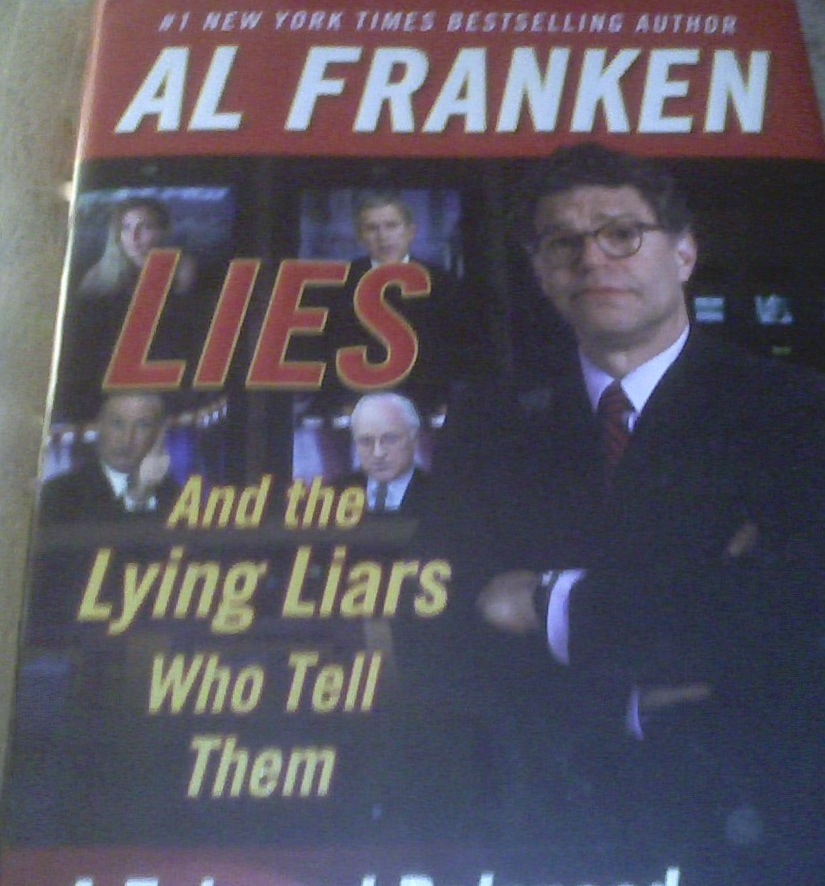
Al Franken's Lies Book Cover, November 16, 2010. Donald Earl Collins. Qualifies as fair use under US copyright law because the photo is being used for illustrative purposes only and is a low-quality crop of original book cover.

Below is a set of emails I received regarding a job I applied for about a month ago. I filled out a thirteen-question addendum to my original application for an initial phone interview, and authorized them to contact all six of my references (which they did) before being offered an interview:


11/09/10 5:24 PM
Dr. Collins – would you be available this Thursday or Friday to come to AERA in Washington for an interview? Please let me know.

Best regards,
Bob


Robert W. Jackson, Partner
Jackson & Associates Consulting Services, Inc.
“Excellence in Human Resources & Marketing”
Manage your most important resources – your employees
Tel.  703 450 8567
Cell  703 203 0293
rwj11601@gmail.com
jjacksonhr@aol.com

11/09/10 6:01 PM
I believe we will take about two hours of your time. Perhaps two and a half. It is possible there will be a final interview either next week or at a later date. Hope this helps.

Best,
Bob

11/10/10 8:03 AM
Dr. Collins – Due to travel schedules I need to postpone your interview so I won’t need you to come in to AERA this week. I will be back to you next week with next steps.
Thanks very much.

Best,
Bob

11/16/10 4:13 PM
Dr. Collins – I regret to inform you that AERA has selected another candidate for the Program Manager position. The position was offered to the lead the candidate yesterday and he accepted this morning. Thank you for applying for the position and for the time you spent discussing it with me. I wish you the best of luck with your career.

Sincerely,
Bob

Robert W. Jackson, Partner
Jackson & Associates Consulting Services, Inc.

Now, no one likes being rejected for a job, especially knowing that it was most likely an insider — someone who knew the people at the other end doing the hiring. Still, it’s acceptable that it’s who you know, and not what you know, that matters in a high-level job search. But a blatant lie, a delay tactic so that the American Educational Research Association (or AERA) could hire someone with an inside track to the position? Shame on both AERA and Robert Jackson for not having enough transparency and ethics to let me and other applicants know that we were never in line for the job!

In Memoriam – “Dr. K” at 50

Tags

, , , , , , , , , , , , , , , , , , ,


Dwight Gooden on SI Cover (September 2, 1985), November 16, 2010. Source: http://www.inewscatcher.com/2010/03/dwight-gooden.html. Though this image is subject to copyright, its use is covered by the U.S. fair use laws because of the historical significance of the person and the cover, the subject of this blog post.

Before there was Clayton Kershaw, Stephen Strasburg, Kerry Wood or Mark Prior, he had come and gone. Before folks like Tim McCarver and Joe Buck drooled over Roger Clemens, David Cone and Greg Maddox, he was the headliner that caused spittle to fly out of commentators’ mouths. A full quarter-century ago, he was the king of MLB pitching. Who am I talking about? What baseball player could I possibly be referring to? The former Boy Wonder, ’84 NL Rookie of the Year, and ’85 NL Cy Young Winner “Dr. K.,” Dwight Gooden.

He turns fifty years old today. I don’t watch baseball anymore, but thirty years ago, Gooden was the reason I watched. Between a great fastball, sweeping curve and more than average change-up, the nineteen and twenty-year-old Gooden was impossible for most major-leaguers to hit for three years — when’s the last time a pitcher threw for 276 innings but had an ERA of 1.53? — and hard to hit for six of his first seven years. All while on his way to 194 total wins in his career.

Dwight Gooden being honored by Mets at final game at Shea Stadium, Flushing, NY, September 28, 2008. (Kanesue via Wikipedia, Flickr.com). Released to public domain via CC-SA-3.0.

Dwight Gooden being honored by Mets at final game at Shea Stadium, Flushing, NY, September 28, 2008. (Kanesue via Wikipedia, Flickr.com). Released to public domain via CC-SA-3.0.

But no one talks about what could’ve been with Gooden anymore. The mistakes Davey Johnson, Mel Stottlemyre and the Mets leadership made with his arm were not worth mentioning when describing the lessons unlearned with Kerry Wood, Mark Prior or Stephen Strasburg. I guess wearing out a twenty-year-old arm isn’t comparable to, well, wearing out a twenty-year-old arm. Especially when one arm is Black and the other ones are White.

No one mentions Gooden in the same breath with Clemens or Maddox or Cone or any other dominant pitcher of the ’80s or even early ’90s. His drinking and drug problems, his run-ins with law enforcement. All obviously hurt his productivity as his career progressed. But I guess winning 100 games in just over five years as a major-league pitcher made someone like Gooden about as dominant a pitcher as a piñata about to be beaten by a White lynch mob. Someone baseball writers and commentators everywhere could toss aside as easily as they would throw away a donut wrapper.

This is the major reason why I don’t watch MLB baseball anymore. For all of his substance abuse and psychological problems, the man was as dominant a pitcher as any in the history of the game for his first seven years, and was a serviceable shell of himself for another seven of eight years. Yeah, a shell of himself while pitching a no-hitter for the Yankees in ’96.

And yes, he wrecked his career and life — with a lot of help from teammates and coaches. It’s not like he died after killing everyone at a Hall-of-Fame game. But to not discuss Gooden at all shows that, like the ball, only the mindset is White.