• About Me
  • Other Writings
  • Interview Clips
  • All About Me: American Racism, American Narcissism, and the Conversation America Can’t Have
  • Video Clips
  • Boy @ The Window Pictures
  • Boy @ The Window Theme Music

Notes from a Boy @ The Window

~

Notes from a Boy @ The Window

Category Archives: Mount Vernon High School

Sarai’s Death, One Year Later

11 Monday Jul 2011

Posted by decollins1969 in 1, Eclectic, Mount Vernon High School

≈ Leave a comment

Tags

616, 616 East Lincoln Avenue, Death, Eulogy, Family, Funeral, Mount Vernon New York, Sarai Washington, Sickle Cell Anemia, What Could've Been


Sarai Washington, February 9, 1983-July 11, 2010

This was the eulogy I wrote for my sister Sarai’s funeral 360 days ago:

“On Sunday, July 11, 2010, Ms. Sarai Ador Washington passed away at the age of twenty-seven from complications from sickle-cell anemia. It was the battle of Sarai’s life from the moment she was born. Yet Sarai fought that battle with dignity and a sense that her life was worth living. For those of us who knew her, and knew her well, most of the time, Sarai lived as if her disease didn’t exist, or at least, didn’t matter.

Even in those first few months after Sarai was born, she was obviously in trouble. She hardly gained any weight, all of her food had to be fortified with iron, and she only had “three strands of hair,” as our mother put it. It was more like a few dozen in three spots on Sarai’s scalp. She always needed help. Sarai was in and out of the hospital, in need of the occasional blood transfusion, and at times in excruciating pain. Between the disease and the hardships what we were going through as a family during the early years of her life, it’s amazing to know that Sarai managed to survive in the worst of those worst times.

Despite all of this, Sarai managed to grow up and eventually find herself. She almost immediately gained a love of music, whether it was listening to her mother’s singing of hymnals or her older brother Donald’s horrible rendition of Michael Jackson’s “Man In The Mirror.” She sang in choirs with her brothers Maurice and Yiscoc while growing up. Sarai attended Mount Vernon’s public schools, where she made friends along the way. Though delayed by her bouts with sickle-cell anemia, she eventually graduated from Mount Vernon High School, in 2003.

Later that year she spent some in Silver Spring, Maryland helping to care for her nephew, Noah Collins before returning to Mount Vernon. In 2005 Sarai moved to Huntsville, Alabama to live on her own for the first time. In addition to working for Western Corporation as a customer care professional, Sarai found her voice, making a whole new group of friends, touching others lives in the process. Sarai’s wonderful sense of humor and sense of kindness were assets that her friends in New York and Alabama truly appreciated.

When her disease became more difficult to manage, Sarai moved back to Mount Vernon in the spring of 2009 to live with our mother. Though her illness had gotten worse, she still had dreams for the future. She was hoping to go back to school to earn a cosmetology license.

Sarai’s sickle-cell anemia complications got worse, so bad that she had no choice but to quit her job. Although Sarai in her final months was not always feeling her best, she still found the time and energy to spend with her nephew, Roshad Washington. Despite it all, Sarai lived her life her way. Along the way, she enriched the lives of her family and her many friends.”

Sarai’s Death, 1 Year Later

Sarai’s Death, 1 Year Later

There isn’t much that I’d change about what I wrote last July, other than the two or three minor grammatical errors that I didn’t catch because I was working on less than five consecutive hours of sleep per night. But I do wish that I’d been able to do more for Sarai while she was alive. I think about her almost every day, wishing that she’d stayed with me in Silver Spring long enough to look into Howard University Hospital’s work on sickle cell anemia.

Mostly, I think about how I wish the quality of Sarai’s twenty-seven years, four months and two days had been better, that her parents had been better, that my life could’ve somehow made her’s better. It just wasn’t to be.
When Being An American Equals Never Having to Say Sorry

08 Friday Jul 2011

Posted by decollins1969 in 1, Academia, Boy @ The Window, culture, Eclectic, Mount Vernon High School, Politics, race, Religion

≈ Leave a comment

Tags

"Another E", A Curriculum of Inclusion, Academia, Afrocentricity, Arthur Schlesinger Jr., Asa Hilliard III, Blackness, Commissioner's Task Force on Minorities: Equity and Excellence, Cultural Pluralism, Culture Wars, Davis Middle School, Diane Ravitch, Diversity, Ethnic Studies, Ethnicity, Humanities, Humanities Program, K-12 Curriculum, K-12 Educaiton, Leonard Jeffries, Mount Vernon High School, Multicultural Education, Multiculturalism, New York State Department of Education, Race, University of Pittsburgh, Whiteness, Writing


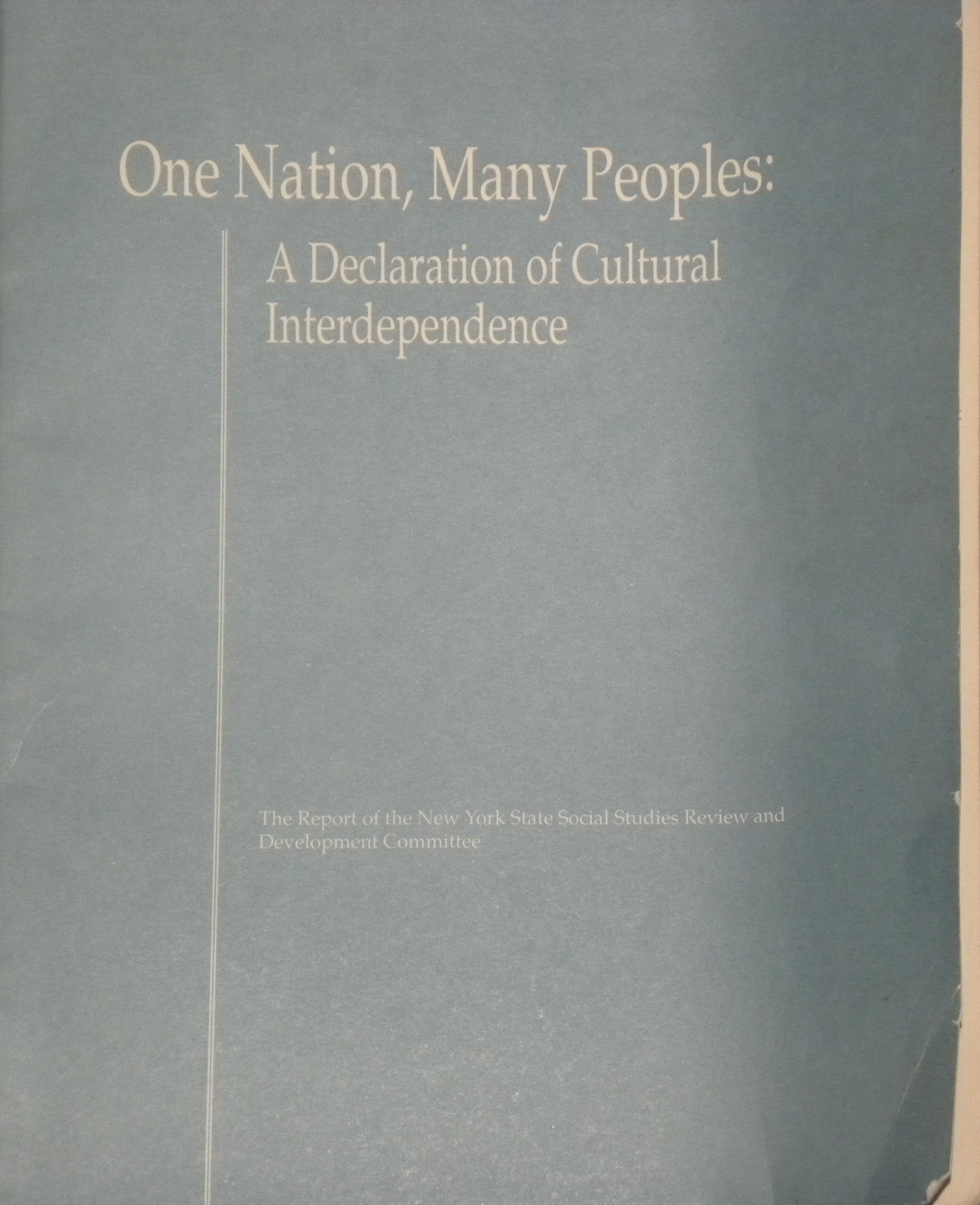
New York State Social Studies Review and Development Committee Report, June 1991 (Picture/Donald Earl Collins). One of several reports produced for the New York State Education Department and Commissioner, as part of the Commissioner's Task Force on Minorities: Equity and Excellence

Twenty years ago this week, I began writing an academic piece that would lead to my dissertation topic, doctorate and first book Fear of a “Black” America (2004). It was a topic that I’d fall in and then out of love with. Ironically, I pursued this topic because of my academic experiences in Humanities at Davis Middle and Mount Vernon High School. The topic was multiculturalism, and more specifically, multicultural education, and how to achieve this kind of curriculum reform in K-12 education. Just writing these words makes me feel both young and naive at the same time.

This whole quest started with a girl. Actually, with the young woman “Another E” (see “The Power of Another E” from April ’09 and “Beyond the Asexual Me” from last month”). She wanted to put an article together for publication, in response to what was then a major controversy involving research into the revision of New York State’s social studies and other curricula. The New York State Department of Education had given a committee the task of figuring out how to make the state’s K-12 curriculum more inclusive and representative of the state’s tremendous racial, ethnic and other forms of diversity.

By the end of September ’91, it would produce A Curriculum of Inclusion: Report of the Commissioner’s Task Force on Minorities: Equity and Excellence. But that deliverable was far from my mind when, tired from my weeks of near starvation post-graduation that April (see “Sometimes Starvation” from May ’11), I reluctantly said okay to working on this article.

Leonard Jeffries, Newark Public Library, February 1, 2007. (http://npl.org)

Now here I was, minus the young woman in whom I no longer had an interest, now working on a piece that had become more academic than either of us had originally intended. By the time I’d written my first words on multiculturalism, I’d already learned the names Leonard Jeffries, Asa Hilliard III and Arthur Schlesinger, Jr. I’d read articles from the New York Times and the Wall Street Journal about Jeffries’ name-calling, Schlesinger’s incredulousness about calling slaves “enslaved persons,” and about the committee in general getting along like hyenas tearing at a dead wildebeest.

If I’d been just a tad bit smarter, I would’ve done an investigative piece and called and emailed the people on this task force. I would’ve asked them to divulge to me what they would eventually tell the world about their dislike of each other and of anything “multicultural,” which was in quotes for them. For Schlesinger, multicultural was the equivalent of bad ethnic studies or a kind of Afrocentrism that blamed Whites for all that has ailed America and the world for the past 500 years. For Jeffries, it was a racist attempt at appeasing Blacks and other groups of color while maintaining the main theme of Whites on top.

Although this is an oversimplification, it’s not by much. There really wasn’t anyone from the task force, the

Arthur Schlesinger, Jr., CUNY, circa 2006, months before his death on February 28, 2007. (http://www.nytimes.com)

NYS Department of Education, or anyone who spoke on the Himalayas-out-of-a-termite-mound controversy over a more inclusive K-12 curriculum without taking one of those two views. That’s what interested me the most. Schlesinger, and eventually, folks like Diane Ravitch, Mario Cuomo and others completely against revision that even approached cultural pluralism, versus Jeffries, Hilliard and others arguing beyond what they called a White multiculturalism.

I didn’t have the capacity at that stage of my life to see myself as a writer or a journalist in any way. Just two years removed from the end of my mother’s marriage to my now idiot ex-stepfather, I only saw the piece that I’d turn into a Master’s research paper, doctoral thesis and first book as an academic exercise, one where I found the philosophical middle. I hadn’t a clue as to how to make myself part of the Ground Zero issue of the first seven years of the ’90s, the Culture Wars.

But I did have one experience that provided unique insight into multiculturalism and the arguments made by scholars and pols on all sides. Six years in Humanities in Mount Vernon, New York’s public schools. A place where cultural diversity and how to deal with it within the curriculum was the elephant in the classroom. Some teachers and classes addressed it, and many didn’t, to the detriment of what was a solid program, not to mention me and the others who were my classmates.

Either way, I saw more issues of diversity crop up where a multiculturalist approach would’ve been helpful all during my time in Humanities, including with my kufi and my Hebrew-Israelite years. It was a missed opportunity, one that I unconsciously wanted to address with my research of and writing on multiculturalism.

Elephant in School, retrieved July 7, 2011. (http://teachhub.com)

A One-Year Sooner “What If?”

18 Saturday Jun 2011

Posted by decollins1969 in 1, Academia, Boy @ The Window, Eclectic, Mount Vernon High School, New York City, Work, Youth

≈ Leave a comment

Tags

616, 616 East Lincoln Avenue, Class of 1987, Graduating Early, High School Graduation, Humanities, Humanities Program, Mount Vernon High School, Mount Vernon New York, New York Giants, New York Mets, Super Bowl XXI, Technisort, Time Traveling, University of Pittsburgh, Working, World Series


Through The Wormhole, Star Trek DS9 Style, June 18, 2011. Donald Earl Collins

Today’s twenty-four years since I graduated from Mount Vernon High School in Mount Vernon, New York as part of the Class of ’87. I’ve talked about the events immediately before and after that milestone. I’ve spent a bit of time on the day of the ceremony itself, and will again when I hit the quarter-century anniversary mark next year. Today, though, I want to hypothesize about what would’ve happened if I had decided to graduate one year earlier. I can’t help it. I’m a historian and intellectual, and not just a scholar who cares about research, so I often speculate in order to find answers that are a little outside of the box.

Because of Humanities and AP, many of the best of the best and brightest had or nearly had enough credits to graduate by the end of our junior year, in June ’86. A dozen or more members of the projected Class of ’87 actually took the option of graduating without a senior year. I could’ve myself. I was a quarter-credit short of graduation, and could’ve gone to summer school to take PE or health class to graduate no later than August ’86.

Back To The Future Photo Clip, May 7, 2009. Source: http://gilka.co.uk

What would’ve happened or not happened isn’t all that easy to figure out with any degree of certainty. But I can make a few educated guesses based on the kind of person I was twenty-five years ago. I hadn’t made any definitive decisions about what college to go to because my plans by April ’86 were for the fall of ’87, and not sooner. I had taken the AP US History exam that May, and all but knew that I’d earned a “5” and six college credits because of my score. The thought of graduating early had crossed my mind in the weeks after the exam.

The reality of life at 616, meanwhile, would’ve been harder to manage. With me out of school in ’86 instead of ’87, I suddenly would’ve found myself with more time on my hands for resentment and anger than I had before. Especially once my Technisort job came to an end at the beginning of August of that year. Sure, I would’ve filled my afternoons with watching or listening to Mets games from August to the World Series win on October 27th, and my fall/winter Sundays with Giants games as they marched to their first Super Bowl. But in between, I would’ve been looking for work, or would’ve found part-time work.

I know for sure that I would’ve spent even more time watching over my younger siblings, washing clothes, running to the grocery store, cooking meals, and so many other things that I ended up doing during my summers at home from my studies at the University of Pittsburgh. That would’ve made me resentful, given the lack of emotional support I had from my Mom.

I would’ve had to endure more weekend searches for my alcoholic father Jimme in order to have enough money to get away from 616 while waiting to start college in ’87. I probably would’ve seen a bit more of my idiot (ex) stepfather between September and November ’86 and March through May ’87, not an easy task considering I sometimes imagined myself stabbing him in the neck.

Or would I? If I know anything about space, time and history, if you change one decision, no matter how small, you change almost everything that comes afterward, even if some events on the surface look the same. I would’ve thought about taking some college courses at Westchester Community College, Pace University, perhaps even Fordham or one of the CUNY schools, like Hunter College. I still would’ve explored applying for schools outside of the NYC area, including the University of Pittsburgh. A couple of extra months at home would’ve made me more weary of being at 616 and in Mount Vernon than I actually was at the beginning of my senior year at MVHS.

Still, there was so much I would’ve missed learning my senior year. About the pitfalls of liking a girl whose only goal in life besides pleasing her parents was in pulling away from them by being cool (read Crush #2 and cruel, actually). All of the friendships and relationships that failed to endure the year. The difference between a great teacher like the late Harold Meltzer and someone in need of a career change like an Estelle Abel or a David Wolf. And that taking three AP courses in one year with teachers of varying abilities and with senioritis in full bloom was a terrible idea.

Those lessons wouldn’t have been learned for at least a year, and made my transition to college harder. Without those bitter lessons, I probably wouldn’t be a historian and a writer. For all I know, I probably would’ve ended up a bartender making the best daiquiris in Westchester County.

My Last Day

10 Friday Jun 2011

Posted by decollins1969 in 1, Boy @ The Window, Mount Vernon High School, race

≈ 2 Comments

Tags

Class of 1987, Estelle Abel, Generational Prejudice, Hometown, Mount Vernon High School, Mount Vernon New York, MVHS


My last day at MVHS was a complete blur of “goodbyes” to teachers and classmates who I considered friends and “good riddance” to some classmates and my wonderful incompetent and uncaring guidance counselor, Sylvia Fasulo. My eighth-period Health class was the last class I’d ever have at MVHS. It was the class where a drug-dealing-student who lived near East Lincoln and Sheridan had suggested that Saran Wrap was a good substitute for a condom. I don’t think I’ll ever forget that. After class, I walked down the second floor steps and the first floor halls of the high school to my locker one more time.

While clearing out my locker, Estelle Abel walked by and asked to meet with me. I went over to her office, and for the next fifteen minutes, she proceeded to explain to me how much of a disappointment I was while a student at MVHS. Abel claimed that I had underachieved throughout my four years as a student, that I should have been ranked in the top ten of my class, and that my performance in AP Physics was beyond abominable. All I could focus on was the amount of anger and emotion she possessed in her voice and eyes. You’d have thought that I’d been expelled from school or had raped her daughter.

There were two really odd things Abel said during her attack on my character. One was that I had let down the Black students of the school and “my community” by not finishing closer to the top of my class. She said, “You could’ve been a shining example of achievement to us,” all but hinting at Sam as the person I should’ve been like. I guess I did let my Black classmates down. I only ranked second in GPA among Black males and eighth among all African Americans and Afro-Caribbeans in my class.

Abel’s other comments really surprised me.”You don’t have any excuses! There is nothing going on at home that could justify your performance.” When I disagreed, the Science department head’s face turned stern. She said that nothing occurring in my life would ever compare to the problems Blacks faced “back in the 1960s . . . I marched with Dr. Martin Luther King!” My mind clicked off my eardrums at that point. Short of showing her my war wounds and having her meet my family, what could I possibly do or say to that?

I left her office feeling like my years at MVHS and in Humanities were just bullshit. I was in a mood and in a mode in which I needed someone to be there for me, to not judge me, but to save me again. If anyone had walked up to me on my way home to tell me how great a place Mount Vernon was to live in, I would either chewed them out or punched them in the jaw. Mount Vernon, MVHS, Humanities, 616. I saw them as different sides of the same box, a place of isolation, ignorance, abuse and apathy, a macabre place where only the stereotypical and the cool could survive.

My opinion about Mount Vernon hasn’t changed much in the twenty-four years since Estelle Abel acted an ass with me present. Despite all attempts by former classmates and former neighbors to make Mount Vernon sound like, say, the Black suburbs of Atlanta, it isn’t that place, not by a long shot. When one in five residents are below the poverty line, with a school district among the worst in the state (even though I know it’s getting better), a crime rate that would make folks in the DC area take notice, and with a generational and ethnic divide still in existence, I think that it’s difficult to argue that Mount Vernon is a great place to live. But then again, I’ve seen the worst the former “city on the move” has to offer.

I guess that it wasn’t all bad. I miss Clover Donuts, Papa’s Wong’s, Prisco’s Used TVs and Radios, the Army-Navy store, Mount Vernon Public Library, some of my teachers, and a few folks I did get along with. Those places of business mostly don’t exist, the libraries I go to now are just as good and the buildings much better maintained, and many of the folks I liked are either dead or scattered to the four corners of the Earth. I guess that you can’t go home again, in this case, thankfully so.

With the exception of a few friends, 616 and Crush #2, I really had left Mount Vernon in my mind by the time I walked out of MVHS for the last time as a student. There are some things I wished I could’ve done growing up there. Like hanging out more, going to the basketball games and other sporting events. Or spending more time at public gatherings in Hartley Park or at th Wilson Woods pool. Yet it wasn’t to be. I was a Mount Vernonite, in it, but certainly not of it.

Maybe that’s why I don’t feel like I’ve ever really had a hometown, why I prefer my remains to be scattered in Seattle or in the Atlantic than buried in the city of my birth. All I know is that by the time of my last day at MVHS, twenty-two years ago to the date and day, my hometown had shown no interest in me or in my success. That, folks, is reason enough to not see a place you grew up in as your own.

Know Food, Know The World

04 Saturday Jun 2011

Posted by decollins1969 in 1, Academia, culture, Eclectic, Mount Vernon High School, race, Religion

≈ Leave a comment

Tags

Carnegie Mellon University, Commodities, Conflict, Cooperation, Exploitation, Food, Ingredients, Jared Diamond, Peter Stearns, Recipes, Resources, Teaching, Teaching and Learning, University of Maryland University College, World History


Chocolate Cake, Vanilla Icing, 2011. Source: http://www.tastebook.com

I don’t really dedicate much of my blogging to what I do these days, my college teaching work. I guess that I kick up enough dust talking about my Mount Vernon years, my Humanities years, my Carnegie Mellon years, and my former jobs and bosses as it is.

But this is a fairly positive post (mostly, anyway). It about something that I learned recently while teaching one of my World History courses. Something so simple that it’s amazing sometimes how stupid I can be.

I realized one day in discussing the age of exploitation, um, well, exploration that one of the best ways to think about this period — heck, any period in world history, really — begins and ends with one word: food. I’d taught this course a couple of times for University of Maryland University College already. Not to mention having served as a teaching assistant under the great Peter Stearns while a grad student at Carnegie Mellon a decade and a half before (see my “Ego Inflation” post from last month).

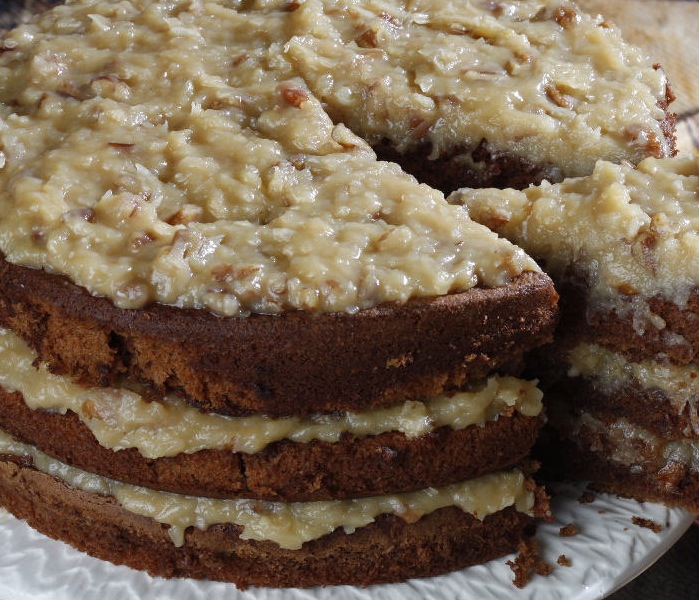
German Chocolate Cake, 2011. Source:http://blogs.courier-journal.com. Meet a cake that was never German, but named by an English guy. And, since when do coconuts grow in Europe or the US?

But on that fall evening in ’09, looking at exploration patterns, commerce patterns and the state of the world circa 1600 CE, it hit me how I could just about reorganize every aspect of the way I’d been teaching World History by just looking at how much food has influenced it. Every bite we take, everything we imbibe, has some history attached to it, and with it, stories of bloody conflict, imperial conquest or rare attempts at true humanity and cooperation.

This is about much more than Jared Diamond’s books on the rise and fall of civilizations because of resources and the lack thereof. Commodities like salt, sugar, black pepper and olive oil have all been written about over the past fifteen years. It’s fairly obvious that these spices and other foodstuffs were fundamental in the histories of the Middle East, ancient Greece and Rome, India, Timbuktu and Western Europe over the past 5,000 years.

Still, I’m not really talking about that kind of history, either. It’s more about something as simple as taking a modern dish and using its ingredients to tell a story. Take something like a chocolate cake with vanilla icing. If the ingredients are natural and not ones cooked up at a chemical plant in northern New Jersey, then they’ve come from all over the world. Cocoa, the main ingredient to mix with the flour, is from the cacao plant, which originally from South America, but is primarily produced in sub-Saharan Africa. Sugar’s needed to sweeten it, and though originally from India, has been grown in Florida, Louisiana and in the Caribbean for centuries. One of the main economic drivers for the enslavement of Africans was the European need to rot out their teeth with the stuff.

Vanilla extract or vanilla beans are originally from Mexico and other parts of Central America. But the largest producers of it are Indonesia and especially Madagascar. There’s history in every gram of devil’s food cake with vanilla icing that we eat.

You could do the same thing with a “traditional” Chinese stir-fry. Especially if ingredients like baby corn or

Sweet-and-sour-chicken, 2011. Source: http://www.foodnetwork.com

sweet and sour sauce are added to the mix. That’s because baby corn and tomatoes (the latter the main ingredient in sweet and sour sauce) are both from the Americas, not Asia or Europe. Both arrived in Ming China nearly 500 years ago.

Every dish, whether invented in 2011 CE or 2011 BCE, has a rich story attached to it. From that story, we can all find important patterns in world history, cultural development, domination and destruction within. It may not be the most profound thing I’ve ever stumbled upon. Still, I didn’t get this from Peter Stearns or Jared Diamond. If anything, I might’ve gotten this from Forrest Gump.

Balkis Makeda’s 2nd Coming

23 Monday May 2011

Posted by decollins1969 in 1, Boy @ The Window, culture, Eclectic, Mount Vernon High School, Politics, race, Religion, Youth

≈ Leave a comment

Tags

616, 616 East Lincoln Avenue, Balkis Makeda, Balqis Makeda, Birthday, Christianity, Cooking, Cult, Cults, Eri, Hebrew-Israelites, Hell, Hello, Interpreting Dreams, Israelites, Ivory Soap, Judah ben Israel, King Solomon, Kufi, Maurice Eugene Washington, Mount Vernon High School, Mount Vernon New York, Poverty, Queen of Sheba, Race, Reincarnation, Rituals, Unclean Issues of Blood


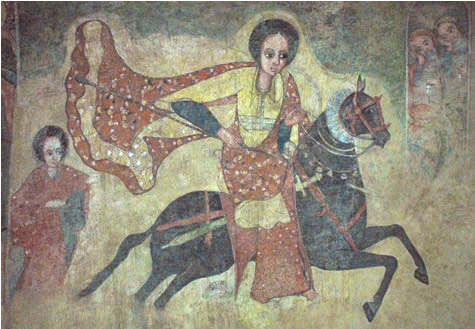
Queen of Sheba traveling to Solomon: A fresco in Ethiopia, Date Unknown. Source: http://www.expedition360.com/journal/archives/2007/05/. In public domain.

Yesterday, my youngest brother Eri turned twenty-seven (Happy Birthday again, bro!). He was the fourth baby my mother gave birth to in a five-year span. I’d been pissed before about all that had happened with us regarding my mother, my stupid (ex)-stepfather, our poverty and being on welfare, and the whole Hebrew-Israelite thing. But now, along with Eri’s birth, came with it an elderly trespasser at 616, courtesy of the fifty-four-inch waist — and waste — of an idiot Maurice.

You see, my stupid stepfather invited his Hebrew-Israelite matriarch “Balkis Makeda” to stay with us. The woman claimed to be a reincarnated Balkis Makeda (Queen of Sheba and wife of King Solomon of the ancient Israelites), and was the catalyst in Maurice’s Hebrew-Israelite conversion during his separation from Mom between October ’80 and April ’81.

Because of Maurice — um, excuse me, Judah ben Israel — and our fearless leader “Balkis Makeda,” we followed a number of un-Torah-like practices. This included the requirement that we all were to believe that she was the reincarnation of the Queen of Sheba, living among us in the twentieth century as an average person and showing us the way to Yahweh and ultimate truth.

Bar of Ivory Soap, December 28, 2009. Source: Erin Gifford, http://couponcravings.com/2009/12/cvs-free-ivory-soap.html.

We stopped using Ivory Soap at home because our leader had a dream once about rats gnawing on a bar of it. Baby Maurice couldn’t use a soap that’s 99.44 percent pure because of Makeda’s dream, and we switched to Zest. (The real reason, I think, was because the soap was white — like Whites ethnically — and considered the opposite of pure by many in the Hebrew-Israelite community).We weren’t allowed to use the word “Hello” when greeting someone in person or when answering the telephone. Maurice explained that “Hello’s got the word Hell in it, you know, Hell-low!” We’d somehow be committing someone to eternal damnation with a universal English greeting.

Now in her seventies and in declining health, the geezer was moved in before Mom could seriously object. What a situation! Six kids, including me, plus Mom, Maurice, and an old woman living together in a 1,200-square-foot, two-bedroom, one-bathroom apartment. We now needed to behave like good little Hebrew-Israelites with this woman in our house, so as to not embarrass my stepfather. Yeah, right!

One of the other rules of our absurdly orthodox practice was that Mom couldn’t cook or do any familial tasks for the next three months. She was “unclean” because she’d just given birth to Eri. This might’ve made sense in the deserts of ancient Canaan, with no antibiotics and drugs to deal with unclean issues of blood and other bodily fluids. It didn’t now. Plus I didn’t remember Mom not cooking for three months after Yiscoc and Sarai were born. This was suck-up time, plain and simple.

Maurice made what was an abyss of bad even worse by cooking dinner for three days. Three straight nights of over-boiled and under-ripened cabbage drenched in its own juices and seasoned to high heaven with red and black pepper. My stepfather could’ve been the founder of a new weight-loss diet. Mom, of course, asked me to take over her cooking duties, which I did for the next six weeks (see my “Top Cook” post from May ’09).

The woman couldn’t stand us, and especially couldn’t stand me. She probably sensed how much I couldn’t

A child in the Black Hebrews community, in Dimona, Israel, September 5, 2005. Source: Dror Eiger, http://flickr.com/photos/95465714@N00/41252116. In public domain, as file is licensed under the Creative Commons Attribution-Share Alike 2.0 Generic license.

stand her and her idiotic notions of Judaism, even with the context of being a Hebrew-Israelite. All I knew was that when I cut through all of the words and nuggets of truth, ritual and superstition, that “Makeda” was full of crap, and had fostered the conversion of my stupid stepfather, the only person I knew who was even more full of crap than her. I was already a Christian in the closet by then. Now I faced the prospect of revealing my spiritual conversion in the middle of such a grand mess. But I knew I had little other choice.

Within weeks of “coming out” to Mom, Maurice and my classmates at Mount Vernon High School (see my post “Kufi Emancipation Day” from September ’09 for more), the older woman moved out, under pressure from Mom. Both, ironically, were under pressure from me, as I threatened to move out myself. She died in Section 8 housing on Mount Vernon’s South Side in February ’85. I dare say that she wasn’t the reincarnated Makeda. For the only one who could’ve learned a lesson from a lifetime of poverty and cult-like rituals would’ve been her, not us.

No Good Teaching Deed Goes Unpunished

13 Friday May 2011

Posted by decollins1969 in 1, Academia, Boy @ The Window, culture, Eclectic, Mount Vernon High School, Politics, race, Youth

≈ 2 Comments

Tags

AP American History, AP US History, AP US History Exam, Blue Ribbon Schools, Burnout, Harold Meltzer, Mount Vernon High School, Mount Vernon New York, Politics of Education, Richard Capozzola, Student Achievement, Teacher Effectiveness, Teachers Unions, William Prattella


AP US History, Harold Meltzer & Teachers Under Assault

AP US History, Harold Meltzer & Teachers Under Assault

It’s never really been much of a surprise to me how much we don’t appreciate good teachers. I should know. A few semesters ago, a student of mine filed a complaint against me because she couldn’t see my lecture notes well enough due to some issue with the LCD projector for my classroom. Mind you, she admitted that she didn’t have her glasses that day. When I didn’t allow her to interrupt me in the middle of class over the issue, she stormed out, yelled a couple of obscenities at me, and slammed the classroom door shut.

I know, it’s much worse on the K-12 level, between incorrigible students and insolent parents, school and district administration. Not to mention the pressures of NCLB, initiatives like Race to the Top (or bottom, really) and private foundations with their own agendas. Add to that article after article blaming teachers unions for being on the wrong side of corporatized education reform that emphasizes math and science and test scores over humanities and social science and critical thinking.

Former NYC DOE Chancellor Joel Klein’s now among them, in his lengthy (really, too long) piece on “The Failure of American Schools” in this month’s Atlantic Monthly, laid much of the blame on teachers and teachers unions. Not our nation’s economic woes, an overemphasis on math and science, or a system that was created not to teach academic excellence, but to weed out the so-called weak-minded. It’s no wonder that the average career of a teacher is five years!

A quarter-century ago on this date, my former teacher Harold Meltzer’s good deeds came to fruition through our AP US History class and our AP exam that year. We learned in September ’86 —  the beginning of our senior year — that three of us (including yours truly) all scored 5’s on the AP American History exam on this date. That meant that three of us had earned six college credits a year before enrolling in any university. There were at least four others who scored a 4, guaranteeing them three college credits. Another five scored a 3, considered a passing score by colleges and the College Board.

It was the best an MVHS AP class had ever done on any AP exam up to that point in the high school’s history, and should’ve been a crowning achievement for Meltzer and the school. Yet instead of praise or at least a “Congratulations,” Meltzer was treated as if he’d shown up MVHS by his boss, Social Studies Department Chair Larry Smith, a red-headed man who looked like a character from Dune. He snickered at me every time he saw me with Meltzer. Neither Superintendent William Prattella nor Richard Capozzola saw fit to honor Meltzer or our class for our achievements. It was ironic, because MVHS won a Blue Ribbon Schools of Excellence award from the US Department of Education a few months later, off of the work of teachers like Meltzer, as well as Humanities students.

There were rumors that some of the White parents were unhappy with Meltzer’s methods of teaching, which typically involved us interpreting history rather than answering straightforward history trivia questions. More than rumors, actually, as I walked in on a meeting between Meltzer and a parent my senior year. That mother demanded an A for her daughter in Meltzer’s AP US History class. What wasn’t exactly a rumor, either was that Smith was looking for any excuse to take AP US History away from Meltzer. Especially since it was so shocking that both White and Black students did equally well on the exam that year. Of course, there were other, more deeply personal issues between the two men that likely involved jealousy and other not-so-secret secrets.

For our part, our cohort stopped talking to Meltzer altogether. Sure he was eccentric, even a bit strange and unorthodox as a teacher, but at least he cared. And by the way our scores turned out, he didn’t deserve the cold shoulders he received from most of my classmates our senior year. It bothered me when I’d see Meltzer saying “Hello” to one of us as we passed his Room 275, only for one of us to walk by as if Meltzer had phased out of our space-time continuum.

I was sure that some of it was related to Meltzer being a “confirmed bachelor.” But mostly, I thought that despite Meltzer’s lack of a normal teaching style, that my classmates were total assholes toward him. Meltzer spent the week before the AP exam after school with us going over every conceivable fact of American history for the more anal of us. It was above and beyond, and also unnecessary. Because Meltzer had taught us enough about egalitarianism, critical and independent thinking, and “coming to the point at once” in the first months of his class for all of us to do well.

Meltzer died from a number of ailments at the age of sixty-six in early January ’03. But one thing I was sure of that hastened his decline was the bitter and broken heart he had from the way he’d been treated in his last years as a teacher. I just hope that I brought a little bit of laughter to the man in his final months and weeks. Or at least, something to smile about.

← Older posts
Newer posts →

Boy @ The Window: A Memoir

Boy @ The Window: A Memoir

Places to Buy/Download Boy @ The Window

There's a few ways in which you can read excerpts of, borrow and/or purchase and download Boy @ The Window. There's the trade paperback edition of Boy @ The Window, available for purchase via Amazon.com at http://www.amazon.com/Boy-Window-Donald-Earl-Collins/dp/0989256138/

There's also a Kindle edition on Amazon.com. The enhanced edition can be read only with Kindle Fire, an iPad or a full-color tablet. The links to the enhanced edition through Apple's iBookstore and the Barnes & Noble NOOK edition are below. The link to the Amazon Kindle version is also immediately below:

scr2555-proj697-a-kindle-logo-rgb-lg

Boy @ The Window on Amazon.com: http://www.amazon.com/Boy-The-Window-Memoir-ebook/dp/B00CD95FBU/

iBookstore-logo-300x100

Boy @ The Window on Apple's iBookstore: https://itunes.apple.com/us/book/boy-the-window/id643768275?ls=1

Barnes & Noble (bn.com) logo, June 26, 2013. (http://www.logotypes101.com).

Boy @ The Window on Barnes & Noble: http://www.barnesandnoble.com/w/boy-the-window-donald-earl-collins/1115182183?ean=2940016741567

You can also add, read and review Boy @ The Window on Goodreads.com. Just click on the button below:

Boy @ The Window

Twitter Updates

Tweets by decollins1969
  • RSS - Posts
  • RSS - Comments

Archives

  • June 2025
  • April 2023
  • September 2022
  • August 2022
  • July 2022
  • June 2022
  • May 2022
  • April 2022
  • March 2022
  • January 2022
  • December 2021
  • November 2021
  • October 2021
  • September 2021
  • August 2021
  • July 2021
  • June 2021
  • April 2021
  • March 2021
  • February 2021
  • January 2021
  • December 2020
  • November 2020
  • October 2020
  • September 2020
  • August 2020
  • July 2020
  • May 2020
  • April 2020
  • March 2020
  • January 2020
  • December 2019
  • November 2019
  • August 2019
  • July 2019
  • June 2019
  • May 2019
  • April 2019
  • March 2019
  • February 2019
  • January 2019
  • December 2018
  • November 2018
  • October 2018
  • September 2018
  • August 2018
  • July 2018
  • June 2018
  • May 2018
  • March 2018
  • February 2018
  • January 2018
  • December 2017
  • November 2017
  • October 2017
  • September 2017
  • August 2017
  • July 2017
  • June 2017
  • May 2017
  • April 2017
  • March 2017
  • February 2017
  • January 2017
  • December 2016
  • November 2016
  • October 2016
  • September 2016
  • August 2016
  • July 2016
  • June 2016
  • May 2016
  • April 2016
  • March 2016
  • February 2016
  • January 2016
  • December 2015
  • November 2015
  • October 2015
  • September 2015
  • August 2015
  • July 2015
  • June 2015
  • May 2015
  • April 2015
  • March 2015
  • February 2015
  • January 2015
  • December 2014
  • November 2014
  • October 2014
  • September 2014
  • August 2014
  • July 2014
  • June 2014
  • May 2014
  • April 2014
  • March 2014
  • February 2014
  • January 2014
  • December 2013
  • November 2013
  • October 2013
  • September 2013
  • August 2013
  • July 2013
  • June 2013
  • May 2013
  • April 2013
  • March 2013
  • February 2013
  • January 2013
  • December 2012
  • November 2012
  • October 2012
  • September 2012
  • August 2012
  • July 2012
  • June 2012
  • May 2012
  • April 2012
  • March 2012
  • February 2012
  • January 2012
  • December 2011
  • November 2011
  • October 2011
  • September 2011
  • August 2011
  • July 2011
  • June 2011
  • May 2011
  • April 2011
  • March 2011
  • February 2011
  • January 2011
  • December 2010
  • November 2010
  • October 2010
  • September 2010
  • August 2010
  • July 2010
  • June 2010
  • May 2010
  • April 2010
  • March 2010
  • February 2010
  • January 2010
  • December 2009
  • November 2009
  • October 2009
  • September 2009
  • August 2009
  • July 2009
  • June 2009
  • May 2009
  • April 2009
  • March 2009
  • February 2009
  • January 2009
  • December 2008
  • November 2008
  • October 2008
  • September 2008
  • August 2008
  • July 2008
  • June 2008
  • May 2008
  • April 2008
  • March 2008
  • February 2008
  • January 2008
  • December 2007
  • November 2007
  • October 2007
  • September 2007
  • August 2007
  • July 2007
  • June 2007

Recent Comments

decollins1969's avatardecollins1969 on No Good Teaching Deed Goes…
Mary Rose O’Connell's avatarMary Rose O’Connell on No Good Teaching Deed Goes…
Lyndah McCaskill's avatarLyndah McCaskill on The Raunchiest of Them Al…

NetworkedBlogs on Facebook

NetworkedBlogs
Blog:
Notes From a Boy @ The Window
Topics:
My Life, Culture & Education, Politics & Goofyness
 
Follow my blog

616 616 East Lincoln Avenue A.B. Davis Middle School Abuse Academia Academy for Educational Development AED Afrocentricity American Narcissism Authenticity Bigotry Blackness Boy @ The Window Carnegie Mellon University Child Abuse Class of 1987 CMU Coping Strategies Crush #1 Crush #2 Death Disillusionment Diversity Domestic Violence Economic Inequality Education Family Friendship Friendships Graduate School Hebrew-Israelites High-Stakes Testing Higher Education History Homelessness Humanities Humanities Program Hypocrisy Internalized Racism Jealousy Joe Trotter Joe William Trotter Jr. K-12 Education Love Manhood Maurice Eugene Washington Maurice Washington Misogyny Mother-Son Relationship Mount Vernon High School Mount Vernon New York Mount Vernon public schools Multiculturalism MVHS Narcissism NFL Pitt Pittsburgh Politics of Education Poverty President Barack Obama Race Racial Stereotypes Racism Relationships Self-Awareness Self-Discovery Self-Reflection Sexism Social Justice Teaching and Learning University of Pittsburgh Violence Whiteness Writing

Top Rated

Blog at WordPress.com.

  • Subscribe Subscribed
    • Notes from a Boy @ The Window
    • Join 103 other subscribers
    • Already have a WordPress.com account? Log in now.
    • Notes from a Boy @ The Window
    • Subscribe Subscribed
    • Sign up
    • Log in
    • Report this content
    • View site in Reader
    • Manage subscriptions
    • Collapse this bar
 

Loading Comments...