• About Me
  • Other Writings
  • Interview Clips
  • All About Me: American Racism, American Narcissism, and the Conversation America Can’t Have
  • Video Clips
  • Boy @ The Window Pictures
  • Boy @ The Window Theme Music

Notes from a Boy @ The Window

~

Notes from a Boy @ The Window

Tag Archives: Corporatized Education Reform

Common Core Advocacy As A Job Requirement?

16 Thursday Jan 2014

Posted by decollins1969 in 1, Academia, culture, Politics, Pop Culture, race, Youth

≈ 2 Comments

Tags

Assessments, Common Core State Standards, Corporatized Education Reform, Education, Education Reform, Employment Practices, High-Stakes Testing, North Carolina, Partisan Politics, Teacher Effectiveness, Teacher Evaluations, The Hunt Institute, The James B. Hunt Jr. Institute for Educational Leadership and Policy


The James B. Hunt, Jr. Institute for Educational Leadership and Policy (aka, The Hunt Institute), building and logo, 1000 Park Forty Plaza, Durham, NC, January 16, 2014. (http://www.beacondevelopment.com and Facebook.com).

The James B. Hunt, Jr. Institute for Educational Leadership and Policy (aka, The Hunt Institute), building and logo, 1000 Park Forty Plaza, Durham, NC, January 16, 2014. (http://www.beacondevelopment.com and Facebook.com).

A few months ago, I applied for a Director of Programs job with The Hunt Institute in Durham, North Carolina. I know, I know. I should’ve known better, considering their ties to the Common Core, but I didn’t. In my defense, I did it through the University of North Carolina job website. I received an email on Monday to set up a Thursday interview, followed by another email on Tuesday asking me to write a hypothetical two-page brief “intended for a state legislator that describes why standards and assessments are important; how they interact; and what legislators need to understand about implementation.” (Keep in mind, The Hunt Institute is supposed to be a nonpartisan nonprofit organization).

Below is the brief I wrote in response (also, here):

Over the past decade and a half, you have been a key advocate of public education reform. You have helped pave the way for the adoption of Common Core Standards and a series of comprehensive assessments for students across the state. You have also served on committees that have urged the implementation of new measures for teacher effectiveness, measures based in no small part on the resulting scores that students and schools obtain on the new comprehensive assessments. Your rationale and that of your colleagues has been to cite the need to close the achievement gap between low-income students and students of color on the one hand, and high-income and White students on the other. Although this goal remains laudable, the means that you have advocated and the state of North Carolina has adopted will do more harm than good on the path toward educational equity and the nurturing of high academic achievement regardless of race and socioeconomic status.

There is mounting evidence across the state – indeed, across the country – that more and more comprehensive testing and assessments have failed to achieve the desired result of closing the achievement gap. Teachers and principals have noted that the time devoted to testing and to preparing students for testing has grown to the point where they have time for little else in terms of student learning. Recent surveys of students have shown that student motivation for learning has declined as the amount of testing has increased. And the most undeniable statistic is that nearly half of the state’s veteran teachers (i.e., teachers who have been in the profession for more than five years) have resigned or retired since we began introducing new state standards and assessments a little more than a decade ago.

This isn’t to suggest that we go back in time to the period before the rise of new state standards and assessments in the late-1990s. Rather, this is a time in which we should reflect on the deficiencies of the current model and take the following steps to ensure that our standards and assessments actually encourage student learning and thus a closing of the achievement gap. Below is a list of recommendations before continuing to move forward with Common Core State Standards and school district/statewide testing regimen:

1. Reconsider the Common Core, or at the very least, disconnect the relationship between it and the state assessments. States all over the country, including North Carolina, have reported problems in taking these standards and using them to develop appropriate curricula for their students. The use of these standards, developed in less than a decade, with little input from teachers, administrators, in some cases including administrators in Raleigh, has meant little to no ability for teachers on the ground to match up the standards with the curriculum or the needs of their students. It is simply a too big, one-size-fits-all approach to teaching and learning that results in neither teaching nor learning. The effect has been to reduce our classrooms to laboratories, where our teachers serve as principal investigators, and our students as lab rats. We should have standards, but ones that better fit our state and the needs of our students. Not to mention ones that allow for teacher adaptations to encourage learning.

2. Revise the number, frequency and kinds of assessments that we are doing for our students. As it stands now, we are doing entirely too many assessments too early and too often for students in the state. Assessments start as early as the second grade, with school district and state level assessments occurring throughout the year, approximately once ever six weeks. For students, the psychological effect has been to turn education into a torturous and boring chore, rather than a fun and imaginative process of learning and development. Nearly every study that nonpartisan groups have conducted in the past seven years has shown this to be true. To be sure, we need to do assessments, but not two or more levels of assessment six or seven times a year, especially in the elementary grades. Rather, we should be doing one set of diagnostic assessments twice a year at the elementary school level, and once a year at the middle and high school levels, so that the students in greatest need of academic help can get that help. In practical terms, the money the state legislature currently has devoted to testing and the testing companies for our regimen of assessments could be better spent on diagnostic testing and additional tutoring for students in need of it.

3. Resist the need to tie teacher evaluations to assessment scores. This is simply the wrong way to go about determining a teacher’s ability to reach their students. Even the best researchers in the field on teacher effectiveness have shown that the best teachers can only improve a classroom’s performance on any given assessment regimen by about two (2) percent. From poverty to eating a healthy breakfast and getting a good night’s sleep, there are plenty of factors in assessment scores in which individual teachers have no control. Yet the irony is that because the state has adopted this form of teacher evaluation, it has all but eliminated the ability of teachers to be teachers – to think independently and to act with enough autonomy to best determine how to reach their students. This kind of teacher evaluation process has encouraged every teacher in the state to “teach to the test.” This has significantly reduced the amount of time teachers devote to such tasks as independent reading, geography, social studies and other subjects that, ironically, stimulate student learning. We certainly need better trained teachers. What this means, though, is that the state needs to create a process by which the standards for entering the profession are higher. This could include the use of National Board for Professional Teaching Standards assessments of teacher excellence early on, as well as consistent mentoring and professional development as early as their first day in the classroom.

In summary, the best way to move forward in terms of standards and assessments is for our state not to rely on them as a substitute for actual teachers and actual teaching as the means for improving student performance. What we have in terms of standards and assessments is cost-ineffective, and it actually defeats the goal of closing the achievement gap, the very goal we in this state are all after.

It’s difficult to respect a job process in which a prospective employer isn’t up front about a key component of the position, in this case, the need to promote Common Core State Standards and teacher evaluations based on student assessments. It’s also difficult when they insist they’re nonpartisan, even though taking on the role of advocate for this brand of education reform is decidedly a centrist-conservative position. But being asked to not interview after writing this hypothetical brief is the best example for why education, politics and a job search should never come together. Especially if we really care about education and kids.

“The Negro Problem,” “The Jewish Question,” & “Closing the Achievement Gap”

10 Saturday Aug 2013

Posted by decollins1969 in 1, Academia, culture, Eclectic, Politics, Pop Culture, race

≈ Leave a comment

Tags

Anti-Union, Booker T. Washington, Closing the Achievement Gap, Corporatized Education Reform, Crisis in Education, Education Reform, Eugenicists, Eugenics Movement, Frederick Hoffman, High-Stakes Testing, Jewish Question, Negro Problem, Parallels, Private Foundations, Teacher Effectiveness, Teachers Unions, Technocrats, W. E. B. Du Bois


Logo of the Second International Congress of Eugenics, 1921, May 9, 2005. (Fastfission via Wikipedia). In public domain.

Logo of the Second International Congress of Eugenics, 1921, May 9, 2005. (Fastfission via Wikipedia). In public domain.

What do these three disparate phrases have in common? This came up during my recent lunch with my friend Andrew at Lebanese Taverna a little more than a week ago. Among other things, we were lamenting the dominant theme of education reform as union-busting and the supplanting of teachers with high-stakes tests and Teach for America substitutes.

As we discussed Andrew’s second book on the 1990s culture wars and their roots in the 1960s conservative movement, it occurred to me that what both of us have thought of as recent or new really wasn’t. The efforts over the past decade to “close the achievement gap,” an actual problem really, are based in the nineteen and twentieth-century eugenics movement more than it is in a real sincere effort to confront the barriers to high academic achievement for students in poverty and for students of color.

Satirical cartoon of Rudyard Kipling's The White (?) Man's Burden ("white" colonial powers being carried as the burden of their "colored" subjects),  Life Magazine, March 16, 1899. (Travb via Wikipedia). In public domain.

Satirical cartoon of Rudyard Kipling’s The White (?) Man’s Burden (“white” colonial powers being carried as the burden of their “colored” subjects), Life Magazine, March 16, 1899. (Travb via Wikipedia). In public domain.

“How does it feel to be a problem?,” W. E. B. Du Bois asked numerous times and wrote in numerous ways in his The Souls of Black Folk (1903).  The Negro problem for White scholars and politicians at the turn of the twentieth century varied from Frederick Hoffman’s 1896 statistical eugenics argument that predicted the “extinction of the Negro” to the much more common struggle of how to educate the Negro (but not educate them too well). Hoffman’s White supremacy argument was a bit outside the mainstream even for his Whites-are-always-right era. The more mainstream problem of Negro education became one of “practical” vocational (or, as it was called at the time, industrial) education as advocated by accommodationist Booker T. Washington versus Du Bois’ higher education and leadership preparation for the Black Talented Tenth.

We’re here again, in the early twenty-first century, with the technocrats in government and White paternalists in the private foundation world sounding the alarm that there’s an achievement gap between the affluent and the poor, as well as between Whites, Blacks and Latinos. Except that this achievement gap’s been around for a half-century. Except that the biggest single factor in raising student achievement rates is family income and occupation(s), not more testing or a theory of change to assess teacher effectiveness. Except that schools in the districts in which the achievement gap is the most obvious — segregated, mostly poor and of color — are underfunded when accounting for inflation and other factors (e.g., age of school buildings, teacher-student ratios).

So too with the “Jewish question” in comparison to this crisis in education. One of the worst kept secrets in the first half of the twentieth century was that the Jewish question wasn’t just a Nazi German one, but an American one as well. The real Jewish question for American educators was how to explain Jewish overrepresentation as high achievers in public education and as the best and brightest in higher education. That despite the work of eugenicists — the technocrats of their day — to tweak IQ tests and entrance tests in favor of affluent White Anglo-Saxon Protestants.

They couldn’t answer their Jewish question in higher education, except to limit the number of Jews accepted in elite institutions like Harvard, Yale and Princeton (in the latter case, to the point of exclusion). But we know how Nazi Germans decided to address their Jewish question — exclusion, discrimination, persecution, and the Final Solution. All to the detriment of advanced science and technology programs, not to mention the German economy. Vast resources went to a deadly and ultimately useless cause, all in the name of racial purity and betterment for “Nordic Aryans.”

"Mind The Gap" warning in London Underground, Victoria Station, November 27, 2011. (Reinhard Dietrich via Wikipedia). Released to public domain.

“Mind The Gap” warning in London Underground, Victoria Station, November 27, 2011. (Reinhard Dietrich via Wikipedia). Released to public domain.

In a very limited sense, the same is occurring with the education reform movement these days. Educators and politicians all pulling billions of dollars that could otherwise go to free breakfast and lunch programs, psychological services, physical education and arts programs for an eugenics-light agenda. No one from this movement has suggested a final solution as such, but they do believe that teachers unions, bad teachers and not enough STEM programs are the problem. Note that though the goal here is to “close the achievement gap,” the actual things that occur at schools in which most of the high-achieving Whites and Asian Americans (many of whom attend private and parochial schools) aren’t on the table at all.

Ultimately, the problem with the fear-mongering crowd on the “problem,” the “question” and the “gap” is that their perspective is one of the all-knowing, all-seeing White paternalist. One whose ideas about a situation or a group comes out of thin air, in some strange attempt to help said situation or group. In the case of today’s version of education reform, the only end-game is to destroy public education while exacting a profit in the process. Closing the achievement gap? Yeah, if “closing the gap” is defined by closing schools, killing unions and leaving most of America’s poor and of color students with no alternative for a better future.

My Take On K-12 & Higher Education & Corporatism

08 Monday Oct 2012

Posted by decollins1969 in 1, Academia, Boy @ The Window, culture, Eclectic, Mount Vernon High School, Mount Vernon New York, Movies, New York City, Politics, Pop Culture, race, Youth

≈ Leave a comment

Tags

Adult Learners, Bill & Melinda Gates Foundation, Corporatized Education Reform, Education, For-Profit Colleges, Future of American Education, High-Stakes Testing, Higher Education, Higher Education Access and Success, K-12 Education, K-12 Education Reform, KIPP, Knowledge Is Power Program, Low-Income Students, Poverty, Privatization, Self-Discovery, Students of Color, Teach for America, Technocrats, The New Teacher Project, University of Phoenix


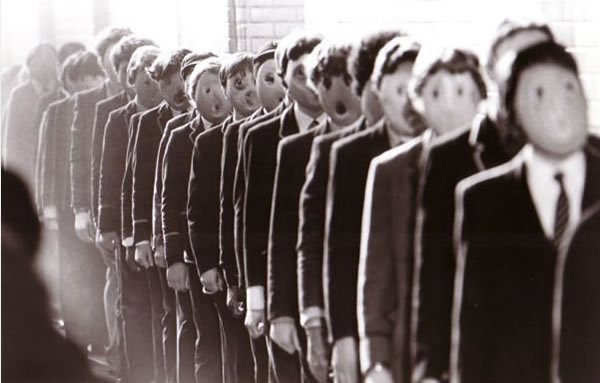
Pink Floyd–The Wall (1982), February 16, 2012. (http://free-education.info). Qualifies as fair use under US Copyright laws – low res and related to blog subject.

We often treat K-12 education and higher education as if they have nothing in common, as if they possess completely separate values and have developed in complete isolation from each other. But in this age where the American technocratic and the plutocratic elites want to privatize everything, there are clear connections behind and between emerging trends in corporatized K-12 education reform and with the rise of for-profit colleges and universities. These trends and connections aren’t good ones for the mass of American students, particularly for those who are poor and of color.

It’s pretty simply really. Both public education and postsecondary education have been under attack from profiteers and the politicians who do their bidding for at least a quarter century. In particular, the issues have been how to improve public schools so that poor Black and Latino kids can graduate high school on the one hand, and how to modify higher education so that the adult version of these kids can obtain a serviceable certificate or degree on the other. With these changes comes the theme of a watered-down education for the poorest twenty-five percent of Americans. It’s the new pathway to a sub-living wage job and tens of thousand of dollars of student loan debt.

A better way of presenting this reality, though, would be to overlay my own educational journey as a poor African American growing up in Mount Vernon, New York onto this corporatized educational insanity. I would’ve gone to public school to be sure. But instead of the SRA exam test that I took every year between third and sixth grade (not a high-stakes test evaluating teaching effectiveness, by the way), I would’ve seen some sort of comprehensive reading/mathematics test from at least second grade on.

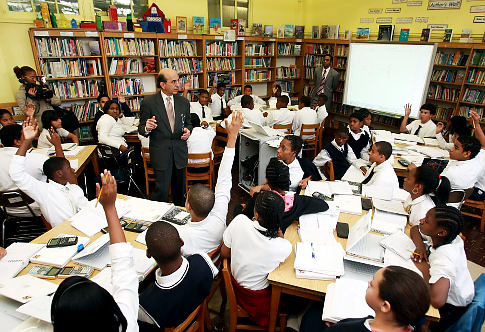
Overcrowded classroom (with DOE Chancellor Joel Klein) with two teachers, PS 189, Brooklyn, NY, September 16, 2009. (Craig Warga/NY Daily News). Qualifies as fair use – blog subject with no comparable picture.

Given where I grew up, instead of having a group of veteran Black teachers for most of elementary schools, I would’ve ended up with some teachers from Teach for America or The New Teacher Project. For the technocrats surely would’ve held my teachers responsible for the sixty-percent poverty rate at my elementary schools, um, I mean, the low test scores. Teachers from these alternate certification programs tend to be well-meaning, perhaps even extremely smart, but not passionate or fully trained teachers. Certainly not like the highly dedicated African American teachers I had at Nathan Hale (now Cecil Cooper) and William H. Holmes Elementary, who held us all to high enough standards to prepare me for a gifted-talented magnet school program known as Humanities.

Of course, given the resources devoted to high-stakes testing, and the constant practice tests, there would’ve been the virtual elimination of music, art, PE, and creative writing. With that shift, there wouldn’t have been a Humanities Program, just a few classes for the best and brightest students. Instead, the option of a private charter school or a KIPP program may have been a possibility. With an average cost of $10,000, however, I doubt a $1,000 or $2,500 voucher would’ve made it possible for me to attend the one, and with KIPP schools being all about discipline, I would’ve thrived there about as much as fish thrive in the desert.

I would’ve moved on to middle school and high school, received algebra in ninth or tenth grade (if at all), struggled to enhance my reading, writing, science, math and other skills, and otherwise would’ve goofed my way to a high school diploma. Would I have taken an AP class, or had a Meltzer as a history teacher, or taken the PSAT or SAT? I’m not sure, but highly unlikely. Still, I would’ve graded with a diploma, with proof that my education was the equivalent of an average ninth or tenth grader’s, confirmed by a decade of standardized state tests!

Then, after three to five years of struggling to find full-time work above minimum wage, or after several years in the military, I’d make the choice between  a University of Phoenix, Kaplan University, DeVry University or some other for-profit college. I’d discover quite quickly that I was wholly unprepared for even the most watered-down online college curriculum, taking courses in a four, six or eight-week format (instead of the typical ten or sixteen-week semester format).

Romanian Army POWs from Battle of Stalingrad, February 3, 1943. (http://ww2incolor.com).

There would’ve been no agonizing choice between Columbia University and the University of Pittsburgh, no switch of majors from computer science to history, no big moment in my development as a person. All because I wouldn’t have had the kind of earth-shattering experience that attending college full-time and in-person often can be.

Somehow, if I’d somehow survived the first semester or first year, I might’ve eventually graduated, albeit with a degree that will be of limited use in obtaining a good living wage. And with $70,000 in student loan debt and a degree from a disreputable for-profit college, forget about me going to graduate school to be a professor.

That’s what this K-16 system will lead to. Money flowing into the hands of illegitimate technocrats, testing companies, charter schools and for-profit institutions. Money and influence flowing from entities like the Bill & Melinda Gates Foundation and Teach for America. A permanent, if slightly better educated, low-wage underclass. That’s the now and future construction of K-16 education if we allow these trends to continue.

The Endless Drivel of NBC’s Education Nation

22 Saturday Sep 2012

Posted by decollins1969 in 1, culture, Eclectic, Politics, Pop Culture, Work, Youth

≈ Leave a comment

Tags

"Casualties in the Education Reform Wars", Bill & Melinda Gates Foundation, Corporatized Education Reform, CTU Strike, Drivel, Education Nation, Education Nation Week, Education Policy, Education Politics, High-Stakes Testing, K-12 Education Reform, Low-Income Students, Melissa Harris-Perry, MSNBC, NBC, Parent Engagement, Prattle, Teacher Engagement, The Nation, University of Phoenix


NBC Nightly News/Rock Center anchor Brian Williams, host of Education Nation Week, September 4, 2012. (http://educationnews.org).

This weekend, for the third year in a row, NBC will kick off their Education Nation Week in New York City. It will involve MSNBC’s rising stars like Melissa Harris-Perry, Chuck Todd and Alex Wagner. It will include a two-day summit broken down into a series of case studies about the various issues in K-12 education and how to improve it for America’s children. It will also include a teacher town hall and a student town hall.

In the end, it will all be a staged pageant of concern about kids, a subliminal message of corporatized education reform, a series of half-baked ideas that wouldn’t have been good for schools a hundred years ago, much less now. I don’t normally trash events before they begin, but I’ve seen this movie before. It’s the one that’s been given a bad title, a poor script worked on by five writers, with poor character development, mediocre actors and a wholly implausible ending.

NBC News Education Nation logo, March 10, 2012. (http://mediabistro.com).

NBC’s Education Nation Week fits all of those because its hosts know about as much about the nuances of education as I do about the interactions of neutrinos with the Higgs boson particle. The week-long event is sponsored by University of Phoenix, the Bill & Melinda Gates Foundation, ExxonMobil, Target, Citi and the General Motors Foundation (the last one as a “Knowledge Partner”). Seriously? A for-profit institution with a ten (10) percent graduation rate? The biggest funder of ill-conceived education reform efforts, ones that have little chance of actually creating better conditions for teachers to effectively teach students of all stripes? Not to mention a bunch of corporations that have little incentive to reform public education for America’s low-income students in a way that would truly level the playing field? Are you kidding me?

In light of the recent Chicago Teachers Union strike and the serious issues that the union, Chicago’s parents and the local (not the national) media raised about the corporate-based assumptions behind education reform, NBC’s should (but won’t) call off this year’s Education Nation Week. High-stakes testing and a concentration on teacher effectiveness as reflected by test scores is the mantra of the mainstream education reform movement these days. Along with charter schools as “choice” for low-income families, battles to weaken teacher’s unions, an insistence on STEM fields as the content-based focus of reform, and the creation of a standard curriculum that is neither standard nor a full curriculum.

All in all, a prescription that would make the technocrats at the Gates Foundation and ExxonMobil feel better. But given the lack of funding at the state and federal level these days for everyday school needs — much less funding to implement such reforms — it simply cannot work. Without any concentration on critical thinking, writing comprehension skills, physical education, music, art, creativity, the leaders and hosts of Education Nation Week expect teachers and students to do more with less in a system that was never meant to work for most students in the first place.

Harris-Perry’s all-over-the-place commentary on the CTU strike in The Nation this week is an example of media ignorance of what reforms would actually look like in the long-term, even in the case of a prominent political science professor. Her piece “Casualties in the Education Reform Wars” is based on a suffer-the-little-children (and parents) premise that demonizes all sides of the education deform battles. It shows that she has little understanding of education history, policy and politics.

This is by far the most disappointing piece I’ve ever read by Harris-Perry. It’s a piece based purely on emotion, and not on the challenges that educational policy/politics have forced on teachers, administrators, students and parents. A system based on high-stakes testing and the corporatized education reform movement doesn’t work for anyone. Evaluating teachers based primarily on exams created by technocrats from afar and taken by their students means a watery gruel of education for all of our kids.

Striking Chicago teachers turn the West Side streets into a river of red, September 14, 2012. (David Rapkin/Socialist Worker)

Unlike Harris-Perry, cursing all sides isn’t an option for most of us. Engaging and engaged teachers, school leaders, and yes, being involved in our kids’ education is where we need to start. Holding our politicians’ feet to the fire on real education reform is another piece. And also, holding columnists’ feet to the fire when they write a piece short on facts and long on hand-wringing when writing on educational issues is something we as parents and educators must do. Especially since folks like Harris-Perry only write about these issues after a strike or a tragedy.

I can guarantee, sadly, that NBC’s Education Nation Week, with the vapid thinking of thinkers like Harris-Perry involved, will be yet another media event devoid of substance and full of style points. In other words, endless drivel.

Boy @ The Window: A Memoir

Boy @ The Window: A Memoir

Places to Buy/Download Boy @ The Window

There's a few ways in which you can read excerpts of, borrow and/or purchase and download Boy @ The Window. There's the trade paperback edition of Boy @ The Window, available for purchase via Amazon.com at http://www.amazon.com/Boy-Window-Donald-Earl-Collins/dp/0989256138/

There's also a Kindle edition on Amazon.com. The enhanced edition can be read only with Kindle Fire, an iPad or a full-color tablet. The links to the enhanced edition through Apple's iBookstore and the Barnes & Noble NOOK edition are below. The link to the Amazon Kindle version is also immediately below:

scr2555-proj697-a-kindle-logo-rgb-lg

Boy @ The Window on Amazon.com: http://www.amazon.com/Boy-The-Window-Memoir-ebook/dp/B00CD95FBU/

iBookstore-logo-300x100

Boy @ The Window on Apple's iBookstore: https://itunes.apple.com/us/book/boy-the-window/id643768275?ls=1

Barnes & Noble (bn.com) logo, June 26, 2013. (http://www.logotypes101.com).

Boy @ The Window on Barnes & Noble: http://www.barnesandnoble.com/w/boy-the-window-donald-earl-collins/1115182183?ean=2940016741567

You can also add, read and review Boy @ The Window on Goodreads.com. Just click on the button below:

Boy @ The Window

Twitter Updates

Tweets by decollins1969
  • RSS - Posts
  • RSS - Comments

Archives

  • June 2025
  • April 2023
  • September 2022
  • August 2022
  • July 2022
  • June 2022
  • May 2022
  • April 2022
  • March 2022
  • January 2022
  • December 2021
  • November 2021
  • October 2021
  • September 2021
  • August 2021
  • July 2021
  • June 2021
  • April 2021
  • March 2021
  • February 2021
  • January 2021
  • December 2020
  • November 2020
  • October 2020
  • September 2020
  • August 2020
  • July 2020
  • May 2020
  • April 2020
  • March 2020
  • January 2020
  • December 2019
  • November 2019
  • August 2019
  • July 2019
  • June 2019
  • May 2019
  • April 2019
  • March 2019
  • February 2019
  • January 2019
  • December 2018
  • November 2018
  • October 2018
  • September 2018
  • August 2018
  • July 2018
  • June 2018
  • May 2018
  • March 2018
  • February 2018
  • January 2018
  • December 2017
  • November 2017
  • October 2017
  • September 2017
  • August 2017
  • July 2017
  • June 2017
  • May 2017
  • April 2017
  • March 2017
  • February 2017
  • January 2017
  • December 2016
  • November 2016
  • October 2016
  • September 2016
  • August 2016
  • July 2016
  • June 2016
  • May 2016
  • April 2016
  • March 2016
  • February 2016
  • January 2016
  • December 2015
  • November 2015
  • October 2015
  • September 2015
  • August 2015
  • July 2015
  • June 2015
  • May 2015
  • April 2015
  • March 2015
  • February 2015
  • January 2015
  • December 2014
  • November 2014
  • October 2014
  • September 2014
  • August 2014
  • July 2014
  • June 2014
  • May 2014
  • April 2014
  • March 2014
  • February 2014
  • January 2014
  • December 2013
  • November 2013
  • October 2013
  • September 2013
  • August 2013
  • July 2013
  • June 2013
  • May 2013
  • April 2013
  • March 2013
  • February 2013
  • January 2013
  • December 2012
  • November 2012
  • October 2012
  • September 2012
  • August 2012
  • July 2012
  • June 2012
  • May 2012
  • April 2012
  • March 2012
  • February 2012
  • January 2012
  • December 2011
  • November 2011
  • October 2011
  • September 2011
  • August 2011
  • July 2011
  • June 2011
  • May 2011
  • April 2011
  • March 2011
  • February 2011
  • January 2011
  • December 2010
  • November 2010
  • October 2010
  • September 2010
  • August 2010
  • July 2010
  • June 2010
  • May 2010
  • April 2010
  • March 2010
  • February 2010
  • January 2010
  • December 2009
  • November 2009
  • October 2009
  • September 2009
  • August 2009
  • July 2009
  • June 2009
  • May 2009
  • April 2009
  • March 2009
  • February 2009
  • January 2009
  • December 2008
  • November 2008
  • October 2008
  • September 2008
  • August 2008
  • July 2008
  • June 2008
  • May 2008
  • April 2008
  • March 2008
  • February 2008
  • January 2008
  • December 2007
  • November 2007
  • October 2007
  • September 2007
  • August 2007
  • July 2007
  • June 2007

Recent Comments

MaryPena's avatarMaryPena on My Day of Atonement/Bitter Hat…
decollins1969's avatardecollins1969 on No Good Teaching Deed Goes…
Mary Rose O’Connell's avatarMary Rose O’Connell on No Good Teaching Deed Goes…

NetworkedBlogs on Facebook

NetworkedBlogs
Blog:
Notes From a Boy @ The Window
Topics:
My Life, Culture & Education, Politics & Goofyness
 
Follow my blog

616 616 East Lincoln Avenue A.B. Davis Middle School Abuse Academia Academy for Educational Development AED Afrocentricity American Narcissism Authenticity Bigotry Blackness Boy @ The Window Carnegie Mellon University Child Abuse Class of 1987 CMU Coping Strategies Crush #1 Crush #2 Death Disillusionment Diversity Domestic Violence Economic Inequality Education Family Friendship Friendships Graduate School Hebrew-Israelites High-Stakes Testing Higher Education History Homelessness Humanities Humanities Program Hypocrisy Internalized Racism Jealousy Joe Trotter Joe William Trotter Jr. K-12 Education Love Manhood Maurice Eugene Washington Maurice Washington Misogyny Mother-Son Relationship Mount Vernon High School Mount Vernon New York Mount Vernon public schools Multiculturalism MVHS Narcissism NFL Pitt Pittsburgh Politics of Education Poverty President Barack Obama Race Racial Stereotypes Racism Relationships Self-Awareness Self-Discovery Self-Reflection Sexism Social Justice Teaching and Learning University of Pittsburgh Violence Whiteness Writing

Top Rated

Blog at WordPress.com.

  • Subscribe Subscribed
    • Notes from a Boy @ The Window
    • Join 103 other subscribers
    • Already have a WordPress.com account? Log in now.
    • Notes from a Boy @ The Window
    • Subscribe Subscribed
    • Sign up
    • Log in
    • Report this content
    • View site in Reader
    • Manage subscriptions
    • Collapse this bar
 

Loading Comments...