• About Me
  • Other Writings
  • Interview Clips
  • All About Me: American Racism, American Narcissism, and the Conversation America Can’t Have
  • Video Clips
  • Boy @ The Window Pictures
  • Boy @ The Window Theme Music

Notes from a Boy @ The Window

~

Notes from a Boy @ The Window

Tag Archives: Carnegie Mellon University

Spencer for Higher

23 Saturday Oct 2010

Posted by decollins1969 in 1, Academia, Boy @ The Window, Eclectic

≈ Leave a comment

Tags

Carnegie Mellon University, Dissertation Fellowship, Doctoral Thesis, Finding Purpose, Grant Making, Grant-seeking, Spencer Foundation, Teaching, Writing


Spenser For Hire Title Screen, February 26, 2008. Source: http://www.aolcdn.com/new_promos/dl_spenser_733x270.jpg

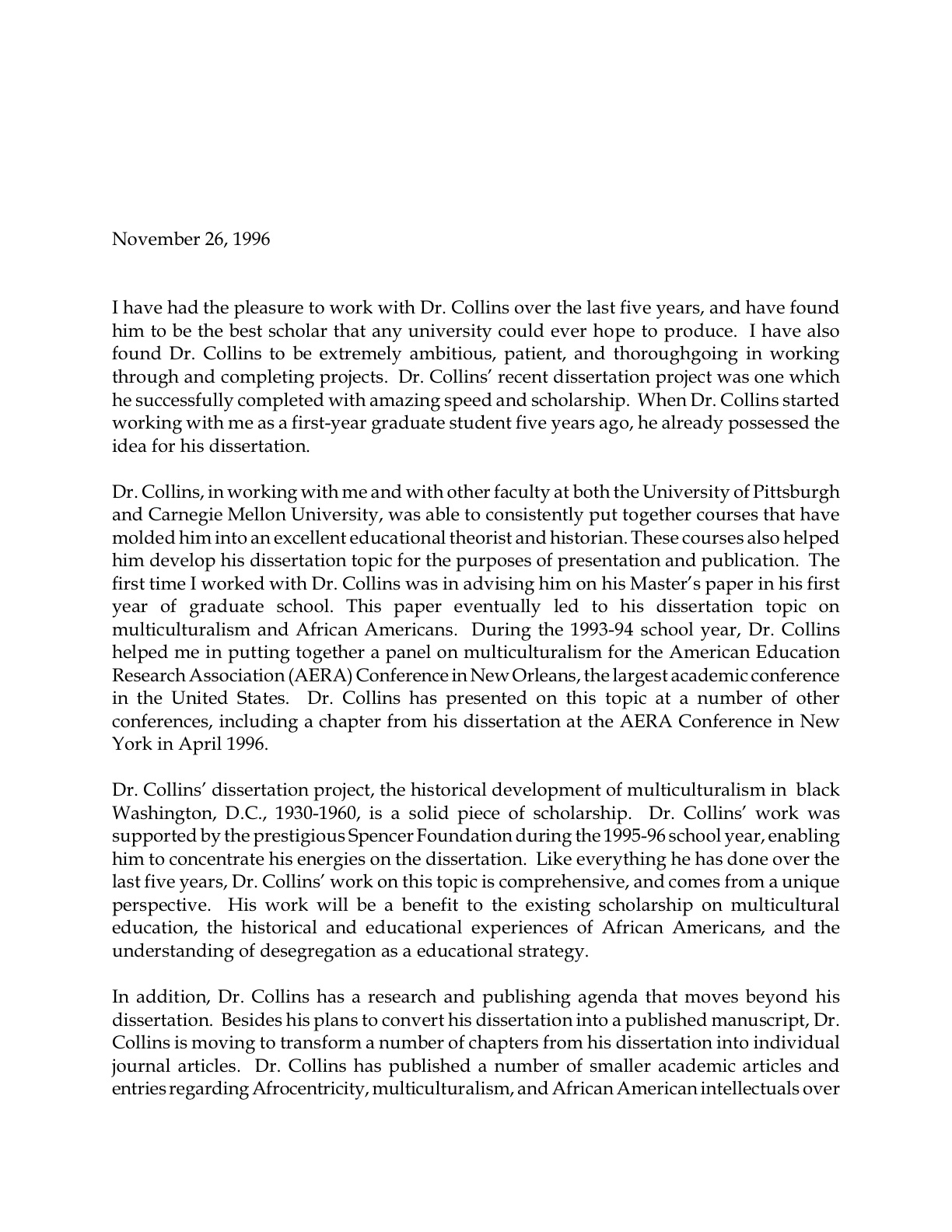
Higher education, that is. Sixteen years ago this weekend, I put my application in the mail for a Spencer Foundation Dissertation Fellowship. It was a $15,000, one-year award that would give me time off from teaching or doing grunt work for my advisor and other professors. I’d have a year to do nothing but do work on my doctoral thesis, to travel, do additional research and lock myself in my apartment for week on end to write what would become a 505-page document.


But don’t let me over-glamorize the moment. After all, I’d applied for fellowships and been in search for grants in the years before and after this application. The University of Pittsburgh had made me part of the first class of recipients for their Challenge Scholarship in ’87. I’d been awarded a graduate student assistantship and teaching assistantships throughout grad school. The Ford Foundation Predoctoral Fellowship — I applied for it twice, in ’91 and ’93. Soon after my Spencer application, I also applied for the Ford Foundation Dissertation Fellowship and the NEH (National Endowment for the Humanities) Dissertation Fellowship (which they disbanded the following year).

I’d later apply for a few postdoctoral fellowships in ’96 and ’97. Then, once I became part of the nonprofit sector, grant-seeking became a part of my jobs. Including letters of inquiry, concept papers, about three dozen grant proposals that I worked on in part or in whole. Not to mention meetings with foundation program officers, numerous networking opportunities at the Independent Sector and other conferences. Between them all, I directly or indirectly helped raise about $1.4 million over the past ten years, and played a role in programs that possessed about $11 million in funding overall.


Spencer Foundation Logo, October 23, 2010

But the most satisfied I ever was in putting together a proposal, or in receiving an award, or in participating in a grant-related experienced, was when I applied for the Spencer Foundation Dissertation Fellowship. You see, I’d spent nearly eighteen months preparing myself to apply. I started doing my dissertation topic research a full year before the October ’94 application deadline, months before my advisor and committee were to officially approve my topic and research.


I’d started going through microfilm of Black Washington newspapers from the 1920s, 1930s, and 1940s, looking up Census data, thinking of places to look up old records of DC Public Schools  from the segregation era, and contemplating interviewing former teachers and students who’d worked at or attending DCPS between 1920 and 1970. It was exhausting doing that and taking a full load of classes, struggling with finances so badly that I had no money for new sneakers, that I’d walk in three-year-old sneakers with holes in them to and from campus in ankle-deep snow to push this project forward. Of course, I lined the sneakers with plastic bags from Giant Eagle to keep my socks and feet dry and warm.

Yes, I was committed to the task all right, and probably should’ve been committed in the process. But it was also worth it. I felt — rather, I practically knew — that it would all work out with the Spencer Fellowship somehow. And it did, not just because of the award, and not just because of my friend and mentor, Catherine Lacey (see April 2009 post). It worked, because it helped me find my calling as a writer and teacher. It worked because it helped bring to the fore my ambivalence about academic writing and scholarship as the raison d’etre of an academically-trained historian.

The application, fellowship and that year free from Carnegie Mellon’s clutches helped put me on the right path. Even if I didn’t know it at the time.

Letter of Recommendation (or Wreck-o-mendation)

23 Thursday Sep 2010

Posted by decollins1969 in 1, Academia, Boy @ The Window, Eclectic, Mount Vernon High School

≈ Leave a comment

Tags

Academia, Carnegie Mellon University, Dan Resnick, Daniel P. Resnick, George Reid Andrews, Joe Trotter, Joe William Trotter Jr., Letters of Recommendation, Pittsburgh, Race, References, Sy Drescher, Transparency, University of Pittsburgh


George Reid Andrews, University of Pittsburgh

About a year and a half ago, I wrote about a string of not-so-wonderful professors I had at Pitt and Carnegie Mellon who were less than fine with me pursuing anything beyond a bachelor’s degrees, much less with me becoming Dr. Collins. I talked about how some of them went so far as to tell me that I wasn’t “graduate material,” as if I were made from parts found at a junk yard instead of in the shop of an Italian tailor.

I’m more than aware of the fact that I didn’t let those doubters stop me from becoming who I am today. Some were undoubtedly ones whose skepticism bordered on racist because of their assumptions about my intelligence and writing ability. Still, it should be noted that there are pitfalls to be avoided, if at all possible, when you’re applying for a job or applying to a college or graduate and professional school.

One, even if a professor or teacher has assigned an A for your performance in one of their courses, that doesn’t mean that think that you’re a great student. I learned that the hard way with George Reid Andrews, my professor for Latin American Revolutions my junior year at Pitt. Twenty years ago this week, I asked him for letters of recommendation for graduate school. Andrews agreed, but only to tell me seven months later what he really thought of my work. My research writing samples were “problematic,” my GRE scores were “barely adequate,” and I should’ve considered myself “lucky” just to get into the master’s program in the history department. That terse conversation told me that Andrews’ letter was lukewarm at best, or had found me seriously deficient at worst.

Two, and related to my interactions with Andrews, the process of providing a letter of recommendation or a reference ought to be transparent, so that the student or employee can be confident that they’re not being back-stabbed by the same people in which they’re placing significant trust. It was never a question I dared asked — to see my letter of recommendation — before I’d reached the final stages of grad school.

It would’ve helped with Andrews, and it would’ve helped with two of my three dissertation committee members, Joe Trotter and Dan Resnick. I found out through my Spencer Fellowship that Trotter had written me a lukewarm letter, while Resnick had rambled on and on about my “close relationship” with my “mentor Sy Drescher,” who had played “an instrumental role” in making me a scholar. Drescher, while one of my best professors at Pitt, played much less of a role in me pursuing grad school than so many other professors and students, including his former student Paul Riggs. It was a Leslie Stahl, “let’s give the poor Black boy a hand” kind of letter.

Later, when I asked to see my letters of recommendation from Resnick before sending them out for jobs, he went on for ten minutes about the “sanctity” of the recommendation process, about how privacy and “anonymity” were critical to provide protection for all parties involved. Needless to say, if someone blusters about privacy when politely asked about a letter of recommendation they’re writing for you, do not use that letter!

Bruce Anthony Jones, University of South Florida

Three, it’s important to get to know a person, to gain some sense of trust from them, before asking for a letter or a reference. You don’t have to become friends with them or meet their family — although that does help. They just have to know that their recommendation or reference will be put to good use by you and that what they say about you matters to both of you, in the most positive light possible. Otherwise, what’s the point of writing a letter or spending fifteen minutes on the phone talking about your qualities as a student or worker, right? This can go a bit too far, of course, as I wrote one of my own recommendations for Bruce Anthony Jones, another dissertation committee member, for him to merely put his signature to. Once he changed jobs for the University of Missouri-Columbia, his, um, my letter became worthless, if it had been worth anything at all to begin with.

I’ve written about two dozen letters of recommendation for high school, college and graduate students, for jobs, school applications and fellowship programs. Not to mention about an equal number of recommendations and references for professional colleagues and friends in academia and the nonprofit world. I’ve always written my own letters, insisted on them being seen by the people I’ve recommended and required that they explain their own rationale for their acceptance in the process. Most importantly, I’ve made sure to say “No” if I didn’t feel I could recommend them well or provide a great reference.

And Now, A Plagiarism Moment

13 Monday Sep 2010

Posted by decollins1969 in 1, Academia, Boy @ The Window, Eclectic, race

≈ Leave a comment

Tags

Academia, Black Issues in Higher Education, Carnegie Mellon University, Dan Resnick, Daniel P. Resnick, Department of HIstory, Plagiarism, University of Pittsburgh


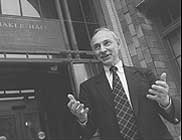
Professor Emeritus Daniel P. Resnick. Source: http://www.cmu.edu

I was sitting in the office of the only professor in Carnegie Mellon’s History Department with expertise in the area of history of education one mid-September day in ’93. It was my first semester in the doctoral program there, after transferring from Pitt to finish my PhD. I had already begun to question my decision to do my remaining studies there. My advisor Joe Trotter was “upset” that I’d taken and passed my doctoral written exams the spring before, when I was still technically a Pitt grad student, and had “run interference” to forbid me from publishing any new articles during the ’93-’94 school years. That was after my piece with my friend Marc had come out in Black Issues in Higher Education.

Steve Schlossman, the chair of the history department, was also upset, because I had decided not to take the American history proseminar, a course for first semester grad students. Apparently, even though I had taken the same course at Pitt two years before — and Carnegie Mellon had accepted all of my credits from my master’s program and first year as a doctoral student at Pitt — I had to take this course. I was read the riot act and told that I needed Carnegie Mellon’s “stamp of approval” before becoming a doctoral candidate. I was incensed, because this wasn’t what I’d been promised by my esteemed advisor and the graduate advisor, John Modell.

All this happened before I met Daniel P. Resnick in his office on Tuesday on a cool, but not too cool, and sunny late-summer day. His office was neat, relatively speaking, but spare and spartan in some ways, with books stacked in orderly fashion, and papers in numerous labeled folders. What I noticed the most was the smell, an old person’s not-fully-washed smell, of bagels and lox with some onion cream cheese.

Professor Resnick had gone to the restroom and left the door open for me to sit at a table next to his desk. He had already laid out my writing samples, the ones I’d put in his mailbox the week before. They included the Black Issues in Higher Education piece. After our exchange of greetings, Resnick sat down and said, “Considering your background, your writing is remarkable!” in a way that showed real surprise.

Before I could respond with a defense or process the obvious bigotry in that statement, Resnick then said, “There’s no way you could’ve written all this.” I responded, “Well, I did, and have the grades and degrees to prove it,” preferring not to accuse the only professor in the department with a specialty in the history of education of racism. “What-what I meant was, your papers are well-written…compared to most young scholars,” Resnick stammered. I accepted that response at face value, but kept what he had said before it in mind as I worked with him over the next three years.

Resnick, as it turned out, had lived for a year with his wife, the great Lauren Resnick, on the Mount Vernon-Bronxville border in 1960-61 (one of them was teaching at Sarah Lawrence, I think), so after finding out where I grew up, he had put two and two together and come up with sixteen. I found him patronizing, and about as knowledgeable in the recent developments of educational history as I would be of underground house music in Chelsea right now. Resnick himself had plagiarized, not in terms of his own work, but from the race relations rule book. He had plagiarized in stereotypes, far worse than anything of which he’d accused me.

Was it worth having this man on my dissertation committee? Yes, because I graduated. But, in the final analysis, it would’ve made more sense to transfer to NYU or Stanford School of Education than to spend three minutes, much less three years, working with a man whose belief in my work was minimal at best.

Outrage, Maybe

18 Tuesday May 2010

Posted by decollins1969 in 1, Academia, Eclectic

≈ Leave a comment

Tags

Academia, Carnegie Mellon University, Graduate School, Joe William Trotter Jr., Outrage (HBO 2009), Power, Race


Today’s date makes it thirteen years since I marched in my polyester cap and gown in a hot and humid tent on Carnegie Mellon’s campus to receive my doctorate. It should’ve been a great day, but it was a bittersweet one. For it revealed far more about my mother’s imperfections and jealousies than I ever wanted to know (see “My Post-Doctoral Life” post from May 18, ’08). That was sad, and remains one of the worst times in my life. Not just because of my relationship with my mother since then. Because, as a result of her actions, I never did get the chance to properly accept my degree in an individual department ceremony, in front of my closest peers, my former professors, and especially my dreaded advisor, Joe Trotter.

Outrage Poster (HBO, 2009)

About two months ago, I saw the documentary (finally) Outrage on HBO. Outrage, for those of you who haven’t watched, is the story about powerful Washington politicians and operatives, ones who’ve used their power to discriminate against gays and lesbians, really the whole LGBT community. Ones whom themselves are gay, deep in the closet, but gay. Ones whom folks like Michael Rogers have made a point of exposing their hypocrisy by outing them. Everyone from Ed Koch — which explained a lot to me, seeing as I found the former mayor of New York from ’77 to ’89 an enigma while I was growing up — to Larry Craig and Florida Governor Charlie Crist was in the film.

It was a good film, and a revelation to me. The lengths to which people in powerful position and places will go to protect their secrets, their power, by destroying others if necessary. It’s safe to say that this is how I see my former advisor as well. I’m not suggesting that Joe Trotter is gay or in the closet, for I have no evidence of this (or of his heterosexuality, for that matter!). But, the film helped me realize that a person doesn’t have to have a secret of the magnitude of being gay in a homophobic society to be a hypocrite. Being Black on a historically anti-Black campus like Carnegie Mellon could just as easily do the trick.

It may be impossible for my former advisor to hide his skin color, but boy did he try to get me to hide my Blackness by doing what he called “running interference” on me on multiple occasions. He tried to forbid me from doing conference presentations, at AERA and on the 40th anniversary of Brown v. Board of Education at the University of Georgia. From sending drafts of articles to the Journal of American History and other scholarly publications. Trotter practically blew his shiny-headed top when he found out

Professor Joe William Trotter, Jr. (circa 2008)

about my feature piece (done with my friend Marc) in Black Issues in Higher Education back in ’93. There was something there with Trotter that I didn’t take the time to piece together when I was his student, as I was too busy trying to get out of there as fast as I could.

Yet, there are signs that Trotter was “in the closet” about something, be it race, jealousy, sexual orientation, maybe even a rough upbringing. At least two other male students, one who graduated a year ahead of me, the other who never finished his dissertation, who had problems with Trotter, personality conflicts, confounding issues that went unexplained. Even when each of us took into account Trotter wanting his “proletarianization hypothesis” in our doctoral dissertations.

Whatever it was, it was enough where he all but refused to help any of us — male or female — find work or  get postdoctoral fellowships, even after finishing our doctorates. What a hypocrite! His thirty years of scholarship have been all about recognizing the active role ordinary Blacks played in shaping their lives and communities, despite racism and violence. His role with me and other students was in opposition to his own research, at least during my time there.

If I’d had the chance to speak at the individual ceremony thirteen years ago, especially after watching something like Outrage, I’d have said the following. That as much as liked working with my advisor at the beginning of our four years of working together, that I always felt uneasy about his guidance. That there was always a sense that I hadn’t fulfilled my end of the bargain, that I hadn’t met my half of the quid pro quo. And that because I was a late-bloomer in many respects, sex included, I couldn’t fully understand what he really expected of me beyond my academic work. It’s too bad he didn’t come out and say whatever it was he wanted from me, it would’ve made both of our times working with each other easier. Too bad, for in the end, it was his loss, of a friend and potential colleague, not mine.

My Post-Doctoral Life

18 Sunday May 2008

Posted by decollins1969 in 1, Boy @ The Window, earth, wind & fire, Eclectic, Mount Vernon New York, race, Youth

≈ Leave a comment

Tags

Betrayal, Carnegie Mellon University, Jealousy, Mother-Son Relationship, PhD, PhD Graduation, Pittsburgh


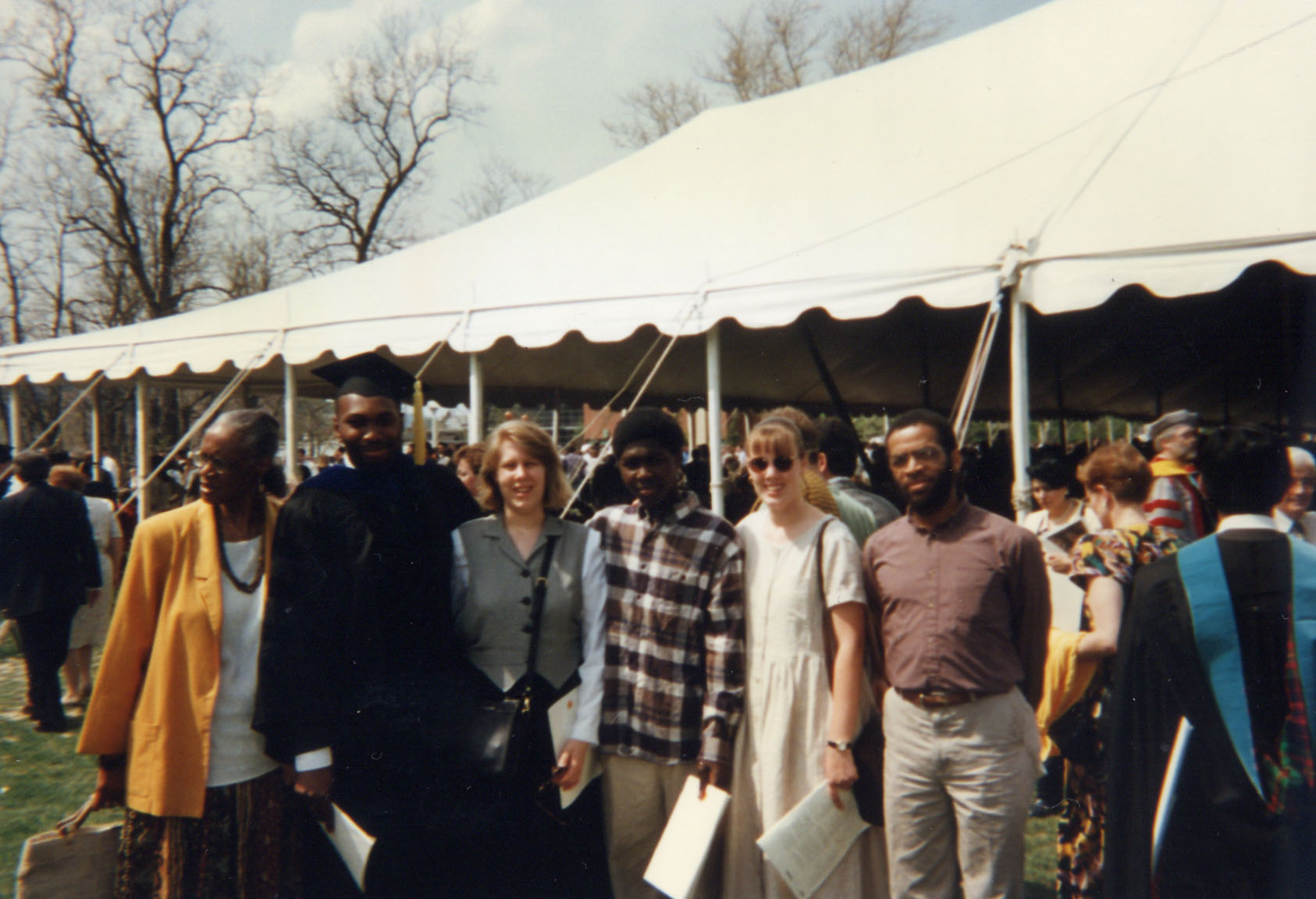
PhD Graduation Group Photo – May 18, 1997. A great photo, except for the one (my mother) who was missing – note my mother-in-law gesturing to her. (Angelia N. Levy).

Today is the eleventh anniversary of my marching across stage to officially end the formal student phase of my life. Around 2 pm, I shook hands with the president of Carnegie Mellon University and the Dean of Humanities and Social Sciences to accept my PhD in History. It could’ve and should’ve been a joyous moment, but it wasn’t. After all, I had learned that my mother was about as happy for me as some of my former fellow grad students, who threw around words like “envious” and “jealous” in the year before my official graduation.

I tell this story in Boy At The Window this way: “The proverbial someone once said that a picture is worth a thousand words. But…even in the age of megapixels, pictures miss what words can say. Such is the case with a picture of me and my closest folk on my PhD graduation day in May ’97. On this sultry and sunny spring day, I stand in my polyester black cap and gown with my future mother-in-law dressed in a yellow-gold blazer and flower-print skirt on my right, and my longtime high school friend on my left. My friend’s one-time ‘surrogate’ son and her twenty-three-year-old sister, as well as my graduate-school friend and colleague Ed are also in this picture, from my friend’s left through the rest of the four-by-six-inch print. They all look hot and happy, as if they went through the doctoral thesis process in one afternoon. At the least, they looked ready for air conditioning or shade. I’m happy too, if only for that moment.

The Carnegie Mellon University-wide ceremony was anticlimactic. I’d finished my dissertation with approval from my committee six months before I marched across stage. Yet I had reason to smile the smile of relieved happiness. Relieved that the outdoor graduation ceremony had concluded and happy to see my then girlfriend Angelia grinning ear-to-ear as she snaps the picture of the six of us. Noticeably absent from this picture is my mother, who stood outside of our huddle (to the right of Angelia’s mother). If you look closely at the picture, you can see Ms. Levy gesturing—presumably to my mother—to get her into the picture. What you don’t see is my mother shaking her head and looking at the rest of us with discomfort as we set up for Angelia’s shot. What you also don’t and can’t see is the pride that everyone involved in the picture possessed about my accomplishment. It was an almost overwhelming experience to receive so much emotional support after so many years without it.

But pictures, no matter how well orchestrated, only capture a moment in time, a moment that could be connected to a string of events or an off-the-beaten path tangent from events already in motion. Or a picture can be a snapshot of a transition point between events. For all of us, I think, this picture symbolized major turning point in our lives, ‘the way we were,’ if you will. My relationships with my mother, my soon-to-be mother-in-law and wife, and my friends all changed or were in the process of change.

How I saw my mother had changed forever a few days before Angelia snapped the picture of me and the others. The best evidence of this is the next picture in this photo album, at the time the next picture in the roll of film from that day. It was of me angrily stomping down a spiraling flight of stairs at The Thackeray Club on the University of Pittsburgh’s campus. I held my doctoral diploma for the camera as if I wanted to hit someone with it. My face looks dark, and not just because I’m Black and had been on five hours’ sleep per night for the past ten days. My face looks frozen between anger and disappointment. Anger about my mother comparing my nine and a half years of undergraduate and graduate education to being ‘in school long enough to earn another high school diploma.’ Disappointment in her later telling me, ‘I don’t have to tell you that I’m proud of you. I tell other folks, just not you.’

Angelia’s picture captures the dark mood that my concrete expression struggled to show. I privately acknowledged that my mother had never cared about my degree or other accomplishments because I somehow was ‘showing her up.’ I had worked for nearly fifteen years to make this moment in my life happen, a moment where my dreams, my ultimate make-believe fantasy life had finally begun to merge with 3-D reality.

Then my mother had decided at the last minute to catch an earlier flight. And just as my individual, Department of History celebration was about to start. To say that my reasonably close—sometimes too close—relationship with my mother hasn’t been the same since would be like saying Hiroshima was never the same after the Enola Gay unloaded her deadly payload.

She needed to go to the airport for her flight to take care of ‘the kids’—my four younger siblings. ‘The kids’ were between thirteen and eighteen years old, and had been without my mother’s supervision for two full days before her airport request. During the trip to the airport in my graduation robe, I thought about crying, yelling, even about shaking my mother to see if she could show any emotion other than a blank disdain. I chose instead the most uncomfortable silence I could summon.

When we arrived at the gate, I finally said to her that she had ‘ruined every event in my adult life’ that I had given her the opportunity to attend. And this was the first opportunity my mother had taken advantage of—she couldn’t get to my other graduations because neither of us had the money to pay for her transportation. I certainly understood that reality, because I grew up in it. This was different. This was telling me that even if money weren’t an issue, my mother wouldn’t have been able to show any sense of pride or joy in what I had done. The irony of that fateful day was that my mother’s six o’clock US Airways flight was delayed more than two hours due to thundershower activity in Pittsburgh and New York. It was after eleven by the time my mother arrived home, according to one of my brothers.

It would be a month before we talked again, and that only occurred because my seventeen-year-old brother Maurice was about to graduate from Mount Vernon High School….In the years since my graduation, I’ve learned that even a parent can be jealous of their children. Especially if a parent attempts to live the life that they would like to have through them.”

What I don’t discuss in the manuscript are other details to this week eleven years ago. Including the fact that I was living on four or five hours of sleep for a week and a half. That I started the week of my Carnegie Mellon graduate in New York interviewing for an assistant professor job at Teachers College. That my mother marched for her associate’s degree at Westchester Business Institute in White Plains five days before my graduation, and that her comment to me about my years of working on a second high school diploma came the day after her graduation ceremony. What I don’t talk about is how my mother and eventual mother-in-law, in their first-ever meeting during my mother’s time in Pittsburgh, spent three hours discussing their failed marriages and the horrible nature of Black men the day before my graduation. And finally, that for the next four days after my graduation, I had a severe gastrointestinal infection, no doubt made worse by my sleeplessness and emotion distress.

The last eleven years have been a struggle to have a career as satisfying and as successful as my post-high school academic experience, with many more positives than negatives. At the same time, my struggles in career and in my life in general are the reason that I find myself in constant self-reflection about my life. It’s this self-reflection that helped me in writing Boy At The Window in the first place.

But the most difficult aspect of the things that I do struggle with centers on trust. Between my mother and my former advisor, not to mention some of my former fellow grad students and others on my dissertation committee, I felt a sense of betrayal that I hadn’t felt since the day my stepfather had knocked my mother unconscious. It took about a year and a half for me to recover from the dissertation process and from what my mother did during my graduation weekend.

I certainly was sarcastic before, but I know that I’m jaded about trusting others these days. Especially folks in positions of authority who happen to be somewhere between flighty and absolute fakes. Some people I’ve worked with in publishing come to mind. Others I’ve worked with and for, though, are far more typical in my world of being careful with whom I divulge my information and life experiences to. Most of time, I find myself much more deliberate about the company I keep and the folks I talk to about my world beyond my job, my teaching and my writing.

I’ve had to learn a second time how to overcome betrayal and distrust. The first time, I could almost trust anyone. This time, I have much more choice as to whom I trust and for how long, which also makes it all the more difficult. As for my mother, I have long since forgiven her for the things that she did and said eleven years ago, although I have to work hard at standing in that forgiveness sometimes. But with my memory, in which I can tell you what I had to eat for dinner on May 12th of ’97, it’s hard to forget.

Newer posts →

Boy @ The Window: A Memoir

Boy @ The Window: A Memoir

Places to Buy/Download Boy @ The Window

There's a few ways in which you can read excerpts of, borrow and/or purchase and download Boy @ The Window. There's the trade paperback edition of Boy @ The Window, available for purchase via Amazon.com at http://www.amazon.com/Boy-Window-Donald-Earl-Collins/dp/0989256138/

There's also a Kindle edition on Amazon.com. The enhanced edition can be read only with Kindle Fire, an iPad or a full-color tablet. The links to the enhanced edition through Apple's iBookstore and the Barnes & Noble NOOK edition are below. The link to the Amazon Kindle version is also immediately below:

scr2555-proj697-a-kindle-logo-rgb-lg

Boy @ The Window on Amazon.com: http://www.amazon.com/Boy-The-Window-Memoir-ebook/dp/B00CD95FBU/

iBookstore-logo-300x100

Boy @ The Window on Apple's iBookstore: https://itunes.apple.com/us/book/boy-the-window/id643768275?ls=1

Barnes & Noble (bn.com) logo, June 26, 2013. (http://www.logotypes101.com).

Boy @ The Window on Barnes & Noble: http://www.barnesandnoble.com/w/boy-the-window-donald-earl-collins/1115182183?ean=2940016741567

You can also add, read and review Boy @ The Window on Goodreads.com. Just click on the button below:

Boy @ The Window

Twitter Updates

Tweets by decollins1969
  • RSS - Posts
  • RSS - Comments

Archives

  • June 2025
  • April 2023
  • September 2022
  • August 2022
  • July 2022
  • June 2022
  • May 2022
  • April 2022
  • March 2022
  • January 2022
  • December 2021
  • November 2021
  • October 2021
  • September 2021
  • August 2021
  • July 2021
  • June 2021
  • April 2021
  • March 2021
  • February 2021
  • January 2021
  • December 2020
  • November 2020
  • October 2020
  • September 2020
  • August 2020
  • July 2020
  • May 2020
  • April 2020
  • March 2020
  • January 2020
  • December 2019
  • November 2019
  • August 2019
  • July 2019
  • June 2019
  • May 2019
  • April 2019
  • March 2019
  • February 2019
  • January 2019
  • December 2018
  • November 2018
  • October 2018
  • September 2018
  • August 2018
  • July 2018
  • June 2018
  • May 2018
  • March 2018
  • February 2018
  • January 2018
  • December 2017
  • November 2017
  • October 2017
  • September 2017
  • August 2017
  • July 2017
  • June 2017
  • May 2017
  • April 2017
  • March 2017
  • February 2017
  • January 2017
  • December 2016
  • November 2016
  • October 2016
  • September 2016
  • August 2016
  • July 2016
  • June 2016
  • May 2016
  • April 2016
  • March 2016
  • February 2016
  • January 2016
  • December 2015
  • November 2015
  • October 2015
  • September 2015
  • August 2015
  • July 2015
  • June 2015
  • May 2015
  • April 2015
  • March 2015
  • February 2015
  • January 2015
  • December 2014
  • November 2014
  • October 2014
  • September 2014
  • August 2014
  • July 2014
  • June 2014
  • May 2014
  • April 2014
  • March 2014
  • February 2014
  • January 2014
  • December 2013
  • November 2013
  • October 2013
  • September 2013
  • August 2013
  • July 2013
  • June 2013
  • May 2013
  • April 2013
  • March 2013
  • February 2013
  • January 2013
  • December 2012
  • November 2012
  • October 2012
  • September 2012
  • August 2012
  • July 2012
  • June 2012
  • May 2012
  • April 2012
  • March 2012
  • February 2012
  • January 2012
  • December 2011
  • November 2011
  • October 2011
  • September 2011
  • August 2011
  • July 2011
  • June 2011
  • May 2011
  • April 2011
  • March 2011
  • February 2011
  • January 2011
  • December 2010
  • November 2010
  • October 2010
  • September 2010
  • August 2010
  • July 2010
  • June 2010
  • May 2010
  • April 2010
  • March 2010
  • February 2010
  • January 2010
  • December 2009
  • November 2009
  • October 2009
  • September 2009
  • August 2009
  • July 2009
  • June 2009
  • May 2009
  • April 2009
  • March 2009
  • February 2009
  • January 2009
  • December 2008
  • November 2008
  • October 2008
  • September 2008
  • August 2008
  • July 2008
  • June 2008
  • May 2008
  • April 2008
  • March 2008
  • February 2008
  • January 2008
  • December 2007
  • November 2007
  • October 2007
  • September 2007
  • August 2007
  • July 2007
  • June 2007

Recent Comments

decollins1969's avatardecollins1969 on No Good Teaching Deed Goes…
Mary Rose O’Connell's avatarMary Rose O’Connell on No Good Teaching Deed Goes…
Lyndah McCaskill's avatarLyndah McCaskill on The Raunchiest of Them Al…

NetworkedBlogs on Facebook

NetworkedBlogs
Blog:
Notes From a Boy @ The Window
Topics:
My Life, Culture & Education, Politics & Goofyness
 
Follow my blog

616 616 East Lincoln Avenue A.B. Davis Middle School Abuse Academia Academy for Educational Development AED Afrocentricity American Narcissism Authenticity Bigotry Blackness Boy @ The Window Carnegie Mellon University Child Abuse Class of 1987 CMU Coping Strategies Crush #1 Crush #2 Death Disillusionment Diversity Domestic Violence Economic Inequality Education Family Friendship Friendships Graduate School Hebrew-Israelites High-Stakes Testing Higher Education History Homelessness Humanities Humanities Program Hypocrisy Internalized Racism Jealousy Joe Trotter Joe William Trotter Jr. K-12 Education Love Manhood Maurice Eugene Washington Maurice Washington Misogyny Mother-Son Relationship Mount Vernon High School Mount Vernon New York Mount Vernon public schools Multiculturalism MVHS Narcissism NFL Pitt Pittsburgh Politics of Education Poverty President Barack Obama Race Racial Stereotypes Racism Relationships Self-Awareness Self-Discovery Self-Reflection Sexism Social Justice Teaching and Learning University of Pittsburgh Violence Whiteness Writing

Top Rated

Blog at WordPress.com.

  • Subscribe Subscribed
    • Notes from a Boy @ The Window
    • Join 103 other subscribers
    • Already have a WordPress.com account? Log in now.
    • Notes from a Boy @ The Window
    • Subscribe Subscribed
    • Sign up
    • Log in
    • Report this content
    • View site in Reader
    • Manage subscriptions
    • Collapse this bar
 

Loading Comments...