The Writing Bug

Tags

, , , , ,


It’s been twenty-nine years since I first saw myself as a writer and attempted to pursue writing in any form. It was the summer of ’81, the summer before Humanities and seventh grade, the year before the summer of my abuse. For me at least, this was a calm summer, like I was sitting out by a lake with only a slight breeze blowing around me. I was enjoying the peace and quiet of being near still water, of an occasional rustle of trees, of a plop or two of something dropped into the lake. This was a time for me to imagine our lives as better, better than they actually were. I was on an end-of-elementary school and Humanities-acceptance high. I couldn’t have been any higher than if I had snorted coke at one of those drug-fueled parties my mother used to drag us to hang out with her Mount Vernon Hospital buddies when I was five or six (Luckily, my mother didn’t do drugs.)

I spent most of that summer writing my first book. It was a book about the top-secret military hardware the Department of Defense didn’t want the rest of America to know about. I remained consumed with reading about war and military technology in my spare time — I wouldn’t have learned the word “fortnight” otherwise! Everything from the B-1 bomber to the M-1 Abrams tank to the Trident submarine and MX missile was to be in this scoop on the latest in military high-tech. I even wrote a letter to the Pentagon for declassified pictures of these weapons, which I received in mid-July. By the time of my brother Yiscoc’s birth (one form of Hebrew for “Isaac” and pronounced “yizz-co”) later in the month, I’d written nearly fifty pages on these weapons and why they were so cool for the US military to have. Especially in light of the Soviet military threat. Unfortunately, they didn’t declassify the fact that America’s latest tank used depleted uranium in parts of its hull or in its cannon shells. That would’ve been a real scoop at the time.

I also began to keep my own journal as I began to lose interest in America’s military hardware at the end of that summer. Little did I know what was to come at 616 and in seventh grade in Humanities. My journal was an off and on again project of dreadful tales of hunger, humiliation and heartache. By the time of Crush #1 and witnessing my stepfather’s attack of my mother on Memorial Day ’82, I could barely write at all. The last thing I wrote for my journal (which was a spiral notebook) was about my own abuse throughout July ’82. By the time that ended, I didn’t feel like writing anymore.

But that wasn’t the end of the story. My imagination, my constant talking to myself, my eventual fascination with having an eclectic variety of music and rooting for underdog teams and athletes were all part of a writing process that actually didn’t require me to write. All of these coping mechanisms and more gave me more to write about once I went off to college, and especially after my ex-stepfather broke up with my mother after my sophomore. It wasn’t an accident that within a few months of dumb ass moving out in June ’89, I had started my first journal in seven years. I guess that I always had the writing bug, even when I didn’t possess the paper necessary to write.

Gotta Have Heart — In Sports and In Life

Tags

, , , , , , , , , ,


Me on Leg Press, August 2010

I learned something watching the end of the 92nd PGA Championship at Whistling Straits yesterday. That no matter how much talent, training, conditioning and nutrition a professional golfer or athlete does, that it’s the mind and heart that matters in the end. Folks that TNT’s Ernie Johnson and CBS’ Jim Nance were ordaining as the “change of the guard” or part of the “youth movement” in international golf looked like a bunch of also-rans who were playing their first pro tournament as fifteen-year-old amateurs.

To say the least, it’s a bit premature to say that we’ve seen the last touch of greatness of Tiger Woods, Phil Mickelson, and the other over-32 golfers. Dustin Johnson, Nick Watney, Bubba Watson and Rory McIlroy are all “not quite ready for prime time” players. But the media’s haste to anoint the next great one in the sport speaks volumes about them and us, and less about the Dustin Johnson’s and Nick Watney’s of the world of sports and in life.

Meanwhile, someone by the name of Tiger Woods looked like they were finding glimpses of a golfing game again. Not enough to win or be in contention this week. But encouraging nevertheless for anyone who cares about watching someone who plays the game with the intestinal and mental fortitude of a Jim Brown or a Michael Jordan. Overall, it shows that we cannot judge any player’s game based on one horrible week or even a stretch of mediocre play. At the very least, we should look for patterns, for signs of will and commitment to improve, and not just at momentary lapses in reason and a temporary case of the whatevers.

I remember well my second, third and fourth times I ever played basketball. I was nine years old, and I hadn’t picked up a basketball since my mother — a high school basketball star in Arkansas — refused to teach me after I threw a minor fit out of frustration. I played with other 616 kids, Terry, Joe S. and Joe W. All I remember hearing was “You’re terrible!,” “You throw like a girl!,” and “You’re no good!” It scarred me, left me unwilling to play basketball with kids my age for years. I really didn’t pick up the game again until I was twenty-two, in the middle of my first year of grad school at Pitt. After working at it, lo and behold, I discovered that I was actually pretty good at the game, and could play reasonably well against guys even three inches taller than me. I’ve been playing and improving my game ever since.

I say that to remind me, to remind all us, that no person or athlete can be judged by just a snapshot of their work, but by what they do over time. Tiger’s already proven three times over how he can retool his game and be a better player. Dustin Johnson’s shown brilliance, but not the mental toughness yet to close the deal. So many of us are ready to anoint, to believe the hype, without looking deeply at what it is we’re hyping. This may be why so many athletes, entertainers and politicians are able to disappoint us.

The fame and money are too easy, the temptations and pressures are too much, and the work needed to be successful too daunting for any of us to consider seriously. And we do the same things in everyday life that these folk do on the public stage. Maybe it’s time for all of us to dig deep and find some real passion and drive for making our lives and selves better.

Writer’s Start

Tags

,


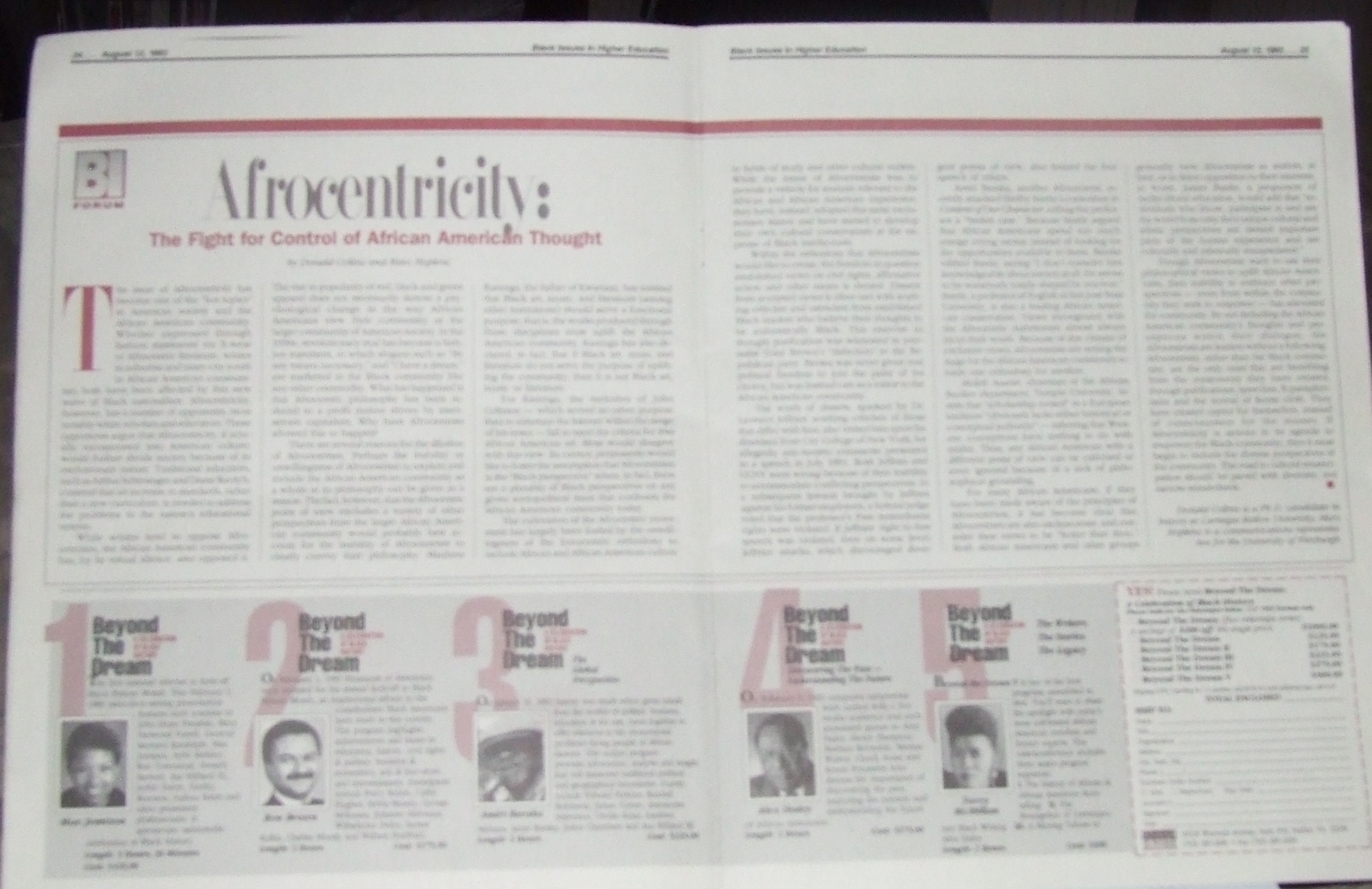
"Afrocentricity" Piece, August 12, 1993

Seventeen years ago today, I found out that an article that I had worked on with my dear friend Marc had been published by Black Issues in Higher Education. It wasn’t the typical process in which an editor or an editorial assistant contacts you to let you know that your piece has made the cut. No, I found out from Marc, who found out from a librarian at Hillman Library at Pitt, that our 1,200-word “Afrocentricity: The Fight for Control of African American Thought” was already published by Black Issues as their central Forum article for their August 12, ’93 issue. We did so many things incorrectly in getting that article published. But in the end, it meant renewing a struggle for a sense of my own purpose in life. At twenty-three years old, I was half my lifetime removed from seeing myself as a writer, and had spent most of the previous eleven years denying that any such yearnings remained in my mind and heart.

It was an article borne out of Marc’s desire to have an impact on a ridiculous debate over what is and isn’t authentically “Black” or “African” and my need for a few extra dollars. Unfortunately, authentic Blackness – along with my need for increased income – remains after so many years. We worked for two weekends in May on this short critique of Black Studies greats such as Maulana Karenga, Molefi Asante and the latter’s cult of Afrocentric followers, including those who would claim that such things as jazz aren’t authentically Black. After we finished the draft, I left it to Marc to compile the contact information for editors and periodicals. I was too busy looking for work and making sure that I wasn’t evicted from my firetrap of an apartment in East Liberty to put much more work beyond the piece into getting it published.

Other than Marc occasionally calling me to let me know that he’d been in contact with Harper’s or had mailed the article to Emerge, I didn’t give the piece much thought until that day in August seventeen years ago. Since our piece was already published, it meant that we’d have to fight to get paid. Based on the number of words, they owed us about $100 a piece. We’d never even received an acknowledgment letter, much less an acceptance or rejection follow-up. In all, Marc contacted some seventeen different magazines about “Afrocentricity,” probably too many to keep up with and police, especially in the case of Black Issues.

We learned later that one of the editors hoped to use our article as a straw man for Molefi Asante and his students/followers to burn in effigy, with one letter after another describing us as “Uncle Toms,” “inauthentic,” and “misguided Negroes.” We were virtually everything except children of God. This went on for two months’ worth of Black Issues issues. I wanted to write a rebuttal letter, one that would at least stick it to our melanin-worshipping, authentically-seasoned-fried-chicken-eating, Afrocentric brothas and sistas. My description, not Marc’s. But Marc refused to partake in a follow-up. “We were just trying to help,” he said more than once, as if we were the 300 Spartans at Thermopylae, about to be killed off by an ignorant swarm.

I learned quite a bit from those days of naiveté. One, that as a writer, that it was just as important for me to be involved in the selling of our article as it was for me to do the actual writing. Two, that mass mailings of articles for publication only work if you don’t care about making money or about how you as a writer are treated. Three, that I as a writer must stand by my work, especially when I know I’m in the right. And four, that even in the midst of my climb into all things PhD, that I was and would always remain a writer. This experience would serve to help me figure out how much of a writer I could and should be as my time pursuing an academic career came and passed.

The Rejection of All Things “All-American”

Tags

, , , , ,


Source: http://en.wikipedia.org/wiki/Captain_America. Scanned panel from the cover to ''Captain America (vol. 4)'' # 6. Art by John Cassaday

About a week and a half ago, BBC News America brought in an American athlete for an interview, calling him a typical “all-American man” in the process. It’s not a term that Americans use nearly as much these days, but BBC America still felt comfortable in using it, assuming that all Americans would understand on some unconscious level what an all-American man, hero, boy or girl would mean. The phrase has a variety of implications, and whole groups of people who become excluded in the process.

There are racial — but not necessarily racist — implications to the “all-American” archetype. Of course, the term refers almost always to White men, heroes, boys or girls, especially those with blond hair and blue eyes. You know, like Captain America. Whether it’s been athletes like Roger Clemens, Mia Hamm, Tom Brady, Lindsay Vonn, Mark McGwire, Phil Michelson, or actors like Tom Cruise, Zack Efron, Justin Bieber, Jennifer Aniston, Renee Zellweger, or the Olson twins, all-Americans are essentially the White boy or girls next door. They are allegedly everyday people who’ve managed to become enormously rich, famous and successful individuals.

Somehow, their hard work and talent, like cream in tea or coffee, rose to the top, enabling these individuals to become the archetype all-American. Never mind that hard work for most of the remaining 310 million of us isn’t really an issue, and talent alone needs to be found, discovered, and connected to the powers that be in order for it to rise to the top. But let me not burst that all-American bubble of a myth. Luckily in the past fifteen years, there are a select few of color who may fit that “all-American” moniker, folks like Will Smith or Derek Jeter. Still, Will Smith broke in as a rapper who was anointed as one with great potential by Quincy Jones, while Jeter plays for the New York Yankees, not exactly an under the radar sports team.

Which leads to my other point about the “all-American” myth. No one who grows up a nerd, or a misfit of some sort, or just introverted, gets to be seen as an all-American boy or girl. No one who’s overweight or impoverished or considered unattractive is found by the media as “all-American as apple pie.” Everyone from Bill Gates to Bill Maher, Colin Powell to Whoppi Goldberg, would’ve never made it in this society if we waited for the media to anoint them as “all-American” heroes or success stories.

I must admit, I’ve only watched a few videos by the group The All-American Rejects, but their very name makes my point. Though the use of this term is on the decline, it’s not dying fast enough. We’re a multicultural society, whether those who think that only a select few are “all-American” boys and girls want to acknowledge this or not. Maybe BBC America, or for that matter, the news business in general, should catch up with the rest of our society before they look as if they’re waiting for the next eugenics movement.

Race, Racism and Bigotry

Tags

, , , , , , , , , , , ,


Seven and a half years ago, at a retreat for a gathering of social justice fellows in Northern California, a lengthy discussion of -isms occurred. The premise was the fact that every human being has prejudices, biases, can come off as a bigot.

At one point, I made the point that there’s a difference between bigotry and racism. The average bigoted person usually doesn’t have the ability to slander, libel or otherwise act on their bigotry in a way that discriminates against the person or a whole class of people who are the object of this individual’s bigotry. Afterward, a fellow insisted that all bigotry rose to the level of an -ism of some sort, no matter how little the power or influence the person harboring this bigotry possessed.

In recent weeks, between the New Black Panther Party, FOX News, Ben Jealous and the NAACP, Shirley Sherrod, the USDA, the White House, the workplace shooting in Hartford, Connecticut, the radioactive issues around race and racism have reared their ugly heads. For a society forty-five years removed from the end of Jim Crow — and 146 years removed from the end of slavery — we’re still much in need of a Truth and Reconciliation Commission on race. But in order to have a real conversation on race, we need to understand that there are differences between race, racism and bigotry, that these words aren’t interchangeable.

Take the term race. As defined by so many other scholars over the past 110 years — it’s a social construction based on skin and hair-deep differences between groups of people from various parts of the world.  Not to mention the legacy of the Transatlantic Slave Trade and slavery in the Western Hemisphere. Saying that there are differences based on race between the incomes of Blacks, Whites, and Latinos, for instance, is merely a statement of fact, and not an implication that any individual or group is practicing racism. Nor does race make sense outside of cultural distinctions. Tens of millions of us are living proof that there’s only one human race, genetically speaking, that is.

The word racism involves much more than mere racial distinctions and history. It involves the embracing

in words and deeds ideas and systems that either deliberately or inadvertently discriminate against other groups based on their race. It’s an expression of bigotry, but not just simply to acknowledge or enlighten oneself or others. Rush Limbaugh’s spit-flying session on President Obama in the weeks before the ’08 Election — “It was all about RACE! It was all about RACE!” — is a good example of this. Limbaugh was arguing that Obama was winning the election because of racism. Specifically, reverse racism among African Americans and White guilt over racism among independents and progressives. Limbaugh all but kissed his microphone while hollering out of a rage that can only be described as racism.

Anyone can express racism or be a racist. But where should we draw the line between bigotry and racism? I’ll use my mother as an example. She’s complained for thirty years how “all the jobs been taken by West Indians and Spanish people” in Mount Vernon and other parts of Westchester County. Well, working-class jobs, anyway. There’s no doubt that this is an expression of bigotry. But does this mean that my mother’s a racist? Hardly. For whatever it’s worth, my mother has worked with, gone to church with, and broken bread with folks regardless of their race or ethnicity, and not begrudgingly. Even with the authority to hire and fire thirty years ago, my mother worked to ensure that all under her supervision weren’t discriminated against.

But while all of us have a smidgen of bigotry in our hearts and minds as occasionally expressed from our mouths, many of us aren’t racists or practicing racism. But a racist is without a doubt a bigot. So experience, intent, position in society, and race (not racism, not bigotry) are all involved in making someone’s words and deeds examples of racism, and that person a racist.

These are subjective definitions, and I could be challenged and wrong. However, they’re based on twenty years of work as a writer, scholar, historian, professor, and forty years living in post-Civil Rights America. We need to start somewhere to have a real and serious discussion of race. Maybe this is it.

Ex-Stepfather’s Balance Sheet

Tags

, , , , , , ,


Scales of Justice. No Copyright.

Today marks my idiot ex-stepfather’s sixtieth birthday. Like monsters and other things that go bump in the night, I remember Maurice Washington’s birthday for no other reason than because he made my life — all of our lives at 616, really — a living hell between ’81 and ’89. Of course, the years between ’77 and ’81 weren’t exactly a picnic themselves. The balance sheet of his time as my stepfather would make the national debt look like pocket change by comparison.

The days and weeks since the death of my sister Sarai — and my ex-stepfather’s daughter — have proven how little some people want to change. Four days after I arrived in Mount Vernon and at 616 to help my mother with Sarai’s funeral arrangements, my mother’s telephone rang. It was around 10:30 pm on that muggy, mid-July night, with fans blowing hot air through the otherwise quiet apartment. Quiet because my brothers Maurice and Yiscoc were out and about, and my youngest brother Eri had taken his son to see others on the Washington side of his family. The caller ID showed that the call was coming from St. Joseph’s Hospital in Yonkers, and with my younger siblings out roaming the streets, I immediately became concerned.

I picked up the telephone, said “Hello?,” anticipating some bad news. “How DARE you, YOU BASTARD!,” a man yelled. I had no idea who it was at first. Then, when I heard, “How dare you plan MY daughter’s funeral!,” I suspected that it was my ex-stepfather, but I wasn’t sure. I hadn’t heard his bellowing and bombastic voice in nearly sixteen years. “Who the heck is this?,” I asked. “Who do you THINK this is? Who’s Sarai’s father? Who’s Sarai’s father?” the idiot yelled, as if I were still sixteen and living under the same roof with him.

I ignored the question, and with about a five-second delay as my ex-stepfather reloaded, I said, “I’m not planning Sarai’s funeral. I’m helping my mother plan it.” After that, the dumb ass continued to yell. “A funeral on a Saturday? A Saturday?!?,” he said, as if Sarai was a Hebrew-Israelite, as if any of us cared what he wanted, really.

“Put your mother on the phone! Put your mother on the phone!” he continued. My mother was fully asleep for the first time in nearly five days. I wasn’t about to wake her up. I said, “No. No I’m not.” As he continued yelling, I said, “Until you calm down and start talking rationally, I’m not letting you talk to my mother.” My ex-stepfather paused, then found some more bullets for his yelling gun. “Rational? How I’m supposed to be rational. Put your mother on the phone, boy!,” he yelled as I hung up the telephone. I turned the ringer off, knowing that the fool would continue to call until what was left of his brain would explode, or at least until the nurses drugged him up to make him sleep.

Why was my ex-stepfather in the hospital? Besides his daily need for dialysis, he managed to break his one remaining leg in two places. The broken leg became infected, turned gangrene, and was amputated, at or above the knee I believe. All this apparently happened in June. My ex-stepfather, a fourth-degree black belt in Isshin-ryu Karate, a man who could lift the sixteen-year-old version of myself and the eighteen-year-old version of my older brother Darren with each arm, was now fully wheelchair bound. This, of course, is irony that often can only be found in fiction books like Catch-22, Crime and Punishment or The Kite Runner.

I remember my ex-stepfather giving me two pieces of good advice in the twelve years he was officially with

Balance Sheet.

my mother, either living together or married. Once, when I was fourteen, he caught me walking down the street with my head down, looking at my feet instead of holding my head up. He said, “Donald, your tall, be proud of your height. Don’t ever hang your head. Hold it up straight.” A few months later, when I was just about ready to move in with my father Jimme, he convinced me to stay with my mother at 616. The latter piece of advice was extremely self-serving, but it was good advice anyway.

On balance, though, the man did virtually nothing that could be considered fatherly by anyone outside of Idi Amin or Josef Stalin. Yes, there are worse men and women in the world, but most of them have substantially more power, money and influence than Maurice Eugene Washington. Still, few have literally paid the price for their evils the way he has in the past twenty years. A horribly bad back, Type-2 diabetes, an almost complete loss of kidney function, and a double amputee. That makes me feel sorry for him, even though a part of me doesn’t want to.

Beware of the Blogger

Tags

, , , , , , ,


Me the Evil Blogger

I have a haiku for Tony Kornheiser, host of ESPN’s Pardon the Interruption and ESPN DC 980’s The Tony Kornheiser Show:

Beware the Blogger, for he’s only right sometimes, but wrong all the time.

This not only sums up Kornheiser’s sentiment regarding bloggers, but those of many veterans of professional journalism. But since Kornheiser’s the most recent dissenter who’s used his microphone as a weapon to whack all bloggers over their heads about blogging, I’ll work with him. Apparently a person who wants to become a print journalist today must, absolutely must, “pay their dues” in order to be great at the profession. By Kornheiser’s definition as a long-time beat sports reporter, that means years of lousy pay, traveling to godforsaken towns and villages, staying in crappy motels and eating artery-clogging food in order to hone the craft of gathering sources and doing interviews.

I have no argument against honing one’s craft. We all should do it, regardless of profession, in order to make the most of our talents and eventually become successful. What I do have a problem with, though, is the idea that bloggers somehow are taking a shortcut. It’s as if we’ve all decided to warp space-time itself instead of seeking to break the speed-of-light-barrier in order to become successful journalists and writers.

All we do, according to Kornheiser and numerous others, is “spew” and “spout opinions,” not based on anything except our guts. Apparently we’re all supposed to become old, gray and grizzled in order to have the privilege of making a decent living and being able to have a radio show and a half-hour TV gig. Still, I get it. Andrew Breitbart’s blogging crusade against anything that he considers politically left managed to drag Shirley Sherrod, Ben Jealous and NAACP and the White House along for his pitiful ride into the mud.

Yet I don’t remember too many people complaining about the blogosphere when the story about former presidential candidate John Edwards broke into the mainstream two years ago. A story that bloggers and the National Inquirer had been banging around for eight months before the real professional journalists got a hold of it. I don’t recall Kornheiser and his buddies giving folks like Mitch Albom (Detroit Free Press, bestselling author of Tuesdays With Morrie) or Bob Ryan (long-time sports reporter and columnist for the Boston Globe) too hard a time over stories that they should’ve never filed or were completely inaccurate. I don’t remember Kornheiser complaining about the plight of print journalism when the Jayson Blair plagiarism scandal (New York Times, 2003) or the Mike Barnicle fabrication scandal (Boston Globe, 1998) broke.

I take offense to any journalist or writer insisting that every blogger is an unadulterated hack with zero skills necessary to be — or become — good writers or journalists. I take offense because I’ve paid my dues, thank you very much. I’ve been writing on the topic of race, culture and diversity for more than twenty years, and have been a published writer for the past seventeen years. Five and a half years of graduate school to become an American and African American historian, and the past ten years to make myself more than an academic writer. Maybe I just imagined my days without food and with holes in my sneakers back then.

Within that, years of archival research hunting for sources much more obscure than “Deep Throat.” Interviews with people in authority, with people long forgotten by the press. A year of my life just learning how to do statistical analysis. Two and a half years of post-graduate unemployment and underemployment, taking crap work and teaching part-time in order to become a better writer and a better historian. But, alas, I haven’t “paid my dues.”

I blog for three reasons. One, because it serves as a form of a journal for me, to be able to track my mood, my progress as I pursue the publication of my memoir Boy @ The Window. Two, because as long as I have something to say about a subject I know quite a bit about — and through my years of experience, I know quite a bit about a lot of things — I can write about that subject. Three, I blog because I want to build an audience, to have an honest presence in the blogosphere, where I spew more than vitriol, where what I have to say is based on research, interviews, sources, and, of course, my biases and my opinions.

To Kornheiser, I say, based on a quote from Vernon Jordan’s memoir, Vernon Can Read! (2001): “Read, Tony, Read!” Read an occasional blog like mine. Don’t just spew your opinion, you dope!