• About Me
  • Other Writings
  • Interview Clips
  • All About Me: American Racism, American Narcissism, and the Conversation America Can’t Have
  • Video Clips
  • Boy @ The Window Pictures
  • Boy @ The Window Theme Music

Notes from a Boy @ The Window

~

Notes from a Boy @ The Window

Category Archives: Pop Culture

Generation Gap

03 Thursday Jun 2010

Posted by decollins1969 in 1, Eclectic, Politics, Pop Culture

≈ Leave a comment

Tags

"Greatest Generation", Baby Boom Generation, Band of Brothers, Culture, Generation X, Generation Y, Politics, Tom Brokaw


Off and on for three years, I’ve waled on the ’60s generation and its own obsession with its achievements. Not to mention its occasional turn to Generation Xers and those younger than us, as if to say, “Well, why aren’t you more like us?” For years I thought that this was the stuff of arrogance, a sense of superiority that the Baby Boom Generation felt toward us young folk. But I’ve come to the realization that it’s just the opposite, that the folks who marched with Dr. King and shut down Berkeley and Columbia were themselves attempting to fill shoes larger than Shaquille O’Neal’s size twenty-threes. And no, this isn’t about my generation.

For the umpteenth time, I watched most of the Band of Brothers series on Memorial Day (it was on Spike TV, of all places). If it’s possible for me to have a man-crush on anyone, it’s with Damien Lewis playing Col. Richard Winters, as well as the man himself. So moving, so inspirational, and so hard to live up to. Especially since another 16 million men and women served in the armed forces during the Second World War. Millions more worked hard in factories and on farms, in shipyards and railroad yards to supply these folks with food, equipment and ammunition to fight.

The generation of folks born between 1910 and 1930 are part of what Tom Brokaw and others have called the “Greatest Generation.” That’s going a bit too far, given that the generation born in the 1880s and 1890s helped make them this way. But given the times they grew up in — the Roaring ’20s, the Great Depression, and the Second World War — it’s hardly a stretch to say that as a generation, they rose far  above their circumstances to achieve great things, to build and rebuild our country, to make the US as great as it would become after the war.

Sure, there are a variety of tensions in this assessment, racial segregation and discrimination not being the least of these tensions. In this case, then, you could argue that the generation of Blacks born between 1915 and 1930 were the “Greatest Generation.” They’re the ones who marched on Washington in ’63, who helped do the leg work for Brown v. Board of Education, who fought segregation and discrimination to fight valiantly in World War II, where leaders like Dr. King, Malcolm X, and so many others emerged. To act as though Whites from this generation weren’t themselves fighting against racial segregation, economic inequality, and gender discrimination is to deny the tensions that existed in the world in which Baby Boomers grew up in, the mythically placid ’50s and early ’60s.

So yes, the ’60s generation was one that was radicalized by civil rights, Vietnam, social unrest, politics (and eventually, a distrust for government), it was also one that, for all its denial, was following in the footsteps of the generation before. It would be nice if folks from this generation would put their narcissistic biases aside and give a fair and complete assessment of their own achievements and their own role in creating the narcissistic generations that have followed in their footsteps. But they’re probably not going to do that. Oh well.

Our Flat-Butt Society

08 Saturday May 2010

Posted by decollins1969 in 1, culture, Eclectic, Politics, Pop Culture, race

≈ Leave a comment

Tags

Beauty, Culture, Flat Butts, Pop Culture, Race


Flat-Butt Truck

Picture a world in which the only ingredient needed to achieve beauty was a flat butt. Imagine that this flat butt would guarantee more than an easier time in dating, marriage, and beauty pageants. A flat butt makes it easier to do well in school, to find comfortable fitting jeans, and to gain access to higher education, quality health care, better homes, and steady employment. Now imagine that those who have oblong butts, round butts, bubble butts, or some other combination of butt shapes have limited access to education, employment, medical care, housing, well-fitting clothes, and beauty pageants. Sounds ridiculous, doesn’t it? But, despite the numerous exceptions, we live in a flat-butt society.

We assume that flatter is better because some dead person created it as our ideal vision of beauty centuries ago. But this dead person created this standard without the benefit of interacting with people with other kinds of butts. Today we find ourselves in two worlds: the make-believe world of flat butts, and the real world of multiple kinds of butts. Hundreds of years of conditioning have left most in our society with the impression that a flat butt is a good butt and that other butts—especially round and bubbly ones—are unhealthy and symbolize low intellectual stamina. We need to dig up this dead person and ask him a few questions about his flat-butt vision.

Take the symbols of beauty for our culture. Whether male or female, they usually have flat butts with big chests. Round, shapely butts equal obesity as far as most of us are concerned. The ideal flat butt is one that is firm and muscular, an extension of a firm and muscular back. It’s one that a rubber band would boomerang off of. Has anyone ever seen a Miss America or Mr. Universe with anything other than a flat, muscular butt? Between so-called supermodels like Heidi Klum and Gisele, Sports Illustrated’s annual swimsuit issue, and the constant fawning over Hollywood actors, the women and especially men that are with them should feel extremely lucky. At least, that’s what we’re told by advertisers, journalists, reporters and commentators nearly every minute of every day.

There are of course exceptions to the flat-butt rule. These anomalies are often exotic and rarer than gold, but not the flat-butt norm. The popular press and hip-hop videos tend to cover these unusual people as ones who have exceptional derrieres. This only reinforces the idea that flat butts are normal and within everyone’s reach, and that anyone who doesn’t have a flat butt and isn’t exotic simply isn’t attractive. It’s no wonder that non-flat-bottomed men, women, and girls are spending millions for doctors to suck the fat out of their butts.

Another dead expert decided that a flat-butt person, as the international symbol of beauty, also was more athletic and intelligent. Because those with flat butts already were in the top positions of our society, it was self-evident that anyone without a flat butt lacked intellect or leadership ability. This expert assumed by scientific observation that people with non-flat butts couldn’t lead in science, society, or sports because their butts would get in the way. Over time, those with non-flat butts became leaders in the athletic field, but only in areas where intelligence seemed unnecessary. It’s likely that this deceased expert had a non-flat butt and spent much of his life obsessed with flattening it, wanting to become part of the flat-butt elite.

We can even see the penetration of our culture’s flat-butt philosophy in clothing and in our public spaces. Go to any clothing store in the country, and one will find it almost impossible to find trousers, slacks, jeans, pants, skirts, shorts, and underwear made for people with oblong, round, bubble, or mixed butts. The closest approximation to bottoms for the non-flat-bottomed male or female are ones made for the overweight, another population that fails to meet our society’s beauty standards.

We design our public spaces with flatness in mind. Take a look at the interior, exterior, and posterior of any public transit system in the country. A flat butt fits better in the molded seat of a bus or train than a round one. Public transit vehicles themselves have flat features, especially their rears. Public restrooms have toilet seats with flat butts in mind, as any non-flat-butted person can attest. And only someone with a flat butt would design slides in public parks for children with flat butts. Kids without flat butts tend to get stuck on these slides because the slides aren’t built with enough flexibility to accommodate other kinds of butts.

Sexual relations is one area in which the divide between flat butts and bubble butts (at least) has softened in recent years. It appears that some flat butt people are actually attracted to people with round, even jiggly butt cheeks. Yet this attraction only goes so far. Despite the mixing of flat and round and the recently discovered coolness of the non-flat, thinking in this area for most flat butts remains flat. For them, flat is phat-in beauty, culture, intelligence, and in some cases, athletics. The round, oblong, bubble, and mixed butts still have a long way to go.

What those with round butts need are pioneers to prove that like the world, the ideal for butts is variety and balance, not flat as the ideal. Proving this may require studies that show that a round butt provides long-term health benefits or has no genetic connection to intelligence. Chiropractors could show that those with non-flat butts have a greater chance of avoiding spinal degeneration than those with flat butts. Geneticists with round and flat butts may need to show that the round butt gene is the dominant one while flat-butt genes are recessive. Engineers can prove that rounding off buses and trains will make them more aerodynamic and energy-efficient, and deeper seat moldings will save millions in caring for our backs. Whatever the innovation or discovery, it’s up to the round butts of our nation to make this flat-butt society more round.

Driving as a Metaphor

26 Monday Apr 2010

Posted by decollins1969 in 1, culture, Eclectic, Politics, Pop Culture

≈ Leave a comment

Tags

American psyche, Driving, Narcissism, neurosis, psychosis


I’ve spent the last few months talking about our individual and collective narcissism in this country, about Whites and Blacks and people of color and women and academics who all demonstrate our national psychosis. I’ve arrived at the conclusion that nothing illustrates our American narcissism more than what takes place on our roads and highways, in our parking lots and intersections, more than what we do as drivers and pedestrians. We are petty, nervous, angry, unyielding, selfish, oblivious and unthinking assholes when it comes to what we do to get from point A to points B and beyond every single day.

It took me a while to get to this point. I’m a late-blooming driver. I didn’t get my license until a month after my twenty-second birthday, during the morning of a minor snowstorm that had left six inches of snow on the ground at the testing center on Washington Blvd. in Pittsburgh. After that, I drove sporadically, renting a Ford Escort in Yonkers to get to a conference at Lincoln University in the hinterlands of southeastern Pennsylvania in May ’92. House-sitting for professors with car access in August ’92. Renting a car in July ’95 and April ’96 to go places. Borrowing my eventual mother-in-law’s car for errands and job interviews in July ’97, November ’97, November ’99 and November ’01. And more rentals of cars and a moving truck in May, June, July and August ’03, and July ’04. We didn’t buy our Honda Element until the end of September ’04, our first car, and definitely my first car. I was almost thirty-five years old.

But I’ve learned a lot in the past six years and 50,000 miles of driving. I’ve learned that there are only two kinds of narcissistic drivers: neurotic ones and psychotic ones. The neurotic ones tend to drive as if they’re about to be ambushed by an armed gang with a rocket-propelled-grenade launcher driving in front, behind and beside them. They often drive five or ten miles below the speed limit, slow down for no reason, and make sure that everyone behind them become neurotic for fear of bumping into them. Neurotic drivers describe about thirty percent of the narcissistic people I encounter on the road.

Why narcissistic? Because — and I can attest to this feeling during my on-and-off again driving experiences between ’92 and ’04 — they’re driving scared, as if out of the 220 million people on the road, someone’s out to get them. That we as drivers have no margin for error, even though people may be beeping on us to speed up, jumping in front of us because of the five-car-long gap in front of us. These drivers drive as if it were an early Sunday morning in rural Georgia, and they were on their way to Macon for some Krispy Kremes before heading to church. Mind you, it’s usually the height of rush hour when this occurs.

But psychotic drivers are even more narcissistic. While neurotic drivers do what they do out of a combination of a need for self-preservation and their belief that the way they drive is the only way anyone should drive, psychotic drivers tend not to care much at all. They run stop signs and red lights, cut you off from making a turn, drive past you when you’re already ten miles over the speed limit themselves, honking and giving you the finger all the while. They don’t use turn signals to let you know they’re turning or changing lanes. They refuse to turn their lights on at night, even when you’ve given them the signal that their lights are off. They will brush the clothes of any pedestrian in a crosswalk, because no matter what, they have the right-of-way. They make u-turns that turn into three- and five-point turns in the middle of traffic, with no hint of an apology of any kind. They act as if other drivers are clairvoyant, and get angry if you don’t know what their next unpredictable move is.
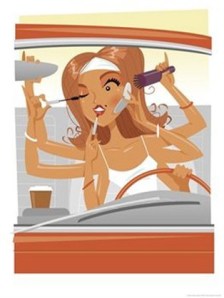
These are the same people we work with, or used to go to school with, every day of the week. They go to church, temple, mosque and synagogue, attend PTA meetings, see plays and go to music concerts and sporting events. They go to the gas stations and supermarkets and strip malls. They are unpredictable people, the kind that are constantly on the phone or texting while they drive, as if bluetooth earpieces and headsets and hands-free technology haven’t been invented yet. They are us, the seventy percent of us out on the roads these days.

In many respects, driving with the psychotic is like being in high school for me all over again. In my case, of course, Mount Vernon High School might as well have been four years of time between gen pop and my neurotic grade-obsessed, cool-obsessed classmates. But I digress, again. I remember being in line at the cafeteria for lunch on about a hundred occasions with guys constantly trying to cut in because they didn’t want to wait. When I’d say, “No!,” often loudly, I’d get called “m____f____” and the f-word. It’s the same thing in rush hour traffic. All of sudden, some dumb butt comes up beside you, practically sticking the front end of his or her car in the way to get into my lane. I usually refuse, especially if they didn’t have their turn signal on or look as if they really are psychotic. That refusal usually draws a middle finger and some cuss words, racial epithets and other idiotic statements. Just like high school.

Even in parking lots or other areas where drivers have to stop, pull to the side or at least slow down, you see the high school stuff. The other day, at a Metro Rail station parking and pickup area near Silver Spring, a guy in a white Isuzu SUV stopped in the driving lane to wait for his girl, I guess, to walk out of the tunnel, walk through half the parking area, and put her bag in the back of the car. The skinny stick-of a-woman then took her time buckling her seat belt before they slowly got out of our way so that we could pick up our loved ones. I’ve seen people block my car for no reason, or worse still, people get out of their car to talk and snack on the hood of my car, I guess because it was too clean for them.

Pedestrians, bicyclists and motorcyclists aren’t immune from this psychotic, narcissistic behavior. All attempt to have their cake and eat it too. While the law protects pedestrians in crosswalks, it doesn’t mean you can cross the street whenever you feel like it. If the light is green, don’t cross the street. If the crosswalk signal is orange or red and not blinking, and the light directly in front of you is about to turn red, that’s a pretty good sign that the traffic you’re about to cross into is about to start moving, right? And if you are jaywalking, walking the slow version equivalent of crossing patterns in football, you may want to, say, hurry it up by walking faster or running, instead of acting as if my insurance will cover your hospital bill.

Bicyclists and motorcyclists, when on the road, act as if we should watch out for them as they weave in and out of traffic, run stop signs and stop lights, and ride two and three across a lane. A bicycle weighs at most thirty pounds. A motorcycle, maybe 800. A car weighs anywhere between 2,000 and 5,000 pounds. It might be a good idea to make a note of this when you flip a psychotic driver the bird when you’ve cut them off from making a turn.

I think that there should be a change in law, one that requires a person to have an education at least the equivalent of two years of college, and at least 500 hours of training as a driver, before they can obtain a driver’s license. And, that license should cost at least $600 (as much as two iPods), and really, between $1,000 and $1,500, renewable every ten years after a brief test. That would take most of the high-school-esque, narcissistic and psychotic drivers on the road today off of it, possibly including me (because I didn’t have 500 hours of driving to my credit before ’04). Given the stress that comes with driving, though, I would welcome the break.

Banning the Term “Legislate Morality”

23 Friday Apr 2010

Posted by decollins1969 in 1, culture, Eclectic, Politics, Pop Culture, race, Sports

≈ Leave a comment

Tags

"legislate morality", Ben Roethlisberger, Culture, Michael Wilbon, Morality, NFL, Pardon the Interruption (PTI), Pittsburgh Steelers, Politics, Pop Culture


I love Michael Wilbon’s work as a sports journalist, columnist with The Washington Post, as a commentator on the NBA on ESPN/ABC, and as co-host of Pardon the Interruption (PTI) on ESPN with Tony Kornheiser. I’ve loved his work for a bit more than two decades, certainly in comparison to Pope Lupica and the other holier-than-thou sports reporters and columnists out there these days. I find him refreshing as a journalist and writer, and an unabashed and unafraid host when it comes to how sports and American society intersect.

But I found myself bitterly disappointed in Wilbon’s “can’t legislate morality” comment on PTI on Wednesday, April 21. Wilbon said this in response to the NFL’s six-game suspension of two-time-Super Bowl-winning-quarterback and Pittsburgh Steeler Ben Roethlisberger for the latter’s violation of the league’s personal conduct policy. The NFL “shouldn’t legislate morality,” Wilbon said, as Roethlisberger “hadn’t committed a crime.” NFL Commissioner Roger Goodell, the league, and the Steelers ownership were all “overreacting,” according to Wilbon. Well, Wilbon has certainly earned the right to be entitled to his opinion. But, as my wife has said to me on countless occasions, Wilbon’s also entitled to be wrong.

Societies, governments, employers and families “legislate morality” every single day, and have been doing so for as long as there has been a human civilization on this planet. Murder, stealing, banking regulations, adultery, and certainly sexual assault and rape are all examples of us “legislating morality” over the past five millenia. Now, I’m not totally naive — I know what Wilbon was attempting to say (I think). That because Roethlisberger wasn’t arrested, indicted or convicted, that the issue of his alleged encounter with a twenty-year-old White college student whom he helped become incredibly intoxicated is now a moral one, not a criminal one. Yes, this is true. But what would ESPN do to someone like Wilbon in the same situation? What would the University of Maryland system do to me in that situation? Would ESPN let Wilbon continue to show up for work without a reprimand, a suspension, or a quiet termination? Would I continue to teach classes, or would my employer consider not renewing my teaching contract?

We as a people legislate morality in ways that none of us really think about. Like Wilbon, most of us think that crimes are crimes and morals are morals, as if passed down from Moses or Hammurabi completely unchanged for the past 3,800 years. But moral issues have led to things that once were not crimes becoming crimes. The whole notion of illegal drugs or illegal immigrants didn’t exist in this country a century ago. Someone could’ve been a pot-smoking Polish immigrant “without papers” in 1910, and that immigrant wouldn’t have gone to jail. The folks in favor of making marijuana illegal or shutting off immigration from Southern and Eastern Europe didn’t end their crusades (however misguided) by saying, “Well, we can’t legislate morality!”

Or, to use much more recent examples, those White supremacists who said, “you can’t legislate morality” after the Brown v. Board of Education decision, the passage of the Civil Rights Act of 1964 and the Voting Rights Act of 1965. For nearly twenty years, those opposed to Black civil rights argued that the issue of Black equality was a moral issue, not a legal or human rights one. Or those from the Religious Right who said, “you can’t legislate morality” when the Supreme Court’s Roe v. Wade decision came down in 1973 or in the wake of the growing Gay Rights Movement in the late-1970s. Of course, in both cases, those in leadership who were influenced by what we now call the evangelical movement have engaged in legislating morality since the early ’90s, attempting to roll back Roe v. Wade and putting laws on books defining marriage as only between a heterosexual adult male and a heterosexual adult female.

On the issue of civil rights, desegregation, reproductive rights and gay rights, what is and isn’t moral isn’t just a matter of perspective. It’s also a matter of power and bias and the people who are wielding that power in order to reflect their bias. I’m not saying that Roethlisberger actually committed a crime, or that he didn’t commit a crime. Yet we cannot say that what Roethlisberger engaged in was simply a violation of the generally accepted morals of American society either. Even if seen in the most optimistic light, Roethlisberger brought significant embarrassment to himself, his team and teammates and the NFL. An executive at a Fortune 500 company could no more get away with going on a bender and attempting to have sex in a public bathroom — an incident that somehow becomes public — than Roethlisberger could. So for Wilbon or anyone else to rally around the “can’t legislate morality” flag is somewhere between idiotic and shameful.

The issue with Roethlisberger isn’t that the NFL’s engaged in legislating morality. Nor is it that the district attorney in Georgia wanted to bring a case to trial but couldn’t because of insufficient evidence. The real issue here is that we as a society have made a thick distinction between what is and isn’t moral behavior and what is and isn’t criminal behavior, because they aren’t mutually exclusive. For progressives and libertarians, the distinction is whether one’s behavior is detrimental to the health and lives of other people. Black civil rights, gay rights, and smoking weed are among the things that most would assume would not harm the lives of other citizens, at least in 2010. Having an encounter in a bathroom that leads to another person going to the hospital with bruising and bleeding, however minor, is detrimental to that other person.

In light of this being Sexual Assault Awareness and Prevention Month, maybe folks like Wilbon should be more careful when choosing words like “can’t legislate morality.” Not only do we legislate morality, societies will engage in this kind of activity as long as there is such a thing as a society. So I ask that everyone with a microphone and a camera pointed at them to stop talking about legislating morality as if moral values are as set in stone as the Earth orbiting the Sun. You’re merely reflecting your own bias, against women, gays, Blacks, drugs, science. Or in Wilbon’s case, a need to stay out of the judgment fray that moves us from one scandal to the next, a need to get to the day when Roethlisberger throws three, four or five touchdown passes in a game. On that part I fully agree. But say that, Wilbon, because that’s what you’re good at. Don’t say you can’t legislate morality, because last I checked, this isn’t your area of journalistic expertise.

First Contact

22 Thursday Apr 2010

Posted by decollins1969 in 1, Eclectic, Marriage, Pop Culture

≈ Leave a comment

Tags

Dating, Marriage, Pittsburgh, Relationships, Star Trek: First Contact, University of Pittsburgh


I met my wife Angelia (pronounced Angela, or, as she would say, “it’s ‘Angela’ with an ‘i'”) twenty years ago today. It was an early spring Saturday evening, one that’s typically crispy-cold in Pittsburgh. Our mutual friend Bryan was throwing himself an apartment-warming party. Bryan has recently moved into an apartment building in the Bloomfield/Friendship section of the ‘Burgh. I vaguely remember Bryan complaining that his one-bedroom apartment was $420/month, which, in Pittsburgh even now, could get you a one-bedroom apartment bigger than our first place in Silver Spring. Still, he was happy to have his own place, to not living at home or with roommates.

I was in a rare place of peace at the time of Bryan’s party. I had found my stride in my social life, with real friends, a solid group of acquaintances, and wonderful times. I was doing well academically without it being an obsession. And I was working, but only fifteen hours a week, leaving time to do so many other things like going to clubs and hanging out all hours. Bryan had become one of the folks in my circle that I could talk to about school, work, social issues, and music. Even though has was also the only person I knew who truly liked the late Barbara Sizemore, a professor in the Black Studies department at Pitt who had served as superintendent of DC Public Schools in the mid-1970s. To say that Sizemore was abrasive would be an insult to Brillo Pads mixed with pumice. But Bryan loved her, and though I had figured out that Bryan was gay, I assumed that he also wanted to marry her.

I was a bit surprised to have been invited to one of Bryan’s parties, which were sophisticated compared to the college-scene parties I’d been to before my junior year at Pitt. Now I’d see something like that and say that Bryan was trying too hard for an Iberian/Bohemian effect, minus the weed and the crystal meth. But back then, it would’ve been like being a working-class character on Kelsey Grammer’s show Frasier, all awe-struck by the expanse of space that I saw when I first walked in his place on April 22 two decades ago.

It was a place that I would’ve never, ever complained about back then, with a small foyer, a kitchen with more counter space than we have even now, and a bedroom larger than my one-room firetrap of an efficiency in South Oakland. Bryan had turned his living room into a meet-and-greet-and-dance space, with red-colored light bulbs and red candles lit. The beverage of choice was Bryan’s own margarita concoction, blended just right. Blended so well that I was on my third before I realized that there was a ton of alcohol in it.

That was when I met my future wife for the first time. It was the first time we had met, but not the first time I’d ever seen here. Six weeks before, on an eighty-plus degree March day just before Spring Break, me, my friend Kenny and a couple of others sat on the corner of Forbes and Bigelow. We were across the street from the Cathedral of Learning, outside of the William Pitt Union, rating the young women (and men) as they walked by. It was fun of course, and some of the women knew what we were doing, so we did catch hell at times. Then this tall woman with a middling skirt walked by, her head held up high, her cheeks as puffy as a bird’s, her hair and makeup done really well. Kenny said, “She looks thirteen!,” and we all burst out laughing as she walked by. She didn’t notice, oblivious to the humor we were having at her expense.

Angelia was Bryan’s boss at his part-time interviewer job with Campos Market Research. Bryan was such a connector/networker (as Malcolm Gladwell would describe him if he knew Bryan back then) that he could become friends with almost anyone in those days. Bryan had apparently invited the two of us to the party to meet, to set up two of his Black friends, as if height alone would bring us together. Angelia was already in an on-and-off again relationship with a third-string Pitt football player, one whom I’d met before. A man with a head bigger than Donovan McNabb’s, but whose athletic skills were average at best. Angelia had recently become a part-time student at Pitt while working full-time hours at Campos in downtown Pittsburgh. She probably wasn’t in the mood to meet a young man about sixteen months away from graduate school.

Bryan introduced us. She was just over six-feet tall, with her hair permed and teased. Angelia was wearing a pink-and-white checkered blouse, with the front-fringe tied into a knot. She wore a long, flared dark-denim skirt with sheet pantyhose and short heels. She was attractive. Until I started talking to her. Angelia’s voice, with that Pittsburgh accent, reminded me of listening to a duck as it bit another one in a pond in a fight over pieces of floating bread. She sounded weird, and she seemed bored. Then, when Angelia asked me about school, and I told her that “It’s going well. I have a chance to get a 4.0 this semester,” I might as well have said that “I’m doing much better than you.” At least according to her. Bryan apparently asked Angelia, “What do you think?” “He’s arrogant!,” she apparently blurted out in response. When Bryan asked me what I thought of Angelia, I said, “She’s weird!” Given what I was like back then, me calling someone weird was saying something.

Needless to say, we didn’t exactly hit it off. But I kept bumping into her in the weeks after the night at Bryan’s margarita-ville. During my two weeks working for Campos, thanks to Bryan. During the summer on Pitt’s campus. The following fall, where we inadvertently ended up seeing a movie together and going out to eat afterward. It would take nearly six years to get beyond “arrogant” and “weird” to significant others. And another four before our marriage. I guess this disproves the idea that you have only one chance to make a first impression.

My Father and Conservatives

13 Tuesday Apr 2010

Posted by decollins1969 in 1, culture, Eclectic, Politics, Pop Culture, race

≈ Leave a comment

Tags

Debate, Discourse, Jimme, NBA on TNT, Parody, Politics, Race


This particular post may be a bit much for some of you. So this is a warning. There are some verbal bombs in this posting. It’s a “What-If?” post about a hypothetical interview between me and my father. My father, though, at the height of his alcoholism, when even on his best days, Miller Beer wasn’t far from his mind. This pseudo-interview would be me as if I was Ernie Johnson as anchor for the NBA on TNT with Charles Barkley, being played by my drunken father from the second half of the ’80s. The topic? The last couple of years of the Conservative Movement, specifically its response to the presidency of Barack Obama and its obsession with spreading fear and fomenting violence, as if Armageddon were on our very doorstep. Remember: you’ve been forewarned.

So I asked, “Do you think the changing conservative movement has been a positive influence on Americans in the past two years?”

My father: “That Reagan a good man dere, but most of those dum muddafuckin’ conservatives don’t know shit. Reagan think you dumb asses too, and he dead! I’m tired of yo’ muddafuckin’ asses sayin’ a bunch of stupid shit all the time! You tea baggers need to go bag some the fuck else where! You dum muddafuckas, and I’m tired of yo’ shit! I beat yo’ ass and keep beatin’ yo’ ass, you dum muddafuckas!” Father Files 1.April 2010

Me: “Wow! I mean, are you in the camp of those progressives and other folks who’ve been using the text messaging acronym STFU in their comments about the Tea Party and other reactionary conservatives? Do you really think that they deserve this kind of language and response?”

My father: “I’m a big shot muddafucka. I make fitty million dollas a week. Look at dis dum lookin’ muddafucka conservative — dat dum muddafucka cain’t do shit fo’ me! Muddafucka! Got thoughts nobody want! I buy an’ sell muddafuckas ’round here! I kick yo’ muddafuckin’ stupid ass! And I’m da boss of the bosses. No conservative tell me what ta do. You conservatives don’t know shit!” Father Files 2.April 2010

Me: “Well, okay. Do you have any final words for the folks who have become part of the post-Obama conservative movement, or do you really care about this at all?”

My father: “You dum muddafuckin’ conservatives — su my dict! You dum muddafuckas. I don’ giv’ no money to no dum muddafuckin’ conservative. If you a conservative, I don’ want you ’round me. You betta get the fuck outta here!” Father Files 3.April 2010

Hopefully most of you laughed and weren’t too offended. Still, I have a few points to make regarding this. Our language toward each other has become so coarse and rough that we sound like my father when he was in his mid-forties, drinking many more days than not, and angry at the world. We’ve reached the point where most of us — me included — refuse to take the high road. In our language or actions. The Tea Party or other conservatives who’ve become like rabid dogs really don’t have anything to say. Which is why President Obama is a Nazi/Communist/Socialist tyrant (by the way, all educated Blacks who are too uppity are Communists, going all the way back to World War I ). Or why health care reform is a form of terrorism, alternative energy the downfall of American civilization, and talking with the world the road to Hell itself.  Many of these folks are — dare I say it — closeted bigots who were crushed by Obama’s election in ’08. But we live in an era in which racism should never be mentioned, especially by people who look like me. So I’m saying it anyway.

But for progressives to respond with STFU across Facebook, Twitter and the blogosphere? Conservatives, even bigoted ones who are tea-baggers and part of the birther movement, have the right to spout their idiotic ideology. I have a bit of experience with the bizarre form of Afrocentric Judaism that I grew up with or listening to folks spew their venom toward Whites in the form of Melanin Theory in the ’90s. We gain little to nothing with verbal bombs the equivalent of being in a bar with your blitzed father on East 241st Street in the Bronx in ’84 or ’85.

I must admit, though, that this hypothetical conversation (based on far too many real ones between ’82 and ’97) made me laugh a few sheepish laughs. Not of approval, but of understanding. Understanding that not everyone can maintain civility at all times. Certainly not me, and certainly not the likes of Tiger Woods. But try we must, even if the other side’s foaming at the mouth. Others, hopefully, will see that those who are foaming are in need of a rabies shot.

Raised on Hip-Hop?

10 Saturday Apr 2010

Posted by decollins1969 in 1, culture, Eclectic, eclectic music, music, Politics, Pop Culture, race

≈ Leave a comment

Tags

Authenticity, Cultural Segregation, Culture, Hip-Hop, Music, Politics, Pop Culture, Race


About seven years ago, I had lunch with a young woman and my former boss (see “What We’ll Do for $$$” post, July ’09) at some overpriced Dupont Circle restaurant specializing in Russian cuisine. It was just before the birth of my son Noah. There was so much wrong in that lunch, in that conversation, in the dynamics of that conversation. But in between the idiotic moments of conversation, there was something completely unrelated to it mentioned that topped everything else. In describing her background in the arts and humanities, the young woman said, “I grew up on hip-hop…”

“Huh?,” I thought. Where did that come from? At the time, I was thirty-three, and she was twenty-seven. That would’ve meant that the young woman was born in ’75 or ’76. Hip-hop was barely an embryo the day she was born, and hadn’t become a truly national phenomenon until the end of ’86. Even then, it would take until the ’90s for hip-hop to dominate the music scene. And, given that this individual had grown up in the mid-Atlantic region and in the Midwest — not exactly hotbeds for the development of hip-hop — I found her statement somewhere between ridiculous and as true as a hollow bell.

It did get me thinking, though, about how circumscribed lives in this country of ours can be when we believe that everyone should see the world the way we see it. As if everyone else’s experience can be encompassed in our little life story. “I was raised on hip-hop” sounded to me like this young woman’s family, friends, community and education was completely immersed in the development and growth of hip-hop. Short of her being best friends with Russell Simmons, Sean Coombs and MC Lyte, the statement’s unbelievable on its face. But it’s also a refusal to recognize that the idealized way in which we describe our lives and world doesn’t really add up to what our world was, is, or the way in which we would like it to be.

Now, there are a whole generation of folks who’ve grown up listening to nothing but hip-hop, dancing in nothing but hip-hop rhythms, reading hip-hop-based novels and watching movies with hip-hop themes. Those folk, born after ’82, have the right to say that they were “raised on hip-hop.” But what does that mean, really? That they see the world through the lens of hip-hop culture? That American politics, globalization, social justice, education, popular culture, sports and entertainment can all be seen by folks simply and completely through the lens of hip-hop culture? If it does mean that, then I guess that’s a’ight. After all, that’s how some of these people in the hip-hop era have grown up.

I suspect, however, that this isn’t what folks like the young woman I described earlier mean when they say that they were “raised on hip-hop.” They’re asserting a sense of Blackness, an essence of an understanding of being Black or African American that they assume cannot be distilled as easily through their parents’ R&B, Jazz or pop music, through dance or art that’s more consistent with more culturally integrative times. For them, hip-hop is being Black — or “keepin’ it real” — a step beyond The Lost Poets, a phase past Marvin Gaye and Jackie Wilson, a grittiness that can’t be expressed through Diana Ross, Michael Jackson or Quincy Jones. Hip-hop is being Black in an urban and impoverished context — or being real and cool, I suppose — even when the people growing up on it aren’t impoverished or aren’t even Black.

And I have problems with this assessment of what being “raised on hip-hop” means for so many who have embraced it without understanding the eclectic origins of hip-hop. Or without acknowledging that too much drink from this well can be as isolating as only embracing neo-conservative ideology or only believing that one denomination of a religion — much less an entire religious ideology — can provide all of the answers we will ever need in this life.

The rhythms of my voice, my ability to speak and write in standard English, my eclectic music collection and my understanding of math and science, all illuminate the fact that I have lived a life of many textures. Yet I am still a Black man whose life was shaped by poverty, racism, community, education, music, sports and so many other things that other African Americans of similar backgrounds face and often embrace. I would never claim that I was “raised on hip-hop” any more than I’d say that I was “raised on physical abuse.” I heard Sugar Hill Gang, Doug E. Fresh and Run D.M.C. between ’80 and ’86, and I experienced physical abuse, but I wasn’t “raised” by either. My experiences are a part of me, but they don’t define me, and I certainly wouldn’t allow myself as an African American be defined by them.

To misquote Laurence Fishburne’s character Morpheus from The Matrix (1999), I’ll say this: “What is Black? How do you define, Black? If you’re talking about what you can feel, what you can smell, what you can taste and see, then ‘Black’ is simply a social construct interpreted by our brains.” Being Black isn’t all that’s hip-hop, and hip-hop isn’t all that makes or defines anyone as Black. It’s the totality of our experiences and actions that do so. Even if we were “raised” on country music, lima beans and Ex-lax.

← Older posts
Newer posts →

Boy @ The Window: A Memoir

Boy @ The Window: A Memoir

Places to Buy/Download Boy @ The Window

There's a few ways in which you can read excerpts of, borrow and/or purchase and download Boy @ The Window. There's the trade paperback edition of Boy @ The Window, available for purchase via Amazon.com at http://www.amazon.com/Boy-Window-Donald-Earl-Collins/dp/0989256138/

There's also a Kindle edition on Amazon.com. The enhanced edition can be read only with Kindle Fire, an iPad or a full-color tablet. The links to the enhanced edition through Apple's iBookstore and the Barnes & Noble NOOK edition are below. The link to the Amazon Kindle version is also immediately below:

scr2555-proj697-a-kindle-logo-rgb-lg

Boy @ The Window on Amazon.com: http://www.amazon.com/Boy-The-Window-Memoir-ebook/dp/B00CD95FBU/

iBookstore-logo-300x100

Boy @ The Window on Apple's iBookstore: https://itunes.apple.com/us/book/boy-the-window/id643768275?ls=1

Barnes & Noble (bn.com) logo, June 26, 2013. (http://www.logotypes101.com).

Boy @ The Window on Barnes & Noble: http://www.barnesandnoble.com/w/boy-the-window-donald-earl-collins/1115182183?ean=2940016741567

You can also add, read and review Boy @ The Window on Goodreads.com. Just click on the button below:

Boy @ The Window

Twitter Updates

Tweets by decollins1969
  • RSS - Posts
  • RSS - Comments

Archives

  • June 2025
  • April 2023
  • September 2022
  • August 2022
  • July 2022
  • June 2022
  • May 2022
  • April 2022
  • March 2022
  • January 2022
  • December 2021
  • November 2021
  • October 2021
  • September 2021
  • August 2021
  • July 2021
  • June 2021
  • April 2021
  • March 2021
  • February 2021
  • January 2021
  • December 2020
  • November 2020
  • October 2020
  • September 2020
  • August 2020
  • July 2020
  • May 2020
  • April 2020
  • March 2020
  • January 2020
  • December 2019
  • November 2019
  • August 2019
  • July 2019
  • June 2019
  • May 2019
  • April 2019
  • March 2019
  • February 2019
  • January 2019
  • December 2018
  • November 2018
  • October 2018
  • September 2018
  • August 2018
  • July 2018
  • June 2018
  • May 2018
  • March 2018
  • February 2018
  • January 2018
  • December 2017
  • November 2017
  • October 2017
  • September 2017
  • August 2017
  • July 2017
  • June 2017
  • May 2017
  • April 2017
  • March 2017
  • February 2017
  • January 2017
  • December 2016
  • November 2016
  • October 2016
  • September 2016
  • August 2016
  • July 2016
  • June 2016
  • May 2016
  • April 2016
  • March 2016
  • February 2016
  • January 2016
  • December 2015
  • November 2015
  • October 2015
  • September 2015
  • August 2015
  • July 2015
  • June 2015
  • May 2015
  • April 2015
  • March 2015
  • February 2015
  • January 2015
  • December 2014
  • November 2014
  • October 2014
  • September 2014
  • August 2014
  • July 2014
  • June 2014
  • May 2014
  • April 2014
  • March 2014
  • February 2014
  • January 2014
  • December 2013
  • November 2013
  • October 2013
  • September 2013
  • August 2013
  • July 2013
  • June 2013
  • May 2013
  • April 2013
  • March 2013
  • February 2013
  • January 2013
  • December 2012
  • November 2012
  • October 2012
  • September 2012
  • August 2012
  • July 2012
  • June 2012
  • May 2012
  • April 2012
  • March 2012
  • February 2012
  • January 2012
  • December 2011
  • November 2011
  • October 2011
  • September 2011
  • August 2011
  • July 2011
  • June 2011
  • May 2011
  • April 2011
  • March 2011
  • February 2011
  • January 2011
  • December 2010
  • November 2010
  • October 2010
  • September 2010
  • August 2010
  • July 2010
  • June 2010
  • May 2010
  • April 2010
  • March 2010
  • February 2010
  • January 2010
  • December 2009
  • November 2009
  • October 2009
  • September 2009
  • August 2009
  • July 2009
  • June 2009
  • May 2009
  • April 2009
  • March 2009
  • February 2009
  • January 2009
  • December 2008
  • November 2008
  • October 2008
  • September 2008
  • August 2008
  • July 2008
  • June 2008
  • May 2008
  • April 2008
  • March 2008
  • February 2008
  • January 2008
  • December 2007
  • November 2007
  • October 2007
  • September 2007
  • August 2007
  • July 2007
  • June 2007

Recent Comments

MaryPena's avatarMaryPena on My Day of Atonement/Bitter Hat…
decollins1969's avatardecollins1969 on No Good Teaching Deed Goes…
Mary Rose O’Connell's avatarMary Rose O’Connell on No Good Teaching Deed Goes…

NetworkedBlogs on Facebook

NetworkedBlogs
Blog:
Notes From a Boy @ The Window
Topics:
My Life, Culture & Education, Politics & Goofyness
 
Follow my blog

616 616 East Lincoln Avenue A.B. Davis Middle School Abuse Academia Academy for Educational Development AED Afrocentricity American Narcissism Authenticity Bigotry Blackness Boy @ The Window Carnegie Mellon University Child Abuse Class of 1987 CMU Coping Strategies Crush #1 Crush #2 Death Disillusionment Diversity Domestic Violence Economic Inequality Education Family Friendship Friendships Graduate School Hebrew-Israelites High-Stakes Testing Higher Education History Homelessness Humanities Humanities Program Hypocrisy Internalized Racism Jealousy Joe Trotter Joe William Trotter Jr. K-12 Education Love Manhood Maurice Eugene Washington Maurice Washington Misogyny Mother-Son Relationship Mount Vernon High School Mount Vernon New York Mount Vernon public schools Multiculturalism MVHS Narcissism NFL Pitt Pittsburgh Politics of Education Poverty President Barack Obama Race Racial Stereotypes Racism Relationships Self-Awareness Self-Discovery Self-Reflection Sexism Social Justice Teaching and Learning University of Pittsburgh Violence Whiteness Writing

Top Rated

Blog at WordPress.com.

  • Subscribe Subscribed
    • Notes from a Boy @ The Window
    • Join 103 other subscribers
    • Already have a WordPress.com account? Log in now.
    • Notes from a Boy @ The Window
    • Subscribe Subscribed
    • Sign up
    • Log in
    • Report this content
    • View site in Reader
    • Manage subscriptions
    • Collapse this bar
 

Loading Comments...