• Spinning Sage’s Gold: Allegories on the Western-Dominated Present and a Possible Post-Western Future (2025)
  • About Me
  • Other Writings
  • Interview Clips
  • Video Clips
  • Boy @ The Window Pictures
  • Boy @ The Window Theme Music

Notes from a Boy @ The Window

~

Notes from a Boy @ The Window

Category Archives: Boy @ The Window

Un-Father Figure

06 Tuesday Jul 2010

Posted by decollins1969 in 1, Boy @ The Window, Eclectic, Youth

≈ Leave a comment

Tags

Abdul Ali, Domestic Violence, Fatherhood, Joel Steinberg, Maurice Eugene Washington, Mount Vernon New York, Pookie


Random Suge Knight Mugshot (closest I could find to what my stepfather looked like in '82)

Recently, a fellow writer — and poet — Abdul Ali, put together a series of posts with other writers regarding their experiences with their fathers or father figures. I thought about contributing to his efforts, but I couldn’t. I could’ve easily told any number of stories about being the father of Noah Michael Collins, my extraordinarily strong and sweet soon-to-be-seven year old. But I knew that I couldn’t tell that story in under 500 words. When it comes to growing up and helping others grow up, my life has been unduly complicated, bordering on suicidal misery. Especially in discussing fathers.

Today marks twenty-eight years since Maurice Washington whipped me like I was Kunta Kente for allowing myself to be mugged for $10 by Pookie at Wilson Woods Pool. That is, before I told him I hated him and was then nearly knocked unconscious and ended up with bruised ribs and a bloody lip. I’ve written about this before, in posts from July ’07, ’08, and ’09. That today’s date falls exactly on a Tuesday twenty-eight years later makes this a bit more unique.

No, today’s post has more to do with the motivations behind what happened twenty-eight years ago. You see, I learned later on that my stepfather was attempting to teach me a lesson in manhood by making a deal with the young wannabe thug Pookie to rob me. Part of the lesson was that I needed to defend myself against the world. The other part was that I should see Mr. Maurice as my one and only father, disregarding the fact that Jimme was alive, if not well, and still my father.

Even under the best light, the despicable act of putting a twelve-year-old at the early stages of puberty through some idiotic test of manhood was a form of psychological abuse so grave that this alone should’ve earned Maurice Washington a Joel Steinberg Award for the furthest thing away from a father. Otherwise, it was a cruel and calculated thing that my stepfather pulled, perhaps the worst thing he ever did to any of us. I wasn’t asking for a rite of passage, and even if I needed to pull my head out of books, was this the best way to do that?

I could think of a million more mean words to say about the bastard if I so chose. Only a sadistic sociopath could come up with a worse scenario for blaming the victim of a crime that he set up to happen and then punish the victim by perpetrating another crime. Yet, for a host of reasons, I can’t. I can’t allow myself the painful luxury of making this blog my version of revenge. And I can’t afford spend all of my time in righteous indignation mode.
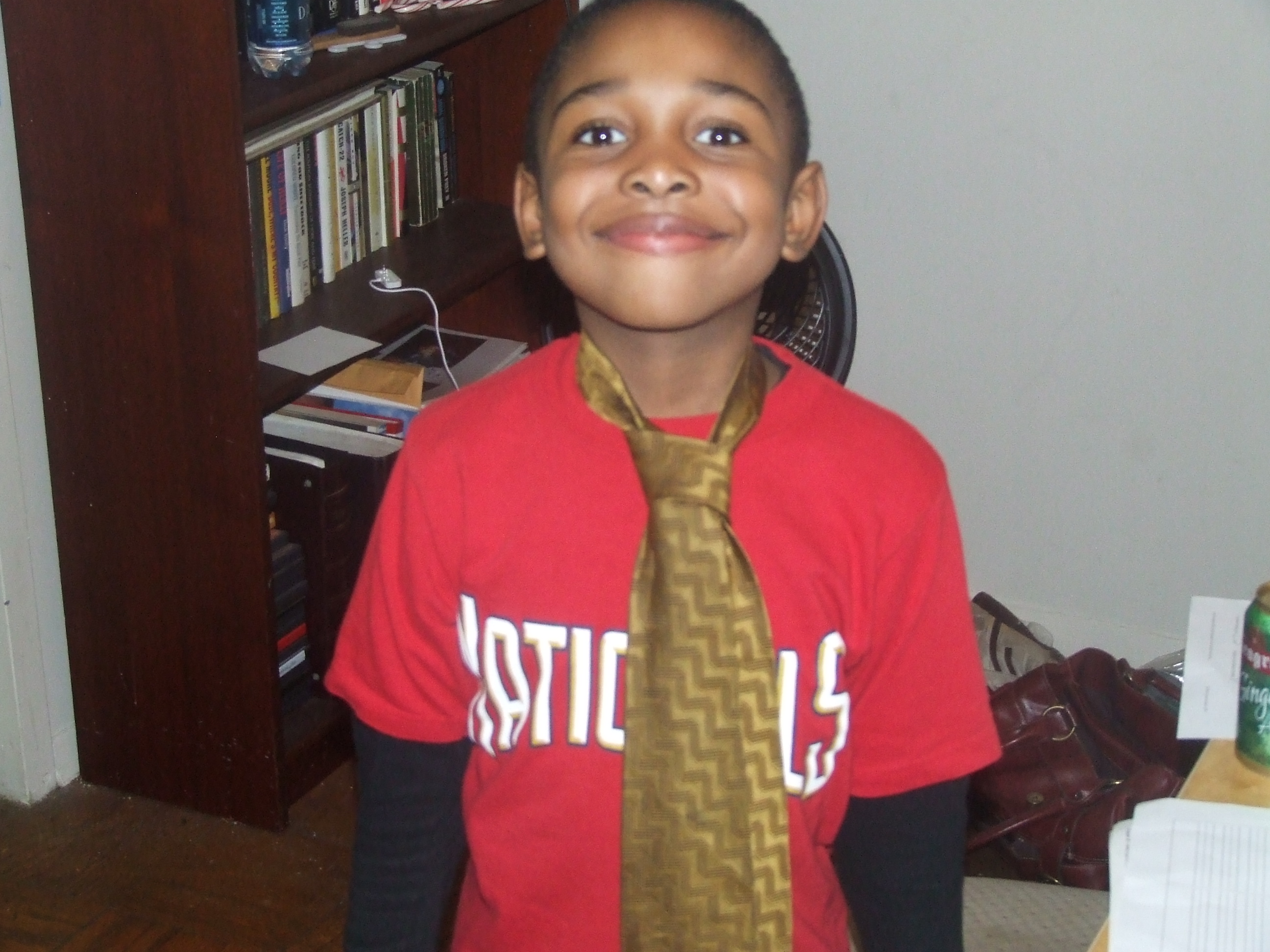
Noah With One Of My Ties

I’ve often wondered whether it’s enough for me to take the 180-degree approach to discipline regarding Noah. That is, to mete out discipline — almost exclusively non-corporal in nature — tinged with grace and mercy, or to just take the path of my screaming with belt-in-hand mother and stepfather. I look at myself when I take Noah’s toys away, or deny him dessert or TV time, or send him to bed early. Those things actually hurt me when I do them, probably more than they do him. I feel for him, right in the pit of my stomach. That’s how I know that I’m nothing like the so-called father I had to live with at 616 for so many years.
Patriot Days

03 Saturday Jul 2010

Posted by decollins1969 in 1, Boy @ The Window, culture, Patriotism, Politics, race, Religion, Sports

≈ 1 Comment

Tags

Charlie Brown, foreign policy, Independence Day, July 4th, Military, Patriotism, Peanuts, Pledge of Allegiance, Social Justice


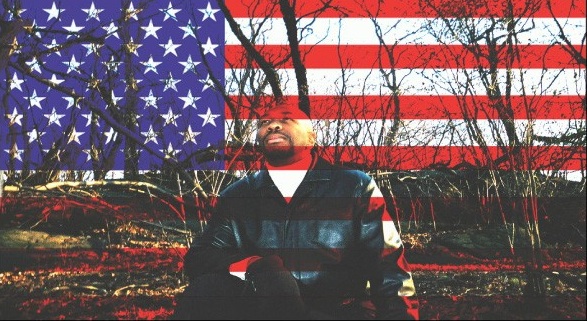
Source: Donald Earl Collins, Fear of a "Black" America Cover

Few things are more annoying or more confusing than my understanding of patriotism and how others — mostly White — perceive my patriotism and the patriotism of people of color more broadly. It’s something that I’ve struggled to grasp for more than thirty years. For those of you whose patriotism is akin to breathing, that’s your prerogative. I’ve found that something like one’s love for their country, like one’s belief in God (or not), shouldn’t be one that comes without thought or without any doubts at all. For without giving it any serious or critical thought or without any questioning or lingering doubts, most American patriotism is like being a Yankees or a Lakers fan. Patriotism in that sense is simply rooting for a team that can do no wrong, one that is expected to win in any contest simply because that’s all they’ve ever done.

My sense of patriotism began in ’79, when I started to devour history books and volumes of World Book Encyclopedia. I wasn’t completely naive, because I had also read Lerone Bennett’s/Ebony’s three-volume Black America set while learning about World War II. But I did believe that America ultimately stood for goodness and prosperity, for freedom and democracy all over the world. I fervently saluted the flag at pledge of allegiance time in school in fourth, fifth, sixth and seventh grade.

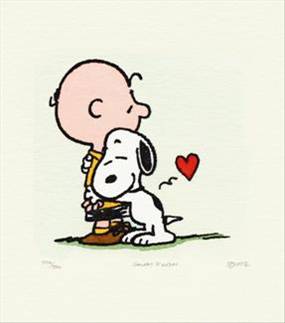
Snoopy & Charlie Brown. Source: Charles Schulz, Peanuts

At one point between fourth and sixth grade, I even created a pretend nation-state in our bedroom at 616, where I played out domestic and foreign policy issues through make-believe characters, from, of all things, the Peanuts comic strip. I saw the Cold War with the Soviet Union as one we absolutely had to win in order to keep the totalitarian communists at bay. Several of my Humanities classmates can attest to my defense of American foreign policy as late as ninth grade.

But even as I generally saw the US as the country the Scholastic Weekly Reader described it to be, I had my doubts as to America the always right and beautiful. It started at the end of fifth grade, when I hit the chapter in our social studies book about how we ended World War II with Hiroshima and Nagasaki. I hadn’t seen the mushroom cloud or the fire-bleached skulls before then. It scared me, but more importantly, it made me think about how cruel it was to wipe out a city the size of Mount Vernon but with three times as many people in the same space.

Then, with the Reagan Years and the almost complete refusal to acknowledge racism and poverty in the ’80s got me to the point where I refused to recite the pledge by my junior year of high school. One of the reasons I never saw the military as an option for escaping the abuse and poverty I’d grown up with was because I saw American foreign policy as one that was at least as imperialistic as that of the Soviets. Iran-Contra, Vietnam, El Salvador and Grenada were examples of us over-stepping our role as the leader of the free world.

It got worse for me before it got better. The Gulf War (’90-’91) and my growing knowledge of American history and atrocities at home and abroad made me feel as if this country was never meant for me, never meant to be mine.

Luckily I had other people from which to draw inspiration about how to approach a nation that generally takes people like me for granted, as if my life and death doesn’t matter at all. People as varied as Derrick Bell, Martin Luther King, Jr., Malcolm X, W.E.B. Du Bois, Anna Julia Cooper, Zora Neale Hurston, and Ralph Ellison — not to mention my Army ROTC friends who served — served to inspire another sense of patriotism.

Their writings and speeches, their acts on behalf of civil rights, human rights and social justice did teach me two things. One, that even folks who serve in the military deserve credit for understanding that their projection of American power means little without clear objectives and a clear sense that this use of power is necessary, justifiable and can actually matter to and gain the support of the rest of the world. Two, that holding my country’s feet to the fire around racism, poverty, imperialism and other forms of injustice is a form of patriotism. Without the socially conscious, this country’s ideals, its flag and other symbols of power, are meaningless beyond the imperial. So, for better and for worse, happy birthday America.

Great Northern Beans and Rice

25 Friday Jun 2010

Posted by decollins1969 in 1, Boy @ The Window, Eclectic

≈ Leave a comment

Tags

616, Abuse, Domestic Violence, Food, Great Northern Beans, Healthy Food, Irony, Mount Vernon New York, Poverty, Rice, Vegans


Great Northern Beans (they never looked this good growing up)

I wrote this six years ago, but I realized this week that the thirtieth anniversary of my last bout of physical abuse at the hands of my now deceased stepfather was upcoming (which I didn’t include in Boy @ The Window). Wow! There are moments that I can’t believe I survived all that.

====================================================

It’s been twenty-eight years since I unwittingly carried a $10 bill halfway hanging out of my right hand for a hoodlum named “Pookie” to steal at Wilson Woods Pool in Mount Vernon, leading to so many evil things occurring in my life. But I’ve talked about this already. I’ve talked about my idiot ex-stepfather Maurice Washington and his equally idiotic attempt at making me a man in his own decrepit image. I’ve even talked about the domestic violence that I was exposed to first and second-hand by him. What I talk about now is a variation on a theme, and a story that won’t be in Boy @ The Window — it would disrupt the flow of the period of time in question.

It all started with the usual at 616. It was the end of January ’86, and we were short on money. It was the middle of the week, so it wasn’t as if I could track down my father Jimme for a couple of extra bucks. So my mother, out of a rare sense of desperation — since there wasn’t any food to eat at 616 — turned to my then stepfather for help. As par for the course since ’83, his response was to call me over. “Boy, go get some Great Northern Beans and rice,” he said. It was the eighth occasion in five years that he had paid for a meal for the family — which only happened to include four of his kids, and he chose the cheapest thing he could think of.

“That’s it? That’s all we get?,” I said in response to his wonderful act of generosity. “Boy, I feed my family,” the lipid-laden idiot said. Being an idiot myself for a moment, I said back, “All you’ve ever done is just buy a couple of meals!,” as I turned around to go to the store.

Maurice jumped me from behind, knocking me head-first into the kitchen wall, and just kept punching me. He got me twice in the mouth. I obliged by covering up and then biting down on his knuckles on the second mouth punch, which caused some cuts and bleeding. My mother walked in and got between us. For once, the dumb ass had nothing else to say. He was angry and breathing hard, as if he’d been in a three-rounder with Mike Tyson. I was stunned, but I stood my ground, with my fists balled up. After scowling at the fool for a few seconds, I left for the store.

The damage that this last incident of physical abuse caused is with me to

My front teeth, including slightly darker lower tooth (right/my left), two root canals later, May 14, 2012, (Donald Earl Collins).

My front teeth, including slightly darker lower tooth (right/my left), two root canals later, May 14, 2012, (Donald Earl Collins).

this day. My stepfather chipped my upper front tooth on my right in two places, and caused enough damage to one of my lower front teeth that I would eventually need a root canal done on it seven years later. So yeah,  I should’ve kept my mouth shut — literally — when it came to issues with my abuser.

On the other hand, given our unhealthy obesity times today, Great Northern beans and rice isn’t such a bad meal, right? For vegans, I’d imagine that this is a very good meal. But not when the person you despised most in your world when you were a teenager’s buying it, and buying it in a begrudging and miserly way.  Of course, now beans and rice are actually expensive and considered healthy food by the arugula-eating sector of our society. Go figure!

=====================================================

The kicker, though, came the Monday after this last incident. I’d completely forget that I was supposed to do an oral presentation in my 11th grade English class, first period. Completely. And this, I did write about in Boy @ The Window:

For Mrs. Warns’ class, we had a presentation assignment that I didn’t even remember existed. The first day of presentations came, and she designated me as the first presenter. I was caught completely off-guard. I didn’t have time to whip up something, so I did the only thing I could think of. I balled up a piece of paper like I normally did a few times a day, stood up and walked to the front of the classroom. I took a shot at the garbage can and missed like I usually did, this time deliberately, and proceeded to ramble for a couple of minutes about how to recover from mistakes when you make them or something. Mrs. Warns was so cross with me. “I’m very disappointed in you. You obviously didn’t prepare at all for your assignment,” she said in her Brooklyn accent. She gave me a D for my presentation, adding “and you should feel lucky to get that.

I found out later that our eventual salutatorian had gotten an extension for his presentation. I was more mad with myself than anything else, knowing unfair things had always been in my life to that point. Today, I could take the garbage can and put it upside my teacher’s head, take the balled-up paper and throw it at my former classmate, and find my ex-stepfather’s grave and piss on it. Of course, I’d have to have some Great Northern beans and rice first, so that I could give the obese idiot a good fart as well.

The Silent Treatment

21 Monday Jun 2010

Posted by decollins1969 in 1, Boy @ The Window, culture, Mount Vernon High School, Pop Culture, race, Youth

≈ Leave a comment

Tags

616, Class of 1987, Coolness, Culture, Mount Vernon High School, Mount Vernon New York, Pop Culture, Race, Silent Treatment, The Roots, Westchester County Department of Community Mental Health


Source: Screen Shot from The Roots, “Silent Treatment” Music Video, Geffen, 1995

Right after the MVHS graduation ceremony at Memorial Field in June ’87, it started. I’d walk down the street to the store, and bump into one of my suddenly former classmates, say “Hi,” and get no response at all. The few times I bumped into a certain Ms. Red Bone, she’d stare straight at me, then straight through me, all as I said “Hi.” She just kept on walking, as if I had phased out of our space-time continuum into a parallel universe. By the beginning of August, I honestly thought that these people, my classmates for so long, were showing their true colors. They just didn’t like me, not me because I’d been a Hebrew-Israelite or me because I was poor or me because I listened to Mr. Mister. It was all about me, something within me that they detested.

“You can’t pay any attention to that. They’re all just jealous,” my new friend E (see “The Power of E” posting from August ’08) said when I told her about the ghost treatment over lunch one day. She and I worked for General Foods in Tarrytown that summer.

“Of what? Of me?,” I asked in disbelief.

“It’s because you’re not trying to be anybody except yourself,” she said.

“That’s a good theory,” I thought, but I didn’t really believe it. E was fully in my corner, and much more obvious about it than anyone else.

This pattern of treatment had only occurred two other times. Once was in sixth grade, after I came to Holmes with my kufi for the first time. My best friend Starling stopped talking to me, and refused to even acknowledge my presence for nearly two weeks before our second and last fight. The other was earlier in my senior year, in the weeks after the final class rankings were posted. Some in the Class of ’87 were upset with me because I was ranked fourteenth in our class. Three of them responded by not talking to me at all. They’d walk by me in the hallways, looked at and through me, and kept going without so much as a nod. That went on from mid-December through the beginning of March.

The Black “Party All The Time” folks in my class, the popular and dapper folks, snickered whenever they saw me. So I guess that they decided that to acknowledge me after graduation would me contaminating themselves with the knowledge that I was still alive, still figuring things out, still not cool enough to be bothered with.

Three years later, I bumped into one of these folks on my way home from my summer job with Westchester County Department of Community Mental Health in White Plains. I was walking home to 616 on East Lincoln, having just gotten off the 41 Beeline Express. It was after 6:30, and I was beat from another day of database work and my research preparations for my senior year at Pitt. Coming in the opposite direction toward North Columbus was a party-all-the-timer, a popular, slightly light-skinned dude named J. Since I assumed that he would walk by me as if I were thin air, I started to walk by him as if he weren’t there.

Surprisingly, J stopped me and said, “Hi, Donald.” He said that he needed to talk to me, to tell me that the path that I walked in high school, while weird, was a better path than the one that he was on. He told me about his mind-bending experiences at Howard, about his dropping out and need to take care of some serious emotional and mental health issues. After a year of work at Pitt and in Westchester County, I could tell, too.

At first, I was taken aback. I mean, this was a guy who laughed at me for nearly six years, who’d never lowered himself to so much as to give me a thumbs-up while in school. Now J was sharing the most intimate of details about his life with me? I asked him, “Why are you telling me this?” Among the other things he said, the thing that stuck with me was, “Because you’re true to yourself.” I gave him a handshake, and wished him well.

That was nearly twenty years ago. I guess that J and others were under a lot of pressure — peer pressure, girl pressure, family pressures — to be cool, to be successful, to be something other than themselves. None of this justified how they treated me back then. Nor does it justify how any of them may see me now. I’m just glad the only silent treatment I get now is from my wife when I’ve taken a joke too far. At least I know that she’ll talk to me again, eventually.

Graduation

19 Saturday Jun 2010

Posted by decollins1969 in 1, Boy @ The Window, Eclectic, Mount Vernon High School, Youth

≈ Leave a comment

Tags

Adulthood, Class of 1987, George Gibson, High School Graduation, Home, Mount Vernon High School, Mount Vernon New York, Pictures, Uncle Sam


Me and My Uncle Sam, June 18, 1987. Source: Donald Earl Collins

Twenty-three years on, as the British would say. To think that it’s been that long since the Class of ’87’s graduation from Mount Vernon High School. Wow. I’ve talked about various aspects of the last days of my time at MVHS, in Humanities and in Mount Vernon already. This one’s only about the actual ceremony.

My high school graduation ceremony at Memorial Field in South Side Mount Vernon went well enough, except it didn’t. It was a hot, hot mid-June day, about eighty-seven triple-H degrees. It was likely hotter for the guys, as many parents — my mother included — made us wear suits underneath our heat-absorbing burgundy polyester gowns. The girls, at least, wore yellow, the other school color for caps and gowns. It was a good day all right. Except that an eighty-eight year-old White guy stole the show. George Gibson graduated with our class, having fulfilled his requirements for a high school diploma some seven decades later than the kids from his generation. At least the few who made it to high school back then, as most kids in early twentieth-century never made it past middle school.

My father Jimme showed up to the ceremony drunk as a skunk. My mother and my Uncle Sam, whom I hadn’t seen in almost three years, had to keep him from insulting the other parents. In retrospect, in might’ve been good to take him Capozzola, Prattella and Estelle Abel’s way. Valedictorian and salutatorian got the opportunity to represent our class on stage, each giving overworked  and unimpressive speeches. That wasn’t bad, for they had stolen the show the week before at MVHS’ Honors Convocation. That was the good thing about the old White guy. Local TV news covered Gibson instead of the Class of ’87’s top two students, which I laughed about when I watched the 11 o’clock news later that evening.

The picture with me and my Uncle Sam was the first non-school related picture I had taken in something like eight or nine years. Who knew that it’d be the last picture taken of me in Mount Vernon for the next two decades? If I’d known that twenty-three years ago, I would’ve bought a camera that spring, at least before graduation.

After throwing our burgundy and yellow caps in the air, we went over to our now former classmates — who were now friends, lovers, acquaintances, and in some cases, foes — to say good-bye, to embrace and hug, to cry and scream and dance and twirl around in the air with. Afterward, I walked home, minus family and friends, trying to make sense of the moment. Not fully realizing that the moment we threw our caps in the air, Mount Vernon was no long my home, and I was no longer welcome.

Not Finding Work

14 Monday Jun 2010

Posted by decollins1969 in 1, Boy @ The Window, Eclectic

≈ 1 Comment

Tags

job search, Mount Vernon New York, New York City, Underemployment, unemployment, University of Pittsburgh


Source: Rob Rogers, Pittsburgh Post-Gazette, 2003

This is at least the fifth time in my adult life that I’ve struggled with having enough full-time work consistently, this time in concert with the Great Recession and a drying up of consultant work. Luckily I do teach and do have some consulting work. There have been other times over the years, though, where having any work at all was beyond my grasp.

The first time I went through this as an adult was the long, hazy-hot-and-humid summer of ’88. Long because the University of Pittsburgh’s school year ended the last week of April. I was home from April 30 to August 29, 120 days in all, marking the longest time I ever had off from school. I came back to New York, Mount Vernon and 616, and spent the first two weeks on domestic work. I waited two weeks because there was too much cleaning to do, too many clothes to wash, too many old responsibilities to pick up again.

It was already too late by the time I began to look. Summer jobs were sparse and I was now in competition with college students in the area. I could’ve had a two or three-week head start on things if I’d started looking right away. My mother didn’t let me here the end of it. “I told you to look, but you didn’t listen,” she said to me over and over again. “You could’ve had a good job, but you sat on your ass and did nothing” was another thing my mother said to me, as if I didn’t need a break before looking for work.

By the beginning of June, I was also in competition with high school students for jobs. The summer of ’88 just happened to be one of the worst summers on record for finding a job, at least if you were between sixteen and twenty-four. In some areas like New York, the summer unemployment rate for young adults went over seventy percent, and it was worse for Black males. So I wasn’t alone, at least according to Tom Brokaw and NBC Nightly News.

I certainly didn’t feel any better, though. I went to the New York State Employment Office on Gramatan, and they offered me jobs mowing grass and fixing air conditioners. The first one required a car and barely paid four an hour. The other paid $4.50 an hour but I needed to have experience fixing air conditioners. Oh well! I looked through the papers, and called for a law office job doing research. The job required a history background and offered a $10 an hour salary, but it required me to have my B.A. in hand. “Just because I don’t have degree yet doesn’t mean I can’t do the work,” I practically begged. The woman on the other end of the phone responded, “Trust me, I’m doing you a favor. You’ll thank me later.”

I was desperate for work by the second half of June, so desperate that I literally walked Manhattan for a job one day. I looked at a job ad in the Daily News, one that required applicants to go to an address on Broadway in Manhattan. The job allegedly paid $400 a week. I had just enough money left from my CIS job at Pitt to catch the Subway there and back. I walked from 616 to 241st, and took the 2 like I used to. Stupid me got off the train at 42nd Street and Times Square, having forgotten that New York’s numbered addresses didn’t take jumps from block to block. If a building’s address on one block was 1000 Broadway, the building’s address on the next block would likely be 996 Broadway. My address was around the 200 mark of Broadway. I proceeded to walk in my only good suit from Times Square to Broadway and from there in Midtown all the way to Chinatown, a walk of nearly three miles. It was pouring rain on that hot and humid day, somewhere in the upper eighties.

After almost an hour of walking, I found the place. It was a sweatshop, with lots of Chinese immigrant women sewing cloth for dear life. Apparently the job involved “supervising” these poor women. I had to turn around and walk until I found the nearest Subway stop, wind my way back to 241st, and then walk home from there. Five hours, five lost pounds and two ruined shoes later, I was beyond worn and forlorn. I gave up hope that day of finding any summer work.

My last real attempt at finding work that summer was to take the U.S. Postal Service’s postal carrier exam out at their sorting facilities in North White Plains. It was an embarrassing experience, taking a civil service exam with folks who obviously weren’t in school. I didn’t even know that there were study guides for these exams, for knowing the difference between McClellan and Mclellan, zip codes 10552 and 15250, and AK and AL as states. I spent two hours sweating in a warehouse-like room, breezing through questions and hoping that I would get a call. That was the twenty-fifth of July, the last Monday of the month.

About ten days later, a letter came from the Postal Service telling me that I passed the exam with an 86. Preference would be given to veterans and other applicants with special circumstances, then the highest scores after that would get a call, depending on job vacancies. I knew that it would be a long time before I heard from them again. I did, just before Christmas ’92, when I was in my second year of grad school.

While going back to school ended my unemployment cycle that time around, I don’t have that as an option now as a partially gainfully employed professor and consultant. But, between my skills, faith, hope and the fact that I still have quite a bit of work already, I have as much to look forward to now as I did twenty-two summers ago.

Doctoring History

25 Thursday Mar 2010

Posted by decollins1969 in 1, Boy @ The Window, Eclectic

≈ Leave a comment

Tags

A.B. Davis Middle School, American History, Class of 1987, Demontravel, Humanities, Teachers, Teaching and Learning


One of the worst teachers I ever had was my eighth grade history teacher. There were a few others in my Mount Vernon K-12 days — and certainly in my times at Pitt and Carnegie Mellon — who were worse. But the absolute worst history teacher or professor I ever had between ’74 and ’96 was in a classroom in the corner of the new wing at A.B. Davis Middle School from September ’82 through June ’83.

His name was Mr. Demontravel, our American history teacher. Or as he preferred in the last three months of eighth grade, Dr. Demontravel (he had finished his doctoral thesis on the Civil War, on what beyond that, I wasn’t sure, and, given the way he was to me and us, I didn’t care either). Or as I liked to call him throughout that year, “Demon Travel.” His was a class that sucked the life out of history for most of us. Like most teachers of K-12 social studies or history, it was a dates, names, and places class. Unlike most social studies teachers, his teaching methodology was the epitome of lazy. Every class, five days a week, Demontravel would put up five questions on the blackboard for us to copy down and answer using our textbook. At the end of every two-week period, we’d get a fifty-question multiple choice exam, helping Scan-Tron stay in business.

Demontravel rarely stood up to lecture or do anything else. Lectures for him might as well have been appearances by Halley’s Comet, only the lectures were far less memorable. This process went on unabated for forty-weeks, four marking periods, an entire school year. Calling this boring would only get you into the door of the intellectual famine Demontravel subjected us to in eighth grade.

He wasn’t particularly helpful on the rare occasions when someone did have a question. When a classmate did ask him something, the portly Demontravel would stand up from his desk, which was to our right as we faced the chalkboard, slowly walk toward it, point to a question on the board, tell us in his best Teddy Roosevelt voice what page to turn to in looking for the answer, and then, just as slowly, return to his seat at his desk. Of course, the page numbers he gave us were usually wrong. Demontravel was truly an unremarkable man, virtually bald in all of his pink salmon-headedness, skinny and potbellied beyond belief. His shiny bald head had a Gorbachev-like spot on it. In his early fifties, Demontravel was so boring that it was a wonder that I noticed him at all.

But there was the fact that there was a prize on the line for us nerdy middle-schoolers—the eighth-grade History Award. “Something I could actually win,” I thought. And Demontravel was the sole arbiter over the award. My favorite and easiest subject was in the hands of this hack of a teacher. That made me downright angry whenever I thought about it.

What made it worse was that I was in competition with a classmate who cared for history in the same way that a semi-suburban boy like me cared for milking cows. For most of the year, we were separated by less than a point in our overall grades as we fought for the award. I guess I should’ve known that I wasn’t going to get it, regardless of my grades in Demon Travel’s course. My competitor, female and White as she was, was doted on by Demontravel for most of the year. I guess my near-exact same grade just meant that I was slumming in the A+ zone.

Then there was Demontravel’s demand for a typewritten three- to five-page essay on a World War II topic of our choosing, at the beginning of April ’83. It wasn’t something I could just write at my leisure and in my own handwriting. My father Jimme had to go buy a typewriter for me, one of those where you have to punch the keys to leave lettered ink on a page. I didn’t know how to type, and I knew no one else at home did either. So I used the two-index finger method, gradually figuring out how to type in double-space, to add footnotes and references, to write without using a pen. I chose to look at the Battle of the Philippines and the almost comical errors of both the Japanese and the U.S. there in 1942 and again in 1944-45. Demontravel gave me a 95 or 96 on it, helping me pull away of my friendly competitor at the beginning of May.

This was when we had our little incident, me and “Demon Travel,” in which I showed up the newly-minted PhD in his classroom. Ours was a discussion of World War I, one of the few times he actually attempted to lecture. He somehow managed to get wrong a key treaty on the Eastern Front that declared Germany a victor, gave them parts of Belarus and the Ukraine, and took Russia out of the war. Demontravel managed to get the parties involved in the treaty incorrect as well. I raised my hand, and when called upon I politely pointed out his error. He immediately became angry and told me that he couldn’t be wrong. Since I also could never be wrong, especially about an historical fact, I quoted the book directly, pointed out the name and date of the treaty, the parties involved, and the significance of the treaty to boot.

At that point he told me that if I ever corrected him like that again I would go Assistant Principal Gentile’s office. Gentile, a hard ass, would’ve been better off as a correction’s officer in Shawshank Redemption or in the HBO series Oz than as an administrator at Davis. I still didn’t want to see him, so I got quiet, quiet but fuming. Demontravel looked like a redneck after a day of labor in the hot Mississippi sun. All he needed was a shotgun in one hand and a bottle of beer in the other. My classmates were cracking up, excited even because they saw me as having put Demontravel in his place. I kind of knew then that it wouldn’t matter if I did finish ahead of my competitor. I wasn’t going to get my much-deserved award.

The lesson that it would take me until my thirties to learn was that life and learning isn’t just about how much you know and how well you exhibit such knowledge and wisdom. It’s much more about politics and being able to read people and situations before speaking and acting in such situations. I knew, but pretty much didn’t care, that Demontravel didn’t like me. He probably knew, but didn’t need to care, that I thought that his class was a joke, a cheap version of the short-lived contest show on NBC, Sale of the Century. Bottom line — especially in having gone through the experience of earning my own doctorate in history — you don’t mess with a boring yet overworked teacher who just finished earning a Ph.D. Even if his reach has exceeded his grasp of it.

← Older posts
Newer posts →

Boy @ The Window: A Memoir

Boy @ The Window: A Memoir

Places to Buy/Download Boy @ The Window

There's a few ways in which you can read excerpts of, borrow and/or purchase and download Boy @ The Window. There's the trade paperback edition of Boy @ The Window, available for purchase via Amazon.com at http://www.amazon.com/Boy-Window-Donald-Earl-Collins/dp/0989256138/

There's also a Kindle edition on Amazon.com. The enhanced edition can be read only with Kindle Fire, an iPad or a full-color tablet. The links to the enhanced edition through Apple's iBookstore and the Barnes & Noble NOOK edition are below. The link to the Amazon Kindle version is also immediately below:

scr2555-proj697-a-kindle-logo-rgb-lg

Boy @ The Window on Amazon.com: http://www.amazon.com/Boy-The-Window-Memoir-ebook/dp/B00CD95FBU/

iBookstore-logo-300x100

Boy @ The Window on Apple's iBookstore: https://itunes.apple.com/us/book/boy-the-window/id643768275?ls=1

Barnes & Noble (bn.com) logo, June 26, 2013. (http://www.logotypes101.com).

Boy @ The Window on Barnes & Noble: http://www.barnesandnoble.com/w/boy-the-window-donald-earl-collins/1115182183?ean=2940016741567

You can also add, read and review Boy @ The Window on Goodreads.com. Just click on the button below:

Boy @ The Window

Twitter Updates

Tweets by decollins1969
  • RSS - Posts
  • RSS - Comments

Archives

  • June 2025
  • April 2023
  • September 2022
  • August 2022
  • July 2022
  • June 2022
  • May 2022
  • April 2022
  • March 2022
  • January 2022
  • December 2021
  • November 2021
  • October 2021
  • September 2021
  • August 2021
  • July 2021
  • June 2021
  • April 2021
  • March 2021
  • February 2021
  • January 2021
  • December 2020
  • November 2020
  • October 2020
  • September 2020
  • August 2020
  • July 2020
  • May 2020
  • April 2020
  • March 2020
  • January 2020
  • December 2019
  • November 2019
  • August 2019
  • July 2019
  • June 2019
  • May 2019
  • April 2019
  • March 2019
  • February 2019
  • January 2019
  • December 2018
  • November 2018
  • October 2018
  • September 2018
  • August 2018
  • July 2018
  • June 2018
  • May 2018
  • March 2018
  • February 2018
  • January 2018
  • December 2017
  • November 2017
  • October 2017
  • September 2017
  • August 2017
  • July 2017
  • June 2017
  • May 2017
  • April 2017
  • March 2017
  • February 2017
  • January 2017
  • December 2016
  • November 2016
  • October 2016
  • September 2016
  • August 2016
  • July 2016
  • June 2016
  • May 2016
  • April 2016
  • March 2016
  • February 2016
  • January 2016
  • December 2015
  • November 2015
  • October 2015
  • September 2015
  • August 2015
  • July 2015
  • June 2015
  • May 2015
  • April 2015
  • March 2015
  • February 2015
  • January 2015
  • December 2014
  • November 2014
  • October 2014
  • September 2014
  • August 2014
  • July 2014
  • June 2014
  • May 2014
  • April 2014
  • March 2014
  • February 2014
  • January 2014
  • December 2013
  • November 2013
  • October 2013
  • September 2013
  • August 2013
  • July 2013
  • June 2013
  • May 2013
  • April 2013
  • March 2013
  • February 2013
  • January 2013
  • December 2012
  • November 2012
  • October 2012
  • September 2012
  • August 2012
  • July 2012
  • June 2012
  • May 2012
  • April 2012
  • March 2012
  • February 2012
  • January 2012
  • December 2011
  • November 2011
  • October 2011
  • September 2011
  • August 2011
  • July 2011
  • June 2011
  • May 2011
  • April 2011
  • March 2011
  • February 2011
  • January 2011
  • December 2010
  • November 2010
  • October 2010
  • September 2010
  • August 2010
  • July 2010
  • June 2010
  • May 2010
  • April 2010
  • March 2010
  • February 2010
  • January 2010
  • December 2009
  • November 2009
  • October 2009
  • September 2009
  • August 2009
  • July 2009
  • June 2009
  • May 2009
  • April 2009
  • March 2009
  • February 2009
  • January 2009
  • December 2008
  • November 2008
  • October 2008
  • September 2008
  • August 2008
  • July 2008
  • June 2008
  • May 2008
  • April 2008
  • March 2008
  • February 2008
  • January 2008
  • December 2007
  • November 2007
  • October 2007
  • September 2007
  • August 2007
  • July 2007
  • June 2007

Recent Comments

MaryPena's avatarMaryPena on My Day of Atonement/Bitter Hat…
decollins1969's avatardecollins1969 on No Good Teaching Deed Goes…
Mary Rose O’Connell's avatarMary Rose O’Connell on No Good Teaching Deed Goes…

NetworkedBlogs on Facebook

NetworkedBlogs
Blog:
Notes From a Boy @ The Window
Topics:
My Life, Culture & Education, Politics & Goofyness
 
Follow my blog

616 616 East Lincoln Avenue A.B. Davis Middle School Abuse Academia Academy for Educational Development AED Afrocentricity American Narcissism Authenticity Bigotry Blackness Boy @ The Window Carnegie Mellon University Child Abuse Class of 1987 CMU Coping Strategies Crush #1 Crush #2 Death Disillusionment Diversity Domestic Violence Economic Inequality Education Family Friendship Friendships Graduate School Hebrew-Israelites High-Stakes Testing Higher Education History Homelessness Humanities Humanities Program Hypocrisy Internalized Racism Jealousy Joe Trotter Joe William Trotter Jr. K-12 Education Love Manhood Maurice Eugene Washington Maurice Washington Misogyny Mother-Son Relationship Mount Vernon High School Mount Vernon New York Mount Vernon public schools Multiculturalism MVHS Narcissism NFL Pitt Pittsburgh Politics of Education Poverty President Barack Obama Race Racial Stereotypes Racism Relationships Self-Awareness Self-Discovery Self-Reflection Sexism Social Justice Teaching and Learning University of Pittsburgh Violence Whiteness Writing

Top Rated

Blog at WordPress.com.

  • Subscribe Subscribed
    • Notes from a Boy @ The Window
    • Join 103 other subscribers
    • Already have a WordPress.com account? Log in now.
    • Notes from a Boy @ The Window
    • Subscribe Subscribed
    • Sign up
    • Log in
    • Report this content
    • View site in Reader
    • Manage subscriptions
    • Collapse this bar

Loading Comments...