
• About Me
  • Other Writings
  • Interview Clips
  • All About Me: American Racism, American Narcissism, and the Conversation America Can’t Have
  • Video Clips
  • Boy @ The Window Pictures
  • Boy @ The Window Theme Music

Notes from a Boy @ The Window

~

Notes from a Boy @ The Window

Tag Archives: UMUC

The Emotional, The Personal and Black History

01 Friday Feb 2013

Posted by decollins1969 in 1, Academia, Boy @ The Window, culture, Eclectic, Movies, Patriotism, Politics, Pop Culture, race, Youth

≈ 3 Comments

Tags

A Lynching in Marion, African American History, Anger, Black History, Black History Month, Carnegie Mellon University, Comparative Slavery, Emotions, Fear, Fogel and Engerman, Grief, Indiana (1995), Irony, Jim Crow, Larry Glasco, Laurence Glasco, Learning, Lynching, Pitt, Racism, Rage, Roots (1977), Sarcasm, Seymore Drescher, Slavery, Students, Sy Drescher, Teaching and Learning, Time on the Cross (1974), UMUC, University of Pittsburgh


Black History Month 2013 electronic poster, February 1, 2013. (http://dclibrary.org).

Black History Month 2013 electronic poster, February 1, 2013. (http://dclibrary.org).

After all of these years — and thirty-seven years’ worth of Black History Months — I sometimes forget how emotionally charged Black history can be. After all, I’m an academically trained historian, one whose emotional range varies from sarcastic to ironic with most things US, World and African American history. But ever so often, I’m reminded by my students about the sadness and pain involved in learning history. I surprise myself sometimes at how passionate or angry I can become in revisiting a piece of history that I otherwise would show no emotion for on most days.

Black history, though, can bring out both the water works and the daggered eyes. My African American history students at Carnegie Mellon University surprised me one day in October ’96 during a discussion I tried to have about lynching and the KKK. It was based on the Indiana PBS documentary, A Lynching in Marion, Indiana, about the lynching of two Black men and the almost lynching of a young Black male for allegedly killing and robbing a White male and raping a young White female in 1930.

The forty-five minute documentary showed clips of defaced and emasculated Black men hung from trees, beaten beyond recognition and even burned postmortem. It also showed films of KKK rallies in the 1920s and early 1930s Indianapolis and other towns in the state, as well as pictures from the Marion lynching itself. The young Black man in Marion, one James Cameron, was only saved from lynching because a member of White mob actually protected him. It turned out, per usual, that the alleged murder and rape was a false accusation, but Cameron still had to spend four years in jail for a crime he didn’t commit.

Thomas Shipp and Abram Smith, lynched in Marion, IN, August 7, 1930. (Lawrence H. Beitler). Qualifies as fair use under US Copyright laws, as It is the only image known to depict this hanging, and is used here to illustrate the event.

Thomas Shipp and Abram Smith, lynched in Marion, IN, August 7, 1930. (Lawrence H. Beitler via Wikipedia). Qualifies as fair use under US Copyright laws, as It is the only image known to depict this hanging, and is used here to illustrate the event.

My students could barely speak to me or each other after the film, much less be part of a dispassionate discussion of the film. My Black students were tearful and angry, and my White students were pale and scared. I let them express their emotions for about ten minutes, but waited until the next class to draw out a more comprehensive discussion. As this was the first standalone class I’d taught as an adjunct professor, I was a bit unprepared for the how emotional my students became, how personally they took the film and its content.

But I should’ve been better prepared, especially given my own emotions about Black and other histories over the years. I remember the first time I watched Roots, along with millions of other Americans, in February ’77. I cried or was stunned that whole week. Twelve years later, in my undergraduate readings seminar for History majors at Pitt, I found myself angry with my classmates. My eventual first graduate advisor Larry Glasco was leading a discussion on slavery and the Middle Passage. I didn’t know why, but I was angry that whole class. It wasn’t just a knee-jerk anger. It was a low-heat rage, beyond anything my idiotic classmates were saying about slavery in the eventual US not being as brutal as slavery in the Caribbean or Brazil.

The following semester, I took my first graduate course as a Pitt junior, Comparative Slavery with Sy Drescher. We got into a discussion of Fogel and Engerman’s Time on the Cross (1974), a study in which the authors tried to show scientifically that slavery wasn’t as bad for Africans in the US as it was for Africans in the Caribbean and Brazil. Using records from one plantation, Fogel and Engerman tried to show that since few slaves were whipped, that therefore slavery wasn’t brutal for my African ancestors. I was pissed when some of the grad students in my class defended Time on the Cross  idea that 1,800 calories a day was sufficient for the average slave. It pissed me off so much that I had to leave the seminar room for five minutes to make sure I didn’t punch someone.

Me really pissed, at CMU PhD graduation, Pittsburgh, PA, May 18, 1997. (Angelia N. Levy).

Me really pissed, at CMU PhD graduation, Pittsburgh, PA, May 18, 1997. (Angelia N. Levy).

I see some of this in my UMUC students sometimes. Students who turn every issue in US history into a referendum on race. “Immigrants exploited? Well, not compared to African Americans as sharecroppers!” Or “Jim Crow was really a second slavery,” some of my students have said emphatically, as if Blacks did nothing during Reconstruction or Jim Crow to make their lives better. They feel, and rightfully so for the most part, that Blacks have gotten a raw deal throughout American history, and that it is my job to expose the hypocrisy of racism in every lecture and discussion.

It’s emotional and it’s personal. But it’s also historical, which means not so much putting emotions or personal investment aside as much as it does putting these emotions and personal investments in perspective. I’ve never been dispassionate about history – I’ve just learned how to use my New York-style sarcasm to hide my passion pretty well.

Grading and the 21st Century Professor

03 Monday Sep 2012

Posted by decollins1969 in 1, Academia, culture, Eclectic, Politics, race, Work

≈ 3 Comments

Tags

Academic Integrity, Adult Learners, Duquesne University College of Education, Ethical Dilemma, Excuses, Grade Inflation, Grading, Higher Education, Job Security, Plagiarism, Student Entitlement, Students, Teaching, UMUC, University of Pittsburgh


Between a rock and a hard place, The Simpsons (movie), September 2, 2012. (http://clubsnap.com). Qualifies as fair use under US copyright laws –  low resolution.

The Chronicle of Higher Education and other prominent periodicals have been talking about the precarious rise of grade inflation for more than two decades now. Article after article and story after story has shown professors at elite and public institutions lowering their standards and bending into advanced yoga positions to give students higher grades than they’ve earned. All to ensure a minimum of contention over grades and maximum scores in student evaluations of their courses.

But what of the many professors who don’t want to lower their standards but so far, who can’t ignore a student’s lack of attendance or participation, their late assignments or attempts at plagiarism? For those college instructors, they can expect more grief and stupid ass excuses from students, not to mention lower evaluation scores.

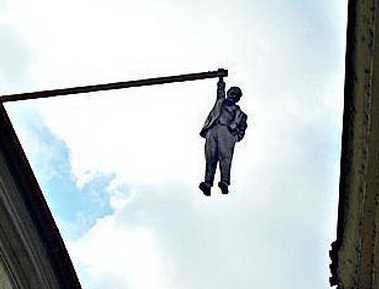
Sigmund Freud hanging by one hand by David Cerney (1997), Prague, September 2, 2012. (http://swick.co.uk/). Qualifies as fair use – pic has low resolution.

For tenured professors, particularly those at research universities, this doesn’t matter at all. For some tenure-track professors, instructors at teaching-focused liberal arts colleges, and the army of adjuncts that are the majority of instructors at the college level, this could mean the difference between steady employment and homelessness. It’s a sad situation when folks aren’t secure enough in their jobs to actually do the most difficult parts of their jobs, to evaluate a student’s performance accurately and to confront students whenever they violate an academic code of conduct.

It was part of the deal that I made with myself when I began teaching my own sections and then course as a graduate student twenty years ago at the University of Pittsburgh. To be fair and flexible, to be tough when necessary, but to be compassionate when the circumstances called for it. For the vast majority of the 2,000 or so high school, undergraduate and graduate students I’ve taught since ’92, that has been a workable philosophy. It’s even gotten me the occasional praise and recognition for being a very good professor.

Of course, I faced the occasional student who complained to me about their grade. Most of those students were C students looking for a C+ or a B, or a B+/A- student hoping for an A. Really, prior to my current faculty position, I had only had three complaints of any major consequence. One was from a student who managed to never show up for my US History to 1877 sections the spring semester of ’93, who failed the final exam so badly that I let him get away with his attempts at cheating — his cheat notes were that bad!

The other two came from two students in my History of American Education graduate course in the summer of ’98 at Duquesne University. One thought that someone as young (and as Black) as me could give her a grade lower than an A, while another harassed me with emails for a month because her A- in my course ruined her 4.0 average. Though an adjunct, I stood my ground, knowing that I had the support of my department chair.

Since starting my current teaching position in January ’08, I’ve faced a couple of dozen situations in which students have complained about their grades. I think I’ve only taught three courses out of about twenty in the past four years in which I haven’t fielded any complaints from students about their grades.

Most of these complaints have been really ones about me not accepting every cockamamie excuse for a late assignment or plagiarism. Excuses like their Internet or their access to the university’s online classroom platform being down. Or not knowing that cutting and pasting ten pages’ worth of other people’s words for a ten-page history research paper was in fact blatant plagiarism. Or that their jobs, last-minute deployments (which were hardly last-minute), children (who in many cases were teenagers), three car accidents in two weeks or other life challenges managed to get in the way of them submitting multiple assignments on time, even with extensions. But somehow, when I’ve held these students accountable and assigned an appropriate grade, I’m the bad guy.

That the students I teach these days are technically adult learners (I say “technically” because they don’t act like adults when they complain about their grading) actually makes this matter worse. Whether in the military, married with children, or working a full-time job, these students in their twenties, thirties and older tend to complain, beg, threaten me and then beg again. It’s exhausting to constantly have to persuade students to read my syllabus in order to make them understand that the rules and rubrics I’ve laid out are the reasons for their F, D, C or B.

But no matter the vitriol I provoke from assigning a grade, I also have to be careful in my language, emotions and tone. That is the reality that is teaching in many higher education institutions today. It is unfortunate, for there are many students who don’t understand that being a student requires being a responsible and ethical adult. Whether seventeen or seventy, whining, complaining and threatening your professor for a higher grade is completely unacceptable, and deserves at least a little sarcasm in response.

Newer posts →

Boy @ The Window: A Memoir

Boy @ The Window: A Memoir

Places to Buy/Download Boy @ The Window

There's a few ways in which you can read excerpts of, borrow and/or purchase and download Boy @ The Window. There's the trade paperback edition of Boy @ The Window, available for purchase via Amazon.com at http://www.amazon.com/Boy-Window-Donald-Earl-Collins/dp/0989256138/

There's also a Kindle edition on Amazon.com. The enhanced edition can be read only with Kindle Fire, an iPad or a full-color tablet. The links to the enhanced edition through Apple's iBookstore and the Barnes & Noble NOOK edition are below. The link to the Amazon Kindle version is also immediately below:

scr2555-proj697-a-kindle-logo-rgb-lg

Boy @ The Window on Amazon.com: http://www.amazon.com/Boy-The-Window-Memoir-ebook/dp/B00CD95FBU/

iBookstore-logo-300x100

Boy @ The Window on Apple's iBookstore: https://itunes.apple.com/us/book/boy-the-window/id643768275?ls=1

Barnes & Noble (bn.com) logo, June 26, 2013. (http://www.logotypes101.com).

Boy @ The Window on Barnes & Noble: http://www.barnesandnoble.com/w/boy-the-window-donald-earl-collins/1115182183?ean=2940016741567

You can also add, read and review Boy @ The Window on Goodreads.com. Just click on the button below:

Boy @ The Window

Twitter Updates

Tweets by decollins1969
  • RSS - Posts
  • RSS - Comments

Archives

  • June 2025
  • April 2023
  • September 2022
  • August 2022
  • July 2022
  • June 2022
  • May 2022
  • April 2022
  • March 2022
  • January 2022
  • December 2021
  • November 2021
  • October 2021
  • September 2021
  • August 2021
  • July 2021
  • June 2021
  • April 2021
  • March 2021
  • February 2021
  • January 2021
  • December 2020
  • November 2020
  • October 2020
  • September 2020
  • August 2020
  • July 2020
  • May 2020
  • April 2020
  • March 2020
  • January 2020
  • December 2019
  • November 2019
  • August 2019
  • July 2019
  • June 2019
  • May 2019
  • April 2019
  • March 2019
  • February 2019
  • January 2019
  • December 2018
  • November 2018
  • October 2018
  • September 2018
  • August 2018
  • July 2018
  • June 2018
  • May 2018
  • March 2018
  • February 2018
  • January 2018
  • December 2017
  • November 2017
  • October 2017
  • September 2017
  • August 2017
  • July 2017
  • June 2017
  • May 2017
  • April 2017
  • March 2017
  • February 2017
  • January 2017
  • December 2016
  • November 2016
  • October 2016
  • September 2016
  • August 2016
  • July 2016
  • June 2016
  • May 2016
  • April 2016
  • March 2016
  • February 2016
  • January 2016
  • December 2015
  • November 2015
  • October 2015
  • September 2015
  • August 2015
  • July 2015
  • June 2015
  • May 2015
  • April 2015
  • March 2015
  • February 2015
  • January 2015
  • December 2014
  • November 2014
  • October 2014
  • September 2014
  • August 2014
  • July 2014
  • June 2014
  • May 2014
  • April 2014
  • March 2014
  • February 2014
  • January 2014
  • December 2013
  • November 2013
  • October 2013
  • September 2013
  • August 2013
  • July 2013
  • June 2013
  • May 2013
  • April 2013
  • March 2013
  • February 2013
  • January 2013
  • December 2012
  • November 2012
  • October 2012
  • September 2012
  • August 2012
  • July 2012
  • June 2012
  • May 2012
  • April 2012
  • March 2012
  • February 2012
  • January 2012
  • December 2011
  • November 2011
  • October 2011
  • September 2011
  • August 2011
  • July 2011
  • June 2011
  • May 2011
  • April 2011
  • March 2011
  • February 2011
  • January 2011
  • December 2010
  • November 2010
  • October 2010
  • September 2010
  • August 2010
  • July 2010
  • June 2010
  • May 2010
  • April 2010
  • March 2010
  • February 2010
  • January 2010
  • December 2009
  • November 2009
  • October 2009
  • September 2009
  • August 2009
  • July 2009
  • June 2009
  • May 2009
  • April 2009
  • March 2009
  • February 2009
  • January 2009
  • December 2008
  • November 2008
  • October 2008
  • September 2008
  • August 2008
  • July 2008
  • June 2008
  • May 2008
  • April 2008
  • March 2008
  • February 2008
  • January 2008
  • December 2007
  • November 2007
  • October 2007
  • September 2007
  • August 2007
  • July 2007
  • June 2007

Recent Comments

decollins1969's avatardecollins1969 on No Good Teaching Deed Goes…
Mary Rose O’Connell's avatarMary Rose O’Connell on No Good Teaching Deed Goes…
Lyndah McCaskill's avatarLyndah McCaskill on The Raunchiest of Them Al…

NetworkedBlogs on Facebook

NetworkedBlogs
Blog:
Notes From a Boy @ The Window
Topics:
My Life, Culture & Education, Politics & Goofyness
 
Follow my blog

616 616 East Lincoln Avenue A.B. Davis Middle School Abuse Academia Academy for Educational Development AED Afrocentricity American Narcissism Authenticity Bigotry Blackness Boy @ The Window Carnegie Mellon University Child Abuse Class of 1987 CMU Coping Strategies Crush #1 Crush #2 Death Disillusionment Diversity Domestic Violence Economic Inequality Education Family Friendship Friendships Graduate School Hebrew-Israelites High-Stakes Testing Higher Education History Homelessness Humanities Humanities Program Hypocrisy Internalized Racism Jealousy Joe Trotter Joe William Trotter Jr. K-12 Education Love Manhood Maurice Eugene Washington Maurice Washington Misogyny Mother-Son Relationship Mount Vernon High School Mount Vernon New York Mount Vernon public schools Multiculturalism MVHS Narcissism NFL Pitt Pittsburgh Politics of Education Poverty President Barack Obama Race Racial Stereotypes Racism Relationships Self-Awareness Self-Discovery Self-Reflection Sexism Social Justice Teaching and Learning University of Pittsburgh Violence Whiteness Writing

Top Rated

Blog at WordPress.com.

  • Subscribe Subscribed
    • Notes from a Boy @ The Window
    • Join 103 other subscribers
    • Already have a WordPress.com account? Log in now.
    • Notes from a Boy @ The Window
    • Subscribe Subscribed
    • Sign up
    • Log in
    • Report this content
    • View site in Reader
    • Manage subscriptions
    • Collapse this bar
 

Loading Comments...