My Apologies, “M”

Tags

, , , , , , ,


M Line, Q-Brooklyn, Nassau Line

I have a confession to make (as if I haven’t confessed enough the past four years, right?). I owe a few of my former Humanities classmates apologies, though not the kind of apology some of you may expect. For these apologies have nothing to do with what I’ve written on this blog since June ’07. Nor are they about anything I’ve written (or rewritten) to date in the Boy @ The Window manuscript. These apologies are more about my trust and truthfulness, or lack thereof, to specific people at specific moments of time, during my six years of semi-solitude, somewhat self-imposed, I might add.

This particular apology is to a classmate who sat in front of me for most of my classes between 7S and AP US History with Meltzer. For the purposes of this post, let’s call her “M” (I know that some of you will likely figure out who “M” is, but play along anyway, please). M was one of the most curious people I went to school with during those years, which by definition, also made her extremely intelligent. She was part of the Italian crew that seemed to overwhelm me in 7S especially, yet not part of it at the same time.

But I didn’t even know that about M on my first day of seventh grade in ’81. I showed up, white kufi and all, with smiles and a sense of myself that was a combination of naiveté and sheer arrogance that morning. I no sooner sat at my assigned and alphabetically-arranged seat than both Mrs. Sesay and my new classmates of 7S began to ask me questions about my background. M, who sat two seats in front of me, asked, “Have you ever been to Israel?” “Yes, once. I’ve been to Tel Aviv and Jerusalem,” I lied. I’d only traveled outside of New York four times, including my fetus travels in ’69. I lied so quickly that I spent the next several minutes thinking about why.

It was the first of my several Christmas Story moments. I was like the character Ralphie, who was forced by his adoring mother to wear a pink bunny suit made by his aunt. Except that he was never made to parade his social suicide clothing all over town and school so that he could bring even more ridicule and scorn his way than his mouth could earn all by itself. There was no one in my circle who could’ve saved me from the ostracism that would follow me because of my kufi.

M’s question let me know immediately that I was in trouble with these Humanities kids. My elementary school classmates would’ve never asked me if I’ve ever been to Israel. M’s question gave me my first indication that I was poor. It made me think, if this whole Hebrew-Israelite thing was so wonderful, then why in five months hadn’t we gone to Israel? Why had we only been to temple once? Why, then, didn’t I have an allowance? M wasn’t the only one who had questions.

I was mad at M, but more angry and disappointed with myself for lying to her. Over the years, I grew bitter and angry with my family as well, about the whole Hebrew-Israelite thing, about kufis and other things. I think that M was the only White person in my classes other than our eventual valedictorian who may have sensed any of this during our Davis years. M, despite the big ’80s hair, Sergio Valente jeans, and constant gum chewing, was not only inquisitive. She had a talent for language that no one I knew in Humanities possessed. I’m sure she worked at it a bit, but still, Italian or not, M picked up the nuances of language faster than any of us, including the kids whose parents and grandparents spoke the language at home.

Unfortunately, she had her own issues in the social pecking order that was Humanities and in the diversity that was Davis and MVHS. She was Italian after all, and as a Humanities student, a nerd by definition. Yet she was attractive and by definition, also needed to be cool. M became this interesting contrast of pop cultural fashion, teenage cool and mostly subtle intellectual prowess, not much different from the main character played by Rob Brown in Finding Forrester. My Italian nemesis A tried, and tried, and tried again with her in those early years of Humanities, only to get shut down time and time again. I loved hearing her  tell A to “Shut up!” in her Brooklyn-esque accent on so many occasions.

I thought that M found me both fascinating and puzzling at times, as if I were a science experiment that yielded some surprising results. I was interesting because in many ways I represented the anti-stereotype, a Black kid who wasn’t cool and cared about grades, a Hebrew-Israelite who actually wanted to learn Italian and learn more about Italian culture. This made me an enigma because I was Black, part of a race that many Italians in Mount Vernon distrusted in the early ’80s. The politics of the town around City Hall, the police and fire departments and the Board of Education certainly helped make it so.

We did get into it once after school, about what I don’t remember. I remember calling her a “slut” for something she had said to me. I was picking fights a lot during my months of infatuation with Crush #1, so I didn’t keep a complete scorecard of every argument and every idiotic thing I said. In any case, I apologize. My bad.

But that’s not what I’m apologizing about.  Sometime in the middle of eleventh grade in Mrs. Warns English class, we were discussing travels to different parts of the world. M had missed the first three weeks of tenth grade, I think, to spend time in Italy, and was interested in traveling to places like Spain and Mexico, as she was quickly learning Spanish to go with her virtually fluent Italian. When the class conversation turned to me, I admitted that I hadn’t been out of New York State since ’78, and had never left the country. M’s mouth dropped open, as if I’d admitted that my father had tried to get a prostitute for me (which he did the following school year — see my “Secrets and Truths” post, January 2009). Her eyes glared at me, letting me know that she remembered. I stared blankly back at M, not even so much as shrugging my shoulders in response.

So, M, I apologize, and not just for lying. You’re one of only a handful of folks who showed genuine interest in me because of and beyond my kufi during the Humanities years. Yet I didn’t trust that interest at all. I took it as more a passing curiosity than anything else. I never gave either of us a chance to become acquaintances, much less friends. For that, and for calling you a “slut” in seventh grade, I am truly sorry.

Our Flat-Butt Society

Tags

, , , ,


Flat-Butt Truck

Picture a world in which the only ingredient needed to achieve beauty was a flat butt. Imagine that this flat butt would guarantee more than an easier time in dating, marriage, and beauty pageants. A flat butt makes it easier to do well in school, to find comfortable fitting jeans, and to gain access to higher education, quality health care, better homes, and steady employment. Now imagine that those who have oblong butts, round butts, bubble butts, or some other combination of butt shapes have limited access to education, employment, medical care, housing, well-fitting clothes, and beauty pageants. Sounds ridiculous, doesn’t it? But, despite the numerous exceptions, we live in a flat-butt society.

We assume that flatter is better because some dead person created it as our ideal vision of beauty centuries ago. But this dead person created this standard without the benefit of interacting with people with other kinds of butts. Today we find ourselves in two worlds: the make-believe world of flat butts, and the real world of multiple kinds of butts. Hundreds of years of conditioning have left most in our society with the impression that a flat butt is a good butt and that other butts—especially round and bubbly ones—are unhealthy and symbolize low intellectual stamina. We need to dig up this dead person and ask him a few questions about his flat-butt vision.

Take the symbols of beauty for our culture. Whether male or female, they usually have flat butts with big chests. Round, shapely butts equal obesity as far as most of us are concerned. The ideal flat butt is one that is firm and muscular, an extension of a firm and muscular back. It’s one that a rubber band would boomerang off of. Has anyone ever seen a Miss America or Mr. Universe with anything other than a flat, muscular butt? Between so-called supermodels like Heidi Klum and Gisele, Sports Illustrated’s annual swimsuit issue, and the constant fawning over Hollywood actors, the women and especially men that are with them should feel extremely lucky. At least, that’s what we’re told by advertisers, journalists, reporters and commentators nearly every minute of every day.

There are of course exceptions to the flat-butt rule. These anomalies are often exotic and rarer than gold, but not the flat-butt norm. The popular press and hip-hop videos tend to cover these unusual people as ones who have exceptional derrieres. This only reinforces the idea that flat butts are normal and within everyone’s reach, and that anyone who doesn’t have a flat butt and isn’t exotic simply isn’t attractive. It’s no wonder that non-flat-bottomed men, women, and girls are spending millions for doctors to suck the fat out of their butts.

Another dead expert decided that a flat-butt person, as the international symbol of beauty, also was more athletic and intelligent. Because those with flat butts already were in the top positions of our society, it was self-evident that anyone without a flat butt lacked intellect or leadership ability. This expert assumed by scientific observation that people with non-flat butts couldn’t lead in science, society, or sports because their butts would get in the way. Over time, those with non-flat butts became leaders in the athletic field, but only in areas where intelligence seemed unnecessary. It’s likely that this deceased expert had a non-flat butt and spent much of his life obsessed with flattening it, wanting to become part of the flat-butt elite.

We can even see the penetration of our culture’s flat-butt philosophy in clothing and in our public spaces. Go to any clothing store in the country, and one will find it almost impossible to find trousers, slacks, jeans, pants, skirts, shorts, and underwear made for people with oblong, round, bubble, or mixed butts. The closest approximation to bottoms for the non-flat-bottomed male or female are ones made for the overweight, another population that fails to meet our society’s beauty standards.

We design our public spaces with flatness in mind. Take a look at the interior, exterior, and posterior of any public transit system in the country. A flat butt fits better in the molded seat of a bus or train than a round one. Public transit vehicles themselves have flat features, especially their rears. Public restrooms have toilet seats with flat butts in mind, as any non-flat-butted person can attest. And only someone with a flat butt would design slides in public parks for children with flat butts. Kids without flat butts tend to get stuck on these slides because the slides aren’t built with enough flexibility to accommodate other kinds of butts.

Sexual relations is one area in which the divide between flat butts and bubble butts (at least) has softened in recent years. It appears that some flat butt people are actually attracted to people with round, even jiggly butt cheeks. Yet this attraction only goes so far. Despite the mixing of flat and round and the recently discovered coolness of the non-flat, thinking in this area for most flat butts remains flat. For them, flat is phat-in beauty, culture, intelligence, and in some cases, athletics. The round, oblong, bubble, and mixed butts still have a long way to go.

What those with round butts need are pioneers to prove that like the world, the ideal for butts is variety and balance, not flat as the ideal. Proving this may require studies that show that a round butt provides long-term health benefits or has no genetic connection to intelligence. Chiropractors could show that those with non-flat butts have a greater chance of avoiding spinal degeneration than those with flat butts. Geneticists with round and flat butts may need to show that the round butt gene is the dominant one while flat-butt genes are recessive. Engineers can prove that rounding off buses and trains will make them more aerodynamic and energy-efficient, and deeper seat moldings will save millions in caring for our backs. Whatever the innovation or discovery, it’s up to the round butts of our nation to make this flat-butt society more round.

My AP US History Story

Tags

, , , , , ,


In honor of all the students I’ve taught who are in the midst of AP exams the next two weeks — especially the ones who are due to take the AP US History or APUSH exam Friday — the following is my APUSH story. It’s about the weeks and days from early April to May 13 of ’86. Unlike my other mediocre and bittersweet stories of AP crash-and-burn, this one’s about academic triumph. But, it’s from a kid-like perspective, so buckle up.

***************************

In the weeks before the APUSH exam, Meltzer practically locked us in his classroom, sweeping through nearly a century of American history. We covered Reconstruction, industrialization and Woodrow Wilson, both World Wars, FDR and the Great Depression as if we were in a time machine with a warp drive engine. The last week before the exam was critical for everyone in the class, except for me of course. God had created a mind and imagination such as mine for this moment, where analysis was as important as knowledge for this kind of exam. After school that week was one of Meltzer ordering pizza and buying sodas for us so that we could grasp how to tackle the AP exam using his methods. I stayed because I loved Meltzer’s stories and because of five days of free food.

Watching my classmates sweat it out while asking Meltzer every conceivable question on American history, especially the parts he didn’t cover, was the most entertaining part of the week. They grilled him to the point where Meltzer had walked them through the exam point-by-point. All while telling us “Not to worry, kiddos! You’re all gonna do just fine!” Our soon-to-be-valedictorian and one other classmate were probably the most anxious and most diligent in their inquisition of Meltzer. They had all but outlined our textbook Morison and Commager page by page to get answers to issues and events they didn’t understand. We covered the women’s suffrage movement, immigration, the Great Depression and the New Deal, the League of Nations, the Cold War and McCarthyism, and so many other events that I was tired just listening to them ask. All this time with Meltzer and they still didn’t fully comprehend Meltzer’s master plan for preparing us for the exam.

Even in my calmness, I knew that this was the most significant exam I’d take going into college, one certainly more reflective of my skills than New York State Regents exams or the SAT. Of all things, my only concern was making sure I had a good breakfast before taking the exam. The weekend before, I scored over a hundred dollars off my father Jimme, and after distributing the spoils to Darren and my mother, I still had fifty left. The night before the exam, I went to the store and deli and bought all my little morning snacks, yogurt included. I slept well that night, dreaming about the exam and how well I thought I’d do.

Tapes prepared and Walkman somewhat in working order, I walked to school the next morning fully charged and as well-fed as my boney butt could be. It was the thirteenth of May, a brisk and overcast Tuesday that felt more like early November. I made sure not to go into MVHS’ library, our exam room for the morning, until about a minute before we were going to start. If I learned anything from being around my classmates, it was to be as calm and cool as a cup of ice. They still generally ran around acting all nervous and stressed out before a major test, turning colors and breaking out in hives, which sometimes drove me nuts. Why couldn’t they just chill? So my solution was to avoid their stress for as long as I could before coming into the room.

Once I sat down, I didn’t even remember what the proctor or Meltzer had said. Once they said “Go,” I hit the multiple choice section and just blew through it. The only problem I had during the exam was understanding what the word “pluralism” meant. And when I saw the term “cultural pluralism,” I felt slightly more baffled. What I did in response was read the questions and answers to form context, which seemed to me to be around American society having groups of people from different races and parts of the world living in the same country. About fifteen or twenty of my one hundred bubble questions was on pluralism or cultural pluralism.

Then we began the essay portion of the exam. Two essays to write and we had forty-five minutes to write each one. The first one was also on the topic of pluralism. “This must be the word of the day,” I thought. It dawned on me that there might’ve been a relationship between these pluralism questions and the century anniversary of the Statue of Liberty’s opening on Liberty Island. I don’t know, I think that this may have been my document-based essay question. The other essay, by comparison, was a piece of cake. By the time we finished they exam, I was tired but pretty happy with my performance. It was basketball season, and I felt like I’d been knocking down jumpers left and right in going after these questions, like Isiah Thomas or Bernard King wouldn’t know by how much until sometime in July.

I looked at my classmates. They all seemed tired and bent out of shape by the exam. Some looked a little frustrated and angry. I was a bit surprised. I knew that most of them had done well, and I assumed that valedictorian and salutatorian had done at least as well as me. Yet they weren’t at all happy. Their moods varied from relieved to downright surly after the exam was over. Meltzer was happy for us all.

My AP score arrived in the mail just after the fourth of July. I scored my coveted 5, meaning that I had earned six college credits before choosing my school. I expected this score, but what I didn’t expect was how perfectly I performed. The College Board’s breakdown showed that I’d gotten ninety-four out of one hundred multiple choice questions correct and that two of my three essays had received the highest possible score — I scored a 4 on one of the free-response essays. I wasn’t just happy. It was like winning the lottery. I was in another world the rest of the day.

***********************************

What makes this story interesting is that I took the approach that as long as I stayed calm, away from my classmates and well fed, everything would work the way I wanted them to. All too often, we make big moments even bigger in our heads and hearts than necessary, causing ourselves more stress, and, ironically, guaranteeing ourselves poor or mediocre performances. I don’t want to hear the all-too-often-used-phrase, “I work well under pressure.” We think we do, but twenty years of teaching and even more as a student have proven to me otherwise. So, please folks, eat a good meal, take a chill pill and a deep breath before sitting down and cutting open your test booklets over the next week or so. Sixteen’s too young to have ulcers.

Where Grace and Rhodes Meet

Tags

, , , , , , , , ,


In the past couple of weeks, two incidents have occurred that have brought attention to race and intelligence in America — again. One really is an incident, though, while the other is a continuing conversation about the head-scratching that goes on when someone personifies the idea of the anti-stereotype in a world full of them. Both make me cringe, even as I know that people like me can’t allow others to define us.

Over the past week, there’s been a minor firestorm blowing over comments from the soon-to-be Harvard Law School graduate, the amazing Stephanie Grace. She inserted foot-in-mouth — or, rather, fingers up her butt — regarding her wanting to keep open the option of the possibility that African Americans may be predisposed to being intellectually inferior to Whites. The fact that she sent this out to the Black Law Student Association at Harvard as an email was somewhere between foolish and obnoxiously audacious. The contents of her email, a display of the thoughts of someone about to begin a federal clerkship in the next few months is disturbing. It’s not just because Grace has spent the past three years at Harvard Law. It’s also because she spent that time there in a school with the likes of Charles Ogletree, Lani Guinier, and Randall Kennedy — all Black or Biracial — teaching there.

There will be no rationale refuting Grace’s idiotic email here, because my own very existence as a writer, professor and educator — not to mention the millions of highly educated people of color like me — should be enough. But for folks whose minds remain mesmerized by the eugenics movement and Nazi experiments in the first half of the twentieth century, no amount of evidence against their racist views would be enough.

Just ask Myron Rolle. He was the last person drafted in the sixth round of the NFL draft that occurred a little more than a week ago. All because he took a year off from playing football at the end of his college experience at Florida State University to — of all things — go to Oxford University in the UK to study medical anthropology for a year as a Rhodes Scholar! Rolle became the 207th overall pick because NFL geniuses in the front office suspected that the future neurosurgeon had a mixed set of priorities, that he couldn’t both play football and be interested in another demanding and rewarding career that would require raw intellectual talent. Teams passed on him because he accepted a Rhodes Scholarship and decided to postpone playing in the NFL for a year.

A scholarship that only former NBA players like Bill Bradley and Tom McMillen, and former NFL quarterback Pat Haden were able to obtain. Not to mention such luminaries as former POTUS Bill Clinton, Susan Rice (high-level official in the State Department under the Obama Administration), Newark mayor Cory Booker, and MSNBC commentator and host Rachel Maddow. But, I guess African American male athletes are only supposed to eat a bag full of oats and then run a 4.3-40-yard-dash, rather than explore the neurology of the human brain.

Former Baltimore Ravens coach Brian Billick insinuated that NFL players can’t be thinkers, at least intellectual ones, because that would mean they would get clobbered playing the game. Other coaches and GMs simply questioned Rolle’s commitment. I question their faulty and bigoted logic. It’s not every day that a Black athlete at a NCAA Division I football school can flex his intellectual muscles as easily as he can bench press 400 or 500 pounds. Maybe that’s what was so scary about Rolle.

Except that it shouldn’t have been scary at all. Indianapolis Colts star Peyton Manning stayed an extra year at the University of Tennessee, and not just to use up his last year of eligibility. Having finished his bachelor’s degree in four years (he was red-shirted his freshman year), Manning spent his fifth year working on a master’s degree. Hall of Famer Steve Young worked on a law degree at Stanford while playing for the San Francisco 49ers, during a stretch that included a Super Bowl win. But Rolle isn’t any of those guys. They’re White, and quarterbacks at that. They need to be smart. Cornerbacks in the NFL, on the other hand, don’t need to use their brains to read the difference between a screen pass, an out route, a go route or a skinny post, right?

What both cases show is that there’s an alarming portion of our population who find it easier to believe that African Americans have low intellectual potential. What’s even more significant, though, is that many of these same folks become agitated, even fearful, of educated Blacks, particularly Blacks who are their intellectual superiors. It’s an agitation I’ve been all too familiar with for nearly twenty years. With White professors who’ve allowed students to speak racial stereotypes to and about me in their classrooms, who’ve accused me of plagiarism, and refused to help me find a job because they thought I would just get one because I’m Black. With White supervisors who’ve accused me of being everything but a child of God because they thought I was after their job, or used me as part of a dog-and-pony show to get money from corporate funders. It’s something that I don’t expect to go away anytime in the immediate future.

Which is why I found it astounding to read a comment on another blog about the Stephanie Grace issue last week. A recent law school graduate talking about his experience as a young African American male lawyer, in which he felt he had to constantly disprove stereotypes while proving himself at some New York law firm. He advised folks thinking about becoming lawyers to not pursue the profession, which is about as sane as saying that melanin, genetics and intelligence are inextricably linked.

Even in the absence of racism, we all have to compete, to prove ourselves, to overcome in order to be successful in this world. It’s not about others bigotry and their attempts to stifle your success or career. It’s about proving to yourself how good you are, about how successful you can be, in law or any other field. Not to mention giving yourself financial security, finding work that you can be passionate about (even when it doesn’t bring riches), taking care of your family and yourself, helping other cope and be successful in an insane world. You can’t avoid idiots. I learned that ages ago, the hard way, with my former advisor Joe Trotter at Carnegie Mellon, who, by the way, is African American. We have to keep walking our path, to get beyond the corner of Grace and Rhodes, in order to be to Colossus we hope we are.

Marriage in the Un-marriage Age

Tags

, , ,


DNA Marriage, April 28, 2000

Yesterday made it ten full years since me and my wife Angelia exchanged marriage vows. Even though this is a great thing, this marriage and love of ours, it ain’t been a crystal stair either. Meshing our ways, our likes and dislikes, our approaches to life, and our baggage can still cause me and Angelia more gray hairs, not to mention ulcers. Noah has taken up much of our lives and time over the past seven years, leaving precious little time to work on our relationship. None of this takes into account the ups and downs of job security, financial stability, going back to school, and taking chances with our careers that can take their toll on any marriage, no matter how much spouses love each other.

The average long-term marriage lasts about fifteen years, so if I or one of you were to take a cynical perspective, you could say that our marriage has already reached the zenith, due to decline into a slow, painful cycle before the big D occurs. After all, we all have our issues, me in particular. With my socioeconomic background, I still find it amazing sometimes that anyone would fall in love with me, much less marry me. Prior to 2000, I never made more than $21,000 in a year, and the most I’ve made in any year in our ten-year marriage is $80,000 (although, that number represents most of our years together). With the financial problems we’ve had the past three years, including the feast and famine of consulting work — not to mention my work to publish Boy @ The Window — most women would’ve moved on for that reason alone. That’s the nature of marriage in an age in which money justifies almost everything people in our world do.

But there’s more, much more. I’ve discovered through a decade of marriage how truly imperfect and human I am. The high level of emotional control that I demonstrate in the workplace or in the classroom can be missing at times in my marriage. I care so much about making all of our lives better that I sound like I don’t care at all. I’ve been tempted — although not seriously so — about three or four times by other women over the years. Nothing approaching adultery has ever actually taken place. But temptation in one’s mind is still a challenge, one that all of us adult humans face. I’ve felt a number of times that a week away by myself on South Beach would be a good thing for both of us. And all of these things have been expressed in so many ways by Angelia over the past ten years as well.

So how does this thing work, this marriage, when our lives are so unbalanced, when we’re still growing and maturing as individuals, when dramatic changes occur in our lives, when there are children involved? I don’t have any major words of wisdom. All I know is, that after ten years, I still enjoying talking to my wife about everything. God, social justice, education, teaching, sports, music, sex, politics. I don’t tell Angelia every thought I have at every moment of every day the way I used to. But I do prefer to share things with her first before approaching any of my friends or current and former co-workers. I really can’t imagine having this kind of relationship with anyone else.

If I had to do this over again, would I get married again? Probably not. I’ve learned that when it comes right down to it, any serious relationship, in order for it to be a successful one, requires commitment, communications, and a rooted and grounded love. Having a piece of paper in the form of a marriage certificate, or even exchanging vows before God does not guarantee much but heartache and debt if the marriage doesn’t work out after the honeymoon. Marriage as we know it today is a two-century-or-so institution that sells us the dreams of harmonious, monogamous heterosexual relationships that are nominally sanctioned by God, but more directly, sanctioned by our government and economic system.

Knowing this, knowing all of the hard work that’s involved in maintaining a marriage, requires the ability to separate a relationship from the junk that has accumulated in our minds about how a marriage ought to be. Whoever thinks about their marriage in this way has ignored the human factor, the fact that we married another human being, not a robot that can only express unconditional love. Ultimately, for a real marriage to work, it means rejecting most of what we’ve learned about marriage from poets, priests and politicians (as Sting and The Police would say). It means having a marriage based only on who you are and who your spouse is, not one on societal, religious or others expectations. Which is why I would have the nerve to suggest that, looking back, I might not have gotten married to Angelia, at least in the way we define it these days.

Oh, I can hear it now. The voices of my more godly acquaintances, of men and (mostly) women complaining about what I’ve suggested. That I should feel lucky that I’m with a woman who understands me and would be willing to allow me to post this sacrilegious document. And how dare I go against the dictates of my God and Christianity. Fine. Believe what you will about me. I actually don’t care. But understand this. Any real commitment to another human being that involves supporting each other’s growth and maturing, the development and raising of another child, a love that endures through hardship and suffering as well as the good times, doesn’t need marriage as justification.

And yes, I’m a lucky man. To have the love and support of a wonderfully weird woman who understands me in ways few people in this world, including my mother, have even attempted to. To have been able to spend almost fifteen years in love with my best friend, with ten of those in marriage. If it somehow doesn’t last, if the worst occurs somehow, I still believe that I will always cherish the years we’ve had together, and the future that we will continue to strive for and in.

Driving as a Metaphor

Tags

, , , ,


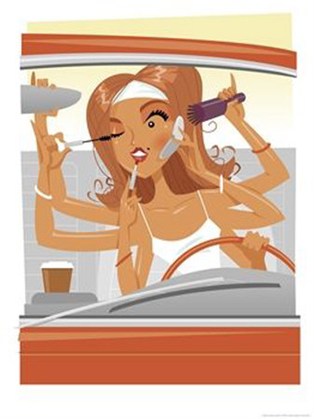
I’ve spent the last few months talking about our individual and collective narcissism in this country, about Whites and Blacks and people of color and women and academics who all demonstrate our national psychosis. I’ve arrived at the conclusion that nothing illustrates our American narcissism more than what takes place on our roads and highways, in our parking lots and intersections, more than what we do as drivers and pedestrians. We are petty, nervous, angry, unyielding, selfish, oblivious and unthinking assholes when it comes to what we do to get from point A to points B and beyond every single day.

It took me a while to get to this point. I’m a late-blooming driver. I didn’t get my license until a month after my twenty-second birthday, during the morning of a minor snowstorm that had left six inches of snow on the ground at the testing center on Washington Blvd. in Pittsburgh. After that, I drove sporadically, renting a Ford Escort in Yonkers to get to a conference at Lincoln University in the hinterlands of southeastern Pennsylvania in May ’92. House-sitting for professors with car access in August ’92. Renting a car in July ’95 and April ’96 to go places. Borrowing my eventual mother-in-law’s car for errands and job interviews in July ’97, November ’97, November ’99 and November ’01. And more rentals of cars and a moving truck in May, June, July and August ’03, and July ’04. We didn’t buy our Honda Element until the end of September ’04, our first car, and definitely my first car. I was almost thirty-five years old.

But I’ve learned a lot in the past six years and 50,000 miles of driving. I’ve learned that there are only two kinds of narcissistic drivers: neurotic ones and psychotic ones. The neurotic ones tend to drive as if they’re about to be ambushed by an armed gang with a rocket-propelled-grenade launcher driving in front, behind and beside them. They often drive five or ten miles below the speed limit, slow down for no reason, and make sure that everyone behind them become neurotic for fear of bumping into them. Neurotic drivers describe about thirty percent of the narcissistic people I encounter on the road.

Why narcissistic? Because — and I can attest to this feeling during my on-and-off again driving experiences between ’92 and ’04 — they’re driving scared, as if out of the 220 million people on the road, someone’s out to get them. That we as drivers have no margin for error, even though people may be beeping on us to speed up, jumping in front of us because of the five-car-long gap in front of us. These drivers drive as if it were an early Sunday morning in rural Georgia, and they were on their way to Macon for some Krispy Kremes before heading to church. Mind you, it’s usually the height of rush hour when this occurs.

But psychotic drivers are even more narcissistic. While neurotic drivers do what they do out of a combination of a need for self-preservation and their belief that the way they drive is the only way anyone should drive, psychotic drivers tend not to care much at all. They run stop signs and red lights, cut you off from making a turn, drive past you when you’re already ten miles over the speed limit themselves, honking and giving you the finger all the while. They don’t use turn signals to let you know they’re turning or changing lanes. They refuse to turn their lights on at night, even when you’ve given them the signal that their lights are off. They will brush the clothes of any pedestrian in a crosswalk, because no matter what, they have the right-of-way. They make u-turns that turn into three- and five-point turns in the middle of traffic, with no hint of an apology of any kind. They act as if other drivers are clairvoyant, and get angry if you don’t know what their next unpredictable move is.

These are the same people we work with, or used to go to school with, every day of the week. They go to church, temple, mosque and synagogue, attend PTA meetings, see plays and go to music concerts and sporting events. They go to the gas stations and supermarkets and strip malls. They are unpredictable people, the kind that are constantly on the phone or texting while they drive, as if bluetooth earpieces and headsets and hands-free technology haven’t been invented yet. They are us, the seventy percent of us out on the roads these days.

In many respects, driving with the psychotic is like being in high school for me all over again. In my case, of course, Mount Vernon High School might as well have been four years of time between gen pop and my neurotic grade-obsessed, cool-obsessed classmates. But I digress, again. I remember being in line at the cafeteria for lunch on about a hundred occasions with guys constantly trying to cut in because they didn’t want to wait. When I’d say, “No!,” often loudly, I’d get called “m____f____” and the f-word. It’s the same thing in rush hour traffic. All of sudden, some dumb butt comes up beside you, practically sticking the front end of his or her car in the way to get into my lane. I usually refuse, especially if they didn’t have their turn signal on or look as if they really are psychotic. That refusal usually draws a middle finger and some cuss words, racial epithets and other idiotic statements. Just like high school.

Even in parking lots or other areas where drivers have to stop, pull to the side or at least slow down, you see the high school stuff. The other day, at a Metro Rail station parking and pickup area near Silver Spring, a guy in a white Isuzu SUV stopped in the driving lane to wait for his girl, I guess, to walk out of the tunnel, walk through half the parking area, and put her bag in the back of the car. The skinny stick-of a-woman then took her time buckling her seat belt before they slowly got out of our way so that we could pick up our loved ones. I’ve seen people block my car for no reason, or worse still, people get out of their car to talk and snack on the hood of my car, I guess because it was too clean for them.

Pedestrians, bicyclists and motorcyclists aren’t immune from this psychotic, narcissistic behavior. All attempt to have their cake and eat it too. While the law protects pedestrians in crosswalks, it doesn’t mean you can cross the street whenever you feel like it. If the light is green, don’t cross the street. If the crosswalk signal is orange or red and not blinking, and the light directly in front of you is about to turn red, that’s a pretty good sign that the traffic you’re about to cross into is about to start moving, right? And if you are jaywalking, walking the slow version equivalent of crossing patterns in football, you may want to, say, hurry it up by walking faster or running, instead of acting as if my insurance will cover your hospital bill.

Bicyclists and motorcyclists, when on the road, act as if we should watch out for them as they weave in and out of traffic, run stop signs and stop lights, and ride two and three across a lane. A bicycle weighs at most thirty pounds. A motorcycle, maybe 800. A car weighs anywhere between 2,000 and 5,000 pounds. It might be a good idea to make a note of this when you flip a psychotic driver the bird when you’ve cut them off from making a turn.

I think that there should be a change in law, one that requires a person to have an education at least the equivalent of two years of college, and at least 500 hours of training as a driver, before they can obtain a driver’s license. And, that license should cost at least $600 (as much as two iPods), and really, between $1,000 and $1,500, renewable every ten years after a brief test. That would take most of the high-school-esque, narcissistic and psychotic drivers on the road today off of it, possibly including me (because I didn’t have 500 hours of driving to my credit before ’04). Given the stress that comes with driving, though, I would welcome the break.

Banning the Term “Legislate Morality”

Tags

, , , , , , , , ,


I love Michael Wilbon’s work as a sports journalist, columnist with The Washington Post, as a commentator on the NBA on ESPN/ABC, and as co-host of Pardon the Interruption (PTI) on ESPN with Tony Kornheiser. I’ve loved his work for a bit more than two decades, certainly in comparison to Pope Lupica and the other holier-than-thou sports reporters and columnists out there these days. I find him refreshing as a journalist and writer, and an unabashed and unafraid host when it comes to how sports and American society intersect.

But I found myself bitterly disappointed in Wilbon’s “can’t legislate morality” comment on PTI on Wednesday, April 21. Wilbon said this in response to the NFL’s six-game suspension of two-time-Super Bowl-winning-quarterback and Pittsburgh Steeler Ben Roethlisberger for the latter’s violation of the league’s personal conduct policy. The NFL “shouldn’t legislate morality,” Wilbon said, as Roethlisberger “hadn’t committed a crime.” NFL Commissioner Roger Goodell, the league, and the Steelers ownership were all “overreacting,” according to Wilbon. Well, Wilbon has certainly earned the right to be entitled to his opinion. But, as my wife has said to me on countless occasions, Wilbon’s also entitled to be wrong.

Societies, governments, employers and families “legislate morality” every single day, and have been doing so for as long as there has been a human civilization on this planet. Murder, stealing, banking regulations, adultery, and certainly sexual assault and rape are all examples of us “legislating morality” over the past five millenia. Now, I’m not totally naive — I know what Wilbon was attempting to say (I think). That because Roethlisberger wasn’t arrested, indicted or convicted, that the issue of his alleged encounter with a twenty-year-old White college student whom he helped become incredibly intoxicated is now a moral one, not a criminal one. Yes, this is true. But what would ESPN do to someone like Wilbon in the same situation? What would the University of Maryland system do to me in that situation? Would ESPN let Wilbon continue to show up for work without a reprimand, a suspension, or a quiet termination? Would I continue to teach classes, or would my employer consider not renewing my teaching contract?

We as a people legislate morality in ways that none of us really think about. Like Wilbon, most of us think that crimes are crimes and morals are morals, as if passed down from Moses or Hammurabi completely unchanged for the past 3,800 years. But moral issues have led to things that once were not crimes becoming crimes. The whole notion of illegal drugs or illegal immigrants didn’t exist in this country a century ago. Someone could’ve been a pot-smoking Polish immigrant “without papers” in 1910, and that immigrant wouldn’t have gone to jail. The folks in favor of making marijuana illegal or shutting off immigration from Southern and Eastern Europe didn’t end their crusades (however misguided) by saying, “Well, we can’t legislate morality!”

Or, to use much more recent examples, those White supremacists who said, “you can’t legislate morality” after the Brown v. Board of Education decision, the passage of the Civil Rights Act of 1964 and the Voting Rights Act of 1965. For nearly twenty years, those opposed to Black civil rights argued that the issue of Black equality was a moral issue, not a legal or human rights one. Or those from the Religious Right who said, “you can’t legislate morality” when the Supreme Court’s Roe v. Wade decision came down in 1973 or in the wake of the growing Gay Rights Movement in the late-1970s. Of course, in both cases, those in leadership who were influenced by what we now call the evangelical movement have engaged in legislating morality since the early ’90s, attempting to roll back Roe v. Wade and putting laws on books defining marriage as only between a heterosexual adult male and a heterosexual adult female.

On the issue of civil rights, desegregation, reproductive rights and gay rights, what is and isn’t moral isn’t just a matter of perspective. It’s also a matter of power and bias and the people who are wielding that power in order to reflect their bias. I’m not saying that Roethlisberger actually committed a crime, or that he didn’t commit a crime. Yet we cannot say that what Roethlisberger engaged in was simply a violation of the generally accepted morals of American society either. Even if seen in the most optimistic light, Roethlisberger brought significant embarrassment to himself, his team and teammates and the NFL. An executive at a Fortune 500 company could no more get away with going on a bender and attempting to have sex in a public bathroom — an incident that somehow becomes public — than Roethlisberger could. So for Wilbon or anyone else to rally around the “can’t legislate morality” flag is somewhere between idiotic and shameful.

The issue with Roethlisberger isn’t that the NFL’s engaged in legislating morality. Nor is it that the district attorney in Georgia wanted to bring a case to trial but couldn’t because of insufficient evidence. The real issue here is that we as a society have made a thick distinction between what is and isn’t moral behavior and what is and isn’t criminal behavior, because they aren’t mutually exclusive. For progressives and libertarians, the distinction is whether one’s behavior is detrimental to the health and lives of other people. Black civil rights, gay rights, and smoking weed are among the things that most would assume would not harm the lives of other citizens, at least in 2010. Having an encounter in a bathroom that leads to another person going to the hospital with bruising and bleeding, however minor, is detrimental to that other person.

In light of this being Sexual Assault Awareness and Prevention Month, maybe folks like Wilbon should be more careful when choosing words like “can’t legislate morality.” Not only do we legislate morality, societies will engage in this kind of activity as long as there is such a thing as a society. So I ask that everyone with a microphone and a camera pointed at them to stop talking about legislating morality as if moral values are as set in stone as the Earth orbiting the Sun. You’re merely reflecting your own bias, against women, gays, Blacks, drugs, science. Or in Wilbon’s case, a need to stay out of the judgment fray that moves us from one scandal to the next, a need to get to the day when Roethlisberger throws three, four or five touchdown passes in a game. On that part I fully agree. But say that, Wilbon, because that’s what you’re good at. Don’t say you can’t legislate morality, because last I checked, this isn’t your area of journalistic expertise.