• About Me
  • Other Writings
  • Interview Clips
  • All About Me: American Racism, American Narcissism, and the Conversation America Can’t Have
  • Video Clips
  • Boy @ The Window Pictures
  • Boy @ The Window Theme Music

Notes from a Boy @ The Window

~

Notes from a Boy @ The Window

Category Archives: Politics

Emancipation and Compromise

01 Tuesday Jan 2013

Posted by decollins1969 in 1, culture, Eclectic, Patriotism, Politics, Pop Culture, race

≈ 3 Comments

Tags

American Civil War, Compromise, Economic Inequality, Emancipation Proclamation, Fiscal Cliff, Fiscal Cliff Deal, Harry Reid, President Abraham Lincoln, President Barack Obama, President Lincoln, President Obama, Racism, Sen. Mitch McConnell, Slavery, Social Justice, social mobility, Social Safety Net, The Great Emancipator, US Civil War


Statuary by the US Capitol, Washington, DC, December 25, 2012. (J. Scott Applewhite/AP).

Statuary by the US Capitol, Washington, DC, December 25, 2012. (J. Scott Applewhite/AP).

Today marks 150 years since President Abraham Lincoln issued an order as Commander-in-Chief that granted freedom to slaves in territories that remained in rebellion against the Union. It enabled Lincoln to become know as the Great Emancipation, and paved the road for the passage and ratification of the 13th Amendment to the Constitution, outlawing slavery in the US, nearly three years later. This is a great thing to remember on this New Years Day, and yet, the Emancipation Proclamation exemplifies flaws in the political tactics of our leaders.

We seldom see real, lasting changes in our nation. Our Founding Fathers wrote our very Constitution with the expressed purpose of protecting “life, liberty, and property,” specifically the property of rich White male slaveowners and merchants. Lincoln used his office to strip the Southern one-percenters of the Civil War period of the one thing that was central to their “way of life,” the liberty of owning African slaves, of treating humans as property.

But even Lincoln’s proclamation was as much political posturing as it was an order on the road to emancipation and abolition. It would take the bulk of 1863, 1864 and 1865 to bring enough of the Confederate states under Union Army control to make emancipation a reality for three out of four million slaves. Border states and areas already under Union Army would only be forced to free the other one million slaves with the ratification of the 13th Amendment on December 6, 1865. This wasn’t exactly a great compromise, especially for the slaves and for abolitionists.

Fast-forward a century and a half to our tumultuous Congress and jelly boned White House. They’re fighting over tax cuts that should’ve never been enacted in ’01, or expanded in ’03. The cuts should’ve expired two years ago instead of fourteen hours ago. The compromise that the Senate passed at 2 am today is weaker than the Emancipation Proclamation. At least Lincoln knew that he had an Army and Navy that could enforce it over time. In the case of President Barack Obama, Senators Harry Reid and Mitch McConnell, the compromise deal is worth about as much as Neville Chamberlain’s “peace in our time” Munich Agreement with Hitler in September 1938, and led indirectly to World War II less than a year later.

"Kicking the can down the road" cartoon, September 23, 2012. (Clay Bennett/ Chattanooga Times Free Press).

“Kicking the can down the road” cartoon, September 23, 2012. (Clay Bennett/ Chattanooga Times Free Press).

The media loves to say that “both sides need to compromise to make a deal.” President Obama loves to say that “no side can get a hundred percent of what they want.” Let’s follow this line of thought by looking at the compromises that led to the Civil War and Lincoln’s proclamation. Here’s seventy-six years of compromise (starting with the US Constitution):

  • Kicking can of end of US participation in international slave trade to 1808;
  • African slaves (not term used) equated to three-fifths of a person for political representation purposes;
  • Missouri Compromise of 1819 (creating distinction between slave and free states at the 36°30′ parallel);
  • Gag Resolution (forbade Congress from debating anti-slavery bills on the floor of the House and (essentially) the Senate between 1836 and 1844);
  • The Compromise of 1850, which tore up the Missouri Compromise, opening up new territories for slavery’s expansion, while allowing California into the Union as a free state; and
  • Kansas-Nebraska Act (1854) officially declared policy of “popular sovereignty,” that each territory in its petition for statehood could determine to be a state that allowed or did not allow slavery.

Years of compromise led to increasing violence to protect or destroy slavery (including “Bleeding Kansas” and John Brown’s Harper’s Ferry raid in 1859), and of course, to the Civil War. So while Lincoln’s Emancipation Proclamation was itself a compromise, it might as well have been an ultimatum compared to the previous seven decades of inaction and negotiation.

Emancipation Proclamation reproduction, National Underground Railroad Freedom Center,  Cincinnati, OH, (photo taken November 15, 2009). (Wikipedia). In public domain.

Emancipation Proclamation reproduction, National Underground Railroad Freedom Center, Cincinnati, OH, (photo taken November 15, 2009). (Wikipedia). In public domain.

Not that taxes, spending and the social safety net are the same as slavery. But after nearly four decades of declining social mobility, expanding economic inequality and every conceivable break in favor of the wealthy and corporations, isn’t it time to stop compromising our lives and our children’s lives?

Unless we consider the reality that Congress is only doing what its greedy Civil War-era predecessors did a century and a half ago. That the White House is too beholden to moneyed interests to stand for anything that truly helps ordinary Americans. That it will take something far more serious than the Great Recession (or even something potentially as violent as the Civil War) to make this group finally find religion.


Randomness & Faith

27 Thursday Dec 2012

Posted by decollins1969 in 1, Academia, Boy @ The Window, Christianity, culture, earth, wind & fire, Eclectic, Hebrew-Israelite, Politics, Pop Culture, Religion, Youth

≈ Leave a comment

Tags

Agnostic, Atheism, Atheist, Belief, Bible, Buddhism, Evolution, Faith, Forgiveness, God, Grace, Love, Mathematics, Mystery, Physics, Randomness, Reason, Religion, Science, Scientific Method, The Universe, Youth


Randomness equation, Schrage random number generator, December 27, 2012. (http://ops.fhwa.dot.gov).

Randomness equation, Schrage random number generator, December 27, 2012. (http://ops.fhwa.dot.gov).

Today’s my forty-third birthday (at least, as of 8:37 am EST). It means that I’ve been a spiritual believer of one sort or another for nearly thirty years. With so much that has happened in my life, there are many who wonder why I believe in God, or why I’m a Christian in particular. With my expertise as a historian, my background in math and science (and continuing study of such), there have been many who’ve mocked and questioned my faith in anything other than the randomness of the universe. With the world in seemingly endless turmoil, good people maimed and killed, and evil people able to get away with maiming and killing others, there are those who greet any profession of belief in a higher power with anger and bitterness.

To me, that’s too bad. I can see all sides of this argument. I’ve been a Christian for more than twenty-eight years, and before that, an unwilling, if outwardly obvious, Hebrew-Israelite. In that time, I’ve also been an atheist, agnostic and angry, a bit of a Buddhist and a Muslim to boot. I’ve gone years without prayed and prayed at least once every day for nearly twenty years. I’ve read the Bible cover to cover at least six times in three decades, but also the Torah and the Qur’an. I’ve gone to temple, to Roman Catholic mass, to church, sometimes every week for years, sometimes not at all for years. I’ve had crises of faith and been almost unquestioning in faith over the years.

An actual double-slit experiment (electrons or photons behaving as particles and waves, in two places at same time), December 27, 2012. (http://www.bbc.co.uk/bbcfour)

An actual double-slit experiment (electrons or photons behaving as particles and waves, in two places at same time), December 27, 2012. (http://www.bbc.co.uk/bbcfour)

I’m also a believer in science and the scientific method. I realize that even with all of the advances in biology, physics, chemistry and mathematics, that there is much more we don’t know versus all that we’ve learned in the past two centuries. But that doesn’t mean that I believe that the universe — that life itself — is some random event or a long-chain series of random events. I’m with evolution on everything except the random. I don’t think that the universe can be seen as random. Even as chaotic as our lives may seem, the choices that we make do provide order. It’s never been sheer dumb luck that has determined everything that has occurred in my life, as other people have made their own choices that can easily affect the range of choices in my own life.

Most of all, while I do believe that there are reasons behind the events that occur in our lives and in world, that these reason are neither random nor something that God somehow came down from on high to make possible. Whether it’s Hurricane Sandy or Sandy Hook Elementary School, the civil war in Syria or a tsunami in the Indian Ocean, somehow so many have it that either God’s angry with us or that God allows horrible things to happen to us. Or that there is no God, because a real God would prevent these seemingly random events from occurring at all.

All this proves one thing, and one thing only. That most of us have little understanding of faith, of God, or of the universe itself. Period. Even those of us who are experts in particle physics or theoretical mathematics don’t know enough to dismiss God or to prove their educated guess (otherwise known as belief) in the randomness of the universe. Most of us who do believe in God — at least, those of us who are Christian — treat God as if he were Zeus casting down lightning bolts to keep us in line.

Roman Seated Zeus, marble and bronze (restored), Hermitage Museum, St. Petersburg, Russia, January 4, 2006. (Sanne Smit via Wikipedia). In public domain.

Roman Seated Zeus, marble/ bronze, Hermitage Museum, St. Petersburg, Russia, January 4, 2006. (Sanne Smit via Wikipedia). In public domain.

I see God in the universe, in the creation and re-creation of life, and yes, even in the various tragic and apparently chaotic events that have occurred in my life and in this world. That I don’t think these events to be random doesn’t make me any less of a thinker. I just don’t accept the blind faith of scientists in the idea that maybe cosmic rays led to the mutations in the primordial soup of our ancient oceans that led to the spark of life and evolution. I also don’t believe that God is simply presiding over every event on our planet and in the universe, making life-and-death decisions that bring pain and anguish to our lives for enjoyment or as a form of punishment.

Rather, God for me has been about living life by principles like social justice, social and spiritual mobility, love, forgiveness, grace and wisdom. Explaining what may or may not be random, each and every conceivable mystery of the universe or of life? I know that this isn’t in the Bible. But I do know that the reasons behind why bad, ugly, even evil things have happened in my life don’t include the “random nature of the universe.” People made decisions, I’ve made decisions, institutions made decisions, that have had an impact on the course, speed and direction of my life over the last forty-three years.

So, even when I’ve found myself angry with God, I’ve also been cognizant of the role all and each of us play in the heaven and hell that tends to be our lives, separate and together, in this world of ours.

Sports and “The -tions”

22 Saturday Dec 2012

Posted by decollins1969 in 1, Academia, culture, Eclectic, High Rise Buildings, Politics, Pop Culture, race, Sports, Work

≈ Leave a comment

Tags

"Social Political Economic", African American History, De-industrialization, Declining Cities, Economic Inequality, Gentrification, High School Social Studies Teaching Formula, Higher Education, History, History of American Sports, History of Education, Immigration, Industrialization, Migration, social mobility, Suburbanization, Teaching History, The -tions, Urbanization, US History, World History


Gentrification via sports collage, December 22, 2012. [Includes aerial view of location of new DC baseball stadium site, June 22, 2006, http://www.wreckingcorp.com; Nationals Park Greeting Card; Baseball Stadium Price Tag cartoon, March 27, 2008 (Nate Beeler/Washington Examiner)]

Gentrification via sports collage, December 22, 2012. [Includes aerial view of location of new DC baseball stadium site, June 22, 2006, http://www.wreckingcorp.com; Nationals Park Greeting Card; Baseball Stadium Price Tag cartoon, March 27, 2008 (Nate Beeler/Washington Examiner)]

Off and on for the past twenty years, I’ve attempted to wean my students off the ridiculous high school social studies formula for addressing an essay question or writing a history paper. Thinking about history — particularly modern world history or US history — purely in social, political and economic terms misses so much. History is about patterns, trends and dynamic processes involving people and human tendencies. So in my discussion sections for US History Since 1877 in the fall of ’92, I began to discuss the idea that you can better understand history through applying what I started to call “the -tions” as a series of trends, processes and patterns.

I did this because I’d already grown tired of students who had adopted “the formula.” The formula goes something like this. First, write an introduction (usually, without mention of the need for a clear thesis statement). Then, put facts, events, ideas and evidence in the social, political and economic changes silos (it always has to be these three). Then, write a conclusion that restates the introduction, with a “my essay/paper has proven” sentence.

Steel grain silos, Ralls, Texas, October 12, 2010. (Leaflet via Wikipedia). In public domain.

Steel grain silos, Ralls, Texas, October 12, 2010. (Leaflet via Wikipedia). In public domain.

It’s a terrible way to teach history, and a terrible way to write about it. It leaves so much out, including the idea that history is a constantly evolving process, not a static picture of events involving larger-than-life individuals herding billions of people through one period of history or another. So I decided to make immigration, industrialization, urbanization, and migration (sometimes called internal migration) a bigger focus with my students my second year of graduate school at Pitt. Some liked it, some didn’t, and some just kept writing their formulaic five-paragraph essays for their midterm and final exams. Oh well.

So, in expanding my list of -tions to include de-industrialization, suburbanization, globalization and gentrification over the years, I’ve begun to see patterns beyond what I typically teach or even write about. The rise and decline of American cities are a case in point. Especially if one compares this to the rise and decline of mainstream American team sports over time. That baseball, football and basketball have all been the nation’s first or second most popular sports at one point or another since the 1890s is a reflection of the leisure activities available to ordinary Americans living in growing or declining cities.

Of course, I could also include boxing (as this was America’s most popular sport through the first four decades of the twentieth century). But as an individual sport wrought with even more racial overtones than baseball, boxing deserves a separate discussion. For team sports, though, their rise or decline in popularity seems to have followed a number of trends related to the -tions.

Baseball was the nation’s most popular team sport from the 1890s through the 1950s, mirroring the growth of American cities (urbanization) during the same period. Immigrants from Southern and Eastern Europe helped grow these cities, as they left behind rural poverty, religious persecution and pogroms for industrial exploitation here in the US. Native-born Whites, already enamored with baseball, essentially introduced these immigrant groups to the sport, which in turn made it more popular. Of course, many sons of these immigrants became great baseball players. Blacks migrating to cities such as New York, Pittsburgh, Kansas City and Chicago also adopted the pastime. Every -tion is involved, at least, that’s my argument.

As we well know, though, baseball has declined in popularity since the 1950s, as the professional game became an integrated sport, and as millions of Whites began moving to the suburbs, taking millions of jobs with them. Blacks underwent a second massive wave of migration after 1940 that grew during the 1950s and 1960s.

During this transition, basketball and football (especially the latter) became more popular sports. Both were sports whose history and records were less revered than those in baseball, and at least appeared to be more welcoming of athletes of color than baseball. In the migration of Whites from cities to suburbs and Blacks to cities, the shuffling of team sports’ popularity and their locations began.

Pittsburgh's Civic Arena under demolitiion, March 11, 2012 (AVPHOTOGRAPHICS PGH via Flickr.com). In public domain. The "Igloo" (home of the Pittsburgh Penguins) itself was built after the demolition of the Lower Hill District between 1958 and 1961, displacing thousands of Blacks in the process.

Pittsburgh’s Civic Arena under demolition, March 11, 2012. (AVPHOTOGRAPHICS PGH via Flickr.com). In public domain. The “Igloo” (home of the Pittsburgh Penguins) itself was built after the demolition of the Lower Hill District between 1958 and 1961, displacing thousands of Blacks.

Once the US economy began to decline, and then de-industrialize, in the 1970s, 1980s, and 1990, the role of declining cities attempting to hold on to their sports franchises became a new theme. Declining post-industrial cities like Baltimore, Detroit and Cleveland lost their teams entirely to other cities, or lost them to the suburbs. While Sunbelt cities like Dallas-Fort Worth, Atlanta, Phoenix, Denver and Houston have picked up some of these pieces.

Gentrification, backed by a politically conservative model for economic growth and nary a concern for the declining income of city residents, has led to a return of professional sports teams to city centers. Billions of taxpayer dollars have gone into sports arenas and stadiums in Washington, DC, Brooklyn, Seattle, Detroit, Boston, San Jose, and so many other places across the country. But with little to no benefit for the people living in these cities, especially the poor. As a result of the inflation that came with gentrification and these commercial building ventures, millions of America’s poor have been forced to move out into poorer suburban communities that often border major cities.

Maybe it’s just me. I just don’t find much to celebrate about the business side of sports today, because it reflects the trends of growing economic inequality and much more difficult social mobility. It shows how desperate the mayors of declining cities are for growing their municipalities, without regard for its poor and working-class residents. It’s emblematic of our culture’s inability to see that the shift from industrial work to service industry work has left millions without the ability to live decent lives in city or suburb, whether they migrate to Houston or stay in New York. Sports is a reflection of these trends, but they also exacerbate them as well.

Newtown Calling

19 Wednesday Dec 2012

Posted by decollins1969 in 1, Boy @ The Window, culture, Eclectic, Mount Vernon New York, Politics, race, Youth

≈ Leave a comment

Tags

Adam Lanza, Bryan Ferry, Entitlement, Gun Control Debate, Gun Obsession, Gun Violence, Handguns, Mass Murder, Mass Shootings, Media Coverage, Mental Illness, Misconceptions, Newtown Connecticut, Newtown Shooting, President Barack Obama, Sandy Hook Elementary School, Second Amendment, Tragedy, Video Games


President Barack Obama tears up during White House press conference on Newtown, CT mass shooting, December 14, 2012. (UPI)

President Barack Obama tears up during White House press conference on Newtown, CT mass shooting, December 14, 2012. (UPI)

One thing that I can say about myself with confidence is that I’ve had some experience with violence and tragedy. A witness to domestic violence, a victim of child abuse, an observer of violent assaults involving knives and baseball bats. Knowing a couple of folks who committed suicide — one who jumped on my side of the office building in which I worked a decade ago — and watching a former boss flip out from a manic-depressive episode right in front of me.

Still, even with all of that experience, I don’t know anything about being the parent of a child killed in the midst of a mass shooting like the one at Sandy Hook Elementary School in Newtown, Connecticut. I can only begin to imagine that kind of grief, pain and anger.

So, it’s with that in mind that I write about the things that have been said by journalists, parents, politicians and others about this latest tragedy that have really bothered me. Despite the core-shaking event in Newtown last week, apparently there are people in this country who believe in guns more than people, who believe that some lives are worth more than others, that people with mental health issues are the perpetrators of most violent crimes. These people are wrong, wrong-headed, and the kind of people who seemingly want to steal my hope that we’ll do something serious about guns and gun violence in the US.

Mogadishu (Somalia) suicide bomb victims, January 24, 2009. (Ontdek Islam website).

Mogadishu (Somalia) suicide bomb victims, January 24, 2009. (Ontdek Islam website).

1. The “I can’t believe that this happened here” response. Every time I hear someone say something like this, I think, “So it’s all right if a mass shooting happens in Mogadishu, Harlem or Southeast DC?” It’s one of the most entitled, elitist and bigoted things I’ve heard over the years. Tragedy happens everywhere, especially in a nation as fearful, violent, imperialistic and gun-obsessed as ours. And people’s lives are invariably screwed up by tragic events, regardless of race or location. Whether in a mostly White bedroom suburb like Newtown or on the South Side of Chicago.

2. “If the teachers and principal had been armed, this wouldn’t have happened” response. Really now? Folks whose job it is to teach should walk around with or have handy a handgun on the rare chance someone like Adam Lanza shows up? Gun enthusiasts can say this a billion times a day. But more people with guns doesn’t make anyone any safer. There’s about a generation’s worth of research showing this very fact. End of discussion.

3. “We need to get rid of violent video games” response. This is ludicrous. American history is replete with mass murders and mass shootings, from White “settlers” decimating American Indians to the Rosewood, Florida race riot of 1923 to Charles Whitman shooting and killing fourteen during his University of Texas clock tower rampage in 1966. Last I checked, Mortal Kombat and Halo 4 didn’t exist in 1877, 1923 or 1966. Violent video games aren’t the problem. Our violent obsession with guns and supremacy in life is the problem.

4. “We need a better mental health system in this country” response. This one is actually correct. At least, it mostly is. The assumption here, of course, is that people somehow snap in the process of taking their own and others lives without a coherent rationale. Psychological screenings (see my post “A Call for Psychological Screenings” from September ’12) and backgrounds checks with 100 hours of mandatory gun training would definitely help. But the vast majority of people with mental illness are NOT violent. There are plenty of “normal” folks who are anti-social, have borderline personalities, are psychotic, but function normally in our society. Until the day they get a hold of a gun or some other weapon, that is. Those folks, though, would likely not test as having a mental illness.

Sidewalk memorial with 26 stuffed animals representing 26 shooting victims, Newtown, CT, December 16, 2012. (David Goldman/AP).

Sidewalk memorial with 26 stuffed animals representing 26 shooting victims (cropped), Newtown, CT, December 16, 2012. (David Goldman/AP).

We need much tougher gun control laws, a total assault weapons ban, regulations on bullets sales, maybe even a repeal of the Second Amendment. We certainly need a system that promotes comprehensive mental health services from birth through death. But right now, we also need to stop engaging in clichés, to get the story right before reporting it first (hint, CNN), to step outside of our cloistered and entitled way of viewing the world. Newtown’s calling, but for me, so is Mount Vernon, New York, Littleton, Colorado, New Orleans, Washington, DC, Silver Spring, Maryland, Aurora, Colorado, Norway, Afghanistan, Pakistan and so many other parts of this world that have experienced violent tragedies.

December Doctoral Decisions

13 Thursday Dec 2012

Posted by decollins1969 in 1, Academia, Boy @ The Window, culture, Eclectic, Politics, Pop Culture, race, Work, Youth

≈ Leave a comment

Tags

Advisor-Student Relationships, Advisors, Bruce Anthony Jones, Carnegie Mellon University, Doctoral Research, Graduate Fellowships, Graduate School, Joe Trotter, Larry Glasco, Lawrence Glasco, Multiculturalism, PhD programs, Pitt, Politics of Education, Politics of Graduate School, Quantitative Analysis, Quantitative Methods, School of Education, Strategy, Tactics, Tokenism, Transfer, University of Pittsburgh


Saint Wolfgang and The Devil [Faustian Bargain], by Michael Pacher, ca. 1471-1475, Munich, Germany, February 19, 2009. (The Yorck Project via Wikipedia). In public domain.

Saint Wolfgang and The Devil [Faustian Bargain], by Michael Pacher, ca. 1471-1475, Munich, Germany, February 19, 2009. (The Yorck Project via Wikipedia). In public domain.

It was this time twenty years ago that I decided to transfer from the University of Pittsburgh to Carnegie Mellon to complete my PhD in history. It was a solid tactical decision on many levels. The strategy, however, was a bust, although the reasons for this failure wouldn’t become apparent for several years.

I made the decision to leave Pitt based on at least three deficiencies. One, I was a doctoral student who’s dissertation research would be about multiculturalism, education, and a Black urban community (I hadn’t decided on Washington, DC yet). The only person in the history department with expertise in African American history was Larry Glasco, my advisor, and it had become obvious by the beginning of the 1992-93 school year that his interests had shifted to Afro-Caribbean studies, specifically Afro-Cuban history (see my post “Larry Glasco and the Suzy-Q Hypothesis” from August ’11). Larry’s understanding of such things as Black migration studies, Black education and Black intellectual developments pretty much stopped with the year he took his job at Pitt, 1969 (the year I was born).

Two for moving on from Pitt came out of my interactions with other professors and grad students in the department and in the School of Education. It was obvious during the fall of ’92 that most of my professors found me an enigma, from Dick Oestriecher’s “exceptional Black man” allowances in class (see my post “Dairy Queens, Dick Oestriecher and Race” from February ’11) to some colleagues’ comments about how easy I made grad school look (especially since I had time to talk and go up the hill to shoot hoops).

Hammer & Sickle & Pitt Flag [symbolic of Pitt's history department], December 13, 2012. (Donald Earl Collins).

Hammer & Sickle & Pitt Flag [symbolic of Pitt’s history department], December 13, 2012. (Donald Earl Collins).

I realized that in a department that placed a premium on American working-class studies, on the supremacy of class warfare and neo-Marxism above any other historical field, that my chances for graduating anytime before the year 2000 were slim. And forget about picking up a fellowship or grant to do my dissertation research or finding a job if and when I did graduate! There were still professors at Pitt — like Reid Andrews (now department chair) and the former department chair Richard Smethurst — who didn’t even think I was “grad school material,” and they said as much. I was an anomaly in an anomalous department (see my “Letter of Recommendation (or Wreck-o-mendation)” post from September ’10).

I did consider doing a PhD in education at Pitt, with possibly Bruce Anthony Jones as my advisor, or someone more senior like Bill Thomas. Bruce, though, discouraged me from that idea, as he was only an assistant professor at the time. It was obvious that Bill Thomas was a popular professor, so much in demand that I’d be lucky to meet with him three times in a semester to discuss his work, much less my own.

And I already had that kind of relationship with Larry. My third reason that led to my decision to transfer to Carnegie Mellon involved a very angry Larry at the end of November ’92. You see, one of the requirements for getting to the end of coursework status was the completion of a quantitative methodology course or the completion of a project in which quantitative methods drove said project.

I decided on the latter, but told Larry that between teaching four sections of US Since 1877 with over 100 students and taking three grad seminars with 1,500 pages of reading per week, that I wouldn’t be doing an independent study with him that fall. I said that I’d carve out time “on my own” to get started this fall, but wouldn’t be prepared to complete the quantitative methods project until the spring semester.

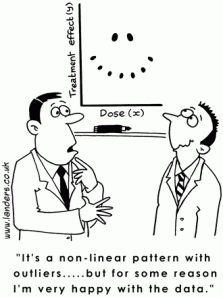
Cartoon on data points & regression analysis involving drug trials, December 13, 2012. (http://www.landers.co.uk).

Cartoon on data points & regression analysis involving drug trials, December 13, 2012. (http://www.landers.co.uk).

So after I presented some of my early findings regarding 1910 census data and infant mortality rates among Black women in Pittsburgh to Larry’s History of Black Pittsburgh class, we met to discuss how far I’d gotten in my regression analysis. I hadn’t done much with the variables yet, simply because I hadn’t had the time in November to do any off-time work. Larry became furious, said that he was “disappointed in me,” and wondered aloud if I’d make it through this year as a grad student. When I pointed out for a second time that I was doing this work in my spare time — not as an independent study course, not for a grade — he finally remember what we had discussed in August.

Larry did apologize, profusely. But I was pissed. “You’re only advising one active student, and you can’t remember what I’m working on,” I thought. With Joe Trotter at Carnegie Mellon attempting to woo me into their program, with me already taking his grad seminar in African American history, and with the writing on the wall at Pitt (where I’d already earned my B.A. and M.A. in history), I set up a meeting with Joe in mid-December to explore the possibility of transferring.

Although it would’ve been a worse decision to stay at Pitt, leaving for Joe Trotter and Carnegie Mellon was just about the worst decision I’d made as an adult (see my post “The Audacity of Youth, Grad School Style” from August ’11). For it set up so many of my other career decisions and choices I’ve made in the two decades since.

A school of education would’ve made more sense for me and the research I wanted to pursue, after all. But I would’ve had to think beyond Western Pennsylvania, taken a year off, and then pointed at Stanford, Harvard, UPenn or Teachers College as possibly better choices, better situations. Chris Rock is right. “Life is long, when you make the wrong decisions.”

Providing the Wrong Frame for Higher Education

12 Wednesday Dec 2012

Posted by decollins1969 in 1, Academia, culture, Eclectic, Politics, race, Work, Youth

≈ Leave a comment

Tags

"Investing in the Future", American Competitiveness, Center for American Progress, Critical Thinking, Drew Gilpin Faust, Educational Attainment, Efficiency, Gene Sperling, Glenn Hutchins, Harvard University, Higher Education, Innovation, K-12 Education, Neera Tanden, Philosophy of Education, Poverty, Purpose of Education, social mobility, STEM Fields, Technocrats, Workforce Development


Neera Tanden and Drew Gilpin Faust, Center for American Progress' "Investing in the Future" event (screen shot), Washington, DC, December 10, 2012. (http://americanprogress.org).

Neera Tanden and Drew Gilpin Faust, Center for American Progress’ “Investing in the Future” event (screen shot), Washington, DC, December 10, 2012. (http://americanprogress.org).

I was supposed to attend the Center for American Progress event “Investing in the Future: Higher Education, Innovation, and American Competitiveness” yesterday morning (who does a two-and-a-half-hour event two Mondays before Christmas, really?). But my son happened to have his worst night of sleep in his nine and a third years of life, compounded by a minor asthma attack. So I didn’t get to go.

I’m glad that I didn’t attend, though, as the above link to the site and video will indicate to even an educator with the patience of Jesus. After watching and skipping through the 138-minute recording today, I realized that passing a kidney stone (which I’ve actually done) would be preferable to hearing the drivel that the Center for American Progress, Harvard University and Google sponsored yesterday.

It was a tour-de-force of K-16 education as preparation for practical careers and scientific/technological innovation. Period. Not education to formulate a critical mind. Not education for the betterment of society, for social justice, for changing the world. No, Americans, our very future depends purely on the willingness of Harvard (and other elite universities), corporations and government to work together to turn out millions of students to work in STEM fields, apparently the only fields that matter in the twenty-first century.

Yesterday’s Center for American Progress event proves, more than anything else, that K-12 public education has lost the battle for educational equity and US higher education is in the process of becoming a two-tiered system. The comments and answers from Neera Tanden, Harvard President Drew Gilpin Faust, Glenn Hutchins, Gene Sperling, et al. were indicative of a class of folks who hold little interest in providing the resources necessary to level the educational playing field for poor and struggling working class students.  Or, when they did address K-12 education, it was purely in technocratic scales-of-efficiency terms, as they gave K-12 most of the blame for America’s reduced economic competitiveness.

Box of Cracker Jack bags, December 11, 2012. (http://crackerjackpopcorn.com).

Box of Cracker Jack bags, December 11, 2012. (http://crackerjackpopcorn.com).

But this is the problem with leaders involved in American education these days. Instead of opening up K-12 education to real innovations in philosophy, curriculum, a teacher’s ability to use all of their skills (measurable and intangible) in a student-centered classroom, critical thinking and neuroscience, we were given the typical mantra of testing, teacher effectiveness and cost-cutting. It means that even among our alleged best thinkers — apparently still White, mostly male and over fifty years of age — the best ideas involve an expansive education for the well-off and a Cracker Jack education for the growing numbers of the poor and those struggling to remain above the poverty line.

As for higher education, I’ve already noted that we are well on the way to a two-tiered system in the US (see my post “edX and Ex-lax (& Higher Education’s Future)” from September ’12). One tier will consist of group of schools that will remain elite and near elite, the top 500 or so colleges and universities in the country. The other group of colleges (public, HBCU and for-profit) will struggle mightily with the weight of providing a specialized education for the masses of unprepared and underprepared low-income first generation students, of color and otherwise. They will increasingly lose out to the elite university/corporate/government partnership that will lead to a cheaper, streamlined college education, and mostly online. And all without the complications of providing a well-rounded, liberal arts education.

Ben & Jerry's half baked ice cream flavor, December 11, 2012. (http://bestuff.com/).

Ben & Jerry’s half baked ice cream flavor, December 11, 2012. (http://bestuff.com/).

The speakers at “Investing in the Future: Higher Education, Innovation, and American Competitiveness” also discussed the need to make higher education cheaper. Their solutions of cheaper loans and more stringent requirements for students to meet in order to obtain merit-based aid is nothing new, and in fact reflects trends that date back to the late-1970s. Even Faust’s encouragement of spreading the Harvard solution of providing need-based aid for low-income students only works for high-achieving students, the “low-hanging fruit” strategy that allows the other grapes on the trees to rot.

To be sure, the speakers at this event also talked about comprehensive immigration reform, green jobs/economy and universal health care. But without sufficient attention to the millions and millions of poor and of color people affected by their words and deeds, the Center for American Progress event might as well have been called “Investing in the Oligarchic Past.” Same new-old solutions, same half-baked ideas that show that as long as American education and industry leaders try to force solutions on our poor, we’ll be about as competitive as the USSR was between Stalin and Glasnost/Perestroika.

My Beef With Cory Booker’s Food Stamps Experiment

05 Wednesday Dec 2012

Posted by decollins1969 in 1, Boy @ The Window, culture, Eclectic, Jimme, Marriage, Mount Vernon New York, My Father, New York City, Politics, Pop Culture, race, Work, Youth

≈ Leave a comment

Tags

616, 616 East Lincoln Avenue, Academy for Educational Development, C-Town, Cory Booker, Food Stamps, Food Stamps Experiment, hunger, Newark New Jersey, Nutrition, Omar Wasow, Poverty, Social Safety Net, Social Welfare, Stanford University, Welfare


Cory Booker at the 2011 Time 100 Gala, April 27, 2011. (David Shankbone via Wikipedia). Released to public domain via  Creative Commons Attribution 3.0 license.

Cory Booker at the 2011 Time 100 Gala, April 27, 2011. (David Shankbone via Wikipedia). Released to public domain via Creative Commons Attribution 3.0 license.

I like Cory Booker. I worked with someone at Academy for Educational Development in the mid-00s who told me stories about Booker while she knew him at Stanford and her contact with him over the years. I’ve admired his work in Newark, for the most part, and the fact that he’s been a personable, in-your-face Twitter-accessible mayor who has fought hard for his city over the past decade.

But this week-long “I feel your pain” publicity stunt through living on $30 in food stamps (the SNAP program) seems a bad idea at best, and just plain disingenuous otherwise. Booker’s argument has been the need to raise awareness of how difficult it is to live on food stamps for the most impoverished of us, in Newark or anywhere else in the US. After being critical of Booker’s slumming it via food stamps on Twitter a couple of weeks ago, I received this response from Booker through tech guru and Princeton doctoral candidate Omar Wasow:

“@decollins1969 @corybooker said you can’t love your neighbor if you don’t understand them & you can’t understand w/out shared experience”

Really? I didn’t know that Franklin D. Roosevelt had been homeless, old and sick and out of work before ramming through the Social Security Act of 1935! Or that Lyndon Johnson had been a sharecropper or beaten up for marching to Selma before pushing through the Civil Rights Act of 1964 and Voting Rights Act of 1965!

President Bill Clinton (in context of "I feel your pain" quote), July 23, 2009. (http://dailybail.com).

President Bill Clinton (in context of “I feel your pain” quote), July 23, 2009. (http://dailybail.com).

What worries me, though, more than anything else, is how messiah-like this tweet sounds. It would be a different story if so many politicians and journalists hadn’t run this experiment before (see my post “Slumming Lords Spinning Stories Out Of Suffering” from October ’10). It would be even more different if this experiment really opened up a dialogue on the paltry social safety net and deep poverty. Not to mention the working poor and the millions from the struggling middle class who have fallen into poverty since the start of the Great Recession more than four years ago.

But as someone who’s had way more than one week or one month’s worth of experience with poverty, WIC, welfare checks, case workers with Westchester County Department of Social Services, and of course, food stamps, I actually find these attempts to walk in the shoes of my youth — among millions of others who’ve lived in welfare poverty — insulting on so many levels (see my posts “The Five Sense of Poverty,” “Hunger,” and “Shopping at C-Town“).
Here’s what I lived with between ages twelve and seventeen (October ’82 through August ’87). As the second-oldest child and only other sane person in a household of six, then seven, then eight persons (including my four younger siblings, born between ’79 and ’84), I had many adult responsibilities. I negotiated over the phone with Con Edison and NYNEX/Bell Atlantic when we fell behind on the heat bill or the telephone bill. I walked my mom’s $275 rent check (often three weeks late in ’82 and ’83) over to the super’s office for payment, and usually was at the receiving end of verbal insults and threats for being late.
I went to Waldbaum’s, C-Town and other grocery stores almost every day after school, sometimes three times in one evening (because my mom often forgot items). I also washed clothes with my older brother Darren once a week, watched over my siblings, cooked about one out of every five meals from ’84 until I went off to college in ’87.
Lab mice "Avatars" implanted with cancer to treat cancer, October 5, 2012. (http://danisfoundation.org).

Lab mice “Avatars” implanted with cancer to treat cancer, October 5, 2012. (http://danisfoundation.org).

This is the short list. In doing all of this, especially once we went on welfare in April ’83 (after the birth of my now deceased sister Sarai), I learned a lot about how little Americans thought of the poor, and how little the federal government thought of people like me and my family. The average budget for my mom to raise a family of six kids with a consistently unemployed and wayward idiot (now late) stepfather was a monthly welfare check of $558, $75 in food stamps, and about $50 in WIC benefits.
Even in the best months, it meant a week to ten days with little or no food in the house. Great Northern beans and rice, $5 spaghetti and meat sauce dinners, and days without was a typical month. Unless, of course, my weekly weekend excursions to track down my father Jimme in Mount Vernon, the Bronx and sometimes in Midtown Manhattan at his favorite watering holes yielded enough extra funds to keep me, Darren and my family in food and clean clothes during the leaner times each month at 616.

So, you see Cory Booker, your publicity endeavor really teaches us little about the realities of poverty, hunger and nutrition for the poorest among us, whether in Newark, Mount Vernon, New York or the rest of the US. (Except that you have no experience stretching a dollar). Your food stamps experiment will do what it always does – get the media’s attention. But to understand the embarrassment, the cold stares, the harshness of what I went through and millions like me are going through now? One week and $30 isn’t even close to good enough.

← Older posts
Newer posts →

Boy @ The Window: A Memoir

Boy @ The Window: A Memoir

Places to Buy/Download Boy @ The Window

There's a few ways in which you can read excerpts of, borrow and/or purchase and download Boy @ The Window. There's the trade paperback edition of Boy @ The Window, available for purchase via Amazon.com at http://www.amazon.com/Boy-Window-Donald-Earl-Collins/dp/0989256138/

There's also a Kindle edition on Amazon.com. The enhanced edition can be read only with Kindle Fire, an iPad or a full-color tablet. The links to the enhanced edition through Apple's iBookstore and the Barnes & Noble NOOK edition are below. The link to the Amazon Kindle version is also immediately below:

scr2555-proj697-a-kindle-logo-rgb-lg

Boy @ The Window on Amazon.com: http://www.amazon.com/Boy-The-Window-Memoir-ebook/dp/B00CD95FBU/

iBookstore-logo-300x100

Boy @ The Window on Apple's iBookstore: https://itunes.apple.com/us/book/boy-the-window/id643768275?ls=1

Barnes & Noble (bn.com) logo, June 26, 2013. (http://www.logotypes101.com).

Boy @ The Window on Barnes & Noble: http://www.barnesandnoble.com/w/boy-the-window-donald-earl-collins/1115182183?ean=2940016741567

You can also add, read and review Boy @ The Window on Goodreads.com. Just click on the button below:

Boy @ The Window

Twitter Updates

Tweets by decollins1969
  • RSS - Posts
  • RSS - Comments

Archives

  • June 2025
  • April 2023
  • September 2022
  • August 2022
  • July 2022
  • June 2022
  • May 2022
  • April 2022
  • March 2022
  • January 2022
  • December 2021
  • November 2021
  • October 2021
  • September 2021
  • August 2021
  • July 2021
  • June 2021
  • April 2021
  • March 2021
  • February 2021
  • January 2021
  • December 2020
  • November 2020
  • October 2020
  • September 2020
  • August 2020
  • July 2020
  • May 2020
  • April 2020
  • March 2020
  • January 2020
  • December 2019
  • November 2019
  • August 2019
  • July 2019
  • June 2019
  • May 2019
  • April 2019
  • March 2019
  • February 2019
  • January 2019
  • December 2018
  • November 2018
  • October 2018
  • September 2018
  • August 2018
  • July 2018
  • June 2018
  • May 2018
  • March 2018
  • February 2018
  • January 2018
  • December 2017
  • November 2017
  • October 2017
  • September 2017
  • August 2017
  • July 2017
  • June 2017
  • May 2017
  • April 2017
  • March 2017
  • February 2017
  • January 2017
  • December 2016
  • November 2016
  • October 2016
  • September 2016
  • August 2016
  • July 2016
  • June 2016
  • May 2016
  • April 2016
  • March 2016
  • February 2016
  • January 2016
  • December 2015
  • November 2015
  • October 2015
  • September 2015
  • August 2015
  • July 2015
  • June 2015
  • May 2015
  • April 2015
  • March 2015
  • February 2015
  • January 2015
  • December 2014
  • November 2014
  • October 2014
  • September 2014
  • August 2014
  • July 2014
  • June 2014
  • May 2014
  • April 2014
  • March 2014
  • February 2014
  • January 2014
  • December 2013
  • November 2013
  • October 2013
  • September 2013
  • August 2013
  • July 2013
  • June 2013
  • May 2013
  • April 2013
  • March 2013
  • February 2013
  • January 2013
  • December 2012
  • November 2012
  • October 2012
  • September 2012
  • August 2012
  • July 2012
  • June 2012
  • May 2012
  • April 2012
  • March 2012
  • February 2012
  • January 2012
  • December 2011
  • November 2011
  • October 2011
  • September 2011
  • August 2011
  • July 2011
  • June 2011
  • May 2011
  • April 2011
  • March 2011
  • February 2011
  • January 2011
  • December 2010
  • November 2010
  • October 2010
  • September 2010
  • August 2010
  • July 2010
  • June 2010
  • May 2010
  • April 2010
  • March 2010
  • February 2010
  • January 2010
  • December 2009
  • November 2009
  • October 2009
  • September 2009
  • August 2009
  • July 2009
  • June 2009
  • May 2009
  • April 2009
  • March 2009
  • February 2009
  • January 2009
  • December 2008
  • November 2008
  • October 2008
  • September 2008
  • August 2008
  • July 2008
  • June 2008
  • May 2008
  • April 2008
  • March 2008
  • February 2008
  • January 2008
  • December 2007
  • November 2007
  • October 2007
  • September 2007
  • August 2007
  • July 2007
  • June 2007

Recent Comments

MaryPena's avatarMaryPena on My Day of Atonement/Bitter Hat…
decollins1969's avatardecollins1969 on No Good Teaching Deed Goes…
Mary Rose O’Connell's avatarMary Rose O’Connell on No Good Teaching Deed Goes…

NetworkedBlogs on Facebook

NetworkedBlogs
Blog:
Notes From a Boy @ The Window
Topics:
My Life, Culture & Education, Politics & Goofyness
 
Follow my blog

616 616 East Lincoln Avenue A.B. Davis Middle School Abuse Academia Academy for Educational Development AED Afrocentricity American Narcissism Authenticity Bigotry Blackness Boy @ The Window Carnegie Mellon University Child Abuse Class of 1987 CMU Coping Strategies Crush #1 Crush #2 Death Disillusionment Diversity Domestic Violence Economic Inequality Education Family Friendship Friendships Graduate School Hebrew-Israelites High-Stakes Testing Higher Education History Homelessness Humanities Humanities Program Hypocrisy Internalized Racism Jealousy Joe Trotter Joe William Trotter Jr. K-12 Education Love Manhood Maurice Eugene Washington Maurice Washington Misogyny Mother-Son Relationship Mount Vernon High School Mount Vernon New York Mount Vernon public schools Multiculturalism MVHS Narcissism NFL Pitt Pittsburgh Politics of Education Poverty President Barack Obama Race Racial Stereotypes Racism Relationships Self-Awareness Self-Discovery Self-Reflection Sexism Social Justice Teaching and Learning University of Pittsburgh Violence Whiteness Writing

Top Rated

Blog at WordPress.com.

  • Subscribe Subscribed
    • Notes from a Boy @ The Window
    • Join 103 other subscribers
    • Already have a WordPress.com account? Log in now.
    • Notes from a Boy @ The Window
    • Subscribe Subscribed
    • Sign up
    • Log in
    • Report this content
    • View site in Reader
    • Manage subscriptions
    • Collapse this bar
 

Loading Comments...