• About Me
  • Other Writings
  • Interview Clips
  • All About Me: American Racism, American Narcissism, and the Conversation America Can’t Have
  • Video Clips
  • Boy @ The Window Pictures
  • Boy @ The Window Theme Music

Notes from a Boy @ The Window

~

Notes from a Boy @ The Window

Category Archives: Patriotism

68 Days in 1968

28 Wednesday Mar 2018

Posted by decollins1969 in 1, culture, Eclectic, Patriotism, Politics, Pop Culture, race, Youth

≈ Leave a comment

Tags

"I've Been To The Mountaintop" speech, Assassination, LBJ, Legacy, Martin Luther King Jr., MLK, President Lyndon Baines Johnson, Radical Change, RFK, Robert F. Kennedy, Social Justice, Social Welfare, Stephon Clark, The '60s, The Great Society, This is America, Vietnam War, War on Poverty, Welfare State
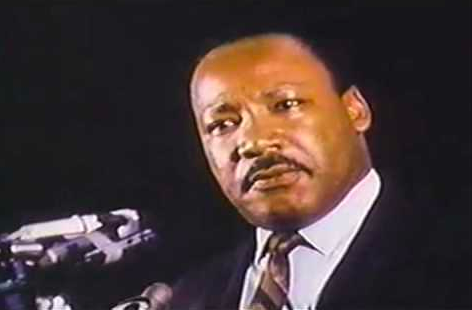

Rev. Dr. Martin Luther King, Jr. delivering his “I’ve Been to the Mountaintop” speech, Mason Temple, Memphis, TN, April 3, 1968. (http://youtube.com).

Over the next week or two, America will talk incessantly about the fiftieth anniversary of the Rev. Dr. Martin Luther King, Jr.’s assassination in Memphis, Tennessee. Many Americans will memorialize MLK this April 4th, one day from the actual day of the week James Earl Ray’s rifle shot took the great one’s life at a two-star motel. This was a moment that shook the nation. It certainly was a moment that blew up in the minds of nearly every Black American. There were more than 100 riots — actual riots, and not the random vandalism the media’s all too quick to call a riot — in cities across the country. It changed the nation enough to where, at least for a few years, African Americans once denied educational and employment opportunities could suddenly find themselves at elite White universities, with major corporations, and with big private foundations, and often, for the first time.

But as much as I want to memorialize Dr. King, his life and his death, I do not want to resurrect him as a zombie-like poster child for ridding the US of racism. Especially when I know all too well that it’ll likely take the The Rapture, and not a rally, to make this impossibility a reality. I’ve long since tired of King as a marble statue of unattainable goodness and perfection for Whites and conservatives of color who use him as a cudgel against any Blacks who haven’t materially progressed or who have exposed the nation as racist. I’m also tired of progressives who call out racism as only hate, and King’s life and death as an attempt to fight it, when King was speaking truth to power, and organizing poor people to siphon that power. That’s what King died over, ultimately.

President Lyndon B. Johnson’s speech on Vietnam and not running for reelection, White House, March 31, 1968. (http://gbpnews.com).

Even more than King, though, is the reality that America has a string of fiftieth anniversary milestones to contemplate. In a sixty-eight day period in 1968, the true nature of American power dashed the delusion of an easy path to ending systemic racism and gross economic inequalities in which millions of naive Americans had once believed. Between LBJ’s refusal to run again on March 31st, MLK’s execution on April 4th, and RFK’s assassination on June 5th, any traditional Democrat, White liberal, or even someone with some sense of hope in America’s future must’ve been devastated. If I’d been at least ten years old in 1968, I would’ve been, too.

Sadly, President Lyndon Johnson tried to fight a War on Poverty and build the Great Society while also escalating a war over communism in Vietnam and in the rest of Southeast Asia. He bled the nation’s wealth and its poorer class of men dry in Vietnam, and starved his modestly radical domestic programs in the process. While so much of Johnson’s legacy remains, none of it remains strong. Every administration since Johnson announced, “Accordingly, I shall not seek, and I will not accept, the nomination of my party for another term as your President” has weakened his attempts at a comprehensive welfare state. Including Social Security, Medicaid, unemployment insurance, and of course, aid to single parents with younger children.

The front-runner for the Democratic nomination in the weeks after President Johnson’s “no mas” announcement was Sen. Robert F. Kennedy (D-NY). His victory in winning the California primary on June 5 had mostly sealed that deal. He barely had more than a few minutes to enjoy it, though. After his victory speech that night, Sirhan Sirhan killed RFK, and with it, the center-very-very-very-slightly-left Democratic coalition of the 1960s. Johnson, of course, died in 1973. No president has come close to being transformative since.
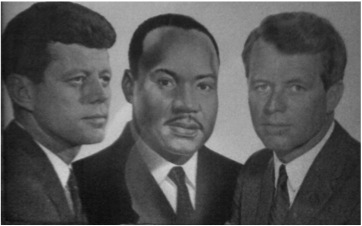
A facsimile of the JFK, MLK & RFK painting that used to hang over many a Black home’s mantle, August 27, 2013. (http://robertktanenbaumbooks.com).

I was born in 1969, so I didn’t get the chance to experience living through these horrible events. But I did learn about them early on. Seeing paintings of MLK, JFK and RFK (or of MLK, JFK, and LBJ) in the living rooms of my mother’s friends. Through John Lennon’s music and CBS’s All in the Family. That sense of lingering hopefulness in changing the world that I did see at the end of America’s Vietnam era. In some ways, I’m as much a “child of the 60s” as anyone who was ten or fifteen years old at the time of RFK’s death.

Yet I grew up in the 1970s and 1980s, a time in which most White liberals and Democrats decided to forget about the overall message of change and social justice that LBJ, RFK, and MLK represented. The youthfulness and motivation that was JFK in the early 60s. The sense that by breaking down barriers and encouraging the end of those practices that leave many Americans behind, our nation would retain its strength as a beacon of democracy, freedom and equality. Of course there was a great tension there. And in that tension, America returned to its center-right script, symbolically using a marble and granite King while chipping away at welfare state protections and regulations, and promoting virulent racism.

Those 68 days in 1968 proved more than anything else that while Americans can envision a multitude of Americas, there was and remains only one America. The one in which money, power, racism, misogyny, and homophobia rule the day. Americans can fight for a better nation, and Americans should, if only to blunt the full fury of America’s ills. But make no mistake. The America that assassinated MLK, RFK, and JFK, and put LBJ in an early grave. That’s the same America that elected 45 and allows police to shoot unarmed Black and Brown people like rabid dogs. This. Is. America.
Is “Never” the Best Time for a Critique?

03 Saturday Mar 2018

Posted by decollins1969 in 1, Boy @ The Window, Christianity, culture, Eclectic, Patriotism, Politics, Pop Culture, race, Religion

≈ Leave a comment

Tags

Anthea Butler, Billy Graham, Blasphemy, Blind Support, Critique, Sacred Cows


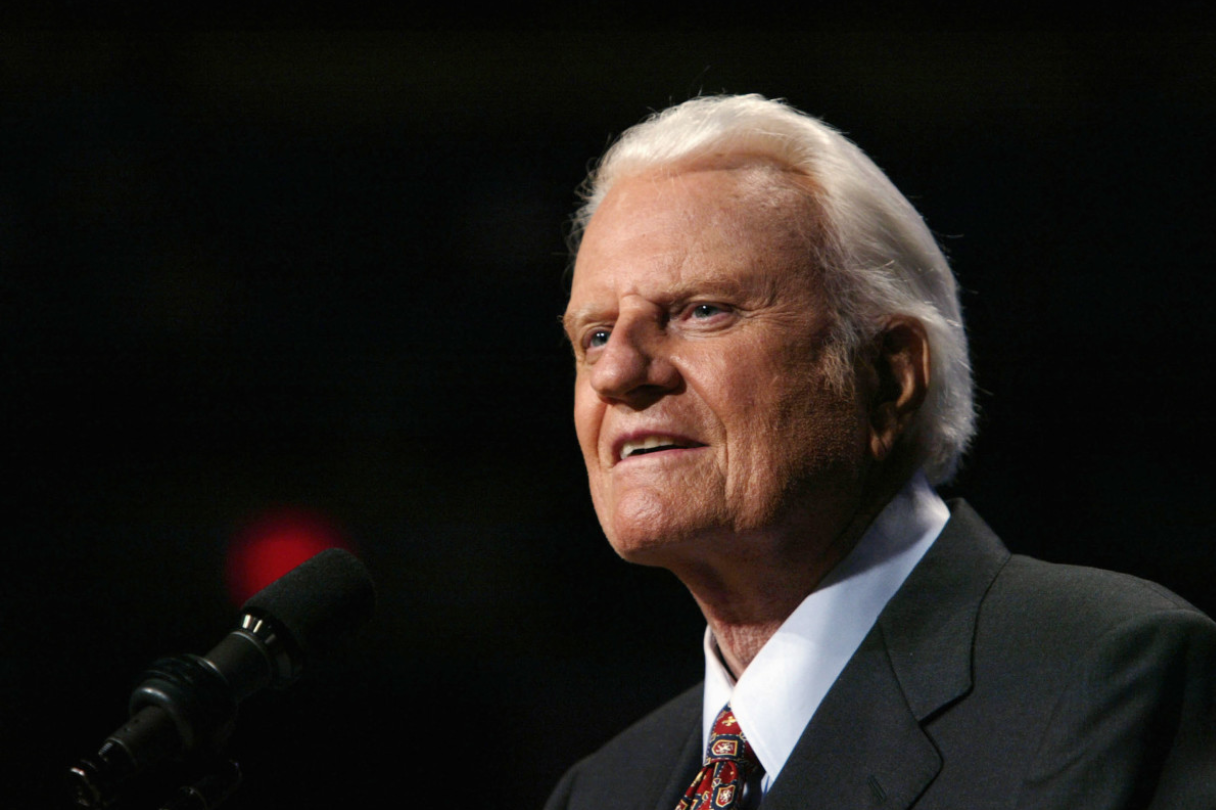
Rev. Billy Graham, 2003. (David Hume/Getty Images). Cropped slightly; qualifies as fair use due to cropping and subject matter.

I’ve been watching the variety of responses to the death of the late great Billy Graham over the past seven or ten days. Most people have been in mourning, which was something to expect. Many, like UPenn religious studies professor Anthea Butler, have reminded the world of the White nationalist, segregationist, and sexist views Graham either represented or excused during his six-decade-long run on the national stage.

And like mechanical clockwork, those who have Victorian and transactional notions of Christianity have defended, deflected, and denied on Graham’s behalf. It’s led to this series of questions for me. When can we critique the legacy of a famous person? While they’re alive? “No siree! That would be disrespectful.” If they claim to be serving God, they’ll add, “That would be blasphemous!” If I were to ask, When they die?, they’ll respond, “Now’s not the time — can’t you see their family’s in morning? The Bible says, ‘Judge not, lest thou be judged’.”

Translation: apparently, we’re never supposed to question what some famous person has done. Especially if they have the word “reverend” or “pastor” as part of their official title. It’s a thought process that imbues power to religious leaders, so much so that we might as well make them god-like, since our job is merely to obey and stay quiet.

But as I’ve learned over the past three-and-a-half decades, religious leaders are fallible. They aren’t sacrosanct. And while seminaries or other religious institutions have ordained them, that doesn’t mean that every vision they’ve ever had came straight from God. Meaning that we can question. Meaning that we can critique. Meaning that we can provide evidence that humanizes whom others would consider a pedestal perfect being. For those whom aren’t Christian, it certainly means they can judge Graham, too.

To err is human, no? Which means we shouldn’t have any sacred cows. Graham might’ve saved millions of souls for eternal life. But that shouldn’t automatically exempt him from a critique of his unwillingness to help those same souls while they were still here on Earth.

We Need a Partnership for a Gun-Free America

22 Thursday Feb 2018

Posted by decollins1969 in 1, culture, Eclectic, Patriotism, Politics, Pop Culture, race, Youth

≈ 1 Comment

Tags

#NeverAgain, 2nd Amendment, Assault Weapons, Brady Bill, Cameron Kasky, Columbine, David Hogg, Emma Gonzalez, Florida, Marjory Stoneman Douglas High School, Mass Shootings, Parkland Shooting, Partnership for a Drug-Free America, Realism, Sophie Whitney, War on Drugs


With all of the fierce courage and eloquence of Marjory Stoneman Douglas herself, students from the Parkland, Florida high school have stepped up and reignited a movement. Emma Gonzales, David Hogg, Cameron Kasky, Sophie Whitney, and so many others from the school have turned their grief, sorrow, and anger into activism in the past seven days. This in the wake of a mass shooting that left 14 classmates and three teachers dead and another 17 wounded. Not only this. High school students from my son’s in Silver Spring to those all across the US have declared this chapter of the gun control movement “Never Again,” and have already staged walkouts and protest demonstrations that could be a watershed in a long-suffering push to end wanton gun violence.

I, for one, hope that they never stay quiet again. I hope, for their sakes (and for mine) that there is never another mass shooting at a public school or anywhere else. But I’m a historian and an educator, not Pollyanna. I cannot afford such a lofty wish, not when there’s so much work to do. That’s why I’m glad that post-millennial teenagers are standing up and taking on this issue. With enough pressure and long-term strategizing, they may well be able to achieve some measure of gun control in the US for the first time in the nation’s history.

Five Stoneman Douglas students speaking out (see names above), February 20, 2018. (http://mediamatters.com).

But we’re not going to get there with mealy-mouthed proposals and idiotic ideas. Arming teachers? Arming veterans as volunteers? Putting more police in schools? Really? How stupid does anyone have to be to believe that more people with guns in public spaces with large numbers of other people to stop a potential threat is a good idea? That’s like saying every country in the world should have as many nuclear weapons as Israel or Pakistan. Because everyone sleeps better knowing that on the wrong day and with the wrong person, they and their families could be vaporized!

Even half-baked measures like age limits, more extensive background checks, and a ban on assault rifles (the old 1994 Brady Bill and the 1994 Crime Bill, really) do little in the end to prevent mass shootings. After all, Jonesboro, Columbine, and the Georgia day trader massacres all occurred between 1994 and when the federal assault weapons ban expired in 2004. Even if it was possible, turning the clock back to the 1990s would still mean that most Americans willing to use guns to kill themselves and others indiscriminately will be more than able to do just that.

Though “Never Again” is overused (think Holocaust and 9/11 here), the idea of working without ceasing on making America as gun-free as possible should be the long-term goal. I think that the nation should mobilize for a War on Guns, just like it did in the 1980s for a War on Drugs, and in the 1970s against drunk driving. Only, without an eye toward racial stereotypes of Black pathologies and cultural dependency on the one hand, and the assumption of White goodness on the other. After all, White males own the vast majority of guns in the US. I think that children, teenagers, and the young adults that are part of my son’s generation should lead the charge. Not conservative dumb asses who believed weed was a gateway drug to cocaine and heroin (look where that got us).

Just like we have a Partnership for a Drug-Free America, we need a Partnership for a Gun-Free America. We need graphic commercials demonstrating what occurs when a bullet rips through flesh, disintegrates bone and nerves, and pummels brain matter. We need commercials where a mass shooter kills a bunch of people and then is somehow captured. One where the father asks

“I learned it by watching you, Dad!” PSA, July 1987. (Partnership for a Drug-Free America).

“Where did you get the guns? Who did you learn this from?”

“You, all right! I learned it by watching you!,” the son would and should say.

Why? Because, despite the relatively diversity of the student body at Stoneman Douglas High School and despite the pain of what those students went through, they are hardly alone in their suffering. So many Americans of color know this pain, too, between crime-related shootings in poorer communities and the police state that is all about shooting and killing much, much, much more than deescalation of potential threats. While I would’ve been proud to have a daughter like Emma Gonzales, I also want to not worry that some racist, trigger-happy cop or some random White supremacist/misogynist (the typical profile of a mass shooter) will one day cross paths with my son.

So many Whites know this pain as well. For their access to guns has ripped apart their families, between the accidental shootings, suicides, and family annihilators. So many own guns out of fear of crime (really, a proxy for their fear/hatred/disdain for the Black and Brown) or a need to feel powerful, this despite the evidence that most people never get to use their guns when they are the victims of crime.

What I want ultimately, is the repeal of the Second Amendment. The US needs to go the way of Japan, the UK, and so many other countries, where some older firearms or some guns that are specifically for hunting may be kept, everything else must go. This means no firearms for law enforcement as well. This is what the more radical of us want. This is what Black Lives Matter wants. I’m sure so many who’ve survived these mass shootings would at least strongly consider this proposition.

There will be those who’ll say, “Not a chance in Hell! If someone comes for my guns, I’ll put them in a bodybag!” I’m not arguing the Second Amendment will be gone today. Or that it’ll be gone tomorrow. But with the kind of sustained effort that only youth, mass mobilization, and coalition-building can bring, maybe America can get part of the way there in the next decade or two. Or not.

Du Bois Was a Marxist. Aye. So?

03 Saturday Feb 2018

Posted by decollins1969 in 1, Academia, culture, Eclectic, Patriotism, Politics, Pop Culture, race, Religion, Work

≈ 1 Comment

Tags

Biography, Black History, Contradictions, David Levering Lewis, E. Ethelbert Miller, Ideology, Marxism, The Crisis, W. E. B. Du Bois


W.E.B. Du Bois at 82 (cropped), New York, NY, 1950. (Keystone/Getty Images). Cropped photo qualifies as fair use under US copyright law.

In recent months, a few people I know have brought up the fact that at least since the mid-1930s, the great W. E. B. Du Bois had professed himself a Marxist. The poet E. Ethelbert Miller, one of my co-panelists at a talk a couple of months back, made a point of interrogating notions of Blackness with the idea that Black activists were/are afraid to identity Du Bois as a Marxist. Certainly by the time Du Bois broke free from the federal government’s McCarthy-era ban on his international travel in 1958, he was. Du Bois re-obtained his passport, traveled the world, and ended up in Ghana in 1961. There, at the age of 93, he renounced his US citizenship and declared himself a Communist. Two years later, on the eve of the March of Washington, Du Bois died. The end.

All the above is true, but not so fast! The thing I’ve known in all my years of reading Du Bois’ work, writing about Du Bois, and in reading others who’ve written about Du Bois, was that Du Bois wasn’t just one thing. Nearly every social science and humanities tradition in the US can claim influence from Du Bois’ work. Poetry, theology, philosophy, psychology, economics, and American literature would be one set of his influences, and that’s just with The Souls of Black Folk!

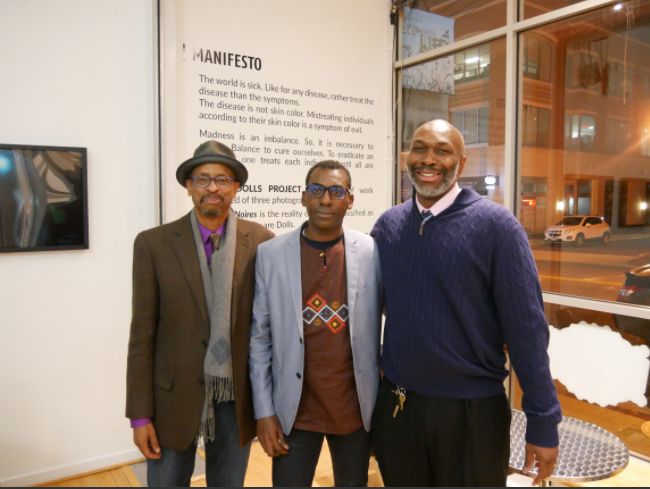
E. Ethelbert Miller, Mirtho Languet, and Me, Anacostia Arts Center, Washington, DC, November 18, 2017. (Keita Stephenson).

Though Du Bois’ Harvard doctorate was in history, he’s widely recognized as one of the founders (if not the actual founder) of American sociology. His 1898 study The Philadelphia Negro is really the first urban sociological study ever conducted in the US. His dissertation on the Trans-Atlantic slave trade was the only major work to cover the cost of the Middle Passage for kidnapped Africans (and estimate the total number of Africans stolen for slavery in the Western Hemisphere) for nearly seven decades. And there’s Black Reconstruction, probably Du Bois’ magnum opus of scholarly work.

With almost 70 years’ worth of Du Bois’ writings alone, anyone who’d think that Du Bois was just one thing would be guilty of a gross oversimplification of the man. Really, Du Bois was a mess of contradictions. He believed in elitist ideas like The Talented Tenth. Yet Du Bois also fought Booker T. Washington in books and in the press for more than a decade over the latter’s prominence as the “race man who Teddy Roosevelt and “liberal” White philanthropists talked to about uplifting Black folk.

He was a founder of both the NAACP and the Niagara Movement that preceded the organization. He befriended White philanthropists just as easily as Washington, though, and kept a personal war between himself and long-time NAACP president Walter White going for nearly two decades. On more than one occasion, Du Bois punned White’s last name as an insult, as the man was biracial, and could’ve easily passed for White.

Du Bois was also a Pan-Africanist. One, though, that used his editorialship at The Crisis to discredit Marcus Garvey and his ill-fated “Back-to-Africa” movement. David Levering Lewis in his Pulitzer Prize-winning, two-volume biography of Du Bois has even documented the likelihood that Du Bois helped the FBI (née BOI) in their mail fraud case against Garvey.

Du Bois was also a socialist. Though for most Americans, socialism and Marxism is a distinction, socialism in Du Bois’ mind meant alleviating the worst effects of market capitalism, not necessarily doing away with capitalism all together.

Du Bois was also a pacifist. But like so many of Du Bois’ positions, this one evolved over time. When the US became a military participant in World War I, Du Bois wrote essays where he argued that Black involvement could provide evidence of the need for full integration and citizenship rights for African Americans. By the Cold War, Du Bois was giving speeches about the threat of American imperialism and nuclear war.

Du Bois was also a multiculturalist. One of his more well-known extramarital affairs was with Rachel Davis DuBois (White, no relation), a key founder of the intercultural education movement, which had its heyday between the late-1920s and early 1940s. The idea of a diverse and inclusive curriculum was first fully demonstrated in DuBois’ work, which Du Bois endorsed in the mid-1930s. At the same time, how much can anyone believe from a man who at this point in his career was also serial adulterer?

Even saying Du Bois was a Marxist isn’t the full truth. “I mean by communism, a planned way of life in the production of wealth and work designed for building a state whose object is the highest welfare of its people and not merely the profit of a part.” This was what Du Bois wrote soon after renouncing his American citizenship in Ghana. Technically, this would be socialism more than communism. But more to the point, it’s anti-capitalism and anti-imperialism. It’s really Du Bois using Marxism to protest American imperialism and capitalism through his Pan-African affinity for Ghanian revolutionary and prime minister Kwame Nkrumah, not to mention, with America’s archenemy, the Soviet Union.

The one thing I wish those in the scholarly community would stop doing is taking the pyramid that was Du Bois’ life and reducing it to a two-dimensional square. Why can’t we just call an idea whose main source is Du Bois, well, Du Boisian? Like, Du Boisian sociology, or Du Boisian economics, or Du Boisian politics? Is this an example of Whiteness rearing its ugly head, where it’s too difficult to give Du Bois his own due without subsuming him under another White guy? It seems to me that so many are attempting to use Du Bois for their own ideological purposes, when it’s better to just let him be the so much that he was.

Dateline: Noriega

20 Wednesday Dec 2017

Posted by decollins1969 in 1, Academia, Boy @ The Window, culture, Eclectic, Mount Vernon New York, Patriotism, Pittsburgh, Politics, Pop Culture, University of Pittsburgh, Youth

≈ Leave a comment

Tags

#TaxCutScam, 616 East Lincoln Avenue, American Imperialism, George H. W. Bush, Invasion, Iraq, Kuwait, Manuel Noriega, Military, Panama, Paul Ryan, Pitt, Post-Cold War Era, Saddam Hussein


An army helicopter ferries reinforcements to the Vatican embassy in Panama City, where Gen. Manuel Noriega has taken refuge, Panama, December 21, 1989. (David Walters/Miami Herald).

It was on Wednesday, December 20, 1989 was the true beginning of the post-Cold War world, American style. It was on this date twenty-eight years ago that President George H. W. Bush sent in 20,000 soldiers and sailors to end Manuel Noriega’ dictatorial rule over Panama. It remains a date from which any student of history can infer as the beginning of blatant American aggressions abroad and increasingly craven governmental behaviors at home. At least without the counterweight of the Soviet Union to keep the US from running totally amok.

That week was part of my holiday semester break during my junior year at Pitt. I’d only been back in Mount Vernon and 616 for three full days, yet I was once again fully engrossed in my role as eldest child (in responsibility, if not in age). I was washing dishes post-breakfast that Wednesday morning between 11 am and 12 noon, as the national news of that day preempted The Price Is Right. It was no accident that within two months of the end of communist rule across most of Eastern Europe that the US hatches it first invasion of another nation. At least, that’s the thought I had in my head just before I cut the skin in between my middle finger and my ring finger on my right hand. This as I scrubbed out a glass that apparently had a chip around its rim. I bled profusely for a good ten minutes afterward, all while watching Dan Rather and company dig deep for analysis of what was happening in Panama and why.

It wasn’t even as complex as covering my second-level cut with a band-aid (which we didn’t have at 616). Noriega had become increasingly erratic and more difficult for Bush the puppet-master to control. It wasn’t as if his dictatorship and his running drugs through Panama had been any concern of either Bush or Reagan in the eight years before the invasion.

Drug trafficking and dictatorial crimes would be the excuses the Bush Administration would make for Operation Just Cause, an invasion that took 650 lives (150 or so Panamanian soldiers and more than 500 civilians), including 23 Americans. But it was essentially President Bush’s personal use of military forces to take down an asset that was the real reason for this incursion. Noriega was a man who Bush and other CIA officials had been using for the benefit of US interests in the Panama Canal and in Central America for nearly two decades. See? Much simpler than any justification over drugs and human rights violations Bush and Cheney (then Secretary of Defense) could muster.

Rep. Paul Ryan (R-WI) gaveling in ecstacy as House passed its $1.45-trillion tax cut bill, December 19, 2017 (http://twitter.com).

Both the UN and the European Parliament condemned the action. It didn’t matter. A year later, the US was part of the largest coalition of forces assembled since the end of World War II, this time to kick another former US asset in Saddam Hussein out of Kuwait. That Hussein invaded Kuwait after getting mixed signals from the Bush Administration is pretty well documented. That Hussein would no longer wear the leash the former head of the CIA had put on him was the ultimate cause for an counter-invasion that ultimately has destabilized the Middle East over the past three decades.

This week, Congress is doing for the US what the US has done to countries and regions with increasing levels of brazen and calloused bigotry since 1989 (and in cases like Batista and Cuba, Pinochet and Chile, far longer than 30 years). What’s another trillion dollars between friends, especially friends who can donate to your congressional campaign or stash hundreds of billions of dollars off-shore?

Who can Americans count on to stop this ride of greed-possessed, craven people who believe that the only Americans who count are the one’s who count suitcases full of cash to go asleep at night? Americans can’t invade themselves, after all. Of course, Americans can resist, elect more Democratic candidates, yada, yada. But dear world, we need your help, because America’s leaders are doing their level best to decay the US from within.

The Deadly Bliss of American Ignorance

17 Friday Nov 2017

Posted by decollins1969 in 1, culture, Eclectic, Patriotism, Politics, Pop Culture, race, Religion

≈ Leave a comment

Tags

"Drinking the Kool-Aid", American Narcissism, Balfour Declaration, Bolshevik Revolution, Devin Patrick Kelley, First World War, Gun Rights, Willful Ignorance


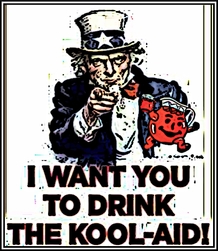
The US and its love for drinking poisonous Kool-Aid, June 21, 2016. (http://www.booksbytesblog.com/).

Events past and present have converged on the world stage in the past three weeks, all to remind the world of American ignorance. The 100th anniversary of the Russian Revolution, ushering in Soviet Russia for most of the 20th century. The Balfour Declaration, also of a century ago, in which the British leaned their imperialist weight into the idea of a Jewish homeland carved out of Ottoman Palestine. And, two Sundays ago, Devin Patrick Kelley’s rampage at First Baptist Church in Sutherland Springs, Texas, where he killed 26 worshippers and wounded another 20. The one thing these seemingly disparate events share in common is America’s ability to will ignorance out of learning moments.

Take the Bolshevik Revolution, for example. Nary a word has been printed about the spark that led to the Union of Soviet Socialist Republics in the US. Not about how the million-plus Russian dead during the First World War created an atmosphere of chaos within the tsarist empire. Not about how the calculations of German leadership led to them injecting Russian exile Vladimir Lenin back into his home country in order to get Russia out of the war. And certainly not about the role of US among the other world powers in attempting to overthrow the new Communist regime in the years after the war.

What little focus there has been on this event has been in assessing whether Russian oligarch Vladimir Putin is a 21st-century Russian tsar. That, and the case of author Simon Sebag Montefiore, who “what-if-ed” about the Russian Revolution in a New York Times op-ed earlier this month. Somehow, the Second World War, the Communist Revolution in China, the Cold War, the Vietnam conflict, and a nuclear-armed North Korea would’ve never happened. While it was a nice touch for Montefiore to write, “Hitler would likely have ended up painting postcards” if not for the Bolshevik Revolution, the lessons deriving from this event should be far more important than typical American navel-gazing. The revolution did happen, a consequence of World War I and the imperialist meddlings of Germany, the United Kingdom, and the US.

The ho-hum coverage around the Balfour Declaration a century on is yet another example of American ignorance, but in two ways. One, Americans have literally ignored the idea that the modern clashes between Jews and Arabs had an origin point straight out of the First World War. The modern conflict over Israel comes out of the European imperialism playbook, led by the UK. As a way to get the Ottoman Turks out of the war, the UK’s Foreign Secretary Arthur Balfour wrote a letter to Lord Walter Rothschild, an avid supporter of the Zionist movement. The promise of a “national home for the Jewish people” in Palestine made its way to the British newspapers a week later, November 9, 1917. The declaration set off a complex chain of events that led to the state of Israel, four Arab-Israeli wars between 1948 and 1973, and the oppression of Palestinian Arabs.

Instead of focusing on this complicated history, Americans often chalk this recent history up to a family squabble that happened 3,000 years ago, as if Jews and Arabs have been fighting since the Biblical days of Isaac and Ishmael. That, and the willingness to automatically blame Arab Muslim culture for inciting and inviting conflict. As conservative Middle East Forum fellow Philip Carl Salzman recently wrote, peace “is not possible in the Middle East because values and goals other than peace are more important to Middle Easterners,” carefully avoiding the word Arab in his article. Salzman’s is merely a more sophisticated version of the ignorant Christian belief that the Middle East represents the “world’s oldest family feud,” that every Muslim is primed for violence. Or, as my neighbor put it last week, in the aftermath of Sayfullo Saipov’s terrorism-by-truck-ramming in New York, “they read that Koran, and they’re radicalized.”

The other part of American ignorance regarding the Balfour Declaration was the American role in helping it evolve from the idea of a homeland to the nation-state of Israel. President Woodrow Wilson supported the declaration. Writers like Lawrence Haas have argued that the declaration was only about “empower[ing] Jews to return to their historic homeland.” Despite his and other’s claims, every US president since Wilson has understood the declaration to be the bedrock for building Israel as a Jewish nation-state, and not just an ancestral homeland for members of the Jewish diaspora. This ignorance of the past and present has cost hundreds of thousands of lives and trillions in dollars, and is likely as intractable as the century-old conflict itself.

Still, from an American perspective, none of this is as ignorant as the common refrain, “Guns don’t kill people. People kill people.” Or, as President Trump described the mass shooting at a church in suburban San Antonio, “I think that mental health is your problem here,” that this isn’t a “guns situation.” In the first few days, experts weighed in on this incident in which Devin Kelley killed and maimed dozens. They have added factors such as Kelley’s domestic violence history and the lack of communication between the Department of Defense and local law enforcement databases about Kelley’s record to the mix.

But in explaining the correlation between domestic violence and a person’s willingness to slaughter random humans, many Americans remain blissfully ignorant of one elephant in the room. Easy access to assault weapons. Americans often avoid the topic, as if the Second Amendment to the US Constitution is sacrosanct. Yet here too is the First World War and the development of hand-held assault guns a factor, as automatic weapons like the Tommy Gun became more readily available to both criminals and law enforcement in the US in the 1920. While some may kill regardless of the weapon, regulations state and federal have made it all too easy for ordinary Americans to murder in large numbers.

The most ignorant thing Americans do on gun regulation, though, is assume the only choices on the table are either full access for everyone or regulated access meant to keep guns out of the hands of criminals and potential mass shooters. Another choice would be to repeal the Second Amendment entirely and replace it with a law that keeps guns mostly out of the American public domain.

The ignorant American in me knows that the idea of a gun-free America is a pipe dream, no more realistic than any line in the Balfour Declaration about protecting the civil rights of “non-Jewish communities in Palestine.” And no more plausible than seeing Soviet Russia as not just an historical accident, but the result of imperial wheeling and dealing to end a deadly world war. Americans are simply too willing to be ignorant of history and the here-and-now.

News Media, You’re Elitism is Showing

26 Thursday Oct 2017

Posted by decollins1969 in 1, culture, Eclectic, Patriotism, Politics, Pop Culture, race

≈ Leave a comment

Tags

Domestic News, Elite Privilege, International News, Journalism, Las Vegas, Manchester Bombing, Mogadishu Bombing, News Coverage, Puerto Rico, Racism, Rohingya Crisis, Sexism, Stephen Paddock, Tropes


Your fly is open: 7 awkward conversations people will never have with your, April 2015. (https://havemoreinfluence.com).

Elitism, and with it, the ability to ignore the pain and suffering of those with no voice, is the true common denominator in American news coverage. Press reports often are about securing access to the rich and powerful, about what news organizations believe the public wants to hear. There’s also the embedded assumption within the news establishment that the American public simply isn’t smart or caring enough to understand serious news that doesn’t involve or look like them.

The news media lets its captive American audience down because it seldom treats events with equal intensity. This is especially true of international news, which outside of The New York Times, NPR, Vice News, and PBS, is virtually nonexistent. On October 14, a suicide bomber set off two truck bombs in the center of Mogadishu, the capital of Somalia, leaving at least 300 dead and more than 300 wounded. And though American reporting on this terrorist attack has been more robust than usual, it is hardly 24/7. Instead, the Hollywood producer Harvey Weinstein’s fall from grace and his decades of predatory sexual harassment has been the dominant news story. Not to mention, the daily drumbeat around President Donald Trump, his anti-Obama policies, and his unhinged tweets and press conferences.

A more classic example of disproportionate news coverage occurred in May. The American press reported around-the-clock on the suicide bombing at the end of an Ariana Grande concert in Manchester, England, a tragedy that took 23 lives. Yet that same week, gunmen surrounded a bus full of Egyptian Coptic Christians on their way to a monastery and killed 29 men, women, and children, and wounded two dozen others. American news coverage of the Egypt attack was the equivalent of crickets in the woods by comparison. One could easily substitute the reportage on the London Tube (the city’s subway system) attack at the Parsons Green station that injured 30 in September and compare it to the minimal coverage of ethnic cleansing of the Rohingya in Myanmar since the middle of August. Or, contrast it with the widespread flooding that killed more than 1,200 in India, Nepal, and Bangladesh, and left more than 40 million people homeless, school-less, without work, or with farmland too ruined to work. This is more than the idea that Black and Brown lives matter far less than European and White ones. It is the unwitting elitist judgment within American news organizations that stability, peace, justice, and innocence only belong to those living in the West.

Domestically, American news is just as slanted in favor of elitism and access. Puerto Rico and its 3.5 million people have suffered and died in the aftermath of Hurricane Maria and from malignant government neglect over the past three weeks According to one report, at least 450 Puerto Ricans may have died from this one-two punch of climate-change tragedy and federal government incompetence. Yet most of the American news on Puerto Rico has focused on Trump’s statements blaming its people for their own misery. The American press has been covering Puerto Rico as if it’s just another poor country, one full of brown-skinned people, one that really has nothing to do with Americans or American interests at all.

Even when the reporting involves the continental US and White Americans, the elitism remains obvious. White male terrorist attacks have been on the rise in recent years, especially in the year since Donald Trump won the 2016 Presidential Election. Stephen Paddock orchestrated the latest attack, the mass shooting at the Route 91 Harvest Festival in Las Vegas that scattered a crowd of 22,000 concert-goers, as he killed 58 and wounded more than 500 before taking his own life. The American press, true to itself, has refused to use the word terrorism to describe the attack. The incident itself has faded from the news media’s eyeline. But what reporting there has been in the weeks since has included a focus on Paddock’s possible motive and his mental health status. Their coverage, though, has also included a heavy dose of the elitist trope of all-American individual heroes triumphing over individual evildoers. Treatment of these incidents reveals the significant role news reportage plays in perpetuating stereotypes. In this case, one where White criminality is rare and unusual, while Arab Americans are automatically Islamic terrorists. A monolithic, elitist news media makes this half-baked reporting possible.

The triumph of elitism in news stems from forty years of corporate consolidation across all platforms (thanks to Rupert Murdoch and Ted Turner) and the increasing socioeconomic exclusion within the industry’s ranks. According to freelance writer and editor David Dennis, Jr., the industry is “populated by those who can afford the jobs,” predominantly by White men (and to lesser extent, White women) in an era of shrinking staffs. The “they” attend elite universities and colleges, earn master’s degrees at journalism schools, and mostly work unpaid internships as the entry point for their careers.  The increasing abundance of affluent individuals in the field has also “changed the way issues are reported and the quality of the product” Americans consume. News organizations and the people they employ are every bit as representative of the American elite as the affluent business leaders and powerful politicians on whom they regularly report. Keeping things simple and giving “equal time” to “both sides”—unless it involves Americans of color and the developing world—is a reflection of elitist values, a rationale that undermines the industry’s own claims of objectivity and fairness.

Defenders of simplistic news media reporting, though, often remind the public of what the news media is not. The Fourth Estate is certainly neither liberal nor conservative, an accusation made all too often by the ill-informed American public. As New York University media critic and expert Jay Rosen once wrote “It’s very simple. The press isn’t on the side of the left or the right…vs. This is complicated!” Although tongue-in-cheek, embedded within Rosen’s quip was his own elitist assumption that the news media’s work is variegated and knotty, a mere reflection of the world at large, and not a reflection of its own elitist bubble.

It is the elitist nature of today’s news media that has rendered press coverage as little more than breaking news bulletins for the American public. All while the real global divides at the intersections of race, economic inequality, gender, and immigration remain mostly sidelined. It remains all too easy for the news media to rely on tropes like heroes and villains and the civilized West versus the uncivilized developing world.

← Older posts
Newer posts →

Boy @ The Window: A Memoir

Boy @ The Window: A Memoir

Places to Buy/Download Boy @ The Window

There's a few ways in which you can read excerpts of, borrow and/or purchase and download Boy @ The Window. There's the trade paperback edition of Boy @ The Window, available for purchase via Amazon.com at http://www.amazon.com/Boy-Window-Donald-Earl-Collins/dp/0989256138/

There's also a Kindle edition on Amazon.com. The enhanced edition can be read only with Kindle Fire, an iPad or a full-color tablet. The links to the enhanced edition through Apple's iBookstore and the Barnes & Noble NOOK edition are below. The link to the Amazon Kindle version is also immediately below:

scr2555-proj697-a-kindle-logo-rgb-lg

Boy @ The Window on Amazon.com: http://www.amazon.com/Boy-The-Window-Memoir-ebook/dp/B00CD95FBU/

iBookstore-logo-300x100

Boy @ The Window on Apple's iBookstore: https://itunes.apple.com/us/book/boy-the-window/id643768275?ls=1

Barnes & Noble (bn.com) logo, June 26, 2013. (http://www.logotypes101.com).

Boy @ The Window on Barnes & Noble: http://www.barnesandnoble.com/w/boy-the-window-donald-earl-collins/1115182183?ean=2940016741567

You can also add, read and review Boy @ The Window on Goodreads.com. Just click on the button below:

Boy @ The Window

Twitter Updates

Tweets by decollins1969
  • RSS - Posts
  • RSS - Comments

Archives

  • June 2025
  • April 2023
  • September 2022
  • August 2022
  • July 2022
  • June 2022
  • May 2022
  • April 2022
  • March 2022
  • January 2022
  • December 2021
  • November 2021
  • October 2021
  • September 2021
  • August 2021
  • July 2021
  • June 2021
  • April 2021
  • March 2021
  • February 2021
  • January 2021
  • December 2020
  • November 2020
  • October 2020
  • September 2020
  • August 2020
  • July 2020
  • May 2020
  • April 2020
  • March 2020
  • January 2020
  • December 2019
  • November 2019
  • August 2019
  • July 2019
  • June 2019
  • May 2019
  • April 2019
  • March 2019
  • February 2019
  • January 2019
  • December 2018
  • November 2018
  • October 2018
  • September 2018
  • August 2018
  • July 2018
  • June 2018
  • May 2018
  • March 2018
  • February 2018
  • January 2018
  • December 2017
  • November 2017
  • October 2017
  • September 2017
  • August 2017
  • July 2017
  • June 2017
  • May 2017
  • April 2017
  • March 2017
  • February 2017
  • January 2017
  • December 2016
  • November 2016
  • October 2016
  • September 2016
  • August 2016
  • July 2016
  • June 2016
  • May 2016
  • April 2016
  • March 2016
  • February 2016
  • January 2016
  • December 2015
  • November 2015
  • October 2015
  • September 2015
  • August 2015
  • July 2015
  • June 2015
  • May 2015
  • April 2015
  • March 2015
  • February 2015
  • January 2015
  • December 2014
  • November 2014
  • October 2014
  • September 2014
  • August 2014
  • July 2014
  • June 2014
  • May 2014
  • April 2014
  • March 2014
  • February 2014
  • January 2014
  • December 2013
  • November 2013
  • October 2013
  • September 2013
  • August 2013
  • July 2013
  • June 2013
  • May 2013
  • April 2013
  • March 2013
  • February 2013
  • January 2013
  • December 2012
  • November 2012
  • October 2012
  • September 2012
  • August 2012
  • July 2012
  • June 2012
  • May 2012
  • April 2012
  • March 2012
  • February 2012
  • January 2012
  • December 2011
  • November 2011
  • October 2011
  • September 2011
  • August 2011
  • July 2011
  • June 2011
  • May 2011
  • April 2011
  • March 2011
  • February 2011
  • January 2011
  • December 2010
  • November 2010
  • October 2010
  • September 2010
  • August 2010
  • July 2010
  • June 2010
  • May 2010
  • April 2010
  • March 2010
  • February 2010
  • January 2010
  • December 2009
  • November 2009
  • October 2009
  • September 2009
  • August 2009
  • July 2009
  • June 2009
  • May 2009
  • April 2009
  • March 2009
  • February 2009
  • January 2009
  • December 2008
  • November 2008
  • October 2008
  • September 2008
  • August 2008
  • July 2008
  • June 2008
  • May 2008
  • April 2008
  • March 2008
  • February 2008
  • January 2008
  • December 2007
  • November 2007
  • October 2007
  • September 2007
  • August 2007
  • July 2007
  • June 2007

Recent Comments

decollins1969's avatardecollins1969 on No Good Teaching Deed Goes…
Mary Rose O’Connell's avatarMary Rose O’Connell on No Good Teaching Deed Goes…
Lyndah McCaskill's avatarLyndah McCaskill on The Raunchiest of Them Al…

NetworkedBlogs on Facebook

NetworkedBlogs
Blog:
Notes From a Boy @ The Window
Topics:
My Life, Culture & Education, Politics & Goofyness
 
Follow my blog

616 616 East Lincoln Avenue A.B. Davis Middle School Abuse Academia Academy for Educational Development AED Afrocentricity American Narcissism Authenticity Bigotry Blackness Boy @ The Window Carnegie Mellon University Child Abuse Class of 1987 CMU Coping Strategies Crush #1 Crush #2 Death Disillusionment Diversity Domestic Violence Economic Inequality Education Family Friendship Friendships Graduate School Hebrew-Israelites High-Stakes Testing Higher Education History Homelessness Humanities Humanities Program Hypocrisy Internalized Racism Jealousy Joe Trotter Joe William Trotter Jr. K-12 Education Love Manhood Maurice Eugene Washington Maurice Washington Misogyny Mother-Son Relationship Mount Vernon High School Mount Vernon New York Mount Vernon public schools Multiculturalism MVHS Narcissism NFL Pitt Pittsburgh Politics of Education Poverty President Barack Obama Race Racial Stereotypes Racism Relationships Self-Awareness Self-Discovery Self-Reflection Sexism Social Justice Teaching and Learning University of Pittsburgh Violence Whiteness Writing

Top Rated

Blog at WordPress.com.

  • Subscribe Subscribed
    • Notes from a Boy @ The Window
    • Join 103 other subscribers
    • Already have a WordPress.com account? Log in now.
    • Notes from a Boy @ The Window
    • Subscribe Subscribed
    • Sign up
    • Log in
    • Report this content
    • View site in Reader
    • Manage subscriptions
    • Collapse this bar
 

Loading Comments...