• About Me
  • Other Writings
  • Interview Clips
  • All About Me: American Racism, American Narcissism, and the Conversation America Can’t Have
  • Video Clips
  • Boy @ The Window Pictures
  • Boy @ The Window Theme Music

Notes from a Boy @ The Window

~

Notes from a Boy @ The Window

Tag Archives: High-Stakes Testing

Curriculum 2.0 – Been There, Done That

21 Monday May 2012

Posted by decollins1969 in 1, Academia, Boy @ The Window, culture, Eclectic, Mount Vernon New York, Politics, Pop Culture, race, Youth

≈ Leave a comment

Tags

Academic Excellence, Closing the Achievement Gap, Curriculum 2.0, Desegregation, Diane Ravitch, Grimes Center for Creative Education, High-Stakes Testing, Humanities Program, Integrated Curriculum, MCPS, Montgomery County Public Schools, Mount Vernon public schools, Pennington-Grimes ES, Politics of Education, Reinventing the Wheel, White Flight


Nekyia: Persephone supervising Sisyphus pushing his rock in the Underworld. Side A of an Attic black-figure amphora, ca. 530 BCE, from Vulci, February 13, 2007. (Bibi Saint-Pol via Wikipedia). In public domain.

This school year, my son’s school district, Montgomery County Public Schools in Maryland, began implementation of what they call Curriculum 2.0. This new curriculum, formerly known as the Elementary Integrated Curriculum, has been in the works for the better part of a decade. As MCPS explained in a flyer to parents, Curriculum 2.o will be one that will “better engage students and teachers, and dedicate more learning time to subjects such as the arts, information literacy, science, social studies and physical education. By blending these subjects with the core content areas of reading, writing, and mathematics, students will receive robust, engaging instruction across all subjects in the early grades.”

Why is better engagement of teachers and students necessary, and how will an integrated curriculum make this possible? The answer to the first part of this question is much more obvious than the answer to the second part. In light of county-level and state-level testing (in the latter case, the MSA for third, fourth and fifth grades), an engaging and integrated curriculum will enable students to be better prepared for the heavy doses of critical reasoning and reading comprehension that this testing involves, at least theoretically.

What hasn’t made much sense has been the implementation process itself, as Curriculum 2.0 became the curriculum for kindergarten and first graders in this 2011-12 school year, with the option of having it for second graders at some schools (like my son’s school in Silver Spring). Meanwhile, third and fourth graders won’t become part of Curriculum 2.0 until 2012-13, and this year’s fifth graders won’t see Curriculum 2.0 at all. It seems as if the implementation process was about as well planned as the SS Minnow’s tour of the South Pacific.

But that’s not the only story here. For someone’s who’s spent a great deal of time attempting to understand

A One Thousand and One Night manuscript written in Arabic under the second half of the Abbasid Era (750-1258 CE), February 9, 2008 (Danieliness via Wikipedia). Released into public domain via cc-by-sa-3.0 license.

the circumstances under which I grew up, including my times in Mount Vernon, New York’s public schools in the ’70s and ’80s, MCPS’s Curriculum 2.0 is sort of like deja vu all over again. Except that in the period between ’76 and ’93, the kind of curriculum MCPS is implementing now was mostly for Mount Vernon’s gifted and talented students then, students who were part of the district’s Humanities Program, particularly those in the Grimes Center for Creative Education. The motivations for developing a similar curriculum three and half decades earlier came out of the need for racial integration and preventing White Flight, and in the process, a measure of academic excellence. Different circumstances in search of the same results, I guess.

A piece of evidence I uncovered a few years ago while working on Boy @ The Window shows how much educators reinvent the wheel in terms of curriculum development, a pitfall in education on which Diane Ravitch has been proven correct for the past thirty years. Charlotte Evans wrote in her April 1981 New York Times article on the Grimes Center that there “is a flowering of creativity at Pennington-Grimes [Grimes had combined with Pennington in the 1980-81 school year] that is evident in the hallways as well as in the classrooms.” Leroy L. Ramsey, New York State Department of Education Administrator of Intercultural Affairs and Educational Integration, when asked by Evans to comment, said that “the intent” of a school like Pennington-Grimes “was to break racial isolation and to stop white flight, and we have done that in Mount Vernon.”

As detailed by Evans in her April 1981 New York Times article, with the

[c]oordinating [of] language, math and science with social studies in the same way, first graders study the family and its roots, how people live and lived in different places. Second graders focus on prehistoric times – the old and new Stone Ages; third graders on the ancient Middle East, fourth graders on Greek and Roman civilization and sixth graders on the Renaissance, Reformation and the Age of Discovery.

This interdisciplinary approach to creating a magnet-style gifted track curriculum did not stop with a focuson other histories and cultures in social studies. “Fifth-graders, for example, specialize in studying the Middle Ages in Islamic nations and in Africa and Europe,” but they also “read Arabian Nights in connection with their Islamic study and went on to African folk tales,” according to fifth-grade teacher Mattie Lucadamo. In addition, there were other “flourishes,” such as “learning the foundation of Hindu-Arabic numbers” and “study[ing] astronomy, tracing it back to the Babylonians.”

It never ceases to amaze me how we as educators, education researchers, and governments spend time, money and human resources recreating what was already in existence, in this case, when I was my son’s age. But, like with the experiment that was the Grimes Center and Humanities, parents with resources will find a way to game the system. In one case, an innovative program was moved to Mount Vernon’s predominantly White North Side in May ’80, and tended to give more preferences to White students in general.

In the case of Curriculum 2.0, the more aware parents will send their kids to Kumon or Kaplan or other testing centers to give their kids every opportunity to do well in this new curriculum, score in the top percentiles on the MSA, and garner the gifted label in time for middle school.

Education, A Numbers Game Love Story

22 Thursday Sep 2011

Posted by decollins1969 in 1, Academia, Boy @ The Window, culture, Eclectic, Politics, race

≈ Leave a comment

Tags

Accountability, Craps, Crunching Numbers, ETS, High-Stakes Testing, K-12 Education, K-16 Education, NCLB, P-20 Education, Politicians, Politics of Education, Psychometricians, Psychometrics, Qualitative Research, Quantitative Analysis, SAT, Statistics, Student Success, Teaching Effectiveness, The Education Trust, US Department of Education


Craps dice, like the state of education reform via numbers crunching these days, August 6, 2006. (Source/Roland Scheicher via Wikipedia). In public domain.

This could just as easily be titled, “Why your multivariate regression analysis isn’t better than my chi-square test,” because that is the state of mainstream education research these days. I find it stifling, like being wrapped in Saran Wrap covered by a condom lined in sheep’s intestines.

Numbers have their place, but the field’s obsession with crunching numbers for trends that defy quantification has increased as a result of federal mandates like NCLB and philanthropy’s accountability movement over the past fifteen years. What’s the long-term impact of the thousands of studies and the deployment of thousands of psychometricians and research analysts in P-20 education reform (that’s early childhood education, K-12, undergraduate and graduate education combined)? Not much, because our politicians and philanthropists are staking themselves to trends almost regardless of numbers.

It all started for me about this time twenty years ago. I did an independent study with Bruce Anthony Jones,

Linear regression graph with over 200 data points, February 22, 2009. (Source/Michael Hardy via Wikipedia). In public domain.

then an assistant professor in the University of Pittsburgh School of Education’s ed policy and administration department. In that one semester, I quickly learned that folks in the education field defined research in only two ways: quantitative and qualitative. And by qualitative, they meant soft research, like Carvel’s soft-serve ice cream. What I didn’t know was that many in the field were working to make the qualitative — surveys, focus groups, oral interviews/transcripts — quantifiable.

Today, everything that can be tracked in American education usually has a number attached to it. It’s hardly grades and standardized test scores anymore. Homework hours, time to task on lesson plans to work on a single problem that may be part of a high-stakes state exam, teacher effectiveness, suspensions and disciplinary reports disaggregated by race and gender. It drives me nuts, and I’ve used SAS and SPSS before, during my grad school days. I can only imagine how a teacher who just wants their students to learn and do well must feel about this numbers game.

But if education has become a number game, it most resembles the game of craps. Take the issue of teacher

Michelle Rhee, former DCPS Chancellor, one of many who've taken advantage of education as craps game, Washington, DC, February 19, 2008. (Source/US Department of Labor). In public domain.

effectiveness, often tied to state-mandates around test scores and students meeting or exceeding a percentile at a given school on these tests. Let’s say if a school as a whole actually exceeds the proficiency percentile. They may well receive more money, and teachers may well get a bonus (depending on the state and school district and union contracts, which by the way, may also be part of a statistical formula). None of this actually proves that these students are better prepared for, say, thinking independently or critically, because critical reasoning isn’t tested by most of the high-stakes state tests.

Nor can they show the writing skills necessary for student success later on in their education, as most of these tests don’t test writing comprehension skills either. Most importantly, where does teacher effectiveness come in as a factor? Do we have to account for time to task in comparison to each exam item, like a psychometrician at the Educational Testing Service (ETS) would? Do we factor out home studying/ homework time, parents’ education, income and race, or whether they eat a hearty breakfast the morning of the exam? Or do we continue to simply say, if Teacher X gets Class A to raise its state test score by 25 percent, they get a raise and a pat on the head? Really?

What’s more, whether teacher effectiveness, student success, or free and reduced lunch programs, politicians, parents and pundits hardly look at any numbers beyond any report’s executive summary. We all insist that our school and community colleges and universities get better at graduating students ready for the real world of work. Fine. Then we insist on lower taxes, blaming teachers, destroying unions, complaining about the state of things but not doing anything to make education work for all of our students. Not fine.

It doesn’t take a two-year study from The Education Trust to realize that there’s no one-to-one correlation

Taco Bell's Gordita Supreme, September 22, 2011. (Source/TacoBell.com).

between an effective teacher and higher student test scores. Or a report from the Institute of Education Sciences at the US Department of Education to know that a lunch of murder burgers and suicide fries with ketchup as a vegetable is about as nutritious as a Taco Bell gordita. School districts and many a college have gone without even adequate resources for years. But instead of providing them, we make them kneel in begging for them, and yet expect them to perform Lazarus-type miracles in the process.

We waste time with numbers and spend little time on causes and solutions that make sense in education. I think about that weak +0.4 correlation number that ETS has put out for years regarding the SAT. It’s the likelihood of someone who does well on the exam beginning their freshman year in college with a 3.0 GPA. I scored an 1120 on the SAT in October ’86, not exactly the greatest score. But I did manage a 3.02 average my first year (and a 2.63 my first semester, by the way), and still came within a few days of dropping out because I was homeless at the beginning of my sophomore year.

I dare say the numbers crunchers at ETS didn’t factor that in their multivariate analysis. Or my homesickness or obsession with a former high school crush. Mark Twain is right about statistics — they can “a good walk spoiled (or lies, I think).”

The Testing Season

12 Tuesday Oct 2010

Posted by decollins1969 in 1, Academia, Boy @ The Window, culture, Eclectic, Politics, race

≈ Leave a comment

Tags

Academic Achievement, ACT, Anthony Carnevale, AP, Colleges & Universities, Educational Testing Service, ETS, GMAT, GRE, High-Stakes Testing, LSAT, MCAT, SAT, Standardized Testing, Strivers Research


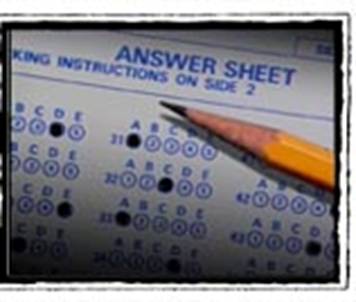
Mock SAT Answer Sheet, October 12, 2010. Source: http://kellgradcoach.blogspot.com

This really is the testing season, isn’t it? In many more ways than one. For voters, the underemployed and the unemployed, the welfare poor, for undocumented workers, for the Obama Administration, for so many others. But the testing season I’m talking about is standardized testing. Between the SAT, GRE, LSAT, MCAT, GMAT, and ACT, high school students and college undergrads face incredible amounts of stress over a five-decade-long practice that, in the end, reveals more about the system of competition that technocratic university administrators and eugenics-type scientists have created than it actually does

ETS Logo, from http://www.ETS.org, October 12, 2010

about our own abilities.


My own standardized testing history includes the following (not counting the AP or New York State Regents exams, which occur in May and June, another testing season), starting with elementary school:

1. SRAs (1st through 6th grade – ironically, started by Lyle Spencer, who also founded the Spencer Foundation, which sponsored my doctoral dissertation research in 1995-96)

2. PSATs (10th grade)

3. SATs (11th and 12th grade)

4. GREs (junior and senior years, Pitt)

5. LSATs (senior year, Pitt)

My highest score on the SAT — 1120 (540 Verbal, 580 Math). My highest score on the GRE — 1730 (530 Verbal, 580 Math, 620 Analytical). On the LSAT, I scored in the 50th percentile, not bad for someone who studied for it for only two weeks. What does any of this prove in the whole scheme of things? Nothing, really. If these scores were truly great predictors of future academic performance, then Harvard, Yale, Princeton and Carnegie Mellon should have graduation rates approaching 100 percent. Which would explain why many elite institutions have either downgraded their use of these tests in their admissions formulas, or in the case of the big three and UC-Berkeley regarding the SAT, are barely using them at all.


My GRE Score, October 1990.

But for most colleges and universities, these tests are a critical factor in a student’s acceptance and enrollment. They are a necessary evil for figuring out who has academic potential and who doesn’t, at least according to ETS and admissions directors. Which is why I still don’t understand why educators and other folks haven’t taken former ETS vice-president Anthony Carnevale’s work around “strivers” seriously. Or, rather, I do understand. Why give someone like me a leg up because my SAT score was an 1120 — giving my score more weight than a 1280 score for a White kid from a middle class background? All scores are equal. That’s why we call them standardized tests, a standard that doesn’t measure up to the realities of earning a degree.


I guess for those I know who are rolling into these exams this fall (and in some cases, before March or April), the best advice I can give is to get the best score you can. But don’t despair if your scores are only in the 51th, 64th, or 74th percentile, like mine were on the different sections of the GRE. What will ultimately matter is how you perform after you’ve been accepted by and enrolled in that institution.

I’ve given some thought to going back to school in the next couple of years, possibly even law school. Not to become a lawyer, but to make myself more marketable outside of academia and within the philanthropic world. For some odd reason, there are lots of people with law degrees who are working in education reform, international development, and social justice. Go figure.

But even this professor will likely have to take the LSATs again in order to apply to a law program at Georgetown, UPenn or some other school. And that will mean trying to figure out why A and B won’t sit together at the same conference table, but B can sit next to E, except when meetings are held on Tuesdays.

Newer posts →

Boy @ The Window: A Memoir

Boy @ The Window: A Memoir

Places to Buy/Download Boy @ The Window

There's a few ways in which you can read excerpts of, borrow and/or purchase and download Boy @ The Window. There's the trade paperback edition of Boy @ The Window, available for purchase via Amazon.com at http://www.amazon.com/Boy-Window-Donald-Earl-Collins/dp/0989256138/

There's also a Kindle edition on Amazon.com. The enhanced edition can be read only with Kindle Fire, an iPad or a full-color tablet. The links to the enhanced edition through Apple's iBookstore and the Barnes & Noble NOOK edition are below. The link to the Amazon Kindle version is also immediately below:

scr2555-proj697-a-kindle-logo-rgb-lg

Boy @ The Window on Amazon.com: http://www.amazon.com/Boy-The-Window-Memoir-ebook/dp/B00CD95FBU/

iBookstore-logo-300x100

Boy @ The Window on Apple's iBookstore: https://itunes.apple.com/us/book/boy-the-window/id643768275?ls=1

Barnes & Noble (bn.com) logo, June 26, 2013. (http://www.logotypes101.com).

Boy @ The Window on Barnes & Noble: http://www.barnesandnoble.com/w/boy-the-window-donald-earl-collins/1115182183?ean=2940016741567

You can also add, read and review Boy @ The Window on Goodreads.com. Just click on the button below:

Boy @ The Window

Twitter Updates

Tweets by decollins1969
  • RSS - Posts
  • RSS - Comments

Archives

  • June 2025
  • April 2023
  • September 2022
  • August 2022
  • July 2022
  • June 2022
  • May 2022
  • April 2022
  • March 2022
  • January 2022
  • December 2021
  • November 2021
  • October 2021
  • September 2021
  • August 2021
  • July 2021
  • June 2021
  • April 2021
  • March 2021
  • February 2021
  • January 2021
  • December 2020
  • November 2020
  • October 2020
  • September 2020
  • August 2020
  • July 2020
  • May 2020
  • April 2020
  • March 2020
  • January 2020
  • December 2019
  • November 2019
  • August 2019
  • July 2019
  • June 2019
  • May 2019
  • April 2019
  • March 2019
  • February 2019
  • January 2019
  • December 2018
  • November 2018
  • October 2018
  • September 2018
  • August 2018
  • July 2018
  • June 2018
  • May 2018
  • March 2018
  • February 2018
  • January 2018
  • December 2017
  • November 2017
  • October 2017
  • September 2017
  • August 2017
  • July 2017
  • June 2017
  • May 2017
  • April 2017
  • March 2017
  • February 2017
  • January 2017
  • December 2016
  • November 2016
  • October 2016
  • September 2016
  • August 2016
  • July 2016
  • June 2016
  • May 2016
  • April 2016
  • March 2016
  • February 2016
  • January 2016
  • December 2015
  • November 2015
  • October 2015
  • September 2015
  • August 2015
  • July 2015
  • June 2015
  • May 2015
  • April 2015
  • March 2015
  • February 2015
  • January 2015
  • December 2014
  • November 2014
  • October 2014
  • September 2014
  • August 2014
  • July 2014
  • June 2014
  • May 2014
  • April 2014
  • March 2014
  • February 2014
  • January 2014
  • December 2013
  • November 2013
  • October 2013
  • September 2013
  • August 2013
  • July 2013
  • June 2013
  • May 2013
  • April 2013
  • March 2013
  • February 2013
  • January 2013
  • December 2012
  • November 2012
  • October 2012
  • September 2012
  • August 2012
  • July 2012
  • June 2012
  • May 2012
  • April 2012
  • March 2012
  • February 2012
  • January 2012
  • December 2011
  • November 2011
  • October 2011
  • September 2011
  • August 2011
  • July 2011
  • June 2011
  • May 2011
  • April 2011
  • March 2011
  • February 2011
  • January 2011
  • December 2010
  • November 2010
  • October 2010
  • September 2010
  • August 2010
  • July 2010
  • June 2010
  • May 2010
  • April 2010
  • March 2010
  • February 2010
  • January 2010
  • December 2009
  • November 2009
  • October 2009
  • September 2009
  • August 2009
  • July 2009
  • June 2009
  • May 2009
  • April 2009
  • March 2009
  • February 2009
  • January 2009
  • December 2008
  • November 2008
  • October 2008
  • September 2008
  • August 2008
  • July 2008
  • June 2008
  • May 2008
  • April 2008
  • March 2008
  • February 2008
  • January 2008
  • December 2007
  • November 2007
  • October 2007
  • September 2007
  • August 2007
  • July 2007
  • June 2007

Recent Comments

decollins1969's avatardecollins1969 on No Good Teaching Deed Goes…
Mary Rose O’Connell's avatarMary Rose O’Connell on No Good Teaching Deed Goes…
Lyndah McCaskill's avatarLyndah McCaskill on The Raunchiest of Them Al…

NetworkedBlogs on Facebook

NetworkedBlogs
Blog:
Notes From a Boy @ The Window
Topics:
My Life, Culture & Education, Politics & Goofyness
 
Follow my blog

616 616 East Lincoln Avenue A.B. Davis Middle School Abuse Academia Academy for Educational Development AED Afrocentricity American Narcissism Authenticity Bigotry Blackness Boy @ The Window Carnegie Mellon University Child Abuse Class of 1987 CMU Coping Strategies Crush #1 Crush #2 Death Disillusionment Diversity Domestic Violence Economic Inequality Education Family Friendship Friendships Graduate School Hebrew-Israelites High-Stakes Testing Higher Education History Homelessness Humanities Humanities Program Hypocrisy Internalized Racism Jealousy Joe Trotter Joe William Trotter Jr. K-12 Education Love Manhood Maurice Eugene Washington Maurice Washington Misogyny Mother-Son Relationship Mount Vernon High School Mount Vernon New York Mount Vernon public schools Multiculturalism MVHS Narcissism NFL Pitt Pittsburgh Politics of Education Poverty President Barack Obama Race Racial Stereotypes Racism Relationships Self-Awareness Self-Discovery Self-Reflection Sexism Social Justice Teaching and Learning University of Pittsburgh Violence Whiteness Writing

Top Rated

Blog at WordPress.com.

  • Subscribe Subscribed
    • Notes from a Boy @ The Window
    • Join 103 other subscribers
    • Already have a WordPress.com account? Log in now.
    • Notes from a Boy @ The Window
    • Subscribe Subscribed
    • Sign up
    • Log in
    • Report this content
    • View site in Reader
    • Manage subscriptions
    • Collapse this bar
 

Loading Comments...