• About Me
  • Other Writings
  • Interview Clips
  • All About Me: American Racism, American Narcissism, and the Conversation America Can’t Have
  • Video Clips
  • Boy @ The Window Pictures
  • Boy @ The Window Theme Music

Notes from a Boy @ The Window

~

Notes from a Boy @ The Window

Tag Archives: Academia

Golden State Spencer Fellows

12 Saturday Feb 2011

Posted by decollins1969 in 1, Academia, Boy @ The Window, Eclectic

≈ Leave a comment

Tags

Academia, Academic Arrogance, Ambivalence, Berkeley California, Catherine Lacey, Fellows, Misfits, Morgan Freeman, Publish-or-Perish, Shawshank Redemption, Spencer Foundation, Spencer Foundation Dissertation Fellowship Program, UC Berkeley, West Coast


Spencer Foundation Dissertation Fellows Retreat, Berkeley, CA, February 17, 1996. Donald Earl Collins (psst - I'm the young and cute Black guy in the white turtleneck in the back row)

Fifteen years ago this week I went on my first trip to the West Coast. It was for a Spencer Foundation Dissertation Fellows retreat in some villa of a conference center just off UC Berkeley’s campus. It was our second meeting as a cohort, presenting some of our doctoral thesis work in front of a group of professors from Berkeley, Stanford, UCLA and other places. It was also a chance for the thirty-three of us to meet the selection committee that had made it possible for us to be Spencer Foundation Dissertation Fellows in the first place. We spent so much time in Berkeley and in Oakland that most of us didn’t bother to take the BART into San Francisco, so the trip was a failure in that area — not really.

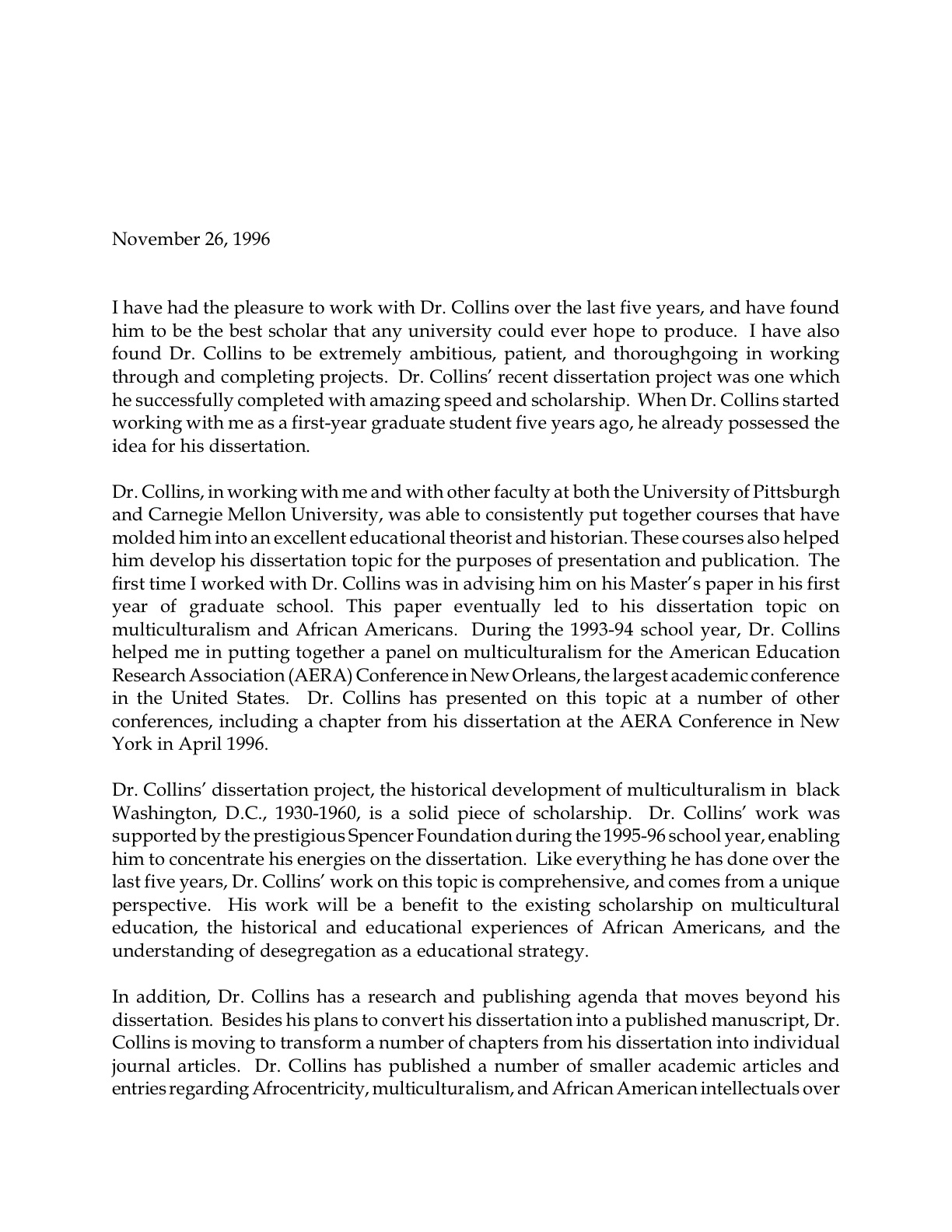
But it was very important in one aspect above all else. I learned during our three days of meetings how I wasn’t alone in the world of academia. That I wasn’t the only misfit was the first revelation. There were other Fellows whose departments and classmates had shunned them and their work because it touched on the “soft” field of education. Or because it wasn’t hardcore quantitative analysis. Or because they weren’t thirty years old yet. Or even because of the age-old academic issues of looking at educational issues through the trifocal lens of race, gender and class.

Some of us talked about our dissertation advisors and their lack of support for us and our work. We were individuals who had won a prestigious individual award and a $15,000 grant to research and write a doctoral thesis, but somehow had managed to do this without the support of tenured faculty at major, even elite, universities! I found that fascinating. I also would’ve found that unbelievable if my advisor hadn’t been Joe Trotter. We didn’t have any obvious solutions to the problem of asshole advisors who may well not have supported us on the job market. Nor did we have a solution to their midlife crises or male pattern baldness. Yet it was good to spend significant time talking about this.

I also discovered through this retreat that I wasn’t the only one of us ambivalent about having a career as a professor. It didn’t help that we had a freshly minted associate professor from U Chicago talking to us about her average work week. Not because a forty to forty-five hour work week seemed anywhere close to arduous. At least to me. The half of the Fellows who really did want academic careers moaned quite loudly at the prospect of teaching, research, writing and serving on committees for so many hours. I, among others, looked at the list and found it rather mundane and restricting.

Many of us were concerned about becoming institutionalized, kind of like the way Morgan Freeman’s character “Red” talked about it in Shawshank Redemption. My own fear was that I could make myself a successful academician, molding my imagination and writing more fully into the forms of academic prose. Meaning that I wouldn’t be able to communicate with anyone outside of my subfield or field, and certainly not with the general reading public, who usually wouldn’t use words like fait accompli unless they were French speakers. There were a few other Fellows who didn’t want to write or do research at all. They wanted to teach, to change the world of K-16 education somehow.

Catherine Lacey, the director of the Dissertation Fellowship program at the time, concluded with a lofty and philosophical speech about our bright futures. It was a good speech. It made me begin to think about what to do with my life if I didn’t get a full-time gig as faculty at an elite university. For many of us, though, this would also be the last time we could be this honest about our hopes, fears, and warts when it came to our doctoral theses and post-doctoral careers. If only I had known about the Ford Foundation’s associate program officer program when it existed back in ’96.

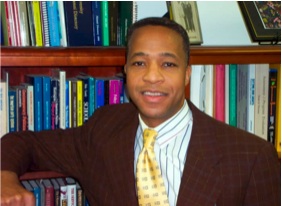
Letter of Recommendation (or Wreck-o-mendation)

23 Thursday Sep 2010

Posted by decollins1969 in 1, Academia, Boy @ The Window, Eclectic, Mount Vernon High School

≈ Leave a comment

Tags

Academia, Carnegie Mellon University, Dan Resnick, Daniel P. Resnick, George Reid Andrews, Joe Trotter, Joe William Trotter Jr., Letters of Recommendation, Pittsburgh, Race, References, Sy Drescher, Transparency, University of Pittsburgh


George Reid Andrews, University of Pittsburgh

About a year and a half ago, I wrote about a string of not-so-wonderful professors I had at Pitt and Carnegie Mellon who were less than fine with me pursuing anything beyond a bachelor’s degrees, much less with me becoming Dr. Collins. I talked about how some of them went so far as to tell me that I wasn’t “graduate material,” as if I were made from parts found at a junk yard instead of in the shop of an Italian tailor.

I’m more than aware of the fact that I didn’t let those doubters stop me from becoming who I am today. Some were undoubtedly ones whose skepticism bordered on racist because of their assumptions about my intelligence and writing ability. Still, it should be noted that there are pitfalls to be avoided, if at all possible, when you’re applying for a job or applying to a college or graduate and professional school.

One, even if a professor or teacher has assigned an A for your performance in one of their courses, that doesn’t mean that think that you’re a great student. I learned that the hard way with George Reid Andrews, my professor for Latin American Revolutions my junior year at Pitt. Twenty years ago this week, I asked him for letters of recommendation for graduate school. Andrews agreed, but only to tell me seven months later what he really thought of my work. My research writing samples were “problematic,” my GRE scores were “barely adequate,” and I should’ve considered myself “lucky” just to get into the master’s program in the history department. That terse conversation told me that Andrews’ letter was lukewarm at best, or had found me seriously deficient at worst.

Two, and related to my interactions with Andrews, the process of providing a letter of recommendation or a reference ought to be transparent, so that the student or employee can be confident that they’re not being back-stabbed by the same people in which they’re placing significant trust. It was never a question I dared asked — to see my letter of recommendation — before I’d reached the final stages of grad school.

It would’ve helped with Andrews, and it would’ve helped with two of my three dissertation committee members, Joe Trotter and Dan Resnick. I found out through my Spencer Fellowship that Trotter had written me a lukewarm letter, while Resnick had rambled on and on about my “close relationship” with my “mentor Sy Drescher,” who had played “an instrumental role” in making me a scholar. Drescher, while one of my best professors at Pitt, played much less of a role in me pursuing grad school than so many other professors and students, including his former student Paul Riggs. It was a Leslie Stahl, “let’s give the poor Black boy a hand” kind of letter.

Later, when I asked to see my letters of recommendation from Resnick before sending them out for jobs, he went on for ten minutes about the “sanctity” of the recommendation process, about how privacy and “anonymity” were critical to provide protection for all parties involved. Needless to say, if someone blusters about privacy when politely asked about a letter of recommendation they’re writing for you, do not use that letter!

Bruce Anthony Jones, University of South Florida

Three, it’s important to get to know a person, to gain some sense of trust from them, before asking for a letter or a reference. You don’t have to become friends with them or meet their family — although that does help. They just have to know that their recommendation or reference will be put to good use by you and that what they say about you matters to both of you, in the most positive light possible. Otherwise, what’s the point of writing a letter or spending fifteen minutes on the phone talking about your qualities as a student or worker, right? This can go a bit too far, of course, as I wrote one of my own recommendations for Bruce Anthony Jones, another dissertation committee member, for him to merely put his signature to. Once he changed jobs for the University of Missouri-Columbia, his, um, my letter became worthless, if it had been worth anything at all to begin with.

I’ve written about two dozen letters of recommendation for high school, college and graduate students, for jobs, school applications and fellowship programs. Not to mention about an equal number of recommendations and references for professional colleagues and friends in academia and the nonprofit world. I’ve always written my own letters, insisted on them being seen by the people I’ve recommended and required that they explain their own rationale for their acceptance in the process. Most importantly, I’ve made sure to say “No” if I didn’t feel I could recommend them well or provide a great reference.

And Now, A Plagiarism Moment

13 Monday Sep 2010

Posted by decollins1969 in 1, Academia, Boy @ The Window, Eclectic, race

≈ Leave a comment

Tags

Academia, Black Issues in Higher Education, Carnegie Mellon University, Dan Resnick, Daniel P. Resnick, Department of HIstory, Plagiarism, University of Pittsburgh


Professor Emeritus Daniel P. Resnick. Source: http://www.cmu.edu

I was sitting in the office of the only professor in Carnegie Mellon’s History Department with expertise in the area of history of education one mid-September day in ’93. It was my first semester in the doctoral program there, after transferring from Pitt to finish my PhD. I had already begun to question my decision to do my remaining studies there. My advisor Joe Trotter was “upset” that I’d taken and passed my doctoral written exams the spring before, when I was still technically a Pitt grad student, and had “run interference” to forbid me from publishing any new articles during the ’93-’94 school years. That was after my piece with my friend Marc had come out in Black Issues in Higher Education.

Steve Schlossman, the chair of the history department, was also upset, because I had decided not to take the American history proseminar, a course for first semester grad students. Apparently, even though I had taken the same course at Pitt two years before — and Carnegie Mellon had accepted all of my credits from my master’s program and first year as a doctoral student at Pitt — I had to take this course. I was read the riot act and told that I needed Carnegie Mellon’s “stamp of approval” before becoming a doctoral candidate. I was incensed, because this wasn’t what I’d been promised by my esteemed advisor and the graduate advisor, John Modell.

All this happened before I met Daniel P. Resnick in his office on Tuesday on a cool, but not too cool, and sunny late-summer day. His office was neat, relatively speaking, but spare and spartan in some ways, with books stacked in orderly fashion, and papers in numerous labeled folders. What I noticed the most was the smell, an old person’s not-fully-washed smell, of bagels and lox with some onion cream cheese.

Professor Resnick had gone to the restroom and left the door open for me to sit at a table next to his desk. He had already laid out my writing samples, the ones I’d put in his mailbox the week before. They included the Black Issues in Higher Education piece. After our exchange of greetings, Resnick sat down and said, “Considering your background, your writing is remarkable!” in a way that showed real surprise.

Before I could respond with a defense or process the obvious bigotry in that statement, Resnick then said, “There’s no way you could’ve written all this.” I responded, “Well, I did, and have the grades and degrees to prove it,” preferring not to accuse the only professor in the department with a specialty in the history of education of racism. “What-what I meant was, your papers are well-written…compared to most young scholars,” Resnick stammered. I accepted that response at face value, but kept what he had said before it in mind as I worked with him over the next three years.

Resnick, as it turned out, had lived for a year with his wife, the great Lauren Resnick, on the Mount Vernon-Bronxville border in 1960-61 (one of them was teaching at Sarah Lawrence, I think), so after finding out where I grew up, he had put two and two together and come up with sixteen. I found him patronizing, and about as knowledgeable in the recent developments of educational history as I would be of underground house music in Chelsea right now. Resnick himself had plagiarized, not in terms of his own work, but from the race relations rule book. He had plagiarized in stereotypes, far worse than anything of which he’d accused me.

Was it worth having this man on my dissertation committee? Yes, because I graduated. But, in the final analysis, it would’ve made more sense to transfer to NYU or Stanford School of Education than to spend three minutes, much less three years, working with a man whose belief in my work was minimal at best.

Outrage, Maybe

18 Tuesday May 2010

Posted by decollins1969 in 1, Academia, Eclectic

≈ Leave a comment

Tags

Academia, Carnegie Mellon University, Graduate School, Joe William Trotter Jr., Outrage (HBO 2009), Power, Race


Today’s date makes it thirteen years since I marched in my polyester cap and gown in a hot and humid tent on Carnegie Mellon’s campus to receive my doctorate. It should’ve been a great day, but it was a bittersweet one. For it revealed far more about my mother’s imperfections and jealousies than I ever wanted to know (see “My Post-Doctoral Life” post from May 18, ’08). That was sad, and remains one of the worst times in my life. Not just because of my relationship with my mother since then. Because, as a result of her actions, I never did get the chance to properly accept my degree in an individual department ceremony, in front of my closest peers, my former professors, and especially my dreaded advisor, Joe Trotter.

Outrage Poster (HBO, 2009)

About two months ago, I saw the documentary (finally) Outrage on HBO. Outrage, for those of you who haven’t watched, is the story about powerful Washington politicians and operatives, ones who’ve used their power to discriminate against gays and lesbians, really the whole LGBT community. Ones whom themselves are gay, deep in the closet, but gay. Ones whom folks like Michael Rogers have made a point of exposing their hypocrisy by outing them. Everyone from Ed Koch — which explained a lot to me, seeing as I found the former mayor of New York from ’77 to ’89 an enigma while I was growing up — to Larry Craig and Florida Governor Charlie Crist was in the film.

It was a good film, and a revelation to me. The lengths to which people in powerful position and places will go to protect their secrets, their power, by destroying others if necessary. It’s safe to say that this is how I see my former advisor as well. I’m not suggesting that Joe Trotter is gay or in the closet, for I have no evidence of this (or of his heterosexuality, for that matter!). But, the film helped me realize that a person doesn’t have to have a secret of the magnitude of being gay in a homophobic society to be a hypocrite. Being Black on a historically anti-Black campus like Carnegie Mellon could just as easily do the trick.

It may be impossible for my former advisor to hide his skin color, but boy did he try to get me to hide my Blackness by doing what he called “running interference” on me on multiple occasions. He tried to forbid me from doing conference presentations, at AERA and on the 40th anniversary of Brown v. Board of Education at the University of Georgia. From sending drafts of articles to the Journal of American History and other scholarly publications. Trotter practically blew his shiny-headed top when he found out

Professor Joe William Trotter, Jr. (circa 2008)

about my feature piece (done with my friend Marc) in Black Issues in Higher Education back in ’93. There was something there with Trotter that I didn’t take the time to piece together when I was his student, as I was too busy trying to get out of there as fast as I could.

Yet, there are signs that Trotter was “in the closet” about something, be it race, jealousy, sexual orientation, maybe even a rough upbringing. At least two other male students, one who graduated a year ahead of me, the other who never finished his dissertation, who had problems with Trotter, personality conflicts, confounding issues that went unexplained. Even when each of us took into account Trotter wanting his “proletarianization hypothesis” in our doctoral dissertations.

Whatever it was, it was enough where he all but refused to help any of us — male or female — find work or  get postdoctoral fellowships, even after finishing our doctorates. What a hypocrite! His thirty years of scholarship have been all about recognizing the active role ordinary Blacks played in shaping their lives and communities, despite racism and violence. His role with me and other students was in opposition to his own research, at least during my time there.

If I’d had the chance to speak at the individual ceremony thirteen years ago, especially after watching something like Outrage, I’d have said the following. That as much as liked working with my advisor at the beginning of our four years of working together, that I always felt uneasy about his guidance. That there was always a sense that I hadn’t fulfilled my end of the bargain, that I hadn’t met my half of the quid pro quo. And that because I was a late-bloomer in many respects, sex included, I couldn’t fully understand what he really expected of me beyond my academic work. It’s too bad he didn’t come out and say whatever it was he wanted from me, it would’ve made both of our times working with each other easier. Too bad, for in the end, it was his loss, of a friend and potential colleague, not mine.

Where Grace and Rhodes Meet

04 Tuesday May 2010

Posted by decollins1969 in 1, Academia, culture, Eclectic, Politics, race, Sports

≈ Leave a comment

Tags

Academia, Culture, Harvard Law School, Intelligence, Myron Rolle, NFL, Race, Rhodes Scholarship, Sports, Stephanie Grace


In the past couple of weeks, two incidents have occurred that have brought attention to race and intelligence in America — again. One really is an incident, though, while the other is a continuing conversation about the head-scratching that goes on when someone personifies the idea of the anti-stereotype in a world full of them. Both make me cringe, even as I know that people like me can’t allow others to define us.

Over the past week, there’s been a minor firestorm blowing over comments from the soon-to-be Harvard Law School graduate, the amazing Stephanie Grace. She inserted foot-in-mouth — or, rather, fingers up her butt — regarding her wanting to keep open the option of the possibility that African Americans may be predisposed to being intellectually inferior to Whites. The fact that she sent this out to the Black Law Student Association at Harvard as an email was somewhere between foolish and obnoxiously audacious. The contents of her email, a display of the thoughts of someone about to begin a federal clerkship in the next few months is disturbing. It’s not just because Grace has spent the past three years at Harvard Law. It’s also because she spent that time there in a school with the likes of Charles Ogletree, Lani Guinier, and Randall Kennedy — all Black or Biracial — teaching there.

There will be no rationale refuting Grace’s idiotic email here, because my own very existence as a writer, professor and educator — not to mention the millions of highly educated people of color like me — should be enough. But for folks whose minds remain mesmerized by the eugenics movement and Nazi experiments in the first half of the twentieth century, no amount of evidence against their racist views would be enough.

Just ask Myron Rolle. He was the last person drafted in the sixth round of the NFL draft that occurred a little more than a week ago. All because he took a year off from playing football at the end of his college experience at Florida State University to — of all things — go to Oxford University in the UK to study medical anthropology for a year as a Rhodes Scholar! Rolle became the 207th overall pick because NFL geniuses in the front office suspected that the future neurosurgeon had a mixed set of priorities, that he couldn’t both play football and be interested in another demanding and rewarding career that would require raw intellectual talent. Teams passed on him because he accepted a Rhodes Scholarship and decided to postpone playing in the NFL for a year.

A scholarship that only former NBA players like Bill Bradley and Tom McMillen, and former NFL quarterback Pat Haden were able to obtain. Not to mention such luminaries as former POTUS Bill Clinton, Susan Rice (high-level official in the State Department under the Obama Administration), Newark mayor Cory Booker, and MSNBC commentator and host Rachel Maddow. But, I guess African American male athletes are only supposed to eat a bag full of oats and then run a 4.3-40-yard-dash, rather than explore the neurology of the human brain.

Former Baltimore Ravens coach Brian Billick insinuated that NFL players can’t be thinkers, at least intellectual ones, because that would mean they would get clobbered playing the game. Other coaches and GMs simply questioned Rolle’s commitment. I question their faulty and bigoted logic. It’s not every day that a Black athlete at a NCAA Division I football school can flex his intellectual muscles as easily as he can bench press 400 or 500 pounds. Maybe that’s what was so scary about Rolle.

Except that it shouldn’t have been scary at all. Indianapolis Colts star Peyton Manning stayed an extra year at the University of Tennessee, and not just to use up his last year of eligibility. Having finished his bachelor’s degree in four years (he was red-shirted his freshman year), Manning spent his fifth year working on a master’s degree. Hall of Famer Steve Young worked on a law degree at Stanford while playing for the San Francisco 49ers, during a stretch that included a Super Bowl win. But Rolle isn’t any of those guys. They’re White, and quarterbacks at that. They need to be smart. Cornerbacks in the NFL, on the other hand, don’t need to use their brains to read the difference between a screen pass, an out route, a go route or a skinny post, right?

What both cases show is that there’s an alarming portion of our population who find it easier to believe that African Americans have low intellectual potential. What’s even more significant, though, is that many of these same folks become agitated, even fearful, of educated Blacks, particularly Blacks who are their intellectual superiors. It’s an agitation I’ve been all too familiar with for nearly twenty years. With White professors who’ve allowed students to speak racial stereotypes to and about me in their classrooms, who’ve accused me of plagiarism, and refused to help me find a job because they thought I would just get one because I’m Black. With White supervisors who’ve accused me of being everything but a child of God because they thought I was after their job, or used me as part of a dog-and-pony show to get money from corporate funders. It’s something that I don’t expect to go away anytime in the immediate future.

Which is why I found it astounding to read a comment on another blog about the Stephanie Grace issue last week. A recent law school graduate talking about his experience as a young African American male lawyer, in which he felt he had to constantly disprove stereotypes while proving himself at some New York law firm. He advised folks thinking about becoming lawyers to not pursue the profession, which is about as sane as saying that melanin, genetics and intelligence are inextricably linked.

Even in the absence of racism, we all have to compete, to prove ourselves, to overcome in order to be successful in this world. It’s not about others bigotry and their attempts to stifle your success or career. It’s about proving to yourself how good you are, about how successful you can be, in law or any other field. Not to mention giving yourself financial security, finding work that you can be passionate about (even when it doesn’t bring riches), taking care of your family and yourself, helping other cope and be successful in an insane world. You can’t avoid idiots. I learned that ages ago, the hard way, with my former advisor Joe Trotter at Carnegie Mellon, who, by the way, is African American. We have to keep walking our path, to get beyond the corner of Grace and Rhodes, in order to be to Colossus we hope we are.

Comparative Slavery

20 Tuesday Apr 2010

Posted by decollins1969 in 1, Academia, race

≈ Leave a comment

Tags

Academia, Comparative Slavery, Graduate School, Paul Riggs, Race, Seymour Drescher, South Africa, University of Pittsburgh, Writing


This time twenty years ago, I was finishing up what would turn out to be my first 4.0 semester at Pitt as an undergrad. I’m not bragging, even though my wife once thought I was (more on that in a few days). Key to the way that semester turned out — academically, at least — was a graduate course I talked myself into my junior year, Comparative Slavery. I found a loophole in the University of Pittsburgh handbook that allowed an undergrad to take a graduate school if that course would eventually be used as credit toward a master’s degree in that student’s fifth year. Somehow, I convinced my advisor and an administrator to let me take the course. Groveling and highlighting of obscure rules in the Pitt handbook were involved, though.

It was a good course, taught by Sy Drescher, whose scholarly research we in the history field would now consider part of Transatlantic Studies, as he looked at slavery from the standpoint of its impact on European notions of freedom, as much as he looked at the slave trade itself. As an aside, my nutty Carnegie Mellon University professor Dan Resnick once wrote a letter of recommendation for me to the Spencer Foundation discussing how huge an impact Drescher had on me as a student, which helped me become the great grad student I was. It was a bigoted, paternalistic letter, and I don’t think Drescher would’ve appreciated it if he had known about it. Drescher was one of my best professors at Pitt, undergrad and grad, but his student Paul Riggs was the one who had made a big impression on me in terms of my decision to pursue history as a degree, and to a large extent a profession.

But I digress, once again. This was my second course with Drescher as my professor. My freshman year, I had taken his Western Civilization II course (about how Europe came to dominate the world, 1492-present). It was a great course, and when I saw that he was teaching this one, I sought advice from Paul about the course and about his advisor, all of which convinced me to take it. I learned so much in that semester from that course, and not just the academic content. The fact that American slavery wasn’t the worst in the Western Hemisphere, the fact that the slave trade continued because the average life expectancy of slaves in places like Brazil and Haiti was about seven years, the fact that slavery and the slave trade made money for everyone involved, including West Africans. It was an eye-opening course.

I also learned a few important life and academic socialization lessons. I was in a class of seven people, including about three veteran grad students, a grad student who was the son of a famous civil rights leader, and a nineteen-year old first-year grad student who had gone off to college at the age of fifteen. Listening to these folks debate serious historical issues week after week was fun at first. Until I realized that some of them didn’t know what they were talking about. That at least two were classic yet sophisticated brown-nosers, attempting to sell arguments that would most likely impress Drescher (luckily, our professor didn’t like brown-nosers). And that there were many moments when all seven of us would sit in our grad seminar stumped by a question Drescher asked us about our readings for that week. I learned that students with master’s degrees or working on master’s degrees weren’t any more intelligent than I was as a college junior, or for that matter, when I was a high school junior. They simply read more on a given set of topics, much more in some cases than ninety-five percent of the educated public.

We had a primary source research paper on comparative slavery to do that semester, one that was supposed to be between twenty-five and thirty-five pages long. I decided to do mine on slavery in South Africa versus slavery in the US. It was a continuation of my undergraduate interest in South Africa that had developed my sophomore year. It turned out that with the other paper assignments and readings, Drescher realized that no one in the class would have their papers ready in time to submit by the end of April. So a week before the papers were due, he assigned us all “I” grades (incomplete) and told us to get our papers done as soon as possible.

It put me in a weird position, because I wasn’t a grad student. My semester Work-Study job was up, and I had made plans to be in Mount Vernon that summer working for Westchester County Department of Community Mental Health again. So it meant that I needed a job and some money in May and possibly June, I needed to extend my one-room efficiency lease, and I needed to turn a seventeen-page draft into a workable document of at least twenty-five pages. The last part was the easiest, since I had access to British parliamentary document and documents from the colonial government in South Africa about the conditions of slaves and the laws about slavery in that part of the world, all on microfiche. I just needed time to work on it.

Plus, I needed to get over the fact that I had earned A’s in my other four courses that semester: Latin American Revolutions, History of Africa to 1800, History of Blacks in Sports, and American Working-Class History. I had learned that semester how to be a cool nerd, to be diligent, to be social, to hang out when I made the time, and to study when I made the time as well. I had found balance in my life and broken free from six years of Humanities thinking. I no longer obsessed about A’s, which I believed was why I was doing nothing but earning them that semester.

So I did nothing on the comparative slavery paper in the first seventeen days of May. I worked my idiot job at Campos Market Research, where one of my friends and my eventual wife worked (again, more about that in a couple of days). I hung out with E (see “The Power of Another E” post from April 2009) and my other folks, took some driving lessons, went to see the Pirates play, cried about my Knicks again, and watched the Detroit Pistons clothesline players on their way to the hoop. I read the Autobiography of Malcolm X for the first time, and learned that life really is ironic as a result of reading his story.

Then I got a call from my eventual boss with Westchester County, telling me I had until June 19 to start my job if I still wanted it for the summer. That, and Drescher about to go on vacation after Memorial Day sent me into overdrive. It took a week, but I wrote, cut, wrote and revised my paper until it was thirty-four pages long and had enough endnotes to take up another six pages. It was by far the best academic writing I’d done up to that point in school. I think that Drescher was so happy that any of us turned in a paper that made any sense at all that he graded me on a curve and gave me an A. Honestly, I was just happy to have it out of the way.

I knew by the end of May that I was ready for grad school. It would take until I was done with my doctorate to prove to people like Dan Resnick, though, that I was truly grad school material. Either way, I think of that semester and this course and realize that while I would always care about my grades, I stopped worrying about them after that. And that really is a kind of freedom that can’t be underestimated, especially going into my senior year and in those six years of grad school that came after. I think that this experience helped me to become a better and more confident me.

Pressure

09 Friday Apr 2010

Posted by decollins1969 in 1, Academia, culture

≈ Leave a comment

Tags

Academia, College, Higher Education, Mental Health, Stress, Student Development, Teaching and Learning


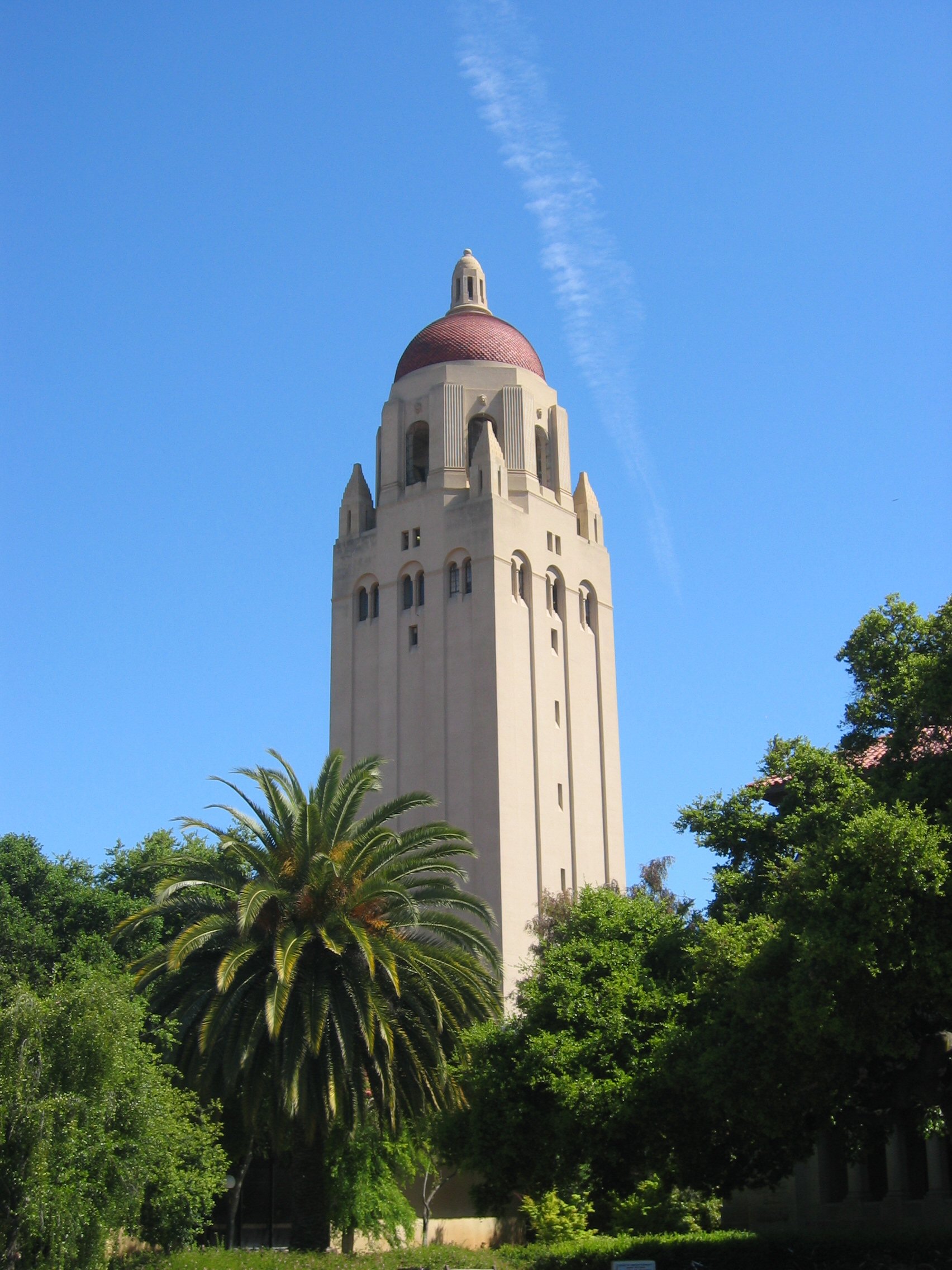
Stanford University's Hoover Tower

This week, The Daily Beast posted their piece “The 50 Most Stressful Colleges” (see link: http://www.thedailybeast.com/blogs-and-stories/2010-04-04/the-50-most-stressful-colleges/?cid=hp:beastoriginalsC1). In the piece, the writer or writers emphasized five (5) criteria for college stressfulness: 1) cost; 2) competitiveness; 3) acceptance rate; 4) engineering; and 5) crime on campus rates. Sounds great right? Not if the writer or writers relied mostly on US News and World Report for most of their data in ranking what they believe are the Top 50. It seems to me that reporters with little background in higher education, the psychology of talented high school youth and college students, or financial aid should refrain from writing about such a topic. Still, since they did bring the subject up, it’s probably a good idea to address it from perspectives The Daily Beast would likely not consider.

For starters, the high correlation between their five criteria and the most prestigious research universities in the country — including Harvard, Princeton, Columbia, Stanford, University of North Carolina, and my doctoral alma mater, Carnegie Mellon University — seems okay on the surface of things. But really, are students at the University of Pittsburgh who are engineering majors less stressed out than English majors at Carnegie Mellon? Or could a student at a liberal arts school like Oberlin be experiencing higher levels of stress than a student at a school not on The Daily Beast’s list — say George Washington University?

Based on my own experiences as a professor and a student, yes, highly selective, research-oriented universities with competitive engineering programs can deliver stress to students on a platter. Yet, it’s not as if the other liberal arts colleges, state colleges and universities, and schools of similar elite ilk not on the list. The Daily Beast could’ve used pre-med and biology programs — such as those at Tufts and Johns Hopkins — as examples of competitiveness, as if engineering students are particularly prone to stress and suicide. I think, though, that this is the main point about The Daily Beast’s piece. It’s the taking of the recent news stories — students killing themselves or murdering students and faculty — and drawing the conclusion that it’s combination of the criteria that’s the difference here.

The piece discounts the experience of millions of college students under the stress of financial aid, whose programs, though not as prestigious, are likely as demanding, and with the pressure of high expectations from their schools and their families. It discounts students, quite frankly, and the baggage they bring with them when they enter college. The schools they list could cost $150,000 a year to attend, have acceptance rates or eight percent or less (I have no idea how Carnegie Mellon made their list with a thirty-seven percent acceptance rate), and pressure-cooker engineering programs, but the suicide rate and violent crime rate would likely not correlate at all. It’s all about how students handle pressure, and how schools help students with managing the pressures they experience at competitive and selective colleges and universities.

I should know. Halfway through my first semester at the University of Pittsburgh, I experienced stress because of the baggage I brought from my Mount Vernon High School days, specifically in the form of a young woman I wanted to date but couldn’t. I spent the last six weeks of that semester missing more than sixty percent of my classes, withdrew into a alcohol-binge one weekend, and generally didn’t seek any social outlets for my emotional and psychological pain. Because I knew that there was a stigma attached to seeking psychological help, I didn’t, and struggled my way through the end of ’87 and into the first days of ’88 wondering if the sacrifices I made to get into college in the first place were actually worth it.

I think that student mental health is a much neglected aspect of pre-K to graduate education. Period. We act as if students and parents are solely responsible for the maintaining of student mental health, when in point of fact, most students and parents see the exploration of the subject as a stigma of some sort. Of course they are wrong. Still, I think that every school and every school district in this country should have at least one psychologist on staff (age-appropriate, of course), and that every student be given a mental health evaluation at least once a year.

Going a step further, I think that mental health fitness should be a part of the college admissions process, and that students who have the academic abilities but show signs of mental health issues be given additional resources to deal with these issues before the stress of higher education has had a chance to effect their undergraduate journey. I also don’t think it would hurt to make faculty, staff and administrators at universities to take professional development seminars in student psychology, so that they themselves can understand the difference between normal and abnormal behaviors of their students.

Some of you will think this idea beyond crazy. After all, those who can’t cut it are losers, right? And, since when can a university look at the mental health fitness of applicants, anyway? How many parts of doctor-patient privilege don’t I understand? I never said that this would be a perfect solution. This would provoke a number of controversies and lend itself to multiple obstacles. On the other hand, wouldn’t it be good for students and parents to have a sense of the kinds of stresses that can affect the well-being — academic and otherwise — of someone before they went off to a college or university?

Perhaps the biggest obstacle of all on this matter is the issue of competition. There’s nothing wrong with having students in a competitive environment. It often brings out the best in them academically (and the worst, unfortunately, hence my comments in the previous two paragraphs). Suffering setbacks in the process of competition can even teach us more about ourselves and the world around us than constant success. That’s what folks say, at least. So students shouldn’t be afraid to compete. But college campuses — and public schools also — should wrap this competition in a velvet cocoon of excellence. Meaning that from an early age, students are encouraged to strive for and achieve excellence, academically, socially, athletically, and so on. Along the way, healthy competition should be inculcated, but within the context of students performing well to begin with.

All so that by the time students arrive on a college campus, the stress of competition is managed through an atmosphere that is all about excellence. This is not a zero-sum game where the winner takes all and the loser should think about becoming a janitor. These are human beings, after all, whose lives should be about more than A’s, and competition about more than destroying their opponents. It took me until my third semester at Pitt to learn that lesson, which made my transition to a healthier mental health easier.

Newer posts →

Boy @ The Window: A Memoir

Boy @ The Window: A Memoir

Places to Buy/Download Boy @ The Window

There's a few ways in which you can read excerpts of, borrow and/or purchase and download Boy @ The Window. There's the trade paperback edition of Boy @ The Window, available for purchase via Amazon.com at http://www.amazon.com/Boy-Window-Donald-Earl-Collins/dp/0989256138/

There's also a Kindle edition on Amazon.com. The enhanced edition can be read only with Kindle Fire, an iPad or a full-color tablet. The links to the enhanced edition through Apple's iBookstore and the Barnes & Noble NOOK edition are below. The link to the Amazon Kindle version is also immediately below:

scr2555-proj697-a-kindle-logo-rgb-lg

Boy @ The Window on Amazon.com: http://www.amazon.com/Boy-The-Window-Memoir-ebook/dp/B00CD95FBU/

iBookstore-logo-300x100

Boy @ The Window on Apple's iBookstore: https://itunes.apple.com/us/book/boy-the-window/id643768275?ls=1

Barnes & Noble (bn.com) logo, June 26, 2013. (http://www.logotypes101.com).

Boy @ The Window on Barnes & Noble: http://www.barnesandnoble.com/w/boy-the-window-donald-earl-collins/1115182183?ean=2940016741567

You can also add, read and review Boy @ The Window on Goodreads.com. Just click on the button below:

Boy @ The Window

Twitter Updates

Tweets by decollins1969
  • RSS - Posts
  • RSS - Comments

Archives

  • June 2025
  • April 2023
  • September 2022
  • August 2022
  • July 2022
  • June 2022
  • May 2022
  • April 2022
  • March 2022
  • January 2022
  • December 2021
  • November 2021
  • October 2021
  • September 2021
  • August 2021
  • July 2021
  • June 2021
  • April 2021
  • March 2021
  • February 2021
  • January 2021
  • December 2020
  • November 2020
  • October 2020
  • September 2020
  • August 2020
  • July 2020
  • May 2020
  • April 2020
  • March 2020
  • January 2020
  • December 2019
  • November 2019
  • August 2019
  • July 2019
  • June 2019
  • May 2019
  • April 2019
  • March 2019
  • February 2019
  • January 2019
  • December 2018
  • November 2018
  • October 2018
  • September 2018
  • August 2018
  • July 2018
  • June 2018
  • May 2018
  • March 2018
  • February 2018
  • January 2018
  • December 2017
  • November 2017
  • October 2017
  • September 2017
  • August 2017
  • July 2017
  • June 2017
  • May 2017
  • April 2017
  • March 2017
  • February 2017
  • January 2017
  • December 2016
  • November 2016
  • October 2016
  • September 2016
  • August 2016
  • July 2016
  • June 2016
  • May 2016
  • April 2016
  • March 2016
  • February 2016
  • January 2016
  • December 2015
  • November 2015
  • October 2015
  • September 2015
  • August 2015
  • July 2015
  • June 2015
  • May 2015
  • April 2015
  • March 2015
  • February 2015
  • January 2015
  • December 2014
  • November 2014
  • October 2014
  • September 2014
  • August 2014
  • July 2014
  • June 2014
  • May 2014
  • April 2014
  • March 2014
  • February 2014
  • January 2014
  • December 2013
  • November 2013
  • October 2013
  • September 2013
  • August 2013
  • July 2013
  • June 2013
  • May 2013
  • April 2013
  • March 2013
  • February 2013
  • January 2013
  • December 2012
  • November 2012
  • October 2012
  • September 2012
  • August 2012
  • July 2012
  • June 2012
  • May 2012
  • April 2012
  • March 2012
  • February 2012
  • January 2012
  • December 2011
  • November 2011
  • October 2011
  • September 2011
  • August 2011
  • July 2011
  • June 2011
  • May 2011
  • April 2011
  • March 2011
  • February 2011
  • January 2011
  • December 2010
  • November 2010
  • October 2010
  • September 2010
  • August 2010
  • July 2010
  • June 2010
  • May 2010
  • April 2010
  • March 2010
  • February 2010
  • January 2010
  • December 2009
  • November 2009
  • October 2009
  • September 2009
  • August 2009
  • July 2009
  • June 2009
  • May 2009
  • April 2009
  • March 2009
  • February 2009
  • January 2009
  • December 2008
  • November 2008
  • October 2008
  • September 2008
  • August 2008
  • July 2008
  • June 2008
  • May 2008
  • April 2008
  • March 2008
  • February 2008
  • January 2008
  • December 2007
  • November 2007
  • October 2007
  • September 2007
  • August 2007
  • July 2007
  • June 2007

Recent Comments

MaryPena's avatarMaryPena on My Day of Atonement/Bitter Hat…
decollins1969's avatardecollins1969 on No Good Teaching Deed Goes…
Mary Rose O’Connell's avatarMary Rose O’Connell on No Good Teaching Deed Goes…

NetworkedBlogs on Facebook

NetworkedBlogs
Blog:
Notes From a Boy @ The Window
Topics:
My Life, Culture & Education, Politics & Goofyness
 
Follow my blog

616 616 East Lincoln Avenue A.B. Davis Middle School Abuse Academia Academy for Educational Development AED Afrocentricity American Narcissism Authenticity Bigotry Blackness Boy @ The Window Carnegie Mellon University Child Abuse Class of 1987 CMU Coping Strategies Crush #1 Crush #2 Death Disillusionment Diversity Domestic Violence Economic Inequality Education Family Friendship Friendships Graduate School Hebrew-Israelites High-Stakes Testing Higher Education History Homelessness Humanities Humanities Program Hypocrisy Internalized Racism Jealousy Joe Trotter Joe William Trotter Jr. K-12 Education Love Manhood Maurice Eugene Washington Maurice Washington Misogyny Mother-Son Relationship Mount Vernon High School Mount Vernon New York Mount Vernon public schools Multiculturalism MVHS Narcissism NFL Pitt Pittsburgh Politics of Education Poverty President Barack Obama Race Racial Stereotypes Racism Relationships Self-Awareness Self-Discovery Self-Reflection Sexism Social Justice Teaching and Learning University of Pittsburgh Violence Whiteness Writing

Top Rated

Blog at WordPress.com.

  • Subscribe Subscribed
    • Notes from a Boy @ The Window
    • Join 103 other subscribers
    • Already have a WordPress.com account? Log in now.
    • Notes from a Boy @ The Window
    • Subscribe Subscribed
    • Sign up
    • Log in
    • Report this content
    • View site in Reader
    • Manage subscriptions
    • Collapse this bar
 

Loading Comments...