My Post-Doctoral Life

Tags

, , , , , ,


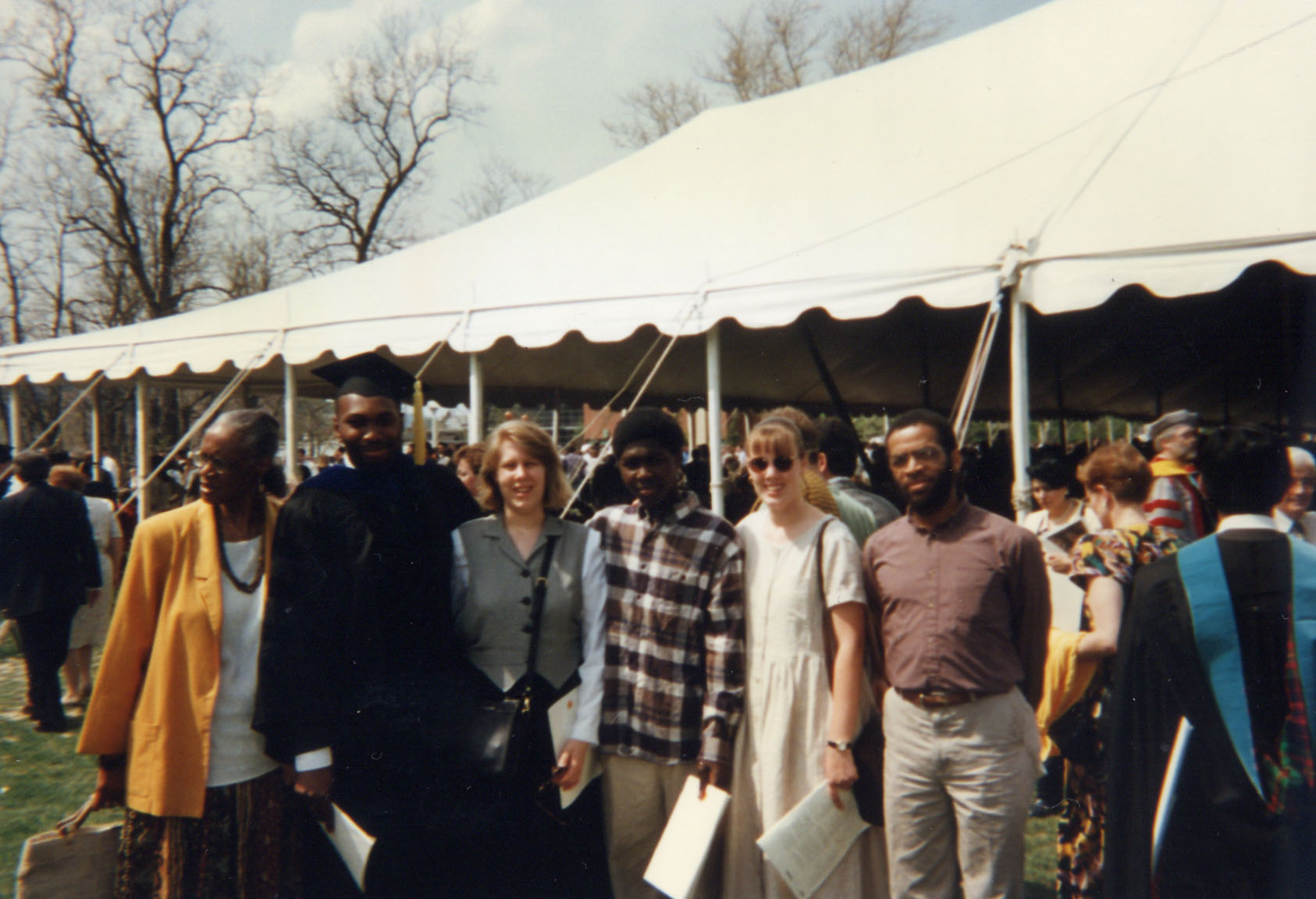
PhD Graduation Group Photo – May 18, 1997. A great photo, except for the one (my mother) who was missing – note my mother-in-law gesturing to her. (Angelia N. Levy).

Today is the eleventh anniversary of my marching across stage to officially end the formal student phase of my life. Around 2 pm, I shook hands with the president of Carnegie Mellon University and the Dean of Humanities and Social Sciences to accept my PhD in History. It could’ve and should’ve been a joyous moment, but it wasn’t. After all, I had learned that my mother was about as happy for me as some of my former fellow grad students, who threw around words like “envious” and “jealous” in the year before my official graduation.

I tell this story in Boy At The Window this way: “The proverbial someone once said that a picture is worth a thousand words. But…even in the age of megapixels, pictures miss what words can say. Such is the case with a picture of me and my closest folk on my PhD graduation day in May ’97. On this sultry and sunny spring day, I stand in my polyester black cap and gown with my future mother-in-law dressed in a yellow-gold blazer and flower-print skirt on my right, and my longtime high school friend on my left. My friend’s one-time ‘surrogate’ son and her twenty-three-year-old sister, as well as my graduate-school friend and colleague Ed are also in this picture, from my friend’s left through the rest of the four-by-six-inch print. They all look hot and happy, as if they went through the doctoral thesis process in one afternoon. At the least, they looked ready for air conditioning or shade. I’m happy too, if only for that moment.

The Carnegie Mellon University-wide ceremony was anticlimactic. I’d finished my dissertation with approval from my committee six months before I marched across stage. Yet I had reason to smile the smile of relieved happiness. Relieved that the outdoor graduation ceremony had concluded and happy to see my then girlfriend Angelia grinning ear-to-ear as she snaps the picture of the six of us. Noticeably absent from this picture is my mother, who stood outside of our huddle (to the right of Angelia’s mother). If you look closely at the picture, you can see Ms. Levy gesturing—presumably to my mother—to get her into the picture. What you don’t see is my mother shaking her head and looking at the rest of us with discomfort as we set up for Angelia’s shot. What you also don’t and can’t see is the pride that everyone involved in the picture possessed about my accomplishment. It was an almost overwhelming experience to receive so much emotional support after so many years without it.

But pictures, no matter how well orchestrated, only capture a moment in time, a moment that could be connected to a string of events or an off-the-beaten path tangent from events already in motion. Or a picture can be a snapshot of a transition point between events. For all of us, I think, this picture symbolized major turning point in our lives, ‘the way we were,’ if you will. My relationships with my mother, my soon-to-be mother-in-law and wife, and my friends all changed or were in the process of change.

How I saw my mother had changed forever a few days before Angelia snapped the picture of me and the others. The best evidence of this is the next picture in this photo album, at the time the next picture in the roll of film from that day. It was of me angrily stomping down a spiraling flight of stairs at The Thackeray Club on the University of Pittsburgh’s campus. I held my doctoral diploma for the camera as if I wanted to hit someone with it. My face looks dark, and not just because I’m Black and had been on five hours’ sleep per night for the past ten days. My face looks frozen between anger and disappointment. Anger about my mother comparing my nine and a half years of undergraduate and graduate education to being ‘in school long enough to earn another high school diploma.’ Disappointment in her later telling me, ‘I don’t have to tell you that I’m proud of you. I tell other folks, just not you.’

Angelia’s picture captures the dark mood that my concrete expression struggled to show. I privately acknowledged that my mother had never cared about my degree or other accomplishments because I somehow was ‘showing her up.’ I had worked for nearly fifteen years to make this moment in my life happen, a moment where my dreams, my ultimate make-believe fantasy life had finally begun to merge with 3-D reality.

Then my mother had decided at the last minute to catch an earlier flight. And just as my individual, Department of History celebration was about to start. To say that my reasonably close—sometimes too close—relationship with my mother hasn’t been the same since would be like saying Hiroshima was never the same after the Enola Gay unloaded her deadly payload.

She needed to go to the airport for her flight to take care of ‘the kids’—my four younger siblings. ‘The kids’ were between thirteen and eighteen years old, and had been without my mother’s supervision for two full days before her airport request. During the trip to the airport in my graduation robe, I thought about crying, yelling, even about shaking my mother to see if she could show any emotion other than a blank disdain. I chose instead the most uncomfortable silence I could summon.

When we arrived at the gate, I finally said to her that she had ‘ruined every event in my adult life’ that I had given her the opportunity to attend. And this was the first opportunity my mother had taken advantage of—she couldn’t get to my other graduations because neither of us had the money to pay for her transportation. I certainly understood that reality, because I grew up in it. This was different. This was telling me that even if money weren’t an issue, my mother wouldn’t have been able to show any sense of pride or joy in what I had done. The irony of that fateful day was that my mother’s six o’clock US Airways flight was delayed more than two hours due to thundershower activity in Pittsburgh and New York. It was after eleven by the time my mother arrived home, according to one of my brothers.

It would be a month before we talked again, and that only occurred because my seventeen-year-old brother Maurice was about to graduate from Mount Vernon High School….In the years since my graduation, I’ve learned that even a parent can be jealous of their children. Especially if a parent attempts to live the life that they would like to have through them.”

What I don’t discuss in the manuscript are other details to this week eleven years ago. Including the fact that I was living on four or five hours of sleep for a week and a half. That I started the week of my Carnegie Mellon graduate in New York interviewing for an assistant professor job at Teachers College. That my mother marched for her associate’s degree at Westchester Business Institute in White Plains five days before my graduation, and that her comment to me about my years of working on a second high school diploma came the day after her graduation ceremony. What I don’t talk about is how my mother and eventual mother-in-law, in their first-ever meeting during my mother’s time in Pittsburgh, spent three hours discussing their failed marriages and the horrible nature of Black men the day before my graduation. And finally, that for the next four days after my graduation, I had a severe gastrointestinal infection, no doubt made worse by my sleeplessness and emotion distress.

The last eleven years have been a struggle to have a career as satisfying and as successful as my post-high school academic experience, with many more positives than negatives. At the same time, my struggles in career and in my life in general are the reason that I find myself in constant self-reflection about my life. It’s this self-reflection that helped me in writing Boy At The Window in the first place.

But the most difficult aspect of the things that I do struggle with centers on trust. Between my mother and my former advisor, not to mention some of my former fellow grad students and others on my dissertation committee, I felt a sense of betrayal that I hadn’t felt since the day my stepfather had knocked my mother unconscious. It took about a year and a half for me to recover from the dissertation process and from what my mother did during my graduation weekend.

I certainly was sarcastic before, but I know that I’m jaded about trusting others these days. Especially folks in positions of authority who happen to be somewhere between flighty and absolute fakes. Some people I’ve worked with in publishing come to mind. Others I’ve worked with and for, though, are far more typical in my world of being careful with whom I divulge my information and life experiences to. Most of time, I find myself much more deliberate about the company I keep and the folks I talk to about my world beyond my job, my teaching and my writing.

I’ve had to learn a second time how to overcome betrayal and distrust. The first time, I could almost trust anyone. This time, I have much more choice as to whom I trust and for how long, which also makes it all the more difficult. As for my mother, I have long since forgiven her for the things that she did and said eleven years ago, although I have to work hard at standing in that forgiveness sometimes. But with my memory, in which I can tell you what I had to eat for dinner on May 12th of ’97, it’s hard to forget.

Meltzer and Mentors


This blog is dedicated to my dear late mentor Harold I. Meltzer. He died on 9 January 2003 at the age of sixty-six, all too young and all too bitter about his years as a high school history teacher. But dealing with entitled parents and unrepentant administrators in Mount Vernon, New York for thirty five years would do that to most people. Despite all that, Meltzer was a rock as a teacher, the first teacher since my elementary school years that I genuinely trusted with my family secrets and my inner self. He was the first teacher I had in my six years of Humanities who actually seemed like he wanted to teach us. Meltzer actually seemed human, at least to me.

It all started at the end of tenth grade, in June of ’85, after a year of constant change. I couldn’t stand my lazy, chain-smoking, couch-lounging, teaching-anything-other-than-the-curriculum teachers from my sophomore year. Many of my affluent White classmates were leaving Mount Vernon or MVHS, something I noted but only saw the significance of later on. I was at a point where my then three-year march toward college and leaving 616 and Mount Vernon altogether was cluttered in anger and disappointment. With myself, my grades, my family, and our poverty. I was a disillusioned new Christian, having thought that my life would all of a sudden become a better one just because I gave my heart to Christ.

Then I met Meltzer. It was the last day of tenth grade, after three days of finals and Regents exams. He had summoned fourteen of us to “Room 275 of Mount Vernon High School,” as the invitation read. We had all registered to take Meltzer’s AP American History class in eleventh grade, our first opportunity to earn college credit while in high school.

Meltzer started off talking to us about Morison and Commager — who I now know as the great consensus historians of the ’50s, until the social history revolution made their textbooks irrelevant by the ’80s — as we sat in this classroom of old history books and even older dust and chalk. Meltzer himself looked to be in his late-fifties (he was actually about to turn 49 at the time), tall and lanky except for the protruding pouch in the tummy section. His hair was a mutt-like mixture of silver, white and dull gray, and his beard was a long, tangled mess. The way he spoke, and the way his eyes looked when he spoke made me see him as a yarmulke-wearing preteen on his way to temple. He seemed old and young at the same time. The force with which his words would leave his mouth hit me immediately. If I believed him, Morison and Commager had created the greatest textbook in the history of history as a subject. As much as I noticed how frequently spit would spew out of Meltzer’s mouth, the rhythm of his speech was slow and sing-song, like an elder or grandfather taking you on a long, winding, roller-coaster-ride of a story.

Meltzer spent at least twenty minutes explaining the Morison and Commager textbook as if the book alone was the key to scoring the precious “5” on the AP American History exam. As he went on and on about how this was his college textbook “at Hunter College in 1958” and how it changed his life, he gave each of us Morison and Commager to read in preparation for the next school year. Upon receipt of the black hardback book, I turned it over and looked at the last page because the book was so thick. It was 508 pages long! I gasped at the thought of reading so many pages over the summer and during school. I could only think of trying to read this book—one almost completely absent of pictures, maps, and other visuals that could take up space—in my home of horrors and hysterical young’uns. Then I looked up to find a couple of my classmates snickering or looking overwhelmed as well.

One of the next things Meltzer did moved me from jaded to interested in him as my teacher. It was so out-of-the-way goofy that it made me want to show up for class in the fall. He noticed that one of my classmates had completely zoned out on his elevator speech on the importance of American history via Lincoln. Then a blackboard eraser zipped past my right ear and landed on the floor by one of my beloved classmates in the back second row. I don’t know about my comrade, but Meltzer got my attention. Meltzer said,“If I catch any of you napping or not paying attention . . . a book” or eraser will “fly by your desk.” It surprised me, made me laugh, and had me ready to see what the quirky Meltzer would do next.

Meltzer was somewhere between downright weird and absentmindedly eccentric. Yet with all of that, he was by far the most intriguing and involved teacher that I would ever have. After the first week of eleventh grade, Meltzer took my class on this long-and-winding road toward the American Revolution, the Founding Fathers and the US Constitution through an unusual set of stories, testing us in the process. He’d tell us stories about his first trip to the Metropolitan Opera House in Manhattan in ’39 (I later learned that he would’ve only been three at the time) and somehow tied it to Jefferson’s vision of an egalitarian society. Meltzer would take us to eighteenth-century Britain’s House of Commons, giving us a picture of photographic-memoried savants as newspaper reporters and connect this to freedom of the press. Or he would tell us about some Broadway show—like Rodgers and Hammerstein’s Oklahoma—and connect it in his wandering way to social mobility or slavery and inequality.

Of course all of this was well beyond my 616 and Humanities Program experience. But we all needed to see the shape and direction of Meltzer’s stories. He’d ask us questions throughout the class, asking us to draw unlikely connections between obscure opera singers, concert conductors and violin virtuosos and US expansion, the Constitutional Convention, and the Civil War. It was completely counterintuitive to what we normally did in any class, Humanities or otherwise. A normal class was us asking the teacher questions to make sure we’d know everything that we needed to do for the next test or writing assignment. This “What do you think?” stuff was new and should’ve been exciting. It felt bizarre, but it was also a breath of fresh air. Right, wrong or somewhere in between, my hand was almost always up and I was fully willing to participate in Meltzer’s asymmetrical student engagement process of learning. On the few occasions my hand wasn’t up, he’d call on me anyway, saying “I know you’ve got something to say.” He was teaching all of us the critical thinking skills we needed for college, and most of us didn’t even know it or care to know it.

For me at least, Meltzer’s unusual space extended beyond our academic needs. He was the first teach I had since before Humanities who’d ask me if things at home were all right. He was the first to ask me about how poor my family was. And he was the first teacher ever to ask if I had a girlfriend. Needless to say, these questions were unexpected. Yet through these questions, Meltzer had begun to crack my thin, hard wall of separation between school and family. By the time I was in graduate school, I could talk to him and most of my friends about almost anything.

It turned out that I was one of three students who earned a 5 on the AP American History exam in eleventh grade, twenty-two years ago on this date and day as a matter of fact. at least another five students earned 4s and several more turned in 3s. In all the three of us who earned 5s had automatically earned six credits toward college, and the students who scored 4s at least three college credits. It was an amazing year, for me and for Meltzer, but as usual, it went unacknowledged by MVHS administration. Perhaps our ethnic diversity was a factor, but the fact that Meltzer wasn’t well liked by the powers that were certainly didn’t help.

Because Meltzer cared deeply about reaching students — about reaching me — our student-teacher relationship because a quasi-friendship after high school and a mentoring one as well. I wasn’t looking for a mentor, and Meltzer was only being Meltzer. Still, his stories about his battles with MVHS administrators, Board of Education folk, and with upper-crust parents who believed their kids were entitled to A’s just for showing up were filled with lessons of perseverance, patience, and looking beyond everyday headaches in order to reach people. While this wasn’t a factor in my becoming a part-time college professor, these stories have helped me over the years.

Meltzer stands in direct contrast to others who either sought to mentor me without my permission or were tasked with the job of advising or mentoring me. The person who comes most to mind is Joe Trotter, my dissertation advisor during my Carnegie Mellon University years. It should’ve been a good match. He was a twentieth-century African American historian, and I aspired to be such. He was a tenured Black professor, meaning his job was pretty secure. And Trotter was fairly well known in his field. How that dream turned into a near nightmare!

“I’m looking out for your best interests” was what my dissertation advisor typically said in discussing my future with me. As far as Trotter was concerned, he was in charge of the rest of my academic career, determining everything from whether I would finish my doctorate to where I would live and work after I graduated. But as I would discover by the end of my education, he was not nurturing my career at all.

Virtually all of my achievements as a graduate student occurred despite Trotter rather than because of him. This was because my advisor often discouraged my attempts to publish, to obtain grants for my research, to participate in major conferences, and to apply for jobs when it was apparent I had nearly completed my doctoral thesis. Of course I did all of those things anyway, in most cases without informing him. On the few occasions that I did — or if he learned of something from one of my colleagues — Trotter would “run interference,” as he would say, acting in his role as my advisor to protect me politically from the other, White senior professors. Somehow, my publications or presentations would cause their consternation to fall on my head. My advisor would frequently say “You’re not ready” to take on a particular project or to apply for a grant or job to hinder my efforts.

One of our last official meetings as advisor and student covered this particular issue. Six chapters into an eight-chapter dissertation, I was still being told that I was “not ready” to apply for jobs or to attend major conferences. Trotter had in fact contradicted some of what he had said about my work in a previous meeting. So when he declared for the eighteenth time in this particular meeting that he was not giving me his support to apply for a job because he was “looking out for my best interests,” I sarcastically replied “Yeah, right!” I defiantly said that I didn’t believe him, that somehow this was about his interests, whatever those were. I knew that my interests weren’t central here, because he never asked me about them. My defiance led to an eight-month long battle to finish my dissertation and to get my committee to approve it. On the week before Thanksgiving in ’96, it finally was.

But our academic relationship was never the same. I’ve only talked to Trotter twice since I finished the thesis, once to tell him that I didn’t want to just apply for jobs in Nebraska and Iowa, the other to let him and the sense of betrayal I felt about working with him go. It took working a few years to understand his situation. As the first tenured Black professor in Carnegie Mellon’s history, Trotter was the HNIC (Head Negro in Charge) on campus, making him a political target, especially in having a Black student who made graduate school look like a coronation. It was mostly paranoia on his part. I do believe, though, that my former advisor was in the midst of a career and midlife crisis, in having a student half his age ready to finish a doctorate and become a scholar contributing to the field well before my thirtieth birthday. As incredulous as it may sound, I believe that there was some jealously on Trotter’s part toward me and other students.

Meltzer knew intuitively something my former advisor will likely never know. Legacies aren’t just built by writing about things as obscure as proletarianization, by having others who are of like minds respect your work as a scholar. In the case of teachers and advisors, legacies become realized in working with students, helping them reach their potential as human beings, by being real and honest with them as people and not just as experts in a given field. That transparency is the difference between mentoring and “running interference.” While I learned quite a bit from Trotter about being a scholarly historian, I learned a lot more about history and life by having Meltzer as a teacher, friend and mentor, including the fact that mentors often come to us in surprising and unexpected ways, regardless of race. He’s someone that I think about and miss many a day, today especially.

The Race Card?


Most of this election cycle, I’ve sat on the sidelines and not expressed strong opinions about the presidential candidates or their positions on all issues foreign and domestic. I’ve been quite busy reaching out to agents regarding Boy At The Window, looking for more permanent work and the daily business of family, teaching and contract work. At the beginning of the year, I said that I thought that either John Edwards or Barack Obama would be the best candidates for president. In February and March, I talked a bit about the issues surrounding Obama regarding race, especially in the context of his pastor/mentor Jeremiah Wright. I put all of those things in a larger context, because I believe that for most thinking folks, the issue isn’t about what Rev. Wright has said as much as it is about Obama response(s).

As Obama has completely denounced Wright in the past week — and for good reason — I can’t help but think how unfair and dishonest our nation is when it comes to any issues that revolve around race. Not race as a obvious issue, mind you, but not so subtle that most average people don’t notice, either. It’s this notion that Derrick Bell discussed in his Faces at the Bottom of the Well (1992), that there are “Rules of Racial Standing,” in which Blacks are held to a double-standard in the public spotlight. Bell applied them to the legal process (criminal and civil) in his book, but they apply equally well to other public spectacles. Without rewriting my article “Rules to Live By,” I can say that Bell’s Rules basically break down this way. If a Black person regardless of status or socioeconomic background says something that can does offend many Whites, expert Blacks — representative Negroes to some — are virtually required to come out and condemn both the message and the speaker thereof. The only major exception to this if it Whites — and not just White liberals — in fact back up what the offending Black person has said.

In the case of Wright v. Obama, the presidential candidate attempted to amend Bell’s Rules by separating Wright’s message from the reverend himself. He gave an uplifting and wide-ranging speech that most Americans should see as an excellent oration on Bell’s Rules and the need for our nation to confront them. But these rules really weren’t created by Bell in 1992. They’ve been in existence in this country for the better part of three and a quarter centuries. Forty-five years of civil rights and social justice work has done little to change that. Although Obama’s numbers did take a hit as a result of his nuanced high-road response to Wright, it was the media’s response and continued coverage that should be of more concern to most of us.

This ridiculous idea of the race card — made universally known as such by the O.J. Simpson trial of ’94- ’95 — is interwoven within Bell’s Rules. The notion that Blacks only cry about race or racism or bigotry in the public arena when it suits our purposes. To deflect attention from our own failings or missteps. To blame Whites or other folks for our lot in life. To get away with everything from affirmative action to murder. That’s what the race card is in the minds of most Americans. It’s as if any Black person who confronts race head on is shouting “Race!” in a crowded theater, no matter how erudite the statement or how reasoned the argument. We’ve somehow pulled a joker card out of the deck to make others laugh and cringe at the same time. But rarely do people ask about the deck of cards from which Blacks are playing. Or about who the dealer is.

As America has fallen in love with watching Poker on TV and playing it on the Web, it’s interesting to me that so many can take enjoyment out watching something that is so boring unless you’re actually playing. But that’s another blog for another day. At least with these shows, you know that there are other players, a dealer, a smoke-filled room with alcohol available. Or a computer with Internet connections keeping track of the cards. In the court of public opinion, the media in all of its forms deals the cards. And it’s a stacked deck. It almost always has been. It’s so strange how most Americans complain about the media, its liberal or conservative bias, its constant attempt to stir the pot on any number of issues, its inability to bring us real news. Yet when it comes to race, we suddenly become the docile consumers of objective news and information that we otherwise complain about these days.

So when it comes to something like Wright v. Obama, of course the deck is stacked. Once the YouTube video was posted and the media picked up on it, Obama was left with few cards to play. The media had a straight, and Obama needed a royal flush. He tried at first to take the high road, to not up the ante and pick up the card that would condemn the man who led him to spiritual salvation as a Christian. Wright, though, decided to play along with the media, at the National Press Club, no less, revealing himself as a egotistic and bitter man and not a shabby poker player at the same time, forcing Obama’s hand (pun intended). It wouldn’t have been any different if Spike Lee or Steven Spielberg had put together a script on this.

Certainly there are other examples. The recent decision to acquit NYPD officers of murder in a case that involved shooting or shooting at a groom at a wedding more than fifty times. But I guess I’m paranoid and irrational if I think that this is about race. Or how Bill Cosby has become the new voice of Black progress in the past four years. Yeah, a near-billionaire comedian who decided enough was enough as he entered his eighth decade of life. Cosby, by the way, is the other side of the coin around Bell’s Rules. His words support the general view that many Americans have of Blacks, giving him what Bell would call enhanced or superenhanced standing in the public eye. (That’s not to say that some of what Cosby says isn’t true — it’s far from the complete catalog on the realities of poverty and race in this country. Yet another story for another blog.)

But given what’s at stake between now and November 5, Wright v. Obama could well determine whether I want to keep playing poker in the voting booth or with the media at all. It’s a game that I’ve been forced to play all of my life, and I’m starting to get tired. I’m not sure if I want my son to have to play this game in order to grow up here. NAFTA or not, Canada and Mexico look pretty good right now. And to address the famous blogger who’d say that when Whites get tired of the state of affairs in this country, they often talk about moving to Canada, I say that I’m Black, and depending on how things turn, I plan to do much more than talk or play my hand.

Happy Anniversary to Us!


Well, today’s my/our eighth wedding anniversary! It should and is something to celebrate, even if the issues of life stand in the way, especially my mama’s boy son Noah. He insists these days on cutting off all PDAs, putting his almost four-foot body in between me and my wife every time he sees us attempting to hug. Despite our son, my full-time job search, the need for rest, new stuff, and debt relief, we’re still hanging in, looking forward to the future, learning from our pasts.

I have a few choice words for those who say that marriage is easier than being single. Those who say this are either delusional or have been married for less than two years. It’s true — and Chris Rock’s right about this — marriage is hard work, work that keeps it in a constant state of renewal. Length of time together doesn’t make it any easier, especially if your marriage is in the midst of serious problems. But marriage need not be drudgery. Communication, finding a way to be yourself while fitting into your spousal and parental roles at the same time — balance — are critical to any marriage’s success and survival. That we’ve made it this far so far is a sign that our love is more than just about sex and romance. It’s about an enduring friendship, having common goals, and learning to accept each other for who we are rather than despite who we are.
I’ve told the story of how my wife and I met, what the first year of dating was like, her involvement in various aspects of my writing life, and her analysis of my situation growing up in Mount Vernon, New York. It’s funny, but given where I was at one point in my life, it’s a wonder that I’m a husband or father at all, much less alive to be able to say these things. After becoming a Christian in ’84, me and my mother had an argument that almost sent me packing to go live with my alcoholic father. It was a nasty argument, born of the frustration of living with four younger siblings between five months and five years old and my abusive stepfather, being on welfare, and sleeping in the living room because the spiritual leader of the local Hebrew-Israelites, the self-proclaimed reincarnated Queen of Sheba, Balkis Makeda, had taken up residence in my mother’s master bedroom since the week before my youngest brother was born. 
It all started when I couldn’t control my facial expressions. I was normally blank faced at 616, in order not to upset my mother or piss out my stupid stepfather Maurice. But one day in October ’84, I couldn’t contain the anger and rage that had been building since the day I let the world know I wasn’t a Hebrew-Israelite anymore.
“What’s wrong?,” my mother asked as I stomped back and forth in the living room muttering to myself. “Nothing,” I lied sarcastically, thinking that my mother wasn’t wise enough to read my mind. When she probed further, unusual for her, I said, “Why can’t we get rid of the old hag? Why is she still here? Are you still scared of him?” My mother looked like she was in shock by what I said. “You don’t understand,” she said.
To keep from starting an argument Maurice would hear, I kept my voice to a low grinding tone of pent-up frustration.
“What’s there to understand? I have to do everything around here, and he gets to lay on his sorry ass and Darren doesn’t do anything.”
“Oh, you think you grown now? I take care of you, don’t I? I take care of my kids. I feed you, put a roof over your head, buy the clothes and pay the bills. I . . .”
“Yeah, right Mom. And who helps with that? I do. Who has to go over to Jimme’s to get money for food? I do. Who has to pay for it by not having any friends, any free time, a girlfriend? I do. Because of you, I’ll never live in a house, own a car, have a girlfriend, have sex, or get married. And by the way, we’re on welfare. The federal government pays for the ‘roof over our head’.”
“You don’t have to live here you know. Why don’t you go live with your father?”
“You know what? That’s the best idea you’ve come up with in a long time. I should go live with Jimme, become a drunk like him. At least he doesn’t run me all over the place like you do!”
Though I eventually apologize and unpacked my garbage bags of clothes and other belongings, I realized that the only way to relieve the anger would be to leave 616. I knew that nothing would change for me if I stayed there after high school. But what stuck with me most was what I had said about my future. About not having a place to stay, a car to drive, friends to hang out with or count on, no marriage or other future prospects. Even though I no longer had any plans to commit suicide, I didn’t have any plans to live beyond college, certainly beyond the age of thirty. It was hard enough to get myself through tenth grade or to think about things like taking the SAT. The other teenage stuff would either have to wait or wouldn’t happen at all.
I thought about what I had said to my mother a number of times over the years. During my five days of homelessness at Pitt. When I started dating on a semi-regular basis. After I finally got my drivers license. And when I finally asked for my now wife’s hand in marriage. Given everything I’ve been through, I didn’t think that anyone would ever want to marry me or that I could love anyone enough to risk myself and them in marriage. So despite whatever problems we’ve had over the years, this day makes me fully appreciate the ironies of life and the preciousness that is an enduring loving bond. Angelia, if you’re reading this, Happy Anniversary! I love you very much!

The Fire This Time


Tomorrow marks another troublesome day in the life that is my own, but it was a day that led all of us as a family into better times, even as things grew more difficult in the first few years after it happened.

It was the fire that gutted 616 East Lincoln Avenue, a 60-family apartment building on the North Side of Mount Vernon, New York, four short blocks away from the Pelham-Mount Vernon border to its east. It and 630 East Lincoln make up the bulk of low-income and working-class income families that reside in this section of Mount Vernon. Otherwise, the half-mile square area consists of everything from co-ops and converted public housing (now all fairly affordable condos for those of middle class means) to starter homes, cul-de-sacs and stately manor homes. As the years have gone by, 616 and 630 East Lincoln have stuck out like boils on the forehead of an otherwise healthy-looking person.

Until April 25 of ’95, 616 was a code for everything that had gone wrong in my life growing up in Mount Vernon. It bothered me more than Humanities or Mount Vernon High School ever could. 616 was about much more than teenage angst or indifferent teachers. 616 stood for our ugly fall into poverty, the lost years to being a Hebrew-Israelite, my ex-stepfather’s abuse of my mother and me, Darren’s fall into institutionalized retardation, and a sheer sense of a world turned upside down. Even after leaving for college, I still spent most of my next five summers there (not counting the summer of ’91), watching over my younger siblings and working full-time for Westchester County Department of Community Mental Health, which gave me additional insight into the psychological nuances of our family.

By the time I had transferred from Pitt to Carnegie Mellon to finish my doctorate, it was so obvious to me the crippling nature of the poverty that my younger brothers and sister experienced every day. It had also worn down my mother. For years growing up, she talked about how we “shouldn’t take handouts” from the federal government or from other people, that we had to “work for a livin’ to make it” in this world. When we went on welfare in April ’83, I knew that it tore her up. I just didn’t know how much until my Carnegie Mellon years.

When I came home for Xmas in ’93, when the subject of welfare came up, my mother said that this system was the only way that “Black folks could get paid their back wages for slavery.” And she said it more than once. Even if I bought her logic, it would still mean that the descendants of slaves were getting a pittance for the work performed by our ancestors. My mother by this time spent most of her days praying, praising and singing to the Lord, watching the 700 Club and other religious programming, or otherwise keeping the sparse apartment clean and stocked with food. While I had no objections to this as a Christian, I also realized that my mother was waiting for God to change her and her life, waiting as if she had nothing to do with this process herself.

My last visit before the fire was the month before, at the end of March ’95. By this time, New York State had changed its regulations regarding welfare in anticipation of President Clinton’s “mend it don’t end it” legislation that would turn AFDC into TANF the following year. So my mother was taking remedial math and reading classes — as well as cooking classes — at Mount Vernon High School to keep the welfare checks coming in. My mother in August ’89 was about a year away from earning an associate’s degree in accounting from Westchester Business Institute, not to mention her fifteen years working as a dietary supervisor at Mount Vernon Hospital. It was like she had given up. My siblings acted the same way, as if tomorrow didn’t matter. But I was still happy to see them all, and they seemed happy to see me. Of course, they all did their usual song and dance for money from me.

I left for Pittsburgh, having spent the previous seven weeks in DC doing research for my doctoral thesis, hanging out with some new friends and hoping for a grant that would save me from heavy amounts of teaching in the ’95-’96 school year. On April 14, I got the call that put my doctoral thesis “on cruise control,” as a friend of mine put it. I found myself with a year-long dissertation fellowship from the Spencer Foundation that enabled me to live worry-free through the summer of ’96. Five days later, Timothy McVeigh and the Oklahoma City bombing happened. It dominated the news cycle for the next week or so. I felt for the folks in Oklahoma City, but I was still in the middle of my Spencer fellowship high.

Tuesday, April 25 was a normal day of putting together rough drafts of my second and third chapters of my thesis, doing additional research, talking with colleagues and professors, and bumping into my former advisor at Pitt’s Hillman Library. I spent much more time on Pitt’s campus because Carnegie Mellon offered few faces that looked like mine, was a conservative haven and possessed few places where I could do work and then find a chair to take a nap on if I got tired. Around 4 or 4:30, I felt ill. It was as if someone had punched me in the stomach. I thought it was something I ate at first. After a few minutes, I packed up my stuff, left campus and caught the bus back home to my apartment in East Liberty.

Even after getting home and taking some medicine, I still felt ill. Then I felt the need to call home. No answer. I tried again around 8 pm. Still no answer. I tried three more times between 8 and 11 pm. I got really worried. I called the Mount Vernon PD. They told me about the fire and gave me the local number for the American Red Cross to call. When I called them, they couldn’t locate my family.

After a few more calls early the next morning, I found my mother at a shelter at the First Presbyterian Church in Mount Vernon, seven blocks from 616 and down the street from where all of us (except Darren) went to elementary school. I was relieved to find them, to find out that they were all right, that no one was home at the time of the fire.

It was a electrical fire, sparked by loose wiring on the second floor that tenants had reported to the landlord at least a year earlier, and certainly in the weeks prior to the incident. The fire itself was small, but Mount Vernon’s finest apparently flooded my mother’s side of the building with water, making most of 616 uninhabitable. Most of the clothing, the beds, the few pictures and pieces of furniture we had, my high school diploma and yearbook, all gone. But the TV that I had bought my family for Xmas in ’94 survived the flooding. It’s ironic that a friend of mine from high school’s father was also a prominent member of the church in which my family took shelter, while another friend’s father was indirectly connected to the landlord’s real estate company in charge of managing 616. As far as I know, none of my classmates from high school served or had father who served with the Mount Vernon Fire Department.

This was the beginning of a long and difficult journey, for me and for my family. They spent a couple of weeks at a motel in Elmsford while I immediately wired them a few hundred dollars. Then they came back to Mount Vernon for a few months, spending the summer of ’95 in a halfway house normally meant for women seeking shelter from abuse or women who were transitioning from drugs and/or prison with their kids to a more typical living arrangement. By November, my family had moved into low-income housing off Broadway in Yonkers, three blocks from the Bronx and a short walk from Van Courtland Park, one of the biggest in New York City. All the while, I sent home money to help my mother with bills, food, clothing for my siblings, whatever she needed.

I finally visited after another round of research and interviews for my dissertation in DC. This was Thanksgiving ’95, and my family had just moved into the place in Yonkers. It was clean but smelled of cheap paint and looked more sparse than 616. But the biggest change was on the faces of my family. My brothers and sister looked agitated, hungry, defeated, and betrayed. My youngest brother Eri and my brother Yiscoc were in the middle of the first year of academic struggles that would lead both of them to drop out of school. My mother was completely out of sorts, more tired and more depressed than usual. She was “forced to go back to school,” as she put it, to finish up her associate’s degree in exchange for the continuing flow of welfare checks and rent payments on the new temporary apartment.

She refused to transfer my siblings to Yonkers Public Schools. It would be “too much to transfer them back,” she said when I pressed her about it. They were waking up as early as 5:30 am to catch a bus (school bus or transit) to get to school, and weren’t in bed most of the time before 11 pm. I caught on right away that my mother had lost control of and authority over the family. She might’ve been in charge, but my siblings had begun to figure out how to ignore her and shut her out.

A little more than two years later, in March ’98, my mother and family moved back to 616, into a refurbished sanitarium, as my wife has called it over the years. By then my mother had finished her associate’s degree but couldn’t find steady employment. My brother Eri had spent two years in seventh grade, and would have to go to summer school to finish eighth grade. Yiscoc spent his high school days cutting classes and hangin’ out with his homies. Maurice had graduated high school on the honor roll and was in his first year at Westchester Community College, but rudderless while going there. They were all moving ahead with their lives, but in a fog of depression it seemed. The fire and its aftermath had torn up their lives. It explained — though it didn’t excuse — my mother’s behavior toward me as her uppity son.

I too had lost something. As horrible as it was, 616 gave me a sense of home, a physical and psychological address in which I could compare my adult life to my growing-up years. The money that I given my mother all through ’95, ’96 and ’97 was money that I could’ve used in the year after finishing my doctorate. For nearly four years, until I visited in April ’99, I didn’t visit my first hometown.

But the fire did open up the opportunity for my siblings and for me to question my mother’s moral authority and decision-making. It enabled all of us to realize that in the midst of poverty, a parent can only do but so much to protect their kids from the worst that the world offers. It was a wake-up call that forced me to realize that I couldn’t go home again, to the home that never a real home growing up anyway. It was the fire that eventually led to my family intervention nearly seven years later. And that did lead to my siblings growing up and moving on with their lives. It has even helped my mother live her life in a better way in recent years.

The Importance of Months and Symbols


April 14th represents a very good day in the history of my life. I passed my M.A. oral defense on Tuesday April 14th in ’92, and was awarded my Spencer Foundation Dissertation Fellowship on Friday, April 14th in ’95 (which, by the way, was the 130th anniversary of Lincoln’s assassination at Ford’s Theater by John Wilkes Booth). But then again, Aprils in general have been important months in my life, for better and worse.

We — meaning me, my older brother Darren, my mother and my eventual stepfather — moved to 616 East Lincoln Avenue in Mount Vernon, New York on the fifth of April of ’77, a two-bedroom, 1,200-square-foot flat in a working-class apartment complex on the North Side of town. It was a clean break from living on Mount Vernon’s overwhelmingly Black and mostly low-income South Side. But it was a place where most of my wide-awake nightmares occurred.

Five Aprils later was when I had my first experience with physical abuse at the hands of my stepfather. He was a hanger-on at a newly opened Karate studio down the street from 616. He made me come to the studio because he wanted to show me “how to be a man.” My stepfather thought that I was soft, a boy who spent too much time in books and not enough time on New York’s mean streets. This despite the fact that we lived in Mount Vernon, a quietly violent city whose meanest streets were on the South Side, the part of the town that bordered the Bronx. Not that 616 and the Section 8 projects down the street didn’t qualify as “mean.” They were tough, but nothing like the crack and weed wars that would erupt on Third Street by the early ’90s.

Maurice had tried to teach me and my older brother Darren Isshinryu Karate two years earlier — he apparently was a fourth-degree black belt in the martial art. Now he decided that I would learn how to fight no matter the consequences. And forget about the larger philosophy of spiritual balance and harmony involved in learning an East Asian martial art. It was all about breaking bones and inflicting maximum pain. When I told Maurice that I didn’t want to learn, he said “You will learn because I’m your father” as he started to throw punches. After I yelled “You’re not my father!” I got drop-kicked to the ground. Maurice then pulled me up by my arms, slammed me back first into a mirrored wall, and punched me several times in the head, chest, and stomach until several of the men in the studio surrounded him. I was getting hit by a man who was six-one and weighed 270 pounds. My stepfather, completely exasperated, yelled “Don’t you EVER say that again, muthafucka! I’ll kill you next time!” I ran for home with a knot on my forehead that didn’t go down for almost a week.

Other Aprils weren’t nearly as violent or chaotic. But they remained important. April of ’83 was when our family first went on welfare. It was the final nail in my childhood’s coffin. It meant that I couldn’t deny our plunge into grinding poverty any longer. It also meant that I didn’t have to worry as much about when we would have a decent meal to eat. April of ’87 was when I officially accepted Pitt’s invitation for college and their rather generous scholarship and financial aid package. Four Aprils later found me deciding between Pitt, U Maryland and NYU for graduate school, while April of ’00 was when I married my wife Angelia.

Even with the triumphant Aprils in ’92 and ’95 came some pain. My advisor and exam committee made a point of passing me and recommending me into the PhD program of Pitt’s History Department. But not without telling me that I “was moving too fast.” I still don’t know what “too fast” means. Was I showing up my fellow grad students? Was my knowledge or discipline as an historian lacking? If so, then why did I pass? Did I create a political problem for my advisor because I had finished my master’s in two semesters instead of the usual four or five? I never got a direct answer. What I do know is that my advisor and a few others in the department spent the following year attempting to slow me down because I “needed more seasoning.” I knew then that it was time to transfer. My pace as a graduate student was based on what I knew, at least I thought, not who I knew or who I sucked up to, and wanted my experience to stay that way.

Only to find that my next advisor at Carnegie Mellon was even less accommodating of me as a student that worked both quickly and effectively. He once made the comment, “since you have time to travel across the country to present your work, you can make sure to do the same here.” He called himself “running interference” anytime he learned I published an article or was off to present at a conference or at a university. After an exchange we had in April of ’96, our relationship became a cold and dispassionate one. While my advisor taught me how to be a good historian, he also taught me that not everyone with the role of advisor or mentor in my life was actually looking out for my best interests.

So April has been an important month in my life. It’s one where I’ve made major decisions, seen many not-so-good things happen, had to salvage something good out of something bad. It’s also the month of Passover, which between my Hebrew-Israelite years and some Jewish friends from my grad school days, I’ve been a participant in for four Aprils. Passover is a reminder of Jehovah’s great grace for those who believe in Him (or Her) and of divine intervention, fighting for the freedom and lives of the oppressed. Passover, Easter, and April all serve as symbols of that aspect of my life, that reality in which I see myself as an underdog overcoming the worst of circumstances.

This April is a bit different. In four short months, my son Noah begins kindergarten. We have an orientation to get ready for in a couple of weeks. It’s almost time for him to begin to create his own memories, his own stories of triumph and struggle. For him it will likely be another month and other signposts that suggest that his life is going in the right direction. I just hope that he has many more up days and significantly fewer down days than I have had, while still learning the importance of symbols as motivational tools in life.

Sometimes Salvation, Always Hope


This week marks twenty-four years since I became a Christian, giving up forever on the idea that I was somehow special as a supposed member of the Lost Tribes of the ancient Hebrews. For those of you who sit in the agnostic or atheist camps, this blog post should still be of interest. We all need salvation, we all need hope, whether we seek it from ourselves or in the love of others, or whether we seek it from God, Jehovah, Allah, The One or a higher power. It is this dimension of life that provides meaning beyond quantum physics and natural selection, evolution and the near infinity of the universe itself. This is my story of a significant part of my life, the story of how I made sense out of the senseless and began to walk a path to find myself and my purpose in this life.

It was in the aftermath of my fourteenth birthday at the end of ’83 where I began the journey to find myself spiritually. As talked about in my blogs from Fall ’07, this was the day where I spent the afternoon planning to jump off a bridge overlooking the Hutchinson River Parkway on East Lincoln Avenue in Mount Vernon before a voice in my head pulled me off the bridge. After I decided not to take my own life, I spent the rest of my time during the holidays going through everything I could find at home and at Mount Vernon Public Library about Judaism, Christianity and Islam, the three major religions west of India as I saw it. I wanted to know once and for all how to situate myself spiritually. I didn’t want to wake up at thirty only to realize I wasted another fifteen years, ready to commit suicide again.

I picked up an old Bible we had in a storage bin underneath my bed. I went to the library to compare Biblical text with the Qur’an. I read key Talmud scriptures that matched up with key Islamic ones. Two revelations came to me from these exercises. One was that there wasn’t much of a difference between Islamic and orthodox Jewish law. The other was much more significant. Forgiveness and redemption wasn’t automatic in either belief system. You had to go through some form of ritualized spiritual purification to gain Jehovah or Allah’s amazing. You had to earn your forgiveness if you were a Jew, a Muslim, or a Hebrew-Israelite. Messing up even in the smallest of ways left you on the spiritual outside looking in for a connection to The One. It was like being disconnected over the telephone with no way to dial back in except through a holy day of atonement.

In reading the Gospels, it started sinking in that Jesus’ life was about providing a path for each of us to gain unconditional and unearned forgiveness, including me. I read the New Testament at home late at night so that I wouldn’t get caught venturing into forbidden scriptures. Somewhere between Matthew and Mark I found myself, maybe for the first time, realizing that I’ve been searching for someone to save me. From myself, from my family, from a life without meaning, from a life of hell-on-earth, and certainly from an afterlife without my proper place in it. I was finally in a place where I felt like I could turn myself over to my God, possibly through Jesus.
But I wanted to be as sure about this decision as I could be. After the last few years of watching my mother, my stepfather and Jimme make so many horrifying and almost fatal ones, I wanted this decision to be more correct that any 100 I’d gotten on any test. I wanted my potential conversion to Christianity to feel as good as I did the day I served as the introductory speaker at my elementary school graduation. And above all else, I wanted to be at peace with my decision so that if anyone asked me about the Hebrew-Israelite thing again, I could respond to their questions—and their questioning of my decision—with honesty and good information.

After the holiday break, much of what I did was to use my Afro-Asian Literature and History classes to compare and contrast the various belief systems with each other and with Christianity especially. I went from Taoist yin and yang to Zen Buddhism and the need for balance to Confucianism’s ethical standards and the practice of Animism in various cultures around the world. The common theme in every major philosophy or belief system I looked at was achieving a state of spiritual balance. This kind of balance would lead to balance in my physical world. Now some philosophies, like Buddhism and Hinduism, discussed the need to seek a path to full enlightenment and some sort of ultimate balance. That seemed a bit like Judaism and Islam to me. The need to take a long and difficult spiritual journey in order to gain a connection to this essence, or higher being, which would lead to an ultimate state of balance and being.

The long history of social stratification and strife in older and wiser civilizations like India, China, the Arab World, also left me wondering. How much were these belief systems about maintaining a certain social order, and how much were they about providing true enlightenment to every person who was willing and able? Nearly three years as a Hebrew-Israelite had left me feeling like I was part of an oppressed group within an oppressed group within a naively freedom-loving society. Despite the attractions of balance for and in my chi, the status quo of accepting poverty, abuse, and ignorance just wasn’t going to work for me.

Then I turned to Christianity in the everyday lives of folks around me, not my classmates necessarily, but in Mount Vernon generally. Most Blacks were Baptists, most Latinos and Italians were Catholic, while other Whites ranged from Presbyterian to Episcopalian. Afro-Caribbeans were all over the denominational plain. By the time I turned to Christianity in all of its sectarian forms, the beginning of March, I’d already read enough of the New Testament to understand that the writers were all concerned about the creation of sects. It seemed to me that denominations were idiotic. Didn’t everyone who claimed to be Christian worship the same God and believed that Jesus was his son? Does it really matter if one form of Christianity forbids its pastors from having sex and another allows its pastors to marry? Without a full knowledge of the long history of Christianity and its nuances both as a form of social control (see Roman Empire and medieval Europe) and a form of social unrest (see life of Jesus, Protestant Reformation, and Civil Rights Movement), I just assumed that Christians formed different sects because they simply didn’t like each other.

Catholics in so many ways reminded me of Hebrew-Israelites and orthodox Jews. Although they already had spiritual redemption, they lived their lives as if they didn’t. Between Confirmation, Easter, and confession, not to mention the dress of popes and priests, Catholicism didn’t seem all that dissimilar from what I knew about Judaism. The other denominations didn’t seem to me to do much in the way of really making sense of how to reconcile salvation and redemption with how to live my life while waiting for the inevitable.

But more than anything else, I wondered about the brutality of life and how to understand that in the context of other belief systems. I lived in a world where whenever I made a mistake someone was there to jump down my throat about it. At school, if I screwed up, someone was there to make fun of me, to destroy me from the inside out as I saw it. Or some teachers were there to make light of my mistakes. If I made a mistake at home, if I said or did the wrong thing, my mother would yell at me, or I’d have to go back to the store or I might put myself in an abusive situation with Maurice. I felt like I had no margin for error, and any error I did make led to swift and severe retribution.

That was what being a Hebrew-Israelite had come to feel like by the time I was in ninth grade, an unending, broken-down mule kind of burden. Becoming a Hindu, Buddhist or Taoist seemed much more attractive but didn’t provide any immediate or beyond life answers for me that I could put faith or hope into. Becoming a Muslim, a more traditional Jew, or a Catholic would’ve been like trading in one overwhelming, earn-your-salvation-for-the-rest-of-your-life belief system for another. Denominational Protestant Christianity, despite all of its appeal, didn’t seem so different from what it had protested in past centuries.

I was left with one choice. Christianity, plain and simple. If the New Testament said that the only things I needed to concern myself with were putting God and Jesus first in my life and loving others as I should love myself, then that was enough for me. I sat back on the morning of Easter Sunday ’84—no one at home was awake at the time—and after watching a televangelist preach about the power of redemption, I found a corner in my room and prayed for Jesus to come into my heart and life. In my mind, I thought I’d feel a thunderbolt hit me in my stomach. Or at least I thought I might cry or become giddy or something. Instead what I felt was a sense of relief. Nothing more, nothing less. I knew that, maybe for the first time in my life, I made a conscious decision for me, not for anyone else, not influenced by anyone else, at least not anyone bound to earth.

My objective was first to find some sense of peace with myself, enough where my only thoughts late at night weren’t about suicide or nuclear war, taking out Maurice or leaving 616. First I decided not to tell anyone about my spiritual conversion and rejection of the Hebrew-Israelites. Despite the outward contradiction with the kufi, I knew who I was in my heart of hearts, after all, a follower of Christ. Second, I made the decision that with a little bit more than three years left before the possibility of college and life away from Mount Vernon that I would focus more energy on my classmates and my siblings than I would on Maurice. Third, I made a pact with myself to never consider suicide a serious option unless the God I now believe in betrayed me in some way, which to me would be if my stepfather killed my mother or something like that. Fourth, I decided to think of myself as being someone who had some worth, if for no other reason than because I was a child of God. If I couldn’t find anything else worth preserving about me, being one with The One would have to do. This meant doing something that had been difficult in those heady months. I had to not give up on me.

My spiritual faith and journey has gone through a fair number of ups and downs over the years since my conversion, some of which were self-induced, many in the midst of some crisis or another. I can’t say that I’ve never thought about death or suicide at all since ’84. But I know that I’ve never seriously considered it as I did at fourteen. I’ve discovered my own sins and shortcomings, failures and weaknesses, as all who occasionally reflect upon our impact on the world, over the past twenty-four years. But I know that despite all of my imperfections, that I have a purpose, a reason for being, a message to others in this life. That hope, faith, and even salvation on some level are necessary in order to live the purposeful live. And that these things can help a human being overcome just about every hurt, every discrimination, every roadblock put up by this world and this life.